Renaissance of our Education System to make it World class

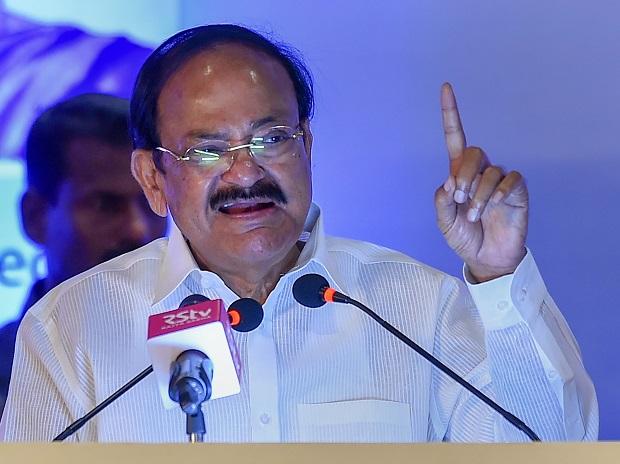
The Vice President, Shri. M. Venkaiah Naidu, today said that religious harmony and unity in diversity are cherished values of our civilization and asked every citizen of the nation to strive to preserve our values of national integration.
He was addressing the Second Convocation ceremony of Shri Vaishnav Vidyapeeth Vishwavidyalaya in Indore, Madhya Pradesh today.
The Vice President commended the efforts of 135-year-old Shri Vaishnav Committee and the Group of Trusts, Indore in establishing Shri Vaishnav Vidyapeeth Vishwavidyalaya (SVVV) to impart quality education.

Stating that there was a need for rejuvenation and renaissance in our education system to make it world class, Shri. Naidu said that educational institutions must focus on academic excellence, physical fitness, mental alertness, moral uprightness and social conscience.
He urged universities to strive to overcome challenges of quality, equity and access in education through the creation of knowledge networks, research and innovation centres, skill development programs and support for faculty development.
The Vice President said that, with technology making deep inroads in our day-to-day lives, there is a greater need today to align academic curriculum in accordance with changing technological developments and to stay ahead of the curve for the country to reach greater heights.
He spoke of the need for India to upscale research facilities to produce world class publications in reputed international journals. ‘Research is an area where we are lagging behind and serious efforts are needed to bolster the culture of research and innovation in the country’, he said.
Highlighting the importance of preserving our rich culture, especially our languages, the Vice President also opined that mother tongue should be the primary medium of instruction in schools till the high school level.
Shri. Naidu also called for enhanced collaboration between academia and industry and urged the industry to earmark CSR funds for promoting collaboration with the academia and research activities.
Referring to India’s impending demographic dividend, Shri. Naidu said that India had the potential to become the human resource centre of the world. He said that quality education, skills, knowledge and creative thinking are essential to realize the demographic dividend and to make India a 21st century innovation hub.
The Vice President said that we must turn our educational institutions into centres of excellence with global standards. ‘’Our universities and educational institutional institutions must attain great heights and figure in top-ranking global academic institutions’, he added.
Observing that the majority of students who win awards for merit and excellence in universities are women, the Vice President said that women’s education and empowerment must become people’s movements.
Shri. Naidu emphasized that there is a need for inculcating the qualities of sharing and caring among youngsters. ‘They need to have empathy for others, particularly for the vulnerable and marginalized sections of the society’, he said.
He urged the students to continuously update themselves with the latest technologies, innovations and the changes in the world. He advised them to think of the nation first and to work hard with determination to realize their dreams and the aspirations of more than a billion people.
He advised students to firmly adhere to the path of righteousness and remain committed to upholding ethics and morals at all times.
The Governor of Madhya Pradesh, Shri. Lal Ji Tandon, the Minister of Public Health and Family Welfare, Government of Madhya Pradesh, Shri. Tulsiram Silawat, the Minister of Higher Education, Government of Madhya Pradesh, Shri. Jitu Patwari, former Speaker, Lok Sabha, Smt. Sumitra Mahajan and others were present at the occasion.
The following is the full text of the speech:
I am indeed delighted to address all of you on the occasion of Second Convocation of Shri Vaishnav Vidyapeeth Vishwavidyalaya.
At the outset, let me congratulate all the degree and medal recipients. I also convey my greetings to all the parents on this memorable occasion.
The efforts of 135-year-old Shri Vaishnav Committee and the Group of Trusts, Indore in establishing Shri Vaishnav Vidyapeeth Vishwavidyalaya (SVVV) to impart quality education are worthy of appreciation.
Over the years, the role of the private sector in Indian higher education has increased significantly and many outstanding private institutions across the country have contributed towards providing quality education to people.
However, higher education in the country continues to face many fundamental challenges of access, equity, affordability and quality. Although India’s higher education system is the third largest in the world in terms of enrollment, next only to China and the United States, its Gross Enrolment Ratio (GER) at 25.4% significantly lags behind other countries like China, which, currently, has an enrollment ratio of 43.39% and USA, which has 85.8%.
Also, there is a wide disparity in GERs across states, urban and rural areas and gender. We need to address this issue on a war footing. Quality of faculty and infrastructure need to be further enhanced.
I am confident that the private universities and institutions will play an instrumental role in overcoming these challenges through the creation of knowledge networks, research and innovation centres, skill development programs and support for faculty development.
With technology making deep inroads in our day-to-day lives, there is a greater need today than ever before to align academic curriculum in accordance with changing technological developments. As a matter-of-fact, we not only need to keep abreast of the latest technological trends, but strive to stay ahead of the curve for the country to reach greater heights.
To this effect, I would like to impress upon all academic establishments and the UGC, AICTE to completely revamp the curricula and teaching methods, utilize latest IT tools and promote the culture of research in a big way. We need to upscale the research facilities to produce world class publications in reputed international journals. Research is an area where we are lagging behind and serious efforts are needed to bolster the culture of research and innovation in the country.
Another area that needs a huge boost is the collaboration between academia and industry. In fact, the industry must earmark CSR funds for promoting collaboration with the academia and research activities. The students coming out of our institutions should be innovative and creative to meet the requirements of the technology-driven world. In essence, a stronger collaboration between academic institutions and industry must evolve.
India is very soon going to have the largest population of youth in the world. This is India’s demographic dividend. India can become the human resource centre of the world. We cannot any longer continue with status quo. We must turn our educational institutions into centres of excellence with global standards.
As we all are aware, India was once known as ‘Vishwaguru’ and was home to the world’s best universities. Our universities and educational institutional institutions must again attain such heights and figure in top-ranking global academic institutions. For that to happen, all stakeholders in the educational field must make relentless and dedicated efforts.
The potential of demographic dividend can be realized if every segment contributes in its capacity to the fullest. In order to benefit from the capabilities of our youth, educational institutions must also involve them in community development activities. There is a need for inculcating the qualities of sharing and caring among youngsters. They need to have empathy for others, particularly for the vulnerable and marginalized sections of the society.
My dear students, your hard work of years has today culminated into an academic degree. Don’t look at this degree as an end to your education. Rather, it should serve as a catalyst for further pursuits of knowledge. Education is the most powerful weapon to change the world. Change is the only constant.
And to keep up with this change, learning should not be seen as an end but as a means to achieve greater heights in life. You should continuously update yourself with the latest technologies, innovations and the changes in the world. Belief is one of the most powerful tools behind the success of a person—be it personal or professional.
Dear students,
My advice to all of you is to think of the nation first. No doubt, you must all be dreaming of building a great career ahead. Work hard with determination to realize your dreams and strive dedicatedly to build a New India. Let us collectively fulfill the aspirations of more than a billion people.
India today stands at the cusp of a tremendous demographic opportunity. 65% of India’s population is under 35 years of age. For this demographic dividend to be effectively realized, quality education with necessary skills, knowledge and creative thinking is essential to build India into a 21st century innovation hub.
Education is not just the accumulation of knowledge from textbooks. Albert Einstein once said that education is not the learning of facts but the training of the mind to think something that cannot be learned from text books. Sometimes, asking the right questions is more important than having the right answers.
Dear students, you must not deviate from the righteous path and remain committed to upholding ethics and morals at all times. As you step out of the portals of this institution, many of you might look for employment and many others might decide to pursue further studies. Irrespective of what you intend to do, one thing is clear—opportunities are aplenty and make yourself capable of utilizing these opportunities to the fullest possible extent.
At the same time, I must remind you that the society expects a lot from today’s young generation. The scope and opportunities are unlimited. You would find a very different sense of accomplishment and contentment, when you make a difference in someone else’s life, especially if that person is not as fortunate as you. Above all, the interest of the nation must remain uppermost in your minds.
With these words, I once again congratulate the graduates who have received medals and degrees and call upon them to serve the humanity to the best of their capabilities and strive for the growth of our nation and welfare of our countrymen.
Jai Hind!
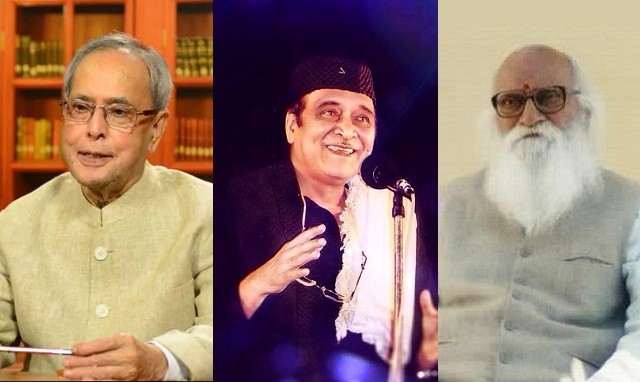
President of India Presents Bharat Ratna Awards 2019

The President of India, Shri Ram Nath Kovind, presented Bharat Ratna Awards to Shri Nanaji Deshmukh (posthumously), Dr Bhupendra Kumar Hazarika (posthumously) and Shri Pranab Mukherjee at an Investiture Ceremony held at Rashtrapati Bhavan today (August 8, 2019).

Union Home Minister Amit Shah to release Vice President’s book on two years in office

A book chronicling two years in the office of the Vice President Shri M Venkaiah Naidu will be released at the Kalaivanar Arrangam, Chennai on August 11, 2019, by Union Home Minister Shri Amit Shah.
The function is being hosted by Shri Prakash Javadekar, Union Minister of Environment & Forests & Climate Change and Information and Broadcasting. The book titled “LISTENING, LEARNING & LEADING” captures a few glimpses of the Vice President’s 330 public engagements in all the States and Union Territories of our country during the last two years.

Crisscrossing the length and breadth of our vast country, the Vice President has delivered 61 convocation addresses, interacted with students on 35 occasions, visited 97 scientific and technological research institutions and delivered 25 special lectures.
The book contains Shri Naidu’s important diplomatic engagements including his visits to 19 countries in 4 continents. He was the first Indian Vice President to visit Panama, Guatemala, Costa Rica, and Malta.
The book will showcase his achievements as Rajya Sabha Chairman and his initiatives to enhance effectiveness, and promote the efficiency of Rajya Sabha.
Shri Banwarilal Purohit, the Governor of Tamil Nadu, Shri Edappadi K. Palaniswami Chief Minister of Tamil Nadu, Shri O. Panneerselvam, Hon’ble Deputy Chief Minister of Tamil Nadu will be attending the event.
Eminent Agriculture Scientist Prof. M.S. Swaminathan, Former Director ISRO, Dr. Krishnaswamy Kasturirangan, Former Attorney General of India Shri K. Parasaran, Editor of Tughlak Shri Swaminathan Gurumurthy, Chairman of Apollo Hospitals Group Dr Pratap C Reddy, Founder & Chancellor of VIT Dr.G.Viswanathan, Chief National Coach of Indian Badminton Team Shri Pullela Gopichand and several other dignitaries and eminent personalities will also attend the event.

5375 Persons Rescued And More Than 42,000 Evacuated By NDRF

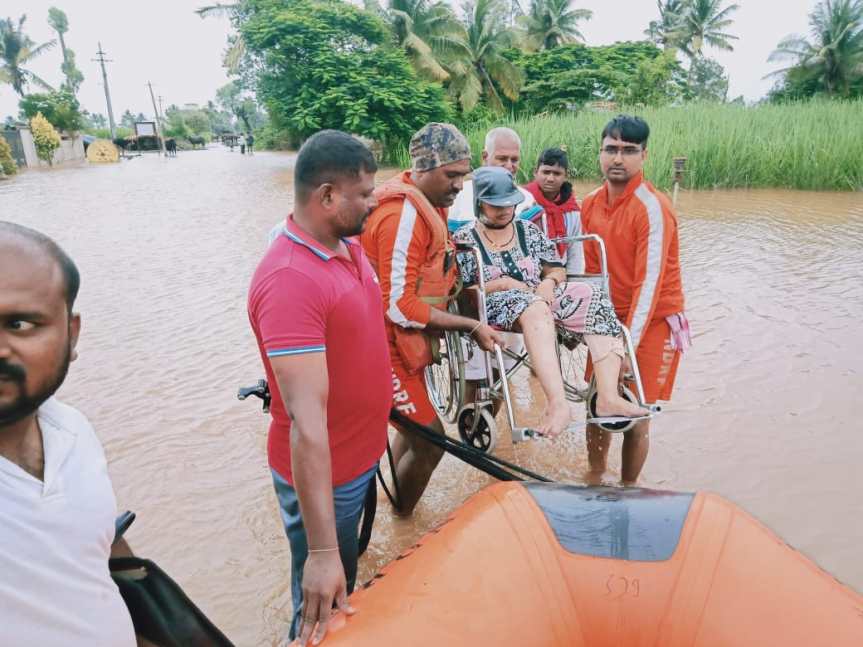
5375 people rescued & more than 42,000 stranded persons & 268 livestock have been evacuated and taken to safer locations by National Disaster Response Force (NDRF) across the country since operation commenced. The NDRF is engaged in rescue & evacuation work with full zeal & commitment at various districts of flood affected states viz. Kerala, Karnataka, Maharashtra, Andhra Pradesh, Madhya Pradesh and Gujarat. Total 173flood rescue teams are deployed by Force across the country for rescue & relief work during the recent monsoon season.
In Kerala the incessant rainfall across the region has affected most of the districts of the state viz. Ernakulam, Idukki, Thrissur, Malappuram, Palakkad, Kozhikode, Wayanad, Kozhikode and Kannur. Bridges, roads are vulnerable to flood which has affected the normal life of the populace. Yesterday, incessant rainfall triggered a major landslide at Ipadi, Puttupala, Wayanad in Kerala, which trapped several people under the debris. NDRF team immediately rushed to the incident site. However, heavy rains and debris on the way obstructed the movement of NDRF team. Despite all odds, NDRF team managed to reach incident site and immediately started the operation with other agencies. In a joint operation, rescue agencies evacuated 194 persons. In addition, NDRF team operational at Mallapuram evacuated 27 person from flood affected areas, today. 13NDRF teams are deployed in Kerala.
In Karnataka, 09 additional teams (05 from Kolkata & 04 from Ghaziabad) are in the State to expedite operations. Presently, 20 NDRF teams are engaged in rescue & relief work with full zeal & commitment at Kodagu, Raichur, Belagavi, Bagalkot & Dharwad districts. Today, teams evacuated 374 persons at Belagavi and 12 at Dharwad . Till Now, NDRF has evacuated over 3400 persons & 24 live Stocks to safer places in Karnataka.

In Maharashtra,  32 NDRF teams are present in the flood affected areas of the State for quick response. Today, NDRF has rescued 2750 persons & evacuated 883 persons at Sangli whereas 300 persons rescued and 246evacuated to safer locations at Kolhapur by NDRF teams. So far, NDRF has rescued 5292 persons and also evacuated more than 18,000 persons & 40 livestock’s in Maharashtra. Besides, team also retrieved 07 dead bodies. The operations are still on.
In Andhra Pradesh, 05 NDRF teams are deployed in Andhra Pradesh. NDRF team deployed at East Godavari commenced rescue operation and evacuated36 people to safer places, today. Total 76 persons evacuated in Andhra Pradesh, till now.
In Madhya Pradesh, 03 NDRF teams are deployed in the State. Today, team evacuated 86 persons at Badwani. So far, 115 persons & 17 livestock have been evacuated by NDRF in Madhya Pradesh.
And In Gujarat today, NDRF team evacuated 150 persons from flooded areas of Chota Udaipur where a total of 4245 persons and 57 livestock have been evacuated by NDRF. 18 teams are deployed in Gujarat.
24×7, NDRF Control Room in New Delhi is functioning round the clock to keep the close vizil over the development of situation and is in touch with other agencies & stakeholder. DG, NDRF is personally monitoring the rescue & relief operations by NDRF and additional teams are on standby at various NDRF locations.

Is Education Overrated?


Importance of Literacy Rate

When discussing the well-being of any country or state of human development of a country; literacy rate is considered to be one of the key parameters. Disparity between literacy rates across genders, geographies, communities tells government where she needs to focus most. Literacy rate is perfect litmus test of a country’s human development.

But why literacy rate is so important?

One of the key requirements for modern societies to function is our abilities to coordinate and communicate effectively. For example, Government launches a new scheme to provide free polio shots for kids.

Unless the general public understands and appreciates this, the rupees spent on this will not yield anything. The citizens need to be able to read on and understand about the government’s role responsibility and actions. Especially when we talk about democracy, it becomes even more important for the citizens to understand various sides of the argument and choose the best alternative.

Literate vs Educated

Literacy is basically understood as ability to read and write. But is it sufficient? Can a person who can read constitution, understand it?
There is a huge gap between being literate and being educated. The third world countries are often blamed for portraying incorrect picture about literacy rates. As they do not take into account the kind of education the person has received.

Formal Education in India

The formal education in India is divided in 10+2+3 followed by specializations. The first 10 years formal education is common for all, before in +2 students are allowed to choose a stream. +2 does not offer lot of options to diverge, but after 2 years of Intermediate, students are ready to take up specialization course- The Graduation. Graduation normally takes 3 years, but for more technically complex courses like Engineering or medicine, it may take little longer. Post graduation, students are free to choose super-specialization courses- the master’s degree. After Masters, student can go for doctorate (PhD) and so on.

Purpose of Education

For a long time, Indian education system was very formal and people studied on as needed basis. Unless someone had deeper interests in literature or another particular field, the purpose of education was very limited. People learned for their interests, there was no burden.
But then came the British. With Merlo-Minto reforms in early 20th century, the Britishers changed the purpose of education from just education to making people job-ready. While this may sound good, it also made the education just a rat race. People read nowadays just to get a job without exploring their interests or even pursuing their interests.
As a result, such students perform very mediocrely in their jobs, with no passion at all, they just go with the flow without attaining their true potential.

The Indian education system believed in
सा विद्या या विमुक्तये|
This means education is the one that sets us free. In other words, if it is does not set us free, it is not education. And this is where the modern education is failing the humanity. It does not set us free from our doubts, our misbeliefs- it does not make us human.
A concentration camp survivor once said that education does not make the world a better place. The concentration camps and the nuclear bombs were built by some of the brightest minds the world has ever seen. Being a better human being is far too important than anything else.
Role of a “good” education becomes more important in today’s world when it is more fragmented than ever. Democratization of media has created so much noise that differentiating black from white is more difficult and more necessary than ever before. We are using our “education” as a weapon. Such type of education does not set us free; it makes us prisoners of our own devise. If the world has to survive, if the world has to be a happy place we need an education system that frees us, that liberates us. Afterall,
सा विद्या या विमुक्तये|

Mobile Phones and Its Evolution

Introduction

A
mobile 
phone is a portable mode of telephone that can make and receive calls.
What makes it different from telephone is its wireless mode of communication as
it allows the user to move while communicating.  
Phones have come a long way since Bell made the first call. Now we have
cellphones which need no wires. The early cellphones were bulky, hard to use
and could do only calling. However with evolution of technology, we have now
camera, music and even internet in mobiles. While the radiations from mobile
have not been proved to be substantially harmful, judicious use of mobiles is
only wise.

The First Phone

 The first
cellular mobile [1] that came in practice was invented in 1980s by Motorola.
This device was named Motorola DynaTAC 8000X. it was the first commercialized
phone that was developed by efforts begun at Bell Labs, which first proposed
the idea of a cellular system in 1947. A series of phone was manufactured in US
from 1983 to 1994 under the name in United States of America. It was first
introduced in market on September 21, 1983.
It was having normal feature of receiving and
sending messages but it was a revolution then as it took communication to a new
height. Undoubtedly it was a revolution then as it changes the concept of
interaction accelerating development at an amazing scale.  Early Cellular phones used analog CDMA technology.
The first commercially available handheld cellular
phone, Motorola DynaTAC 8000x, which hit the market in 1983 weighed in at 2
pounds. It was priced at $3,995 and offered a half-hour of talk per batter
charge.

2G, GSM, mobile internet

CDMA technique of mobile continued its regime for
almost a decade and was later replaced by Global System for Mobile
Communications (GSM) in original termed as Group Special Mobile). It was the forerunner
of the mobile data bloom. It made its first debut in Finland and termed as 2G
network [2].
Phones like the 5110 and 3300 from NOKIA became
iconic and dominated the market during 1992. Till 90s Nokia was supreme leader
in the market. Primarily internet service was availed via GPRS (General Packet
Radio Service) and moving to the faster EDGE (Enhanced Data rates for GSM
Evolution, or EGPRS).

Camera phone

Cell phone later introduced a special feature in
2000 having tiny 0.11-0.35 megapixel resolutions cameras fitted in back cover
of the mobile. In India, the earliest camera phone was the Nokia 7650.

Bluetooth, WiFi

Bluetooth was another unique feature that is still popular.
With the help of Bluetooth user can send receive text and files, photos and videos?
There is no wire needed; only devices must interconnect across short distance.
The first Bluetooth-enabled phone became available in 2000 was Ericsson T36.

3G

 3G is termed
as the third-generation of mobile phone technology standards. The main service
that 3G is associated with wireless voice telephony and broadband wireless
data, all in a mobile environment. Initially introduced in japan, in 2001 [3],
it- is very fast, efficient mobile network. 
With its varying level of speed it allowed addition of numerous applications
on mobile phone making it multitasking device.
 For example,
using 2g to download a 10 MB video or song takes usually 10 to 12 minutes but
with 3G it can be done in a minute. This made the cellphone a utility device.

 Android

It’s an operating system owned by Google and came
into existence in 2005. It runs on majority of phone these days with its
upgraded version. The first Android touchscreen device (G1) came out in 2008
for the US market. It is the modified version of Linux [4].

4G or LTE

The first 4G network, made its début in 2009 in
Sweden based on the LTE standard. Airtel, a cellular company introduced 4G
network in India. 4g relies heavily on internet as most Indian have their
strong focus on music, video and social media.

The Present of Cellular Phones

Cellular phone is now the part and partial of our life.
With upcoming features and high focus on internet availability, gave a massive
boost to mobile usage. From android phone to I phone, the significant change in
cellphones has made it a strong utility device. From keypad to smartphone,
people have witnessed a considerable change in, appearance and efficacy of cell
phones.

The Criticism

Cellular phones work on high
frequency radio waves, which essentially are radiations. These radiations are
non-ionizing. And though it has not been substantially proved, the radiations
of mobile phones have been blamed to cause many diseases including cancer.
While these claims can be neither
accepted nor rejected [5], it is wise to use mobile phones
carefully. Avoid unnecessary usage, keep it at safe distance from body, use
hands-free whenever possible- are some best practices of cellphone use.

Passing of the landmark Bills on Jammu and Kashmir a momentous occasion in Parliamentary Democracy

Prime
Minister Narendra Modi today welcomed the passing of bills pertaining
to Jammu and Kashmir as “a momentous occasion in our Parliamentary
democracy”.
In
a series of tweets Prime Minister was hopeful that “Together we shall
rise and together we fulfil the dreams of 130 Crore Indians!”
He Said, “I salute my sisters and brothers of Jammu, Kashmir and Ladakh for their courage and resilience.”
The
Prime Minister further said “For years, vested interest groups who
believed in emotional blackmail never cared for people’s empowerment.
J&K is now free from their shackles. A new dawn, better tomorrow
awaits!”

Mr
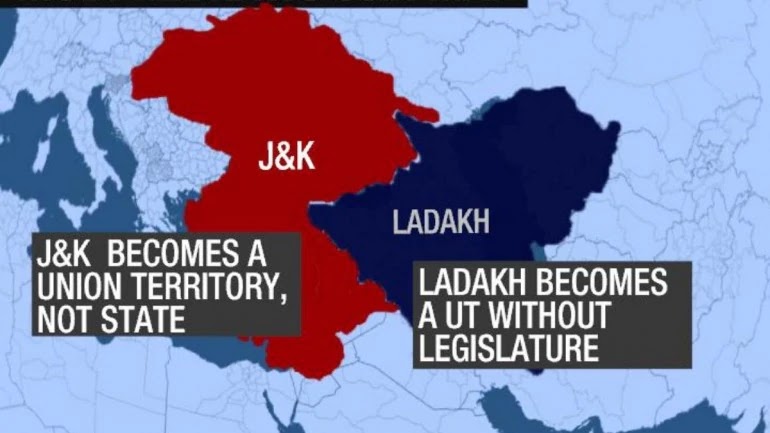
Narendra Modi said, “The Bills pertaining to Jammu, Kashmir and Ladakh
will ensure integration and empowerment. These steps will bring the
youth into the mainstream and give them innumerable opportunities to
showcase their skills and talents. Local infrastructure will
significantly improve.”
He
specially congratulated the people of Ladakh. “It is a matter of great
joy that their long-standing demand of being declared a Union Territory
has been fulfilled. This decision will give impetus to the overall
prosperity of the region and ensure better developmental facilities” he
said.
The
Prime Minister said, “The passage of key Bills pertaining to Jammu,
Kashmir and Ladakh are a fitting tribute to the great Sardar Patel, who
worked for India’s unity, Dr.BabasahebAmbedkar, whose views are well
known and Dr. SP Mookerjee who devoted his life for India’s unity and
integrity.”
He
said, “In Parliament, political parties rose to the occasion, overcame
ideological differences and took part in a rich debate that increased
the pride of our Parliamentary democracy. For that, I congratulate all
MPs, various political parties and their leaders.”
The
prime minister in a separate tweet said “People of Jammu, Kashmir and
Ladakh would be proud that MPs overcame differences and discussed the
future of these regions as well as ensuring peace, progress and
prosperity there. The widespread support can be clearly seen in the
final numbers, 125:61 in RS and 370:70 in LS.”
He
said, “India’s Vice President and Chairman of the Rajya Sabha, M
Venkaiah Naidu Garu as well as Speaker Om Birla Kota Ji conducted
proceedings of both Houses in an excellent manner, for which they
deserve praise from the entire nation.“
He
specially congratulated Home Minister Amit Shah. “Our Home Minister
Amit Shah Ji has been continuously working towards ensuring a better
life for the people of Jammu, Kashmir and Ladakh. His commitment and
diligence is clearly visible in the passage of these Bills. I would like
to specially congratulate Amit Bhai!”

National Informatics Centre pays Tribute to Founder Director General Dr. N. Seshagiri

National
Informatics Centre (NIC) is a key organization under Ministry of
Electronics & Information Technology and plays a pivotal role in the
promotion of e-Governance and provisioning of ICT infrastructure,
platforms, products & services for the Government.
The
vision behind the establishment of NIC was of Dr. NarasimaiahSeshagiri,
Founder Director General, NIC and former Special Secretary to the
Government of India under whose dynamic and visionary leadership during
the 25 year period spanning 1976 to 2000, NIC established an extensive
IT infrastructure and service delivery system across the Government
establishments – covering Ministries, Departments, State Government
establishments up to the districts.

To pay tribute to the visionary, NIC organised the “Dr. N. Seshagiri Memorial Lecture – 2019” on 5th August, 2019
at VigyanBhawan, New Delhi, where the keynote address was delivered by
Shri Narayana Murthy, Founder – Infosys Limited, in the august presence
of Sh. Sanjay Dhotre, Hon’ble Minister of State for HRD, Communications
and Electronics & Information Technology, Sh. Ajay Swahney,
Secretary, MeitY and a large number of Senior Government Officials,
eminent personalities from Government and Private organizations.
Hon’
bleMoS for HRD, Comm. & EIT praised Dr N Seshagiri for guiding NIC
in becoming the IT arm of the Government and providing global solutions
for Digital India.
He also lauded the role of NIC for transforming the Government services through  the use of its physical and human network.
Sh.
Ajay Swahney, Secretary, MeitY described Dr. Seshagiri as the doyen of
Indian IT revolution, an institution builder, visionary, and credited
with creation of a Nation-wide Satellite Network connecting all
districts 30 years ago, which was a great feat.
Sh.
Narayana Murthy, Founder of Infosys Limited, in his Memorial address
titled “The role of education and research in accelerating the growth of
Indian Software Industry “, emphasized on the need for improving the
quality of our educational institutions imparting engineering and
technical education, which should be supplemented by on-job mechanism
for enhancing knowledge and skills. Sh Murthy also remembered his close
association with Dr. Seshagiri which went back as far as 1982. He
described Dr. N Seshagiri as a first rate patriot with a combination of
academic excellence, administrative acumen and a sense of quick decision
making.
The
family of Dr. Sheshagiri was felicitated during the ceremony. A film on
the life and work of Dr. Seshagiri was also screened.
The
event ended with the vote of thanks by Dr Neeta Verma, Director
General, NIC. She paid tribute to the founder of the organisation by
stating that what we see as e-Governance
today,
is the outcome of his vision and its translation through the decades of
80s and 90s. She expressed her gratitude to the great leader of Indian
IT Industry Sh. Narayana Murthy for gracing the occasion and
enlightening all with a very insightful talk. She expressed her sincere
thanks to the Hon’ble Minister of State, Secretary MeitY, family of Dr.
Seshagiri, all senior officers and dignitaries, Print and Electronic
Media and last but not the least, her fellow NIC officials for making
the function a great success.

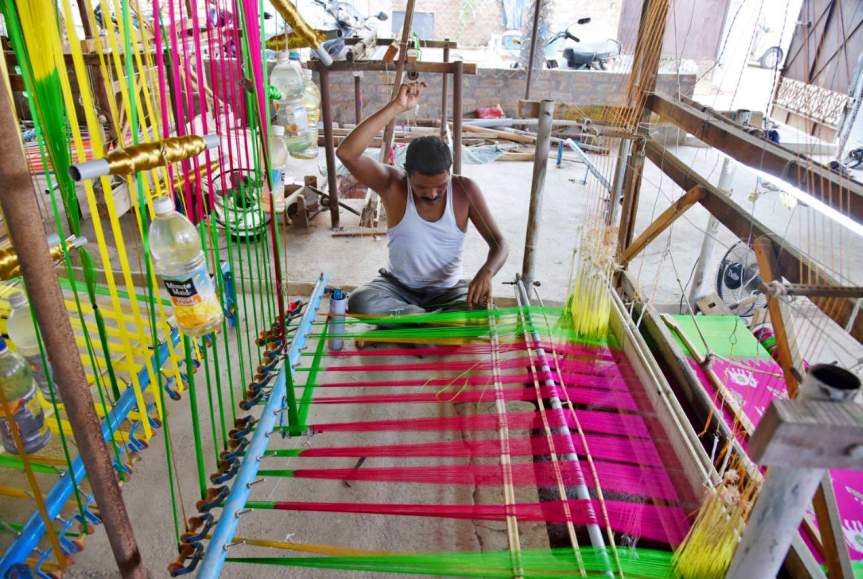
5th National Handloom Day celebrations on August 7

The 5th
National Handloom Day will be celebrated tomorrow across the country.
Union Minister of Textiles and Women and Child Development,
SmritiZubinIrani, will preside over a function at VigyanBhawan in New
Delhi to mark the occasion.
Minister
of Petroleum & Natural Gas, Dharmendra Pradhan, and Minister of
State for Animal Husbandry, Dairying & Fisheries and Micro, Small
& Medium Enterprises, Pratap Chandra Sarangi, will also be present
on this occasion. 

The
main event will be held in Bhubaneswar, Odisha. Bhubaneswar has been
chosen as the venue for the main event due to its rich tradition of
Handlooms. More thanfifty percent of total weavers population of India
resides in Eastern and North Eastern Regions and most of them are women.
The prime objective of holding the National Handloom Day in Bhubaneswar
is to empower women and girls.
The following activities will be undertaken all across the country
  • Distribution of Pehchan Cards and Yarn Passbooks
  • Distribution of MUDRA loan
  • Distribution of lighting units and certificates for construction of work sheds.
  • National Handloom Day to be observed at Weavers’ Service Centres in different States.
  • At
    16 NIFT Campuses and Handloom Mela and exhibition, workshops, panel
    discussions, special stalls for handloom products at Gandhinagar and
    Kolkata NIFT campuses.
  • Live
    broadcast of discussion on Twitter from digital studio of IMG Reliance,
    involving young designers and prominent personalities from the handloom
    sector.
  • Symposium
    at Crafts Museum in New Delhi by Fashion Design Council of India with
    participants from Ministry of Textiles, master weavers, textile
    designers, fashion designers and textile experts. 
  • Workshop through IGNOU/NIOS to impart information about educational opportunities to weave and their wards.
The National Handloom Day is observed annually on 7th
August to honour the handloom weavers in the country and also highlight
India’s handloom industry. National Handloom Day seeks to focus on the
contribution of handloom to the socio economic development of the
country and also increase the income of weavers.
The Union Government had declared 7th
of August as the National Handloom Day in July 2015 with the objective
of generating awareness about the importance of the handloom industry to
the socio economic development of the country. August 7 was chosen as
the National Handloom Day to commemorate the Swadeshi Movement which was
launched on this day in 1905 in Calcutta Town Hall to protest against
the partition of Bengal by the British Government. The movement had
aimed at reviving domestic products and production processes.
The first National Handloom Day was inaugurated on 7th August 2015 by the Prime Minister, Narendra Modi, at the centenary of Madras University in Chennai.

New Education Policy, the way to Nalanda, Takshasila glory

Expressing
concern over India’s slide from the heights of Nalanda and Takshasila
to not being among the world’s top 100 educational institutions now, the
Vice President of India and Chairman of Rajya Sabha, Shri M. Venkaiah
Naidu has said that the New Educational Policy will make India a global
educational hub. He urged the public to give their views and suggestions
on the draft NEP by the stipulated time of 15th of this month.
Shri
Naidu further called for a holistic and value-based education that will
lay strong foundations for the vibrant economy that India is emerging
as. He spoke on the challenges to Indian education after releasing a
book ‘The Dynamics of Indian Education’ authored by Prof. J.S. Rajput at
the Vice President’s residence, here today.
The
Vice President said; “These are the critical times for the country and
there is a need for having a fresh look at the education system. I have
been consistently advocating the need for revamping the education system
to not only make our universities world-class, but to make India the
knowledge hub. I am glad that the draft of the New Education Policy
makes several out of the box suggestions that have the potential to turn
India into a global education hub.”
Shri
Naidu stressed that primary education shall be in the mother tongue
which enables learning other languages effectively at later stages.
Highlighting the knowledge traditions of India, he referred to several
German Universities promoting Sanskrit to decipher ancient palm leaves
and scriptures for clues for scientific innovation.
Former
Union Minister Shri Arif Mohammad Khan who spoke on the occasion said
that the land of India for ages is marked by the tradition of knowledge
and wisdom. He referred to Prophet Mohammad as having said; “Sitting in
Mecca, I am feeling the cool breeze of Knowledge from India. I am an
Arab without Arabness; I am not an Indian but feel the Indianness.”
Prof.
Rajput, former Secretary-General of Lok Sabha, Shri Subhash Kashyap and
Chairman of Prasar Bharti, Shri A. Surya Prakash spoke on various
aspects of Indian Education.
Following is the text of Vice President’s address:
I am immensely pleased to release the book “The Dynamics of Indian Education” written by well-known educationist, Prof Rajput. 
The
book covers a whole gamut of issues relating to Indian education system
and I must compliment the author for this timely work on a topic that
is very close to my heart.
As
we all are aware, India has a rich history, tradition and culture of
education system from Vedic times. The Gurukul system of imparting
knowledge and skills used to focus on holistic development of
individuals. Education of women was also accorded huge importance during
ancient times and there were well-known women scholars during the Vedic
period.
In
fact, India was once known as Vishwaguru because of its world class
centres of learning like Takshashila, Pushpagiri, Nalanda and others. It
was stated that around 10,000 students, including many from foreign
shores used to study diverse subjects at Takshashila.
India
contributed not only in philosophy and spirituality, but in sciences,
mathematics, astronomy and other areas. The objective was “welfare of
one and all – Sarva Bhut Hite Ratah”
Subsequently,
following foreign invasions and the colonial rule, India lost its
pre-eminent position. Today, one finds that not a single Indian
university figures in the top-ranking global educational institutions.
These
are the critical times for the country and there is a need for having a
fresh look at the education system. I have been consistently advocating
the need for revamping the education system to not only make our
universities world class, but to make India the knowledge and innovation
hub.
We
need to recapture the past glory. Our education system must remain
deeply rooted to culture, while simultaneously steadfastly pursuing new
frontiers of knowledge.
Undoubtedly,
our post-Independence achievements in education are praiseworthy. We
have near total enrolment in schools in spite of over-threefold increase
in population!
The
recent launch of Chandrayaan -2 and other remarkable achievements in
space sciences have unveiled before the world the Indian tradition for
the quest of knowledge. It inspires and motivates young Indians and our
scientists deserve all the praise for making us proud. Elsewhere,
Indians working at NASA and Silicon Valley have made the country proud
with their contributions.
I
feel that the need of the hour is to provide quality education at all
levels to all people. I am glad that the draft of the New Education
Policy makes several out-of-box suggestions that have the potential to
turn India into a Global education Hub. With the draft report placed for
another round of receiving inputs, I hope that many more suggestions
would come forth to make Indian universities achieve their rightful
place in the global rankings.
I
must however, mention that in our march towards a knowledge society, we
need to strengthen our school education on priority basis. In
particular, special attention has to be bestowed to improve government
schools.
We
must reform the education system to do away with rote learning. We need
to promote concept learning, critical thinking, creativity, problem
solving skills as also multilingualism and digital literacy to enable
the students to confidently face challenges and successfully pursue
their careers.
I
need not once again enumerate the importance of teaching in mother
tongue from a young age. In fact, I have consistently been advocating
the need to make it mandatory for mother tongue to be the medium of
instruction up to primary level.
I
am told that some of the top universities in Germany teach Sanskrit to
enable the scholars of the subject decipher ancient palm leafs and
scriptures and find clues for scientific innovation. We should not
neglect Sanskrit. I feel that no language should be imposed, nor any
language opposed.
Teachers
are the pivot of national educational endeavors. We need best of the
minds in teaching profession. Once in the profession they need to
internalize “yavadjeevait adhiyate viprah” – the wise continue to gain knowledge throughout life.
Teachers
should be torchbearers of the society. I am told that there are around 1
crore teachers and 30 crore students from KG to PG level in the
country. Filling up all the vacant positions of teachers is equally
important to make our education effective.
Teachers
play the most crucial role in shaping the character of a child after
his or her parents. Therefore, teachers should have societal concerns.
We must develop a model of education that reflects Indian culture and
ethos. We need to inculcate cultural, moral, ethical and spiritual
values among children.
I
hope the new educational policy will address various concerns on
reforming the system and fulfill the need for India-centric education
architecture. The draft policy should be studied with an open mind.
People should give constructive suggestions rather than criticize it for
the sake of criticism.
We
need education for progress and development. Probably more than that,
we need Education for Character Development. Value based education that
prepares the young for an India that abounds in ‘social cohesion and
religious amity’ is our goal.
The
book practically covers all the aspects mentioned by me. Prof. Rajput
strongly pleads for value education, character formation and celebration
of unity in diversity. I wish him well in his efforts.

Commerce & Industry Minister holds discussions with CEOs of Indian IT Companies to explore new markets

Union
Minister of Commerce & Industry and Railways, Piyush Goyal,held a
meeting with senior managers of IT companies in New Delhi yesterday. The
meeting was held to discuss opportunities for Indian IT companies to
invest and grow their business in new markets like the Nordic countries,
Eastern and Central Europe, Canada, Australia and Africa and also
exploreavenues for greater investments and growth in East Asian markets
like China, Japan and Korea.
India’s
IT industry contributed 7.7% to the country’s GDP in FY 2017 and is
expected to contribute 10% of India’s GDP by 2025. According to NASSCOM,
the sector aggregated revenues of USD 160 billion in 2017. The United
States account for 2/3rds of India’s IT services exports.
India’s
IT and ITeS industry grew to USD 181 billion in 2018-19. Exports from
the industry increased to USD 137 billion in FY 2019 while domestic
revenues (including hardware) advanced to USD 44 billion.
During
the discussions with Commerce and Industry Ministry, the
representatives of the companies informed that although the Chinese IT
services market is the third largest in the world India’s investments
and business have not been able to grow in China due to various
non-tariff barriersand challenges faced by Indian companies to set up
their entity in China. Marketaccess issues that create hurdles for
Indian companies to open their business in China was also discussed.
The
top five Indian IT service companies like TCS, WIPRO, Infosys, Tech
Mahindra and HCL are doing business in China for more than a decade and
are employing 90% of local people in their China operations but returns
are very low and thereforeIndian IT service companies are not showing
much interest to invest and expand their operations in China.
Commerce
and Industry Minister during the discussions requested National
Association of Software and Services Companies (NASSCOM) and the senior
managers of the companies attending the meeting to share specific data
regarding non-tariff barriers being faced by them inChina and other East
Asian markets. Government of India will give all support for the global
growth of India’s flagship industry and will make all efforts to
facilitate the IT service industry and for that it is ready to engage
with China and also Japan and Korea, informed Piyush Goyal.
Commerce
and Industry Minister urged India’s IT services companies to explore
other markets and not be inhibited in operating in countries that are
non-English speaking. He urged the top five Indian IT firms to create a
corpus that will be spent on training manpower in languages like
Mandarin, Japanese and Korean for accessing the markets in these
countries.
The
meeting was attended by senior managers of TCS, Satyam Venture
engineering, HCL, NIIT Tech, Infosys, Invento Robotics, Tech Mahindra
and WIPRO. SangeetaGodbole, DG of Services Export Promotion Council
(SEPC) and President of NASSCOM, Debjani Ghosh, were also present during
the discussions with Commerce and Industry Minister.
India
is the largest exporter of IT services in the world and exports
dominate the Indian IT industry and constitutes about 79% of the total
revenue of theindustry. India’s IT service sector is now gearing up to
be the digital partner of intelligent automation like smart algorithms,
bots and AI tools, which arefast becoming a part of every industry and
an increasingly digital world.

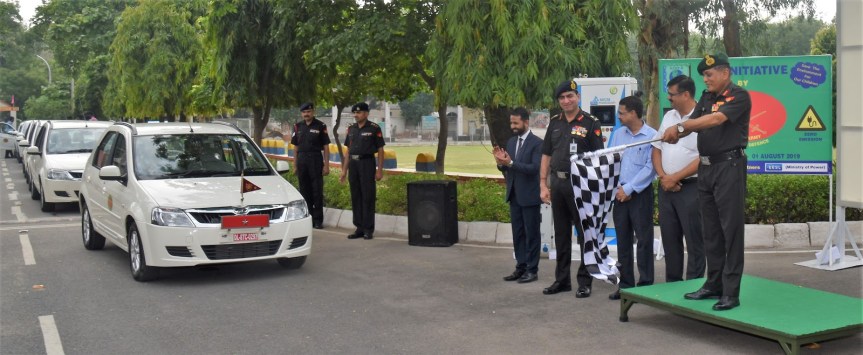
Army Launches E Car to Combat Pollution

The
Indian Army in step with government policies on environmental
protection has launched an ecological initiative with employing E Cars
for use of its officials in New Delhi in partnership with Energy
Efficiency Services Ltd (EESL), a joint Venture of Central PSUs under
Ministry of Power. The introduction of E-Car in Army at Delhi was
visualised on World Environment Day and launched on 01 Aug 2019 with
flagging off the first lot of E-Cars for Indian Army by QMG, Lt Gen
Gopal R. Army plans to operate the first batch of 10 E-Cars as a pilot
project and develop further on this initiative and increase the number
of E Cars in Delhi to ensure economy, efficiency and minimal emissions.
It
is pertinent to mention that Army has always been at the forefront of
environmental initiatives. Indian Army has a large number of Territorial
Army Battalions (ECO) which have done a yeoman service in environmental
protection initiatives such as forestation. Army units posted in remote
and ecologically sensitive areas from Kashmir to Kanya Kumari have been
carrying out various activities in close coordination with local
populace to conserve the ecological balance and protect the environment.
Air
pollution has been a major challenge in Delhi. Governments across the
World are investing a lot of resources in fighting this menace. Electric
vehicle technology has proved to be a viable alternative by reducing
the carbon emission footprint. Indian companies like Tata Motors and
Mahindra have taken a lead in R&D and manufacturing of Electric
Cars. EESL has been the main facilitator in providing these vehicles to
various Government agencies. Army’s initiative in encouraging these
electric vehicles will go a long way in further development of this
technology and its adoption for the general public in near future.

Sea to be The next Gateway for Tourism in The Country

The
Minister of State for Shipping (I/C) and Chemicals & Fertilizers,
Shri Mansukh Mandaviya and  Minister of State (I/C) for Tourism &
Culture, Shri. Prahlad Singh Patel discussed  the immense potential for 
maritime tourism in the country. In a  meeting between the two
Ministers held in New Delhi yesterday, the two  ministers  emphasised 
the need to promote the important tourist destinations in the coastal
areas of the country through coastal tourism .
It
was decided in the meeting to set up a committee of senior officials of
the two Ministries to explore the avenues for coastal tourism  in the
country and work out ways to promote the same. It was also  decided to
explore  the possibilities and opportunities in the areas of  Coastal
Tourism, Cruise Tourism, Sea Sports, Light House Viewing Gallery.  It
was suggested that every coastal area can create a calendar of events
for  tourist engagement, with activities like beach volleyball, sand
art, food festivals, dances of the fishing community, to name a few.
The
Shipping Ministry is promoting tourism in maritime states under the
Sagarmala Programme. This is being done in convergence with the Ministry
of Tourism and Tourism Development Departments of maritime state
governments.
These
new, unexplored tourism areas will open a door to coastal communities
of the maritime states where they will find many new and diverse job
opportunities. In the coming years, coastal and maritime tourism will be
a source for growth and job creation in the coastal states of India.
The
two Ministers  also underscored the need  for better coordination and
synergy between their respective Ministries so that desired results can
be achieved in a time bound manner.

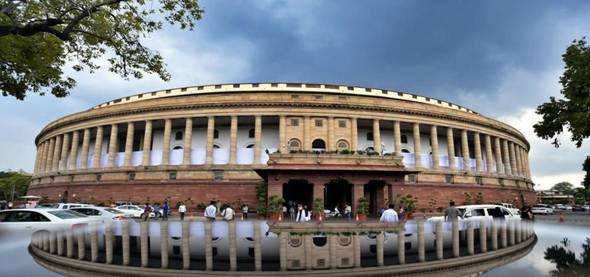
Lok Sabha passes Consumer Protection Bill, 2019

The
Lok Sabha todaypassed the Consumer Protection Bill 2019 after due
consideration and discussion.The Union Minister for Consumer Affairs,
Food and Public Distribution Shri Ram Vilas Paswan said that the bill
aims at protecting the interests of consumers by establishing
authorities for timely and effective administration and settlement of
consumers’ dispute. Moving the Bill, Minister of State for Consumer
Affairs, Food and Public Distribution, Shri Raosaheb Patil Danve said
the Bill aims to simplify a number of rules. Shri Danve said consumers
do not get quick redressal of their complaints and with the passage of
the Bill, consumers will be able to get speedy justice. He said the
government aims to simplify the entire process of redressal of consumer
grievances.
Under
the Bill, there is provision for central government to set up a Central
Consumer Protection Authority (CCPA) to promote, protect and enforce
the rights of consumers and will be empowered to investigate, recall,
refund and impose penalties. It will regulate matters related to
violation of consumer rights, unfair trade practices, and misleading
advertisements. There is also a provision for class action law suit for
ensuring that rights of consumers are not infringed upon. The authority
will have power to impose a penalty on a manufacturer or an endorser of
up to 10 lakh rupees and imprisonment for up to two years for a false or
misleading advertisement. 
Salient Features of the Bill
1.         Central Consumer Protection Authority (CCPA): Executive Agency to provide relief to a class of consumers. The CCPA will be empowered to-
  1. Conduct  investigations into violations of consumer rights and institute Complaints /Prosecution
  2. Order recall of unsafe goods and services
  3. Order discontinuance of Unfair Trade Practices and Misleading  Advertisements
  4. Impose penalties on Manufactures /Endorsers /Publishers of Misleading Advertisements
2.         Simplified Dispute Resolution process
i) Pecuniary Jurisdiction enhanced to-
  • District Commission –Up to Rs1 crore
  • State Commission- Between  Rs1 crore and Rs 10 crore
  • National Commission –Above Rs.10 crore
ii) Deemed admissibility after 21days of filing
iii) Empowerment of Consumer Commission to enforce their orders
iv) Appeals only on question of law after second stage
v) Ease of approaching consumer commission
  • Filing from place of residence
  • E-filing
  • Videoconferencing for hearing 
3.         Mediation
  • An Alternate Dispute Resolution (ADR) mechanism
  • Reference to Mediation by Consumer Forum wherever scope for early settlement exists and parties agree for it.
  • Mediation cells to be attached to Consumer Forum
  • No appeal against settlement through mediation
4.         Product Liability
A
manufacturer or product service provider or product seller to be
responsible to compensate for injury or damage caused by defective
product or deficiency in services
The Basis for product liability action will be:
  • Manufacturing  defect
  • Design defect
  • Deviation from manufacturing specifications
  • Not conforming to express warranty
  • Failing to contain adequate instruction for correct use
  • Services provided arefaulty, imperfect or deficient
New Bill- Benefit to Consumers
Presently
Consumer only have a single point of access to justice, which is time
consuming. Additional swift executive remedies are proposed in the bill
through Central Consumer Protection Authority (CCPA)
Deterrent punishment to check misleading advertisements and adulteration of products
Product liability provision to deter manufacturers and service providers from delivering defective products or deficient services
Ease of approaching Consumer Commission and Simplification of Adjudication process
Scope for early disposal of cases through mediation
Provision for rules for new age consumer issues: e-commerce & direct selling

Nepali and Santhali languages in the Scheme for grant of Senior/Junior Fellowships of Culture Ministry

The
Union Minister of State for Culture and Tourism, Shri Prahlad Singh
Patel has announced to include the remaining 02 languages from the 8th 
Schedule of the Indian Constitution i.e. Nepali and Santhali in the
Sub-Field of Field “Literature” in the scheme component ‘Award of
Senior/Junior Fellowships to Outstanding Artistes in the Fields of
Culture’. The announcement was made by the Culture Minister during an
interaction with media in New Delhi today.

The
Ministry of Culture administers a scheme component namely Award of
Senior/Junior Fellowships to Outstanding Artistes in the Fields of
Culture. The fellowships are awarded for undertaking research oriented
projects.
Centre
for Cultural Resources and Training (CCRT), Dwarka is the Nodal
institute for handling the Scheme of Sr. /Jr. Fellowship till selection
process. “Literary Arts” is one of the Fields under this Scheme where
candidates can apply for research in 22 languages as their Sub-Field.
These 22 languages include the following 20 languages from the 8th Schedule of Articles 344(1) and 251 of the Indian Constitution along with English and Khasi:-
(1)
Assamese, (2) Bengali, (3) Bodo, (4) Dogri, (5) Gujarati, (6) Hindi,
(7) Kannada, (8) Kashmiri, (9) Konkani, (10) Maithili, (11) Malayalam,
(12) Manipuri, (13) Marathi, (14) Oriya, (15) Punjabi, (16) Sanskrit,
(17) Sindhi (18) Tamil, (19) Telugu and (20) Urdu.