GLOBAL WARMING

Climate change” and “global warming” are often used interchangeably but have distinct meanings. Similarly, the terms "weather" and "climate" are sometimes confused, though they refer to events with broadly different spatial- and timescales.
Global warming is the long-term heating of Earth’s climate system observed since the pre-industrial period (between 1850 and 1900) due to human activities, primarily fossil fuel burning, which increases heat-trapping greenhouse gas levels in Earth’s atmosphere. The term is frequently used interchangeably with the term climate change, though the latter refers to both human- and naturally produced warming and the effects it has on our planet. It is most commonly measured as the average increase in Earth’s global surface temperature.
Since the pre-industrial period, human activities are estimated to have increased Earth’s global average temperature by about 1 degree Celsius (1.8 degrees Fahrenheit), a number that is currently increasing by 0.2 degrees Celsius (0.36 degrees Fahrenheit) per decade. Most of the current warming trend is extremely likely (greater than 95 percent probability) the result of human activity since the 1950s and is proceeding at an unprecedented rate over decades to millennia.
Changes observed in Earth’s climate since the early 20th century are primarily driven by human activities, particularly fossil fuel burning, which increases heat-trapping greenhouse gas levels in Earth’s atmosphere, raising Earth’s average surface temperature. These human-produced temperature increases are commonly referred to as global warming. Natural processes can also contribute to climate change, including internal variability (e.g., cyclical ocean patterns like El Niño, La Niña and the Pacific Decadal Oscillation) and external forcings (e.g., volcanic activity, changes in the Sun’s energy output, variations in Earth’s orbit).
Scientists use observations from the ground, air and space, along with theoretical models, to monitor and study past, present and future climate change. Climate data records provide evidence of climate change key indicators, such as global land and ocean temperature increases; rising sea levels; ice loss at Earth’s poles and in mountain glaciers; frequency and severity changes in extreme weather such as hurricanes, heat waves, wildfires, droughts, floods and precipitation; and cloud and vegetation cover changes, to name but a few.
Climate change is a long-term change in the average weather patterns that have come to define Earth’s local, regional and global climates. These changes have a broad range of observed effects that are synonymous with the term.
Since the Industrial Revolution, the global annual temperature has increased in total by a little more than 1 degree Celsius, or about 2 degrees Fahrenheit. Between 1880—the year that accurate recordkeeping began—and 1980, it rose on average by 0.07 degrees Celsius (0.13 degrees Fahrenheit) every 10 years. Since 1981, however, the rate of increase has more than doubled: For the last 40 years, we’ve seen the global annual temperature rise by 0.18 degrees Celsius, or 0.32 degrees Fahrenheit, per decade.
The result? A planet that has never been hotter. Nine of the 10 warmest years since 1880 have occurred since 2005—and the 5 warmest years on record have all occurred since 2015. Climate change deniers have argued that there has been a “pause” or a “slowdown” in rising global temperatures, but numerous studies, including a 2018 paper published in the journal Environmental Research Letters, have disproved this claim. The impacts of global warming are already harming people around the world.
Now climate scientists have concluded that we must limit global warming to 1.5 degrees Celsius by 2040 if we are to avoid a future in which everyday life around the world is marked by its worst, most devastating effects: the extreme droughts, wildfires, floods, tropical storms, and other disasters that we refer to collectively as climate change. These effects are felt by all people in one way or another but are experienced most acutely by the underprivileged, the economically marginalized, and people of color, for whom climate change is often a key driver of poverty, displacement, hunger, and social unrest.
Global warming occurs when carbon dioxide (CO2) and other air pollutants collect in the atmosphere and absorb sunlight and solar radiation that have bounced off the earth’s surface. Normally this radiation would escape into space, but these pollutants, which can last for years to centuries in the atmosphere, trap the heat and cause the planet to get hotter. These heat-trapping pollutants—specifically carbon dioxide, methane, nitrous oxide, water vapor, and synthetic fluorinated gases—are known as greenhouse gases, and their impact is called the greenhouse effect.
In 2015, for example, scientists concluded that a lengthy drought in California—the state’s worst water shortage in 1,200 years—had been intensified by 15 to 20 percent by global warming. They also said the odds of similar droughts happening in the future had roughly doubled over the past century. And in 2016, the National Academies of Science, Engineering, and Medicine announced that we can now confidently attribute some extreme weather events, like heat waves, droughts, and heavy precipitation, directly to climate change.
The earth’s ocean temperatures are getting warmer, too—which means that tropical storms can pick up more energy. In other words, global warming has the ability to turn a category 3 storm into a more dangerous category 4 storm. In fact, scientists have found that the frequency of North Atlantic hurricanes has increased since the early 1980s, as has the number of storms that reach categories 4 and 5. The 2020 Atlantic hurricane season included a record-breaking 30 tropical storms, 6 major hurricanes, and 13 hurricanes altogether. With increased intensity come increased damage and death. The United States saw an unprecedented 22 weather and climate disasters that caused at least a billion dollars’ worth of damage in 2020, but 2017 was the costliest on record and among the deadliest as well: Taken together, that year's tropical storms (including Hurricanes Harvey, Irma, and Maria) caused nearly $300 billion in damage and led to more than 3,300 fatalities.
Global warming can be controlled by Replacing one regular light bulb with a compact fluorescent light bulb will save 150 pounds of carbon dioxide a year. Walk, bike, carpool or take mass transit more often. You'll save one pound of carbon dioxide for every mile you don't drive! You can save 2,400 pounds of carbon dioxide per year by recycling just half of your household waste. A single tree will absorb one ton of carbon dioxide over its lifetime.
The most important is concern within ourselves.

PTSD(post traumatic stress disorder)

-ADITI RAJ

We have often heard about the word PTSD which is abbreviated as posttraumatic stress disorder. According to WHO, Posttraumatic stress disorder  is a psychiatric disorder that may occur in individuals who have experienced or witnessed a distressing event such as a natural disaster , an accident ,maybe a war or rape or have been threatened with death, sexual assault or serious injury. In 1980,the American psychiatric association added PTSD to the third edition of its Diagnostic and Statistical Manual of Mental Disorder(DSM-III)

This kind of stress disorder can affect those people who have personally experienced such trauma which may have affected their mental health in an adverse manner. It can occur in the friends or family members of those who have went through such traumatic event.

What causes PTSD?

When you experiences a tough moment, your nervous system reacts with the fight-or-flight response. Your heart start beating faster and your blood pressure starts rising along your muscles getting tighten, increase your strength and reaction speed .Once the body feels the danger is passed your nervous system calms your body, lowering your heart and blood pressure, recovers to its normal state.

Signs and symptoms of PTSD

PTSD symptoms differ from person to person because everyone’s nervous system and level for stress tolerance can  be different. Most likely to develop posttraumatic stress disorder symptom in the hours or days following  a traumatic event. It can even take year before they appear. People having such disorder get triggered by something that reminds them of their original traumatic event, such as noise or an image, a word or even a smell.

While everyone experiencing PTSD differently, there are primarily three types of symptoms which are following

1.Re-experiencing the traumatic event through bad memories, flashback and nightmares

2.Avoidance and numbing , such as avoiding those thing which reminds you of the trauma, feeling emotionally numb and detached from others

3.Hyperarousal which includes sleeping problems, constantly getting irritated, anger issues, self destructive or reckless behaviour

Curative Measures for PTSD

There is no definite care for PTSD ,but there are many types of treatment available that can lessen the symptoms. Also there are various therapy techniques, as well as evidence shows right medication can be beneficial for people struggling with symptoms of PTSD.

These treatment method are used to minimize, or even eliminate, distressing symptoms that people with Posttraumatic Stress Disorder often experience.

ATLANTIC CHARTER

The Atlantic Charter was a joint statement published by the United States and the United Kingdom during World War II (1939–45) that laid forth a vision for the postwar world. It set forth a wide set of objectives of U.S and British war such as:-

1. the desire for no territorial changes without the consent of the peoples affected.

2. They believed that every people had the right to select their own type of government and that those who had been stripped of their sovereign rights and self-governance should have them restored.

3. They would work to ensure that all states had equitable access to commerce and raw commodities.

4. They aimed to enhance labor standards, economic growth, and social security by promoting global collaboration.

5. They would seek a peace in which all countries could live peacefully inside their borders, without fear or want, after the “Nazi tyranny” (Germany) was destroyed.

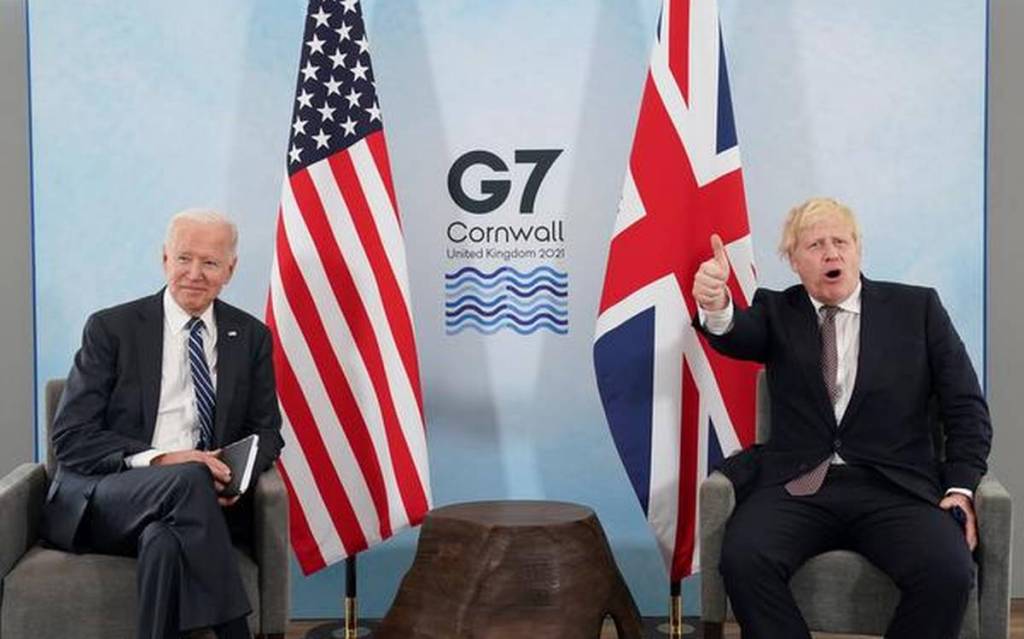
Now, u must be wondering about why we are discussing the year-old charter now. That is because recently, The President of the United States and the Prime Minister of the United Kingdom have signed a revised version of the 80-year-old Atlantic Charter.

This revised version is a 604-word declaration which is an attempt to lay out a grand vision for global relations in the twenty-first century, much like the original charter was a declaration of a Western commitment to democracy and territorial integrity just months before the United States entered World War II. It’s a declaration of principles, a pledge that the United Kingdom and the United States will work together to meet the challenges of their time. It also emphasizes climate change and the need of biodiversity preservation. With references to new technology, cyberspace, and global development that is sustainable. 

It urges Western partners to fight electoral meddling, particularly through misinformation and other harmful activities. In a technology era, it rates the risks to democratic states. It also declared that that the North Atlantic Treaty Organization (NATO) will remain a nuclear alliance as long as nuclear weapons exist.

Now, what will this new version of Atlantic charter holds the opportunity for India. Comparing the old and new version of Atlantic charter, the previous Atlantic Charter alienated Indian nationalism from the West, but the new Charter, as well as the rebooting of western institutions, could pave the way for a fruitful period of India’s collaboration with the US and its allies. 

In 1941, the United Kingdom maintained that the charter’s self-determination concept did not apply to India. However, the inclusion of India and South Africa, as well as Australia and South Korea (as guests) at the G-7 meeting in 2021, demonstrates the urgent need to broaden the West’s base in dealing with global issues. Furthermore, The present Anglo-American initiative to formalize western talks with India is long overdue. 

The Indian Prime Minister, who is participating in the G-7 meeting from afar, has the chance to demonstrate a commitment to both addressing views of decreasing democratic freedoms in India and offering genuine partnership with western democracies on global issues.

Photography – The Poetry of Images

Photography is nothing less than an art form of absolute purity. Silent poetry with the moments
captured in an image is photography. The most memorable and beautiful way to remember the
special things in life with full clarity. Photos are a way of preserving the best memories and
moments for eternity. Photos are the permanent reminder of the past. Never get forgotten. They
will always be alive. The past, the memories, everything is hidden in the photos. Hidden but so
transparent in emotions. All the feelings just in a single place. They get old but are
unforgettable. But on the bright side, photos are a way of expressing your emotions in a
completely different and innovative way.

Photo by Kaique Rocha on Pexels.com

Photography is not just work, it is a passion filled with excitement and hope. It is a specific but
not so specific piece of art. It can be done in various forms with no boundaries. There’s nothing
to dislike in photography. It’s just another way to showcase talent of immense beauty.
Everything, every moment can be captured and kept for the rest of your life. Photos have the
finest texture and the most amazing depiction of a thing. It feels like it’s real.
Photographers have the ability and power to make a photo so great that it magnifies the
moment. They are able to drastically change the outcome of an image by using various
equipment for high quality and definition. Every small detail is shown through photos. It gives
pleasure to experience and relive the moments in life through photos.

Photos are not just a piece of paper or a file occupying a little space in your mobile or camera roll. They are an
explicit version of your life in brief. The small moments to the big memories, all are stored in a
single place for you to look after decades and enjoy living in the moment again. Photography depicts the vulnerability of the photographers through their art. Photographers use photography as a medium for creative expressions. They pour their heart out in the photos. They are artists of very fine quality and beauty in its purest form. The beauty and creativity can not be ignored by any living heart in this world. Embrace moments and capture them in real time
with photography.

Pegasus – A threat to your Privacy

What is Pegasus?

  • It is a type of malicious software or malware classified as a spyware.
  • It is designed to gain access to devices, without the knowledge of users, and gather personal information and relay it back to whoever it is that is using the software to spy.
  • Pegasus has been developed by the Israeli firm NSO Group that was set up in 2010.
  • The earliest version of Pegasus discovered, which was captured by researchers in 2016, infected phones through what is called spear-phishing – text messages or emails that trick a target into clicking on a malicious link.
  • Since then, however, NSO’s attack capabilities have become more advanced. Pegasus infections can be achieved through so-called “zero-click” attacks, which do not require any interaction from the phone’s owner in order to succeed.
  • These will often exploit “zero-day” vulnerabilities, which are flaws or bugs in an operating system that the mobile phone’s manufacturer does not yet know about and so has not been able to fix.

What are the types of cyber attacks?

  • Malware: It is short for malicious software, refers to any kind of software that is designed to cause damage to a single computer, server, or computer network. Ransomware, Spy ware, Worms, viruses, and Trojans are all varieties of malware.
  • Phishing: It is the method of trying to gather personal information using deceptive e-mails and websites.
  • Denial of Service attacks: A Denial-of-Service (DoS) attack is an attack meant to shut down a machine or network, making it inaccessible to its intended users. DoS attacks accomplish this by flooding the target with traffic, or sending it information that triggers a crash.
  • Man-in-the-middle (MitM) attacks: Also known as eavesdropping attacks, occur when attackers insert themselves into a two-party transaction. Once the attackers interrupt the traffic, they can filter and steal data.
  • SQL Injection: SQL stands for Structured Query Language, a programming language used to communicate with databases. Many of the servers that store critical data for websites and services use SQL to manage the data in their databases. A SQL injection attack specifically targets such kinds of servers, using malicious code to get the server to divulge information it normally wouldn’t.
  • Cross-Site Scripting (XSS): Similar to an SQL injection attack, this attack also involves injecting malicious code into a website, but in this case the website itself is not being attacked. Instead the malicious code the attacker has injected, only runs in the user’s browser when they visit the attacked website, and it goes after the visitor directly, not the website.
  • Social Engineering: It is an attack that relies on human interaction to trick users into breaking security procedures in order to gain sensitive information that is typically protected.

What are the initiatives taken by the government to tackle the issue of cyber attacks?

  • Cyber Surakshit Bharat Initiative: It was launched in 2018 with an aim to spread awareness about cybercrime and building capacity for safety measures for Chief Information Security Officers (CISOs) and frontline IT staff across all government departments.
  • National Cyber security Coordination Centre (NCCC): In 2017, the NCCC was developed to scan internet traffic and communication metadata (which are little snippets of information hidden inside each communication) coming into the country to detect real-time cyber threats.
  • Cyber Swachhta Kendra: In 2017, this platform was introduced for internet users to clean their computers and devices by wiping out viruses and malware.
  • Indian Cyber Crime Coordination Centre (I4C): I4C was recently inaugurated by the government.
  • National Cyber Crime Reporting Portal has also been launched pan India.
  • Computer Emergency Response Team – India (CERT-IN): It is the nodal agency which deals with cybersecurity threats like hacking and phishing.

Laws in India related to Cyber Security

  • Information Technology Act, 2000.
  • Personal Data Protection Bill, 2019.
  • International Telecommunication Union (ITU): It is a specialized agency within the United Nations which plays a leading role in the standardization and development of telecommunications and cyber security issues.

5 best places to visit while you are travelling to Aurangabad

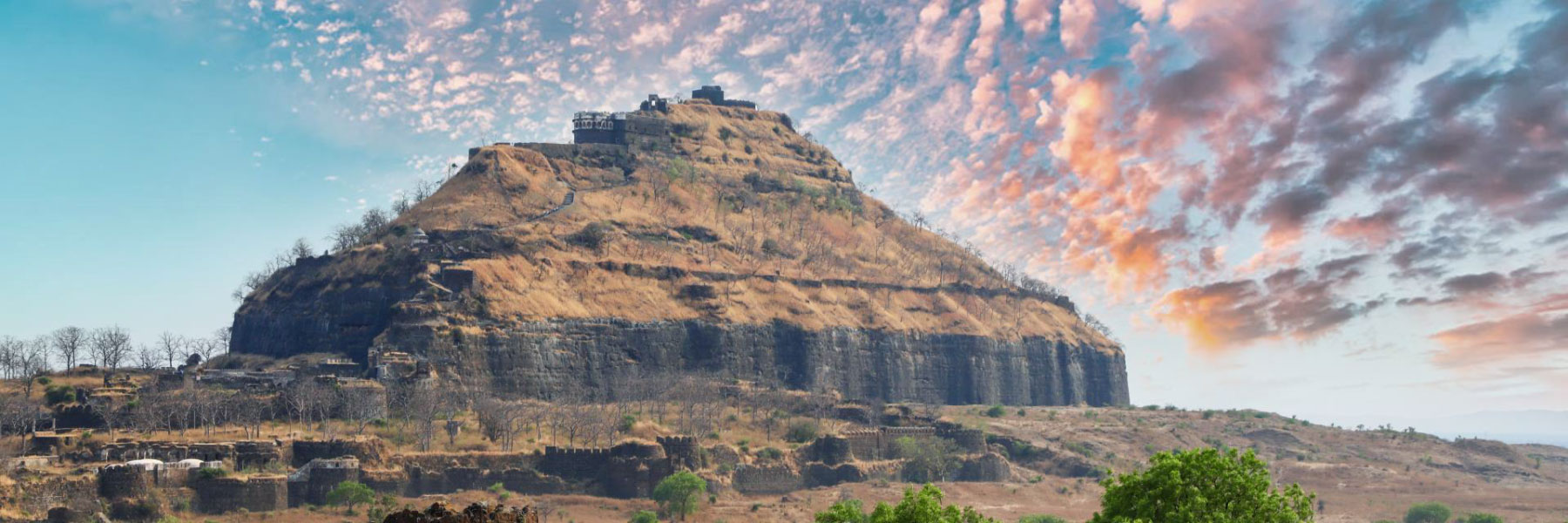
1. Daulatabad Fort

Daulatabad “The City of Fortune” also called as Devgiri. Daulatabad was built in 1187 by Yadava Dynasty. Later Muhammad Tughlak renamed it as “Daulatabad : the city of fortune”.
Just 15 km away from main city of Aurangabad, Daulatabad Fort is located. Often known as one of the “Seven Wonders of Maharashtra”, Daulatabad fort is the best example of powerful architecture. It’s built on a 200m high conical hill, surrounded by the greenery with architecture beauty and protection from enemies. The view after hiking about 700 odd steps up to the top is mesmerising, fascinating and irreplaceable. If you like trekking then you must visit Daulatabad Fort, reaching the top is the most challenging part for every trekker.
The one more reason to visit Daulatabad Fort is “Chand Minar” also called as Tower of the Moon located near the Fort.

Timing = 8am to 6pm

2. Bibi ka Maqbara

Bibi ka Maqbara (Tomb of Rabia) has similar architecture like “Taj Mahal”. A symbol of love and remembrance Bibi ka Maqbara is a beautiful place to visit in Aurangabad. Maqbara has a Charbagh styled garden and it sits pretty right in centre with the surrounding structure, having a water pool and 61 fountains. Located just 3km away from main city.

Timing = 8am to 8pm.

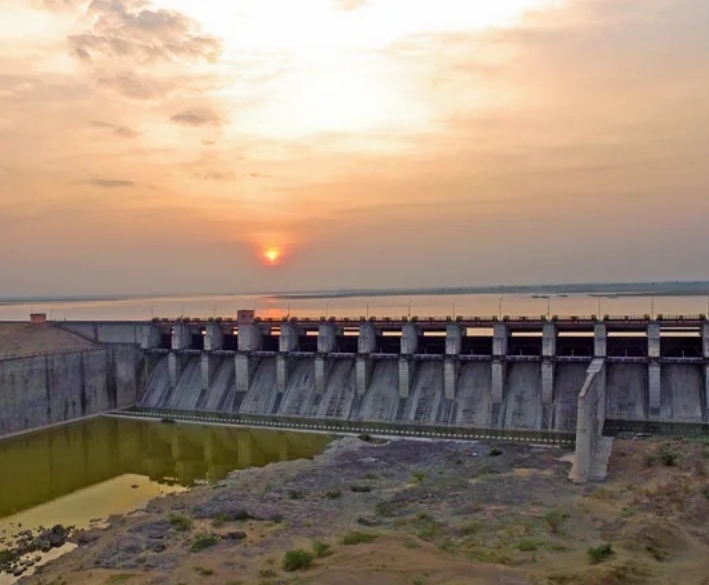
3. Jayakwadi Dam

The largest irrigation dam in Maharashtra and one of the largest earthen dams in Asia, the fascinating Jayakwadi dam is located on Godavari river at site of Jayakwadi village in Paithan taluka of Aurangabad. Watching the dam will make you feel like you are watching a real ocean with no end. Also visit the bird sanctuary near it and don’t forgot to buy famous “Paithani” for your lovely ladies from Paithan.

Timing = 10am to 6pm

4. Ajanta Caves

Located from just 107km away from Aurangabad, Ajanta caves is the most attractive place for foreign tourist’s. A group of around 32 Buddhist caves that are carved out of rocks, these caves date back to the 2nd century and is considered as the most brilliant form of ancient Indian art.
Since 1983, Ajanta caves has been declared a UNESCO World Heritage Site. On the walls of caves there are paintings which recounts the life of Lord Buddha. From the architecture, shape, and form of the caves, it is pretty sure that the ancient Buddhist monks used these caves for studying, living and worship purposes. The murals, paintings, and carvings on the wall reveal many unknown facts about the way of living, the cultures and tradition.

Timings: 8 AM to 5 PM

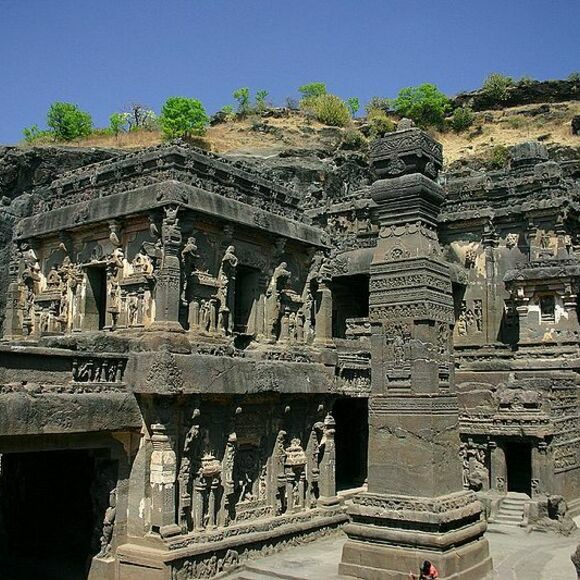
5. Ellora Caves

Another famous tourist place to visit near Aurangabad is Ellora caves, the another powerful example of Indian architecture. Located around 29 km from the city. This chain of caves were built by the Rashtrakuta dynasty of the Buddhist clan and Yadav group of the Jains.
A must visit UNESCO World Heritage site in Maharashtra, this series of caves also showcases the perfection and epitome of the pre historic times of the Indian culture.
There are all 34 caves of which, 12 are Buddhist, 17 Hindu and 5 Jain.

Timings: 6 AM to 6 PM

Benefits of a Handy tool you use in your daily life/routine….

                                                       DESCRIPTION OF A TOOL

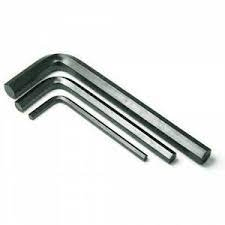
  • Allen key

In general/random terms we classify it as a kind of curved, made out of metal with their heads molded in a hexagonal shape on either side of the objects. Can be found in fixing/removing nuts and bolts that has a similar face of it like in hexagon shaped plugs/sockets that is popularly known as a Hex key these days.

It is a handy and friendly tool can be found in every toolbox as a primary one.

  • Various types on these keys

There are nearly 9 kinds of these tools where they are used in different fields for different purposes as they are comprised of:

  1. L-Style Allen Wrenches
  2. T-Handle
  3. P-Handle
  4. Folding Hex Key
  5. Ratcheting Drivers
  6. Torque Wrench
  7. Allen Screwdriver
  8. Ball Hex Sets and
  9. Key Ring Sets

Here these equipments are being utilized on general repairs, furniture for plumbing and electronics as well being a multi-purpose one for every necessary need of repairs to be made in a defective one.

  • Allen Screwdriver Specifications

The popular size of these tools for any motor or vehicle would be 5 and a half inches, 3/16 inches, one by fourth inch with the millimeters of 4,5,6 respectively. For large king of industrial or manufacturing repairs or assembling they prefer a size of 3 and a half inches, 7 and six inches, 1/8,9/64 and a 7/32 inches respectively.

If it is for case of any carving or joining furniture then it is up to the size/piece of the furniture made in with the mentality of the maker with some screw in mind.

  • Uses of the Screwdriver

It is a six-sided figure of tool that can only get inside hexagonal shaped screws. The random characteristic of the screwdriver is common to everyone as it is used only to screw out or in the bolds as per their mentality and quality of the bolts. These six heads tool help in preserving/saving a lot profit on the manufacture area.

They are commonly used to repair the motorbikes engine or the bicycle bolts fixed along with the wheels or handbar. They play a vital role under mechanical and manufacturing sectors to develop, repair or to disassemble any model, things or to remove spare parts for some other objects.

Helps in reaching out the difficult places where bolts are fixed which an ordinary tool can’t do. Those restricted places can be accessed only by these hex keys hence assuring no loss or damage of things while removing net/bolt. It is applied to many routine circumstances and applications in many personal as well as commercial places of industries.

  • Features of Screwdriver

Reach out easy to any end and remove parts of any mechanism without any hinderance, apply to any kind machines or things those have an exact shape as these tools. Try out various sizes if you find any one size unsuitable for certain places in fixing on bolts to rotate and remove them. The range of sizes are not found in all category of tools.

Mostly where customization happens more under machines and manufacture there you will find the tremendous use of every single Allen Key and the whole set uses separately for each minute and unique purpose comprised of them. Try using them in better ways that helps you sort out issues instant instead of dragging/prolonging it further.

Men in blue beats Spain 3-0,to progress into next round of Tokyo Olympics

Spain in their first match leveled 1-1 against defending champions Argentina. In their next match they lost 4-3 to New Zealand. They conceded 2 goals in the last quarter and eventually lost their lead and match too.

India on the other hand started their campaign with defeating New Zealand 3-2, vice-captain Harmanpreet singh scored 2 goals and Rupinder pal singh scored 1 goal. In their next match, India encountered the number 1 team Australia. Australia defeated India by a margin of 7-1 and it’s one of the worst defeat for the Indian Hockey team in Olympics.

Rupinder pal and simranjeet singh handed Spain a 3-0 defeat

Today morning in OI Hockey Stadium, India and Spain locked horns and India dominated throughout the game and handed Spain a 3-0 defeat.

Simranjeet Singh scored in 14th minute and Rupinder Pal Singh was hero of the match and he striked twice in 15th and 51st minute.

Spain side got many chances but they failed to convert them into goals. With this win India have inched closer to a quarterfinal berth. India have moved to the second spot in Pool A of the Tokyo Olympics. India will face Olympic champion Argentina on Thursday. Spain are yet to register their first win.

THEN CAME YOU

I have been thinking about this movie for the past several days since watching it which is probably the sign of a good movie.  It builds the emotional attachment you have to the characters until you start to truly feel what they are going through.  It also has a great message about living and life.  It's not your usual vapid teen romance comedy but is relatable to any age.  I fell in love with Skye's spirit and strength and  it was another great performance by Maisie Williams  who I believe will be one of our premier actresses in the future.   Asa Butterfield ... remember him from Enders Gsme... can't tell...the guy has some range.  Overall definitely a must watch for when you are looking to sit and chill instead of getting hyped up watching an action glick.

The Chernobyl Disaster

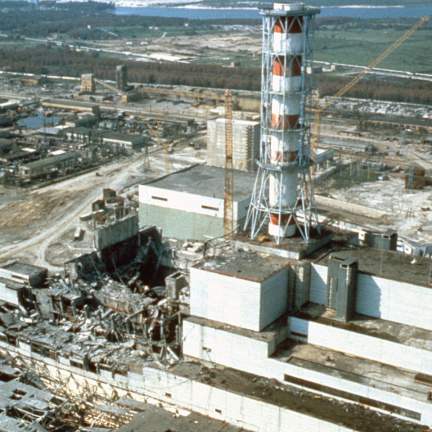
On April 25, 1986, the worst nuclear accident in history occurred in present day Ukraine as a reactor at a nuclear power plant exploded and burned. The disaster took place near the city of Chernobyl in the former USSR, which invested heavily in nuclear power after World War II.

The accident started during a safety test on an RBMK-type nuclear reactor. The test was a simulation of an electrical power outage to help create a safety procedure for maintaining reactor cooling water circulation until the back-up electrical generators could provide power. Three tests were conducted since 1982, but they had failed to provide a solution. On this fourth attempt, an unexpected 10-hour delay resulted in, unprepared operating shift of workers were on duty. During the planned decrease of reactor power in preparation for the electrical test, the power unexpectedly dropped to a near-zero level. The operators were able to only partially restore the specified test power, which put the reactor in an unstable condition. This risk was not made evident in the operating instructions, so the operators proceeded with the electrical test. Upon test completion, the operators triggered a reactor shutdown, but a combination of unstable conditions and reactor design flaws caused an uncontrolled nuclear chain reaction.

A large amount of energy was suddenly released, and two explosions ruptured the reactor core and destroyed the reactor building. One was a highly destructive steam explosion from the vaporizing super-heated cooling water and the other explosion could have been another steam explosion or a small nuclear explosion. This was immediately followed by an open-air reactor core fire that released considerable airborne radioactive contamination for about nine days that precipitated onto parts of the USSR and Western Europe, especially Belarus, 16 km away, where around 70% landed, before being finally contained on 4 May 1986. The fire gradually released about the same amount of contamination as the initial explosion. As a result of rising ambient radiation levels off-site, a 10-kilometre radius exclusion zone was created 36 hours after the accident. About 49,000 people were evacuated from the area, primarily from Pripyat. The exclusion zone was later increased to 30 kilometres when a further 68,000 people were evacuated from the wider area.

To reduce the spread of radioactive contamination from the wreckage and protect it from weathering, the protective Chernobyl Nuclear Power Plant sarcophagus was built by December 1986. It provided radiological protection for the crews of the undamaged reactors at the site, which continued operating.

The reactor explosion killed two of the reactor operating staff. A massive emergency operation to put out the fire, stabilize the reactor, and clean up the ejected nuclear core began. In the disaster and immediate response, 134 station staff and firemen were hospitalized with acute radiation syndrome due to absorbing high doses of ionizing radiation. Of these 134 people, 28 died in the days to months afterward and approximately 14 suspected radiation-induced cancer deaths followed within the next 10 years. More than 15 childhood thyroid cancer deaths were documented. Significant clean-up operations were taken in the exclusion zone to deal with local fallout, and the exclusion zone was made permanent. The World Health Organisation estimates 4000 people will eventually die as a result of the accident, from cancers and radiation poisoning.

It’s estimated that the amount of radioactive material was 400 times more than the atom bomb dropped on Hiroshima. Scientists estimate the zone around the former power plant will not be habitable for up to 20,000 years.

Human Excretory System

Metabolic activities continuously take place in living cells. All metabolic products produced by the biochemical reactions are not utilized by the body because certain nitrogenous toxic waste substances are also produced. They are called excretory products. In human beings urea is the major excretory product. The tissues and organs associated with the removal of waste products constitute the excretory system. The human excretory system consists of a pair of kidney, which produce the urine, a pair of ureters which conduct the urine is stored temporarily and urethra through which the urine is voided by bladder contractions. If the waste products are accumulated and not eliminated, they become harmful and poisonous to the body. Hence, excretion plays an important role in maintaining the homeostatic condition of the body. Some of the excretory organs other than kidneys are skin (removes small amounts of water, urea, and salts in the form of sweat) and lungs (eliminate carbon-dioxide and water vapour through exhaling).

Skin

Skin is the outer most covering of the body. It stretches all over the body in the form of a layer. It accounts for 15% of an adult’s human body weight. There are many structures and glands derived from the skin. It eliminates metabolic wastes through perspiration. The human body functions normally at a temperature of about 37°C. When it gets hot sweat glands start secreting sweat, which contains water with small amounts of other chemicals like ammonia,urea,lactic acid and salts(mainly sodium chloride). The sweat passes through the pores in the skin and gets evaporated.

Kidneys

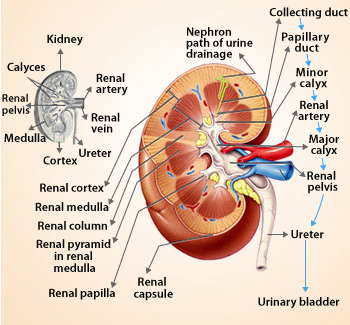
Kidneys are bean-shaped organs reddish brown in colour. The kidneys lie on either side of the vertebral column in the abdominal cavity attached to the dorsal body wall. The right kidney is placed lower than the left kidney as the liver takes up much space on the right side. Each kidney is about 11cm long, 5cm wide and 3cm thick. The kidney is covered by a layer of fibrous connective tissue,the renal capsules,adipose capsule and a fibrous membrane.
Internally the kidney consists of an outer dark region, the cortex and an inner lighter region, the medulla. Both of these regions contain uriniferous tubles or nephorns. The medulla consists of multitubular conical masses called the medullary pyramids or renal pyramids whose bases are adjacent to cortex. On the inner cancave side of each kidney, a notch called hilum is present through which blood vessels and nerves enter in and the urine leaves out.

Ureters: Ureters are thin muscular tubes emerging out from the hilum. Urine enters the ureter from the renal pelvis and is conducted along the Uretet by peristaltic movements of its walls. The ureters carry urine from kidney to urinary bladder.

Urinary bladder: Urinary bladder is a sac-like structure, which lies in the pelvic cavity of the abdomen. It stores urine temporarily.

Urethra: Urethra is a membranous tube, which contacts urine to the exterior. The urethral sphincters keep the urethra closed and opens only at the time of micturition(urination).

Longitudinal section of human kidney

Functions of kidney

  1. Maintains the fluid and electrolytes balance in our body.
  2. Regulates acid-base balance of blood.
  3. Maintains the osmotic pressure in blood and tissues.
  4. Helps to retain the important plasma constituents like glucose and amino acids.

Structure of Nephron

Each kidney consists of more than one million nephorns. Nephrons or uriniferous tubles are structural and functional units of the kidneys. Each nephron consists of Renal corpuscle or Malphigian corpuscle and Renal tubule. The renal corpuscle consists of a cup-shaped structure called Bowman’s capsule containing a bunch of capillaries called glomerulus. Blood enters the glomerulus capillaries through afferent arterioles and leaves out through efferent arterioles. The Bowman’s capsule continues as the renal tubule which consists of three regions proximal convoluted tubule, U – shaped hair pin loop, the loop of Henle and the distal convoluted tubule. The distal convoluted tubule opens into the collecting tubule. The nitrogenous wastes are drained into renal pelvis which leads to ureters and stored in the urinary bladder. Urine is expelled out through the urethra.

Mechanism of Urine Formation

The process of urine formation includes the following three stages.

  • Glomerular filtration
  • Tubular reabsorption
  • Tubular secretion

Glomerular filtration: Urine formation begins with the filtration of blood through epithelial walls of the glomerulus and Bowman’s capsule. The filtrate is called as the glomerular filtrate. Both essential and non-essential substances present in the blood are filtered.

Tubular reabsorption: The filtrate in the proximal tubule consists of essential substances such as glucose, amino acids, vitamins,sodium, potassium, bicarbonates and water that are reabsorbed into the blood by a process of selective reabsorption.

Tubular secretion: Substances such as H+ or K+ ions are secreted into the tubule. This tubular filtrate is finally known as urine, which is hyperbolic in man. Finally the urine passes into collecting ducts to the pelvis and through the ureter into the urinary bladder. When the urinary bladder is full the urine is expelled out through the urethra. This process is called micturition. A healthy person excretes one to two litres of urine per day.

Structure of Nephron

Dialysis or Artificial kidney: when kidneys lose their filtering efficiency, excessive amount of fluid and toxic waste accumulate in the body. This condition is known as kidney (renal) failure. For this, an artificial kidney is used to filter the blood of the patient. The patient is said to be put on dialysis and the process of purifying blood by an artificial kidney is called haemodialysis.when renal failure cannot be treated by drug or dialysis,the patients are advised for kidney transplantation.

Existing Unjust Laws for Women Across the Globe

No country in the world has succeeded in closing the gender gap. Its undeniably true that there’s never been a finer moment for women to be born because there are some sexist laws which are still prevailing. In this article we will know about the discriminatory laws against the women. 

  1. In India Wives can be raped by their husbands with no repercussions.

Starting with our very own country, non-consensual sex inside marriage is not considered a criminal offence or a kind of rape as long as the woman is over a particular age i.e 18 years old. Indian Government in a press release stated that due to various factors, such as levels of education/illiteracy, poverty, myriad social customs and values, religious beliefs, and the society’s mindset to treat marriage as a sacrament, the concept of marital rape, as understood internationally, cannot be appropriately applied in the Indian context.

2. Women may be slaughtered in the sake of “honor” in Jordan

There is no honor in murdering a spouse, daughter, sister, or niece for a supposed moral violation, yet far too many nations like Jordan continue to look the other way when killers use this as an excuse.Articles 340 and 98 of Jordan’s penal code allow judges to lower penalties in situations of murder committed in retaliation for adultery or in a fit of rage.

3. In Northern Nigeria, a man is permitted to strike his wife in order to “correct” her.

Intimate partner violence is legal as long as a husband can show that the beating is “for the purpose of correcting his wife” and does not cause “grievous physical harm.” Surprisingly, the same phrase defines “bodily damage” as injuries that need more than 21 days in the hospital. The Russian government just approved on a measure to decriminalize domes across the world. According to the new rule, first-time offenders would no longer face criminal penalties, while repeat offenders will be granted mercy if the abuse occurs “no more than once a year.”

4. Women in Saudi Arabia are still unable to get a passport without the consent of a man. 

Saudi Arabia may have been elected to the United Nations Women’s Council and recently reversed a prohibition on women driving, but it remains one of the least gender-equal countries in the world. Women in Saudi Arabia are still barred from getting a passport, marrying, or using some government services unless they get permission from a male guardian.

5.A lady may be imprisoned in Iran for disobeying the country’s stringent clothing code.

An instance can be highlighted on this issue when an Iranian lady was detained in 2016 after sharing a selfie of herself on Instagram without a hijab. The arrest drew increased attention to Iran’s stringent dress code, which mandates that women wear a hijab in public or face fines and up to a two-month prison sentence. In recent years, a website called My Stealthy Freedom has encouraged Iranian women to submit photographs of themselves with their heads uncovered in protest of the government’s policies.

Marriage Market Prevailed In Indian Society

The most prevailed system of financial transaction followed in India is marriage market which takes place during the time of marriage. Dowry which is offered by the bride’s side to her groom is like a ritual practice universally in Indian society. In the name of gifts and presents people mostly pressurize the bride mates to offer a bulk amount of dowry. These are not only gifts given with a happy heart but one who gives birth to a girl is bounded to follow such traditions in the name of rituals. One of the root causes of people getting disappointed during a birth of a girl child is the marriage market which is prevailed in our society. And because of this system girls are considered as a burden for the family and due to this reason people usually practice abortion so that they can avoid payment of dowry during their marriage.

This dowry provided during the time of marriage in India usually results as poverty for several households also relative weakness of formal financial markets. Apart from this the expenses of the wedding itself charges high cost and in addition to this dowry successfully plays a significant role in investment of the entire saving amount. According to the Indian Government, giving as well as asking for dowry is a social ill that is not meant to be practice by us. The government has also passed many laws and legislatures regarding it but it seems that all efforts have gone in vain. We live in a contemporary world were we believe in the scheme of modernism and equality and in this time practicing such ill works are not acceptable. It is found that if more females are employed and educated as well as given equal opportunities as men are provided than this rate of dowry may reduce and practice of such marriage market will also fall down. Marriage is something which is it too pure but we human beings have made this a kind of business. First thing which is mostly kept in the mind during the time of marriage is jati and dowry. Dowry were the essential part in every wedding and this was found during the time of 1975 but now if we look at the system it has developed a lot. If there is some negative side there is positive too. Now with the passage of time we all have developed a lot and our mind set has also changed. Today also dowry ritual is followed but in rare case people refuse to take dowry and as an alternative of it they want an educated girl and an employed one too.

Dowry tradition is something which is followed from generation to generation and will be followed too but with the passage of time this rate is decreasing and it is expected to decrease more. If each one of us will decide to boycott such custom and also boycott the one who supports such ill tradition than that day will not be much far when such dowry will end up and no girl will be burned or murdered inside the mother’s womb.

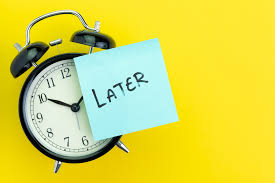
Procrastination!

“Amateurs sit and wait for inspiration, the rest of us just get up and go to work” — Stephen King.

We all are possessed with the mixture of both the good and bad kind of qualities. Procrastination is one such thing which is impregnated in all of us, while we tend to gain something from our daily experiences. It is the act of delaying an important task for the sake of trivial matters. It can restrict one’s potential and undermine one’s career. Some tend to avoid any important meetings, some delay their work schedule and these people cannot reach the higher levels in their life.

Re-scheduling the works would inhibit the growth of oneself. It would lead one to loose their opportunities, affects the outcomes of the accomplished task and would also spoil one’s name. It really takes one to move backward, rather being prudent and moving forward. If one meets a person at 11.00 clock, who is supposed to meet at 10.00; then how would the other trust him/her?he value of time is important to be acknowledged. Each and every second that one go through in a leisure manner, is the time whence, others would be achieving something in some corner. There is something that a person should always consider and, it is known as the other end. We may take privilege upon our tasks and time but the particular thing has its own time to be done; or the other person who is involved may have many other works to be finished and they really don’t waste their time for anyone’s sake.

“Time is a storm in which we all are lost”, said by William Carlos Williams. The value of time is important to be acknowledged. Each and every second that one go through in a leisure manner, is the time whence, others would be achieving something in some corner. There is something that a person should always consider and, it is known as the other end. We may take privilege upon our tasks and time but the particular thing has its own time to be done; or the other person who is involved may have many other works to be finished and they really don’t waste their time for anyone’s sake.

Some reasons for the procrastination of works are : perceiving that the work is hard, fear of getting adapted to a new thing, exhaustion, annoying or uninteresting tasks, fetching for easier tasks, raunchy and carelessness.

Here are few steps to avoid procrastination: The work that should be done today, should not be delayed for the next day. The harder or boring work should be given the first preference, so that it would be finished off. One should always have in their mind that being responsible in our work is linked with our growth and success.

Those who procrastinate their task would lose their happiness and growth. Successful people won’t delay their task as they really long to taste it.

Sunsets

The only reason I believe in happy endings

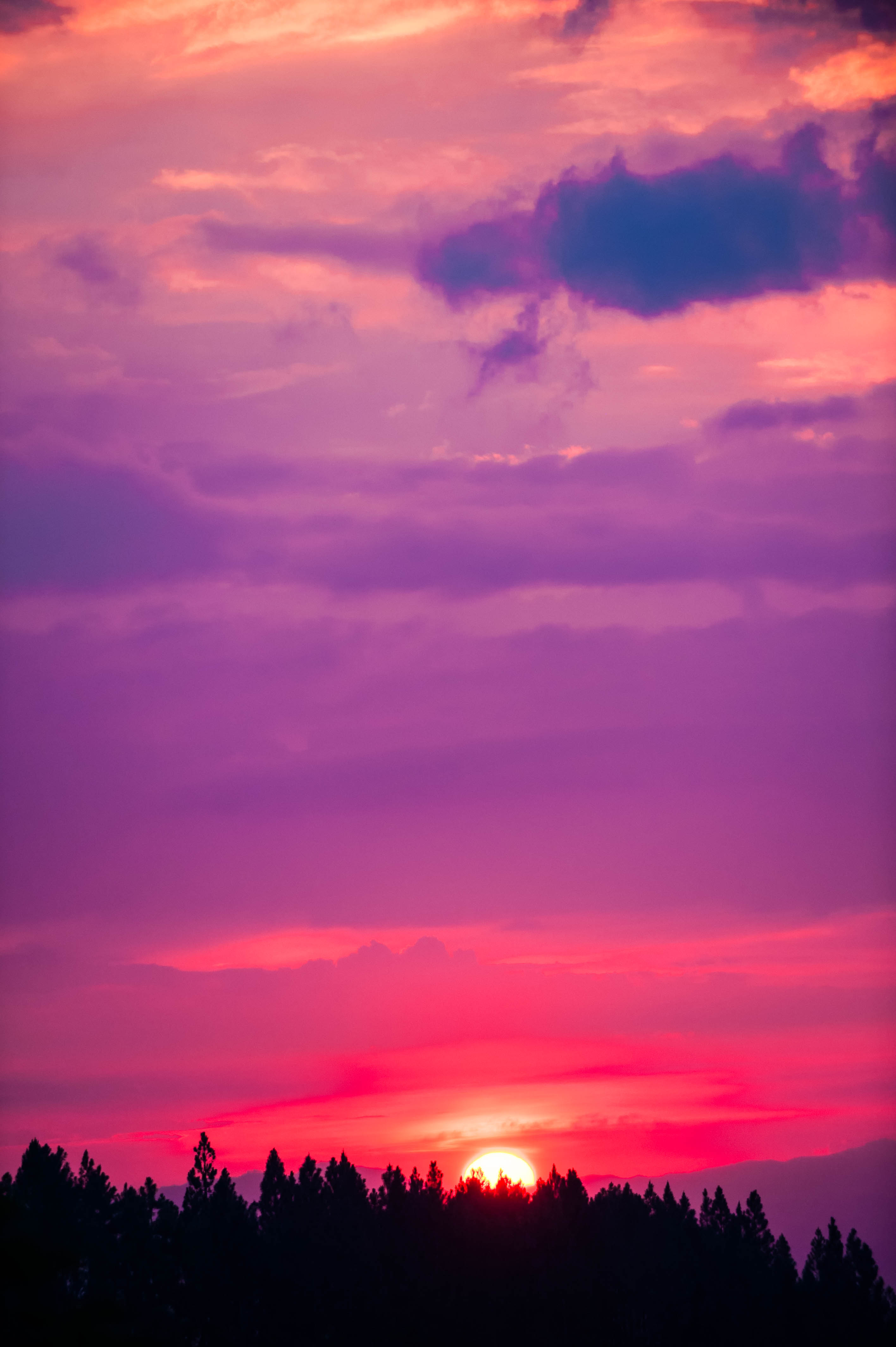
Like SRK said if the ending is not happy ending then, “Picture abhi baki hai mere dost”. When the sky is in it’s beautiful colours and the sun is going down, may be they are trying to say us that look, “the endings can be beautiful too”, may be they are giving us hope, hope for better and beautiful future, may be, they are trying to say us that, let go what happened today, just forgot what happened in the past by looking at this beautiful sunset skies and look forward to every sunrise, it’s your golden opportunity to “RESET”.

It’s the nature of life that things don’t stay the same but sunsets are the proof that, they can end beautifully, so don’t give up, just keep going no matter what happens the end gonna be beautiful. After entire day work just you, a cup of coffee and beautiful sunset with your favourite music will help you to forgot about all your worries and you’ll just want to live in that moment forever when the sky is in it’s beautiful colours. The world is fighting against the virus and we are too young to dealing with all this, so much has happened, so much is happening, at some point in our life we all feel depressed, sad and lonely, sometimes we just want to give up and it’s a life but, DON’T, comfort yourself by looking at these beautiful sunset skies.

Some people may sound like that, you need to do something special in life, and that’s not true. They will judge you at every point in your life but, don’t think, don’t put so much thoughts into what you’re doing and what others are saying or what others will say, you just have to keep going. Start doing things for yourself let them call you selfish sometimes it’s really okay to be selfish.

Also always remember, you are just a little bit doubtful of your potential and unsure of your worth but you are as amazing as these sunset skies.