
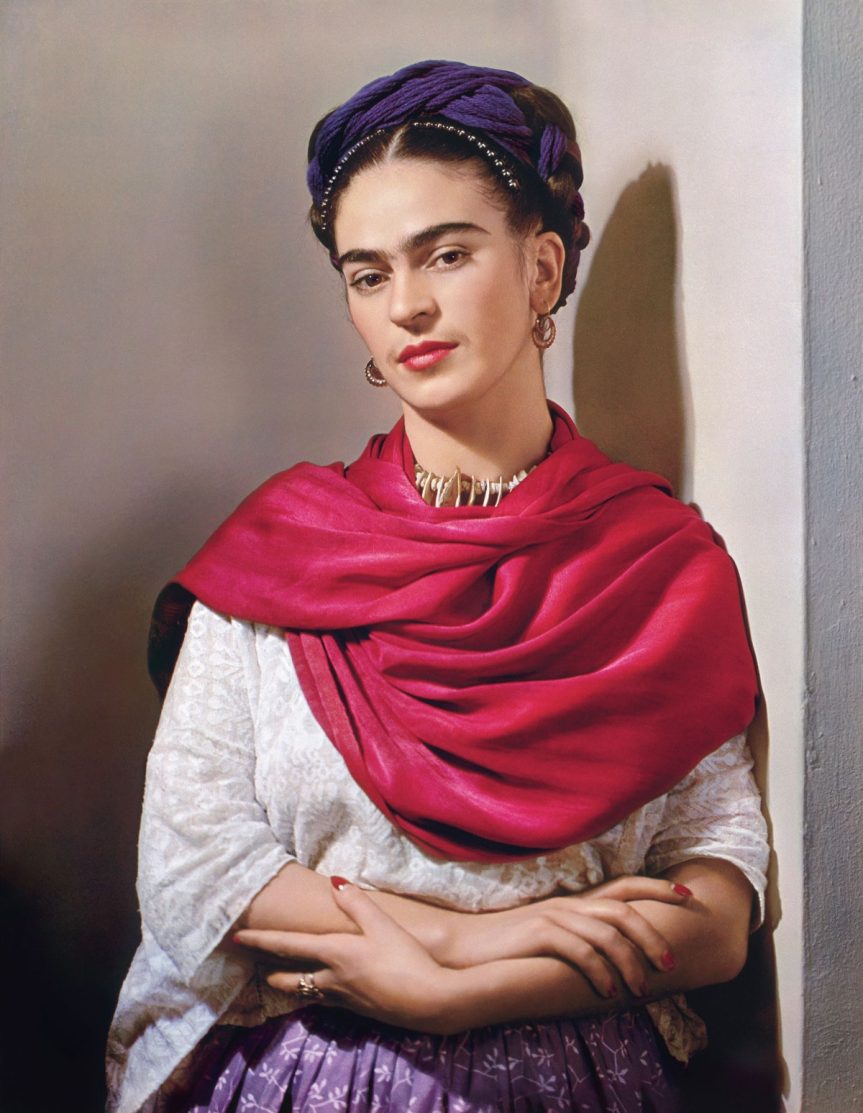
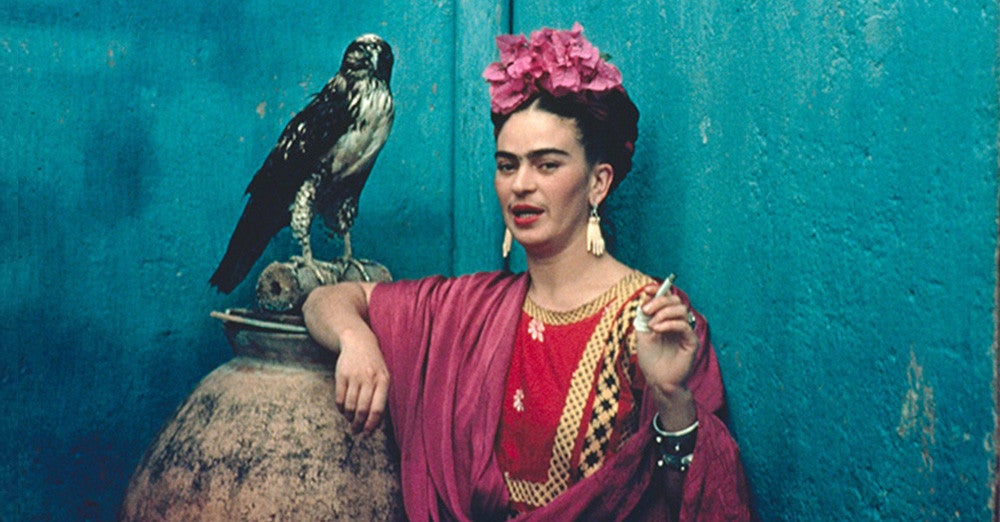
Frida Kahlo: Unconventional, Uncompromising and Unibrows

Frida Kahlo

Introduction

Even after years since Frida Kahlo’s demise, her charisma and powerful sense of style continue to captivate the world. The Mexican artist, famed for her self-portraits, is celebrated in her home country for her attention to indigenous culture, and by feminists worldwide for her depiction of the female experience and form. In fact, she was an advocate of feminism way before it became a staple in the social media age.
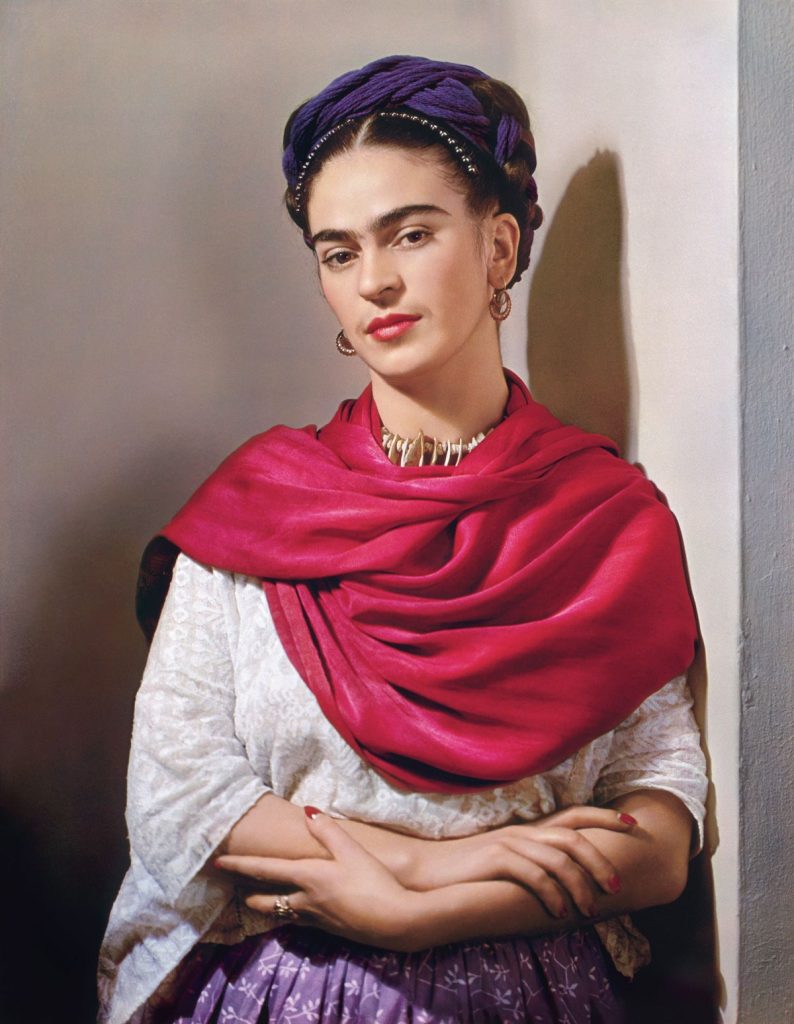
Frida

Early Life of Frida Kahlo

Magdalena Carmen Frida Kahlo y Calderón was born on 6 July 1907 in Coyoacán, a village on the outskirts of Mexico City. Born to a German father and a Mestiza  mother, Kahlo spent most of her childhood and adult life at La Casa Azul, her family home in Coyoacán  – now publicly accessible as the Frida Kahlo Museum. Although she was disabled by polio as a child, Kahlo had been a promising student headed for medical school until she suffered a bus accident at the age of 18, which caused her lifelong pain and medical problems. During her recovery, she returned to her childhood interest in art with the idea of becoming an artist.
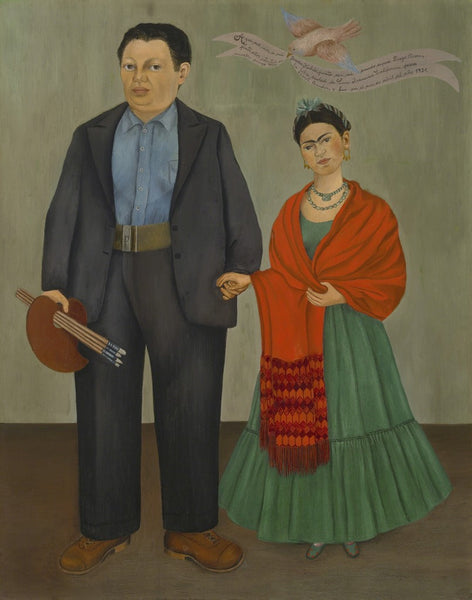
Diego and Frida, Self-Portrait With her Husband

Art Works of Frida Kahlo

Mexican artist Frida Kahlo is remembered for her self-portraits, pain and passion, and bold, vibrant colors. She is celebrated in Mexico for her attention to Mexican and indigenous culture and by feminists for her depiction of the female experience and form.

Life experience is a common theme in Kahlo’s approximately 200 paintings, sketches and drawings. Her physical and emotional pain are depicted starkly on canvases, because of her traumatic bus accident and multiple miscarriages depriving her of Motherhood and leading turbulent relationship with her husband, Mexican Mural artist Diego Rivera, who she married twice. Of her 143 paintings, 55 are self-portraits. She quoted, “I paint self-portraits because I am so often alone, because I am the person I know best.”

Kahlo’s first self-portrait was Self-Portrait in a velvet dress in 1926. It was painted in the style of 19th Century Mexican portrait painters who themselves were greatly influenced by the European Renaissance masters. She also sometimes drew from the Mexican painters in her use of a background of tied-back drapes. Self-Portrait Time Flies  (1929), Portrait of a Woman in White  (1930) and Self-Portrait  (1937) all bear this background.
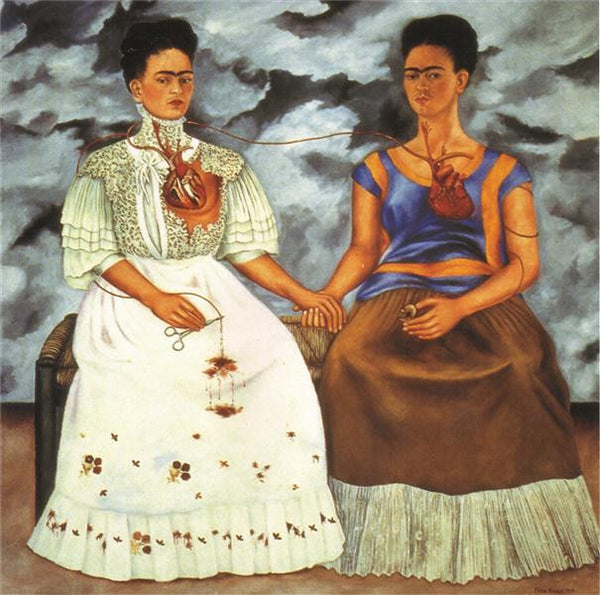
Two Fridas

Self-Portrait With cropped hair (1940), Kahlo is depicted in a man’s suit, holding a pair of scissors, with her fallen hair around the chair in which she sits. This represents the times she would cut the hair Rivera loved when he had affairs. The 1937 painting Memory, The Heart, shows Kahlo’s pain over her husband’s affair with her younger sister Christina. A large broken heart at her feet shows the intensity of Kahlo’s anguish. Frida Kahlo and Diego Rivera divorced in 1939, but reunited a year later and remarried. The Two Fridas  (1939) depicts Kahlo twice, shortly after the divorce. One Frida wears a costume from the Tehuana region of Mexico, representing the Frida that Diego loved. The other Frida wears a European dress as the woman who Diego betrayed and rejected. Later, she is back in Tehuana dress in Self-Portrait as a Tehuana  (1943). Pre-Columbian artifacts were common both in the Kahlo/Rivera home (Diego collected sculptures and idols, and Frida collected Jewelry) and in Kahlo’s paintings. She wore jewelry from this period in Self-Portrait Time Flies  (1926), Self-Portrait With Monkeys  (1938) and Self-Portrait With Braid  (1941), among others. Other Pre-Columbian artifacts are found in The Four Inhabitants of Mexico City  (1938), Girl With Death Mask  (1938).
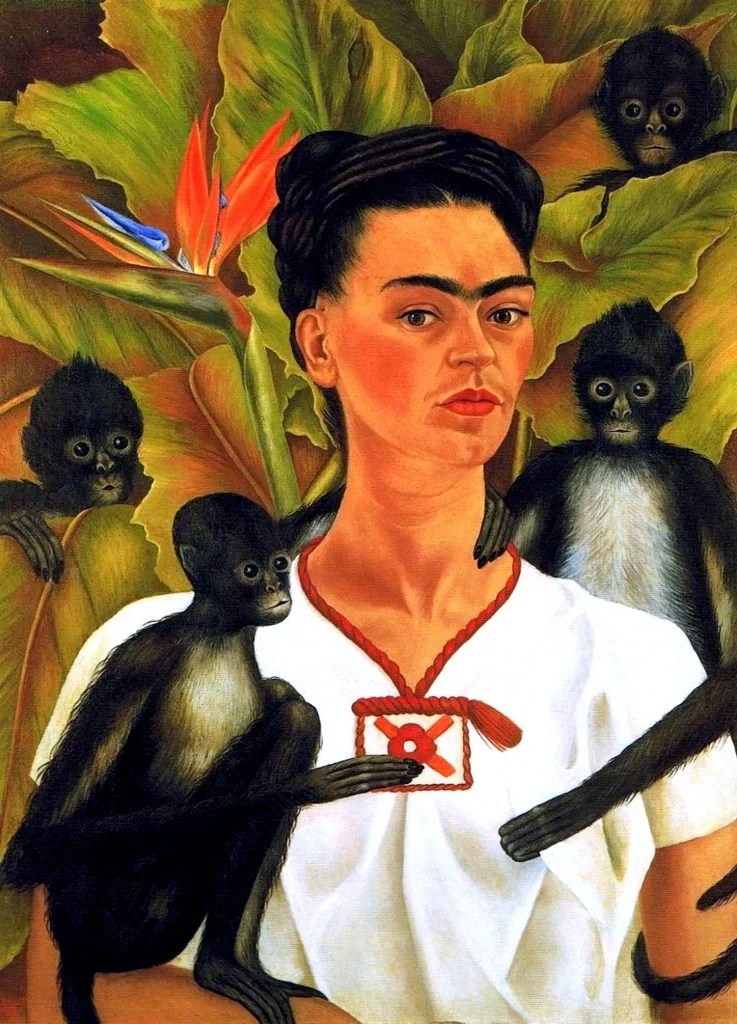
Frida‘s Self-Portrait With Monkeys

Analysis of Frida’s Artworks: Mexican Nationalism

Frida Kahlo was heavily influenced by the Mexicayotl movement, which sprung from the colonialist mindset that native Mexican culture is inferior and that Mexico should emulate Europe. The Mexicayotl movement aimed at protecting the indigenous culture and traditions among the Mexican people. In most of Kahlo’s self-portraits, she paints herself in traditional indigenous Mexican dress. She wears long, colourful skirts, huiplis (loose-fitting tunic), rebozos (shawls) and elaborate headdresses. Painting herself in the Tehuana dress was a chance for Kahlo to express her anti-colonialist ideas and pay homage to her indigenous ancestry.

Frida‘s Portrait of Deer with Human Face

Symbolism and Surrealism

After periods of depression and miscarriages in her life she gave herself to pets around her. She liked to use animals as models in her artworks. Her paintings are domesticated by monkeys, hummingbirds, dogs, and cats. One of her self-portraits depicts her with three spider monkeys. The animals became protective and tender symbols to Kahlo. On the contrary, Mexican Mythology suggests monkeys are symbols of lust. Frida’s significant self-portrait was Self- Portrait with Thorn Necklace and Hummingbird. According to some art historians, Kahlo wanted to show that she had been resurrected and had started a new life with this painting. As a symbol of this idea, the hummingbird was placed in her necklace. The hummingbird symbolizes hope and good luck in Mexican culture. However, the audience may notice the black cat – known as a symbol of bad luck – taking its place behind the right shoulder of Kahlo. Different interpretations say that the hummingbird pendant refers to Huitzilopochtli. It is the Aztec god of war and may refer to the pain Kahlo suffered all her life internally. Other important symbols of the painting were butterflies and the thorn necklace. Butterflies symbolize resurrection and it may refer to her rebirth in life after the accident. Furthermore, the thorn necklace she wears may be the symbol of Jesus’ crown of thorns, which he bore while being dragged to his crucifixion. In addition to these symbols, Kahlo created a painting that both uses Christianity and animal symbolism in one subject matter. Painting The Little Deer, 1946 made by Frida  depicts her as a deer with a human face. The artist portrayed herself in this painting. However, there is a much more important detail in this artwork – the deer wounded by the arrows reminds us of Andrea Mantegna’s depiction of Saint Sebastian from 1480. It may also be a reference to crucifixion and resurrection.
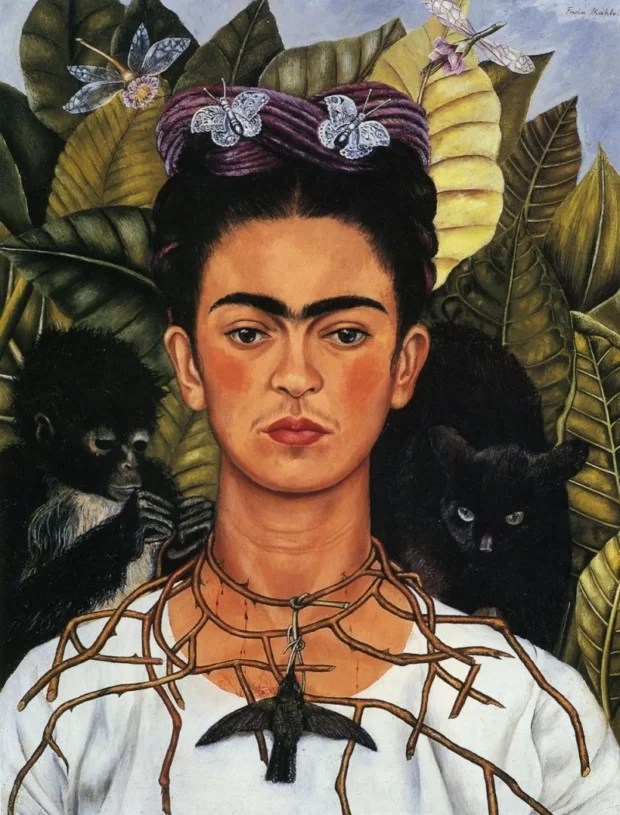
Frida‘s Self-Portrait With Thorn Necklace and Hummingbird

Conclusion

Women prior to Kahlo who had attempted to communicate the wildest and deepest of emotions were often labelled hysterical or condemned insane – while men were aligned with the ‘melancholy’ character type. By remaining artistically active under the weight of sadness, Kahlo revealed that women too can be melancholy rather than depressed, and that these terms should not be thought of as gendered.

About that Artist – Jan van Eyck

Jan Van Eyck was one of the earliest Netherlandish painters, most renowned for his religious and naturalistic oil paintings in the 1400s and is also believed to be the inventor of oil paintings. His work includes portraits, single panels, triptychs and polyptychs, most of them are speculated to be painted in the 1430s. He paid special attention to the religious subjects and realism. 

Even though the exact year and place of Jan van Eyck’s birth is unknown but is believed to be born in the 1390s in Maaseik, a territory that belonged to the Holy Roman Empire, a city now known as Belgium. He is classified under the Flemish painters (artists who were active during the 15th and 16th centuries in Flanders). He was working in Hague somewhere between the years 1422 and 1424. Van Eyck, was the official painter to John of Bavaria, Count of Holland and continued to to work in the palace of Hague until 1325, the year in which the Count died.

After the Count’s death, he began working for Philip the Good, duke of Burgundy and worked for the duke until his death. Under Philip the Good, he did not just work as a painter but was also given political and diplomatic tasks, for which Van Eyck travelled all around Europe.

He took a lot of trips around the continent on Philip the Good’s behalf working on projects that were kept a secret and was given a salary for the same and his income did not depend solely on commissions.

It is believed that Van Eyck came from a family of painters. His brother Hubert van Eyck and he collaborated on perhaps one of Jan’s famous works Ghent Altarpiece, a polyptych altarpiece in St Bavo’s Cathedral, Ghent, Belgium which is considered as one of the most profound oil paintings. It began in 1420 and was completed about 12 years later in 1432. 

In around 1431 Jan Van Eyck, bought a house in Burges and married a lady, Margaret with whom he had 2 children. The prime of his career began in the mid 1430s, a time during which he painted Madonna of Chancellor Rolin, Lucca Madonna and Virgin and Child with Canon van der Paele.

Madonna of Chancellor Rolin, in which Virgin Mary is being crowned by an angel while holding Jesus in her lap and presenting him to Rolin. This painting was kept in a church in  Notre-Dame-du-Chastel in Autun until a fire burnt the church down in 1793 and then later, it was moved to Musée du Louvre, Paris.

Lucca Madonna, an oil painting depicting Mary sitting on a throne with Jesus Christ sitting on her lap.

In July, 1441, Van Eyck passed away and was buried in the Church of St Donatian’s graveyard. After the artist’s death, his widow was paid Van Eyck’s annual salary by Philip as a sign of utmost respect towards the artist. His reputation continued to grow after his death and many of his unfinished works were completed after his death. His brother Lambert van Eyck conducted a workshop after his death as well. 

About 20 paintings are known to be made by him in the 21st century and all of them are still waiting for the mystery that encompasses them to unwind itself.

The genius of da Vinci 1

Leonardo da Vinci, a Renaissance man born in Italy in 1452, considered as one of the greatest painters the world has ever witnessed, was not just a painter but a man of great intellect. His scientific journals and studies way ahead of their time are to this date used by scientists to get a better understanding of them . In addition to being a painter, a sculptor, he was an anatomist and was well known in the field of engineering, architecture and astronomy as well. da Vinci was unmatched, the only artist who was able to get close to his art was the sculptor of the statue David Michelangelo. The fascinating thing is that he was able to do all this without being exposed to a speck of formal education or training in any field except in painting. He was taught how to read and do basic mathematics all the rest was his own creation.

Leonardo was a genius to say the least, he possessed curiosity ever so great. Maybe, this is what made him so great, his desire for knowledge.                                                                   

His scientific evaluations and anatomic studies are very much evident in his paintings. He used his scientific knowledge to better himself as an artist, and so he did.                                     

Here, we are going to take a look at a few of his paintings and some of his contributions in the milieu of science.

Leonardo da Vinci was born in a town in Vinci, Florence. His father was a Florence based legal notary and his mother belonged to a lower class. Not much is known about his family.

PAINTINGS

Leonardo is undoubtedly one of the greatest artists to have ever lived, but where did he start his artistic journey from?

Leonardo worked as an apprentice under Andrea del Verrocchio, an Italian painter, and sculptor of the 15th century. Leonardo first got introduced to Verrocchio at one of his workshops. He learned a plethora of skills by working for Verrocchio and later also collaborated with him for a painting called The Baptism of Christ around 1475.

Baptism of Christ was a collaborative effort of Andrea del Verrocchio and his student Leonardo da Vinci. This painting depicts Jesus being baptized (the Christian act of sprinkling water on someone, symbolizing purification), with two angels beside him, kneeling. The one performing Jesus’ baptism is John the Baptist, who can be seen with a golden cross and a halo over his head. The pair of hands shown above Jesus’ head is God’s representing approval and acceptance. A dove can also be seen above Jesus’ head as well, symbolizing the Holy Spirit.

Saint Jerome in the Wilderness Another unfinished yet wonderful piece by da Vinci portrays Saint Jerome, a Latin priest in the Christian Church, in the middle of the desert, kneeling, looking fixedly upwards with his arm extending outwards. A lion can be seen resting on the ground looking at the Saint. The lion’s presence can be accounted for by the fact that Saint Jerome helped a lion that entered the monastery where he stayed once, by removing a thorn from the lion’s paw.                                                                                                              

Leonardo used a method called tempera for this painting, which involves mixing of painting pigments with water-soluble emulsions, along with classic oil painting techniques.                                                                                     

This painting is currently present at the Vatican museum in Rome.

About that artist- Claude Monet

Claude Monet is considered as the initiator of impressionism along with Pierre-Auguste Renoir, Alfred Sisley, and Frédéric Bazille, who he met while studying under Charles Gleyre.

Early Life

Oscar Claude Monet was a French painter born in 1840 in France. Monet was the eldest kid in his family. He grew up around the coast, which plays a significant role in some of his works. In 1851, Monet got into  Le Havre secondary school of the arts. In his early years Monet started to show inclination towards art and would draw caricatures, which brought him initial success at the age of 15.

In 1858, he met Eugène Boudin through whom he was introduced to multiple techniques namely “en plein air” or painting in open air which he would go on to use in most of his paintings throughout his painting career .

Introduction to Art 

In 1858, Monet started studying in Paris where he was introduced to artists like  Charles Daubigny and Constant Troyon. Monet was called for military service under  Chasseurs d’Afrique

In Algeria. Every experience, every scene for an artist has the potential to serve as an inspiration for an artist and his time in Algeria did exactly that. The colors of Northern Africa were an inspiration for his later research. He was forced to return to Le Havre in 1862 due to illness. He met Johan Barthold Jongkind, who also played an important role and shaped his artistic perception along with Boudin.

In 1867 Monet had a child whom he named Jean with Camille Pissarro. 

A lot of his success comes from the work that he produced between 1865-75. One of those works include Le Déjeuner sur l’herbe which he finished in 1866 which shows a group of well dressed people enjoying a picnic. His paintings from this period portrayed very trivial, domestic scenes.

Some of his paintings from this period include The Beach at Sainte-Adresse(1867), The Woman in the Green Dress (1866), Portrait of Claude Monet, Carolus-Duran (1867).

In 1972, Monet came across Japanese paintings  which influenced his later paintings. Since then, his paintings revolved around nature. Monet is most known for his series of motifs that he started creating in the 1880s, these were impressionist paintings.

Later Years 

In 1883, Monet moved to Giverny with his family. Here he started working on a series of paintings mostly inspired by his surroundings. These paintings represented the River Thames, Charing Cross. During this time Monet frequently traveled to Lomdon and Venice. In 1893, Monet started to assemble a water lily garden and soon this garden became a subject of his later paintings. Most of his work in the 1900s remained unknown to a large population till the mid 20th century. In the later years of his life, his eyesight began to deteriorate despite that he did not stop painting, he painted almost all his life. In 1923, he went through a cataract surgery which improved his sense of sight a bit and went back to some of his older unfinished paintings. In 1926, Monet passed away. Hw spent most of his later years grieving for his friends who he had lost in World War I and perhaps this grief resulted in a series he called Weeping Willow which is regarded as one of his most beautiful series that he painted  

About that artist- Artemisia Gentileschi

Artemisia Gentileschi is regarded as one of the most illustrious artists of the 17th century. She made a name for herself during a time when women were not allowed to be a part of art and cultural activities. Her paintings were a symbol of women empowerment of the Baroque period and yet are not well known.

Early life

Artemisia was born in 1593 in Rome Italy, to Orazio Gentileschi, a renowned painter at the time. Her father recognized her talent from an early age and encouraged her to paint. Her father was a huge follower of the remarkable Baroque painter Caravaggio and her own paintings were highly inspired by Caravagio’s dramatic realism.  

Career

Gentileschi’s earliest known work is Sussana and the Elders, who at the time of painting this was only 17. The painting shows a young woman Sussane taking a bath in her garden and two men with ill intentions and a predatory look towering over the young women. Sussane who obviously seems very vulnerable at the moment and can not do much but just confute the two men with her actions which go to waste. This painting is inspired from a tale in the book of daniel. This tale portrays Sussana taking a bath in her garden as two elders start spying and harassing her sexually. 

In 1611, an Italian landscape painter Agostino Tassi who was working under Orazio, went into their house and raped Artemisia. Orazio was under the impression that Tassi would be marrying her daughter to save the Gentileschi name from embarrassment but when Tassi refused to do so Orazio took him to trial. This was really tragic for the 17 year old Gentilesci, according to her father and all the other men in power her virginity was stolen but for her it was a part of her that was stripped away. As if this wasn’t enough torture for her she was tortured with nails and screws at the trial to attest the authenticity of her testimony. Tassi was found guilty but did not serve any sentence owing to his relations with the pope.

A short while after the trial, her father married her off to a Florence based artist and moved to florence. This period of her life brought her tremendous success. She became the first woman to be accepted at the Academy of Design, Florence. This meant that she did not need permission from any man to buy art supplies, she could do it without any men controlling her.

In Florence, Gentileschi had developed her own style. She used tenebrism in her paintings which is a style of painting that uses light and dark contrasts and the dark becomes a dominating feature.

In 1620, she completed Judith Slaying Holofernes, which is inspired from a narrative in The Bible. Throughout the history of art many versions of this tale have been painted by multiple artists, even Caravaggio but Gentileschi’s  version is more real and violent. This work of hers can be compared with her own traumatic experience, where Holofernes can be compared to Tassi and Judith is Gentileschi.

Now it is not that she was the first female painter ever but all the female artists that came before her chose still lives or aesthetically pleasing subject matters. Gentileschi on the other hand, portrayed women that were a subject to male oppression like herself and were raw. Yet she is not very well known in the 21st century. Gentileschi’s work is empowering and a mark of early feminism and needs to be celebrated.

Leonardo Da Vinci’s Human Powered Helicopter Becomes Reality

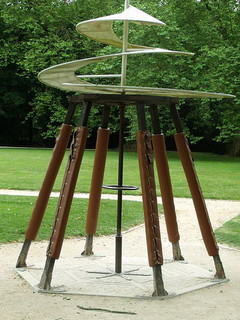
Leonardo Da Vinci's Aerial Screw

It would be hard to call Leonardo Da Vinci anything other than a man ahead of his time.  Between 1452 and 1519, Leonardo did just about everything. He is most famous today for his skills as a painter, where he painted some small works- like the Mona Lisa and The Last Supper. His sketches of man were the most anatomically correct to date (The Vitruvian Man). He was also a famed sculptor, musician, architect, anatomist, geologist, cartographer, botanist, writer mathematician, engineer and inventor. He conceptualized things far beyond his time, including concentrated solar power, a calculator, the double hull for ships, a tank and, most interesting to those of us in the aviation industry, a helicopter.

Over 420 years before the first helicopter was built, Leonardo Da Vinci sketched out what he called the Aerial Screw. This aerial screw was a man powered helicopter that required four men to spin cranks fast enough to generate enough lift to get off the ground.

Now, fast forward to 1980, 461 years after Leonardo passed away.  The American Helicopter Society sought to finally see the first human powered helicopter take flight. To win the prize money, which started at $10,000, the helicopter needed to reach at least 3 meters in the air (9.8 feet) for 60 seconds while being stable enough to have the center of the helicopter stay within a 10 x 10 meter box (32.8 x 32.8 feet). It would take 9 years from then before the first human powered helicopter even got off the ground when students at Cal Poly San Luis Obispo got their human powered helicopter 8 inches off the ground for all of 7.1 seconds. In the next 20 years, not much progress would be made so the Sikorsky Aircraft Corporation pledged additional prize money to try to see if that would inspire more innovation.

Sure enough, it did. Two teams, one from the University of Maryland and the other AeroVelo, were locked in a tight race to win. The university of Maryland got their man powered helicopter to fly for 65 seconds but it only reached 8 ft (about 1.8 feet short of where they needed to be) in August of 2012.

Finally, this July in Toronto, Aerovelo took the $250,000 in prize money with this flight:

While we don’t expect to see these Atlas human-powered helicopter’s flying around a city near you soon, this was a remarkable achievement. Congratulations to the Aerovelo team! And, over 480 years later, Leonardo Da Vinci’s vision of a human powered helicopter came to fruition.