

Since 2014 the Government of India has intensified its efforts to support the Panchayati Raj Institutions (PRIs) in the best manner possible to ensure that the basic objectives of the Panchayati Raj are achieved in true letter and spirit. The country has witnessed a quantum leap in the allocation of fiscal resources to Panchayati Raj Institutions to support various infrastructure requirements and developmental activities in rural areas. The Ministry of Panchayati Raj has been taking several initiatives for strengthening and empowering Panchayati Raj Institutions, increasing the capacity of representatives of PRIs to fulfill their roles and responsibilities and improving the efficiency, transparency of functioning and accountability of PRIs to contribute towards inclusive development, economic growth and achieving the Sustainable Development Goals (SDGs). The details of important activities carried out and progress made during the year 2023 are as follows:
1. SVAMITVA (Survey of Villages and Mapping with Improvised Technology in Village Areas)
1.1 SVAMITVA Scheme was launched by the Prime Minister on National Panchayati Raj Day, 24th April 2020 with a resolve to enable economic progress of Rural India by providing “Record of Rights” to every rural household owner. The scheme aims to demarcate inhabited (Abadi) land in rural areas through the latest surveying drone-technology, is a collaborative effort of the Ministry of Panchayati Raj, State Revenue Departments, State Panchayati Raj Departments and Survey of India. The scheme covers multifarious aspects viz. facilitating monetisation of properties and enabling bank loan; reducing property related disputes; comprehensive village level planning, assuring the rural local government a good source of revenue would be the stepping-stone towards achieving Gram Swaraj in true sense and making rural India Atmanirbhar. The duration of implementation of the scheme is 2020-21 to 2024-25.
1.2 Achievements under the Scheme during the year 2023
- As on December 2023, drone flying has been completed in 2.89 lakh villages.
- Drone flying has been saturated in Madhya Pradesh, Uttar Pradesh, Ladakh, Lakshadweep, Delhi and Dadra and Nagar Haveli and Daman and Diu.
- Scheme has been saturated in Haryana, Uttarakhand, Puducherry, Goa, Andaman, and Nicobar Islands.
- About 1.63 crore property cards have been prepared for 1.06 lakh villages.
- As per Memorandum of Understanding between Survey of India and States/UTs, the scheme coverage is as below:
1.3 Only pilot villages covered in Sikkim, Tamil Nadu and Telangana. The States where the scheme has not been implemented include Bihar, Jharkhand, Nagaland, Meghalaya, and West Bengal. Assam and Odisha – Only unmapped villages to be covered.
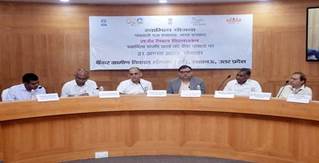
1.4.A Round Table discussion on the Bankability of SVAMITVA property cards was held at Bankers Institute of Rural Development (BIRD), Lucknow, Uttar Pradesh in August 2023.
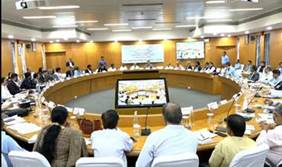
1.5 A training was held on 15 – 16th October 2023 at National Remote sensing Centre (ISRO) Training & Research Institute, Hyderabad, followed by the Geosmart India Conference on 17 – 19th October 2023 at HICC, Hyderabad with collaborative efforts of Ministry of Panchayati Raj and Geospatial World. The Agenda of the Conference focused on knowledge sharing, showcasing various technological interventions, impact assessment and possible solutions for land and property management.
1.6. Awards and Recognition

National Awards for e-Governance 2023: SVAMITVA Scheme won Gold Prize in use of Emerging Technology for providing citizen centric services organized by DARPG at Indore, Madhya Pradesh in October 2023.
SVAMITVA Scheme also conferred with Gold award for Innovative Use of Technology in e-Governance for Digital Transformation at Digitech Conclave 2023 organized at Goa in August 2023.
1.7. Endorsement by the Prime Minister
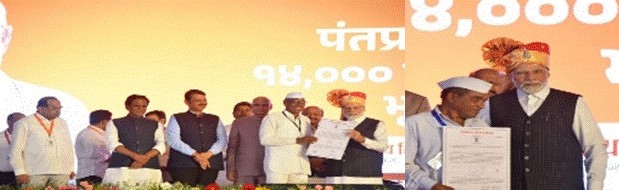
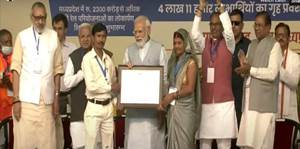
- Prime Minister distributed 35 lakh property cards prepared under SVAMITVA Scheme on the occasion of National Panchayati Raj Day on 24th April 2023 held at Rewa, Madhya Pradesh.
- Prime Minister highlighted the importance of the scheme during India Today conclave 2023

2. Capacity Building & Training (CB&T)
2.1 The Capacity Building and Training (CB&T) of Panchayati Raj Institutions (PRIs) has been one of the major activities of MoPR. The Ministry has been providing programmatic, technical and institutional support for strengthening of PRIs.
2.2 The Centrally Sponsored Scheme (CSS) of Rashtriya Gram Swaraj Abhiyan (RGSA) was implemented during 2018-19 to 2021-22. The scheme was revamped further for implementation during 2022-23 and 2025-26 at a total cost of Rs.5911 crore including Central Share of Rs.3700 crore and State share of Rs.2211 crore.
2.3 Achievements under the scheme of RGSA:
- During 2018-19 to 2021-22, 1.43 crore participants comprising elected representatives of the PRIs and their functionaries and other stakeholders of Panchayats, provided trainings.
- During 2022-23, 43,36,584 participants were trained.
- During the current year as on 28.12.2023, 17,96,410 participants have been trained.
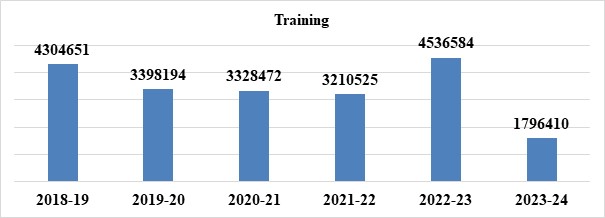
20th December, 2023 uploaded on Training Management portal
3. Localization of Sustainable Development Goals (LSDGs) through Panchayati Raj Institutions (PRIs):
3.1 Ministry has adopted 9 thematic approach for LSDGs leveraging wide network of third tier of Government including Traditional Bodies of non-part IX areas. The goals on these themes to be attained by 2030 in graduated manner by embracing following approach:
- Convergence of all flagship developmental and welfare programmes at Panchayat level,
- Saturation of various activities in all villages in phased manner.
- Usage of digital technology for ensuring transparency and accountability of all concerned.
3.2 Progress on Localization of SDGs:
- Status of uploading thematic Gram Panchayat Development Plan (GPDP), Block Panchayat Development Plan (BPDP) and District Panchayat Development Plan (DPDP) for FY 2023-24:
|
GPDP uploaded on portal |
BPDP uploaded on portal |
DPDP uploaded on portal |
|
250449 (93.06% of GP) |
5705 (84.47% of BP) |
492 (72.46 of DP) |
Source: eGramSwaraj portal as on 20th December, 2023.
- People’s Plan Campaign (PPC)–2023: PPC–2023 was rolled out as ‘Sabki Yojana Sabka Vikas’ from 4th September, 2023 as a strategy for preparation of participatory GPDP in campaign mode with voluntary involvement of community, elected representatives, frontline workers, SHGs, and other stakeholders for preparing the thematic GPDP for the next financial year i.e. 2024-25.
- Project Driven District and Block Panchayat Development Plan:
- The report on formulation of project driven Block and District Panchayat Development Plan released in the workshop held during 4th – 5th September, 2023.
- Based on the recommendations of the report the States /UTs have been advised to prepare project driven Block and District Panchayat Development Plans.
- Thematic National Workshop: Around 1400 Participants from Central Ministries, 30 States (including ERs, Functionaries), UNICEF, UN women and other NGOs attended three-day national workshop on Theme 3-Child Friendly Village and Theme 9-Women Friendly Village of LSDGs held in Odisha during 17 – 19 February, 2023.
- Two-days National workshop on Quality/ISO Certification:
- Around 100 participants from 25 States / UTs attended two-days national workshop on Quality/ISO Certification held in Kerala Institute of Local Administration (KILA), Kerala during 6th to 7th July, 2023 on “ISO Certification of Panchayats”.
- The follow up on the same has resulted in efforts for quality/ISO certification of Panchayats in various States. With standardized procedures of services, it is expected to improve the quality of service delivery at Panchayat level.
- Three-day National Workshop on Theme 8-Panchayat with Good Governance of LSDGs held in Srinagar, Jammu &Kashmir during 21 – 23 August 2023. During the workshop following were released:
-
- Meri Panchayat App
- Operating Guidelines of National Capacity Building Framework 2022.
- Service Level Benchmark, Self -assessments and Model Contract prepared by the MoPR in coloration with the UNICEF.
-
- Panchayat Development Index (PDI):
To measure the progress on LSDGs and to carry out assessment to prepare evidence-based policy, MoPR constituted a Committee to prepare mechanisms for computation of PDI.
- The report was released by Minister of State for Panchayati Raj in a National Workshop held in Delhi on 28th June, 2023. Report of the Committee can be accessed on the Ministry’s Website at the URL: https://panchayat.gov.in/pdi-committee-report-2023/.
- The Committee has laid a framework for computation of PDI, which will be useful tool for Union Ministries/Departments as well as the State Governments and PRIs to assess the outcome of their schemes and plan future developments based on evidence.
- Two-Day National Write-Shop has been organized on PDI Portal for preparation of Baseline Report and computation of PDI in Delhi during 10-11 August, 2023.
- A portal (www.pdi.gov.in) for preparation of PDI has been developed. Around 140 data points received from UDISE+, JJM, SBM, NSAP, PMAY, MGNREGS, Mission Antyodya and eGramSwaraj have been ported in PDI portal, rest will be entered by the Gram Panchayats and Line Departments at GP level.
- Workshops have been held in most of the States to orient the concerned Line Departments and Panchayat officials on the mechanism of data collection and validation for the purpose of preparation of PDI.
- The thematic scores of Gram Panchayat across nine themes as well as the composite PDI score based on thematic score will be used for incentivization of Panchayats.
4. Institutional mechanism for strengthening PRIs
- School of Excellence of Panchayati Raj (SoEPR) has been setup in NIRD&PR for strengthening of PRIs. It will strengthen the SIRD&PRs as well as support the research on the subjects of Panchayati Raj at the National Level.
- Meri Panchayat Application has been launched in August 2023 to facilitate easy access of the information to public about functioning of panchayats to enhance transparency and accountability. The downloading of the said application has crossed 13 lakh.
- The assessment module for the trainings has been made functional in the Training Management Portal (TMP). It will facilitate the assessment of learning outcomes of the participants of trainings.
5. Incentivisation of Panchayats
5.1 Ministry of Panchayati Raj (MoPR) confers the National Panchayat Awards annually to best performing Panchayats across the country which are a strong source of motivation for them to further improve upon their efforts in development at local level. These awards are usually conferred annually on 24thApril, celebrated as National Panchayati Raj Day.
5.2 MoPR has subsumed 17 SDGs into 9 Localization of SDGs (LSDGs) themes. Accordingly, National Panchayat Awards have been revamped aligning with the LSDGs with effect from the year 2023. The NPA are conferred under the 9 LSDGs based themes namely, (i) Poverty free and enhanced livelihoods Panchayat (ii) Healthy Panchayat (iii) Child friendly Panchayat (iv) Water sufficient Panchayat (v) Clean and Green Panchayat (vi) Self-sufficient infrastructure in Panchayat (vii) Socially Secured Panchayat (viii) Panchayat with Good Governance and (ix) Women-friendly Panchayat
5.3 In addition to 9 themes, Ministry of Panchayati Raj also conferred special categories of awards to best performing Gram Panchayats (GPs) i.e. (1) Gram Urja Swaraj Vishesh Panchayat Puraskar for their performance regarding adoption and usage of renewable sources of energy and (2) Carbon Neutral Vishesh Panchayat Puraskar for exemplary work towards achieving Net-Zero carbon emissions.
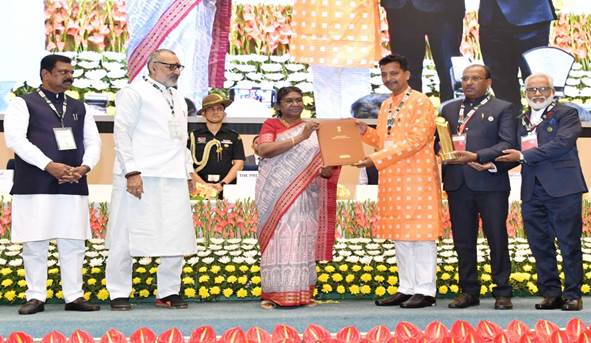
5.4 A total 42 Panchayats were awarded in the year 2023 based on their performance.
6. Celebrations of National Panchayat Awards Week (17th – 21st April, 2023)
6.1 The President of India, Smt. Droupadi Murmu inaugurated the National Panchayat Awards Week Celebrations and presented the National Panchayat Awards–2023 to the best performing Panchayats at the National Conference on Incentivization of Panchayats at Vigyan Bhavan, New Delhi on 17th April, 2023.
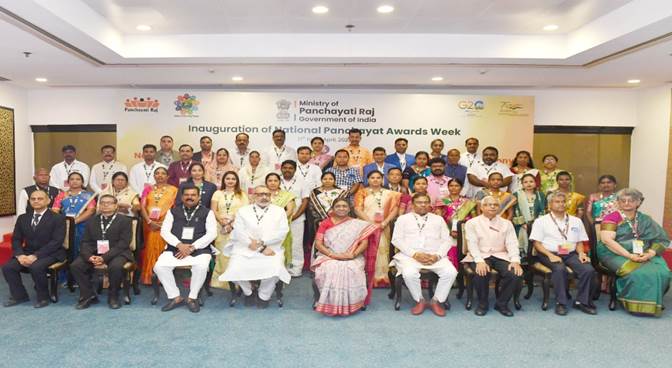
6.2 On this occasion, Union Minister of Panchayati Raj Shri Giriraj Singh launched the GS NIRNAY, National Initiative for Rural India to Navigate, InnovAte and Resolve PanchaYat decisions, a mobile application of the Ministry of Panchayati Raj aimed at empowering rural communities.
7. Commemoration of National Panchayati Raj Day – 24th April, 2023
7.1 Prime Minister participated in the celebration of this year’s National Panchayati Raj Day and addressed all the Gram Sabhas and Panchayati Raj
Institutions across the country. Prime Minister addressed a large public gathering including Panchayat representatives on the occasion of the National Panchayati Raj Day on 24th April, 2023 in Rewa, Madhya Pradesh.
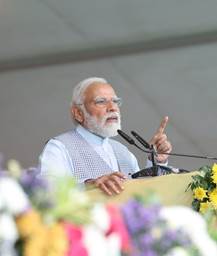
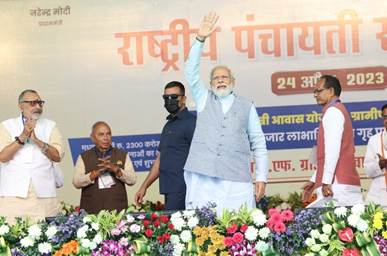
7.2 This year’s celebration of National Panchayati Raj Day at Rewa in Madhya Pradesh witnessed participation of more than one lakh participants, including representatives of Panchayati Raj Institutions, other stakeholders and local residents / rural masses from the District of Rewa and other neighboring Districts.
7.3 Addressing the gathering on the occasion of National Panchayati Raj Day, Prime Minister noted the virtual presence of more than 30 lakh Panchayat representatives from all over the country and said that it presents a bold picture of Indian democracy.
7.4 During the event, Prime Minister inaugurated an integrated eGramSwaraj and GeM portal for public procurement at Panchayat level. The objective of eGramSwaraj – Government eMarketplace integration is to enable the Panchayats to procure their goods and services through GeM, leveraging the eGramSwaraj platform.
7.5 Prime Minister also handed over around 35 lakh SVAMITVA Property Cards to beneficiaries. Post this programme, around 1.25 crore property cards were distributed under SVAMITVA Scheme in the country, including those distributed in Madhya Pradesh.
8. e-Gram Swaraj e-Financial Management System
8.1 eGramSwaraj, a Simplified Work Based Accounting Application for Panchayati Raj assists in enhancing the credibility of Panchayat through inducing greater devolution of funds to PRIs. Some of the salient features existing in eGramSwaraj Application are:
- Workflow Enabled
- Assets available on Gram Manchitra GIS
- Supports multi-tenancy; multiple tenants in the same instance and
- Strong Authentication Mechanism based on open-source technologies
- eGS-PFMS integration – Automation of accounting done by the Panchayats under XV Finance Commission grants.
8.2 New feature launched this year (2023)
eGS-GeM interface – Facilitates the Panchayats in procurement of items/services through GeM at standardized rates and seamless payment through eGS-PFMS interface, thus establishing a transparent procurement system.
8.3 Current progress of the adoption of e-GramSwaraj (including eGramSwaraj-PFMS &eGS-GeM Interface):
|
Action Point |
Status |
|
Panchayat Planning |
2.5 lakh Gram Panchayats have uploaded approved GPDP, more than 5 thousand Block Panchayats have uploaded approved BPDP and 492 DPDP have been uploaded by the District Panchayats. |
|
Physical Progress |
1.03 lakhs GPs have reported physical progress of activities under GPDP |
|
LGD code compliant |
100% GPs (including TLBs) in States receiving CFC Grants are LGD compliant. |
|
eGramSwaraj – PFMS integration |
2.52 Lakh GPs have been ported from PFMS to eGramSwaraj. 2.55 Lakh Gram Panchayats have onboarded eGramSwaraj PFMS for 2023-24 2.36 Lakh GPs have commenced online payments in 2023–2024. Nearly Rs.25,880 crores worth payments have been successfully transferred by the Panchayats to their respective beneficiaries/vendors. |
|
Account closure for 2021-22 |
For 2021-22, 94% of Gram Panchayats have closed their year books. |
|
Account Closure for 2022-23 |
For year 2022-23, 92% of Gram Panchayats have closed month books. |
|
Registration on eGramSwaraj – GeM Interface |
More than 72,000 Panchayats across 22 States have registered themselves on this interface (as of December 2023). |
-
- Integration of Beneficiary details with eGramSwaraj:
As of December 2023, beneficiary details of sixteen scheme of six Union Ministries/ Departments are integrated with eGramSwaraj Application as mentioned below.
|
Ministry/Department |
Scheme |
|
Ministry of Rural Development |
PM Awas Yojana-Gramin (PMAY-G) |
|
Indira Gandhi National Old Age Pension Scheme (IGNOAPS) |
|
|
Indira Gandhi National Widow Pension Scheme (IGNWPS) |
|
|
Indira Gandhi National Disability Pension Scheme (IGNDPS) |
|
|
Indira Gandhi National Family Benefit Scheme (IGNFBS) |
|
|
Mahatma Gandhi National Rural Employment Guarantee Act (MGNREGA) |
|
|
National Family Benefit Scheme (NFBS) |
|
|
National Rural Livelihood Mission (NRLM) |
|
|
Department of Animal Husbandry and Dairying |
National Artificial Insemination Programme Project (NAIP) |
|
National Animal Disease Control Programme (NADCP I & II) |
|
|
Ministry of Agriculture and Farmers’ Welfare |
Pradhan Mantri KISAN Samman Nidhi (PMKSN) |
|
Pradhan Mantri Krishi Sinchayee Yojana |
|
|
Ministry of Education |
Samagra Shiksha |
|
Department of Drinking Water and Sanitation |
Swachh Bharat Mission (Gramin) |
|
Jal Jeevan Mission (Gramin) |
|
|
Ministry of Petroleum & Natural Gas |
Pradhan Mantri Ujjwala Yojana |
9. Geo-tagging of assets:
Ministry of Panchayati Raj has developed “mActionSoft” – a mobile based solution to help in capturing photos with Geo-Tags (i.e. GPS Coordinates) for the works which have asset as an output. Geo-tagging of the assets is done in all three stages viz. (i) before start of the work, (ii) during the work and (iii) on completion of work. As of December 2023, 2.5 lakh photographs of the assets have been uploaded by the Gram Panchayats for the activities taken under Fifteen Finance Commission in the current year.
10. Citizen Charter
As of December 2023, 215628 Gram Panchayats approved and uploaded their Citizen Charters promising to deliver 954 services to their people of which 261 are offered on online.
11. Audit Online
As a part of the critical institutional reform, XV FC has stipulated that the audited reports of Panchayat accounts need to be made available in the public domain, as an eligibility criterion. “Audit Online” application facilitates carrying out online audit of Panchayat accounts pertaining to Central Finance Commission Grants.
|
Activity |
2019-20 |
2020-21 |
2021-22 |
2022-23 |
|
No. of Auditors enlisted |
10,269 |
10,269 |
10,269 |
10,268 |
|
No. of Auditees enlisted |
2,59,758 |
2,60,603 |
2,59,920 |
2,59,812 |
|
No. of GPs – Audit plans prepared |
1,44,613 |
2,40,988 |
2,48,257 |
1,77,883 |
|
No. of Audit observations recorded |
12,58,266 |
21,90,446 |
23,83,415 |
5,25,737 |
|
No. of Audit reports generated |
1,30,222 |
2,18,086 |
2,40,515 |
51,815 |
12. Central Finance Commission Grants to Rural Local Bodies
12.1 The Fifteenth Finance Commission (XV FC) submitted its interim report for the financial year 2020-21 and the final report for the period 2021-26. The XV FC Grant-in-aid is allocated to all tiers of the Panchayati Raj including the Traditional Bodies of Non Part IX States and Fifth and Sixth Schedule areas in two parts, namely, (i) Basic (Untied) Grant (50 % for 2020-21 and 40 % for 2021-22 to 2025-26) and (ii) Tied Grants. (50 % for 2020-21 and 60 % for 2021-22 to 2025-26).
12.2 The total size of the XV FC Grant to the Rural Local Bodies is Rs.60,750 Crore for the period FY 2020-21 and Rs.2,36,805 crores for the period 2021-22 to 2025-26. Rs.15,319 Crore in respect of the current Financial year 2023-24 have been released thus resulting into cumulative release so far of, Rs.1,63,850 Crores out of total allocation of Rs.2,97,555 Crores, i.e. 55.07 %. These grants are released to the States for development works in the Rural Local Bodies.
13. Gram Urja Swaraj Abhiyaan
13.1 The Ministry of Panchayati Raj has collaborated with the Ministry of New and Renewable Energy to include the Gram Panchayats under all its schemes focusing on adoption of renewable energy. This will enable that in the upcoming years, Gram Panchayats would evolve as self-sufficient in terms of energy and become producers of energy instead of only being consumers. Moreover, widespread adoption of renewable energy applications in rural areas would enable the Gram Panchayats to develop Own Sources of Revenue (OSR) and employment opportunities for local youth of the villages.
13.2 Under the Gram Urja Swaraj Abhiyaan, GPs have developed their own implementation models with the support of Renewable energy development Agencies of the states. For example, Odanthurai Panchayat in Tamil Nadu has its own windmill, Thikekarwadi Gram Panchayat in Maharashtra has established Biogas plant in PPP mode and Meenvallam, Project of Palakkad district Panchayat in Kerala is the first initiative of a Panchayat under micro hydel. Many panchayats have taken up solar energy models such as solar roof top models, solar kitchens, solar street lighting and solar high mast light owned by the panchayats.
13.3 Under the Gram Urja Swaraj Abhiyaan, as on date, 2,080 Gram Panchayats have taken up and implemented Renewable Energy Projects. Close to 2020 Gram Panchayats have solar energy systems that are installed and are fully functional. Around 60 – 70 Gram Panchayats have hydel Energy systems and Wind Energy Systems that are installed and there are 106 GP’s with existing Biogas Energy Systems.
***



 Eduindex