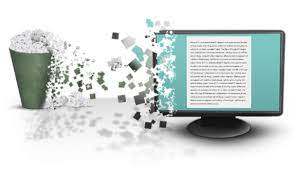
A paperless office or paper-free office is a work environment in which the use of paper is eliminated or greatly reduced. This is done by converting documents and other papers into digital form, a process known as digitization. Proponents claim that “going paperless” can save money, boost productivity, save space, make documentation and information sharing easier, keep personal information more secure, and help the environment. The concept can be extended to communications outside the office as well.
Environmental impact of paper
Some believe that paper product manufacturing contributes significantly to deforestation and man made climate change, and produces greenhouse gas. Others argue that paper product manufacturing, especially in North America, supports the ecological and economic balance of sustainable forestry. According to the 2018 American forest assosiation Sustainability Report, paper manufacturing decreased greenhouse gas emission by 20% in an eleven-year period.Measures such as recycling can help reduce the environmental impact of paper. Some paper production outside of North America may lead to air pollution with the release of nitrogen oxide (NO2), sulfur oxide (SO2), and carbon dioxide(CO2). Waste water discharged from pulp and paper mills outside of North America may contain solids, nutrients, and dissolved organic matter that are classified as pollutants. Nutrients such as nitrogen and phosphorus can cause or exacerbate eutrophicatiob of fresh water bodies.
Printing inks and toners are very expensive and use environment-damaging volatile organic compounds, heavy metals and non-renewable oils, although standards for the amount of heavy metals in ink have been set by some regulatory bodies. Deinking recycled paper pulp results in a waste slurry, sometimes weighing 22% of the weight of the recycled wastepaper, which may go to landfills.
Eliminating paper via automation and electronic forms automation
The need for paper is eliminated by using online systems, such as replacing index cards and rolodexes with databases, typed letters and faxes with email, and reference books with the internet.[Another way to eliminate paper is to automate paper-based processes that rely on forms, applications and surveys to capture and share data. This method is referred to as “electronic forms” or e-forms and is typically accomplished by using existing print-perfect documents in electronic format to allow for prefilling of existing data, capturing data manually entered online by end-users, providing secure methods to submit form data to processing systems, and digitally signing the electronic documents without printing.
The technologies that may be used with electronic forms automation include –
- Portable Document Format (PDF) – to create, display and interact with electronic documents and forms
- E-form (electronic form) management software – to create, integrate and route forms and form data with processing systems
- Databases – to capture data for prefilling and processing documents
- Workflow platforms – to route information, documents and direct process flow
- E-mail (electronics email) communication which allows sending and receiving information of all kinds and enable attachments
- Digital signature solutions – to digitally sign documents (used by end-users)
- Web servers – to host the process, receive submitted data, store documents and manage document rights
Difficulties in adopting the paperless office
A major difficulty in “going paperless” is that much of a business’s communication is with other businesses and individuals, as opposed to just being internal. Electronic communication requires both the sender and the recipient to have easy access to appropriate software and hardware. Costs and temporary productivity losses when converting to a paperless office are also a factor, as are government regulations, industry standards, legal requirements, and business policies which may also slow down the change. Businesses may encounter technological difficulties such as file format compatibility, longevity of digital documents, system stability, and employees and clients not having appropriate technological skills.
For these reasons, while there may be a reduction of paper, some uses of paper will likely remain indefinitely. However, a 2015 questionnaire suggested that nearly half of small/medium-sized businesses believed they were or could go paperless by the end of that year.



 Eduindex
You must be logged in to post a comment.