Meghalaya – a state in northeastern India has always been a far cry from the rest of India.The state is home to the Khasi and the Garo people, two of the few tribes to follow a matriarchal structure of society.
In a country like India, where the status of women is considered to be lower to that of men, where daughters of the household are treated as paraya dhan who are supposed to get married one day and go to her husband’s family , and the patriarchal system that subjugates women, oppresses women and tells them that they are not up to the mark and not as important as men,the fact that there are societies with a culture of dominant women is a wonder in itself! Unlike many places in India, where the birth of a girl is accompanied by reactions ranging from subdued acceptance to outright rage, the birth of a girl in places like Shillong is celebrated with mirth and laughter.There is no disparity in the treatment of women in urban and rural households of the Khasis and the Garos.In Khasi marriages, the men go and live with the wife and her family which is in stark contrast to most other communities in India, which see tearful goodbyes between the woman’s family. An interesting and little known fact is that Khasi children take the title of their mother and her clan. This effectively means there are no illegitimate children among them. It is refreshing to know that such a rare scene exists in our own country. For a nation plagued by a mindset of misogyny, the culture and traditions found in Meghalaya serves as a beacon of hope and change.
To see how Man centric society capacities, get what Male centric society really is? We need to dive further and comprehend its parts like ‘Patrilineal’ society and ‘Patrilocal’ society. See how men themselves become the casualties in a general public overwhelmed by them. The term ‘Man controlled society’ begins from the Greek Word “Patriarkhēs,” which in a real sense signifies “father or boss.” The words “Patria” signifying “genealogy” and “arkhē” representing “control,” “authority,” and “sway” are the separate segments of man-controlled society. Man-centric society is a framework or a philosophy that gives men the advantage to be the ‘Top of the family.’
It alludes to the qualification offered on men to overwhelm and have control over ladies. In this manner, male-centric society stresses male mastery as normal and prudent. It gives men the option to lead through powers ladies to serve men and multiply. “The Male is commonly unrivaled and the female substandard, the Male the ruler and the female the subject.
Patrilineal Society
Patrilineal alludes to the male heredity framework. In this framework, an individual determines his/her privileges to property, family name, and abundance from the dad. The majority of the social orders and societies on the planet follow this arrangement of Patrilineal society. Men are regular inheritors of these advantages, from their introduction to the world. Genealogy is effectively open to them. Accordingly, the patrilineal society gives inconsistent rights dependent on sex, exceptionally to ladies.
Patrilocal Society
Patrilocal society or patrilocality is a sociological term that alludes to the social framework where a wedded couple lives with or close to the in-laws. It likewise alludes to a “virilocal home.” In such a framework, the Male is the super durable inhabitant of his family. Though, the female is a brief occupant in her family. Ladies are simple products or articles moved from one family to the next
Constrained Generalizations
We live in a general public where everybody anticipates that we should act with a specific goal in mind. Or on the other hand, to say it all the more unequivocally, the general public has fixed what is ordinary and strange. The manner in which we talk, act, walk, or even sit chooses our personality. It is a summed-up conviction and idea that applies to all sexual orientations. An individual who acts in a strange way is a casualty of consistent judgment and analysis.
Assumptions for how a male youngster ought to act?
Since the beginning, little fellows accept that they must be emphatic, predominant, and forceful. Though ladies must be agreeable, resigned, supporting, and submissive. Young men need to act all the more skillfully and be free from their youth. For example, the vast majority of the occasions we have seen young men play with balls/toy vehicles/robots/automatic rifles as opposed to with dolls/teddy bears. This is on the grounds that the general public chooses how a male youngster ought to act in a manner so that individuals treat them as typical.
In this way, even the toys that we play with are sexually explicit. It is a result of this sex particularity, men accept that they should act in an ‘ordinary’ way. Consequently, from early on, the general public powers men to conceal their actual selves. As their conduct and the items, they manage to choose their personality and sexuality Indeed, even the idea of shading is sexual orientation explicit. The blue tone consistently addresses the manly element. While pink addresses the ladylike angles. For example, a man who wears a pink shirt goes through a great deal of analysis since it is ladylike and henceforth inadmissible. Such convictions deride men and weights them to act in an ‘ordinary’ way. This further leads them to act all the more forcefully and be predominant.
Harmful manliness is an overstated idea of how men ought to act. It propagates mastery, strength, homophobia, sexism, and hostility. This thought powers men to act intensely in a manner that eats up them, all things considered. It includes the possibility that men should dismiss all that is female. It celebrates unfortunate propensities. For example, a man constrains himself to went through hours in an exercise center to get the ideal body. As it gives the feeling that they are not powerless. Rather, they are solid.
Harmful manliness additionally causes extreme despondency and tension in men. It likewise draws in them to enjoy hazardous propensities like substantial drinking, smoking, or utilizing drugs. These propensities underscore “masculinity.” Notwithstanding, it likewise keeps them from getting clinical assistance. Also, mental issues like discouragement, tension, and psychological wellness issues address ladylike perspectives. As they manage our feelings, psyche, and sentiments. Thus, men accept that being genuinely impressive is a higher priority than being intellectually well.
SEXISM
Sexism is another poisonous characteristic of overstated manliness. It alludes to the disdain for ladies. Since men must be all the more masculine and amazing, poisonous manliness powers men to have hatred for ladies. It drives them to regard ladies as substandard creatures and simultaneously qualifies them to be prevalent. Additionally, male advantage and privilege likewise become an integral factor.
Expressions like “Young men don’t cry” or “Man up” can be hurtful. As young men accept that crying or being compassionate is an indication of a shortcoming. Indeed, even our feelings are sexually explicit. Hostility and strength is an indication of manliness. Compassion, compassion, consideration, and tenderness are indications of gentility. Since the general public anticipates that men should act in a specific way, they will, in general, shroud their essential human feelings. This is another way that supports harmful manliness and male hawkishness. Hence, men accept that being forceful and predominant is the best way to declare their manliness.
The general public weights men with cultural assumptions as well as with familial assumptions. They must be autonomous, legitimate, and insightful. Men need to have generously compensated work and be the sole worker of their families. Men need to take care of the monetary necessities of the family. Though ladies have a place in the kitchen. Men ought to abstain from taking “customary” ladylike jobs, for example, housekeeping and kid raising. They ought to go out and work while ladies should remain inside and take care of the family.
Dealing with the family, kids, and in any event, cooking is an errand and tremendous obligations underneath manliness. Such basic thoughts power men to feel predominant. Likewise, a male who chooses to embrace these “customary female” jobs ‘henpecked spouses’. Accordingly, the general public causes them to accept that specific exercises and jobs are underneath them.
Man is a social animal, and his need to socialise gave rise to society, thus society is made of people. With the birth of society, certain principles and ideologies were born. Even though society was born 2,000,000 billion years ago, differences in ideologies remain within different societies, however certain ideas and principles remain the same in different societies. The inferior position of women to men, i.e. women’s subordination is prevalent in every society, irrespective of the class they belong to. Women’s subordination alludes to the second-rate position of women, their need to get to assets and choice making. Subordination is a result of patriarchy.
Dr Lerner, the author of ‘Creation of patriarchy’, cites proof for the idea that patriarchy is a cultural invention, not a natural or inevitable phenomenon. Pieces of evidence, suggests that prehistoric hunter-gatherer societies were egalitarian. Patriarchal social structures failed to develop until the Pleistocene era. With the rise in social and developmental advancements, domestication took place, this gave rise to the downfall of the women’s status in the society.
The Oxford Dictionary states, patriarchy as, “a society, system or country that is ruled or controlled by men and giving power and importance only to men”. This patriarchal system comprises male-dominated hierarchy throughout the society. Patriarchy is the principal impediment to women’s development and advancements, regardless the levels of domination, the principles remain the same that is men are in control, despite the levels of domination and oppression that may differ.
The roots of patriarchy are embedded deep into the culture of any society. Some scholars believe the concept of fatherhood took root, at the beginning of the spread of patriarchy. Dr Lerner views that patriarchy was established and developed around 3100 to 600 B.C.
Ancient history showed pieces of evidence of patriarchal structures and ideologies. For instance, in his work, Politics, Aristotle saw women as subjects and objects to men, he believed that they are higher than slaves, but lack authority and that men are superior to women and the latter are properties of the former. He also, believed that the husbands are meant to rule, while the wives are meant to be ruled. Aristotle claimed that women are more apt to scold and to strike, more compassionate, more dependent, jealous than men.
Modern events that occur still prove to us that patriarchal ideologies prevail and continues to be an obstacle to women. A relevant example of patriarchy is the ‘Bois Locker Room’ chat conversations that degraded and objectified and shared the nudes of women without their consent. This gave rise to an uproar among many youngsters shunning the chats and calling for serious action against the members of the group. With a large majority calling for the arrest of these boys, and a minor portion supported the boys and their motives, by using the phrase, ‘boys will be boys’, and slut-shaming the girls.
Subordination of women still occurs despite the class or the society she belongs to. Some ways women are held subordinate in the family, at the place of work and the society are stated below:
• Families prefer male infants to the female ones, whenever a baby girl is born in the family, they are treated differently than the boys in the family. Sometimes, the pregnant lady is forced into an abortion, if the family members come to know that the child is the girl. Female infanticide and illegal abortion still go on in the country even though, there are laws.
• Women are pressured into doing more household works like cleaning and sweeping and taking care of the family members, while men are given opportunities to work and advance.
• Girls lack educational opportunities because their parents think education is primarily necessary for male children. In a patriarchal society, a woman from her childhood does not get an equal chance to develop her qualities, which makes her vulnerable and dependent on the male members of her family.
• Sexual harassment and molestation is another feature. Many women have faced sexual harassment either by the members of their family or people they know of or strangers. Sexual harassment is so common that women don’t even feel the need to report it, however, if they do, it turns into a, ‘He said, She said’ situation, wherein the people in power mostly support the male, and victim shame the women. The #metoo movement that encouraged women to speak up against their perpetrator, were told that they were fame chasers.
• Men control female bodies, and how they are supposed to dress and who are they supposed to talk to. Women have no control or access to fertility or reproductive rights. Domestic violence is another example.
• In most cases, women don’t even choose their life partners; rather the male members of their families that choose their spouse for them.
• Honour killing is another patriarchal feature. Women killed by their male family members if seen interacting with members of the other caste or marrying a guy their family didn’t choose for them.
• Women earn a far lower wage than their men counterparts doing the same work. In India, men and women do not earn an equal wage in agriculture, mining and trade. In America, female football players are paid less than their male counterparts, even after they won the women’s world cup; after standing up and bringing the issue to light, they were ridiculed by saying their level of the game, wasn’t that intense in comparison to their male counterparts. Women in all countries face the same issue of not getting equal pay even after putting in more efforts than their counterparts.
Today, media and entertainment institutes spread patriarchal ideologies by portraying women to be the submissive and dependent type, while men are portrayed as the alpha male and more dominant type. Media and entertainment industries reduce women to bodies and objectify them, thus giving rise to an increase in various acts of violence and sexual assault women.
Movies to play an important role in spreading the ideology of women’s subordination, this gives rise to increase incidents of molestation and rape in urban centres. The film Kabir Singh despite having scenes of domestic violence against the women turned out to be a great blockbuster. The filmmaker of the movie justified the movie and the scenes by saying, “Being in love with someone means having the freedom to assault each other”. This movie gave people or men the excuse of justifying domestic violence as their love for their partner.
As it can be seen, without a doubt that women still witness subordination in various parts of the world, despite the class of society they belong to. However, nowadays women face more freedom than what they did before, as of today, they can go out and set their mark in various fields, divorce their husbands, and also gain access to reproductive rights and use contraceptives to some extent. It is obvious that there have been many important changes in state policy over the last 150 years but these also include some very significant limitations.
Thus, the state is still patriarchal and continues to contribute to the subordination of women.
REFERENCES:
Sultana, A. (2012). Patriarchy and Women’s Subordination: A Theoretical Analysis. Arts Faculty Journal, 4, 1-18. Retrieved from:https://doi.org/10.3329/afj.v4i0.12929
Sparshott, Francis, “Aristotle on Women” (1983). The Society for Ancient Greek Philosophy Newsletter. 107. Retrieved from:https://orb.binghamton.edu/sagp/107
We live in a society where our everyday behaviours, thoughts and emotions are shaped by the patriarchal notions, that prevails in the structure of the society. A woman at every stage of her life, in fact even before her birth, was being subjected to the evils of the male-dominated society. Patriarchy is unique, as this oppression is prevalent globally but still many of its aspects are undermined by the society or remain hidden in the structure such that it was noticed by none, even man of the women who are subjected to it fails to notice. In Indian society, in particular, the patriarchal norms and values are also a result of caste and religious inequalities that haunts the society. The most familiar example is the restriction of women entry into Sabarimala Temple in Kerala.
Normalisation of Patriarchy
The transmission of patriarchal values and ideas from one generation to another occurs in the socialisation process. Socialisation is the process of internalising the norms and ideologies of society. During and at the end of the process, the individuals, be it men or women adjusts to the group or the society from which they socialised, and learns to behave in a manner as approved by the society. This socialisation process forms the basis for the normalisation of patriarchy in society. So, any attempt for a social change that is sustainable and egalitarian, should start from the socialisation process.
Primary and Secondary Socialisation
Socialisation occurs at two levels – primary and secondary.
In primary socialization, a child accepts and learns a set of norms, values, attitudes. For example, if a child sees his or her mother expressing hatred towards anybody, the child may think this behaviour is acceptable and could continue to practice hatred towards others.
In secondary socialization, the child learns what is the appropriate behaviour as a member of a smaller group in a larger society. Secondary socialization takes place outside the home. The children and adults learn how to act in an appropriate way in a situation. Schools require very different behaviour from the home, and children must act according to new rules.
The Chain of Transmission
So, the social institutions involving in the process of socialisation- both primary and secondary-should undergo a radical change from the present, in their approaches of socialising the new generation. Socialisation by any of these institutions is influenced by the patriarchal values of the society. Identifying the patriarchal values and norms in these institutions and replacing them with egalitarian value will break the transmission chain that helps in carry patriarchy across generations.
Let us see with some examples,
The key social institution in the primary socialisation process is the Family. The behaviour of the parents has a great influence on the child. In Indian society, there is a notion that males are breadwinners and women are homemakers, which itself is a result of the patriarchal norms. So, any child witnessing his/her father going to job and mother doing. Thus, the occupational segregation that we see in the labour market has its root in the Family. During this, the child ability to think critically about such a notion is not developed. Hence the child accepts this uncritically. This is a vicious cycle – the socialisation process leads to an unequal labour market, the unequal labour market again has its worst effects on the socialisation process.
Even the toys are given to the girls and boys during their childhood also has their effects. Often the boy child was given a bike or car toy, whereas the girl child was given a barbie doll-like toys. Over time this will give a superiority notion to the boy child, against the other gender as possessing a bike or car was often seen in terms of the status of a family in our society and is often associated with boys.
Schools are important secondary social institutions. The present arrangement in schools and colleges is such that the patriarchal notions went unnoticed and hence normalised. Even women who are subjected to this, often accept this as a legible one. Let us look at this with a simple example
Even today many school books of lower classes contain a picture of a family where the father was depicted as going to a job and the mother was doing household chores. Here comes the coincidence of the primary and secondary socialisation. As mentioned above a child sees the same kind of situation as in the book, in his/her home. This makes the child believes that this is how society operates.
But a big relief is that there are men and women who, over the years become aware of this pattern of socialisation and absolves themselves from the clutches of the patriarchal norms of the society and are being gender-neutral.
Breaking the chain
Redefining the socialisation process will be the solution.
Primary Socialisation: Make your child believe that the world is for everyone through your actions. A working male in a household, cooking for some time with his wife or helping her in her work will make a great difference to the child. This develops a sense in the child that no job is restricted to no one and no one is restricted from doing any job.
Secondary Socialisation: Making the words and pictures in the school books of lower classes gender-neutral, helps a lot. Say a picture of a family can be shown as a father and mother doing household chores together. This will make the child thinks that why the family shown in the book and his/her own family was totally different (in the case of a household where the father goes to job and mother do household chores).
The selection process in any kinds of posts in schools or colleges should not be based on gender. This makes every student (boy/girl/another gender) work together under the leadership of another student (boy/girl/another gender).
Thus, a permanent social change is in the hands of future generations.
I am not sure whether the youths and students are the future of India. But every youth will be a parent in the future. So, the responsibility of these youths/parents should be to make their child, being men or women, not to act as men or women.
We must have heard from our relatives and people from our older generation that a good woman or a good wife is the one who knows how to ‘adjust’. We also must have come across conversations where patriarchs have often said things like “to maintain a good relationship, a woman must adjust” or “till the time things don’t go worse a woman should learn to adjust and shouldn’t go for judicial recourse”.
Photo Credits: First Post
These casual patriarchal phrases raise many important questions: do women need to face the worse to get justice? Do women need to tolerate abuse from their partners till the time abuse doesn’t go extremely physical or sexual in nature? Do only women need to give up on their dreams and just look after their families?
Patriarchy apologists, however appraise some women in our society and they are only those women who unwillingly or willingly give up on their dreams and career in order to maintain a ‘happy’ family or women who stay with their ‘cruel’ in laws. This proves that the more a woman sacrifices or the more a woman tolerates abuse, the more she is loved and the more she is considered as an “ideal woman”.
But the moment a woman stands up for herself, the moment she focuses on her dreams and career instead of caring about maintaining a family, the moment she stops adjusting, the same patriarchy apologists start slut shamming her or shamming her simply. In this case, she becomes a “bad example” for all other women just for standing up for her simple basic rights.
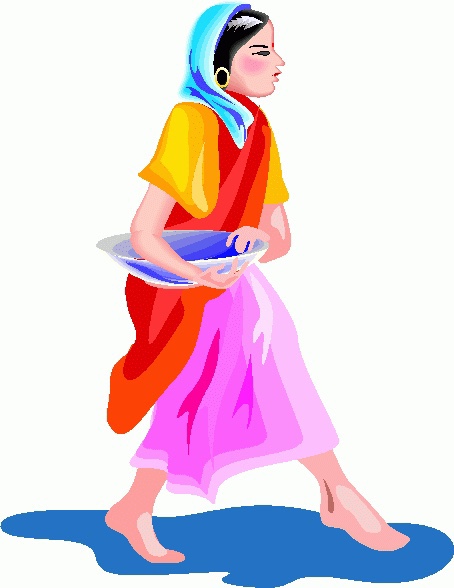
This also reminds us about how society has taught us that a mother only becomes “a true mother” when she is sacrificial. In India, people question a mother’s identity even if she chooses to wear a western outfit. Do women now even have to sacrifice on their preferred clothes? Women wearing western are seen “incapable “of raising a child? How does a simple piece of fabric decides a woman’s worth? Mothers are also judged by our patriarchal world for being into a particular profession, for example, those engaged in beauty and wellness or into travelling. How does a mother’s profession makes her “less of a mother”?
Photo Credits: Clipart Library.
It’s high time we stop romanticising women who suffer because of internalized patriarchy. The only thing our patriarchal society has to understand is that a woman’s personal choices are her own fundamental rights and she can exercise them as and when she wants.
“There is nothing that can destroy a woman and her power.”
Women empowerment is explained as accepting women’s thoughts and helping them to take a stand for themselves. This has become a topic of concern in today’s society. But do we care about empowering women? The answer is probably no. We, as a part of our society, give many speeches on this. Do we indeed mean what we say? Do we follow the same with the women around us? Again, the answer will be no. Indian society is likely to appreciate empowerment when it is about others. When it comes to our own family, we start to think about society. The REAL empowerment starts when there is nothing to think about a woman taking a stand for herself.
Women empowerment should be focused on encouraging women to fight for their rights. Whatever a woman does should be done because it is her right and not because she is allowed to do it. No one has to let her do something that she wants. A woman can do whatever she wants without seeking any permission. A man does not ask for a woman’s permission to do something. Then why should a woman get her father’s or husband’s permission? Let me cite an example. We all have men in our family. Have we seen our father or brother asking for permission to do a job? No. But we would have seen our mother or sister seeking permission to take up her job or studies and also would have come across many ‘NO’s.
What is the need for somebody to allow us to do something when we have the right? First, women should understand this point. She must not get impressed by someone’s sympathy. From the ages, a women’s mindset is fixed that her work is to take care of the family, engage in daily chores and take care of children. We convince ourselves to do all these right from the beginning which should not be done. No woman should compromise their career, dreams in the name of family. The traditional mindset should be withdrawn from women’s minds first. She should believe that she can achieve things beyond family. She has her own identity and being one’s daughter or wife is not her true identity. We can expect the change from others, especially, men only if we become the change.
Women empowerment doesn’t mean that women should be given higher priority. Empowerment should work towards an equal status both for men and women. If a noble thing or achievement is done by a woman, we see it in the headlines of newspapers or magazines mentioning them as woman officer, woman pilot, female poet, or female artist. But we don’t identify any male artist, male poet, man officer, or man pilot. This describes how equal society is. Equality in society will be established when there is no particular mention given to either man or woman.
In addition, we must acknowledge that society is changing practically towards equality. We have started addressing the chairman as chairperson, man-made as artificial, and mankind as humanity. A six-year-old girl raising questions on the terms coined in the patriarchal society stands as proof that this is not going to last anymore. Her questions went viral and she was answered by some of the achievers. They explain to her about our old patriarchal society and the influence of patriarchy in language as well. The world needs to change and it is changing. We must agree that this little kid has already reached halfway to create an equal society.
Designation or Profession shouldn’t be linked with genders. It should be generic. Our work towards this would be supporting and standing for all those who are ready to take a stand for themselves. “Equality is the soul of liberty” should not be ignored at any cost.
I had chosen to write about Dr. Majid Rafizadeh’s phenomenal novel ‘ A God Who Hates Women’. It is a beautiful yet tragically moving story of a women caught in a patriarchal household. It takes us back to the times when women were seen as commodities sold off in markets. Choice was a word that women could not even imagine.
The story highlights the life of the authors mother, how she lived through oppression. This story forms around the background of a civil war. The novels throw light on the cruelties faced by women in a patriarchal society. The story begins with a short background of how the authors grandmother was born. It later shows the birth of the authors mother which turned out to be a disgrace for her own mother, since she expected a baby boy. The story continues with the atrocities faced by his mother at her own home and how she was forcefully married to a man who abused her at all chances he got. The story speaks mostly about the struggles faced by the authors mother in her journey. It shows the cruel side of patriarchy, how women carry it down more than men.
The book is set in the backdrop of a series of political tension in Syria and Iran. The author and his family have moved from Syria to Iran a couple of times and the book shows the difference in the culture in both the countries vividly. The book shows how much political leaders are influenced by religion and how they kill people cruelly who goes against them, the authors father was one such victim. Maybe the author might have also got the influence from his father, but in a much better way. The author was the founder of an organization on human rights which reported cases of human cruelty. The authors father has a very interesting character, he on one side focuses on how modern our thinking should be in various aspects of life except in the equal treatment of women. His character was rather paradoxical.
The name of the book also seems to bring out the story, about how the religion and its god were cruel to women. The people of the religion went to extreme ends to make sure that the rules of the religion are followed, sometimes inhumane practices were also used.
But one of the most important thing that the book has left out is that it hasn’t brought into consideration the larger issues faced by the people. The author has merely had an interview with the close members of his family and friends. And so we cannot really say that the book speaks about the whole of Syria. After certain parts of time in the book, it fails to show the feelings of Amira, the authors mother. How she felt about religion, her passion and how she lied to herself to live for her children. The authors life has been glossed over for most parts and it talks in the perspective of the author while the book was about his mother. More focus should have been given to her as well as the political conditions too.
It refers to the hierarchical relations between men and women whereby men dominates and control over women’s sexuality.
Structures of patriarchy
According to Sylvia walby patriarchy as a system of social structure where men are in the dominant position to exploit and opress women.
She talks about six structures of patriarchy;
1. Patriarchal mode of production,
2. Patriarchal relations in paid work,
3. Patriarchal relations in the state,
4. Male Violence,
5. Patriarchal relations in sexuality,
6. Patriarchy relations in cultural institutions.
Now, let us study some of the institutions, practices and norms that maintain patriarchal set up of the society.
Family
Kate millets says “patriarchy’s chief institution is the family”. Family is the main agent of socialization where young boys and girls first encounter patriarchal power.generally, whatever is taught by the patriarchal ideology running in the family is accepted as natural and unchallengeable.
School
Women need to go to the school to receive education, in order to achieve freedom in true sense. The patriarchal belief system rests on the assumption that there’s no need to enrich women with higher level of education as they just have to remain inside the four walls.patriarchy is able to make women ignorant of her capabilities and makes them highly dependent on the menfolk.
Marriage
Marriage is practiced and institutionalised in our society keeping in mind tha patriarchal ideology and it’s structure. Our society has put certain Norms and values that a man and woman have to follow to make their marriage acceptable by people at large for instance , in the marriage between a man and woman a man should be elder to woman.
Conclusion
Many forms of violence and Crimes against women take place in our society for the sake and defence of patriarchal. Structure and ideology. Other structures like that of caste , class and religion collaborate with patriarchy that leads to violence and oppression like honour killing, female foeticide, forced marriages, control over modes of contraception etc. As a result women and other weaker sections of the society get caught in a vicious circle that leads to never ending modes of domination and suppression. If women and other suffering group identify and acknowledge the source of domination, it would be a great achievement in its own way, this is because the invisibility and acceptability of patriarchy at large is the main reason behind its very existence. So, we may conclude by saying that patriarchy forms the governing ideology that device our experiences when we are born as a girl or as a boy. It directs our socialization and provides us position of submission and domination.





 Eduindex
You must be logged in to post a comment.