Courses and career options for B.Sc. hons. (physics) students

B.Sc. hons. is very popular course, so is competition. So gaining extra knowledge becomes crucial for survival. So if you doing B.Sc. hons. in physics, I have sorted out some courses and career options that you can choose.
Courses

MBA in Data Science

MBA in Information Technology

Bachelor of Education (BEd)

PG Diploma in Data Science

PG Diploma in Astronomy

PG Diploma in Nanotechnology

Diploma in Medical Lab Technology

PG Diploma in Community Health Nursing

Certificate in Lab Assistant/Technician

Diploma in Operation Theatre Technology (OTT)

PG Diploma in Machine Learning/Artificial Intelligence

MSc in Materials Science and Engineering

M. Sc Vacuum Sciences

M. Sc Acoustics

MSc in Applied Physics

MSc in Physics

M. Sc Applied Electronics

MSc in Atmospheric Science

MSc in Nanotechnology

MSc in Astronomy/Planetary Science/Astrophysics

MSc in Aeronautics

Master in Atomic and Molecular Physics

MSc in Particle/Nuclear Physics

MSc in Geophysics

MSc in Molecular Physics

MSc in Optical Physics

MSc in Medical Physics

MSc in Biophysics

Short term courses

There are numerous diplomas and paramedical courses for Physics graduates to explore varied specializations by pursuing a short-term course. Here are the best diploma and paramedical courses after BSc Physics:

PG Diploma in Data Science

PG Diploma in Astronomy

PG Diploma in Nanotechnology

Diploma in Medical Lab Technology

PG Diploma in Community Health Nursing

Certificate in Lab Assistant/Technician

Diploma in Operation Theatre Technology (OTT) PG Diploma in Machine Learning/Artificial Intelligence.

Job opportunities

There are various job roles that B.Sc Physics candidates can opt after the completion of studies. Here is the list of some of the job roles available:

Physicist:

A Physicist is a person who studies and discovers the interaction of matter and energy. They perform experiments and investigate the theories of Physics to reach a conclusion. Usually, a PhD holder in Physics becomes a physicist. However, BSc Physics are also eligible to work as a research assistant or technician in a similar field. For growth and secure job as a physicist, the candidate must go for higher studies in Physics like M.Sc or PhD.

Physics Lecturer:

A candidate with sound knowledge in a physics subject can join an institute or academy as a lecturer. It is a decent job role and candidates can expect a good salary as a lecturer. Further, they can pursue master’s degrees for growth in the career.

Lab Assistant:

Candidates who hold a B.Sc Physics can work as a lab assistant in various firms, clinics or laboratories or institutes. Such professionals handle technical equipment and act as a helping hand for their supervisors.

Subject Matter Expert (SME):

B.Sc Physics graduates can work as a subject matter expert in various organizations. Such candidates are responsible to create content as per the requirement of the client. They are responsible to create effective and format based content as specified.

Researcher:

Candidates who hold a B.Sc physics degree can apply for researcher or scientist posts at top organizations in India like DRDO, BARC, ISRO, NTPC, BHEL etc.

Technician:

Various private organizations hire candidates with B.Sc Physics degree for technical support/Technician jobs. Candidates can look for vacancies and apply for the same.

Radiologist Assistant:

A radiologist is a professional who diagnoses disease and injuries using medical imaging, magnetic resonance imaging (MRI), nuclear medicine, positron emission tomography (PET) and ultrasound. B.Sc physics graduates can also work as radiologists as they have sound knowledge about the rays, devices, emission can assist effectively in handling the devices used for diagnosis and treatment.

Academic Counselor/ Advisor:

B.Sc Physics graduates can join a school/ academic institutes/ colleges as an Academic Counselor/ Advisor. Such candidates can assist students with their queries related to the subject.
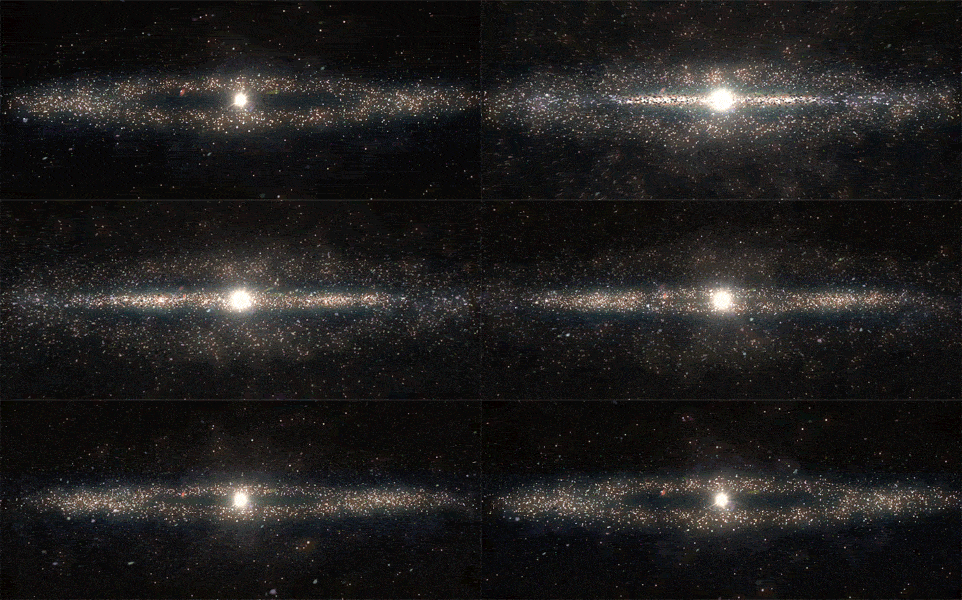
TACHYON A PARTICLE THAT HELPS US TO TIME TRAVEL…

Tachyonhypothetical subatomic particle whose velocity always exceeds that of light. The existence of the tachyon, though not experimentally established, appears consistent with the theory of relativity, which was originally thought to apply only to particles traveling at or less than the speed of light. Just as an ordinary particle such as an electron can exist only at speeds less than that of light, so a tachyon could exist only at speeds above that of light, at which point its mass would be real and positive. Upon losing energy, a tachyon would accelerate; the faster it traveled, the less energy it would have.

The name ‘tachyon’ (from the Greek ‘tachys,’ meaning swift) was coined by the late Gerald Feinberg of Columbia University. Tachyons have never been found in experiments as real particles traveling through the vacuum, but we predict theoretically that tachyon-like objects exist as faster-than-light ‘quasiparticles’ moving through laser-like media. (That is, they exist as particle-like excitations, similar to other quasiparticles called phonons and polaritons that are found in solids. ‘Laser-like media’ is a technical term referring to those media that have inverted atomic populations, the conditions prevailing inside a laser.)

an experiment at Berkeley to detect tachyon-like quasiparticles. There are strong scientific reasons to believe that such quasiparticles really exist, because Maxwell’s equations, when coupled to inverted atomic media, lead inexorably to tachyon-like solutions.

“Quantum optical effects can produce a different kind of ‘faster than light’ effect (see “Faster than light?” by R. Y. Chiao, P. G. Kwiat, and A. M. Steinberg in Scientific American, August 1993). There are actually two different kinds of ‘faster-than-light’ effects that we have found in quantum optics experiments. (The tachyon-like quasiparticle in inverted media described above is yet a third kind of faster-than-light effect.)

“First, we have discovered that photons which tunnel through a quantum barrier can apparently travel faster than light (see “Measurement of the Single-Photon Tunneling Time” by A. M. Steinberg, P. G. Kwiat, and R. Y. Chiao, Physical Review Letters, Vol. 71, page 708; 1993). Because of the uncertainty principle, the photon has a small but very real chance of appearing suddenly on the far side of the barrier, through a quantum effect (the ‘tunnel effect’) which would seem impossible according to classical physics. The tunnel effect is so fast that it seems to occur faster than light.

“Second, we have found an effect related to the famous Einstein-Podolsky-Rosen phenomenon, in which two distantly separated photons can apparently influence one anothers’ behaviors at two distantly separated detectors (see “High-Visibility Interference in a Bell-Inequality Experiment for Energy and Time,” by P. G. Kwiat, A. M. Steinberg, and R. Y. Chiao, Physical Review A, Vol. 47, page R2472; 1993). This effect was first predicted theoretically by Prof. J. D. Franson of Johns Hopkins University. We have found experimentally that twin photons emitted from a common source (a down-conversion crystal) behave in a correlated fashion when they arrive at two distant interferometers. This phenomenon can be described as a ‘faster-than-light influence’ of one photon upon its twin. Because of the intrinsic randomness of quantum phenomena, however, one cannot control whether a given photon tunnels or not, nor can one control whether a given photon is transmitted or not at the final beam splitter. Hence it is impossible to send true signals in faster-than-light communications.

Pin on The Laws of Relativity

THE DOUBLE SLIT EXPERIMENT

One of the most famous experiments in physics is the double slit experiment. It demonstrates, with unparalleled strangeness, that little particles of matter have something of a wave about them, and suggests that the very act of observing a particle has a dramatic effect on its behaviour.

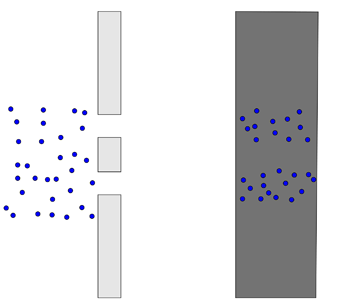
To start off, imagine a wall with two slits in it. Imagine throwing tennis balls at the wall. Some will bounce off the wall, but some will travel through the slits. If there’s another wall behind the first, the tennis balls that have travelled through the slits will hit it. If you mark all the spots where a ball has hit the second wall, what do you expect to see? That’s right. Two strips of marks roughly the same shape as the slits.

In the image below, the first wall is shown from the top, and the second wall is shown from the front.

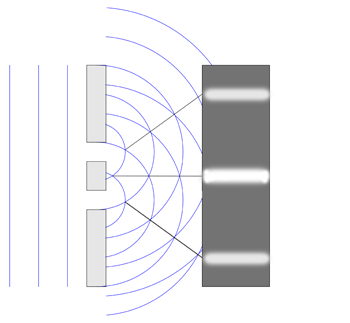
Now imagine shining a light (of a single colour, that is, of a single wavelength) at a wall with two slits (where the distance between the slits is roughly the same as the light’s wavelength). In the image below, we show the light wave and the wall from the top. The blue lines represent the peaks of the wave. As the wave passes though both slits, it essentially splits into two new waves, each spreading out from one of the slits. These two waves then interfere with each other. At some points, where a peak meets a trough, they will cancel each other out. And at others, where peak meets peak (that’s where the blue curves cross in the diagram), they will reinforce each other. Places where the waves reinforce each other give the brightest light. When the light meets a second wall placed behind the first, you will see a stripy pattern, called an interference pattern. The bright stripes come from the waves reinforcing each other.

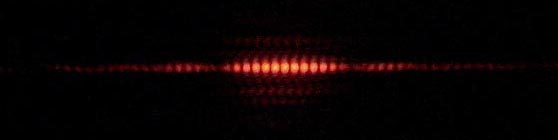
Here is a picture of a real interference pattern. There are more stripes because the picture captures more detail than our diagram.

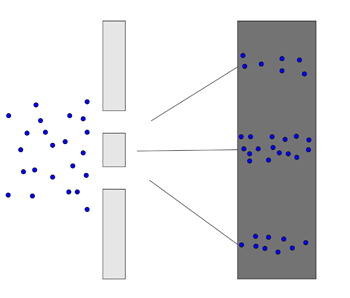
Now let’s go into the quantum realm. Imagine firing electrons at our wall with the two slits, but block one of those slits off for the moment. You’ll find that some of the electrons will pass through the open slit and strike the second wall just as tennis balls would: the spots they arrive at form a strip roughly the same shape as the slit.

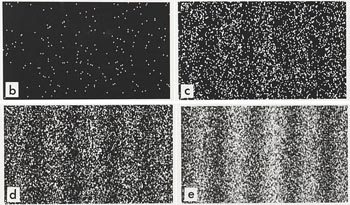
Now open the second slit. You’d expect two rectangular strips on the second wall, as with the tennis balls, but what you actually see is very different: the spots where electrons hit build up to replicate the interference pattern from a wave.

Here is an image of a real double slit experiment with electrons. The individual pictures show the pattern you get on the second wall as more and more electrons are fired. The result is a stripy interference pattern.

What does the experiment tell us? It suggests that what we call “particles”, such as electrons, somehow combine characteristics of particles and characteristics of waves. That’s the famous wave particle duality of quantum mechanics.

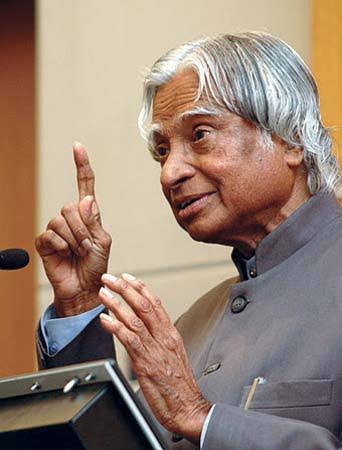
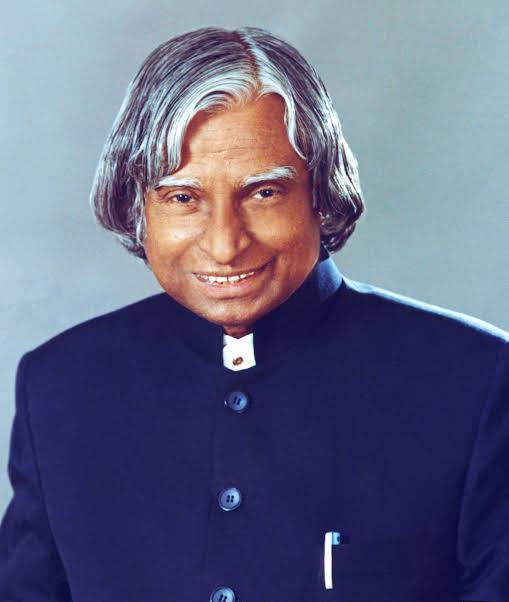
LIFE HISTORY OF APJ ABDUL KALAM

Early life :
His full name is Abul Pakir Jainulabdeen Abdul Kalam. He was born on 15th October, 1931 in Rameswaram, Madras Presidency, British India which is presently known as Tamil Nadu, India. His father’s name was Jainulabdeen Marakayar who was a boat owner and imam of a local mosque. His mother’s name was Ashiamma. She was a housewife. He was the youngest of four brothers and one sister in his family. Even though his ancestors had numerous properties and were wealthy, they lost most of their fortunes by the 1920s. This is why Kalam was born and grew up during poverty.

Education:
He studied in Schwartz Higher Secondary School. Previously he had average grades but later he was described as a bright and hardworking student who had a strong desire to learn. He went to Saint Joseph’s College, Tiruchirapalli, then affiliated with the University of Madras. He graduated in Physics in 1954. In 1955 he moved to Madras to study Aerospace Engineering in Madras Institute of Technology. The Dean was dissatisfied with his lack of progress in a senior class project and threatened to revoke his scholarship unless the project was finished within the next three days. He met the deadline impressing the Dean who later said to him that he was putting Kalam under stress and was asking him to meet a difficult deadline. He narrowly missed achieving his dream of becoming a higher pilot, as he got ninth position and only eight positions were available in Indian Air force.

Career as a Scientist:
After graduating from Madras Institute of Technology in 1960 he joined the Aeronautical Development Establishment of the Defence Research and Development Organisation. He started his career by designing a small hovercraft but remained unconvinced by his choice of job. He was also a part of the INCOSPAR Committee. In 1969 he was transferred to the India Space Research Organisation (ISRO) where he was the project director of India’s first Satellite Launch Vehicle.

Presidency:
APJ Abdul Kalam served as the 11th President of India, succeeding KR Narayanan. He won the Presidential election held in 2002. His term lasted from 25 July 2002 to 25 July 2007.

Books written by Dr. APJ Abdul Kalam:
He played an important role in the second pokhran nuclear test in 1998. He was also associated with India’s Space Program and missile development program. Therefore, he is also called the “Missile Man” of India. He wrote many books. The name of these books are as follows:-
1. India 2020: A Vision for the New Millennium
Publishing year: 1998
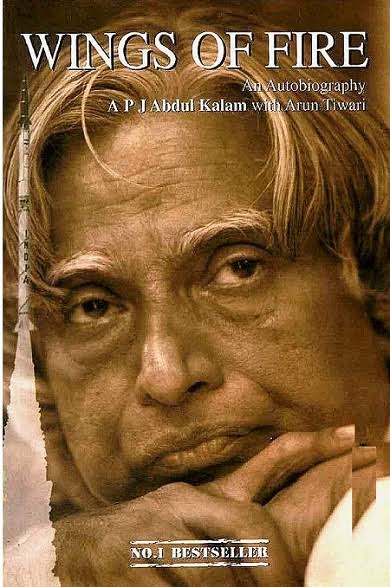
2. Wings of Fire: An Autobiography
Publishing year: 1999
wings-of-fire-biography-kalam
3. Ignited Minds: Unleashing the Power within India
Publishing year: 2002
4. The Luminous Sparks: A Biography in Verse and Colours
Publishing year: 2004
5. Guiding Souls: Dialogues on the Purpose of Life
Publishing year: 2005
Co-author: Arun Tiwari
6. Mission of India: A Vision of Indian Youth
Publishing year: 2005
7. Inspiring Thoughts: Quotation Series
Publishing year: 2007
8. You Are Born to Blossom: Take My Journey Beyond
Publishing year: 2011
Co-author: Arun Tiwari
9. The Scientific India: A Twenty First Century Guide to the World around Us
Publishing year: 2011
Co-author: Y. S. Rajan
10. Failure to Success: Legendary Lives
Publishing year: 2011
Co-author: Arun Tiwari
Ramnath Kovind: 10 facts about 14th President of India
11. Target 3 Billion
Publishing year: 2011
Co-author: ‎Srijan Pal Singh
12. You are Unique: Scale New Heights by Thoughts and Actions
Publishing year: 2012
Co-author: S. Poonam Kohli
13. Turning Points: A Journey through Challenges
Publishing year: 2012
14. Indomitable Spirit
Publishing year: 2013
15. Spirit of India
Publishing year: 2013
16. Thoughts for Change: We Can Do It
Publishing year: 2013
Co-author: A. Sivathanu Pillai
17. My Journey: Transforming Dreams into Actions
Publishing year: 2013
18. Governance for Growth in India
Publishing year: 2014
19. Manifesto for Change
Publishing year: 2014
Co-author: V. Ponraj
20. Forge Your Future: Candid, Forthright, Inspiring
Publishing year: 2014
21. Beyond 2020: A Vision for Tomorrow’s India
Publishing year: 2014
22. The Guiding Light: A Selection of Quotations from My Favourite Books
Publishing year: 2015
23. Reignited: Scientific Pathways to a Brighter Future
Publishing year: 2015
Co-author: ‎Srijan Pal Singh
24. The Family and the Nation
Publishing year: 2015
Co-author: Acharya Mahapragya
25. Transcendence My Spiritual Experiences
Publishing year: 2015
Co-author: Arun Tiwari

Awards:
He won many awards. The list are as follows:-
1981: Padma Bhushan- Government of India
1990 : Padma Vibhushan- Government of India
1997 : Bharat Ratna- Government of India
1997 : Indira Gandhi Award for National Integration- Government of India
1998 : Veer Savarkar Award- Government of India
2000 : SASTRA Ramanujan Prize- Shanmugha Arts, Science, Technology and Research Academy, India
2013 : Von Brown Award- National Space Society

Death:
Dr. APJ Abdul Kalam breathed his last on 27th July,2015 due to a cardiac arrest while delivering a lecture at th Indian Institute of Management, Shillong.

@track2traininginstitute @track2trainingseminar @edunewsnetwork @pen2prints

Special Relativity Made Easy

Does the word “special relativity” strike fear in your heart? It might seem tough at first glance but it is very easy to understand. 

Postulates

Special theory of relativity is a theory regarding space and time, given by Albert einstein. The main postulates of this theory are: 

1]The Principle of Relativity : The laws of physics are the same in every inertial frame of reference. 

2]The Principle of Invariant Light Speed :The speed of light in vacuum is the same in all inertial frames of reference and is independent of the motion of the light source.

Now, let us understand these two postulates. The first postulate basically means that physical laws, for example, Newton’s laws of motion and laws of electromagnetism, are independent from the choice of inertial systems.  If the laws differed, that difference could distinguish one inertial frame from the others or make one frame somehow more “correct” than another. However, all frames of reference are correct in their own way. Suppose you watch two children playing catch with a ball while the three of you are aboard a train moving with constant velocity. Your observations of the motion of the ball, no matter how carefully done, can’t tell you how fast (or whether) the train is moving. If seen from outside, all three appear to be moving with the train at constant velocity.  This is because Newton’s laws of motion are the same in every inertial frame.

Let’s think about what the second postulate means. Suppose two observers measure the speed of light in vacuum. One is at rest with respect to the light source, and the other is moving away from it. Both are in inertial frames of reference. According to the principle of relativity, the two observers must obtain the same result, despite the fact that one is moving with respect to the other. Now suppose a spacecraft moving with constant velocity turns on a searchlight. An observer on the spacecraft measures the speed of light emitted by the searchlight and obtains the value. According to Einstein’s second postulate, the motion of the light after it has left the source cannot depend on the motion of the source. So the observer on earth who measures the speed of this same light must also obtain the same value. This result contradicts our elementary notion of relative velocities, and it may not appear to agree with common sense. But “common sense” is intuition based on everyday experience, and this does not usually include measurements of the speed of light. 

Speed of light as a constant

Einstein’s second postulate immediately implies the following result: It is impossible for an inertial observer to travel at c, the speed of light in vacuum. We can prove this by showing that travel at c implies a logical contradiction. Suppose that the spacecraft is moving at the speed of light relative to an observer on the earth, so that If the spacecraft turns on a headlight, the second postulate now asserts that the earth observer measures the headlight beam to be also moving at c. Thus this observer measures that the headlight beam and the spacecraft move together and are always at the same point in space. But Einstein’s second postulate also asserts that the headlight beam moves at a speed relative to the spacecraft, so they cannot be at the same point in space. This contradictory result can be avoided only if it is impossible for an inertial observer, such as a passenger on the spacecraft, to move at.

Hopefully, now you can brag that you know the special theory of relativity.

https://cosmo.nyu.edu/hogg/sr/sr.pdf
https://en.wikipedia.org/wiki/Special_relativity