
Policymaking and implementation should be a two way process with people’s participation

 The Vice President, Shri M. Venkaiah Naidu today emphasised the need for constant dialogue between the people and the governments for citizen centric and responsive governance. He said that policymaking and implementation should be a two way process with people’s participation at every stage. 

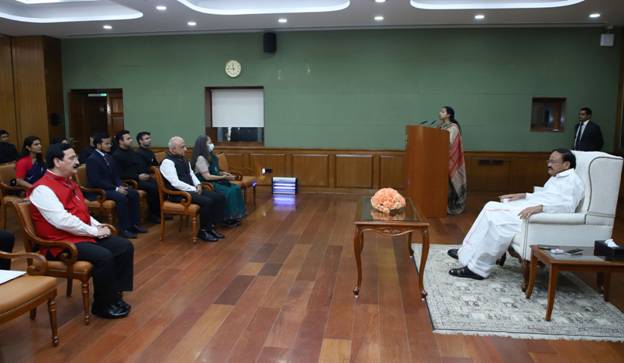
Addressing the Indian Information Service officers of 2018 and 2019 batches who came to call on him at Upa-Rashtrapati Nivas today, Shri Naidu highlighted the role of communication in bridging the divide between the governments and citizens. “In a democracy, people need to be empowered through timely information on government’s policies and initiatives in their mother tongues. On the other hand, governments also need to be apprised of people’s expectations and aspirations in an objective and timely manner,” he said.

Referring to the mass behavioral change campaign undertaken as part of the Swachh Bharat Mission, Shri Naidu said that the success of any reform depends on the cooperation from the people. He further said that people will understand and support an initiative better when they have been involved in its planning and implementation strategy from the beginning.

Describing India as the largest Parliamentary democracy in the world, he said that the purpose of any reform process should be to make people’s life happy and prosperous. “Therefore, the focus of all government policy measures should be on bringing lasting happiness to people’s lives,” he told the officers, and at the same time, underscored the need to bear with “temporary pain for long term gain”.

IIS officers of 2018 and 2019 batches in group photographs with the Vice President, Shri M. Venkaiah Naidu
Mentioning that the ICT revolution and spread of the internet have fundamentally changed the way we consume news, he cautioned that this ‘ease of information’ comes with its associated risks. “Misinformation, disinformation and fake news have emerged as new challenges which need to be promptly tackled by the government communicators round the clock,” he added. The Vice President also cautioned against the misuse of social media by certain anti-social elements, the Vice President called for curbing such tendencies at the earliest.

Drawing attention to the growing trend of ‘instant journalism’ triggered by the emergence of Internet and social media expansion, Shri Naidu expressed concerns about the erosion of journalistic norms and ethos due to this. He emphasized the importance of neutrality and objectivity in media reporting and said that news should not be mixed with views. “Media is the fourth pillar of democracy and its neutrality, objectivity and fairness is crucial for survival of India’s democratic ethos,” he stressed.

The Vice President asked the young officers to bring forth many developmental stories from across the nation. “You as government communicators should also make all efforts to ensure that the good work being done by various ministries and departments is covered adequately by the media,” he told them. Terming information & psychological warfare as an important dimension of modern day wars, Shri Naidu advised the IIS officers to develop expertise in these emerging and strategic areas.

Referring to the increasing frequency of extreme climatic events and erratic weather patterns across the globe, the Vice President asked the young officers to run a mass media campaign for nature conservation and environmental protection. “If you love nature, nature will protect you,” he told them.

Cautioning against the populist measures to garner votes by various political parties, Shri Naidu said that the freebie culture has led to deteriorating financial health of many states. “Government should definitely support the poor and needy, but at the same time should prioritize health, education and infrastructure development,” he said.

In his address, his last as the Vice President of India, Shri Naidu said that “the key to my rise from an ordinary farmer’s son to the second highest constitutional post in the country lies in sheer hard work, single minded devotion and constant travel and interaction with the people in every part of the country.”  I have learned a lot by meeting and talking to the people, he said.

Congratulating the officer trainees for joining the prestigious Civil Services, he exhorted them to work for transforming the lives of people in the country. It may be noted that the Indian Information Service (IIS) is a Central Group ‘A’ Service whose members work as the media managers of the Government of India. The IIS officers, in their various capacities, act as a vital communication link between the Government and the people by way of disseminating information and communicating various Government policies and schemes to the public at large.

Prof. (Dr.) Sanjay Dwivedi, Director General, IIMC, Shri Ashish Goel, ADG, IIMC, Dr Rinku Pegu, Associate Professor IIMC & Training Coordinator for IIS officers, officers of Indian Information Service batches of 2018 & 2019 were present during the interaction. Prof. Sanjay Dwivedi also presented his book titled, “Bharat Bodh ka Naya Samay” to the Vice President on this occasion.

******

Dialogue and Development Commission of Delhi

 The Dialogue and Development Commission of Delhi is envisioned as a think-tank of the Government of National Capital Territory of Delhi advising the government in finding sustainable, people centric solutions to the critical development challenges facing Delhi.


DDC Delhi has the following four broad functions:

1) Policy Design: Consider ideas, innovations, best practices nationally and globally, evidence of impact in a core set of policy areas and translate them into concrete policy recommendations for the Government of National Capital Territory of Delhi.

2) Support Policy Implementation: Support expeditious implementation of critical reforms by developing innovative models of contracting, model RFPs, leveraging technology and by actively bridging knowledge and capacity gaps, if any.

3) Promote Participatory Governance: Establish platforms that bridge the gap between government and external stakeholders such as the private sector, civil society, academia and communities in effective design and implementation of policies and government schemes.

4) Monitoring, Evaluation and Learning: Promote the use of data, evidence and modern monitoring and evaluation techniques for improved policy-making and better delivery of public services. Further, document the impact of reforms and policy innovations of the Government of National Capital Territory of Delhi to facilitate internal and external learning.

To fulfill its mandate, the Dialogue and Development Commission of Delhi’s work is organized around the following six sectors/verticals:

1) Social Sector: The Social Sector team advises and assists the government’s work in following areas:

  • a. Provide world-class education to every child, from early childhood education and higher education with a particular focus on outcomes of quality education.
  • b. Provide affordable and accessible healthcare facilities for all within the framework of a three-tiered universal healthcare system comprising of Mohalla Clinics, polyclinics and hospitals for tertiary care.
  • c. Ensure the welfare, social security and safety of all vulnerable sections such as children, women, elderly, SCs/STs, transgender, unorganized workers etc.

2) Environment: The Environment team advises and assists the government’s work in the following areas:

  • a. Reduce air pollution and carbon emissions substantially from current levels by forming a scientific understanding of underlying sources, and implementing innovative, evidence-backed mitigation measures.
  • b. Clean-up Yamuna by ensuring no untreated water flows into the Yamuna and develop a beautiful
  •  river side on the Yamuna, which will play a big role in maintaining the Yamuna  Eco system and creating a new tourist destination.
  • c. Make Delhi among India’s cleanest cities by working in close coordination with Municipal Corporations to get rid of open dhalavs and institute modern practices for collection, transportation & disposal of solid waste.

3) Transport and Infrastructure: The Transport and Infrastructure team advises and assists the
 government’s work in the following areas:

  • a. Create a world-class and affordable public transportation system comprising of buses, metro and efficient last-mile connectivity that gives priority to electric vehicles and non-motorized modes of transport.
  • b. Build well-designed, beautifully landscaped and safe roads that cater to the needs of all its users – the essential hallmark of a world-class city.
  • c. Provide dignified housing and essential services to all residents of Delhi with a focus on the needs of slum dwellers and residents of unauthorized colonies.

4) Economy: The Economy team advises and assists the government’s work in the following areas:

  • a. Undertake reform measures for the continued growth of Delhi’s economy including modernization of market and industrial areas, furthering the ease of doing business, nurturing the growth of culture and creative economy and establishing Delhi as the nation’s hub for start-ups.
  • b. Promote the growth of quality jobs and employment opportunities by investing in world-class skill training and better industry-government collaboration in labor-intensive sectors.
  • c. Undertake all possible steps to increase the participation of women in Delhi’s economy, including initiatives that connect housewives with job and business opportunities from or near their homes.

5) Governance: The Governance team advises and assists the government’s work in the following areas:

  • a. Establish and nurture platforms of participatory governance that bridge the gap between government and external stakeholders such as the private sector, civil society, academia and communities ineffective design and implementation of government schemes and policies.
  • b. Undertake appropriate administrative and institutional reforms to ensure that public institutions and governance in Delhi is capable of serving the needs and aspirations of the national capital of 21st century India.
  • c. Encourage the usage of modern IT and e-governance tools for transparent and efficient administration.
  • d. Promote a culture of research and innovation to address the most critical development challenges facing Delhi.

6) Monitoring, Evaluation & Learning: This team advises and assists the government’s work in the following areas:

  • a. Strengthen the use of data and modern monitoring tools such as Outcome budgeting, performance dashboards, 
  • high-frequency monitoring etc. for timely course corrections and improved policy implementation.
  • b. Conduct independent surveys and rigorous evaluations of government schemes and policies, either internally (for small/rapid assessments) or in collaboration with external organizations to generate insights on which programmed work and why.
  • c. Act as a knowledge hub on policy innovations and impact of various reforms of Government of National Capital Territory of Delhi and facilitate internal and external learning by publishing policy briefs, case studies, white papers etc. and hosting seminars and conferences.