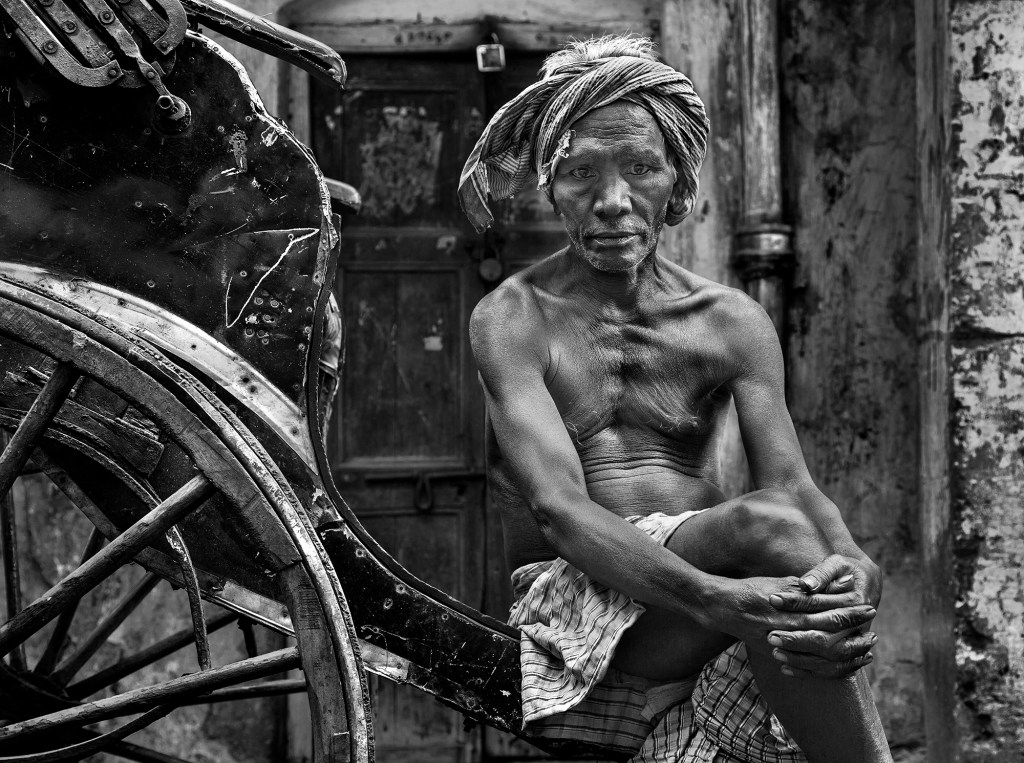
Hand-Rickshaw Pullers of Kolkata: The Legacies Left Behind

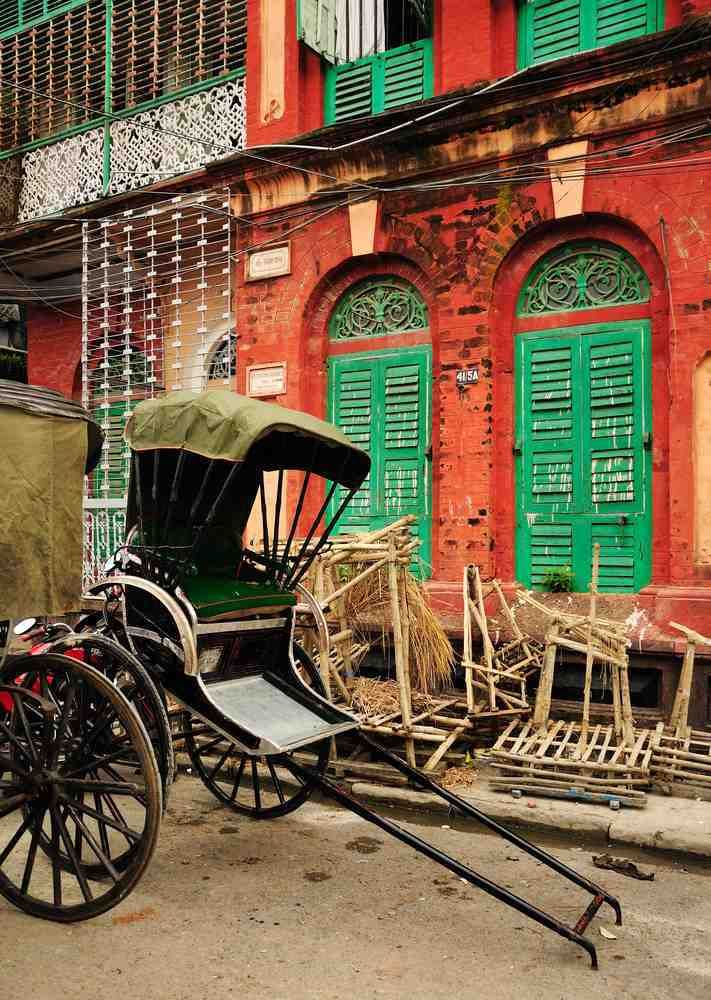
Hand-Rickshaw puller of Kolkata

Introduction

Kolkata is a city that is an amalgamation of the old and new. A city that is being modernised everyday but still manages to hold on to the old charm vibe. It is the only city in India to have various modes of transportation, dating back to the British era. The first city in India to construct a metro rail, it is now the only city in the world that continues to operate licensed hand-pulled rickshaws (called tana rickshawin Bengali) as a mode of public transport. One can still see the tram cars and hand-pulled rickshaws plying on the narrow bylanes of Kolkata.
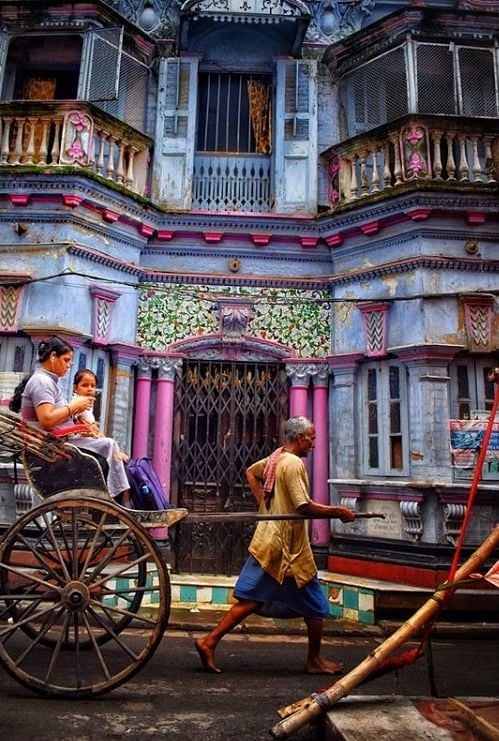
Hand Rickshaw in Kolkata

Histrionic Background

The word ‘rickshaw’ originates from the Japanese word ‘Jin-riki-sha’ (jin meaning human, riki meaning power, and sha meaning vehicle; which translates to human-powered vehicle). The hand-pulled rickshaw was invented in Japan in 1869 and was introduced in China by 1874. Unlike previous modes of transport, like kago, sedan chairs, etc. which needed two persons to carry, the rickshaw had the significant advantage of being driven by a single person. The following decades witnessed a boom of hand-pulled rickshaws in Japan, China, Singapore, India, Indonesia and Malaysia. They served as cheap means of transportation and provided employment to millions of poor working-class families living in cities. 

The British were the dominant colonial power in Asia and the usage of a human to pull another human definitely served in reinforcing the master-slave power hierarchy. Post World War II, colonialism declined in Asia and the hand-pulled rickshaw faded out of use from erstwhile British colonies. Strangely, the legacy of rickshaws continued in Calcutta long after the British Empire was gone (1947), and long after the communist government in China banned (1949) the use of rickshaws. Not only did it survive in Calcutta but the tenacious hand-pulled rickshaw has become an icon of the metropolis

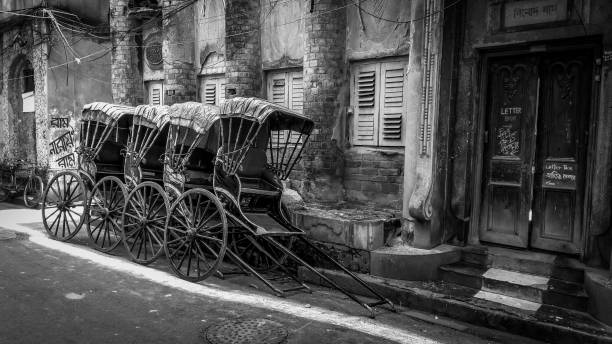
A Hand-Rickshaw in an alley of Kolkata City

A Staple to Kolkata’s Culture

Kolkata’s hand-pulled rickshaws are mentioned in many literary books and featured in films of different languages. It plays the protagonist in Rudyard Kipling’s ‘The Phantom Rickshaw’. The story is set in Shimla of the 1980s. Greg Vore, an international travel photographer, researched on the life, role and history of hand-pulled rickshaws in Kolkata and Bangladesh. Bimal Roy’s classic Do Bigha Zamin (released in 1953) tells the story of a farmer who becomes a rickshaw wallah in the then Calcutta.

Present Situation of Rickshaw: How They Are Doing

The hand-pulled rickshaw survives due to a number of socio-economic reasons peculiar to Kolkata. Firstly, pulling a rickshaw does not require skill; it requires hard physical labour. Unemployed and unskilled labourers find employment as rickshaw pullers in Kolkata. They do not undergo any training or require a driver’s license to operate. Most rickshaw pullers do not even know the names of the roads they ply their trade on, nor do they understand the various traffic symbols. This is because they are mostly illiterate and speak Hindi instead of the local Bengali. Many rickshaw pullers do not even own the vehicles themselves, but rent them from sardars (rickshaw owners) who own khatals (rickshaw garages). This arrangement evolved because many rickshaw pullers are either too poor or seasonal migrants, plying the rickshaws only for a few months when their fields back home lie fallow. 
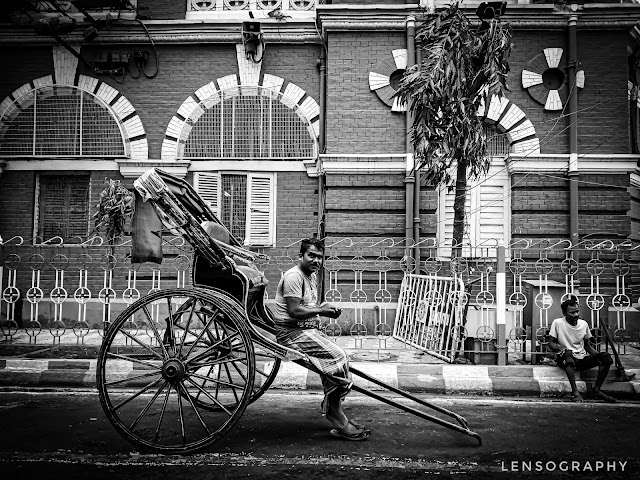
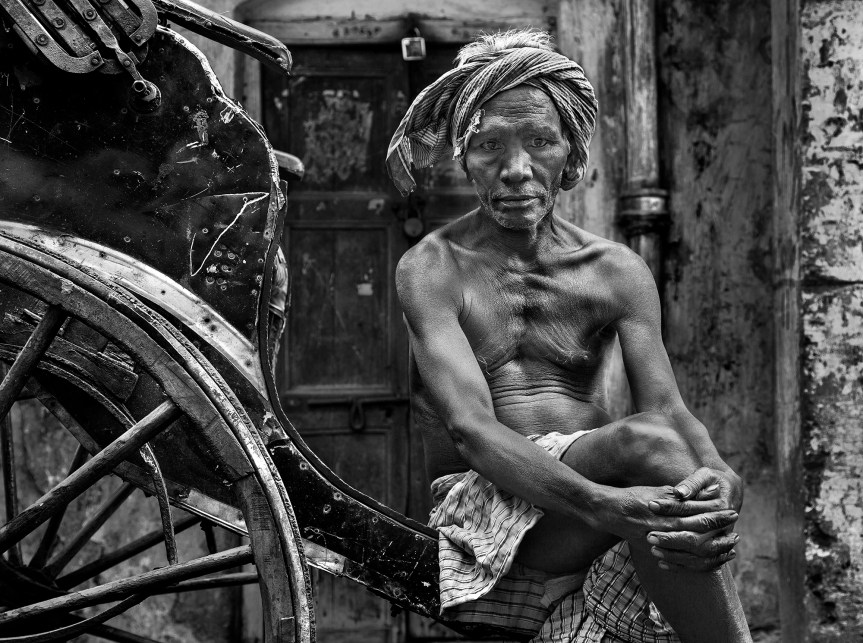
Leisure between the fare trips

Today, due to declining popularity and availability of other modes of transport, rickshaw pullers earn a meagre amount and mostly live on the streets, saving every rupee to send to their families. Added to this are costs for food and rent paid to sardars, after which they are left with very little money for themselves. Many turn to alcohol and suffer from various diseases and medical problems associated with old age and the physical stress of the job.

Kolkata does currently have 18,000 rickshaw pullers and 6000 rickshaws, though not all of them are licensed by the municipality

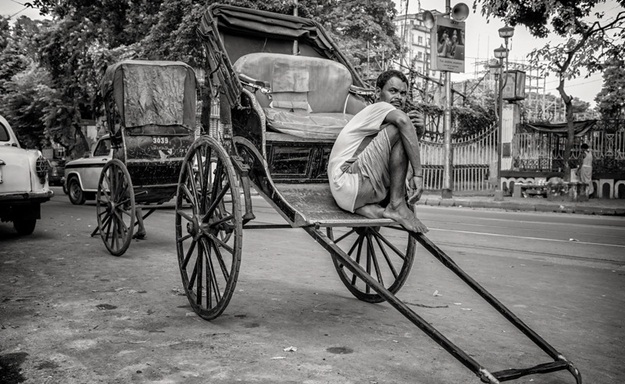
Queued up for passengers

The “Ban” for Rickshaws: The Efforts to Demolish The Rickshaw Transportation

Kolkata has faced much flak due to the existence of this colonial relic. In 2006, the state government tried permanently banning these rickshaws by the passing of the Calcutta Hackney-Carriage (Amendment) Bill, but it was never implemented. Nothing has changed after the change of government in 2011, though promises were made about replacing the licensed hand-pulled rickshaws with electric or cycle rickshaws. If these rickshaws need to be permanently removed from the streets, a justifiable solution needs to be worked out to ensure proper rehabilitation for all the people directly and indirectly attached to the trade.
On the streets of Kolkata

The Positive Side: Why Hand-pulled Rickshaws Are Relevant To Kolkata

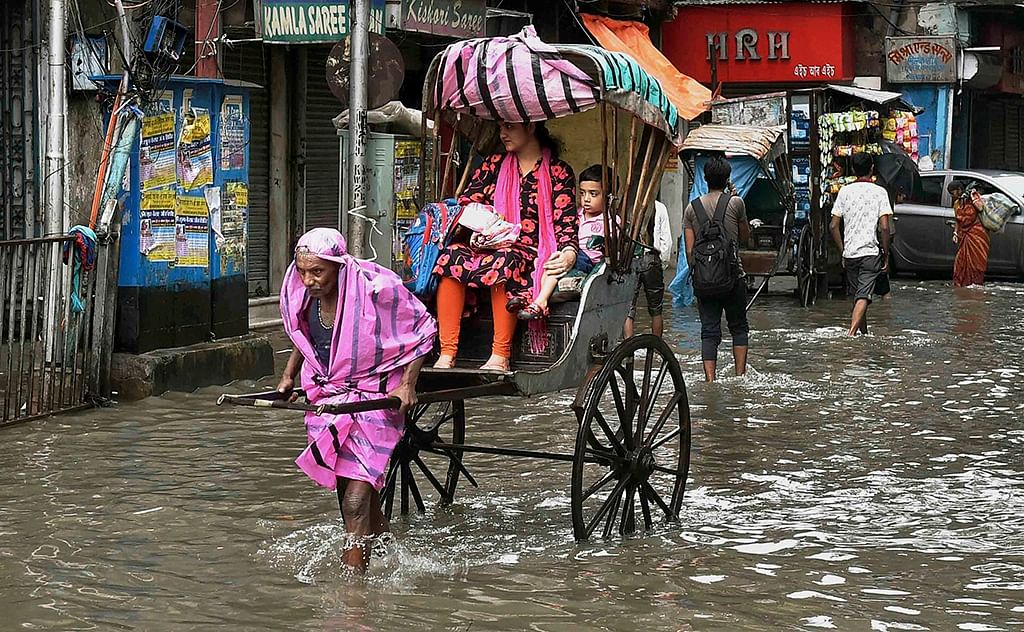
The narrowed urban planning of Kolkata has also played a part in the continuance of this mode of transportation. Due to poor drainage, streets in low-lying areas get flooded frequently. During heavy monsoons, the hand-pulled rickshaw is the only form of transport which can navigate flooded streets. Its non-reliance on fossil fuels makes it less expensive and non-polluting, and its compact size allows easy navigation through the narrow lanes of Kolkata

Carrying passengers in flooded road

Conclusion

Hand-pulled Rickshaws are the legacies of Kolkata’s British colonial past. The demolition of these mannual carts and their replacement with electric mode of carrier carts, would slightly dim the spirit the of the old city. But with time’s stand, it is on the behalf of saving the human labour in a more cost-effective and eco-friendlier way. Although, Kolkata will always cherish its beautiful past garnered with these wooden carts, that served the city and its citizens for ages.


Self-employment Vs Job Vs Profession- What to choose

The corporate world is not limited to jobs only. A person can go for a profession or get self employed as well. Of course, jobs are offered by companies who were once started by a person as a form of self employment/business.

We should never lower our standards or under-estimate ourselves during difficult situations and complexities. Only those who believe in themselves achieve big things so it is necessary that you identify yourself and follow the way of your life be it a job or profession or a business. Nothing is impossible.

Job

Everyone knows what a job is. There are more people applying for jobs than setting up own businesses. The enrollments are ever increasing but the positions are however, limited.

People apply for jobs since they provide a secured return and environment for growth. Incentives are provided over and above salaries and what to say about the government jobs! Most aspirants are found applying to the government jobs only, since they assure reliefs and pension to the employees besides good salary and incentives. Those who wish to play safe generally opt for jobs. However, people of identified and advanced capabilities also opt for jobs in big companies to earn high with their talent and knowledge not being wasted. There are a variety of jobs in a single field which supports individual interest along with providing a platform for skill enhancement and personality development. The working hours are usually fixed for a job and the work load often comes with stress and dissatisfaction at lower levels of operation of a business. Timely completion of work is a necessity when you work under the superiors. The tasks you are assigned with should be done accordingly. There are restrictions related to holidays as well.

Profession

When a person gets specialized in any specific field, he/she can join the profession. You lay your own rules and work according to your convenience while in a profession. This doesn’t mean that you can have free holidays and whatever salary you wish. It means that you have choice of work. A professional is valued and given certain discretions at work in respect of their achievement. A professional worker will always find a place suited to him/her by virtue of its demand and value in the corporate sector. There are opportunities for further growth as well. The more the professionalism, the higher it is valued.

Lawyers, doctors, CA and CS are some examples. Their pay is high; based on the experience and knowledge they hold. One has to do hard work and study to be a professional worker and earn good opportunities to work for.

Self-employed

A self employed person is who starts his own business/venture. It involves great risk for business. A doctor opening his clinic or a teacher starting his tuition classes also come under the category of self employed. A self employed person is his own master and has his own rules but which should be in accordance with laws of the land. It requires planning and execution abilities to start own business. It is not everyone’s cup of tea. You need to be an all-rounder to initiate a plan and manage the workings successfully. Earnings are surely good once everything settles and your costs get covered. Yes, investment is required for it and you must be creative to design a perfect strategy to tackle the competitions.

Based on the capability of a person, choices can be made between the above three. No work is less valued as you require to be hard working and a dedicated and determined person to handle the complexities in each of them. There is need for more dynamic and variety of businesses to start in order to meet the ever increasing demand for employment.

Making a Choice of Profession

In India it is a great problem to choose a profession best suited to one. In America there is a National Intelligence Test Bureau where everybody’s intelligence is tested. This test is carried on a mass scale. It is then quite easy for you to select the career that will suit you the most. The system will naturally save our national energy and our health. It will also help in overhauling our present educational system wh8ch is very defective.

When we look around, we see how our schools, colleges and universities are turning out innumerable young persons. They are not fit for any other job except those of clerks. We have to call these institutions as clerk-manufacturing factories. They do produce lawyers, doctors, engineers etc but ‘clerical line’, has the lion’s share on that side.

There are many factors which should determine the choice of a profession. The first and the foremost is a young man’s taste and aptitude. One who is made to follow a profession for which he has taste or liking is not likely to find himself a misfit therein. He will not be a square peg in a round hole, as the expression goes. One who has a taste for music is likely to shape well as a musician rather than as a lawyer. Rabindranath Tagore had a taste for poetry. If instead of allowing him to follow that line, he was put into some other profession, the result would have been disastrous both for himself and for the world. So aptitude is a great consideration.

Another determining factor is talent. A meritorious young man may go in for a learned profession. But there again a careful choice is to be made. For instance, if he has an argumentative brain and the gift of the gab, but no head for mathematics, he is more likely to make a successful lawyer than an engineer.

A third consideration is sufficiency or otherwise of financial resources of a young man’s family. He may have the aptitude for a particular profession, he may have the talents for it; but if his father or guardian cannot afford to pay for his education or training in that line, it is useless for him to think of joining that profession.

The competition to be faced in a particular profession has also to be taken into account in making a choice. Some professions are already overcrowded and one should try to avoid them unless there are special circumstances, which may help one’s mark in it.

After choosing a profession, there are two fundamentals for its success. First, we must be devoted to our work . We must be able to learn its secrets in the spirit of a devotee. Let us take to any vocation of life. We must work with all the zeal and enthusiasm to make our work a grand success. Secondly, we must be ready to stick to it and struggle for it. A rolling stone gathers no moss and so a drifting worker is rarely a success. The choice should be made after careful consideration, but once it is made, we must stick to it.

The choice of a profession is a matter of vital importance to every man. A right choice may make his future career bright while a wrong choice may mar it forever. It is, however, not possible for an inexperienced young man to assess his abilities for a profession or his chances of success in it. It is, therefore, the duty of his guadians and teachers to help him to make the choice.

CHILDHOOD DREAMS

DREAMS AS A CHILD

Everyone has a profession or two that they aspire to be when they grow up. Some children, for example, want to be firefighters, while others want to be physicians or professors and lots more. This is where everything starts. Dreaming is what gives a child the wings to fly, the hope to survive and the will to become successful in future. Childhood and early adulthood experiences may mould and mould these dreams. Many of these children grow up to abandon their childhood ambitions whereas some of these children, continue on their road to pursue their aspirations and become the professionals they’ve always wanted to be.

My Childhood Aspirations When I reflect on my life, I realize how wonderful it has been. I had an absolutely fantastic childhood and consider myself to be quite fortunate. I grew up in a home with two loving parents who have been there for me through thick and thin, and for that I am eternally grateful, forever. My parents instilled in me the belief that I could be anything I wanted and that I could do everything I set my mind to, they made me believe that nothing is impossible and you can gain what you want if you work hard. As I grew older and developed into the person I am now, my dreams evolved.

DREAMS AS ADULTS

When people consider their life dreams, they frequently consider whether or not they are childlike fantasies. Adults are continually influenced by what is considered juvenile or practical, as well as how others would see them if they pursue their aspirations. Most people who are going to follow all of their childhood aspirations are emotionally immature in some way. Bringing this down to the level of students has a similar effect. After all, when children reach a certain age, the adults in their lives dismiss their dreams as infantile or kiddish which is very much seen among the people in the current generation. Despite the fact that it can drive someone’s willingness, childishness is usually regarded as negative or problematic in some way. People can be motivated by a variety of emotions that are considered juvenile, such as wrath, sadness and many more.

When broken down by gender, it appears that gender stereotypes were still present in the minds of today’s adults when they were children. Pilot (13 percent), Athlete/Olympian (10 percent), and Police Officer or Detective (6 percent) were the most popular dreams for boys, while Vet (12 percent), Teacher (11 percent), and Dancer/Choreographer were the most popular ambitions for girls (6 percent). I’ve had a range of interests and occupations throughout my life that have given me a lot of pleasure. But when it came to my work and something I’d be doing for the rest of my life, I couldn’t think of anything that would make me truly happy.

Some people have an easier time moving on from their “childhood aspirations” than others. As they become older, they develop interests behind the scenes or in theater administration, which they can turn into an internship, which could lead to a full-time job. That’s just fine with them but this is not fine by me.