Bad Bank

A bad bank is a financial entity set up to buy non performing assets (NPAs), or bad loans, from banks. It is not involved in lending and taking deposits, but helps commercial banks clean up their balance sheets and resolve bad loans.It buys bad debtors of a bank at a mutually agreed value and attempts to recover the debts or associated securities by itself.

The aim of setting up a bad bank is to help ease the burden on banks by taking bad loans off their balance sheets and get them to lend again to customers without constraints. After the purchase of a bad loan from a bank, the bad bank may later try to restructure and sell the NPA to investors who might be interested in purchasing it. A bad bank makes a profit in its operations if it manages to sell the loan at a price higher than what it paid to acquire the loan from a commercial bank. A supposed advantage in setting up a bad bank is that it can help consolidate all bad loans of banks under a single exclusive entity. The one time transfer of assets out of the balance sheets will relieve banks of their assets out of bank’s balance sheets will relieve banks of their stressed assets and allow them to focus on their core business of lending. Banks with clean balance sheets can mobilize fresh capital from the market and improve their credit growth, which is crucial for spurring investments. Bad banks would also give an impetus to India’s economic growth , which has been affected by heightened risk aversion arising from the unbridled growth in NPAs . And the bad bank will unlock trapped capital, which will be a net positive for the economy in the long term. The idea of a bad bank has been tried out in countries such as the U.S.,Germany, Japan and others in the past. Some experts believe that by taking bad loans off banks, a bad bank can free capital of over ₹ 5 lakh crore that is locked in by banks as provisions against these bad loans. This will give banks the freedom to use the freed customers.

It is argued that creating a bad bank is just shifting the problem from one place to another.Without fundamental reforms to solve the NPA problem, the bad bank is likely to become a warehouse for bad loans without any recovery taking place. An important concern is regarding mobilizing capital for the bad bank. In an economy hit by the pandemic, it is hard to find buyers for distressed assets and the Government is also in a tight fiscal position. There is no clear procedure to determine at what price and which loans should be transferred to the bad banks.

Former RBI Governor Raghuram Rajan was cautious about the idea of a bad bank in which banks held a majority stake. In his book ‘I Do What I Do,’ the celebrated economist and banker had pointed out that if a bad bank was in the public sector, the reluctance to act would merely be shifted to the bad bank.

Sources : The Hindu, Drishti IAS , Wikipedia

Reservation- requisite or not

Reservation is a system of affirmative action in India which facilitates historically disadvantaged group of people to be represented in education, employment, politics etc. It was framed with a reason to uplift certain castes who were subjugated to atrocities, social and economic backwardness due to the prevalence of dominance of caste system in the society. Based on the amenities in the Indian constitution, it allows the Indian Government to set reserved seats which de-escalates some of the qualifications needed in employment, education, exams etc. for socially and economically backward citizens.

There are points both in the favor and against of the reservation system. Why some argue in favor of such a system ? Caste based reservation became a necessity in India because of historical negligence and injustice caused to the backward communities. Meritocracy is prominent for the better construction of a society as it is the idea that people get ahead based on their own accomplishments and abilities but it becomes meaning less without equality. The caste based reservation systems bridges the gap between upper and lower castes as every human being has the right to education, employment and other factors irrespective of their culture, background, race, sex etc. It provides a level playing field as it is strenuous for the backward sections who were historically deprived of education, skills and economic mobility to cope up with those who had access to those means for centuries. This has been a ray of hope for the backward sections to aspire of diverse professions and achieve an eminent position in life. It has encouraged and aided people to attain higher posts or services in the public sector and in the private as well. This system has mitigated the process of the forward becoming more richer and backward to a more pathetic level.

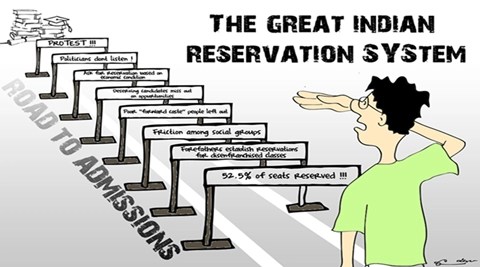
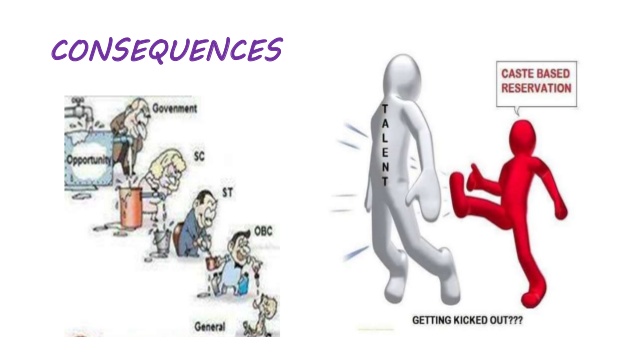
The caste discriminations were prevalent many years ago and now the lower castes have stepped up the social ladder and their is prevailing equity among all for the accessibility to education and employment so there is no more need for reservation. The road to success for the backward communities becomes easy these days but for others it is filled with hurdles and barriers. Although the reservation system plays a crucial role in the empowerment and upliftment of the socially and economically backward communities, to a large extent it degrades the quality of candidates and workers. Because in the competitive exams, entrance exams or for the job openings such people are limited to just a medium level of score to get qualified for the field and toil lesser which automatically impairs the quality of candidates. Imagine the plight of the candidates who travail more to reach the maximum marks framed for them just because they belong to the general class. The situation becomes vice versa again by disadvantaging and discriminating a group of people and fails to eliminate the notion. There are many who are impoverished in the general class but their hard work are underrated and not seriously taken into account as they belong to such class. Many upper class are still poverty- stricken and illiterates. Reservation is a weapon to address social and educational backwardness but it is not the complete solution to all the social indispositions. The government can provide platforms to enhance the knowledge and cognition of such classes to ace in the exams or jobs by facilitating courses to make them qualified rather than minimizing the scores to be obtained and making it a challenge for the other classes. It also brings down the economic growth of the country as it lowers the efficacy of labor.

Everyone should be equally offered with opportunities, that should be the crux of equality but it should be left in their hands how to utilize it and come up in life.