

Tag: Public Participation
Design and Implementation of a Public Participation Process
A public participation process is designed and implemented in four discreet stages, as outlined below.
1) Preliminary Design
- Situation analysis
- Decision process
- Information exchange
- Public and stake-holders
- Planning team
- Approvals
2) Developing the Plan
- Establish objectives
- Identify and address major issues
- Identify and involve the stakeholders
- Choose techniques
- Prepare to provide and receive information
- Develop critical path
- Budget, staff, resources, logistics, roles and responsibilities
- Prepare to give and get feedback
3) Implementation
- Follow the critical path
- Apply techniques
- Provide and receive information
- Monitor the process
4) Feedback
- Report to decision makers
- Report to participants
- Evaluate the overall process
Techniques

A number of emerging public participation techniques provide the opportunity for shared engagement, which has been difficult to achieve with traditional techniques. Traditional techniques include print publications, public meetings, open houses, advisory committees, workshops, bilateral meetings, and focus groups. Emerging techniques include open space technology, future search conferences, policy dialogue, and a suite of electronic techniques. In general, emerging techniques offer more in-depth opportunities for dialogue and collaboration, with emphasis on value exploration and reaching consensus on shared outcomes in complex situations. It should be noted that public servants and community groups have numerous opportunities to interact with each other, exchange information and gain a better understanding of each other’s views and interests.
Citizen participation is mainly seen as an instrument to strengthen and support the way representative democracy is functioning now. The local or national government should take and keep the initiative in policy-making. Initiatives ought to be taken from above. The process of involving citizens in politics and policy-making should not lead to the erosion of the primacy of the representative institutions. The central focus of thought is not on citizens, but on the government. The role of participation is mainly an instrumental one. That is, its main objective is to give citizens and their organizations a say in the official political process. Participation is not regarded as a value in itself, but is merely aimed at producing a government.
How to ensure Public Participation in Plan Formulation and Implementation
Public participation has gradually emerged in urban planning since 1960’s. China has introduced public participation concept in urban planning practices for over 20 years. The purpose of public participation is to change the pattern of elite planning, ensure the public benefits and democratic rights, improve the feasibility and practicability of the planning schemes together with the democracy in the planning decision making process.

The approach of planning should be shifted from top‐down to bottom‐up approach to make planning process more inclusive, comprehensive, and sustainable. Greater public acceptability is desirable, to ensure that plans are relevant. People can participate in the development process in the following realms:
- Pre‐plan participation in decision making in vision development, for identification of development priorities.
- Post‐plan participation before finalization and implementation of development programmes and priorities.
- Participation during implementation and evaluation of development programmes and project.
- Participation and sharing the benefits of development, managing the assets etc.
- e‐Platform and crowd sourcing are coming up as new modes of obtaining feedback speedily.
Taking into account the interest, attitude and behaviour of the people, role of urban development professionals and obligations of local authority, a system of participatory plan approach has been suggested.
The suggested indirect participation of the people is ensured through elected representatives in the Municipal Council / Corporation and Ward committees. The direct participation can be through individuals, citizens, neighbourhood, business, consumer and other such groups. There are several mechanisms and avenues for people’s participation available today, few of these have been presented below. Such mechanisms and avenues can be used to bring wider and more interactive participation of public in planning and developmental process.
Participatory planning approach
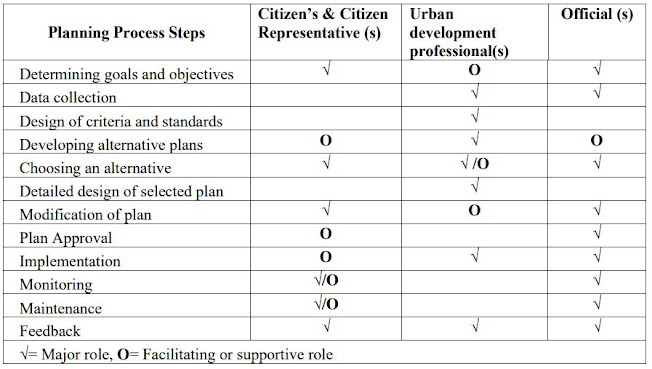
1) Community Design Characteristics
It is a multiple day interactive meetings, workshops and site walks/visits that fosters diverse and community sourced ideas.
2) Advisory Committees
Committees made up of representatives guide planning efforts over an extended period of time while regularly meeting during the planning process.
3) Low cost Demonstrations and Transformations
Use of blocks and day to day objects to create a low cost model of proposals for visual understanding. Relatively inexpensive temporary transformations are made to test the project and experience changes.
4) Focus Groups
Allow small groups of stakeholders to provide their knowledge of a project area and discuss their concerns and issues with local authority staff, planning consultants etc.
5) Other
Citizens report card, participatory mapping and participatory budgeting etc.
People can make contributions to the planning process at the implementation stage only if they are presented with a well-articulated and feasible framework of approaches, objectives, alternatives, etc. The participation of the people in local development programme provides the best guarantee that adequate action will be taken in the area itself. Public participation also creates an awareness of the problem and possible solutions among the people and thereby equip them as citizens to exercise choices relevant to development in a rational manner. When such a participation is institutionalized a stable base is created for decentralized exercise of power both on territorial as well as functional bases.
People’s participation has acquired greater significance in a country like ours which is striving hard since independence to bring an overall socio-economic change through democratic processes. Community development and Panchayati Raj were aimed at securing people’s participation in the planning and execution of the programme as a vital aspect of community development. To expand the democratic basis of development policies and administrative actions public cooperation has assumed great significance. Public cooperation is sought in almost each phase of governance and the entire multifaceted development of the people m the various fields, viz., social, economic, educational, cultural and moral. Involvement and sharing of the people in the process of development, particularly m decision making, planning and implementation is in the interest of good government and good administration
In a democratic society participation gives the ordinary citizen a means of voicing his opinion and of showing by his behaviour and action that he is able to take on responsibilities. It gives the ordinary citizen a chance to show his willingness to carry out constructive public work and to demonstrate his good citizenship by other means than periodically exercising his right to vote. Participation involves a factor of determination on the part of the person participating. It is in the sense participation means self-motion. People’s participation or involvement can be better understood in four senses:Participation in decision making
- Participation m implementation of development programme and projects
- Participation m monitoring and evaluation of development programmes and projects
- Participation in sharing the benefits of development principles
Public participation is the involvement of people in the creation and management of their built and natural environments. Its strength is that it cuts across tradition professional boundaries and cultures. The activity of community participation is based on the principle that the built and natural environments work better if citizens are active and involved in its creation and management instead of being treated as passive consumers. The main purposes of participation are :
To involve citizens in planning and design decision making processes and, as a result, make it more likely they will work within established systems when seeking solutions to problems
- To provide citizens with a voice in planning and decision making in order to improve plans, decisions, service delivery and overall quality of the environment
- To promote a sense of community by bringing together people who share common goals
Participation should be active and directed, those who become involved should experience a sense of achievement. Traditional planning procedures should be re-examined to ensure that participation achieves more than a simple affirmation of the designers or planners intentions.
 Eduindex