

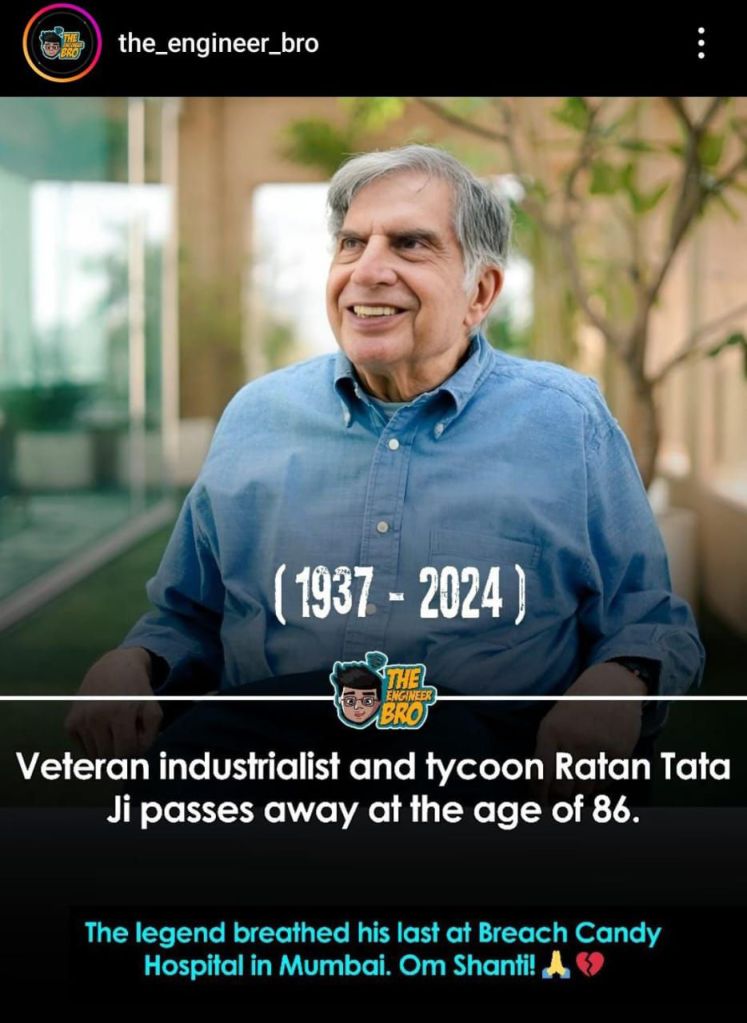
Ratan Naval Tata is one of India’s most influential industrialists, philanthropists, and visionaries, known for his leadership of Tata Group, India’s largest and most diverse conglomerate. Born on December 28, 1937, in Mumbai, Ratan Tata comes from the prominent Tata family, which has played a crucial role in India’s industrial development for more than a century.
Early Life and Education:
Ratan Tata was born to Naval Tata and Sonoo Tata. His parents separated when he was young, and he was raised by his grandmother, Lady Navajbai Tata. Despite his privileged background, Ratan Tata had a modest upbringing, instilled with a sense of responsibility and humility.
For his early education, Ratan Tata attended Campion School in Mumbai and then Cathedral and John Connon School, followed by studies at Bishop Cotton School in Shimla. After completing his schooling, he went to the United States, where he earned a degree in Architecture and Structural Engineering from Cornell University in 1962. Later, he attended the Advanced Management Program at Harvard Business School in 1975.
Early Career:
After completing his studies, Ratan Tata worked briefly at Jones and Emmons, a Los Angeles-based architectural firm, before returning to India in 1962 to join the Tata Group. His first assignment within the Tata Group was on the shop floor at Tata Steel in Jamshedpur, where he worked alongside blue-collar workers. This experience allowed him to understand the inner workings of the business from the ground up.
Rise to Leadership:
In 1991, Ratan Tata succeeded J.R.D. Tata as the chairman of Tata Sons, the holding company of the Tata Group. His appointment was met with some resistance from senior executives within the group, as many doubted his ability to manage such a vast and complex business empire. However, under Ratan Tata’s leadership, the Tata Group transformed into a global entity, expanding its footprint internationally.
Major Accomplishments and Leadership:
1. Global Expansion: One of Ratan Tata’s key achievements was transforming Tata Group from a primarily India-centric company to a global powerhouse. Under his leadership, Tata Motors acquired British automotive brands Jaguar and Land Rover (JLR) in 2008, which was one of the most high-profile acquisitions in Indian corporate history. Similarly, Tata Steel acquired Corus, an Anglo-Dutch steel company, in 2007, making Tata Steel one of the largest steel producers in the world.
2. Tata Consultancy Services (TCS): Ratan Tata played a crucial role in shaping Tata Consultancy Services (TCS) into a global leader in IT services. TCS became India’s first IT company to cross $100 billion in market capitalization, making it a flagship enterprise within the group and a significant player in the global IT industry.
3. Tata Nano: One of Ratan Tata’s most ambitious projects was the launch of the Tata Nano in 2009, an ultra-affordable car designed to provide an alternative to two-wheelers for the masses in India. Although the Nano didn’t succeed commercially as expected, it demonstrated Tata’s innovative thinking and commitment to improving the quality of life for the common Indian.
4. Diversification: Under Ratan Tata, the Tata Group diversified into numerous sectors, including telecommunications, luxury hotels, and aviation. Notable ventures include Tata Communications, Tata Sky, and Taj Hotels.
5. Philanthropy and Social Contributions: Ratan Tata’s commitment to philanthropy is as significant as his business achievements. The Tata family, through Tata Trusts, has long been involved in numerous philanthropic activities, and under Ratan Tata’s guidance, these efforts were expanded further. Approximately 66% of Tata Sons is owned by charitable trusts, making Tata Group unique in its approach to business with a purpose beyond profit.
The Tata Trusts have contributed to a wide range of causes, including education, healthcare, rural development, and scientific research.
Ratan Tata himself has personally invested in various social ventures, particularly focusing on innovations in healthcare and education for the underprivileged.
Personal Life and Values:
Ratan Tata is known for his humility, ethical leadership, and deep sense of integrity. Despite his enormous wealth and power, he is recognized for his simple lifestyle, rarely seen in public limelight, and is famously private. He is unmarried, and though he had several close relationships in his life, he never married, a decision that remains a part of his personal story.
Tata is passionate about animals, especially dogs, and has often been photographed with his pets. He is also a lover of cars and aviation, holding a pilot’s license and personally flying some of Tata’s corporate jets.
Retirement and Legacy:
In 2012, at the age of 75, Ratan Tata stepped down as chairman of Tata Sons, handing over the reins to Cyrus Mistry. However, following a controversial boardroom battle in 2016, Tata briefly returned as interim chairman until a new successor, Natarajan Chandrasekaran, was appointed in 2017.
Even after retirement, Ratan Tata remains actively involved in mentoring young entrepreneurs. Through Ratan Tata’s personal investments, he has supported numerous startups, especially in the tech and healthcare sectors, including companies like Ola, Paytm, and UrbanClap. His deep interest in innovation and supporting the next generation of entrepreneurs showcases his forward-thinking mindset.
Honors and Recognition:
Ratan Tata’s leadership and humanitarian contributions have earned him numerous accolades:
Padma Bhushan (2000) and Padma Vibhushan (2008), India’s third and second-highest civilian honors, respectively.
Honorary Knight Commander of the Order of the British Empire (KBE) in recognition of his contribution to Indo-British relations.
Lifetime Achievement Award from various prestigious organizations, including the Rockefeller Foundation.
Honorary degrees from several universities around the world, including Harvard, where he remains an influential figure in the academic community.
Conclusion:
Ratan Tata’s leadership has left a lasting impact on India and the world. He is celebrated not only for his visionary business acumen but also for his unwavering commitment to ethical values and philanthropy. Through his leadership of the Tata Group, he has fostered a culture of innovation, social responsibility, and sustainable development. His legacy continues to inspire future generations of entrepreneurs and business leaders both in India and globally.
 Eduindex
You must be logged in to post a comment.