THE TOP 6 COMPANIES WITH THE BEST CSR REPUTATION

By: Moksha Grover

Image credit: Relocation Africa Group

WHAT IS CORPORATE SOCIAL RESPONSIBILITY (CSR)?

Its been six years of the advent of the Companies Act, of 2013 that obligated companies to contribute over a specific size and profitability, a portion of their profits or benefits towards societal development, discourses about corporate social responsibility, or CSR, is all over the place. There have been workshops, seminars, meetings, newspaper articles, and award distribution ceremonies galore on the matter.  Today, CSR has become an important aspect for all companies in contributing towards both, society as well as increasing the brand value reputation of the companies. As corporate social responsibility (CSR) is not compulsory, many companies might not prioritize it or engage in it. However, there are many companies ranging from middle-class companies to highly valued companies who have contributed a lot to CSR and continue to contribute, knowing its importance. The top 6 companies with the best CSR reputation are:

INFOSYS LIMITED

Image credit: Alamy

Infosys Limited is ranked as the top company in India, contributing the most towards CSR. Being an early adopter of corporate social responsibility (CSR) initiatives, its contributions to the environment and society have been key factors in the holistic growth of its business.

The company spent nearly Rs. 360 crores on various CSR schemes in the financial year 2019-20[1]. It has contributed to many covid relief works and among its main CSR initiatives in the financial year, 2019-20 were a 100-bed quarantine set up in Bengaluru in partnership with Narayana Health City, and another one which had 182 beds for COVID-19 patients for Bowring and Lady Curzon Medical College & Research Institute[2]. This company has also established the Infosys foundation— a nonprofit nodal body aimed at contributing toward community and society development and betterment and also fulfilling its CSR commitments. Infosys Foundation has worked with many non-government organizations for implementing its projects. Highlights of the Foundation’s interventions in the past include the introduction of Aarohan Social Innovation Awards, restoration of water bodies in Karnataka, enabling the pursuit of access and excellence in sports through the GoSports Foundation, and disaster relief efforts in Tamil Nadu, Karnataka, and Kerala[3].
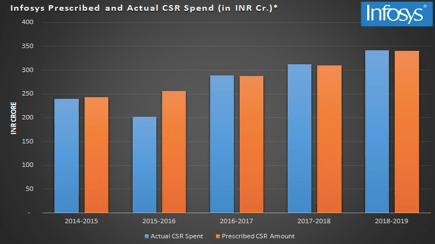
Image credit: The CSR journal

The above graph shows CSR spending of Infosys Ltd. in the last 5 years[4]

ROLEX WATCH CO. LTD.
Image credit: prezi.com

Rolex has been on the top 10 list of the most reputable companies in the world for four consecutive years. Rolex’s success is attributed to the authenticity and longevity of its charity work. By investing in and committing to long-term social enterprise projects, Rolex has an impressive record of over forty years of philanthropic work[5]. The Rolex Awards for Enterprise which were established to commemorate the 50th anniversary of the Oyster Chronometer is a great example of CSR activity carried out by the company. All the individuals who demonstrate leadership and entrepreneurialism in the areas of technology, applied sciences, and the environment are presented with these awards. Since the inception of the Awards, 33,000 people from over 190 countries have applied, and 140 laureates have been selected[6]. These laureates have worked on projects benefitting millions of people in 60 countries across the globe[7]. Several initiatives under the Rolex Perpetual Planet have been taken up for upgrading our environment. These include watching over the Earth’s blue heart, Heroes of the Oceans, and Paula Kahumbu: defending rights for elephants.

MAHINDRA AND MAHINDRA LTD.

Image credit: Avinash Chandra

Mahindra and Mahindra ltd. is known for its contributions to climate change and sustainable business practices. The company spent INR 93.50 crores on CSR initiatives during the financial year 2018-19[8]. The biggest CSR project for educating girls in India known as Nanhi Kali was conducted by Mr. Mahindra. This project provides free education to girls, who belong to low-income backgrounds and also empowers their families. The group works closely with non-profits like Naandi Foundation, which feeds over 1.3 million government school children every[9]. This project also encourages environment-friendly farming practices by working with many small farmers. Mahindra and Mahindra Ltd. has also won the award for India’s best CSR project in the Environment and Sustainability category for its green initiative of project Hariyali, which aims at planting 1 million trees on India’s green cover every year. In the financial year 2019-20, Mahindra & Mahindra planted 1.32 million trees, taking the total tally to 17.93 million trees[10]. Of these, 10.78 million trees have been planted in the Araku Valley, which besides greening the environment, also provides livelihood support to tribal farmers growing coffee in the region[11]. The company’s other CSR projects include Mahindra Pride schools: a unique 90-day livelihood training program for youths from socially and financially disadvantaged communities, Integrated Watershed Management Programme, saving a life with safer roads, employee social options, and covid-19 releif[12].
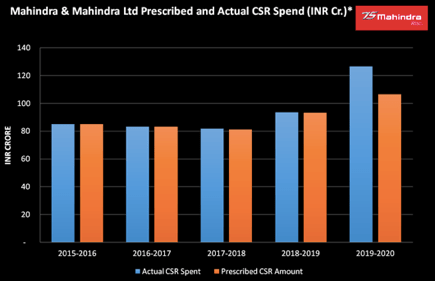
Image credit: The CSR Journal

The above graph shows the CSR Spends of Mahindra and Mahindra Limited for the last five years.

WALT DISNEY COMPANY

Image credit: Money Inc

Considering the Walt Disney company CSR report, it can be said that it is well organized, and consistent, and is in connection with the global reporting initiative (GRI) too.  The company has contributed a lot towards renewable energy, workforce investment, community engagement, charitable giving, and diversity and inclusion. In the financial year of 2019-20, Disney brought online a massive 270-acre, 50+-megawatt solar facility onsite in Orlando, in collaboration with the Reedy Creek Improvement District and Origis Energy USA[13]. The facility generates enough power from the sun to operate two of the four theme parks at Walt Disney World annually[14]. This, along with other initiatives, helped to reduce the net emissions by 47% in FY19 from 2012 levels[15].

Disney has also donated a lot towards workforce investment, supporting the long-term career goals of its employees through education.

The company is investing $150 million over the first five years to cover 100% of employee tuition, books, and education fees[16].

Disney also gave $338.2 million in cash and in-kind donations to non-profit organizations that bring comfort, inspiration, and opportunity to kids, families, and communities around the world[17].
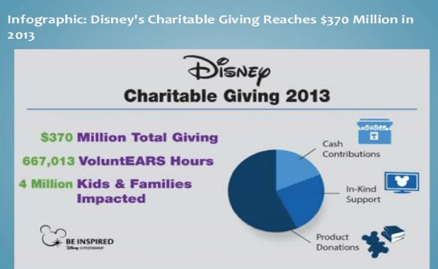
Image credit: Slideshare

COCA- COLA COMPANY

Image credit: India Frontline

Coca-Cola aims to create a sustainable and better future. For this, they follow various activities like Focusing on a World Without Waste, Maximising water conservation, reducing carbon footprint, etc.

In addition to this, all the countries where coca-cola has its market, have increased employment and helped to raise the standard of living which has, in turn, helped to strengthen the national economy.

The company has also launched its project known as the last mile, which aims to expand access to HIV and malaria medicines across Africa. The Coca-Cola Foundation recently awarded a $2 million grant to Project Last Mile—$1 million for South Africa and $1 million for additional countries across the continent—as part of the foundation’s $20 million “Stop the Spread” fund[18]. An additional $500,000 grant from The Coca-Cola Foundation has supported COVAX, a program co-led by the World Health Organization (WHO) to ensure equitable global access to COVID-19 vaccine tests and treatments in the world’s poorest countries[19].

The company also aims at making all its packaging 100% recyclable and also reduce its carbon emissions 25% by 2030 from a 2015 base year[20]
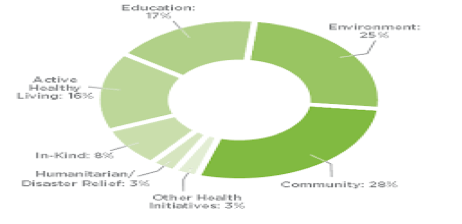
Image credit: research-methodology.net

TATA CHEMICALS LTD.

Image credit: csrbox.org

The CSR model of Tata chemicals limited is very unique. Although the prescribed CSR for 2019-2020 was 21.39 Crores, the company went on to spend 37.81 crores on community development projects[21]. Tata Chemicals spends INR 12 crores on CSR annually, and wildlife conservation accounts for 30% of the budget of the TCSRD[22]. The company has also established the Tata Chemicals society for rural development. The company’s CSR agenda also focuses on empowerment, inclusion—especially of women and socially backward communities, volunteering, technology, innovation, etc. At Okhai, the company provides sustainable livelihood to 900 rural women artisans by applying their traditional handicraft-making skills to create marketable products[23].

Blossom: Promotion and development of native handicrafts •Enhance: Overall enhancing the quality of life, Aspire: Education and vocational skill development, Conserve: Investment in Bio-diversity, natural resource, and climate change management leading to increase in environmental sustainability, Nurture: Health care, sanitary solutions, and safe drinking water are some of the other projects taken up by Tata chemicals ltd[24].
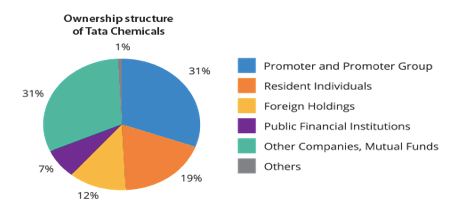
Image credit: Tata Chemicals

[1]  Kasmin Fernandes and Hency Thacker, ‘Top 100 companies in India for CSR in 2020’, The CSR Journal (November 3,2020) < https://thecsrjournal.in/top-indian-companies-for-csr-in-2020/> accessed 18th October,2021

[2] Ibid.

[3] Ibid.

[4]  Hency Thacker, ‘The Ultimate Report on CSR of Infosys Limited’, The CSR Journal (May 18,2021) < https://thecsrjournal.in/infosys-csr-report-india-2020/> accessed 18th October,2021.

[5]  GivingForce Team, ‘Rolex: CSR Business Model Analysis’, GivingForce (July 18, 2018) <https://www.givingforce.com/rolex-csr-business-model-analysis/ > accessed 18th October,2021

[6] Felix Scholz, ‘LIST: 5 times Rolex helped to make the world a better place (for more than just your wrist)’, Time Tide (September 26,2016) < https://timeandtidewatches.com/list-5-ways-rolex-helped-change-the-world/> accessed 18th October,2021.

[7] Ibid.

[8] Kasmin Fernandes and Hency Thacker (n 1)

[9] Ibid.

[10]  Hency Thacker, ‘The Complete CSR Report of Mahindra and Mahindra Limited’, The CSR Journal (January 27, 2021)< https://thecsrjournal.in/mahindra-csr-corporate-social-responsibility-activities-report/ > accessed 18th October,2021.

[11] Ibid.

[12] Ibid.

[13] ‘Disney Publishes its 2019 Corporate Responsibility Report’, The Walt Disney Company (March 12,2020)< https://thewaltdisneycompany.com/disney-publishes-its-2019-corporate-responsibility-report/ > accessed 18th October,2021.

[14] Ibid.

[15] Ibid.

[16] Ibid.

[17] Ibid.

[18] ‘Iteration, for Good: How Project Last Mile is Supporting Covid-19 vaccine distribution in Africa and Beyond’, The CocaCola Company (September 20,2021)< https://www.coca-colacompany.com/news/project-last-mile-covid-19-vaccine-distribution > accessed 18th October,2021.

[19] Ibid.

[20] ‘Sustainable Business’, The CocaCola Company <https://www.coca-colacompany.com/sustainable-business > accessed 18th October 2021

[21] Kasmin Fernandes and Hency Thacker (n 1)

[22] Ibid.

[23] Alka Talwar, ‘Championing CSR’, Tata (March,2018) < https://www.tata.com/newsroom/alka-talwar-championingcsrtatagroup#:~:text=Tata%20Chemicals%20works%20closely%20with,technology%20and%20innovation%2C%20and%20volunteering.> accessed 18th October,2021

[24] Amit Khurana, ‘India’s Top 10 Companies for CSR Initiatives in 2018’, Cross Barriers (November 8,2018)< https://crossbarriers.org/indias-top-companies-for-csr-initiatives-in-2018/ > accessed 18th October,2021.


WANT TO BUILD INTEGRITY? 7 EASY STEPS

Step 1:Fulfill Your Promises

The first step towards building the integrity is to keep the promises that a person has made. If a person is not sure that he will be able to meet his promise, then he/she should not affirm to it.

For Example, If a person has promised to attend an organisational event, then he/she should definitely attend that event without any fail. This will depict that he/she is a person of words, who keep all his promises which will help in achieving a high respect in the organisation.

8 Daily Promises Uncommonly Successful People Make | Inc.com

Step 2:Keep your Appointments

The second step towards the evolution is to be on time in all meetings as it describes punctuality and responsiveness of a person.

For Example, If a person has a meeting scheduled at 6 PM, then he should be present there by 5:50 so that there is no delay in meeting due to that person. Reaching a meeting after the scheduled time of commencing, act as a barrier in the process of building high integrity and results in bad image with other members present in that meeting.

Step 3:Get Comfortable With Saying “No”

The next step towards building integrity is that a person should have guts to say that he will not be able to do a work. If he will keep on saying ‘yes’ to all the work, then he will face a pressure of doing all the tasks and will not be able to perform any of that task properly.

For Example, if a person knows that a task already given to him will consume a day and need to be submitted the next day , in this situation if  he is asked to do some work of his team member also, then he should not agree to do it, telling that he already has some work pilled up .

How to say no, without saying no. - Project Management Articles, Webinars,  Templates and Jobs

Step 4:Examine Your Reaction In Tough Situations

This step depicts that a person should record that how he reacts in different situations and should analyse the reason for that reaction. This will help him to analyse that how he can deal with the matter in a better manner.

For Example, If a person feel panic with deadline coming closer, he should take a note of it and should work in finding a solution of solving this problem. He should analyse that how he could have handled the situation in a  better manner.

Step 5:Your Attitude towards Money

This step deals with analyzing that what is the worth of money in the actions of a person.

For Example if a person is doing a work for sole purpose of earn money, then the person is said to be of low integrity but if he values his goals more than money, then he is said to be a person of high integrity.

Step 6:Define Your Values And Vision

This step depicts that a person need to have a clarity about individual goals and values and should analysing that how a company and that person can play a crucial role in achieving the goals and vision of each other. This will bring a confidence in the person that the organisation will bring him close to his goals which will motivate him to perform better.

For Example, if a person is not clear with his goals, he will doubt his decision and will not be able to perform well. He will have a low will to perform and will not be able to perform with his full callable  which  is a barrier in effectively and efficiently achieving the goals of that organisation.

Step 7:Stay Committed

The last step towards building a high integrity is that the person need to have faith in himself and his decisions. He should not get demotivated from the challenges and should keep on giving his best and he will surely be able to achieve his goals.

For Example, An employee can’t fulfill all his goals on the first day of his job. There is a requirement of firm determination and devotion of that employee towards work which makes it possible that he the vision with which he has joined that organisation.

DEFAMATION

Introduction 

Every Person has right to maintain and preserve his reputation. The Right of reputation is more valuable than right to property. Law gives protection to a man’s reputation. Chapter XXI, Section  499 to 502 of Indian Penal Code relates to offenses of Defamation. 

Meaning of Defamation 

   When injury caused to the reputation of a person it can be termed as defamation. Defamation is both a crime and civil wrong

Definition of defamation

Section 499 of Indian Penal Code defines defamation with for Explanations and ten exceptions and number of illustrations

 Defamation 

 “whoever by words either spoken or intended to be read, or by signs or by visible representations, makes or publishes any imputation concerning any person intending to harm, or knowing or having reason to believe that such imputation will harm, the reputation of such person, is said, except in the cases hereinafter excepted, to defame that person.

The definition of the Defamation contains three essential elements

i) the person

ii) his reputation, and

iii) the harm to reputation of the person with necessary mens rea  (guilty mind)

Essential Ingredients

                         The offence of defamation consists of the following essential Ingredients :

1) Making or Publishing of an Imputation concerning person. 

2) Such Imputation must have made by

     i) words either Spoken or

     ii) signs or

     iii)  visible representations;

3)  offender intends to harm, or knows or has reson to believe that such imputation will harm the reputation of that person.

Explanations 

  1. It may amount to defamation to impute anything to a deceased person, if the imputation would harm the reputation of that person if living, and is intended to be hurtful to the feelings of his family or other near relatives.
  2. It may amount to defamation to make an imputation concerning a company or an association or collection of persons as such.
  3. An imputation in the form of an alternative or expressed ironically, may amount to defamation.
  4. No imputation is said to harm a person’ reputation, unless that imputation directly or indirectly, in the estimation of others, lowers the moral or intellectual character of that person, or lowers the character of that person in respect of his caste or of his calling, or lowers the credit of that person, or causes it to be believed that the body of that person is in a loathsome state, or in a state generally considered as disgraceful.

Examples 

  1. A says-“Z is an honest man; he never stole B’ watch”, intending to cause it to be believed that Z did steal B’ watch. This is defamation, unless it fall within one of the exceptions.
  2. A is asked who stole B’ watch. A points to Z, intending to cause it to be believed that Z stole B’ watch. This is defamation, unless it fall within one of the exceptions.
  3. A draws a picture of Z running away with B’ watch, intending it to be believed that Z stole B’ watch. This is defamation, unless it fall within one of the exceptions.

Exceptions 

1) Imputation of truth which public good requires to be made or published –

                  It is not defamation to impute anything which is true concerning any person, if it be for the public good that the imputation should be made or published. Whether or not it is for the public good is a question of fact.

2) Public conduct of public servants – 

                   It is not defamation to express in good faith any opinion whatever respecting the conduct of a public servant in the discharge of his public functions, or respecting his character, so far as his character appears in that conduct, and no further.

3) Conduct of any person touching any public question. –

                   It is not defamation to express in good faith any opinion whatever respecting the conduct of any person touching any public question, and respecting his character, so far as his character appears in that conduct, and no further.

Example

It is not defamation in A to express in good faith any opinion whatever resepting Z’ conduct in petitioning Government on a public question, in signing a requisition for a meeting on a public question, in presiding or attending at such meeting, in forming or joining any society which invites the public support, in voting or canvassing for a particular candidate for any situation in the efficient discharge of the duties of which the public is interested.

4) Publication of reports of proceedings of courts –

                 It is not defamation to publish a substantially true report of the proceedings of a Court of Justice, or of the result of any such proceedings.

         Explanations – A Justice of the Peace or other officer holding an inquiry in open Court preliminary to a trial in a Court of Justice, is a Court within the meaning of the above section.

5) Merits of case decided in Court or conduct of witnesses and others concerned –

                  It is not defamation to express in good faith any opinion whatever respecting the merits of any case, civil or criminal, which has been decided by a Court of Justice, or respecting the conduct of any person as a party, witness or agent, in any such case, or respecting the character of such person, as far as his character appears in that conduct, and no further.

Examples – 

a) A says-“I think Z’ evidence on that trial is so contradictory that he must be stupid or dishonest.” A is within this exception if he says this in good faith, inasmuch as the opinion which he expresses respects Z’ character as it appears in Z’ conduct as a witness, and no farther.

b) But if A says-“I do not believe what Z asserted at that trial because I know him to be a man without veracity”; A is not within this exception, inasmuch as the opinion which expresses of Z’ character, is an opinion not founded on Z’ conduct as a witness.

6) Merits of public performance –

                    It is not defamation to express in good faith any opinion respecting the merits of any performance which its author has submitted to the judgment of the public, or respecting the character of the author so far as his character appears in such performance, and no farther .

Explanation  –

          A performance may be submitted to the judgment of the public expressly or by acts on the part of the author which imply such submission to the judgment of the public .

Examples –

a) A person who publishes a book, submits that book to the judgment of the public.

b) A person who makes a speech in public, submits that speech to the judgment of the public.

c) An actor or singer who appears on a public stage, submits his acting or singing to the judgment of the public.

d) A says of a book published by Z -“Z’ book is foolish; Z must be a weak man. Z’ book is indecent; Z must be a man of impure mind.” A is within the exception, if he says this in good faith, inasmuch as the opinion which he expresses of Z respects Z’ character only so far as it appears in Z’ book, and no further.

e) But if A says -“I am not surprised that Z’ book is foolish and indecent, for he is a weak man and a libertine.” A is not within this exception, inasmuch as the opinion which he expresses of Z’ character is an opinion not founded on Z’ book.

7) Censure passed in good faith by person having lawful authority over another –

                         It is not defamation in a person having over another any authority, either conferred by law or arising out of a lawful contract made with that other, to pass in good faith any censure on the conduct of that other in matters to which such lawful authority relates .

Example –

       A Judge censuring in good faith the conduct of a witness, or of an officer of the Court; a head of a department censuring in good faith those who are under his orders; a parent censuring in good faith a child in the presence of other children; a schoolmaster, whose authority is derived from a parent, censuring in good faith a pupil in the presence of other pupils; a master censuring a servant in good faith for remissness in service; a banker censuring in good faith the cashier of his bank for the conduct of such cashier as such cashier are within this exception .

8) Accusation preferred in good faith to authorized person –

                       It is not defamation to prefer in good faith an accusation against any person to any of those who have lawful authority over that person with respect to the subject-matter of accusation .

Example – 

       a) If A in good faith accuses Z before a Magistrate; if A in good faith complains of the conduct of Z, a servant, to Z’ master;if A in good faith complains of the conduct of Z, a child, to Z’ father-A is within this exception .

9) Imputation made in good faith by person for protection of his or other’ interests –

                         It is not defamation to make an imputation on the character of another provided that the imputation be made in good faith for the protection of the interest of the person making it, or of any other person, or for the public good.

Examples 

a) A, a shopkeeper, says to B, who manages his business-“Sell nothing to Z unless he pays you ready money, for I have no opinion of his honesty.” A is within the exception, if he has made this imputation on Z in good faith for the protection of his own interests.

b) A, a Magistrate, in making a report to his own superior officer, casts an imputation on the character of Z. Here, if the imputation is made in good faith, and for the public good, A is within the exception.

10) Caution intended for good of person to whom conveyed or for public good –

                      It is not defamation to convey a caution, in good faith, to one person against another, provided that such caution be intended for the good of the person to whom it is conveyed, or of some person in whom that person is interested, or for the public good.

Punishment for defamation (Section 500 I.P.C) –

       Whoever defames another shall be punished with simple imprisonment for a term which may extend to two years, or with fine, or with both.

        The offence under Section 500 is non-cognizable, bailable, compoundable, with the permission of the Court, and triable by the Court of Session.  

 Printing or engraving matter known to be defamatory Section 501 – 

           Printing or engraving matter known to be defamatory – Whoever prints or engraves any matter, knowing or having good reason to believe that such matter is defamatory of any person, shall be punished with simple imprisonment for a term which may extend to two years, or with fine, or with both.

Sale of printed or engraved substance containing defamatory matter Section 502 – 

          Sale of printed or engraved substance containing defamatory matter – Whoever sells or offers for sale any printed or engraved substance containing defamatory matter, knowing that it contains such matter, shall be punished with simple imprisonment for a term which may extend to two years, or with fine, or with both.

    The offence under section 502 is non-cognizable, bailable, compoundable and triable by the Court of Session