Skill Development in a Theoretical Framework for Early Academic Researchers

 Skill development is a crucial aspect of the academic journey, especially for early-stage researchers who are navigating the complexities of their fields. A theoretical framework that encompasses skill development provides a structured approach to understanding how various competencies can be cultivated, assessed, and applied in academic research. Theoretical perspectives on skill development include Constructivist Learning Theory, situated Learning Theory, and Competency-Based Education. Constructivist learning theory emphasizes the importance of active engagement with new information, integration with existing knowledge, and application in practical scenarios. This approach emphasizes the importance of mentorship, collaboration, and active participation in research activities. Situated learning theory suggests that learning occurs within a specific context and is inherently tied to the social and physical environment. For early researchers, engaging in collaborative projects, attending conferences, and participating in research groups can provide rich contexts for skill acquisition.

Competency-based education focuses on the mastery of skills and competencies rather than the mere completion of coursework. In the context of early academic research, this framework encourages researchers to identify specific skills necessary for their fields and seek out opportunities to develop and demonstrate these competencies. Assessment methods, such as portfolios or performance evaluations, can help track progress and ensure that researchers are adequately prepared for their academic careers. Practical applications of the framework include skill assessment and identification, targeted training and workshops, and mentorship and collaboration. Self-assessment helps early academic researchers identify their current skill levels and areas for improvement, while targeted training programs and workshops address the specific needs of early researchers. Mentorship relationships with experienced researchers offer guidance, insights, and constructive feedback, enhancing the learning process and exposing researchers to diverse methodologies and perspectives. In conclusion, a theoretical framework for skill development in early academic researchers is essential for fostering a supportive environment that encourages continuous learning and growth. By prioritizing skill assessment, targeted training, and mentorship, academic institutions can empower early researchers to thrive in their academic pursuits.

Eco-friendly solvents offer solutions for sustainable and diverse silk industry

 Researchers have found an eco-friendly approach that can eliminate the use of toxic chemicals in silk processing. 

Traditionally, toxic chemicals like sodium carbonate, sodium hydroxide, sulfuric acid, and lithium bromide have been used to extract silk proteins, fibroin and sericin from various types of raw silk fibers, an important step in the process of making silk from cocoons.

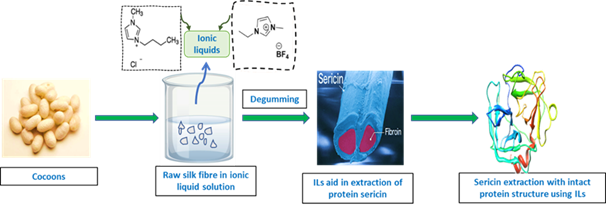
A team at Institute of Advanced Study in Science and Technology (IASST) Guwahati, an autonomous institute of Department of Science & Technology, has identified Ionic Liquids (ILs) which can be promising sustainable alternatives to the toxic chemicals currently in use for the silk protein extraction process.

The team led by Dr. Kamatchi Sankaranarayan has identified 4 different ILs that can be effective in extracting silk proteins from raw fibres.

This new research, published in Chemistry Select by Wiley Publishers, has potential for use in sericin extraction from both mulberry (Bombyx mori) and non-mulberry silks, such as Muga (Antheraea assamensis) and Eri (Philosamia ricini), indigenous to Northeast India.


The researchers explored six different ILs and found some of them were particularly effective in removing sericin without damaging the silk protein structure. The ones showing greatest promise included 1-Butyl-3-methylimidazolium chloride (BMIM.Cl), 1-ethyl-3-methylimidazolium tetrafluoroborate (EMIM.BF4), and Tetraethylammonium bromide (TEAB). TEAB appeared to be highly effective due to its ability to destabilize sericin proteins.

The research holds great significance for the silk industry. Not only does it offer a more environmentally friendly alternative to traditional chemical methods, but it also paves the way for efficient sericin extraction from non-mulberry silks, potentially leading to new applications for these unique fibers.

This is the first instance of using ILs for sericin extraction from non-mulberry silks, highlighting the potential of this new approach for a more sustainable and diverse silk industry.

****

Serves extraordinary researchers

 Jaipur: science and research have a huge importance in building up the strong nation. India contains many famous and prestigious government research institutes. Research institutes provide important impulses for the development of new products and cooperate in nearly every stage of the innovation process. It is a platform for new ideas, skills and innovations. The major benefits of studying in research institutions are having improved course selection, a chance to follow your passion and make a difference, high-level credentials, educational and career opportunities, and study under passionate educators.Government of India and some National agencies established many national and central institutes. These institute or centers improves services and treatments not just for you but also for future generations.Some national agencies are Council of scientific and Industrial Research (CSIR) is one of the world’s largest publicly funded Research and Development organization. It is a premier national R&D organization that has a number of institutes under it. Department of biotechnology (DBT) is responsible for administrating development and commercialization in the field of modern biology and biotechnology in India. Department of Science and Technology (DST) has responsibility of formulation S&t policies and their implementation, identification, and promotion of thrust areas of research in different sectors of Science & Technology(S&T); technology information, forecasting, and assessment; international collaboration, promotion of science & society programs and coordination of S&T activities in our country. Indian Council of Medical Research (ICMR) is the oldest medical research bodies in the world which formulate, coordinate and promote biomedical research. Indian Council of Agricultural Research (ICAR)This body is responsible for coordinating agricultural education and research in India. These institutions offer a unique and amazing career opportunities for the students. Students can develop effective communication, research, and analytical skills, and critical thinking expertise through detailed research. Students develop over all as there thinking skills, analytical skills and communication skills develops.

What is h-Index

 The h-index is an author-level metric that measures both the productivity and citation impact of the publications, initially used for an individual scientist or scholar.

The h index was proposed by J.E. Hirsch in 2005 and published in the Proceedings of the National Academy of Sciences of the United States of America.[i]  The h index is a quantitative metric based on analysis of publication data using publications and citations to provide “an estimate of the importance, significance, and broad impact of a scientist’s cumulative research contributions.”[ii]   According to Hirsch, the h index is defined as: “A scientist has index h if h of his or her Np papers have at least h citations each and the other (Np – h) papers have ≤h citations each.”

How Calculated: Number of papers (h) that have received at least h citations. 

As an example, an h index of 10 means that among all publications by one author, 10 of these publications have received at least 10 citations each.  

Hirsch argues that the h index is preferable to other single-number criteria, such as the total number of papers, the total number of citations and citations per paper. However, Hirsch includes several caveats:

  • A single number can never give more than a rough approximation to an individual’s multifaceted profile;
  • Other factors should be considered in combination in evaluating an individual;
  • There will be differences in typical h values in different fields, determined in part by the average number of references in a paper in the field, the average number of papers produced by each scientist in the field, and the size (number of scientists) of the field; and
  • For an author with a relatively low h that has a few seminal papers with extraordinarily high citation counts, the h index will not fully reflect that scientist’s accomplishments.[iii]
Hirsch stressed that the full career publications for an author should be used for the h index.

Since Hirsch introduced the index in 2005, this measure of academic impact has garnered widespread interest as well as proposals for other indices based on analyses of publication data such as the index, h (2) index, m quotient, index, to name a few.

The h-index has already been used by major citation databases to evaluate the academic performance of individual scientists. Although effective and simple, the h-index suffers from some drawbacks that limit its use in accurately and fairly comparing the scientific output of different researchers. These drawbacks include information loss and low resolution: the former refers to the fact that in addition to h2 citations for papers in the h-core, excess citations are completely ignored, whereas the latter means that it is common for a group of researchers to have an identical h-index.

Several commonly used databases, such as Elsevier’s Scopus, Clarivate Analytics’ Web of Science, and Google Scholar  provide h index values for authors.