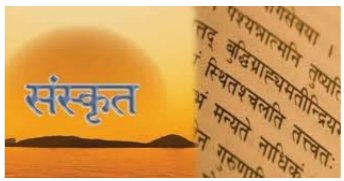
Sanskrit is a standardized dialect of Old Indo-Aryan, originating as Vedic Sanskrit as early as 1700-1200 BCE. One of the oldest Indo-European languages for which substantial documentation exists, Sanskrit is believed to have been the general language of the greater Indian Subcontinent in ancient times.
Sanskrit ; attributively संस्कृत-, saṃskṛta-; nominaly संस्कृतम्, saṃskṛtam, is a classical language of South Asia belonging to the Indo-Aryan branch of the Indo-European languages. It arose in South Asia after its predecessor languages had diffused there from the northwest in the late Bronze Age. Sanskrit is the sacred language of Hinduism, the language of classical Hindu philosophy, and of historical texts of Buddhism and Jainism. It was a link language in ancient and medieval South Asia, and upon transmission of Hindu and Buddhist culture to Southeast Asia, East Asia and Central Asia in the early medieval era, it became a language of religion and high culture, and of the political elites in some of these regions. As a result, Sanskrit had a lasting impact on the languages of South Asia, Southeast Asia and East Asia, especially in their formal and learned vocabularies.
Sanskrit generally connotes several Old Indo-Aryan varieties. The most archaic of these is Vedic Sanskrit found in the Rig Veda, a collection of 1,028 hymns composed between 1500 BCE and 1200 BCE by Indo-Aryan tribes migrating east from what today is Afghanistan across northern Pakistan and into northern India. Vedic Sanskrit interacted with the preexisting ancient languages of the subcontinent, absorbing names of newly encountered plants and animals; in addition, the ancient Dravidian languages influenced Sanskrit’s phonology and syntax. “Sanskrit” can also more narrowly refer to Classical Sanskrit, a refined and standardized grammatical form that emerged in the mid-1st millennium BCE and was codified in the most comprehensive of ancient grammars, the Aṣṭādhyāyī (“Eight chapters”) of Pāṇini.The greatest dramatist in Sanskrit, Kālidāsa, wrote in classical Sanskrit, and the foundations of modern arithmetic were first described in classical Sanskrit. The two major Sanskrit epics, the Mahābhārata and the Rāmāyaṇa, however, were composed in a range of oral storytelling registers called Epic Sanskrit which was used in northern India between 400 BCE and 300 CE, and roughly contemporary with classical Sanskrit. In the following centuries, Sanskrit became tradition-bound, stopped being learned as a first language, and ultimately stopped developing as a living language.
Sanskrit was considered as “Dev Bhasha”, “Devavani” or the language of the Gods by ancient Indians. The word sanskrita, meaning “refined” or “purified”, is the antonym of prakrita, meaning “natural,” or “vulgar. The corpus of Sanskrit literature encompasses a rich tradition of poetry and drama as well as scientific, technical, philosophical and dharma texts.
Sanskrit is the most ancient language and perfect among the great languages in the world.It is the greatest treasure given to the world by ancient India.
Sanskrit is the primary sacred language of Hinduism, and has been used as a philosophical language in the religions of Hinduism, Buddhism, and Jainism. Sanskrit is a standardized dialect of Old Indo-Aryan, originating as Vedic Sanskrit as early as 1700-1200 BCE.
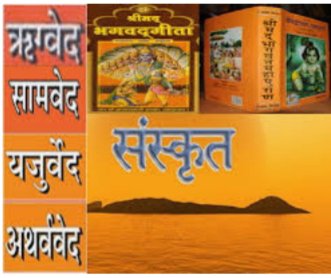
Vedic Sanskrit is the language of the Vedas, the most ancient Hindu scripts, compiled c. 1500-500 BCE. The Vedas contain hymns, incantations called Samhitas, and theological and philosophical guidance for priests of the Vedic religion. Believed to be direct revelations to seers among the early Aryan people of India, the four chief collections are the Rig Veda, Sam Veda, Yajur Vedia, and Atharva Veda. (Depending on the source consulted, these are spelled, for example, either Rig Veda or Rigveda.)
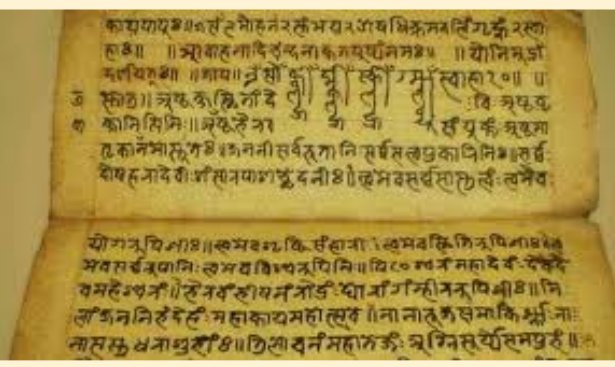
Vedic Sanskrit was orally preserved as a part of the Vedic chanting tradition, predating alphabetic writing in India by several centuries. Modern linguists consider the metrical hymns of the Rigveda Samhita, the most ancient layer of text in the Vedas, to have been composed by many authors over several centuries of oral tradition.
Sanskrit Literature began with the spoken or sung literature of the Vedas from c. 1500 BCE, and continued with the oral tradition of the Sanskrit Epics of Iron Age India, the period after the Bronze Age began, around 1200 BCE. At approximately 1000 BCE, Vedic Sanskrit began the transition from a first language to a second language of religion and learning.
Around 500 BCE, the ancient scholar Panini standardized the grammar of Vedic Sanskrit, including 3,959 rules of syntax, semantics, and morphology (the study of words and how they are formed and relate to each other). Panini’s Astadhyayi is the most important of the surviving texts of Vyakarana, the linguistic analysis of Sanskrit, consisting of eight chapters laying out his rules and their sources. Through this standardization, Panini helped create what is now known as Classical Sanskrit.
As we approach the change of times and as Indians rediscover their roots in their collective consciousness, we begin to reflect why and how the Europe-centric mind-set has pervaded and distanced us from our own languages, culture, traditions and knowledge. More and more countries are popularising the study of Sanskrit, not just for the spiritual, cultural and literary interest in the language, but also for the wealth of scientific knowledge available in Sanskrit texts.
Sanskrit is vital to Indian culture because of its extensive use in religious literature, primarily in Hinduism, and because most modern Indian languages have been directly derived from, or strongly influenced by, Sanskrit.
Knowledge of Sanskrit was a marker of social class and educational attainment in ancient India, and it was taught mainly to members of the higher castes (social groups based on birth and employment status). In the medieval era, Sanskrit continued to be spoken and written, particularly by Brahmins (the name for Hindu priests of the highest caste) for scholarly communication.
Today, Sanskrit is still used on the Indian Subcontinent. More than 3,000 Sanskrit works have been composed since India became independent in 1947, while more than 90 weekly, biweekly, and quarterly publications are published in Sanskrit. Sudharma, a daily newspaper written in Sanskrit, has been published in India since 1970. Sanskrit is used extensively in the Carnatic and Hindustani branches of classical music, and it continues to be used during worship in Hindu temples as well as in Buddhist and Jain religious practices. Sanskrit is a major feature of the academic linguistic field of Indo-European studies, which focuses on both extinct and current Indo-European languages, and can be studied in major universities around the world.
The corpus of Sanskrit literature encompasses a rich tradition of poetry and drama as well as scientific, technical, philosophical and dharma texts. Sanskrit continues to be widely used as a ceremonial language in Hindu religious rituals and Buddhist practice in the forms of hymns and mantras. The one country that still regards Sanskrit as a classical language containing merely religious literature is India. Sanskrit is a treasure and very relevant in the modern knowledge-society and is perhaps the future for science and technology.
Many universities in Europe and America are raising the level of Sanskrit proficiency in their departments, while India is still treating it as a third language meant to enhance scores in school transcripts, without real application. If there is one language that can be called the language of the future, it is undoubtedly Sanskrit.



 Eduindex
You must be logged in to post a comment.