Top Scholarship for African Scholars in Asia


  1. Japanese Government Scholarships (Monbukagakusho): These scholarships are offered by the Japanese government to international students, including Africans, for various academic programs at Japanese universities.

  2. Chinese Government Scholarship – Belt and Road Program: China offers scholarships to students from countries along the Belt and Road, including many African nations. These scholarships cover a wide range of academic fields and degree levels.

  3. Korean Government Scholarship Program (KGSP): The Korean government provides scholarships to international students, including Africans, for undergraduate and postgraduate studies in South Korea.

  4. TaiwanICDF Scholarship Program: The Taiwan International Cooperation and Development Fund (TaiwanICDF) provides scholarships for students from developing countries, including African nations, to pursue higher education in Taiwan.

  5. The Asia Foundation Development Fellows Program: While not a traditional scholarship, this program provides opportunities for professionals from Asian countries, including African nations, to enhance their leadership skills and contribute to positive social change.

  6. Malaysia International Scholarship (MIS): The Malaysian government offers scholarships to international students, including Africans, for postgraduate and postdoctoral studies in Malaysia.

  7. INSEAD Africa Leadership Fund: INSEAD, a business school with campuses in France, Singapore, and Abu Dhabi, offers scholarships to students from Africa. Check the specific eligibility criteria and application process on their official website.

It’s important to note that scholarship programs and eligibility criteria may change, so it’s recommended to visit the official websites of the respective scholarship providers for the most up-to-date information. Additionally, you may want to explore scholarship opportunities offered by specific universities or organizations in the Asian countries you are interested in.

Dumitru Baleanu

 Lebanese American University,Beirut, Professor at Institute of Space Sciences,Bucharest

TITLE

CITED BY

YEAR
New fractional derivatives with nonlocal and non-singular kernel: theory and application to heat transfer model

A Atangana, D Baleanu
Thermal Science 20 (2), 763-769
3328 2016
Fractional calculus: models and numerical methods

D Baleanu, K Diethelm, E Scalas, JJ Trujillo
World Scientific
2906 2012
A new collection of real world applications of fractional calculus in science and engineering

HG Sun, Y Zhang, D Baleanu, W Chen, YQ Chen
Communications in Nonlinear Science and Numerical Simulation 64, 213-231
1219 2018
Fractional dynamics and control

D Baleanu, JAT Machado, ACJ Luo
Springer Science & Business Media
904 2011
New trends in nanotechnology and fractional calculus applications

D Baleanu, ZB Güvenç, JAT Machado
Springer 10, 978-90
849 2010
A new study on the mathematical modelling of human liver with Caputo–Fabrizio fractional derivative

D Baleanu, A Jajarmi, H Mohammadi, S Rezapour
Chaos, Solitons & Fractals 134, 109705
604 2020
Local fractional integral transforms and their applications

XJ Yang, D Baleanu, HM Srivastava
Academic Press
529 2015
New properties of conformable derivative

A Atangana, D Baleanu, A Alsaedi
Open Mathematics 13 (1), 000010151520150081
524 2015
Anomalous diffusion expressed through fractional order differential operators in the Bloch–Torrey equation

RL Magin, O Abdullah, D Baleanu, XJ Zhou
Journal of Magnetic Resonance 190 (2), 255-270
505 2008
Discrete fractional logistic map and its chaos

GC Wu, D Baleanu
Nonlinear Dynamics 75, 283-287
499 2014
Caputo-type modification of the Hadamard fractional derivatives

F Jarad, T Abdeljawad, D Baleanu
Advances in Difference Equations 2012, 1-8
430 2012
On a new class of fractional operators

F Jarad, E Uğurlu, T Abdeljawad, D Baleanu
Advances in Difference Equations 2017 (1), 1-16
423 2017
Fractal heat conduction problem solved by local fractional variation iteration method

XJ Yang, D Baleanu
Vinca Inst Nuclear Sci
350 2013
A Hamiltonian formulation and a direct numerical scheme for fractional optimal control problems

OP Agrawal, D Baleanu
Journal of Vibration and Control 13 (9-10), 1269-1281
329 2007
Stability analysis of Caputo fractional-order nonlinear systems revisited

H Delavari, D Baleanu, J Sadati
Nonlinear Dynamics 67, 2433-2439
326 2012
A review of the Adomian decomposition method and its applications to fractional differential equations

JS Duan, R Rach, D Baleanu, AM Wazwaz
Communications in Fractional Calculus 3 (2), 73-99
321 2012
Integration by parts and its applications of a new nonlocal fractional derivative with Mittag-Leffler nonsingular kernel

T Abdeljawad, D Baleanu
arXiv preprint arXiv:1607.00262
308 2016
About Lagrangian formulation of classical fields within Riemann-Liouville fractional derivatives

D Baleanu, SI Muslih
International Design Engineering Technical Conferences and Computers and …
301 2005
Caputo-Fabrizio derivative applied to groundwater flow within confined aquifer

A Atangana, D Baleanu
Journal of Engineering Mechanics 143 (5), D4016005
292 2017
On some new properties of fractional derivatives with Mittag-Leffler kernel

D Baleanu, A Fernandez
Communications in Nonlinear Science and Numerical Simulation 59, 444-462

Top Scholarship for Students of Africa in Europe

 It’s essential to check the most recent information on scholarship websites or contact relevant institutions directly. However, I can provide you with some general tips on finding scholarships for African scholars in Europe and a few examples of prominent scholarships that were available in the past:

  1. Erasmus Mundus Programmes: The Erasmus Mundus Joint Master Degrees (EMJMDs) offer full scholarships to students from around the world, including Africa, to pursue a master’s degree in various fields. Check the official Erasmus Mundus website for the latest information.

  2. Eiffel Excellence Scholarship Programme (France): This program is offered by the French Ministry for Europe and Foreign Affairs to attract high-achieving international students, including Africans, to pursue a master’s or Ph.D. program in France.

  3. Swiss Government Excellence Scholarships (Switzerland): The Swiss government provides scholarships to promote international exchange and research collaboration. African scholars may be eligible for these scholarships to pursue research, Ph.D., or postdoctoral studies in Switzerland.

  4. Chevening Scholarships (United Kingdom): While Chevening primarily focuses on bringing future leaders, influencers, and decision-makers to the UK, African scholars can benefit from this scholarship to pursue a one-year master’s degree in various fields.

  5. DAAD Scholarships (Germany): The German Academic Exchange Service (DAAD) offers a range of scholarships for international students, including those from Africa, at various academic levels.

  6. Netherlands Fellowship Programs (Netherlands): The Dutch government provides fellowships for mid-career professionals and scholars from various countries, including Africa, to pursue short courses, master’s, or Ph.D. programs in the Netherlands.

Remember to check the eligibility criteria, application deadlines, and required documents for each scholarship program. Additionally, contact the respective scholarship providers or the international offices of universities for the latest and most accurate information. Always refer to the official websites of these organizations for the most up-to-date details on available scholarships and application procedures.


Scholarship Name Country Application Deadline Basic Qualifications Official Link
Erasmus Mundus Joint Master Degrees Europe (Various) Varies Varies based on specific program requirements Erasmus Mundus
Eiffel Excellence Scholarship France Annually (Varies) International students applying for master’s or Ph.D. Eiffel Scholarship
Swiss Government Excellence Scholarships Switzerland Varies Varies depending on the level of study (master’s, Ph.D., postdoc) Swiss Government Excellence Scholarships
Chevening Scholarships United Kingdom Annually (usually November) Full-time master’s degree in any subject, work experience, leadership qualities Chevening
DAAD Scholarships Germany Varies Varies depending on the specific scholarship program DAAD
Netherlands Fellowship Programs Netherlands Varies Mid-career professionals and scholars, various fields Netherlands Fellowship Programs

Please be sure to visit the official websites of these scholarship programs for the most accurate and up-to-date information on eligibility criteria, application procedures, and deadlines.

Support for Student Research and Internships in Africa

Grant opportunities of up to $3,000 are available to support research projects or internships related to Africa through the ASC. The ASC is dedicated to assisting students, regardless of their citizenship or academic level, in pursuing research, internships, or training activities in or on the continent. Project durations are flexible, and they should commence between May 1 in the calendar year of application submission and April 30 of the following year.

Given the challenges posed by the ongoing Covid-19 pandemic, physical travel to Africa may or may not be feasible. In response to this, the ASC encourages alternative approaches, such as virtual internships. Grant funds can also be utilized for hiring local research assistants, scanning archival materials, or supporting internet-based or app-based research plans.

Applicants seeking research grants may be at varying stages of their research, from preliminary to advanced. Internship applicants should specify a particular venue for their internship, such as a governmental agency, business, or non-governmental institution engaged in Africa-focused work. It’s important to note that students graduating in the current Winter Term will not be considered for grants. Additionally, preference will be given to applicants who have not previously received ASC Summer Research and Internship funding. This initiative aims to foster a diverse range of projects and experiences contributing to a deeper understanding of Africa.

Deadline: The application deadline is 11:59 pm on February 15.

Applications are to be submitted using the II Student Fellowships (IISF) common application. Applicants are encouraged to visit the II Student Fellowships Resource Page prior to beginning the application process.

Note: All travel must follow current guidelines, which are detailed in the International Institute Travel Policy.  Please note that additional travel restrictions are in place because of the ongoing Covid-19 pandemic. Applicants must also meet all of the requirements of the Institutional Review Board and provide documentation of IRB approval or exemption should funding be awarded.

A written project report will be required at the conclusion of the grant.

Questions should be directed to iifellowships@umich.edu.

The LSA African Study Centre (ASC) stands as a beacon for academic exploration and cultural understanding, focusing on the diverse and rich tapestry of Africa. At the heart of its mission is the commitment to supporting students across all academic levels and fields, irrespective of their citizenship, in pursuing research, internships, or other training activities related to Africa.

One noteworthy avenue for students to engage with the ASC is through its scholarship opportunities. Generous grants, with amounts reaching up to $3,000, are made available to assist students in funding their research projects or internships. These grants are not only a financial boost but also a testament to the ASC’s dedication to fostering educational experiences that contribute to a broader and nuanced understanding of the African continent.

The ASC recognizes the dynamic challenges posed by the Covid-19 pandemic, and in response, it encourages flexibility in project execution. Acknowledging potential limitations on physical travel, the ASC welcomes alternative approaches, such as virtual internships. This adaptability showcases the center’s commitment to ensuring that students can still engage meaningfully with African-focused projects despite external constraints.

Applicants for these scholarships may find a range of possibilities to explore. Whether at the preliminary stages or with more advanced research, the ASC provides a platform for students to pursue their academic interests. Internship applicants are encouraged to identify specific venues, be it governmental agencies, businesses, or non-governmental institutions, to enhance their practical experiences in the region or within the realm of Africa-focused work.

To maintain a diverse pool of participants, the ASC has set preferences in the selection process. Applicants who have not previously received ASC Summer Research and Internship funding are given priority. This prioritization aims to broaden the reach of opportunities, ensuring that a variety of students can benefit from the resources and support provided by the ASC.

In essence, the LSA African Study Centre and its scholarship opportunities serve as catalysts for academic growth, fostering a community of scholars and researchers dedicated to unraveling the complexities of Africa. Through these initiatives, the ASC plays a pivotal role in shaping the next generation of individuals passionate about contributing to a deeper and more informed global understanding of the African continent.

Scholar Profile

 A comprehensive scholar profile typically includes various elements that provide a holistic view of the scholar’s academic and professional background, achievements, and contributions. Here’s a list of what is commonly included in a scholar’s profile:

  1. Personal Information:

    • Name
    • Contact Information (email, phone)
    • Profile Picture
  2. Professional Details:

    • Affiliation (current institution/organization)
    • Position/Title
    • Department
  3. Biography or Summary:

    • Overview of the scholar’s academic journey
    • Research interests and expertise
    • Career highlights
  4. Publications:

    • List of Published Papers/Articles
    • Books authored or co-authored
    • Contributions to scholarly journals, conferences, etc.
  5. Conference Presentations:

    • Details of presentations or talks given at conferences or seminars
  6. Citations and Metrics:

    • Citations count
    • h-index, i10-index (citation metrics)
    • Impact of the scholar’s work
  7. Academic Achievements:

    • Awards, honors, and recognitions received
    • Grants and fellowships obtained
  8. Professional Affiliations:

    • Membership in academic or professional organizations
  9. Teaching Experience:

    • Courses taught
    • Academic supervision/mentorship
  10. Collaborations and Projects:

    • Collaborative research projects
    • Partnerships with other scholars or institutions
  11. External Profiles:

    • Links to profiles on platforms like Google Scholar, ResearchGate, ORCID, etc.
  12. Social Impact and Outreach:

    • Contributions to community or societal impact
    • Outreach activities, public talks, media engagements related to research
  13. Skills and Expertise:

    • Specific skills, methodologies, technologies the scholar specializes in
  14. Education:

    • Degrees earned
    • Educational institutions attended

The specifics may vary depending on the field, level of expertise, and the scholar’s career stage. Providing comprehensive, accurate, and up-to-date information is crucial for networking, collaborations, and establishing credibility in the academic community.

Poornachandra Tejaswi


ABOUT TEJASWI

Poorna Chandra Tejaswi was renown Indian author and novelist in kannada with a pen name poochanthe. He is son of jnanapith awardee, a famous kannada poet, Raashtrakavi kuvempu and Hemavati. Tejaswi was born on 8 September 1938 in kuppalli in Shimoga district of Karnataka state. Tejaswi has written poems, short stories, novels and also translated many English works into kannada.

His first story is “Linga Banda” which described about the western Ghats from a small boy`s perspective. The story got best story award by newspaper Prajavaani. He graduated from from Maharaja college Mysore and moved to Mudigere Chikmagalur district in Karnataka. because of his immense interest in nature Tejaswi took up farming. If you read his works you will understand the immense love he had for nature. He makes you roam Mudigere while you are sitting in your room through is works.

Tejaswi is known as a navya sahithi, a writer of navya period. He is also a Bandaya poet, a genre of protest literature. He was a polymath. He did farming, writing, photography, painting and many more things. Tejaswi has won many awards like Rajyotsava award, Pampa award, kannada sahithya academy award, Karnataka state film award for his many of his works. Some of his famous works include karvalo, Chidambara rahasya, Jugari cross, huliyoorina sarahaddu, Bellandoorina narabhakshaka, Sahaja krushi, Missing link, Hejje Moodada haadi, Papillon and many more.

He is married to Rajeshwari Tejaswi. Susmitha Tejaswi and Eshanye Tejaswi are his children. He died of cardiac arrest on 5 April 2007 at his farmhouse Niruttara, Mudigere, Chikmagalur district.

Why Tejaswi is everyone’s favorite?

Yes, Tejaswi is everyone’s favorite and mine too. That’s mainly because of his storytelling technique. You go into the dark thick forest while reading his books. You feel the presence of that human eating tiger when he describes it. You are in the adventure while reading his books. He hooks the reader right from the start. he is honest, hilarious and clever at the same time.

Lets take a book called karvalo. In the book they take an adventure to find a strange flying lizard Draco dussumieri, a flying lizard which is capable of gliding from tree to tree found in western Ghats. at the end when the characters, scientist karvalo, the farmer and his fellowmen try to catch the weird creature, but it escapes through the jungle. But the reader, you will feel the fatigue of the efforts they made, you will be annoyed because they didn’t able to catch it.

Not only his storytelling, the other thing that make you read Tejaswi again and again is the knowledge he hides in his books. His book missing links talks about human evolution. The set of three books headed Vismaya , talks about variety of species and facts about them you wouldn’t know ever existed. He doesn’t only entertain you, but he gives nutritious food to your brain.

Tejaswi always links science and philosophy. The incidents that happen in his stories become guard and guide your life. he grows morals in the reader. He grows love and appreciation for nature. Tejaswi puts you in a sense of responsibility towards nature. He makes you believe in simple living. He will push you to think about problems of agriculturists. He talks about culture and and history. He perfectly reaches out to youth.

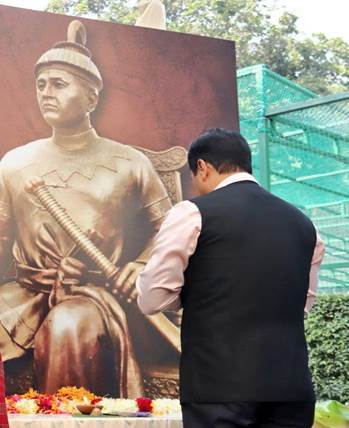
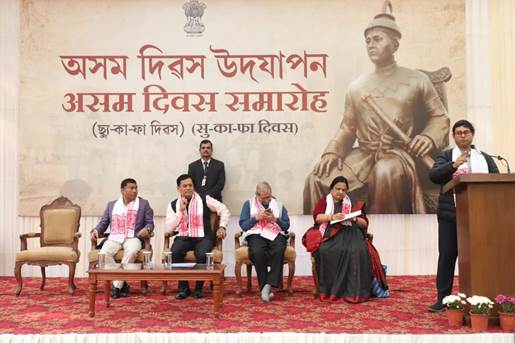
Delhi celebrates Assam Day as eminent scholars light up role of the Ahom King Sukapha – the Great Unifier


WhatsApp Image 2022-12-02 at 5.24.58 PM.jpeg

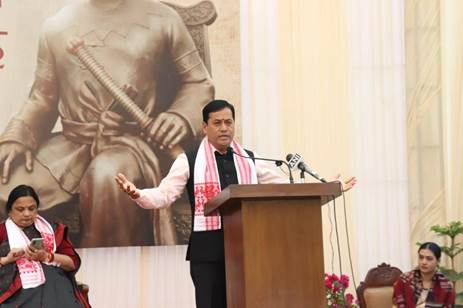
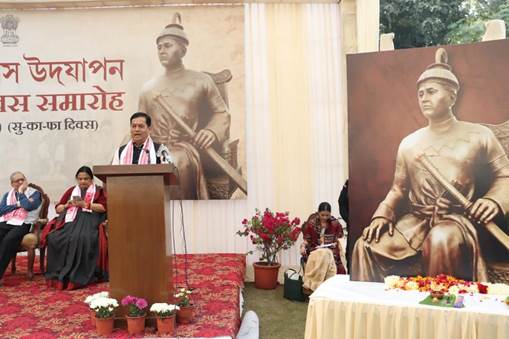
New Delhi, 2 December, 2022: On the pious occasion of Assam Day, the Union Minister of Ports, Shipping & Waterways and Ayush, Sarbananda Sonowal participated in a thought provoking meeting organised at his official residence here today. Leading luminaries, thought leaders of Indian history, prominent academicians including renowned Historian & Senior Journalist, Hindol Sengupta; Vice Chancellor of JNU, Shantishree Dhulipudi Pandit; Eminent Academician, Authority of Indian Intellectual Tradition, Former Chancellor, Mahatma Gandhi Antarashtriya Hindi Vishwavidyalaya, Wardha, Former Chairperson, Indian Studies of Advanced Studies, Shimla, Former Pro Vice Chancellor, JNU, Prof Kapil Kapoor; along with the Chairman, Special Centre for the Study of Northeast India, JNU, Prof Vinay Kumar Rao shared their views on Assam and its role in building the idea of India – from a historical as well as contemporary context.

WhatsApp Image 2022-12-02 at 5.24.58 PM (1).jpeg

Setting the context to the top of the line discussion on the role of Assam and Northeast, the Union Minister Sarbananda Sonowal said, “Today on the pious occasion of Assam Day, we pay our sincere homage to the great unifier & the founder of the great Ahom dynasty in Assam, Swargadeo Saulung Sukapha. The priceless contribution of this great soul to unify the various communities to build the greater Assamese society remains the cornerstone of our identity. Swargadeo Sukapha is a symbol of unity, good governance, bravery for every Asomiya to draw inspiration from. The great king & founder of the Ahom dynasty displayed a rare combination of intellect, valour, visionary, unifier which helped him to become one of the greatest leaders of Assam ever. Under his stewardship, the Assamese society worked to become Atmanirbhar as it started manufacturing various weapons, tools, goods that made the society an invincible military power. This strategic genius empowered us to regularly thwart any foreign invasion including the multiple ones by the Mughals. The vision and value system that the great Swargadeo Sukapha ingrained while building the greater Assamese society still helps us – the Assamese society – to represent our society and Assam at the national as well as International stage with great pride.”  

The Vice Chancellor of Jawaharlal Nehru University (JNU), Prof. Shantishree Dhulipudi Pandithighlighted the forgotten dynasties of India that immensely contributed to protect and enrich the nation. She talked about the Ahoms, Cholas, Mauryas and others. JNU, as one of the leading universities of India, is always ready to welcome new ideas that would contribute to highlight the brave warriors and the history of Assam as well as the entire North East region, remarked Prof Pandit.

WhatsApp Image 2022-12-02 at 5.24.58 PM (2).jpeg

Prof.Kapil Kapoorspoke about the great Ahoms& how it protected the entire the Northeast region from brutal invasions. Prof Kapoor also spoke about the ancient historical connections  that the people of the Northeast shared with the central India. He gave references of Mahabharata and other important treaties that carries witnesses of the Pan-Indian approach of the Kings of North-East.

The Chairman of the Special Centre for the Study of Northeast India, Prof Vinay Kumar Raospoke about the journey of the Ahom kingdom. He touched upon the role of Ahom dynasty in giving the contemporary cultural as well as geographical shape of Assam. Prof Rao also stressed on the importance of preserving the monuments that represent the glorious years of Ahom kingdom.

WhatsApp Image 2022-12-02 at 5.24.57 PM.jpeg

Leading intellectual & eminent historian Hindol Sengupta focused on the distortion of Indian History, from where many names of the brave warriors of India including the Ahoms were erased in order to colonise the Indian minds. To further elaborate on this, he said that such colonisation made people unaware about many notable historical occasions like the rise of Ahom dynasty and how Sukapha played a pivotal role in building a formidable foundation in Assam.His words emphasised on the importance of the resurrection of true Indian history, where the Indians will read about their victories, not about their defeats.

The thought provoking meet was attended by intellectuals and thought leaders from different streams including Professors, Head of Departments from different faculties of JNU as well as Delhi University; intellectuals from leading think tanks; academicians, technocrats as well as senior bureaucrats from the Assamese society based in Delhi NCR, representatives from Assam Association Delhi (AAD), Assam Association Gurgaon (AAG) and Assam Association NOIDA among other senior officials of various ministries were present on the occasion.

******

MJPS

What is h-Index

 The h-index is an author-level metric that measures both the productivity and citation impact of the publications, initially used for an individual scientist or scholar.

The h index was proposed by J.E. Hirsch in 2005 and published in the Proceedings of the National Academy of Sciences of the United States of America.[i]  The h index is a quantitative metric based on analysis of publication data using publications and citations to provide “an estimate of the importance, significance, and broad impact of a scientist’s cumulative research contributions.”[ii]   According to Hirsch, the h index is defined as: “A scientist has index h if h of his or her Np papers have at least h citations each and the other (Np – h) papers have ≤h citations each.”

How Calculated: Number of papers (h) that have received at least h citations. 

As an example, an h index of 10 means that among all publications by one author, 10 of these publications have received at least 10 citations each.  

Hirsch argues that the h index is preferable to other single-number criteria, such as the total number of papers, the total number of citations and citations per paper. However, Hirsch includes several caveats:

  • A single number can never give more than a rough approximation to an individual’s multifaceted profile;
  • Other factors should be considered in combination in evaluating an individual;
  • There will be differences in typical h values in different fields, determined in part by the average number of references in a paper in the field, the average number of papers produced by each scientist in the field, and the size (number of scientists) of the field; and
  • For an author with a relatively low h that has a few seminal papers with extraordinarily high citation counts, the h index will not fully reflect that scientist’s accomplishments.[iii]
Hirsch stressed that the full career publications for an author should be used for the h index.

Since Hirsch introduced the index in 2005, this measure of academic impact has garnered widespread interest as well as proposals for other indices based on analyses of publication data such as the index, h (2) index, m quotient, index, to name a few.

The h-index has already been used by major citation databases to evaluate the academic performance of individual scientists. Although effective and simple, the h-index suffers from some drawbacks that limit its use in accurately and fairly comparing the scientific output of different researchers. These drawbacks include information loss and low resolution: the former refers to the fact that in addition to h2 citations for papers in the h-core, excess citations are completely ignored, whereas the latter means that it is common for a group of researchers to have an identical h-index.

Several commonly used databases, such as Elsevier’s Scopus, Clarivate Analytics’ Web of Science, and Google Scholar  provide h index values for authors.

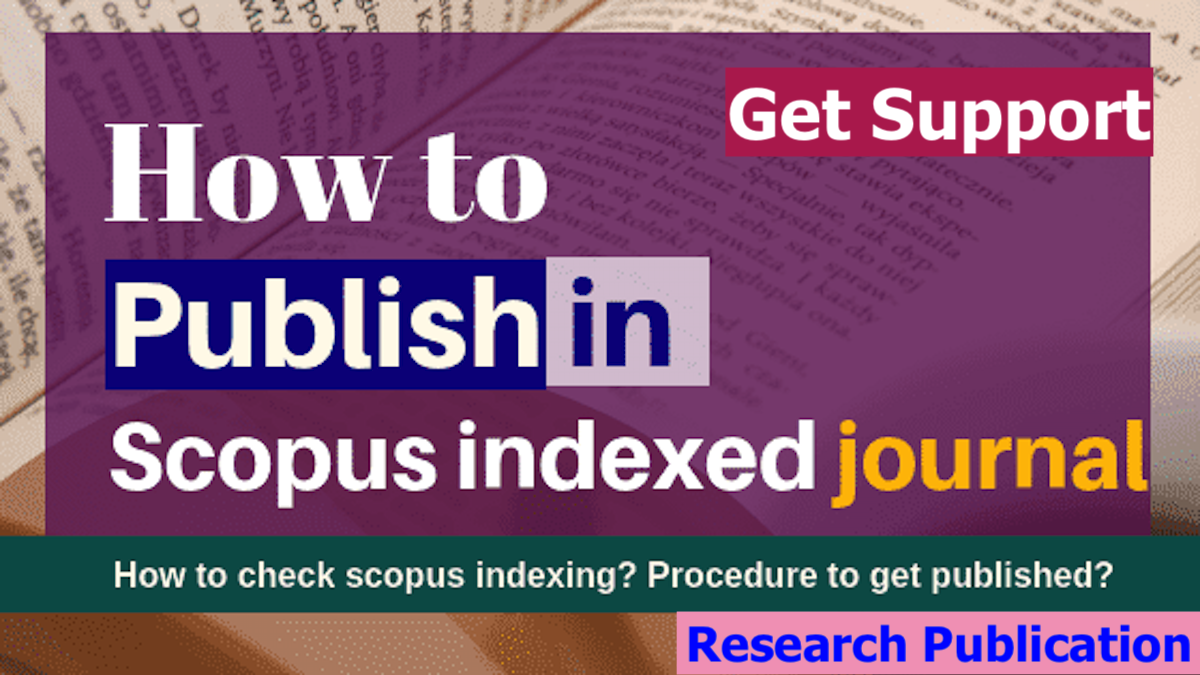
How to publish in Scopus indexed journal

 Are you looking to publish your paper in a Scopus indexed journal then here we will guide you the process for how to publish in Scopus indexed journal.

Before getting to the details lets us understand some of the important points.

What is Scopus index? 

Scopus is one of the most advanced, largest abstract and citation database of peer-reviewed journals, books, conference proceeding, and trade publications. 

It emphasized the indexing of journal which has high value the indexed journals obtain higher academic reputation globally.

What is Scopus indexed journals?

As we have discussed previously it is one of the largest databases of high-quality journals and periodicals so it indexed journals which main highest quality in academic publishing. Journals which got listed in the Scopus master list is known as Scopus indexed journals.

How to check Scopus indexed journals?


Scopus has a list of indexed journal and as a user, you can easily find the right journal according to your topic of interest. It has multiple numbers of journals for a similar subject area and domain.

You can search the journal as per the following.

  • Subject area
  • Title of journal
  • Publisher
  • ISSN


If you have any one of the above data you can easily search. If you are still unable to find the right journal according to your topic then you may choose the “Subject area” and choose the select form “Enter subject area


.Must remember that If you find any journal which claims to be indexed in Scopus then you can enter the ISSN or Title of the journal in the above search option and check in the list. 

Check the journal in  https://www.scopus.com/sources

Procedure to publish in Scopus indexed journal

As we know Scopus is an Indexing platform for highly ranked journals so the procedure to get published in any Scopus indexed journal needs.

Choose the right journal.

As we have discussed Scopus has many journals indexed in its database. So choose your journal from the Journal search. Go to the home page of the journal and check the information.

You can choose the Open access journal or Close access journal according to your need. Basically, Open access journal is the paid journals and as an author/co-author, you need to pay the Article processing charges to the journal if your paper gets selected.

Prepare the paper

After choosing the right journal now you need to prepare your paper according to the format of the journal. You can also take help of the sample paper which is available on the Journal’s home page. 

Read carefully all the terms and conditions of the journal before submitting the paper.

Check all past issues and date of the upcoming issue. Check the upcoming issue date whether it matches your requirement or not.

For example: If my university’s submission date is March 2019 then I must publish the paper before March 2019. If the upcoming issue will come out in April or May 2019 where my paper gets selected then I may face the problem.

Submit the paper

After selecting the journal now it’s time to submit the paper according to the submission process. 

Most of the Journal follows the online submission process where you need to create an online account with your email and some basic contact information.

While submission you need to take care of all the information in the form. 

After submission, you may get a confirmation for the journal publisher in your email. So check your email for the confirmation message. If not you cannot find, contact the editor.

Some journal also accepts the paper for review through the email. You can find the email for submission from the journal’s website. 

Prepublication notification

Every journal takes min 5 to 30 days for the initial notification. Sometimes it may extend up to 60 days due to over submission of papers. 

Generally, the review process completes within 20 to 60 days from the day of submission. After that, you may receive the paper acceptance or rejection letter from the editor.

You may also get the letter for re-submission after the modification mentioned by the editorial board.

Copyright submission.

It’s most important for any journal. As an author, you need to transfer the copyright to the journal. The different journal has different copyright format. So you need to read carefully the copyright agreement before signing it and return to the editor.

If the journal has the Article processing charge then you need to pay it after getting the acceptance letter only and send the payment proof to the editor along with the copyright form.

Publication confirmation

After all the process completes the paper gets published and you may get a publication notification of your paper. All journals have a free review period if any mistake in the publication of your paper you may contact the editor.




Short Essay on \’Rajendra Prasad Jayanti: 03 December\’ (230 Words)

\’Rajendra Prasad Jayanti\’ is celebrated on 3rd December every year. It is the birth anniversary of Dr. Rajendra Prasad. Rajendra Prasad was born on 3rd December, 1884 in the Ziradei village, Siwan district of Bihar, India. His father\’s name was Mahadev Sahai, who was a scholar of Sanskrit and Persian languages. His mother\’s name was Kamleshwari Devi, who was a religious woman.

Rajendra Prasad was a good political leader, lawyer, statesman and social worker. He took active part in the freedom movements of India. He joined the Indian National Congress in 1911. He was elected as the President of the Indian National Congress during the Bombay session in October 1934. He was sent to Jail many times. He was elected the President of Constituent Assembly on 11 December 1946. Dr. Rajendra Prasad was elected the first President of the Republic of India.

Dr. Rajendra Prasad was subsequently awarded the Bharat Ratna, the India\’s highest civilian award. He authored many books. He was a great educationist and a man of world fame. High principles and ideals of Dr. Rajendra Prasad will always alive to show the right path. His birth anniversary is celebrated on 3rd December every year through out the country in a big way. Rich tributes are paid to him on this day. On this occasion several functions are organized at various places. Floral tributes are offered at his samadhi sthal. 

Short Essay on \’Rajendra Prasad Jayanti: 03 December\’ (230 Words)

\’Rajendra Prasad Jayanti\’ is celebrated on 3rd December every year. It is the birth anniversary of Dr. Rajendra Prasad. Rajendra Prasad was born on 3rd December, 1884 in the Ziradei village, Siwan district of Bihar, India. His father\’s name was Mahadev Sahai, who was a scholar of Sanskrit and Persian languages. His mother\’s name was Kamleshwari Devi, who was a religious woman.

Rajendra Prasad was a good political leader, lawyer, statesman and social worker. He took active part in the freedom movements of India. He joined the Indian National Congress in 1911. He was elected as the President of the Indian National Congress during the Bombay session in October 1934. He was sent to Jail many times. He was elected the President of Constituent Assembly on 11 December 1946. Dr. Rajendra Prasad was elected the first President of the Republic of India.

Dr. Rajendra Prasad was subsequently awarded the Bharat Ratna, the India\’s highest civilian award. He authored many books. He was a great educationist and a man of world fame. High principles and ideals of Dr. Rajendra Prasad will always alive to show the right path. His birth anniversary is celebrated on 3rd December every year through out the country in a big way. Rich tributes are paid to him on this day. On this occasion several functions are organized at various places. Floral tributes are offered at his samadhi sthal. 

Short Essay on \’Rajendra Prasad Jayanti: 03 December\’ (230 Words)

\’Rajendra Prasad Jayanti\’ is celebrated on 3rd December every year. It is the birth anniversary of Dr. Rajendra Prasad. Rajendra Prasad was born on 3rd December, 1884 in the Ziradei village, Siwan district of Bihar, India. His father\’s name was Mahadev Sahai, who was a scholar of Sanskrit and Persian languages. His mother\’s name was Kamleshwari Devi, who was a religious woman.

Rajendra Prasad was a good political leader, lawyer, statesman and social worker. He took active part in the freedom movements of India. He joined the Indian National Congress in 1911. He was elected as the President of the Indian National Congress during the Bombay session in October 1934. He was sent to Jail many times. He was elected the President of Constituent Assembly on 11 December 1946. Dr. Rajendra Prasad was elected the first President of the Republic of India.

Dr. Rajendra Prasad was subsequently awarded the Bharat Ratna, the India\’s highest civilian award. He authored many books. He was a great educationist and a man of world fame. High principles and ideals of Dr. Rajendra Prasad will always alive to show the right path. His birth anniversary is celebrated on 3rd December every year through out the country in a big way. Rich tributes are paid to him on this day. On this occasion several functions are organized at various places. Floral tributes are offered at his samadhi sthal.