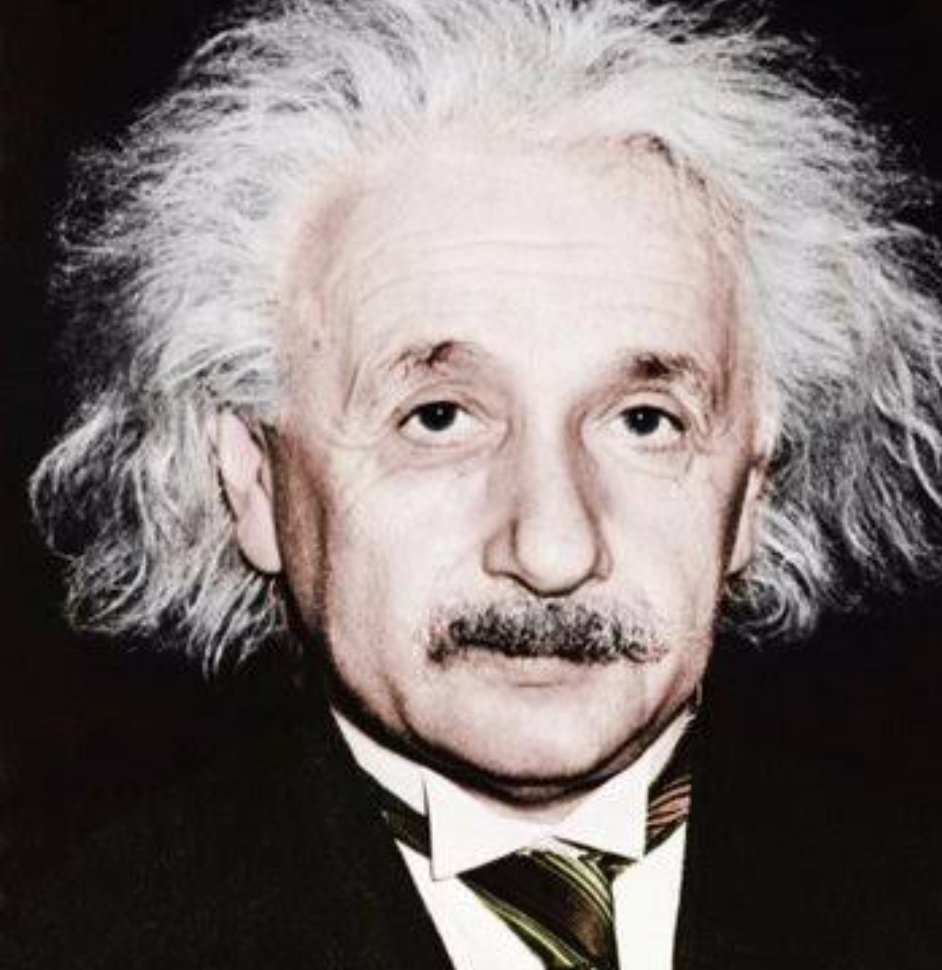
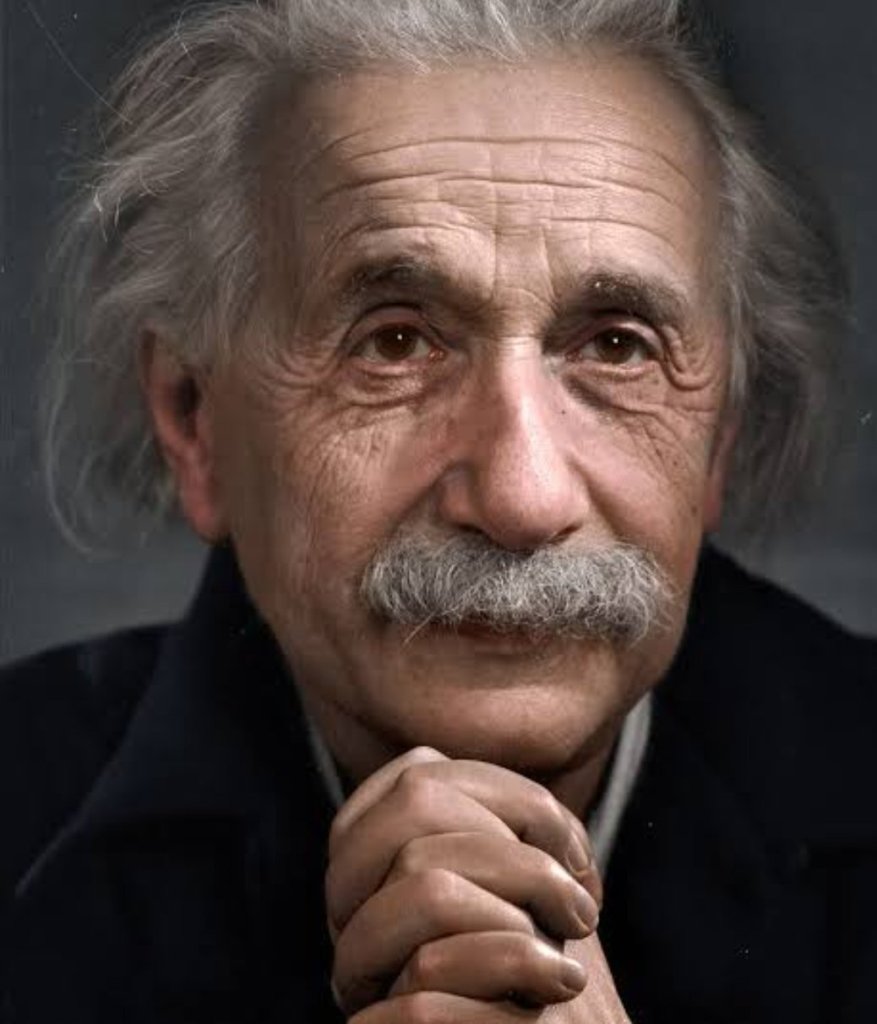
Albert Einstein was a German-born theoretical physicist, widely acknowledged to be one of the greatest physicists of all time. Einstein is known for developing the theory of relativity, but he also made important contributions to the development of the theory of quantum mechanics.he was Born on 14 March 1879, Ulm, Germany. Died on 18 April 1955, Penn Medicine Princeton Medical Center, New Jersey, United StatesSpouse: Elsa Einstein (m. 1919–1936), Mileva Marić (m. 1903–1919)Education: University of Zurich (1905), ETH Zürich (1896–1900)
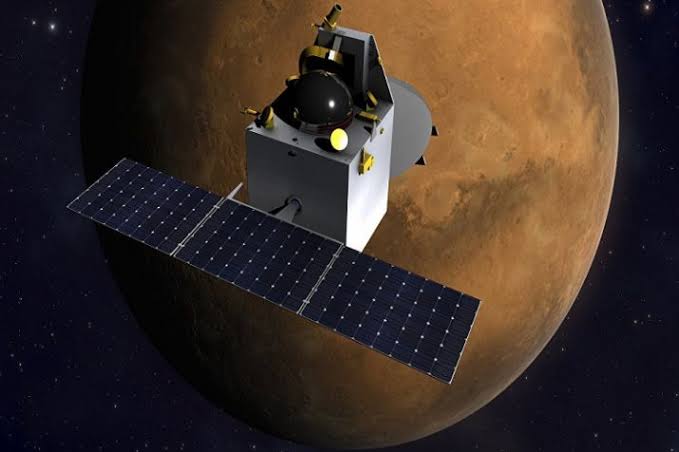
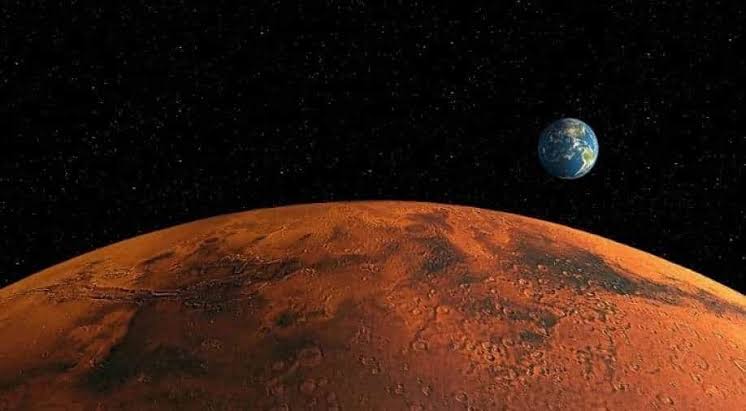
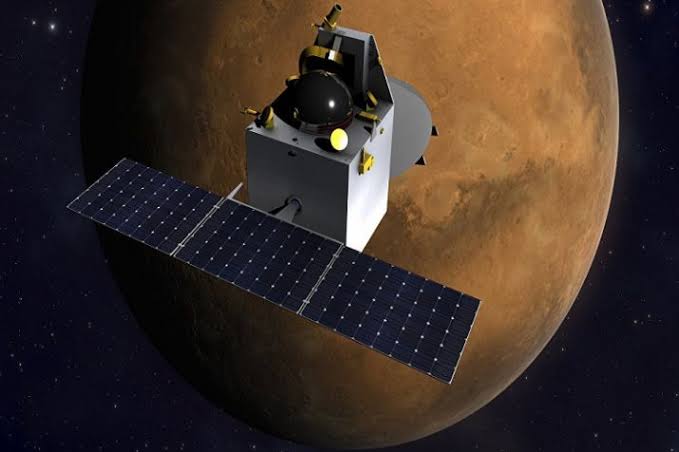
The Mars Orbiter Mission (MOM), also called Mangalyaan is a space probe orbiting Mars since 24 September 2014. It was launched on 5 November 2013 by the Indian Space Research Organisation (ISRO).It is India’s first interplanetary mission and it made it the fourth space agency to achieve Mars orbit, after Roscosmos, NASA, and the European Space Agency. It made India the first Asian nation to reach Martian orbit and the first nation in the world to do so on its maiden attempt.
Names Mangalyaan Mission type Mars orbiter Operator ISRO COSPAR ID 2013-060A SATCAT no. 39370 Website http://www.isro.gov.in/pslv-c25-mars-orbiter-mission Mission duration Planned: 6 months Elapsed: 6 years, 9 months, 19 days
Start of mission
Start of mission Launch date 5 November 2013, 09:08 UTC Rocket PSLV-XL C25 Launch site Satish Dhawan FLP Contractor ISRO
Timeline of Operations Phase Date Event Detail Result References Geocentric phase 5 November 2013 09:08 UTC Launch Burn time: 15:35 min in 5 stages Apogee: 23,550 km (14,630 mi) 6 November 2013 19:47 UTC Orbit raising manoeuvre Burn time: 416 sec Apogee: 28,825 km (17,911 mi) 7 November 2013 20:48 UTC Orbit raising manoeuvre Burn time: 570.6 sec Apogee: 40,186 km (24,970 mi) 8 November 2013 20:40 UTC Orbit raising manoeuvre Burn time: 707 sec Apogee: 71,636 km (44,513 mi) 10 November 2013 20:36 UTC Orbit raising manoeuvre Incomplete burn Apogee: 78,276 km (48,638 mi) 11 November 2013 23:33 UTC Orbit raising manoeuvre (supplementary) Burn time: 303.8 sec Apogee: 118,642 km (73,721 mi) 15 November 2013 19:57 UTC Orbit raising manoeuvre Burn time: 243.5 sec Apogee: 192,874 km (119,846 mi) 30 November 2013 19:19 UTC Trans-Mars injection Burn time: 1328.89 sec Heliocentric insertion Heliocentric phase December 2013 – September 2014 En route to Mars – The probe travelled a distance of 780,000,000 kilometres (480,000,000 mi) in a Hohmann transfer orbit around the Sun to reach Mars. This phase plan included up to four trajectory corrections if needed. 11 December 2013 01:00 UTC 1st Trajectory correction Burn time: 40.5 sec Success 9 April 2014 2nd Trajectory correction (planned) Not required Rescheduled for 11 June 2014 11 June 2014 11:00 UTC 2nd Trajectory correction Burn time: 16 sec Success August 2014 3rd Trajectory correction (planned) Not required 22 September 2014 3rd Trajectory correction Burn time: 4 sec Success Areocentric phase 24 September 2014 Mars orbit insertion
Recognition
In 2014, China referred to India’s successful Mars Orbiter Mission as the “Pride of Asia”. The Mars Orbiter Mission team won US-based National Space Society’s 2015 Space Pioneer Award in the science and engineering category. NSS said the award was given as the Indian agency successfully executed a Mars mission in its first attempt; and the spacecraft is in an elliptical orbit with a high apoapsis where, with its high resolution camera, it is taking full-disk colour imagery of Mars. Very few full disk images have ever been taken in the past, mostly on approach to the planet, as most imaging is done looking straight down in mapping mode.
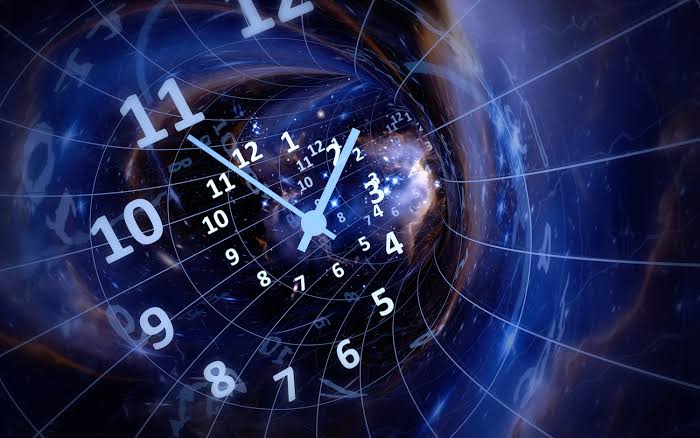
Time travel is the concept of movement between certain points in time, analogous to movement between different points in space by an object or a person, typically with the use of a hypothetical device known as a time machine. Time travel is a widely recognized concept in philosophy and fiction, particularly science fiction. According to scientists time travel can be possible in recent years due to certain theories based on famous scientists.
Time travel.
HISTORY OF TIME TRAVEL
Some ancient myths depict a character skipping forward in time. In Hindu Mythology a king named kakudmi traveled to Time to meet Brahma and he was surprised when he saw time has passed when he returned to earth. The concept of universal time sphere was shown in the stories ages ago. In Jewish tradition, the 1st-century BC scholar Honi ha-M’agel is said to have fallen asleep and slept for seventy years. When waking up he returned home but found none of the people he knew, and no one believed his claims of who he was.
Time travel used to be thought of as just science fiction, but Einstein's general theory of relativity allows for the possibility that we could warp space-time so much that you could go off in a rocket and return before you set out.
      Stephen Hawking
SCIENCE FICTION IN TIME TRAVEL
Christmas Carol by Charles Dickens has early depictions of mystical time travel in both directions, as the protagonist, Ebenezer Scrooge, is transported to Christmases past and future. Other stories employ the same template, where a character naturally goes to sleep, and upon waking up finds themself in a different time. A clearer example of backward time travel is found in the popular 1861 book Paris avant les hommes (Paris before Men) by the French botanist and geologist Pierre Boitard, published posthumously.
TIME TRAVEL IN PHYSICS
Some theories, most notably special and general relativity, suggest that suitable geometries of spacetime or specific types of motion in space might allow time travel into the past and future if these geometries or motions were possible. Many in the scientific community believe that backward time travel is highly unlikely. Any theory that would allow time travel would introduce potential problems of causality. The classic example of a problem involving causality is the “grandfatherparadox“: what if one were to go back in time and kill one’s own grandfather before one’s father was conceived? Some physicists, such as Novikov and Deutsch, suggested that these sorts of temporal paradoxes can be avoided through the Novikov self-consistency principle or a variation of the many-worlds interpretation with interacting worlds.
The art of time
GENERAL RELATIVITY
Time travel to the past is theoretically possible in certain general relativity spacetime geometries that permit traveling faster than the speed of light, such as cosmic strings, traversable wormholes, and Alcubierre drives.:33–130 The theory of general relativity does suggest a scientific basis for the possibility of backward time travel in certain unusual scenarios, although arguments from semiclassical gravity suggest that when quantum effects are incorporated into general relativity, these loopholes may be closed.These semiclassical arguments led Stephen Hawking to formulate the chronology protection conjecture, suggesting that the fundamental laws of nature prevent time travel,but physicists cannot come to a definite judgment on the issue without a theory of quantum gravity to join quantum mechanics and general relativity into a completely unified theory
QUANTUM PHYSICS
The Quantam Physics
THEORIES OF QUANTAM PHYSICS IN TIME TRAVEL
Coming up with a quantum version of time travel requires physicists to figure out the time evolution equations for density states in the presence of closed timelike curves (CTC). Two main routes has been taken in the application of self consistency in Quantam Physics.
Quantum physics theories
LLOYD’s PRESCRIPTION
Based on path Integral and post selection Seth Lloyds proposed a new Alternative. In particular, the path integral is over single-valued fields, leading to self-consistent histories. He assumed it is ill-defined to speak of the actual density state of the CTC itself, and we should only focus upon the density state outside the CTC. His proposal for the time evolution of the external density state
“People like us, who believe in physics, know that the distinction between past, present and future is only a stubbornly persistent illusion.” – Albert Einstein.
One 27th MARCH 2020, a long periodic comet with near parabolicorbit was discovered by a group of astronomer during the NEOWISE Mission the Wide-field Infrared Survey Explorer (WISE) space telescope. At that time, it was an 18th-magnitude object, located 2 AU (300 million km; 190 million mi) away from the Sun and 1.7 AU (250 million km; 160 million mi) away from Earth.
C/2020 F3(NEOWISE)
Discovered by NEOWISE Discovery date March 27, 2020 Orbital characteristics A Epoch 2458953.5 (April 14, 2020) Observation arc 113 days Number of observations 376 Orbit type Long period comet Aphelion 538 AU (inbound) 710 AU (outbound) Perihelion 0.29478 AU Semi-major axis 270 AU (inbound) 355 AU (outbound) Eccentricity 0.99921 Orbital period ~4400 yrs (inbound) ~6700 yrs (outbound) Inclination 128.93° Node 61.01° Argument of periapsis 37.28° TJupiter −0.408 Earth MOID 0.36 AU (54 million km; 140 LD) Jupiter MOID 0.81 AU (121 million km) Dimensions ~5 km (3 mi) Last perihelion July 3, 2020 Next perihelion unknown
HISTORY AND OBSERVATION
The object was discovered by a team using the WISE space telescope under the NEOWISE program on March 27, 2020.It was classified as a comet on March 31 and named after NEOWISE on April 1. It has the systematic designation C/2020 F3, indicating a non-periodic comet which was the third discovered in the second half of March 2020.
Comet NEOWISE made its closest approach to the Sun (perihelion) on July 3, 2020, at a distance of 0.29 AU (43 million km; 27 million mi). This passage through the planetary region increases the comet’s orbital period from about 4400 years to about 6700 years.Its closest approach to Earth occurred on July 23, 2020, 01:09 UT, at a distance of 0.69 AU (103 million km; 64 million mi) while located in the constellation of Ursa Major.
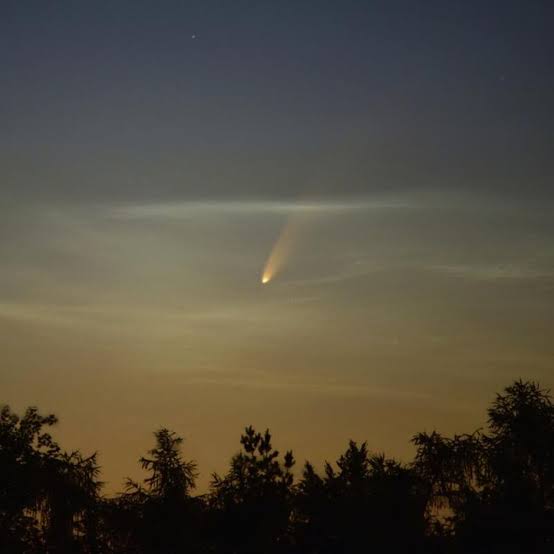
In early July, the comet could be seen in the morning sky just above the north-eastern horizon and below Capella. Seen from Earth, the comet was less than 20 degrees from the Sun between June 11 and July 9, 2020. By June 10, 2020, as the comet was being lost to the glare of the Sun, it was apparent magnitude 7,when it was 0.7 AU (100 million km; 65 million mi) away from Sun and 1.6 AU (240 million km; 150 million mi) away from Earth. When the comet entered the field of view of the SOHO spacecraft’s LASCO C3 instrument on June 22, 2020, the comet had brightened to about magnitude 3, when it was 0.4 AU (60 million km; 37 million mi) away from the Sun and 1.4 AU (210 million km; 130 million mi) away from Earth.
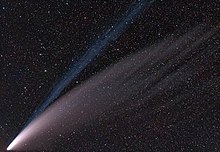
By early July, Comet NEOWISE had brightened to magnitude 1, far exceeding the brightness attained by previous comets, C/2020 F8 (SWAN), and C/2019 Y4 (ATLAS). By July, it also had developed a second tail. The first tail is blue and made of gas and ions stretching almost 70° from its nucleus. There is also a red separation in the tail caused by high amounts of sodium which is nearly stretched 1°. The second twin tail is a golden color and is made of dust stretched almost 50°, like the tail of Comet Hale–Bopp. This combination resembles comet C/2011 L4 (PANSTARRS). The comet is brighter than C/2011 L4 (PANSTARRS), but not as bright as Hale–Bopp was in 1997. According to the British AstronomicalAssociation, the comet brightened from a magnitude of about 8 at the beginning of June to −2 in early July.This would make it brighter than Hale–Bopp. However, as it was very near to the Sun, it was reported as 0 or +1 magnitude and remained that bright for only a few days. After perihelion, the comet began to fade, dropping to magnitude 2. Its nucleus activity subdued after mid-July, and its green coma was clearly visible after that.
On July 13, 2020, a sodium tail was confirmed by the Planetary Science Institute’s Input/Output facility. Sodium tails have only been observed in very bright comets such as Hale–Bopp and C/2012 S1 (ISON).
From the infrared signature, the diameter of the comet nucleus is estimated to be approximately 5 km (3 mi). The nucleus is similar in size to Comet Hyakutake and many short-period comets such as 2P/Encke, 7P/Pons-Winnecke, 8P/Tuttle, 14P/Wolf, and 19P/Borrelly. NASA’s Parker Solar Probe had captured an image of the comet, from which astronomers also estimated the diameter of the comet nucleus at approximately 5 km (3 mi). Later in July 2020, other observations were also reported, including those related to coma morphology and spectrographic emissions. On 31 July 2020, strong detection of OH 18-cm emission was observed in radio spectroscopic studies at the Arecibo Observatory. On August 14, 2020, the rotation period of the comet was reported to be “7.58 +/- 0.03 hr”.
A glimpse
TRAJECTORY
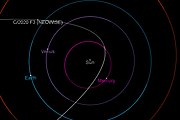
Comet NEOWISE retrograde orbit crossed to the north of the plane of the ecliptic, to which it is inclined at approximately 129 degrees, on June 29, 2020, 01:47 UT. It made its closest approach to the Sun (perihelion) on July 3, 2020, at a distance of 0.29 AU (43 million km; 27 million mi). This passage increases the comet’s orbital period from about 4400 years to about 6700 years.On July 18 the comet peaked at a northern declination of +48 and was circumpolar down to latitude 42N. Its closest approach to Earth occurred on July 23, 2020, 01:09 UT, at a distance of 0.69 AU (103 million km; 64 million mi) while located in the constellation of Ursa Major.
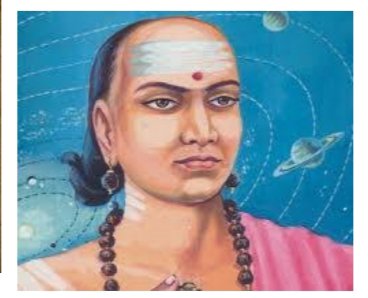
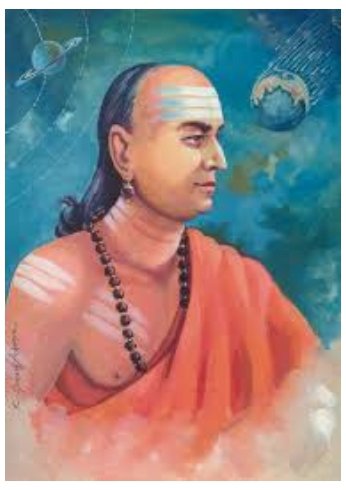
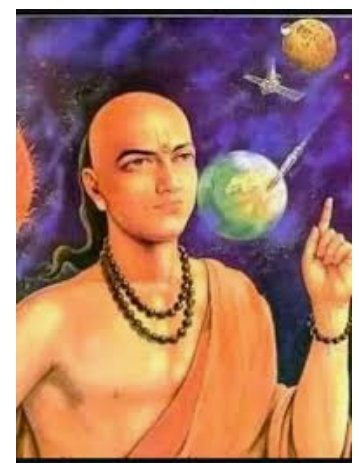
Aryabhatta (476–550 CE) was the first of the major mathematician-astronomers from the classical age of Indian mathematics and Indian astronomy.
Aryabhatta mentions in the Aryabhatiya that it was composed 3,600 years into the Kali Yuga, when he was 23 years old. This corresponds to 499 CE, and implies that he was born in 476.
Aryabhatta provides no information about his place of birth. The only information comes from Bhaskara I, who describes Aryabhatta as asmakiya, “one belonging to the Asmaka country.” During the Buddha’s time, a branch of the Asmaka people settled in the region between the Narmada and Godavari rivers in central India; Aryabhatta is believed to have been born there.
It is fairly certain that, at some point, he went to Kusumapura for advanced studies and lived there for some time. Both Hindu and Buddhist tradition, as well as Bhaskara I (CE 629), identify Kusumapura as Pataliputra, modern Patna. A verse mentions that Aryabhatta was the head of an institution (kulapa) at Kusumapura, and, because the university of Nalanda was in Pataliputra at the time and had an astronomical observatory, it is speculated that Aryabhatta might have been the head of the Nalanda university as well. Aryabhatta is also reputed to have set up an observatory at the Sun temple in Taregana, Bihar.
Therefore, it would make great sense that this was where he would have invested a great deal of time learning to be a great astronomer. There were not exactly scores of other opportunities for him to take advantage during the classical era as institutions in which to learn astronomy were likely very limited.
Aryabhatta is the author of several treatises on mathematics and astronomy, some of which are lost. His major work, Aryabhatiya, a compendium of mathematics and astronomy, was extensively referred to in the Indian mathematical literature and has survived to modern times. The mathematical part of the Aryabhatiya covers arithmetic, algebra, plane trigonometry, and spherical trigonometry. It also contains continued fractions, quadratic equations, sums-of-power series, and a table of sines.
Aryabhata gave the world the digit “0” (zero) for which he became immortal.
The Aryabhatiya was a well-constructed work that covered many different facets of mathematics and astronomy. Portions of the work were quoted in other works and this has allowed it to avoid becoming lost. Within the mathematics portion of the work, a great deal was written about high level math topics.
There are 108 verses in the text and the style of writing is very tight and direct. It can be said the work is written in a manner not dissimilar from the sutra literature crafted at the time. Within the work, information is revealed about the table of sines, progressions in geometry and arithmetic, the relationship of time, the positions of the planets, and insights into celestial spheres. To a great extent, the work was many years ahead of its time. Both thought-provoking and introspection inducing, anyone interested in the subjects of math and astronomy would find it worth reading.
As with many of the great astronomers in history, Aryabhata promoted the notion the earth spun on its own axis and the sun revolved around the earth and not the other way around. This belief is known as heliocentrism and it was deemed a heresy in most parts of the world until well past the Middle Ages.
Aryabhatta is believed to have died around 550 A.D. He has left an amazing legacy to be sure. A great many modern mathematicians and astronomers look towards his early work for inspiration.
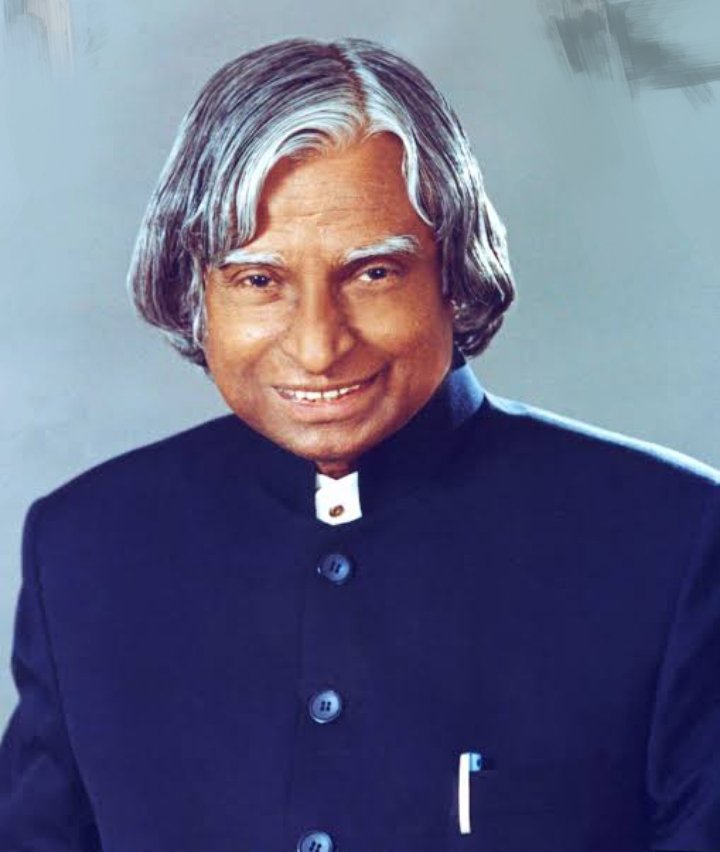
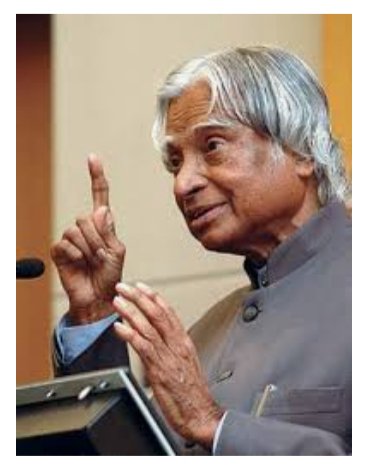
A.P.J. Abdul Kalam was an aerospace scientist who joined India’s defense department after graduating from the Madras Institute of Technology.
Avul Pakir Jainulabdeen Abdul Kalam was born into a Muslim family on October 15, 1931, on the island of Dhanushkodi off the southeastern coast of India. He developed an early fascination with flight by watching birds, which developed into an interest in aeronautics after he saw a newspaper article about a British fighter plane.
Despite his modest beginnings – his dad built and rented boats – Kalam was a bright student who showed promise in science and mathematics. He attended St. Joseph’s College and went on to earn a degree in aeronautical engineering from the Madras Institute of Technology.
His hopes of becoming a fighter pilot were dashed when he narrowly missed out on a spot with the Indian Air Force. Kalam instead joined the Defense Research and Development Organization (DRDO) as a senior scientific assistant in 1958. After moving to the newly formed Indian Space Research Organization (ISRO) in 1969, he was named project director of the SLV-III, the first satellite launch vehicle designed and produced on Indian soil.
From 1992 to 1997 Kalam was scientific adviser to the defense minister, and he later served as principal scientific adviser (1999–2001) to the government with the rank of cabinet minister. His prominent role in the country’s 1998 nuclear weapons tests solidified India as a nuclear power and established Kalam as a national hero, although the tests caused great concern in the international community.
In 2002, India’s ruling National Democratic Alliance helped Kalam win an election against Lakshmi Sahgal and become India’s 11th president, a largely ceremonial post. Known as the People’s President, Kalam set a goal of conducting 500,000 one-on-one meetings with young people over the course of his five-year term. His immense popularity led to him being nominated by MTV for a Youth Icon of the Year award in 2003 and 2006.
After leaving office in 2007, Kalam became a visiting professor at several universities. He formed the “What Can I Give Movement” in 2011 with the goal of creating a compassionate society, and in 2012, his efforts to improve healthcare led to the release of a tablet for medical personnel to use in remote areas.
Kalam wrote several books, including an autobiography, Wings of Fire (1999). Among his numerous awards were two of the country’s highest honours, the Padma Vibhushan (1990) and the Bharat Ratna (1997).
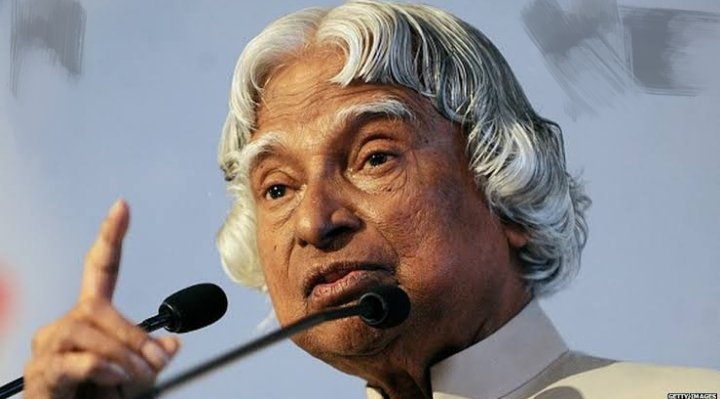
Upon returning to civilian life, Kalam remained committed to using science and technology to transform India into a developed country and served as a lecturer at several universities. On July 27, 2015, he collapsed while delivering a lecture at the Indian Institute of Management Shillong and was pronounced dead from cardiac arrest soon afterward.
Kalam was laid to rest on July 30 with full state honors in his native Tamil Nadu. In honor of the scientist and former president, the southeast Indian state government of Tamil Nadu created a “Dr. A.P.J. Abdul Kalam Award,” which recognizes exceptional individuals who promote the sciences, students and humanities. The government has also established Kalam’s birthday (October 15) as “Youth Renaissance Day.” Discussion about building a large-scale memorial at his burial site is underway.
The first scientifically minded celestial observers included people such as Nicolaus Copernicus (1473–1543), Johannes Kepler, and Galileo Galilei, who began looking at the sky through telescopes they built. Galileo’s view of Jupiter in 1610 transformed our view of the planets. They weren’t just dots of light in the sky. They were worlds. Over the years, more and better telescopes have revealed double stars and nebulae in the sky, and their discoverers set out to figure out what these things were. The science of “natural philosophy” uses mathematics, chemistry, and physics to explain objects and events in the universe. Nicolaus Copernicus came up with the heliocentric solar system, with the planets orbiting the Sun. The laws of planetary motion developed by Johannes Kepler and the laws of physics devised by Sir Isaac Newton helped explain the motions of bodies in space.
Contributions of Famous Scientists and Breakthroughs:
Nicolaus Copernicus – He wrote De revolutionibus orbium coelestium(on the revolution of the heavenly sphere)(1543) in which he proposed the heliocentric theory.
Galileo Galilei– He was the first one to look at the sky with a telescope. In 1610, with a telescope, he watched Jupiter and discovered 4 moons(Galilean moons). He also observed phases of Venus and sunspots. He wrote On motion , Dialogue concerning the two chief world systems and Discourses and mathematical demonstrations relating to two new sciences .
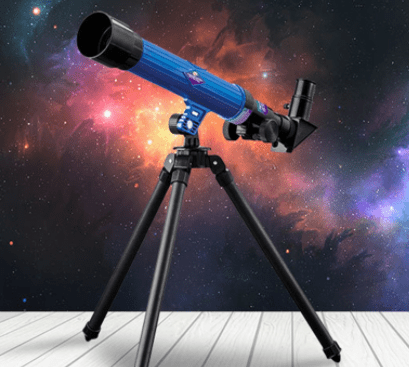
Hans Lippershey and Zacharlas Janssen (dutch-german opticians)- They invented the telescope(first to patent)
Johannes Kepler – He wrote Mysterium cosmographicum (latin for the cosmographic mystery)(1596) in which he defended copernican heliocentric ideas. In 1609, he published the first 2 laws of planetary motion.
Kepler’s laws: 1. The path of the planets about the sun is elliptical in shape, with the center of the sun being located at one focus.
2. An imaginary line drawn from the center of the sun to the center of the planet will sweep out equal areas in equal intervals of time.
3. The ratio of the squares of the periods of any two planets is equal to the ratio of the cubes of their semi-major axis.
Kepler’s Publications- Johannes Kepler published treatises about many topics. Here is a list of some of his other astronomy-related works.
1. Astronomia Pars Optica (Optics in Astronomy)
2. Astronomia Nova (The New Astronomy)
3. Dissertatio cum Nuncio Sidereo (Conversation with the Starry Messenger, an endorsement of Galileo Galilei’s observations)
4. Harmonice Mundi (The Harmony of the Worlds, in which Kepler describes harmony and congruence in geometry and presents his third law of planetary motion)
William Herschel– He deduced that the solar system is moving, and saw martian ice caps. He created a deep sky catalog and double star catalog and catalogue of 500 nebulae, nebulous stars, planetary nebulae,etc. He discovered uranus (1781). He also discovered infrared light.
Caroline Herschel- she was the first woman paid to do astronomy and she discovered 8 comets.
John Federick William Herschel- He published the general catalog of 10,300 multiple and double stars, and The New General Catalog of Nebulae and Clusters(NGC).
Isaac Newton– He gave the famous three laws of motion. 1.The first law states that an object at rest will stay at rest, and an object in motion will stay in motion unless acted on by a net external force.
2]The second law states that the rate of change of momentum of a body over time is directly proportional to the force applied, and occurs in the same direction as the applied force.
3]The third law states that all forces between two objects exist in equal magnitude and opposite direction.
He also gave the universal law of gravitation. He invented Newtonian reflectors- telescopes with reflecting mirrors.
Henrietta Swan Leavitt– She discovered cepheid variables(period of pulsation of star is related to intrinsic brightness of star), many other variable stars and novas.
Edwin Hubble– He showed that the universe was larger and beyond the Milky Way by showing that Andromeda was outside the milky way. He discovered the universe is expanding. He gave the hubble sequence of galaxy morphologies – spiral, elliptical, lenticular or irregular.
Einstein– He discovered the photoelectric effect, and wave-particle duality. He published the special theory of relativity and the general theory of relativity.
Jocelyn Bell burnell– The first pulsar that Bell found is called PSR 1919+21, and its signal repeats precisely every 1.33 seconds.It was called LGM-1.
Vera Rubin– She proved the existence of dark matter.
Clyde Tombaugh – In 1930, He discovered pluto.
Mike brown– He demoted Pluto to dwarf planet and wrote How I Killed Pluto and Why It Had It Coming.






 Eduindex
You must be logged in to post a comment.