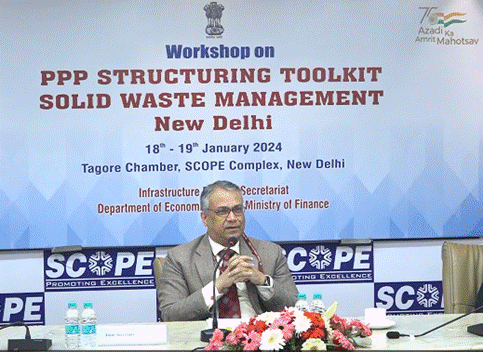
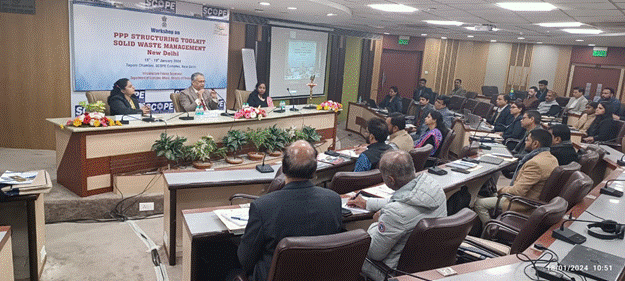
Workshop on ‘Public Private Partnership (PPP) Structuring Toolkit – Solid Waste Management (SWM)’

 The two-day workshop organised in hybrid mode by the Infrastructure Finance Secretariat (IFS) in the Department of Economic Affairs (DEA), Ministry of Finance (MoF), concluded in New Delhi, today. The workshop was organised to sensitise Project Sponsoring Authorities (PSAs) on how to use PPP structuring toolkit for PPP projects in Solid Waste Management (SWM) Sector. SWM is one of the prominent sector where PPPs are happening. The workshop was attended by more than 80 participants from Central Government and State/UT Governments.


‘PPP Structuring Toolkit’ is one among the initiatives that IFS has taken to support the Project Sponsoring Authorities (PSAs) to develop their projects with objectivity and to boost private sector investment in the country.

This workshop, which is the second in a series catering to Solid Waste Management Sector, was inaugurated by Shri Baldeo Purushartha, Joint Secretary, Infrastructure Support & Development (ISD) Division, DEA, MoF. He highlighted the importance of infrastructure and the need for creating a shelf of viable infrastructure projects to take India on a higher growth trajectory. The workshop provided an overview of the toolkit and a demonstration of tools developed for Solid Waste management sector. Shri Purushartha further encouraged the participants to develop few projects in PPP in solid waste management sector.


Ms. Preeti Jain, Director, DEA, highlighted how infrastructure development contributes to GDP growth and also stressed the necessity of appropriately structuring PPP projects due to their inherent complexities.

The workshop familiarised participants with the toolkit’s overview and objectives through the case studies for practical understanding, detailing its five integral tools:-

  • Suitability Filter
  • Family Indicator Tool
  • Mode Validation Tool
  • Financial Viability Indicator, and
  • Value for Money Indicator tool


IFS also showcased the ‘Contingent Liability Toolkit’, which gives a hands-on approach to the PSAs for estimating probable pay-outs of the PSA due to occurrence of various contingencies.

The workshop saw enthusiastic participation from officials representing Central Ministries/Departments, various State/UT Governments especially from Urban Local Bodies.

More details on the PPP Structuring Toolkits are available on:

https://www.pppinindia.gov.in/ppp_structuring_toolkit


****

100% door to door collection of segregated waste from each household/ premise to be done under (SBM-U) 2.0

 The salient features of Swachh Bharat Mission (SBM-U) 2.0, launched on 01st October, 2021, are:

(i). all households and premises segregate their waste into “wet waste” (from kitchen and gardens) and “dry waste” (including paper, glass, plastic, and domestic hazardous waste and sanitary waste wrapped separately);

(ii). 100% door to door collection of segregated waste from each household/ premise;

(iii). 100% scientific management of all fractions of waste, including safe disposal in scientific landfills;

(iv). all legacy dumpsites remediated;

(v).all used water including faecal sludge, is safely contained, transported, processed and disposed so that no untreated faecal sludge and used water pollutes the ground or water bodies, in cities with less than one lakh population;

(vi). phased reduction in use of single use plastic.

The salient features of AMRUT 2.0, launched on 01st October, 2021, are:

(i). Universal coverage of water supply from 500 cities to about 4,800 statutory towns.

(ii). Focus on making the cities ‘self-reliant’ and ‘water secure’.

(iii). Universal coverage of sewerage and septage management in 500 AMRUT cities.

(iv). Target to provide 2.68 Crore tap connections and 2.64 Crore sewer connections.

(v). Focus on financial sustainability of Urban Local Bodies (ULBs) through enhanced credit worthiness and market borrowing.

(vi). ‘Pey Jal Survekshan’ will be undertaken in cities to promote healthy competition among them and function as monitoring tool and Mission accelerator.

(vii). Technology sub-Mission under AMRUT 2.0 will help in identifying proven and potential global technologies in water sector.

(viii). Entrepreneurship/ start-ups involved in low-cost indigenous equipments and processes will be encouraged.


SBM-U 2.0 and AMRUT 2.0 have been launched on 01stOctober, 2021. The financial outlay of SBM–U 2.0 and AMRUT 2.0 is at Annexure-I.


Out of 4372 Urban Local Bodies (ULBs),4371 have been certifiedOpen Defecation Free (ODF),except for one ULBof Purulia in West Bengal.


Under AMRUT Mission, launched on 25thJune, 2015 in 500 cities, the objective was to improve the sewerage coverage and septage management and providing safe drinking water universally, in all ULBs with population of one lakh or more (as per Census 2011), all Capital cities, all Heritage City Development and Augmentation Yojana (HRIDAY) cities, identified cities on the stem of the main rivers, hill states, islands and tourist destinations.Now under AMRUT 2.0 all 500 cities will get universal coverage through sewerage/ septage.

Sewerage, septage management and recycle/ reuse of treated used water in cities with population less than one lakh, which are not covered under AMRUT, will be covered under SBM-U 2.0.

Sanitation being a State subject, it is the State Government which formulates its Action Plan for implementation of SBM-U in the State. Under SBM-U, Ministry of Housing & Urban Affairs (MoHUA) has released the Central Share (CS) assistance for implementation of the Action Plan submitted by the Government of Assam, which includes construction of Individual House Hold Latrine (IHHL), Community/ Public Toilet (CT/PT), Solid Waste Management (SWM), Capacity Building (CB) of the ULBsand also for carrying out Information Education Communication (IEC) and Public Awareness (PA) campaign.  The details of the status of financial and physical progress of SBM-U in Assam are at Annexure-II.

For making cities garbage free, underSBM-U a protocol has been launched for Star Rating of Garbage Free Cities (GFCs) in January, 2018, in order to institutionalize a mechanism for cities to achieve Garbage Free status, and to motivate cities to achieve higher degrees of cleanliness.

In the National Capital Region (NCR) of Delhi, New Delhi Municipal Council (NDMC) has been rated as 3 star ULB in 2019 and 5-star in 2021 in Garbage Free City (GFC) assessment. In the past,Delhi Cantonment achieved 1 star GFC rating in 2020.

Under AMRUT, steps taken to provide water supply to every household includes, taking-up of 1,345 water supply projects worth ₹ 42,206 Crore, of which 1,326 projects worth ₹ 41,847 Crore have been grounded. Out of the target of providing 139 lakh water tap connections to achieve universal coverage, so far 114 lakh new water tap connections have been provided.

In NCR of Delhi, so far ten water supply projects worth ₹ 292 Crore have been taken up in the four ULBs, namelyNew Delhi Municipal Council (NDMC), East Delhi Municipal Corporation (EDMC), North Delhi Municipal Corporation (North DMC) and South Delhi Municipal

Corporation (SDMC).  Of these nine projects of ₹ 262 Crores have been grounded.

Operational Guidelines of SBM-U 2.0 and AMRUT 2.0 have been shared with the States/ Union Territories through the web portals given below:

SBM-U2.0:https://sbmurban.org/

AMRUT 2.0:https://mohua.gov.in/upload/uploadfiles/files/AMRUT-Operational-Guidelines.pdf

Annexure-I


Financial outlay of SBM-U 2.0

Estimated cost of implementation                    : ₹1,41,600 crore.

Government of India share                              : ₹36,465 crores.


Balance cost to be contributed by


(a).  Individuals as beneficiary contribution,

(b). States and UTs/ ULBs

(c). Private Sector under PPP.


(Wherever private sector funding is not available, State/ UT will need to provide the necessary funds)


Remaining cost : To be generated through various other sources of funds, including Corporate Social Responsibility (CSR) funds from public/ private sector, external assistance etc.

Financial outlay of AMRUT 2.0

The total indicative outlay for AMRUT 2.0 is ₹ 2,77,000 crore including central share of ₹ 76,760 crore for five years from FY 2021-22 to FY 2025-26.

The central budgetary allocation for various Mission components will be as under:

S.

No.

Mission component

Central

Allocation ( ₹ Cr)

1.

Projects

66,750

2.

Incentive for Reforms (8% of project CA allocation)

5,340

3..

Administrative & Other Expenses (A&OE) for States/ UTs (3.25% of project CA allocation)

2,169

4.

Administrative & Other Expenses (A&OE) for MoHUA (1.75% of project CA allocation)

1,168

5.

Technology Sub-Mission (1% of project CA allocation)

667

6.

IEC Activities (1% of project CA allocation)

667


The ongoing AMRUT projects will be funded with central assistance up to 31 March 2023.

No funds will be released for any AMRUT project incomplete by that date and it will become the responsibility of the State/ UT to complete them from their own resources.           

Annexure-II


Swachh Bharat Mission


  1. Financial progress: Out of total Mission allocation of ₹244.30 Crores for Assam, an amount of ₹207.49 Crores (84.93%) has been drawn by the Government of Assam till date.


  1. Physical Progress:


(i). Toilet construction :

Type of Toilets

Target

Completed

Percentage Progress

Individual House Hold Latrines (IHHL)

75,720 Units

74,416 Units

(98.50%)

Community / Public Toilets (CT/PT)

3,554 seats

3,350 seats

(92%)


(ii). Open Defecation Free (ODF) status :

ODF certification type

Target

No. of certified ULBs

ODF

All 96 ULBs in the State ODF

96

ODF+

27

ODF++

0


(iii). Solid Waste Management :

Activity

Target

Achievement (in%)

100% Door-to-door collection

In all 943 wards

In 845 wards (89.60%)

100% Segregation at source

In all 943 wards

In 410 wards (43.47%)

Scientific processing of waste

100% of 1,021 TPD of waste generated daily

653 TPD (64%) of waste processed

70 percent Municipal Solid Waste (MSW) processing achieved under Swachh Bharat Mission – Urban

 Swachh Bharat Mission-Urban (SBM-U) was launched on 2nd October 2014 with the objective of making all Urban Local Bodies (ULBs) in the country Open Defecation Free (ODF), scientific management of all Municipal Solid Waste (MSW) generated therein and change in behaviour.  Under SBM-U, out of 4,372 ULBs across the country, 4,371 have been certified ODF, exceptfor one ULB of Purulia in West Bengal. Processing of MSW has increased from 18 per cent in 2014 to 70 per cent in 2021. Through a Jan Andolan approach, there is perceptible change in behaviour towards swachhata in urban areas.

Swachh Bharat Mission (SBM-U) 2.0 has been launched on 1st October, 2021 with a vision of achieving 100 per cent ‘Garbage Free’, status for all cities. The following specific objectives are targeted to be achieved under SBM-U 2.0.

(i). Ensuring cleanliness and hygiene in public places to make all cities clean and garbage free, with 100% scientific processing of MSW.

(ii). Reducing air pollution arising out of SWM activities, through effective management of C&D waste, and mechanical sweeping.

(iii). Phased reduction in use of single-use plastic.

(iv). Remediation of all legacy dumpsites.

The present status of progress of Solid waste Management (SWM) in various States, including Andhra Pradesh and Telangana, is at Annexure-I.

AMRUT:

Under the first phase of Mission AMRUT, launched on 25th June, 2015 in 500 cities, the objective was to improve the sewerage coverage and septage management and providing safe drinking water universally, in all ULBs with population of one lakh or more (as per Census 2011), all Capital cities, all Heritage City Development and Augmentation Yojana (HRIDAY) cities, identified cities on the stem of the main rivers, hill states, islands and tourist destinations.

Under first phase of Mission AMRUT, steps were taken to provide water supply to every household includes, taking-up of 1,345 water supply projects worth ₹ 42,206 Crore, of which 1,326  projects worth₹ 41,847 Crore have been grounded. Against the target of providing 139 lakh water tap connections to achieve universal coverage, so far 114 lakh new water tap connections have been provided.

The second phase, i.e., AMRUT 2.0 has been launched on 1st October, 2021 with the following salient features:

(i). Universal coverage of water supply from 500 cities to about 4,800 statutory towns.

(ii). Focus on making the cities ‘self-reliant’ and ‘water secure’.

(iii). Universal coverage of sewerage and septage management in 500 AMRUT cities.

(iv). Target to provide 2.68 crore drinking water tap connections and 2.64 crore sewer connections.

(v). Focus on financial sustainability of Urban Local Bodies (ULBs) through enhanced credit worthiness and market borrowing.

(vi). ‘Pey Jal Survekshan’ will be undertaken in cities to promote healthy competition among them and function as monitoring tool and Mission accelerator.

(vii). Technology sub-Mission under AMRUT 2.0 will help in identifying proven and potential global technologies in water sector.

(viii). Entrepreneurship/ start-ups involved in low-cost indigenous equipments and processes will be encouraged.

Bhopal to follow Indore waste management system

The protem speaker of Madhya Pradesh Legislative Assembly, Rameshwar Sharma (MLA from Huzur Vidhan Sabha constituency of Bhopal) and Bhopal municipal commissioner, KVS Choudhary visited the city on Thursday to know about Indore’s waste management system.They were welcomed by Indore collector Manish Singh and Indore municipal commissioner, Pratibha Pal at Regional Park. IMC additional commissioner Sandeep Soni was also present.

The duo visited the trenching ground to see the garbage management and the processing plants installed there. They were informed about the segregation of dry and wet garbage as well as the processing of garbage. IMC additional commissioner Soni told them about the door-to-door garbage collection in the city and the use of wet garbage in making manure. Also, he informed them about the dry waste plant where 12 kinds of material were segregated and then recycled into useful material. He also told them about the construction of a park at trenching ground where earlier there used to be mounds of rotting garbage.

The protem speaker and Bhopal municipal commissioner also visited the Bio-gas plant near Choithram Mandi where the wet garbage collected from the mandi is processed in the plant to make a bio-gas.

The protem speaker, Sharma told the officers about the problem of garbage in his constituency. He said that there is no garbage processing or recycling unit in his constituency due to which mountains of garbage can be seen in his area. Due to this problem, nearby water bodies have also got contaminated.

He appreciated the Indore model of garbage processing and said that he will try to replicate such a model and management system in his constituency. He instructed the Bhopal municipal commissioner Choudhary to observe the things minutely and bring similar developments in Bhopal.