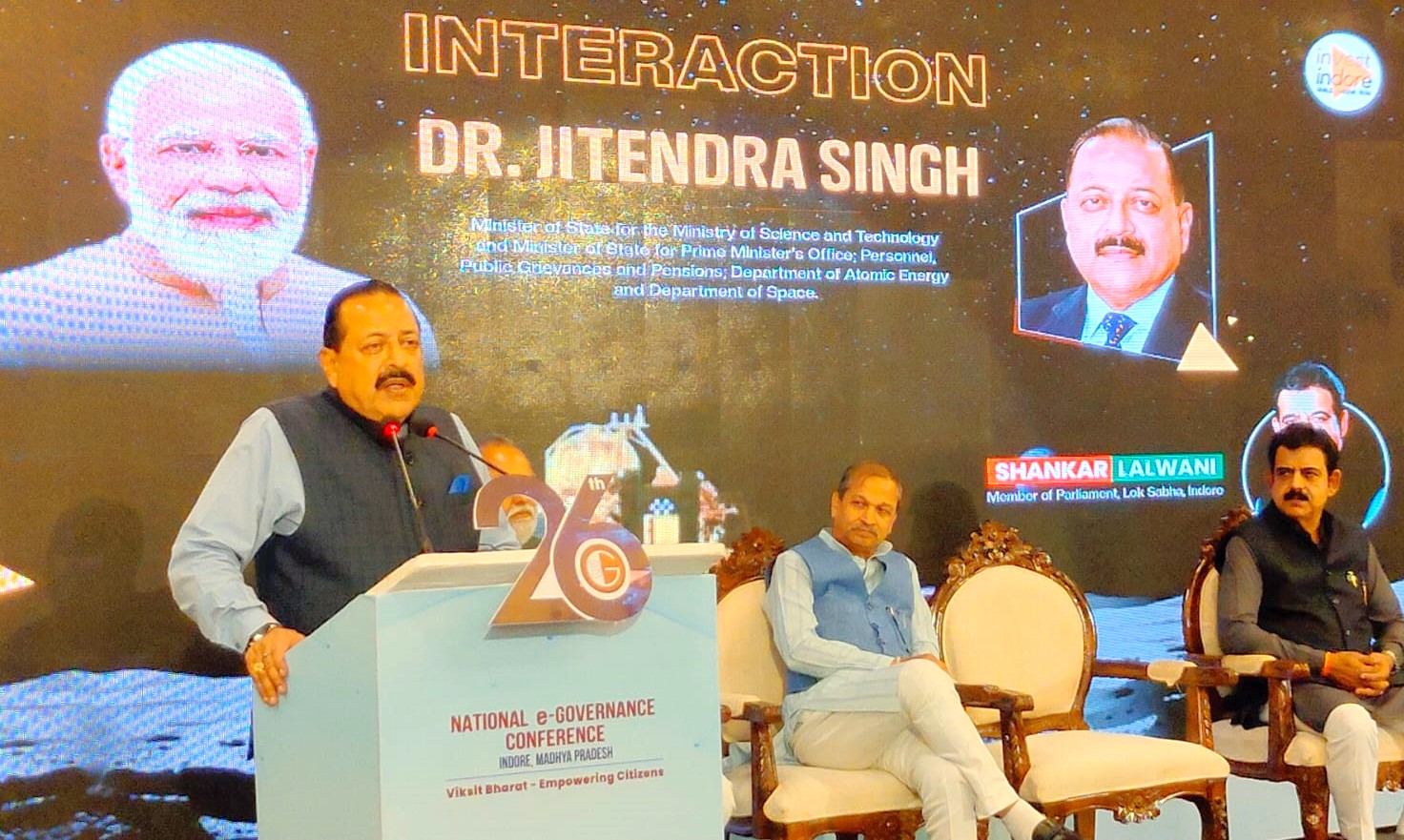
Chandrayaan-3 has proved India's capability for cost-effective Space missions

 “Chandrayaan-3 has proved India’s capability for cost-effective Space missions”.

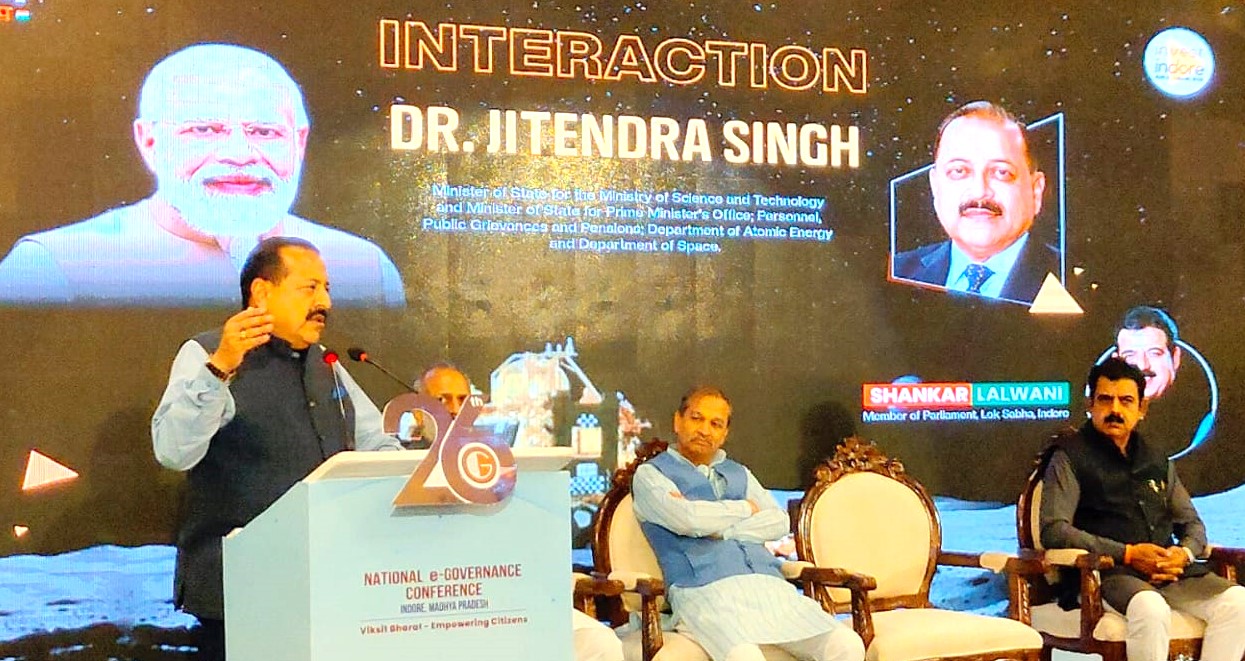
This was stated by Union Minister of State for Space, Dr. Jitendra Singh, while speaking at an interactive meet of intellectuals, prominent citizens and media persons in Indore.

He said, India’s space missions are designed to be cost effective.

The Minister further elaborated saying, “The Russian moon mission, that was unsuccessful, cost Rs.16,000 crore, and our (Chandrayaan-3) mission cost just around Rs.600 crore. Consider, Hollywood films based on Moon & Space Missions cost over Rs.600 crore”.

We have learnt to compensate for cost through our skills, said Dr Jitendra Singh, who is also the Union Minister of State (Independent Charge) Science & Technology; MoS PMO, Personnel, Public Grievances, Pensions, and Atomic Energy.

“Questions will arise, how? We made use of gravitational forces, the spacecraft made about 20 orbits of the earth, each rising in parabola, until it escaped and was captured in the Moon’s gravity and it made 70-80 revolutions of the moon before landing at the designated spot,” he said.

Dr Jitendra Singh said, in order to involve the private sector in R&D efforts, Prime Minister Shri Narendra Modi came out with the “Anusandhan National Research Foundation” Bill, passed by the Lok Sabha in the last session of Parliament, with a budget of Rs.50,000 crore over five years.

“When it is implemented fully, it will be a game-changer. We are planning a unique Public Private Partnership (PPP) entity for which ₹36,000 Cr of the research funding is to come from the private sector, mostly industry whereas the Government will put ₹14,000 crore,” he said.

Dr Jitendra Singh said, under PM Modi India launched a unique initiative which even the US and other countries would envy.

“Two years ago, a provision was made that companies can earmark 10% of their CSR (Corporate Social Responsibility) budget on R&D, earlier this was not so,” he said.

Calling for collective synergy, Dr Jitendra Singh said, we have to get rid of this mutual scepticism between the public and private sector. We can never emerge successful in the geopolitical race by working in silos, the minister said.

“We have to take this off our minds that the Government will and should do everything, those countries that stand developed did not achieve it by depending solely on their government. If today NASA sends rockets for the US, the maximum contribution to such missions is made by private agencies and industry, ” he said.

Stating that no government can provide a Sarkari Naukri to every individual, the Minister said, a responsible government creates job opportunities like PM Modi has done.

“From 350 Startups (in 2014), we now have over one lakh Startups, Startups have sprung up even in Governance technology, which nobody could have imagined earlier. Under Mudra scheme, easy loans of Rs.10-20 lakh are made available to the youth, without mortgage; so, a whole environment has been created to trigger innovation,” he said.

<

p dir=”ltr”>*****

Chandrayaan-3 has proved India&#39;s capability for cost-effective Space missions

 “Chandrayaan-3 has proved India’s capability for cost-effective Space missions”.

This was stated by Union Minister of State for Space, Dr. Jitendra Singh, while speaking at an interactive meet of intellectuals, prominent citizens and media persons in Indore.

He said, India’s space missions are designed to be cost effective.

The Minister further elaborated saying, “The Russian moon mission, that was unsuccessful, cost Rs.16,000 crore, and our (Chandrayaan-3) mission cost just around Rs.600 crore. Consider, Hollywood films based on Moon & Space Missions cost over Rs.600 crore”.

We have learnt to compensate for cost through our skills, said Dr Jitendra Singh, who is also the Union Minister of State (Independent Charge) Science & Technology; MoS PMO, Personnel, Public Grievances, Pensions, and Atomic Energy.

“Questions will arise, how? We made use of gravitational forces, the spacecraft made about 20 orbits of the earth, each rising in parabola, until it escaped and was captured in the Moon’s gravity and it made 70-80 revolutions of the moon before landing at the designated spot,” he said.

Dr Jitendra Singh said, in order to involve the private sector in R&D efforts, Prime Minister Shri Narendra Modi came out with the “Anusandhan National Research Foundation” Bill, passed by the Lok Sabha in the last session of Parliament, with a budget of Rs.50,000 crore over five years.

“When it is implemented fully, it will be a game-changer. We are planning a unique Public Private Partnership (PPP) entity for which ₹36,000 Cr of the research funding is to come from the private sector, mostly industry whereas the Government will put ₹14,000 crore,” he said.

Dr Jitendra Singh said, under PM Modi India launched a unique initiative which even the US and other countries would envy.

“Two years ago, a provision was made that companies can earmark 10% of their CSR (Corporate Social Responsibility) budget on R&D, earlier this was not so,” he said.

Calling for collective synergy, Dr Jitendra Singh said, we have to get rid of this mutual scepticism between the public and private sector. We can never emerge successful in the geopolitical race by working in silos, the minister said.

“We have to take this off our minds that the Government will and should do everything, those countries that stand developed did not achieve it by depending solely on their government. If today NASA sends rockets for the US, the maximum contribution to such missions is made by private agencies and industry, ” he said.

Stating that no government can provide a Sarkari Naukri to every individual, the Minister said, a responsible government creates job opportunities like PM Modi has done.

“From 350 Startups (in 2014), we now have over one lakh Startups, Startups have sprung up even in Governance technology, which nobody could have imagined earlier. Under Mudra scheme, easy loans of Rs.10-20 lakh are made available to the youth, without mortgage; so, a whole environment has been created to trigger innovation,” he said.

*****

Team ISRO on success of Chandrayaan-3

 The Prime Minister, Shri Narendra Modi visited the ISRO Telemetry Tracking and Command Network (ISTRAC) in Bengaluru after his arrival from Greece and addressed Team ISRO on the success of Chandrayaan-3. The Prime Minister met and interacted with ISRO scientists involved in the Chandrayaan-3 mission where he was also briefed about the findings and progress in the Chandrayaan-3 Mission.

Addressing the scientists, the Prime Minister expressed great delight in being present at the ISRO Telemetry Tracking and Command Network (ISTRAC) in Bengaluru and said that such an occasion is extremely rare when the body and mind get filled with such happiness. Referring to the few special moments in everyone’s lives when impatience starts to dominate, the Prime Minister noted that he experienced the exact same emotions during his tour to South Africa and  Greece and said that his mind was focussed on the Chandrayaan 3 Mission at all times. Observing the inconvenience caused to the scientists at ISRO due to his impromptu plans to visit the ISTRAC, a visibly emotional  Prime Minister said that he was eager to visit and salute the scientists for their diligence, dedication, courage, devotion and passion. 

The Prime Minister said that this is not a simple success. He said this achievement heralds India’s scientific power in infinite space. An elated Prime Minister exclaimed, “India is on the Moon, We have our national pride placed on the Moon”. Highlighting this unprecedented achievement, the Prime Minister said “This is today’s India that is fearless and relentless. This is an India that thinks new and in a novel way, the one that goes to the dark zone and spreads light in the world. This India will provide solutions to the big problems of the world in the 21st century.”

The Prime Minister said that the moment of the touchdown has become immortal in the consciousness of the nation. “The moment of touchdown is one of the most inspiring moments of this century. Every Indian took it as his or her own victory ”, he said. The Prime Minister credited the scientists for this grand success. 

The Prime Minister, describing the photographs of the strong footings of the Moon lander said, “Our ‘Moon Lander’ has firmly set its foot on the Moon like ‘Angad… On the one side is the valor of Vikram then there is bravery of Pragyan on the other”. He said these are pictures of the never seen parts of the moon and this has been done by India. “Entire world recognizes India’s scientific spirit, technology and temperament,” said Shri Modi.  

“The success of Chandrayaan 3 is not just India’s alone but it belongs to all of humanity”, the Prime Minister remarked and underlined that the explorations of the mission will open new doors of possibilities for moon missions of every country. He stated that the mission would not only unravel the secrets of the moon but also contribute to overcoming the challenges on Earth. The Prime Minister once again congratulated every scientist, technician, engineer and all members associated with Chandrayaan 3 Mission. 

The Prime Minister announced, “The point where the moon lander of Chandrayaan-3 landed will now be known as ‘Shiv Shakti’”. “In Shiv, there is resolution for the welfare of humanity and Shakti gives us strength to fulfil those resolutions. This Shiv Shakti Point of the moon also gives a sense of connection with Himalaya to Kanyakumari”, he added. 

Emphasizing the welfare core of the pursuit of science, the Prime Minister said that these pious resolutions need the blessings of Shakti and that Shakti is our Nari Shakti. In the success of Chandrayaan-3 lunar mission, our women scientists, the country’s Nari Shakti have played a big role, he emphasized. Shri Modi remarked. “Shiv Shakti Point of the Moon will bear witness to this scientific and philosophical thinking of India”, he added. 

The Prime Minister stated that the point where Chandrayaan 2 left its footprints will now be called ‘Tiranga’. This point, the Prime Minister said, will serve as an inspiration for every effort that India makes and remind us that failure is not the end. “Success is a guarantee where there is strong will power”,  he said. 

Emphasizing that India has become only the 4th nation to have a successful touchdown on the surface of the Moon, the Prime Minister said that the feat becomes more immense when we consider the humble beginnings of India’s space program. He recalled the times when India was considered a third-world country and did not have the required technology and support. Today, the Prime Minister said, India has become the 5th largest economy in the world and it is now among the first-world countries be it trees or technology. “In the journey from ‘third row’ to ‘first row’, institutions like our ‘ISRO’ have played a huge role”, the Prime Minister exclaimed as he highlighted its contributions and said that they have taken Make In India to the Moon today. 

The Prime Minister took the occasion to convey the hard work of ISRO to the countrymen. “From Southern India to the South of the Moon, this was not an easy journey,” the Prime Minister said and informed that ISRO even created an artificial moon in its research facility. The Prime Minister credited the zeal for innovation and science among the youth of India to the successes of such space missions. “Successes of Mangalyaan and Chandrayaan and preparation for Gaganyaan have given a new attitude to the young generation of the country. Your big achievement is awakening a generation of Indians and energizing that”, Shri Modi said. Today, the name of Chandrayaan is resonating among children of India. Every child is seeing his or her future in the scientists, he said. 

The Prime Minister declared that 23rd August, the day of the soft landing of Chandrayaan 3 on the Moon will be commemorated as ‘National Space Day’. He said that National Space Day will celebrate the spirit of Science, Technology and Innovation, and inspire us for an eternity. 

The Prime Minister noted that the capabilities of the space sector are not limited to launching satellites and space explorations, and its strength can be seen in Ease of Living and Ease of Governance. He recalled the workshop that was organized for the Joint Secretary level officers in the central government with ISRO during the initial years of his Prime Ministership. He mentioned the tremendous progress made to link the space applications with  Governance. He mentioned the role of Space technology in Swachh Bharat Abhiyan;  education, communication and health services to far flung areas; tele-medicine and tele-education.  He also talked about the role of the NAVIC system and support during natural calamities. “Space technology is also the basis of our PM Gatishakti National Master Plan. This is helping a lot in the planning, execution and monitoring of projects. This scope of space application, which is increasing with time, is also increasing opportunities for our youth”, the Prime Minister added.  

The Prime Minister requested ISRO to organize national hackathons on ‘Space Technology in Governance’ in collaboration with various departments of center and state governments.  “I am confident that this National Hackathon will make our governance more effective and provide modern solutions to the countrymen”, he said. 

The Prime Minister also gave a task to the young generation of the country. He said “I want the new generation to come forward to scientifically prove the astronomical formulas in the scriptures of India, to study them anew. It is also important for our heritage and also important for science. In a way, this is a double responsibility for the students of schools, colleges and universities today. The treasure of scientific knowledge that India has, has been buried, hidden during the long period of slavery. In this Azadi ka Amrit Kaal, we have to explore this treasure too, do research on it and also tell the world about it.” 

The  Prime Minister referred to the estimates of the experts that India’s space industry will reach 16 billion dollars from 8 billion dollars in the next few years. While the government is working relentlessly for space sector reforms, the youth of the country is also making efforts as, during the last 4 years, the number of space-related startups has gone up from 4 to about 150. The Prime Minister also urged students across the country to take part in a huge quiz competition on Chandrayaan mission organized by MyGov from 1st September.  

Emphasizing the importance of taking the lead in science and technology in this period of the 21st century, the Prime Minister said that India has become the youngest talent factory in the world. “From the depths of the ocean to the heights of the sky, to the depths of space, there’s a lot for the young generations to do”, the Prime Minister said as he highlighted opportunities ranging from ‘Deep Earth’ to ‘DeepSea’,  and the next generation computer to genetic engineering. “New opportunities are constantly opening up for you in India”, he added. 

The Prime Minister underlined that guidance for future generations is a necessity and it is them who will further the important missions of today. He said that scientists are their role models and their research and years of hard work have proved that anything can be accomplished if you set your mind to it. Concluding the address, the Prime Minister said that the people of the country have faith in the scientists, and when the blessings of the people are bestowed, India will become a global leader in science and technology with the dedication shown towards the country. “Our same spirit of innovation will make the dream of a developed India come true in 2047”, Shri Modi said. 

***

ISRO Centre in Bengaluru

 Bharat Mata ki – Jai!

This morning, I was in Bengaluru. I arrived very early in the morning and decided to meet the scientists who have brought such great achievements to the country. So, I went there early in the morning. However, the way people celebrated the success of Chandrayaan, holding the Tricolour in their hands even before sunrise, was incredibly inspiring. And now the sun is scorching equally in this intense heat which can even pierce the skin. It’s fortunate for me too to be a part of the celebration and share in the joy of Chandrayaan’s success in this intense heat with you who have come here. I congratulate all of you for this, and for me, it’s also a privilege to be a part of this celebration. I congratulate all of you for this.

Today, when I arrived at ISRO in the morning, I had the privilege of releasing the images captured by Chandrayaan for the first time. Perhaps, you might have seen those images on TV as well by now. Those beautiful images were a significant scientific success in itself. Traditionally, it’s a global tradition to name such points which are part of such successful campaigns. After much deliberation, I felt that the point where Chandrayaan-3 has successfully landed should be given a name, and that name is ‘Shivshakti’. When we talk about Lord Shiva, it signifies auspiciousness, and when we talk about power, it signifies the strength of the women of my country. When we talk about Lord Shiva, the Himalayas come to mind, and when we talk about Shakti (power), Kanyakumari comes to mind. Therefore, that point has been named ‘Shivshakti’ to capture the essence of this sentiment from the Himalayas to Kanyakumari. In fact, this name was brought to my notice during Chandrayaan-2 in 2019. However, my mind wasn’t ready. Deep down in my mind, I had resolved that Chandrayaan-2 Point would only get a name after we truly succeed in our journey. And when Chandrayaan-3 succeeded, the point of Chandrayaan-2 also got its name, and that point has been named ‘Tiranga’ (the Indian Tricolour flag). The Tricolour gives the strength to overcome all challenges and the Tricolour provides the inspiration to manifest every dream. Hence, as Chandrayaan-2 faced failure and Chandrayaan-3 achieved success, the Tricolour turned into inspiration. This is why the Chandrayaan-2 point will now be known as Tiranga. Another significant aspect that I mentioned this morning is that August 23 is a milestone in India’s scientific journey of development. Therefore, every year, India will celebrate August 23 as National Space Day.

Friends,

I was in South Africa for the BRICS Summit in the past few days. This time, along with members of the BRICS Summit, the entire Africa was also invited there. During the BRICS Summit, I observed that there was hardly anyone in the world who did not mention Chandrayaan, or had not conveyed their congratulations. The congratulations I received there, I instantly shared them with all the scientists. And I’m also sharing all the congratulations from across the world with you.

Friends,

Everyone wanted to know about Chandrayaan’s journey, its timeless accomplishment, and the impact of New India, new dreams, new resolutions, and successive achievements, one after another. The world is sensing the emergence of a new influence, based on the capabilities of our Indian Tricolour, our successes and achievements. Today, the world is not only experiencing this influence but also acknowledging and respecting it.

Friends,

After the BRICS Summit, I went to Greece. It had been 40 years since any Indian Prime Minister had visited Greece. I am fortunate that many tasks that are left undone are destined to be done by me. India was accorded respect for its capabilities in Greece as well. Greece perceives that it can become a gateway to Europe due to the friendship between India and Greece and the friendship between India and Greece will serve as a significant means to strengthen the relationships between India and the European Union.

Friends,

We also have some responsibilities in the days to come. Scientists have done their part. Whether it’s satellites or Chandrayaan’s journey, it has a significant impact on the lives of ordinary people. Therefore, we need to work so that the interest of the youth of my country in science and technology develops further. We are not just people who get stuck with celebrations, enthusiasm, and energy. When we achieve success, we are prepared to take strong steps forward for new advancements. Hence, we should explore how space science can work, how satellite capabilities can be used and how this journey can be useful for good governance, for last-mile delivery, for improvements in the lives of ordinary people. And therefore, I am sounding out all the departments of the government to use space science, space technology and the capabilities of satellites for improvement in delivery, quick response, transparency and perfection. We need to explore all these aspects within our respective departments. I also wish to organize hackathons for the country’s youth in the coming days. In recent days, the country’s students have provided excellent ideas by working non-stop for 30-40 hours during various hackathons, creating an environment of innovation. I want to initiate a series of such hackathons very soon. This will allow the young minds, the young talents of the country, to use space science, satellites, and technology for finding solutions to the challenges faced by ordinary people. We will work in that direction.

Alongside this, we also need to attract the new generation towards science. The 21st century is technology-driven, and the country that progresses ahead in the world will be the one with prowess in science and technology. Therefore, the demand of the time is that by 2047, as we strive to make our country a developed India, we must advance further on the path of science and technology with greater strength. We need to prepare our new generation right from childhood with a scientific temperament. Hence, the significant success we have achieved, the enthusiasm and energy we have, need to be channelled into strength. To channelize this strength, a quiz competition will begin on MyGov from September 1. Through this, our youth will engage with small questions and answers, and gradually develop an interest. Our new education policy has made ample provisions for science and technology. Our new education policy is such that gives significant emphasis to this, and the quiz competition will help our students develop interest in science and technology. Today, I would like to tell the youth of the country, to the students of my country, and to every school, to participate actively in this quiz competition which is centred round Chandrayaan. Millions and millions of youth in the country should become a part of it, and we should take it forward. I believe this will yield significant results.

Today, I want to draw your attention to one more thing. Despite the world’s increasing curiosity, attraction, and belief in India, there are still occasions when it should experience these aspects first hand. There will be an immediate opportunity before us, especially for the people of Delhi, and that is the G20 Summit. In a way, the world’s significant decision-making leadership will be on the soil of Delhi, in the land of India. While the entire India is the host, the guests are coming to Delhi.

The hosting of the G20 Summit is a responsibility of the entire country, but the greater responsibility lies with my brothers and sisters of Delhi, the citizens of Delhi. Therefore, we need to show the world that Delhi can handle this responsibility without any glitches. The privilege of raising the flag of our country’s honour, dignity, and prestige is in the hands of the people of Delhi. There is bound to be some inconvenience when a significant number of guests come. Even when some 5-7 guests visit us, we accommodate them in the main sofa even though we have to sit on smaller chairs. We have the tradition of ‘Atithi Devo Bhava’ i.e., treating guests as gods. The more respect, honour, and welcome we extend to the leaders of the world, the more will they enhance our own pride, our dignity, and our reputation. Therefore, there will be numerous activities taking place here from September 5th to September 15th. Therefore, I apologize in advance to the people of Delhi for the inconvenience which will be caused to them in the days to come. I request the citizens of Delhi to be patient with the inconveniences that may arise during these upcoming days. I urge them to understand that these guests are everyone’s guests, and we might experience some discomfort, changes in traffic arrangements, and restrictions on movement. But some things are necessary. And as we know if there is a wedding in the family, even if a small cut happens while trimming nails, people say, “Take care, it’s a special occasion, nothing bad should happen.” Therefore, this is a significant opportunity, and just as in a family, all these guests are ours. With the collective efforts of all of us, I believe that our G20 Summit will be spectacular, vibrant, and the entire Delhi will be immersed in colours. My fellow citizens of Delhi will showcase this through their endeavours, and I have full confidence in this.

My dear brothers and sisters, my family members,

In just a few days, the festival of Raksha Bandhan is approaching. Sisters tie a rakhi to their brothers. And we have all grown up saying, “Chanda Mama”. From childhood, we are taught about Chanda Mama, and from childhood, we are taught that earth is our mother. The earth is our “mother” and the moon is “mama”. It means that our Mother Earth is the sister of Chanda Mama. Our Mother Earth is going to celebrate the festival of Raksha Bandhan with Chanda Mama this time. And so, let’s celebrate this Raksha Bandhan festival in a splendid way, with brotherhood, unity, and a loving atmosphere, so that in the G20 Summit too, this brotherhood, this unity, this love, our culture, and our traditions introduce the world to this essence. I believe that the upcoming festivals will be grand, and in September, our achievements will once again introduce India in various ways on the world stage. Just as the scientists have raised our flag high with the success of Chandrayaan, we, the citizens of Delhi, will strengthen that flag with our splendid hosting of the G20 Summit. I have full confidence in this. I extend my warm wishes to all of you who have gathered here in this bright sunshine to collectively celebrate the achievements of our scientists, to wave our Tricolour with pride, and I offer my heartfelt congratulations. Let’s chant together –

Bharat Mata ki – Jai!

Bharat Mata ki – Jai!

Bharat Mata ki – Jai!

Thanks a lot!


DISCLAIMER: This is the approximate translation of PM’s speech. Original speech was delivered in Hindi.

***

Legal and policy challenges in space technology


                                                           (Photo: Outlook India)

History is agreed upon as an uninterrupted process in time and space.”

India before independence was very different from the India that we see today. Of course, it is common knowledge that pre 1947 India consisted of modern day, Pakistan and Bangladesh. The after-independence chase of India faced major developments and changes that we can see today. India has an impressive array of achievements in the development of space transport as well as aviation industry for various applications. From a humble beginning with a small RH 75 rocket in the sixties to the successful launch of PSLV-D2 with 804 kg IRS-P2 in October, 1994, the Indian space programme has made remarkable progress through a well-integrated, self-reliant programme. On the other hand, the civil aviation industry of India has emerged as one of the fastest growing industries in the country during the last three years. India has become the third largest domestic aviation market in the world and is expected to overtake UK to become the third largest air passenger market by 2024.

Every country’s success depends upon its government. The way it handles the whole economy largely affect its economic environment. In such a globalized environment, the governmental policies act as the key factor in determining its real success, be it in field of aviation, space technology or any other. The government however has reviewed its aviation policies from time to time and tried to make it friendlier however it lagged in certain jurisprudence. In the recent past, the outlook of the government of India has undergone substantial change. It has tried to adopt emerging trends and include different terminologies, ownership of private companies, more new projects, financing, hassle free management and its operations. The government has increased its investment in this sector. Moreover, it has tried to devise the privatization method to solve many problems attached to this sector. Privatization is needed for solving the problem of “distressed state syndrome”. The complete or partial privatization will give positive impact on efficiency, productivity and profitability. Trends of privatization is rising all around the world and it is important to analyze all consequences and specific results, which will be helpful to understand better difficulties and structural changes.

During the COVID time, there was a dramatic drop in demand for passenger air transport. This threatened the viability of many firms, putting many jobs at stake. While the aviation industry has often been a target of government policies, the COVID-19 crisis has precipitated a new suite of loans, loan guarantees, wage subsidies and equity injections, raising concerns about efficient use of public resources. The COVID-19 crisis has hit hard to the economy.

Although the aviation and space sector contribute a lot to the economy, however every coin has two sides. The other side of the story is that we have grown, but grown at the cost of our mother nature. The question that we need to dwell into is: “Do we belong to this earth or does this earth belong to us”. Commercial aviation is experiencing dramatic growth in various regions throughout the world but at the cost of what. It is leading to the pollution of the environment. Over the past 50 years global demand for air travel has risen by 9 per cent per annum. The environmental impact it has caused is very degrading. This has become a cause of concern.

INVESTMENT

According to the data released by Department for Promotion of Industry and Internal Trade (DPIIT), FDI inflow in India’s air transport sector (including air freight) reached US$ 2.79 billion between April 2000 and June 2020. The government has allowed 100% FDI under the automatic route in scheduled air transport service, regional air transport service and domestic scheduled passenger airline. However, FDI over 49% would require government approval.

India’s aviation industry is expected to witness Rs. 35,000 crore (US$ 4.99 billion) investment in the next four years. The Indian Government is planning to invest US$ 1.83 billion for development of airport infrastructure along with aviation navigation services by 2026.

Key investments and developments in India’s aviation industry includes:

  • In October 2020, Zurich Airport International signed the concession agreement for the development of Jewar Airport on the outskirts of Delhi. The agreement has granted Zurich Airport International the license to design, build and operate Noida International Airport (NIAL) for the next 40 years.
  • In October 2020, the Airports Authority of India (AAI) announced plan to upgrade runways at seven airports across the country by March 2022.
  • In January 2020, IndiGo became first Indian carrier to have an aircraft fleet size of 250 planes and became the first airline to operate 1,500 flights per day.
  • In December 2019, AAI announced its plans to set up India’s first three water aerodromes in Andaman & Nicobar.
  • As of December 2019, France-based Safran Group planned an investment of US$ 150 million in a new aircraft engine maintenance, repair and overhaul (MRO) unit in India to cater to its airline customers.
  • AAI plans to invest Rs. 25,000crore (US$ 3.58 billion) in next the five years to augment facilities and infrastructure at air transport.

THE NEED FOR SPACE LEGISLATION

What we can sketch out is that there’s a greater need for space legislation. With no legal obligation, the dream of ‘DIGITAL INDIA’ can’t be achieved. A robust legal regime would instill investor confidence, attract FDI and new technologies, reduce administrative and regulatory uncertainties, provide clarity on stamp duty, registration requirements, insurance, transfer of property, contractual obligation, space debris liability and intellectual property rights concerning space-related issues, and flourish space entrepreneurship by providing a level playing field to the private entities. 

The policymakers need to resolve the following issues in virtue of requisite space legislation:

·       Single Independent Regulator – In contradiction to the present multiple ministries, agencies and departments, namely, the Ministry of Home Affairs, the Department of Space, the satellite divisions of Department of Telecom, the Department of Telecommunications, the Telecom Engineering Centre, the Network Operation and Control Centre, the Ministry of Defense, and the Ministry of Defense, a single independent regulator is required to perform regulatory processes including the issuance of a place in orbit to launch a satellite and/or rocket, mandatory licenses to launch it, spectrum to communicate with it, and clearance for the technology and/or space equipment to be used. 

·       Space debris – Space debris or space junk encompasses both man-made and natural (meteoroid) particles that enhance the probability of disastrous collision that may cause damage to space vehicles. Although there is no specific international treaty or convention dealing with the imposition of liability, some long-standing guidelines were issued by NASA, on ‘how to deal with space debris’ which were later adopted by the UN General Assembly and COPUOS. However, well-defined provisions on liability of the launching state need to be formulated to reduce the persisting or potential conflicts among countries.

·       Security measures – With the rising threats to national peace and security by potential space and cyber warfare possibilities, countries need to invest adequately in adopting cyber and military security measures. Rules and regulations on lines with the Data protection laws need to be formulated to ensure that adequate cyber security measures are in place.

·       Granting of license – The process for granting a license is yet to be developed, but section 5 of the Bill envisages that there will be eligibility criteria, and a fee to pay, without giving any detail or indication as to what those criteria or fees might be. In particular, it sets out the obligation to provide a financial guarantee or insurance, which essentially addresses the broader liability question and the principles of liability that flow under the international space regime.

·        Intellectual property rights- Section 25 of the Bill states, Any invention, or other form of intellectual property rights, developed, generated or created during the course of any space activity shall be protected by any law for the time being in force, with the primary objective of safe guarding national security. such a provision might deter the potential participation of the private sector in the Indian space industry and thus needs to be looked into by the policymakers to enable innovation in the space industry.    

CONCLUSION

“Without your involvement you can’t succeed. With your involvement you can’t fail.”

Well said by APJ Abdul Kalam.India’s aviation and space transport are largely untapped with huge growth opportunities. It’s the need of the hour to grab these opportunities and the government should deeply involve in this process by making key changes in its policy and legal framework. A single policy should be adopted. In aviation industry, a lot of digital transformation is required. A big vision and strategy are needed to get through stormy waters. Cost pressure should be taken into account. New technology should be adopted. With the increase in competition and entry of private players, only the companies who do best will be able to survive. On the other hand, in space industry, policy changes are needed to make the space sector more accessible to private players. There’s a need of single space legislation. Changes are needed in New Space India Limited (NSIL). Last year, the finance minister announced the opening up of the ISRO’s facilities to the country’s private sector as part of its COVID-19 special economic stimulus. This was an early but a commendable step. Many a thing have changed since COVID.

As it is said, “Every cloud has a silver lining.” We should also hope for the best. It is at these times when the government was able to realize its incapability and failure and hopefully it has started considering legal and policy aspect that needs deeper consideration