Section 66A of the Information Technology Act (“IT Act”), 2000, came into existence through an amendment in 2008. This section penalised sending “offensive messages” via online communication. provision was often misused by enforcement authorities and caused problems over freedom of speech on internet.
Case of shreya singhal vs Union of India
Two girls were arrested in Mumbai over criticising the bandh in maharashtra over demise of shiv sena chief Bala sahib Thackeray in November 2012. One of them posted illegal content while another one simply liked it, both of them were booked under section 66A of IT ACT and section 295A of IPC.
Although,both of girls were released and charges were dropped but this act invited criticism from all over the country. Shocked by misuse of law by the authorities, Shreya singhal filed an PIL in 2012 to declare section 66A of IT ACT 2000 as unconstitutional.
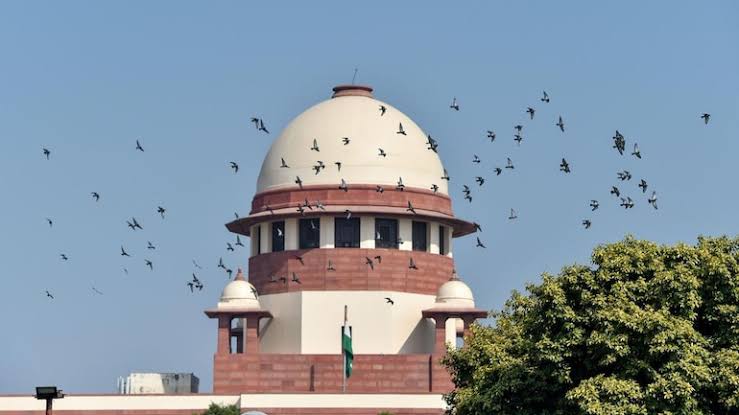
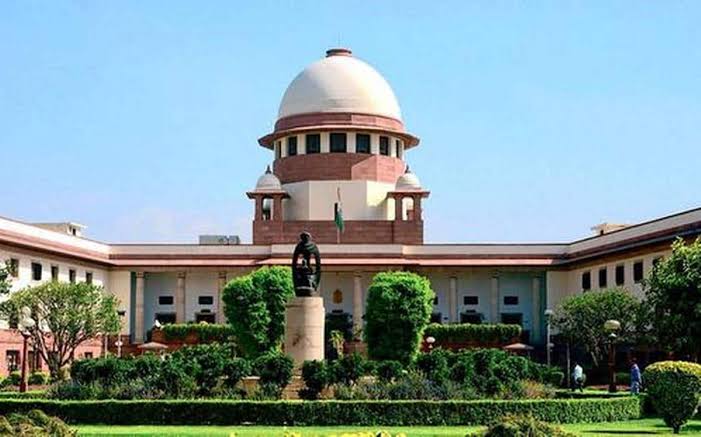
On March 24, 2015 the Hon’ble Supreme Court of India passed a landmark judgement in this matter. The Hon’ble Supreme Court came out with judgement that Section 66A of the IT Act is arbitrarily and disproportionately affects the right to freedom of speech. Also, all the pending cases were directed to be dismissed and no fresh cases were to be registered under this scrapped section 66A of IT ACT.
Why is section 66A of IT Act in news in 2021 ?
Even,after this section was scrapped,many fresh cases were registered under this section of IT act. A plea was filed by PUCL ,it came into light that even after 7 years of the law being scrapped. total of 745 cases are still pending and active before the district courts in 11 states, under Section 66A of the IT Act. Supreme court have sent a notice to centre, demanding why this scrapped section is still in use and why not proper measures are taken till now.
Contempt in its true sense means scandalizing, disrespecting courts or individual judges or jury and attributing motive to certain judgment. With the intent of implementing the orders of the court of law and preserving it from scandalizing the “CONTEMPT OF COURT ACT” was modified and adopted in the parliament in 1971. The punishment for contempt is maximum of six months imprisonment or fine of rupees 2000 or both. It is a restriction on one of the fundamental rights “The Right to Expression”. Contempt is of two types-Civil contempt and Criminal contempt.
According to the section 2(b) of The Contempt of Court Act, 1971, civil contempt means willful disobedience to any judgment, decree and direction, order, writ or other process of a court or willful breach of an undertaking given to the court.
According to the section 2(c) of The Contempt of Court Act, 1971, criminal contempt means the publication (whether by words, spoken or written, or by signs, or by visible representation, or otherwise) of any matter or the doing of any other Act whatsoever which scandalize or tend to scandalize, or lower or tends to lower, the authority of any court or prejudice or interfere or tends to interfere with, the due course of any judicial proceeding or ineterface or tends to interfere with or obstructs, the administration of justice in any other manner. Criminal contempt is considered a conduct directed against dignity of Court. That’s why criminal contempt often highlights as the only contempt. But that’s not true according to the report submitted on the review of the Contempt of Court Acts, 1971 by The Law Commission of India chaired by Justice B.S. Chauhan states that there is more number of civil contempt cases (96,993) than civil contempt cases (583) in various high courts and The Supreme Court. But despite high ratio of civil contempt the punishment ratio is very low. There is a very fine line between contempt and criticisms and because of it criticism is understood as contempt. In its previous judgments Supreme Court states that contempt victims should not be punished until the contempt is intended or tends to interfere in the due course of administration of the courts. One of the major drawback of the contempt law is that the judge is victim as well as prosecutor and the same person is assuring justice which is against the basic theory of justice. In the recent cases we see renowned Prashant Bhushan criticizing CJIs and found guilty in the court of law and fined for Rs 1. The court has the power to pick up any publication and scrutinize it as contempt of court in the courts. This makes people hesitate to present their point of views on certain judgments as they fear to be punished for contempt. This also present judiciary in a bad light in front of the citizens.
The Courts should check civil contempt more than criminal contempt. The Courts should develop habit of criticism on their judgment because they can also give controversial judgments. Even the Supreme Court is supreme but not infallible. In a healthy democracy everything should be questioned. Courts should accept their bonafide criticism as they will help them deliver better judgments in the future and criticism makes any institution better not disrespect them.
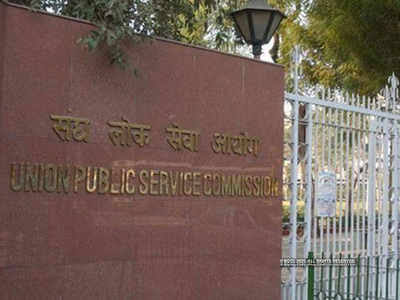
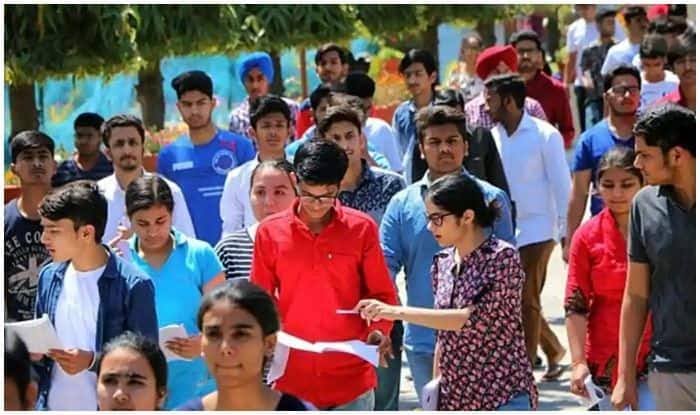
The Union Public Service Commission (UPSC) on Monday informed the Supreme Court that it is impossible to defer the Civil Services Preliminary 2020 as all logistical arrangements have already been made. A 3-judge bench headed by Justice AM Khanwilkar asked UPSC to put this stand in affidavit along with the arrangements made. The matter will be heard on Wednesday.
The bench comprising Justices AM Khanwilkar, BR Gavai, and Krishna Murari has directed the UPSC to file its affidavit in the case by tomorrow.
Twenty civil services aspirants had approached the Supreme Court, seeking the crucial exam to be deferred by two to three months due to the flood situation in several parts of the country along with the coronavirus crisis. The exam, which was earlier scheduled on May 31, was rescheduled to October 4 due to the pandemic
The plea said the Civil Services Exam, being a recruitment examination, is altogether different from an academic examination and in the event of its postponement, there would not be any question of delay or loss of any academic session.
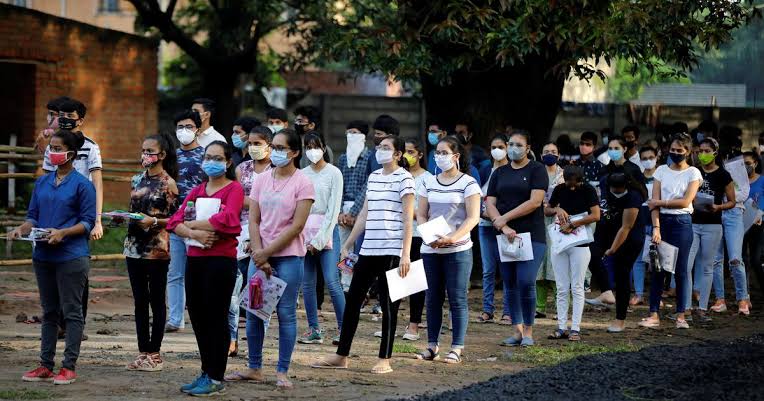
It said that due to non-availability of exam centres in their home towns, many aspirants are facing unimaginable hardship due to non-availability of or unsafe health conditions in, the PG accommodation/ hostels/ hotels etc, where they are forced to stay with their family members, once they are travelling to an outstation Examination Centre.
It is pertinent to mention here that despite alarming spurt in COVID-19 pandemic, UPSC did not increase the number of Examination Centres, resulting into a situation where many candidates from rural areas will be forced to travel for around 300-400 Kilometres, in order to reach to their Examination Centres and there will be high probability of such aspirants, getting affected while using public transportation for such travel, the plea said.
The plea has sought the apex court to direct the National Testing Agency (NTA) to issue a further date when the students, who missed the examinations, can appear.
Shashwat Anand, a lawyer, has asked the Supreme Court to take suo moto cognizance of the report of a student who could not give the examination as he was late by 10 minutes.
Santosh Kumar Yadav, a resident of Bihar’s Darbhanga, missed the NEET as he was 10 minutes late in reaching the examination centre in Kolkata’s Salt Lake area last Sunday.
It may be noted that for many students, 2020 was also the last year to attempt for the JEE Main or NEET 2020 examination. The plea seeks recourse for students who have been impacted. JEE Main 2020 was conducted from September 1 to September 6 and the result of the same has also been released. Meanwhile, NEET 2020 was conducted on September 13. Results are awaited for the undergraduate medical/ dental entrance examination
The plea urges the SC to direct NTA to conduct re-exams. It also seeks the various state governments to arrange for the transportation facilities for the students who would be appearing in these exams conducted by NTA this time.
As per the plea, it has been asked, “ Issue a writ, order or direction, in the exercise of its inherent and plenary powers under Article 142 issuing/ laying down guidelines or directions for the students who miss out on exams like NEET, IIT, JEE etc owing to some of the other sufficient cause, to allow and facilitate the same to appear in such exams on further dates as may be notified by the respondents, inter alia, providing accommodations, food and water, transportation etc.”
Various states, ruled by the opposition parties, had earlier requested the central government to postpone the JEE Main and
NEET considering the grim Covid-19 situation in the country.
Several states of the country had also moved the top court seeking a reconsideration of its own order, which had allowed the holding of the twin examinations.
Citing the top court order, the central government had clearly stated it was in no mood to postpone the examinations.
Supreme Court on Friday refused to entertain the review petition filed by ministers of six opposition-ruled states who were seeking review of the court’s August 17 order to conduct NEET-UG and JEE EXAMINATIONS.
Six ministers from Maharashtra, Punjab, West Bengal, Jharkhand, Rajasthan and Chhattisgarh had had moved to the apex court saying that if the order was not reviewed, “grave and irreparable harm and injury would befall on the student community”.
The petitioners in the case were Moloy Ghatak (minister from West Bengal), Rameshwar Oraon (Jharkhand), Raghu Sharma (Rajasthan), Amarjeet Bhagat (Chhattisgarh), Balbir Singh Sidhu (Punjab), and Uday Ravindra Samant (Maharashtra). In its review plea, stated, “not only will health, welfare and safety of students/candidates appearing for the NEET/JEE examinations stand imperilled but also the public health at large would be in severe jeopardy…”
The ministers in the plea had claimed that the top court order failed to secure students’ “right to life” and ignored “teething logistical difficulties” to be faced in conducting the exams during the COVID-19 pandemic.
The state ministers on August 28 moved SC and demanded that the examinations be postponed by at least six to eight weeks keeping in mind the surge in coronavirus cases and health concerns of students. It alleged that the government’s decision to go ahead with examinations despite the 3.3 million covid cases with over 60,000 deaths, “reveals non application of mind, and is unreasonable, arbitrary and capricious exercise of power”.
The bench of Justices Ashok Bhushan, B R Gavai and Krishna Murari, which considered the pleas in-chamber, also rejected the applications seeking listing of the review petition in the open court. “Applications seeking permission to file review petitions are allowed. We have carefully gone through the review petitions and the connected papers. We find no merit in the review petitions and the same are accordingly dismissed,” the bench said in its order.
The JEE-Main will be held from 1 to 6 September, while NEET exams for admission to undergraduate courses in medical colleges is scheduled for 13 September. JEE Advanced for the Indian Institutes of Technology (IITs) is scheduled for later in September.
JEE-Mains have already begun across the country from September 1, with guidelines for maintaining social distance minimising contact.
PTI reported that on the third day of the JEE-Mains, 82.14 percent of the registered candidates appeared for the examination, as against 54.67 percent on the first day.
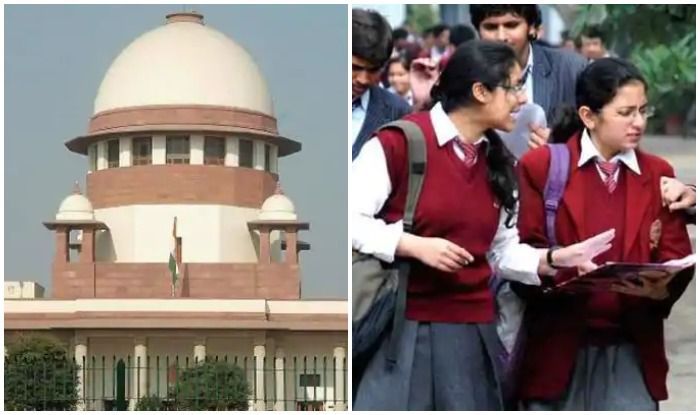
The Supreme Court on Friday issued notice to CBSE on petitions filed by Class 10 and 12 students, who are seeking cancellation of compartment exams, to be conducted for those who have failed or are seeking improvement in subjects they appeared.
The exams are scheduled to be conducted in the last week of September. The top court has also sought an explanation from CBSE regarding holding the exams amid COVID-19 pandemic.
The petition challenges the notification on the grounds that holding of these exams would be detrimental to the health of the students.
A three-judge Bench of the Supreme Court comprising Justices AM Khanwilkar, Dinesh Maheshwari, and Sanjiv Khanna considered the plea filed against CBSE’s decision to conduct compartment examinations for class 10 and 12.
“Without examination where do you stand. Is there any other methodology contemplated by CBSE,” the bench asked during the hearing conducted through video conferencing.
The petitioner argued, ” The students will ultimately come in the category of failed students since exams will not be able to be conducted by September and the students will not be able to apply for further studies. The main grievance in the matter is that the main exam and the CBSE have not yet asserted why the compartment exam cannot be cancelled.”
It has also been pointed out by the petitioners that the, “Admissions in Universities will close by the time the exams are conducted.”
Advocate Rupesh Kumar, arguing in favour of CBSE, said, “We have increased the centres for compartment exams to 1278. We have taken a decision that in a class where 40 students could sit, now only 12 will sit. We are taking all precautions.”
The counsel for the Central Board of Secondary Education (CBSE) said the board has increased the number of examination centres for compartment tests from 575 to 1,278.
The bench of the top court has dismissed the hearing on Friday and will be gathering on September 10 to continue hearing the case.
Amidst this deadly Covid-19 pandemic India is gearing up for conducting competitive examinations (JEE/NEET and final year examination) The commission has announced the dates for several competitive exams to be conducted in September and October. The real question is not if the students are prepared, but is India prepared for this? Despite imposing complete lock-down, especially in Maharashtra, the Covid-19 cases are increasing day by day and now the supreme court has given a verdict that exams should be conducted.This is totally unfair.There are lakhs of students who will appear for writing exams. It is not only putting students and teachers under risk but also their families. Is this worth taking the risk? Putting life under jeopardy to write exams.
The health minister is talking about taking precautions, but before that, what about people who have already been tested COVID positive? Many people are dying not because of the virus but because of a lack of proper health care facilities and treatment. No one can blame the people for raising their suspicion. With a public health care system is in a hodgepodge, many people are looking with doubt at the country’s attempts to battle with the pandemic. The lack of these stocks has decreased the Indian health care base, also, leading to an accelerated rise in COVID-19 crises in the country. At this time when even very advanced countries are striving to deal with this pandemic and due to a dense population, India’s incapacitated health care foundation is in many ways disadvantaged to deal with this pandemic. Today the record surged to 83,883 fresh corona-virus cases in the last 24 hours taking India’s COVID tally past the 38-lakh mark and Maharashtra continues to be the state hit hardest by the pandemic and followed by Delhi, Karnataka, Andhra Pradesh, and Tamil Nadu making India top 3rd Country affected and just some numbers behind Brazil.
The government should look for another solution or option other than making students appear for the examination in centers. What is the technology for then? Competitive exams should be conducted online with certain protocols. In that way, students will not lose their one year and they will be safe, and yes even though there can be certain technical problems in conducting exams online, but this is the better option rather than going to colleges. Offline exams may act as a great threat to health since the crowd of students in huge numbers at the examination center will make them prone to getting in contact with a corona positive person. The thermal screening of all persons entering the examination hall is no remedy. Another option is to cancel the final term exams while using the average of the marks secured in earlier terms as a substitute for the final semester examination scores. The government should realize that the situation can go out of control anytime, which is evident with the day to day spike in COVID cases despite lock down and on top of that now lakhs of students have to go and write exams. The government should reconsider this decision of giving priority to examination over life.
Rebel congress MLAs Sachin Pilot and 18 others voices get heard by the Supreme Court of India. The apex court sternly said that in democracy a voice of dissent cannot be suppressed.The court also allowed the Rajasthan High Court to go ahead and pronounce it’s ruling on the 19 MLAs’ petition, but said that, the verdict will remain subject to the final order of the SC.
The “Lakshman rekha”
A three-judge bench of Justices Arun Mishra, BR Gavai and Krishna Murari, was hearing the special leave petition filed by the assembly speaker CP Joshi. The SLP is against the interim order of the High court on a plea of 19 rebel MLAs. The Top Court said, ‘‘it is the matter of just one day. Why can’t you wait?’’ The Court also questioned, ‘‘why the Speaker, a neutral person, should approach the court at all.’’
Representing the Rajasthan Speaker, Senior Advocate Kapil Sibal argued that, it is the top court’s duty to ensure that all constitutional authorities act within the “Lakshman rekha” drawn for each one of them.
Responding to his argument Justice Arun Mishra asked, “Assume a leader has lost the faith of persons. While remaining in party they cannot be disqualified. Then this will become a tool and no one can raise their voice. Can a person elected by people not express his dissent? Voice of dissent cannot be suppressed. In a democracy, can somebody be shut down like this?”
Judiciary vs. Legislative
Quoting the famous Kihoto Hollohan case in 1992, Kapil Sibal said that, speaker had sent the notice to the dissident MLAs to give them a chance to explain their action as to why there are holed up in a hotel? And if the speaker will satisfy with their explanation, he will not disqualify them. But no judicial authority can interfere till the speaker make his final decision in the disqualification proceedings.
Mr. Sibal also listed the reasons for starting the disqualification proceedings, against Sachin Pilot and 18 others. He said that these19 MLAs did not attend party meetings and conspired to destabilise their own government in the state.The bench said that, ‘‘this is not a simple matter and these MLAs are elected representatives.’’
It should be noted here that, Speaker CP Joshi has filed the SLP, alleging that the high court cannot interdict the disqualification proceedings undertaken by him under 10th schedule of the Constitution. The Bench of the apex court said that the plea of the speaker raises important questions and requires prolonged hearing. The top court has fixed July 27, the date for the hearing. The top court will consider the question of whether courts can interfere with the disqualification proceedings initiated by the speaker at an interim stage before the speaker takes a decision on the disqualification plea.
The Covid-19 pandemic has hit all the countries hard but as far as the legal system is concerned, it has shown us how the coming times and the future shall be and also how things in the ‘new normal’ would be.
But there is always a Silver lining in these tough times which is the Virtual Court Hearings which has ensured that Justice isn’t delayed for the one’s who seek it inspite of these tough times as Justice delayed is Justice denied.
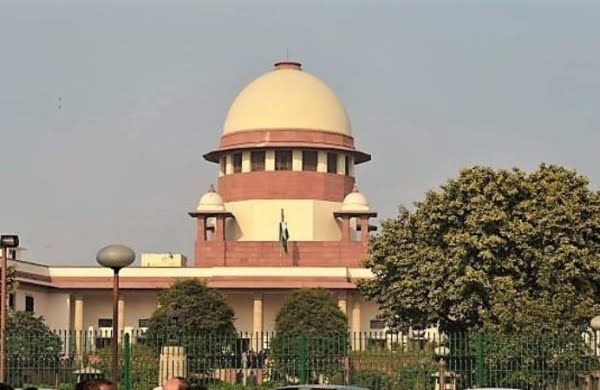
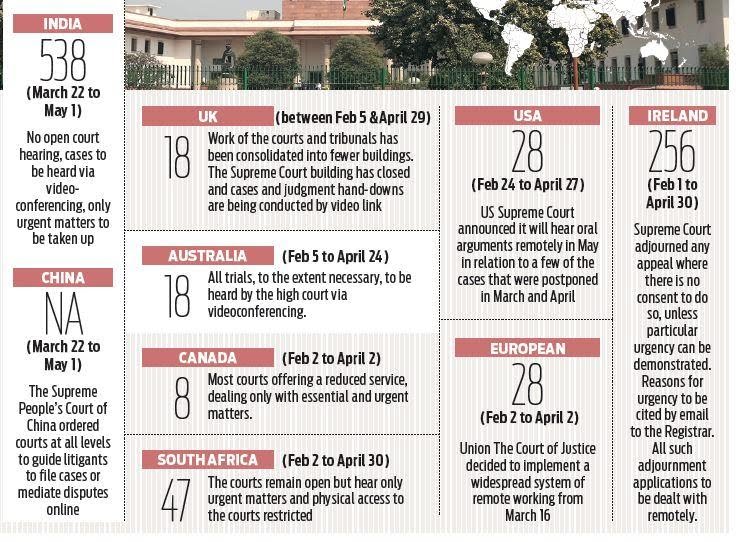
The lockdown has affected the functioning of courts across the globe, but the Hon’ble Supreme Court of India has done much better than the top courts in countries like the UK, the US, Singapore and Canada.
The Apex Court began the hearing of urgent matters virtually till May 1st and heard them for 22 days via video conferencing in March after the imposition of lockdown in order to curb the spread of COVID-19.
ABOUT VIRTUAL HEARINGS
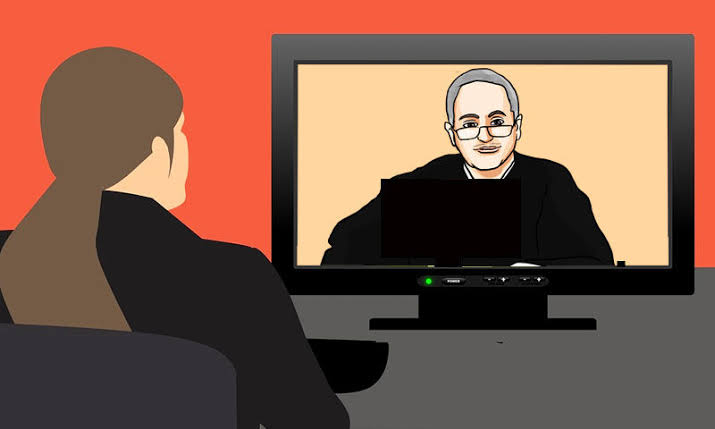
Virtual hearings are court hearings conducted by audio-visual means, where cases are progressed without the need for participants to attend the Court in person. It also shows how the distance becomes immaterial when one has to appear before the court to argue the case.
FOR THE FIRST TIME
The Hon’ble Supreme Court of India held its first Constitutional bench sitting and this is the first time since March 5 that five judges sat together in a single court hall ever since the lockdown forced the apex court to stop physical court hearings and begin hearing cases through videoconferencing from March 25 this year.
It was for the first time on Tuesday, the 14th July, 2020 that a Constitutional Bench (comprising five judges) held a virtual hearing. A bench of justices Arun Mishra, Indira Banerjee, Vineet Saran, MR Shah and Aniruddha Bose appeared wearing masks and maintaining nearly two-feet distance between them on the bench.
The first case that was heard by the five-judge bench was a legal tussle on whether Centre or States have the power to provide reservation to in-servicecandidates in post-graduatemedical degree courses. The plea was brought up by Tamil Nadu Medical Officers Association.
Opening the argument, Senior Advocate Arvind Datar exchanged the extensive compilation of his arguments including cases to be referred through Google drive with all Lawyers. One of the Lawyers, Senior Advocate Vikas Singh appearing for Medical Council of India (MCI) complained about being unable to access Google Drive.
He objected to Datar referring to the same, the first hiccup encountered by the Court in the virtual proceeding. The problem was sorted as Hon’ble court asked Senior Advocate Arvind Datar to give case law citations.
As the virtual hearing proceeded the Senior Advocate Arvind Datar was inaudible to the Hon’ble Court. Hon’ble Justice MR Shah commented in a lighter vein that, “Don’t keep social distancing with your mike.” Datar heard ‘mike’ as “wife”, leaving the bench in splits.
SUCCESS STORY: DATA THAT MATTERS
The Hon’ble Supreme Court of India shared the ‘success story’ of virtual court proceedings. At the beginning of June as many as 2,893 lawyers appeared in the hearings via video-conferencing, it said in the data release.
According to the data, 538 matters were taken up by the SC during the lockdown period, besides 297 connected cases. Judgment was delivered in 57 matters. Besides, 49 special leave petitions, 92 writ petitions, 138 review petitions and 58 pleas for interim relief were also taken up.
HOW THE COURTSFAREDAND PERFORMED?
India has fared the best as per the above data as many other countries have been using the virtual system but their top courts that have lagged way behind in the hearing or disposal of cases.
It conducted proceedings via video-conferencing from March 25 as it has suspended the entry of lawyers and other staff into its premises and also the apex court decided to explore the feasibility of ‘physical appearance’ of advocates in real courtroom hearings after strictly adhering to the guidelines of the COVID-19 triggered lockdown and resorting to virtual hearings since March 25.
Data available on other judicial websites indicate that in the nations hit hard by the pandemic like the US, the UK, France, Italy, Germany, China, Canada, Australia etc., The organs of that state which carried out the administration of justice are mostly relying on the virtual court methodologies and online case management.
CONCLUSION
Hence after going through the above facts and circumstances it’s certainly a grand success yet there is always room and scope for improvement.



 Eduindex
You must be logged in to post a comment.