
Basketball in India

Basketball is a team sport in which two teams, most commonly of five players each, opposing one another on a rectangular court, compete with the primary objective of shooting a basketball (approximately 9.4 inches (24 cm) in diameter) through the defender’s hoop (a basket 18 inches (46 cm) in diameter mounted 10 feet (3.048 m) high to a backboard at each end of the court) while preventing the opposing team from shooting through their own hoop. A field goal is worth two points, unless made from behind the three-point line, when it is worth three. After a foul, timed play stops and the player fouled or designated to shoot a technical foul is given one, two or three one-point free throws. The team with the most points at the end of the game wins, but if regulation play expires with the score tied, an additional period of play (overtime) is mandated.

The five players on each side fall into five playing positions. The tallest player is usually the center, the second-tallest and strongest is the power forward, a slightly shorter but more agile player is the small forward, and the shortest players or the best ball handlers are the shooting guard and the point guard, who implements the coach’s game plan by managing the execution of offensive and defensive plays (player positioning). Informally, players may play three-on-three, two-on-two, and one-on-one.Invented in 1891 by Canadian-American gym teacher James Naismith in Springfield, Massachusetts, United States, basketball has evolved to become one of the world’s most popular and widely viewed sports.
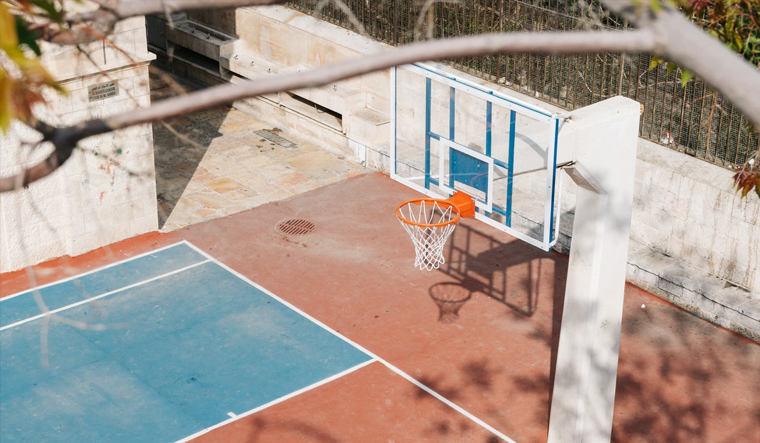
Bball in India

In India, basketball is a popular sport, with a multi-tiered professional club league system, as well as men’s and women’s national teams.In India, the game of basketball started its journey in 1930 when it was played for the first time. The first Indian National Championship for men was conducted in 1934 in New Delhi. The Basketball Federation of India (BFI), which controls the game in India was formed in 1950. Throughout history, Indians learned to appreciate the game because of its fast scoring and intense activity from the beginning until the end.Basketball in India is played in most of the high schools, colleges and universities. There is considerable patronage for the game among the younger generation. Basketball in India is played by both men and women of all ages and ability. Many government institutions have professional basketball teams, who work for the institution and play for them. For example, ONGC in Uttarakhand, Indian Overaseas Bank in Tamil Nadu, Indian Bank in Karnataka, Mahanagar Telephone Nigam Limited in New Delhi, Indian Railways, and Kerala State Electricity Board in Trivandrum play for their respective institution and state.

There are many championships for senior, junior, and youth levels for boys and girls.Being one of the earliest countries to adopt basketball, India has so far produced numerous talented basketball players, who have earned recognition in the international arena. Indian basketball players have also won several trophies for their country. Basketball in India is mainly being run and managed by a large number of national and state level associations, spread all over India. These basketball associations are working with a common view of popularizing the game in all parts of the country. Apart from that, developing the overall infrastructure for the game and uncovering new talent from the grass route level are some of the other principal objectives of the Indian basketball associations.

Professional leagues

List of major Basketball Tournaments in India:

  1. UBA Pro League
  2. National Championship
  3. Federation Cup
  4. ISBL and ICBL (Indian School Basketball League and Indian College Basketball League)

Multiplayer Chess: Turning the Duels Into Battles

Chess in itself is a complicated game. Even with all the strategy, sometimes one can go only that much far. Also known as the game of kings, chess has evolved through the passage of time. It is said to have derived its roots from the indian game chaturanga. The standardized rules of chess that are followed unanimously now were discussed and fixed in the 19th century.

In this game, each player is alloted 16 pieces: one king, one queen, two bishops, two knights, two rooks and lastly, eight pawns. Each piece follows a different movement pattern, and the main objective of the game is to checkmate the opponent’s king. Checkmate refers to the position where the opponent’s king is in threat of capture, with no option to safeguard the piece. 

It is a fact that change is the only thing that is constant. Same applies to chess too. Many variants of chess, on the basis of different criterias, are popular amongst the population. If anyone is keeping up with the chess developments, then they will surely know about three and four player variants of chess. So what are these variants? Let’s see…

Triple Trouble

Three player chess, also known as three way chess, or three handed chess is specially designed for three players. Usually a non-standardized board is used, and many variations of this form exist. The pieces of three players are usually separated on the basis of colours. Three way chess variants are more tough to design as for disbalance caused by teaming up of two players will be a great disadvantage for the third one, and also not easily lovercomable. Hence, some variants declare the first player to checkmate any of the other two players as the winner. The third player might be declared to have lost, alongside the checkmated player, or, might be rewarded a half point.

The strategy in three way chess differs greatly from the traditional chess variant, as for the face against two opponents, the usual opening and defenses might not hold strong. Also, the third player is given the most advantage when the other two players exchange their pieces. This point opens a plethora of new tactics in the game. Also, in the games where the first one to checkmate wins, the players not only have to build on their attack and defense, but also have to make sure that no other player checksmates before them. Also, checkmate from both the opposing players simultaneously is a tricky situation. As for if the checkmated piece is captured by the second player, which in turn, is captured by the third player, then it is considered that the ultimate checkmate is given by the third player. But with all these complications, three way chess pushes the mind to evaluate the game even with more concentration and critical thinking.

Some variants of three way chess are:

  • Boards with triangular cells: Patented by Russian Ilshat Tagiev in 2008, this variant uses a hexagonal board with triangular cells. The cells which are not adjacent to the perimeter have three cells adjacent in an oblique fashion.
  • Boards with quadrilateral cells: Under this, variants can be sub classified on the basis of the geometry of the boards.
  • Hexagonal board: Some variants under this category are Three Man Chess (96 cell board), Self’s Three Handed Chess (144 cell board), Waidder’s Three Handed Chess (126 cell board), etc.
  • Other Boards: Megachess (roughly triangular board with 130 cells), Mad Threeparty Chess (10X10 board) etc.
  • Boards with hexagonal cells: In this type of board, usually three bishops are alloted to each player, in order to include all the cells of the hex- playing field. Some variants with this type of cells are- Chesh, HEXChess etc.
  • Circular boards: Usually has three or four sided cells. One such variant is Three Man Chess.

From all the directions

Four player chess, also known as four way chess and four man chess, is relatively simpler to understand. It follows some basic rules of traditional chess. The board itself, though, is different. The common board format is the standard 8X8 squares, with an extension of three rows, each of eight cells, on each side. The pieces are again differentiated on the basis of colours. Played in both team and single format, the objective is to mate the opponent kings (two in case of team game and three in case of singles). In a team game, check mating only one king successfully leads to a draw. A fun fact: If two or more players team up during a game, then also it is considered legal.

Four player chess, incidentally, has a set of common rules. Those are:

  • Pieces of a certain colour can only be moved at their own turns.
  • Pawn can move diagonally forward only in an attacking case, otherwise it has to move forward in a straight line.
  • A pawn, on successfully reaching the King’s row of any of the other three opponents, has the option to upgrade to a queen, rook, knight or bishop.
  • In most of the variations, if the move of one opponent directly places another opponent in a mate position due to the presence of a piece of third opponent, the third opponent is forbidden to capture the mated King, until the mated opponent gets the opportunity to play something in order to defend their king.

The variation in the chess world is much, much more widespread than this. If this seems interesting, check out the other variations too!

Website References:

https://en.wikipedia.org/wiki/Four-player_chess

https://en.wikipedia.org/wiki/Three-player_chess