THANJAVUR-BIG TEMPLE

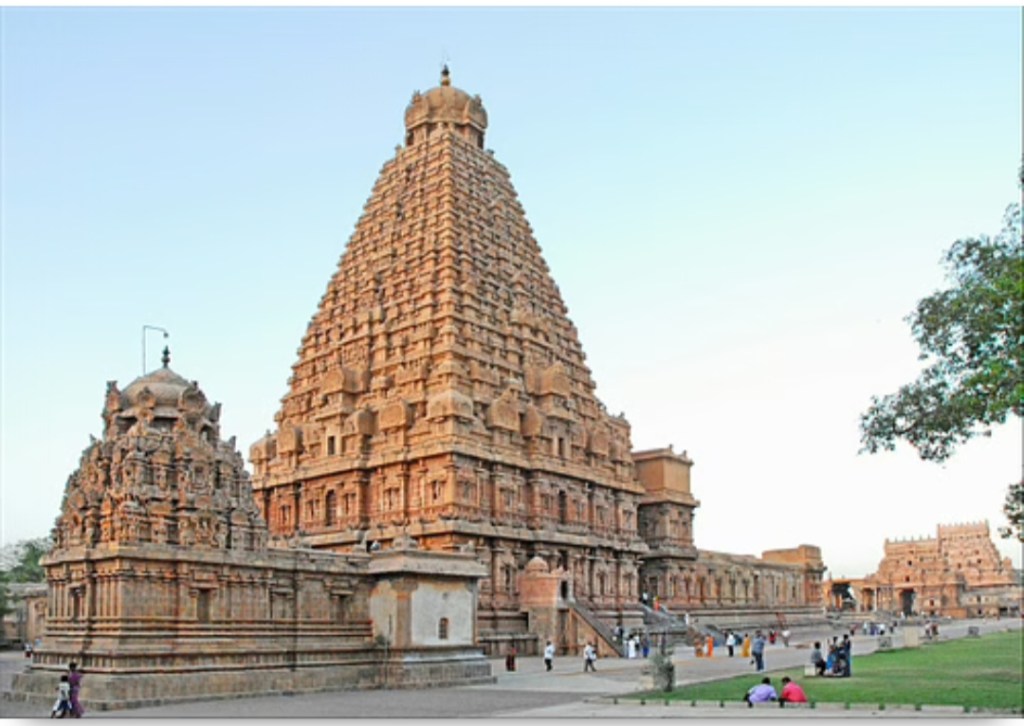
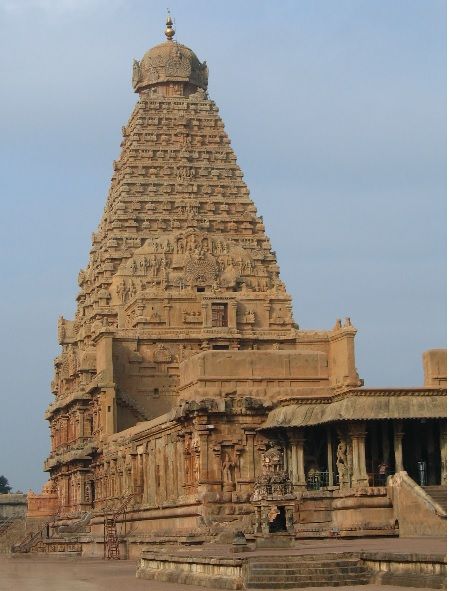
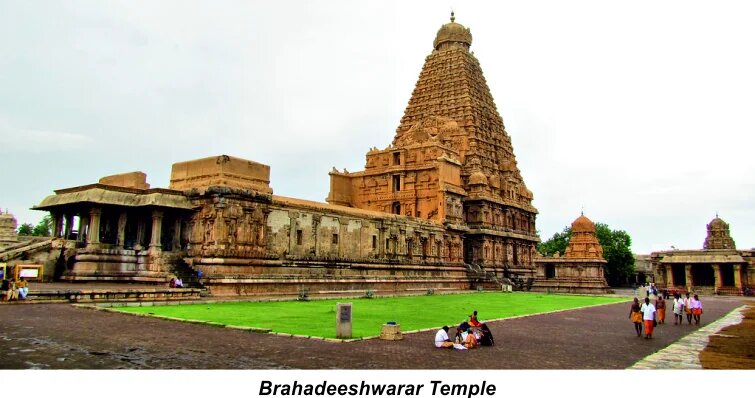
This Temple is situated in Thanjavur Tamil Nadu.It is constructed by Raja Raja chola in 1003 and 1010 A.D. This temple is originally known as Peruvudaiyar Kovil locally known as Thanjai Periya Kovil, and also called Rajarajeswaram, is a Hindu temple dedicated to Shiva located in South bank of Cauvery river in Thanjavur, Tamil Nadu, India. It is one of the largest Hindu temples and an exemplary example of a fully realized Tamil architecture.[4] It is called as Dakshina Meru.In top of the temple they built the vimana which is one of the highest in South India.

The main temple along with its gopurams is from the early 11th century. The temple also saw additions, renovations, and repairs over the next 1,000 years. Because the kings who made wars caused damaged to the temple And it is renovated by the Hindu dynasty.The main temple-related monuments and the great tower is in the middle of this courtyard Around the main temple that is dedicated to Shiva, are smaller shrines, most of which are aligned axially. These are dedicated to his consort Parvati, his sons Subrahmanya and Ganesha, Nandi, Varahi, Karvur deva As a world heritage monument, the temple and the premises comes under the Archaeological Survey of India (ASI) which falls under the Ministry of Culture of the Government of India, to ensure safety, preservation and restoration.The lighting of the monument is designed to enhance the natural color of the stone along with the sculptural forms adorning all corners of the temple. The restoration has been undertaken by the Archaeological Survey of India.

Indian Temple Architecture

India is a Diverse country with many Cultures, religions, Traditions and beliefs living in Harmony. The true meaning of Unity in Diversity. Today we’ll talk about the diverse Temple architecture of India.
As temples grew more complex, more surfaces were created for sculpture by adding more and more rhythmically projecting, symmetrical walls and niches, without breaking away from the fundamental plan of the shrine.

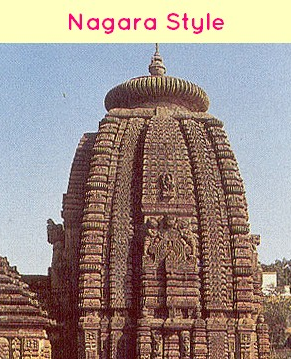
Nagara or North Indian Temple Style

  • In North India it is common for an entire temple to be built on a stone platform with steps leading up to it.
  • Further, unlike in South India it does not usually have elaborate boundary walls or gateways.
  • While the earliest temples had just one tower, or shikhara, later temples had several.
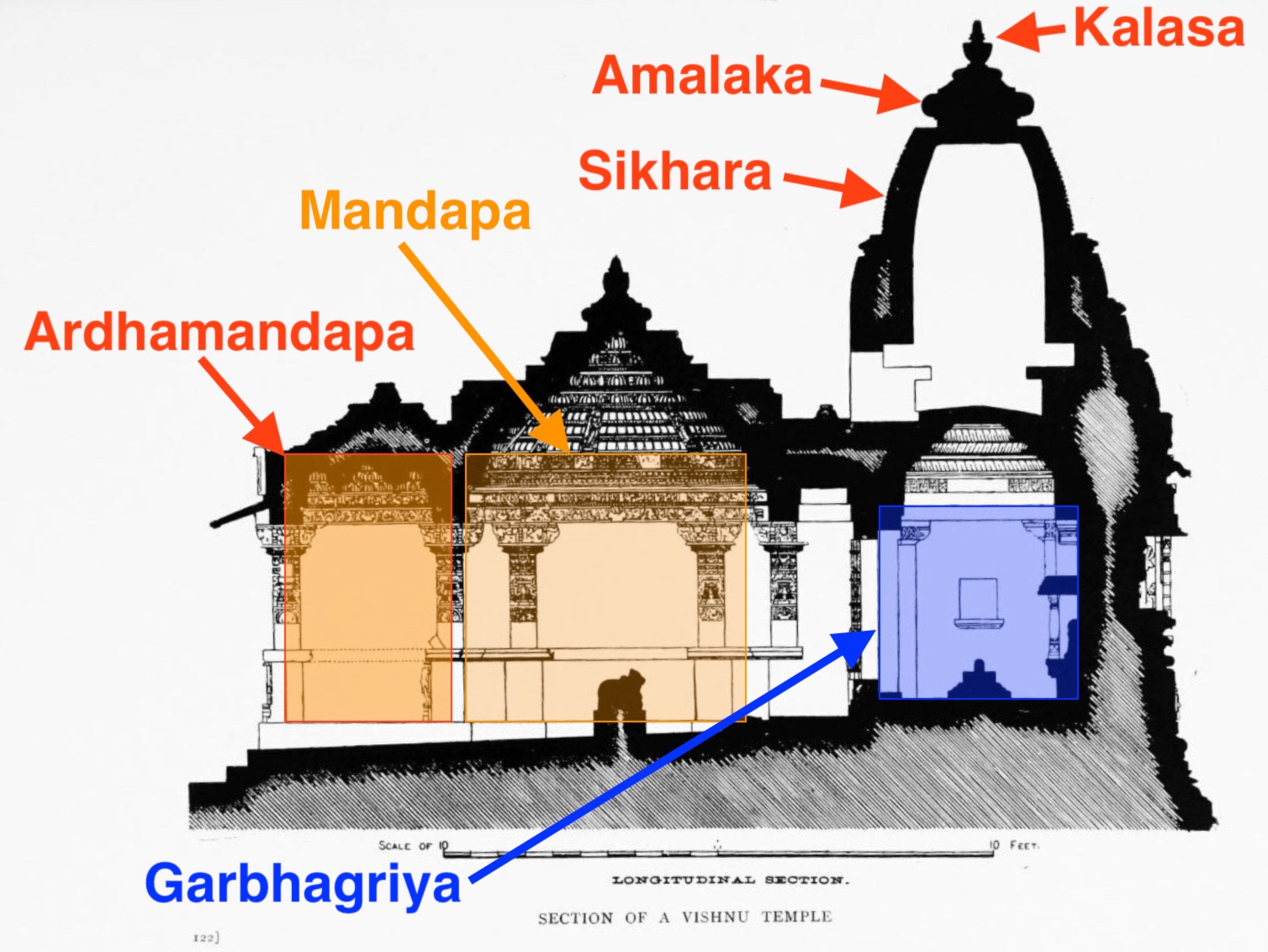
  • The garbhagriha is always located directly under the tallest tower.
  • There are many subdivisions of nagara temples depending on the shape of the shikhara.
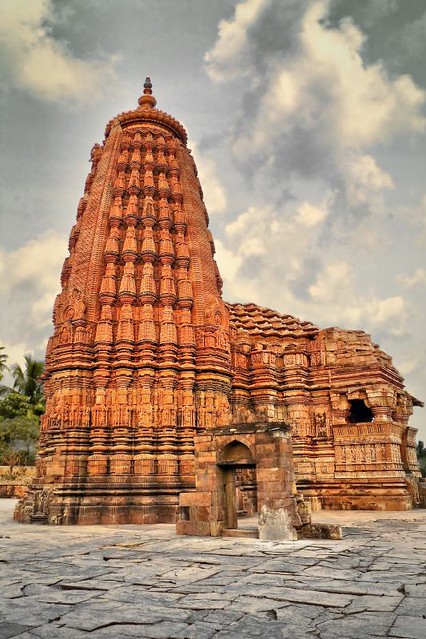
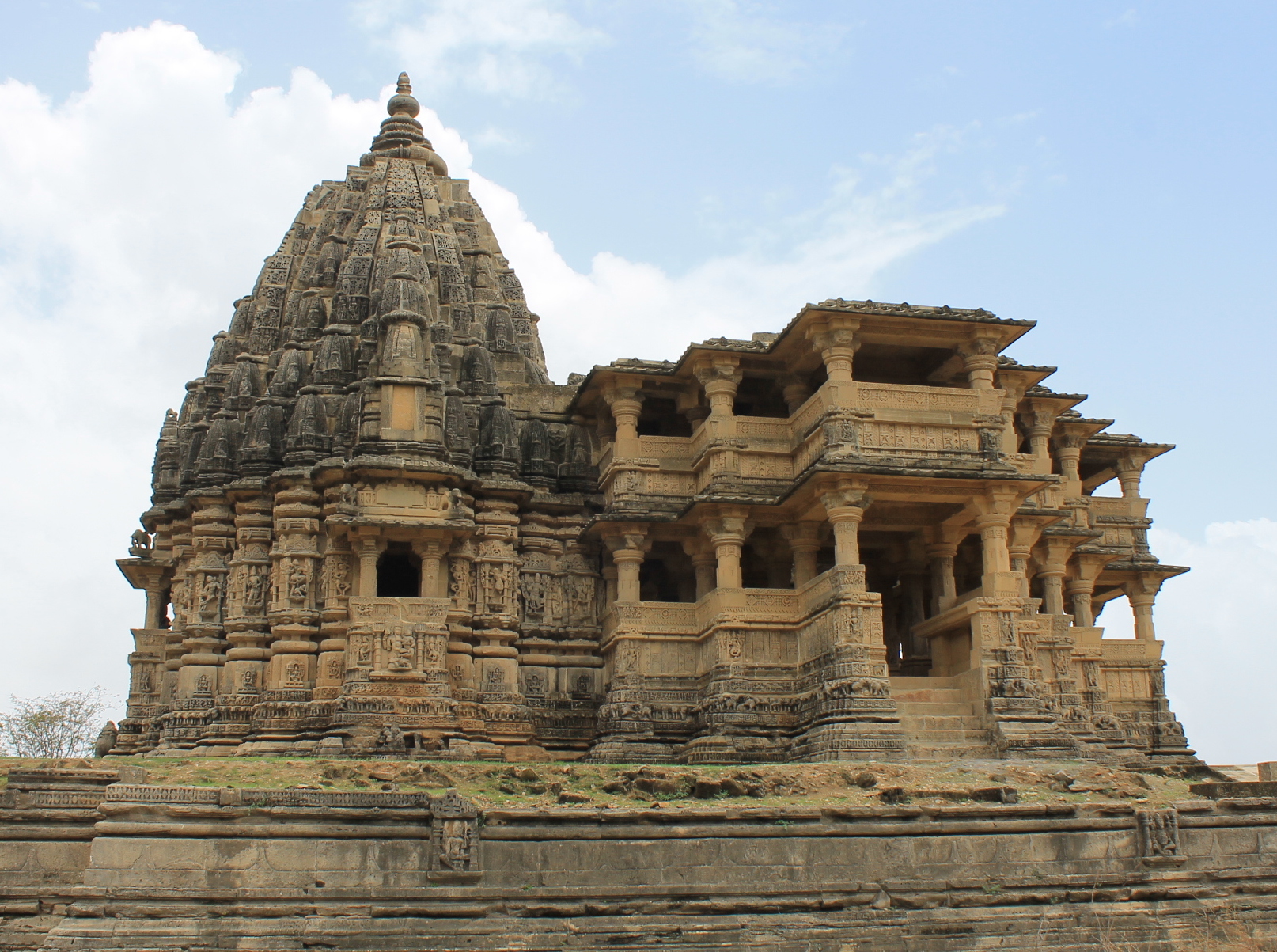
  • There are different names for the various parts of the temple in different parts of India; however, the most common name for the simple shikhara which is square at the base and whose walls curve or slope inward to a point on top is called the ‘latina’ or the rekha-prasada type of shikara.
  • The second major type of architectural form in the nagara order is the phamsana, which tends to be broader and shorter than latina ones. Their roofs are composed of several slabs that gently rise to a single point over the centre of the building, unlike the latina ones which look like sharply rising tall towers.
  • The third main sub-type of the nagara building is generally called the valabhi type. These are rectangular buildings with a roof that rises into a vaulted chamber.

Central India Temples

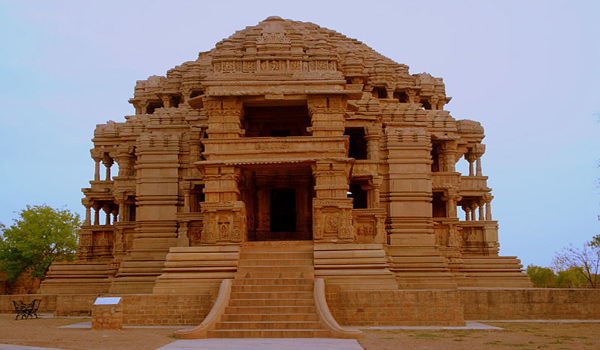
  • Ancient temples of Uttar Pradesh, Madhya Pradesh and Rajasthan share many traits. The most visible is that they are made of sandstone.
  • Some of the oldest surviving structural temples from the Gupta Period are in Madhya Pradesh.
  • The crowning elements- amalak and kalash, are to be found on all nagara temples of this period.
  • These are relatively modest-looking shrines each having four pillars that support a small mandapa which looks like a simple square porch-like extension before an equally small room that served as the garbhagriha.
  • Udaigiri, which is on the outskirts of Vidisha is part of a larger Hindu complex of cave shrines, while the other one is at Sanchi, near the stupa.
  • Deogarh (in Lalitpur District, Uttar Pradesh) was built in the early sixth century CE, is a classic example of a late Gupta Period type of temple. This temple is in the panchayatana style of architecture where the main shrine is built on a rectangular plinth with four smaller subsidiary shrines at the four corners (making it a total number of five shrines, hence the name, panchayatana).
  • The presence of this curving latina or rekha-prasada type of shikhara also makes it clear that this is an early example of a classic nagara style of temple.
  • The temple depicts Vishnu in various forms, due to which it was assumed that the four subsidiary shrines must also have housed Vishnu’s avatars and the temple was mistaken for a dashavatara temple.
  • Predating the tenth century, Chausath Yogini temple is a temple of small, square shrines of roughly-hewn granite blocks, each dedicated to goddesses associated with the rise of Tantric worship after the seventh century.Built between 7th and 10th centuries, several such temples were dedicated to the cult of the yoginis across Madhya Pradesh, Odisha and even as far south as Tamil Nadu.
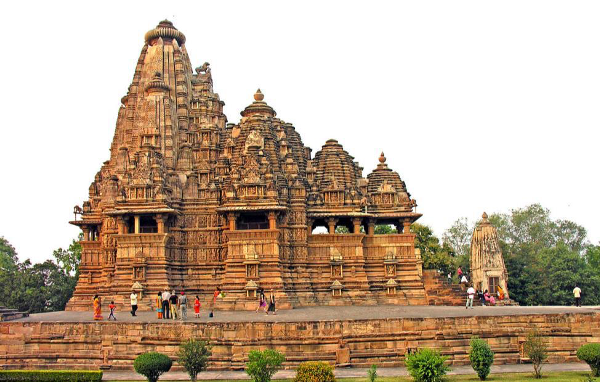
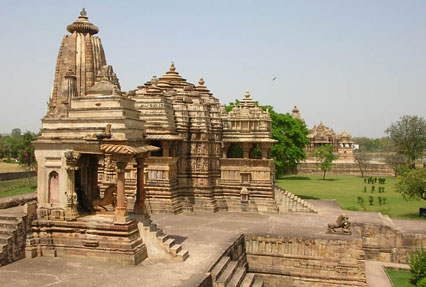
  • There are many temples at Khajuraho, most of them devoted to Hindu gods. There are some Jain temples as well. Khajuraho’s temples are also known for their extensive erotic sculptures; the erotic expression is given equal importance in human experience as spiritual pursuit, and it is seen as part of a larger cosmic whole.
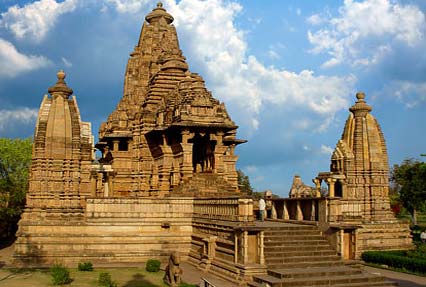
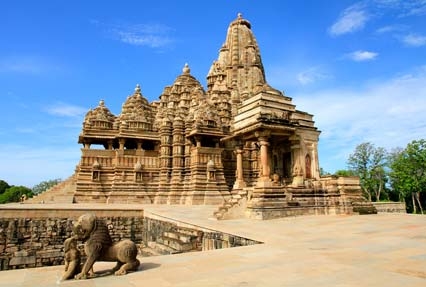
  • The Lakshmana temple of Khajuraho, dedicated to Vishnu, was built in 954 by the Chandela king, Dhanga. It is a nagara temple placed on a high platform accessed by stairs.
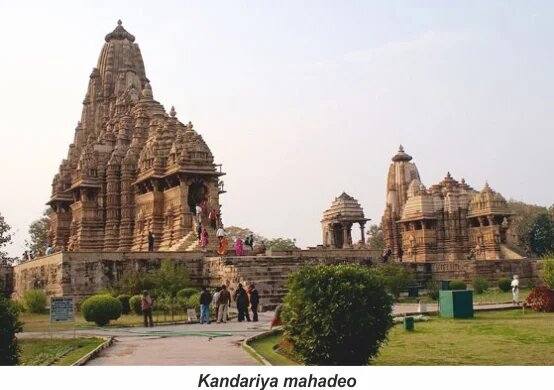
  • Kandariya Mahadeo temple at Khajuraho is the epitome of temple architecture in Central India.
Western Indian Temples

  • The temples in the north-western parts of India including Gujarat and Rajasthan, and in western Madhya Pradesh are large in numbers.
  • The stone used to build the temples ranges in colour and type.
  • While sandstone is the commonest, a grey to black basalt can be seen in some of the 10th to 12th century temple sculptures.
  • The most exuberant and famed is the manipulatable soft white marble which is also seen in some of the 10th-12th century Jain temples in Mount Abu and the 15th century temple at Ranakpur.
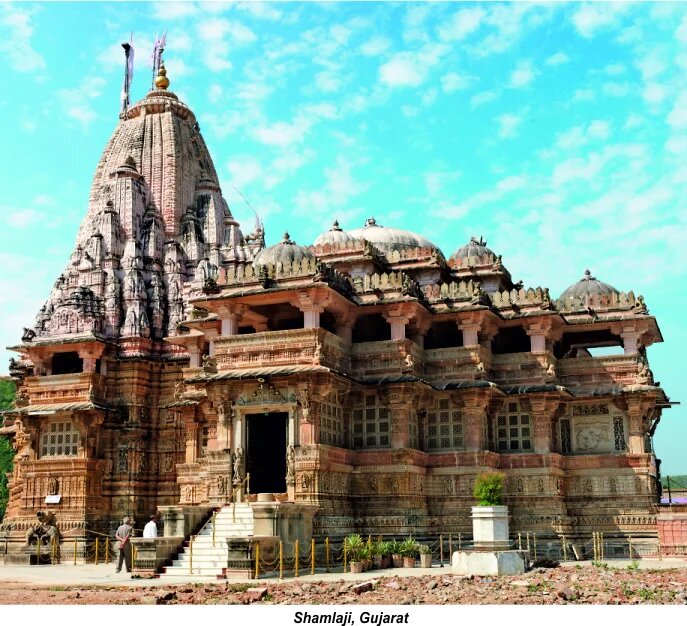
  • Among the most important art-historical sites in the region is Samlaji in Gujarat.
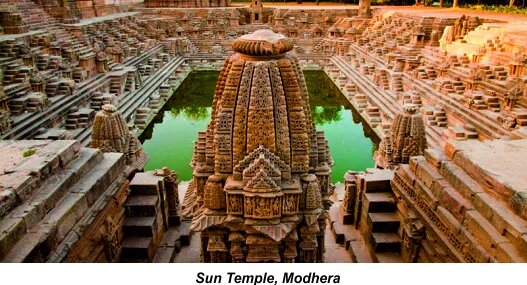
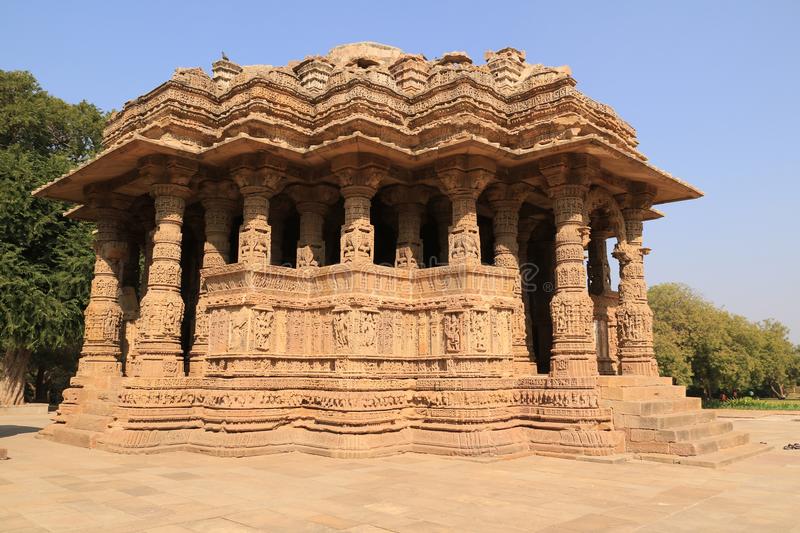
  • The Sun temple at Modhera dates back to the early 11th century and was built by Raja Bhimdev I of the Solanki Dynasty in 1026. There is a massive rectangular stepped tank called the surya kund in front of it, perhaps the grandest temple tank in India.
  • Every year, at the time of the equinoxes, the sun shines directly into this central shrine of the temple.

Eastern Indian temples

  • Eastern Indian temples include those found in the North East, Bengal and Odisha.
  • It appears that terracotta was the main medium of construction, and also for moulding plaques which depicted Buddhist and Hindu deities in Bengal until the 7th century.

Assam

  • An old sixth-century sculpted door frame from Dah Parvatia near Tezpur and another few stray sculptures from Rangagora Tea Estate near Tinsukia in Assam bear witness to the import of the Gupta idiom in that region.By the 12th-14th centuries, a distinct regional style developed in Assam.
  • The style that came with the migration of the Tais from Upper Burma mixed with the dominant Pala style of Bengal and led to the creation of what was later known as the Ahom style in and around Guwahati.
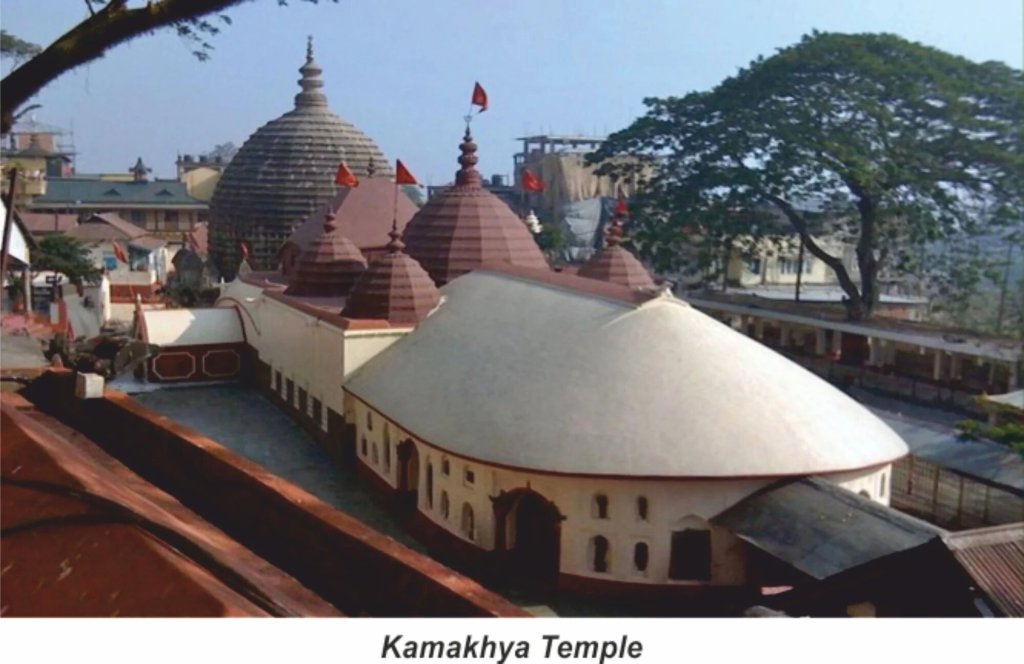
  • Kamakhya temple, a Shakti Peeth, is dedicated to Goddess Kamakhya and was built in the 17th century in Assam.

Bengal

  • The style of the sculptures during the period between the ninth and eleventh centuries in Bengal (including Bangladesh) and Bihar is known as the Pala style, named after the ruling dynasty at the time.
  • While the style of those of the mid-eleventh to mid-thirteenth centuries is named after the Sena kings.
  • While the Palas are celebrated as patrons of many Buddhist monastic sites, the temples from that region are known to express the local Vanga style.
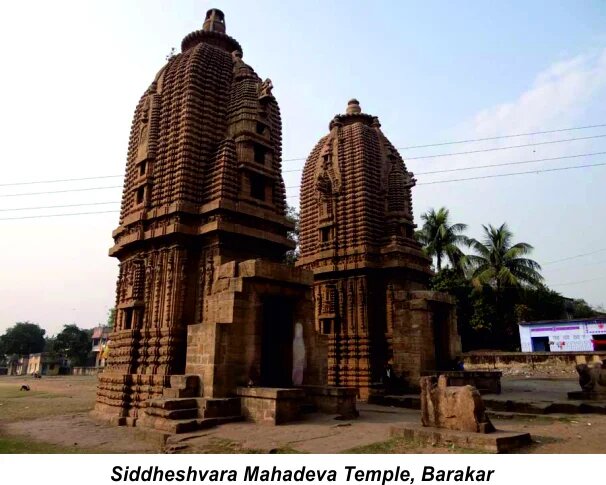
  • The 9th century Siddheshvara Mahadeva Temple in Barakar in Burdwan District, for example, shows a tall curving shikhara crowned by a large amalaka and is an example of the early Pala style.
  • The black to grey basalt and chlorite stone pillars and arched niches of Purlia temples heavily influenced the earliest Bengal sultanate buildings at Gaur and Pandua.
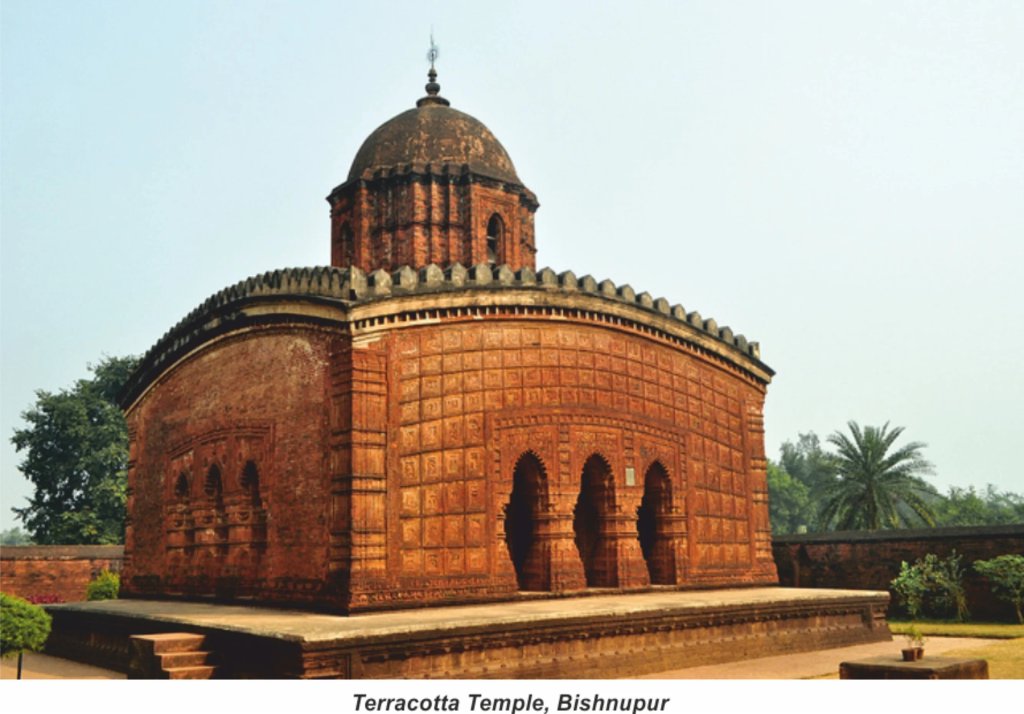
  • In the Mughal period and later, scores of terracotta brick temples were built across Bengal and Bangladesh in a unique style that had elements of local building techniques seen in bamboo huts.

Orissa

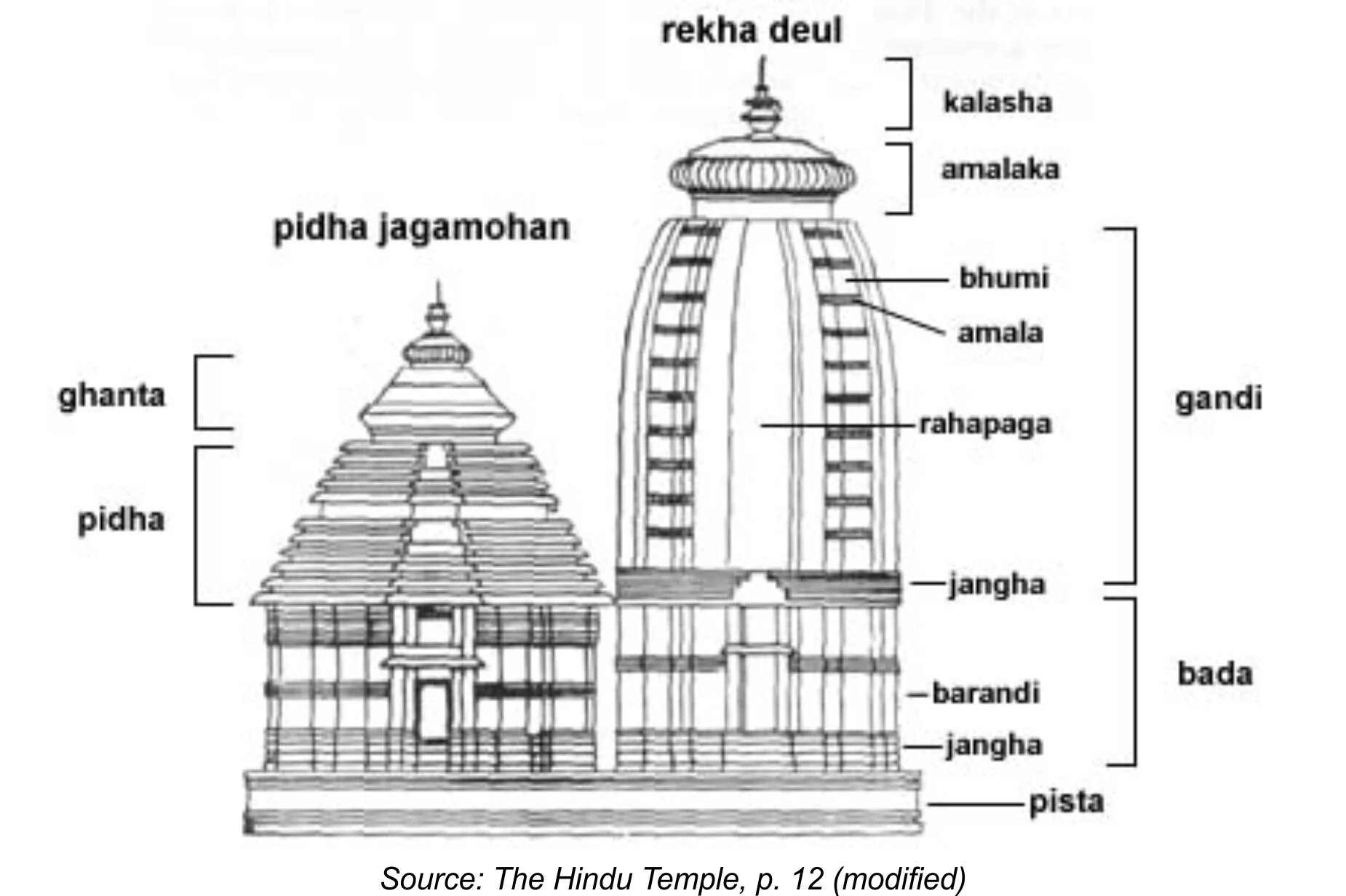
  • The main architectural features of Odisha temples are classified into three orders, i.e., rekhapida, pidhadeul and khakra.
  • Most of the main temple sites are located in ancient Kalinga—modern Puri District, including Bhubaneswar or ancient Tribhuvanesvara, Puri and Konark.
  • In general, the shikhara, called deul in Odisha, is vertical almost until the top when it suddenly curves sharply inwards.
  • Deuls are preceded, as usual, by mandapas called jagamohana in Odisha.
  • Odisha temples usually have boundary walls.
  • The ground plan of the main temple is almost always square, which, in the upper reaches of its superstructure becomes circular in the crowning mastaka.
  • Compartments and niches are generally square, the exterior of the temples are lavishly carved, their interiors generally quite bare.
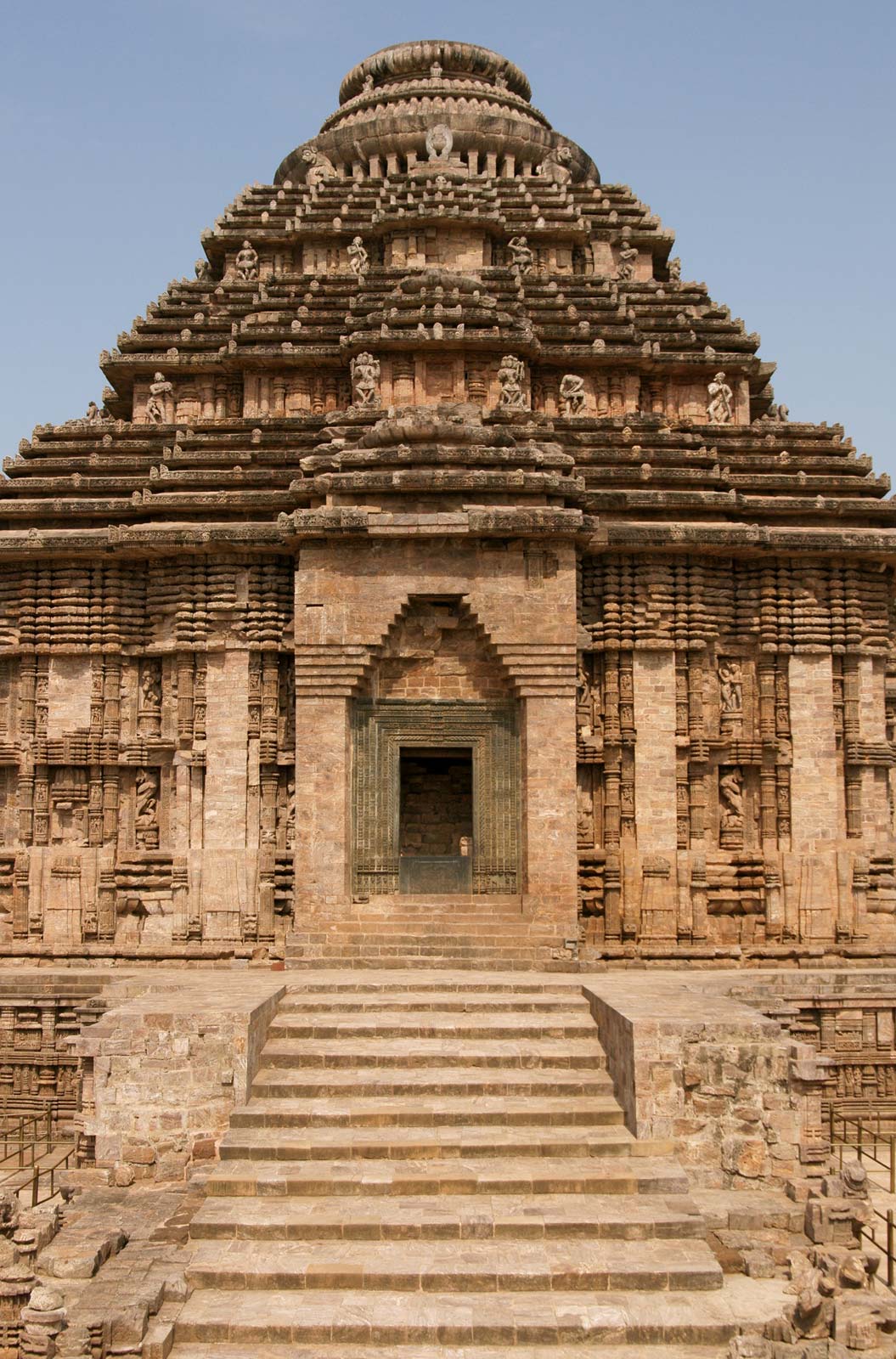
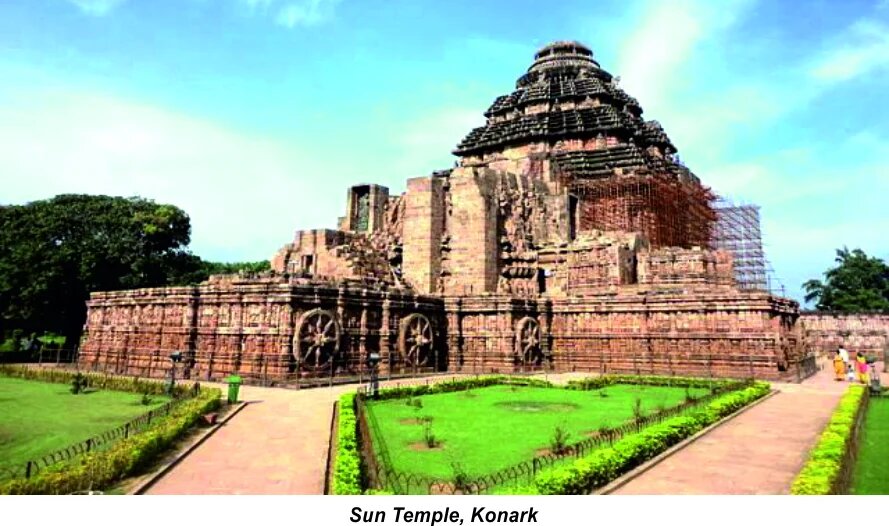
  • At Konark, on the shores of the Bay of Bengal, lie the ruins of the Surya or Sun temple built in stone around 1240. The Sun temple is set on a high base, its walls covered in extensive, detailed ornamental carving.
  • These include twelve pairs of enormous wheels sculpted with spokes and hubs, representing the chariot wheels of the Sun god who, in mythology, rides a chariot driven by seven horses, sculpted here at the entrance staircase.

Hill Temples

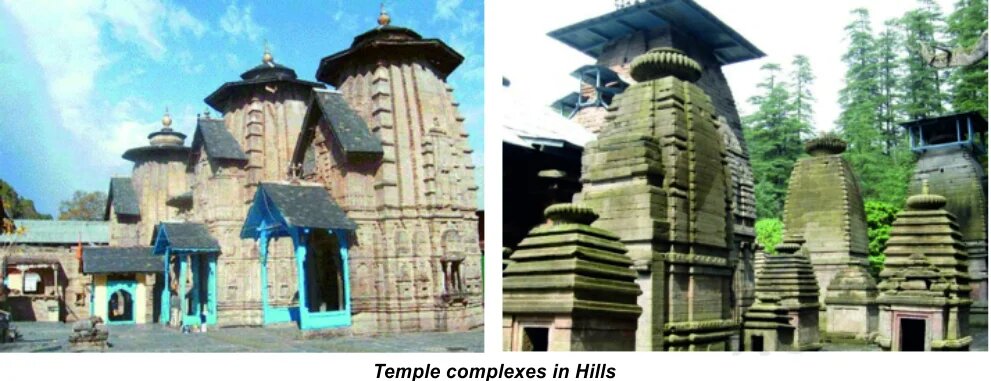
  • A unique form of architecture developed in the hills of Kumaon, Garhwal, Himachal and Kashmir.Kashmir’s proximity to prominent Gandhara sites (such as Taxila, Peshawar and the northwest frontier) lent the region a strong Gandhara influence by the 5th century CE.
  • This began to mix with the Gupta and post-Gupta traditions that were brought to it from Sarnath, Mathura and even centres in Gujarat and Bengal.
  • Brahmin pundits and Buddhist monks frequently travelled between Kashmir, Garhwal, Kumaon and religious centres in the plains like Banaras, Nalanda and even as far south as Kanchipuram.
  • As a result both Buddhist and Hindu traditions began to intermingle and spread in the hills.
  • The hills also had their own tradition of wooden buildings with pitched roofs.
  • At several places in the hills, while the main garbhagriha and shikhara are made in a rekha-prasada or latina style, the mandapa is of an older form of wooden architecture.
  • Sometimes, the temple itself takes on a pagoda shape.
  • The Karkota period of Kashmir is the most significant in terms of architecture.
  • One of the most important temples is Pandrethan, built during the 8th and 9th centuries. In keeping with the tradition of a water tank attached to the shrine, this temple is built on a plinth built in the middle of a tank.
  • Like the findings at Samlaji, the sculptures at Chamba also show an amalgamation of local traditions with a post Gupta style.
  • The images of Mahishasuramardini and Narasimha at the Laksna-Devi Mandir are evidences of the influence of the post-Gupta tradition.
  • Of the temples in Kumaon, the ones at Jageshwar near Almora, and Champavat near Pithoragarh, are classic examples of nagara architecture in the region.
Dravida Or South Indian Temple Style

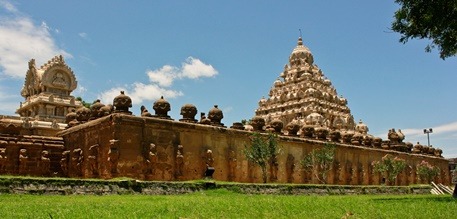
  • Unlike the nagara temple, the dravida temple is enclosed within a compound wall.
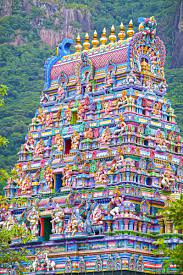
  • The front wall has an entrance gateway in its centre, which is known as a gopuram.
  • The shape of the main temple tower known as vimana in Tamil Nadu, is like a stepped pyramid that rises up geometrically rather than the curving shikhara of North India.
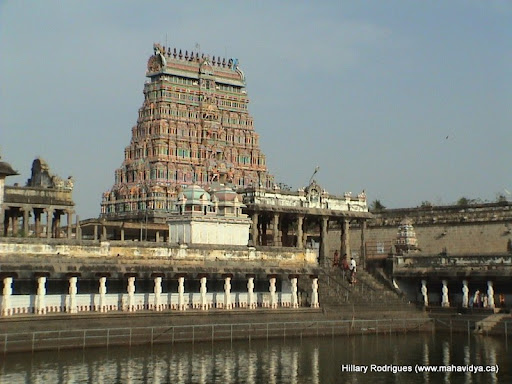
  • It is common to find a large water reservoir, or a temple tank, enclosed within the complex.
  • Subsidiary shrines are either incorporated within the main temple tower, or located as distinct, separate small shrines beside the main temple.
  • Kanchipuram, Thanjavur or Tanjore, Madurai and Kumbakonam are the most famous temple towns of Tamil Nadu, where, during the 8th-12th centuries, the role of the temple was not limited to religious matters alone.
  • Temples became rich administrative centres, controlling vast areas of land.
  • Just as there are many subdivisions of the main types of nagara temples, there are subdivisions also of dravida temples.
  • These are basically of five different shapes: square, usually called kuta, and also caturasra
  • rectangular or shala or ayatasra
  • elliptical, called gaja-prishta or elephant backed, or also called vrittayata, deriving from wagon vaulted shapes of apsidal chaityas with a horse-shoe shaped entrance facade usually called a nasi
  • circular or vritta
  • octagonal or ashtasra.
  • The Pallavas were one of the ancient South Indian dynasties. They spread their empire to various parts of the subcontinent, at times reaching the borders of Odisha, and their links with South–East Asia were also strong.
  • Although they were mostly Shaivite, several Vaishnava shrines also survived from their reign, and there is no doubt that they were influenced by the long Buddhist history of the Deccan.
  • Their early buildings, it is generally assumed, were rock cut, while the later ones were structural.
  • The early buildings are generally attributed to the reign of Mahendravarman I, a contemporary of the Chalukyan king, Pulakesin II of Karnataka.
  • Narasimhavarman I, also known as Mamalla, inaugurated most of the building works at Mahabalipuram which came to be known after him as Mamallapuram.
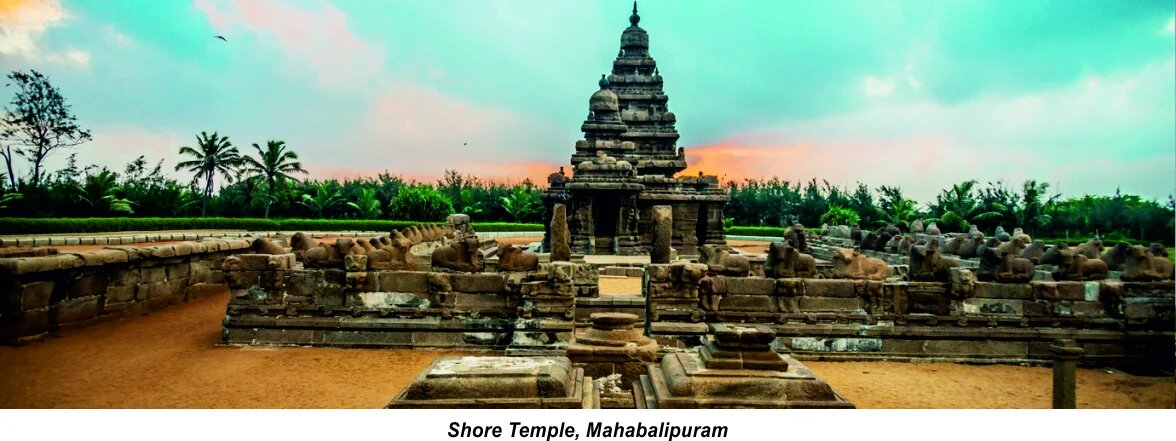
  • The shore temple at Mahabalipuram was built later, probably in the reign of Narasimhavarman II, also known as Rajasimha who reigned from 700 to 728 CE. The temple houses three shrines, two to Shiva, one facing east and the other west, and a middle one to Vishnu.
  • In the compound there is evidence of a water tank, an early example of a gopuram, and several other images.
  • Sculptures of the bull, Nandi, Shiva’s mount, line the temple walls, and these, along with the carvings on the temple’s lower walls have suffered severe disfiguration due to erosion by salt-water laden air over the centuries.
  • The magnificent Shiva temple of Thanjavur, called the Rajarajeswara or Brahadeeshwarar temple, was completed around 1009 by Rajaraja Chola, and is the largest and tallest of all Indian temples.
  • It is in this temple that one notices for the first time two large gopurams (gateway towers) with an elaborate sculptural programme which was conceived along with the temple.

Vesara / Deccan Style of Indian Temple Architecture
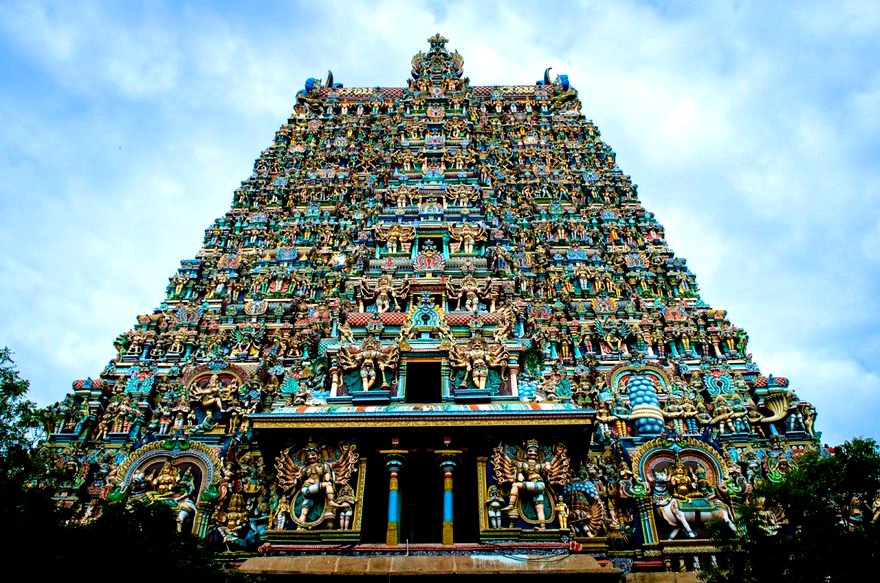
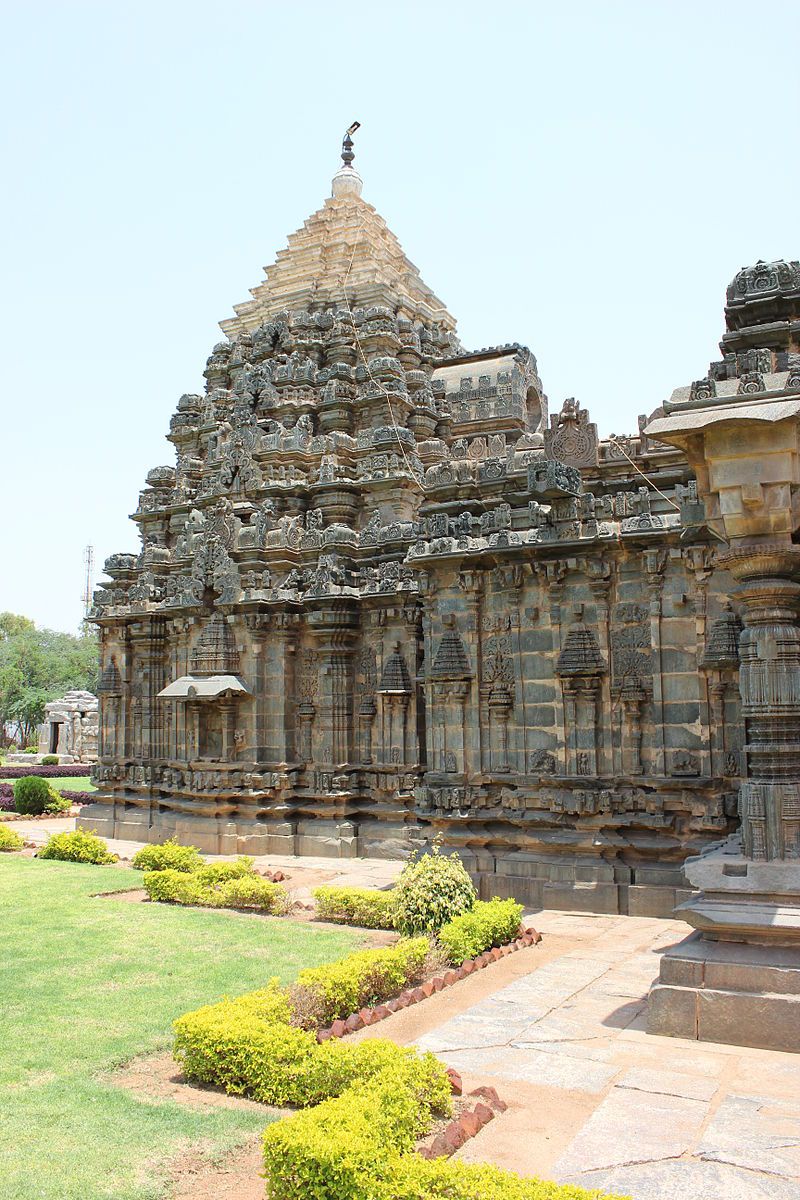
  • Many different styles of temple architecture influenced by both North and South Indian temples were used in regions like Karnataka.
  • By the late 7th or early 8th century, the ambitious projects at Ellora became even grander.
  • By about 750 CE, the early western Chalukya control of the Deccan was taken by the Rashtrakutas.
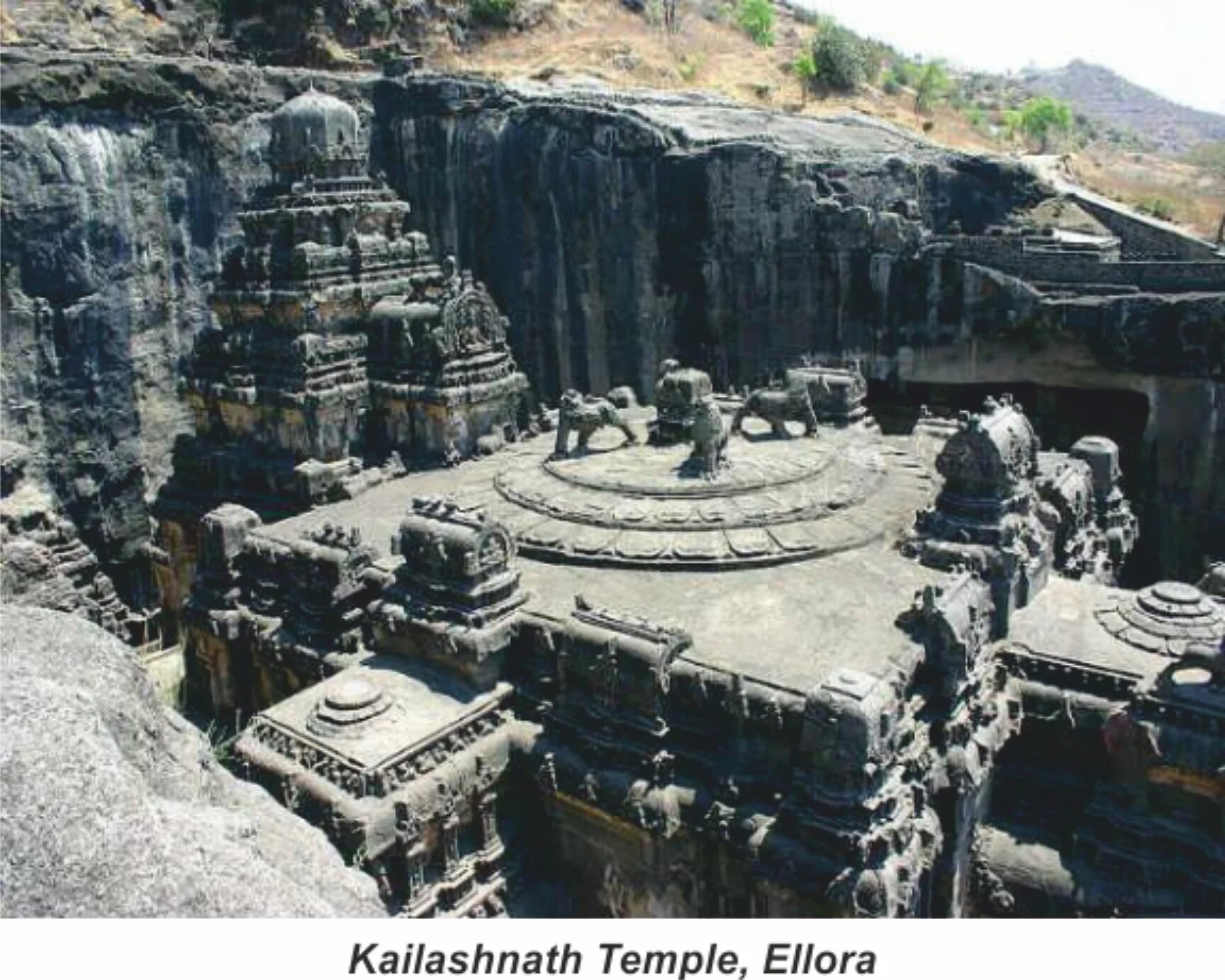
  • Their greatest achievement in architecture is the Kailashnath temple at Ellora, a culmination of at least a millennium-long tradition in rock-cut architecture in India.
  • It is a complete dravida building with a Nandi shrine—since the temple is dedicated to Shiva—a gopuram-like gateway, surrounding cloisters, subsidiary shrines, staircases and an imposing tower or vimana rising to thirty metres.
  • Importantly, all of this is carved out of living rock. One portion of the monolithic hill was carved patiently to build the Kailashnath temple.
  • In the southern part of the Deccan, i.e., in the region of Karnataka where some of the most experimental hybrid styles of vesara architecture are to be found.
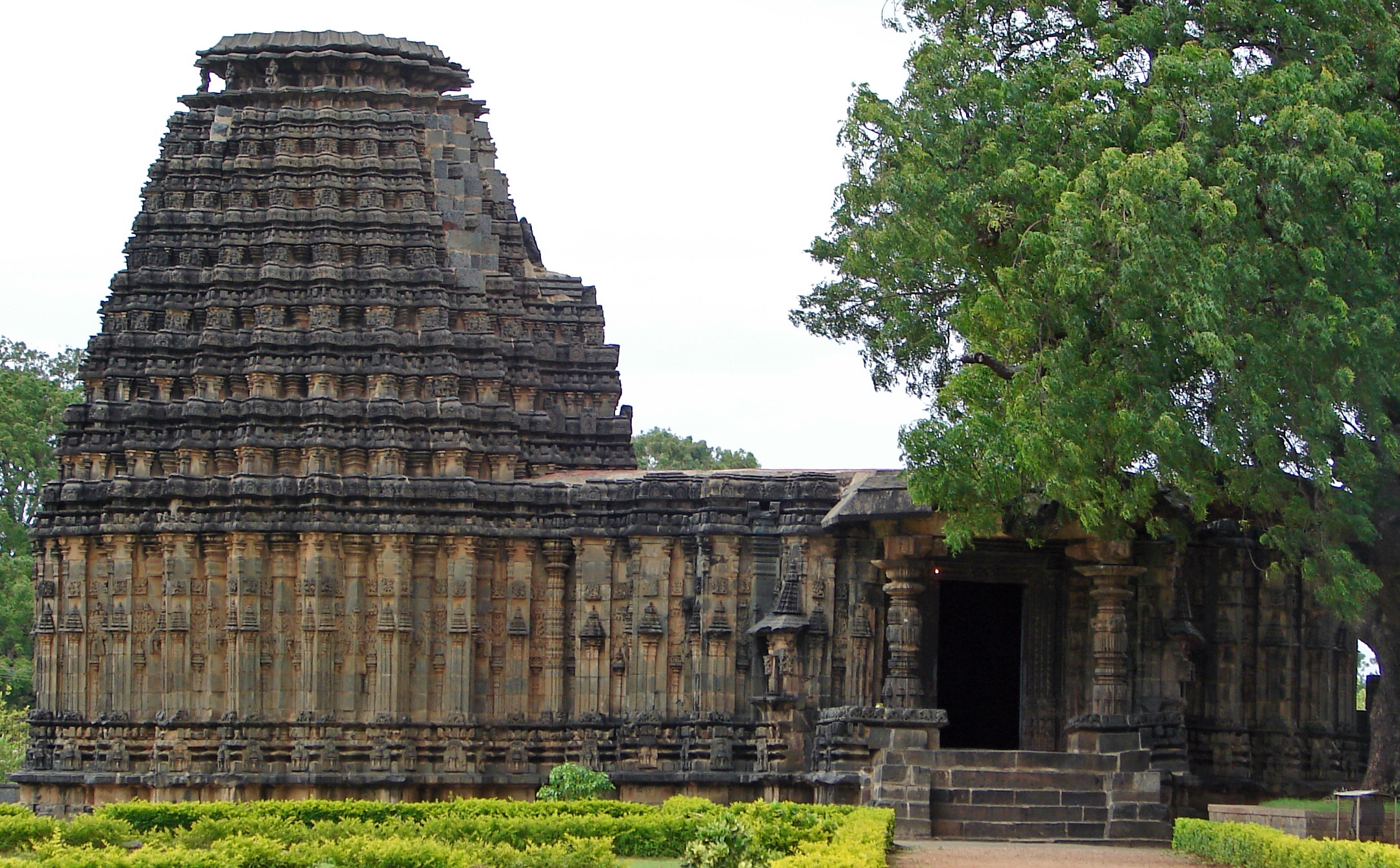
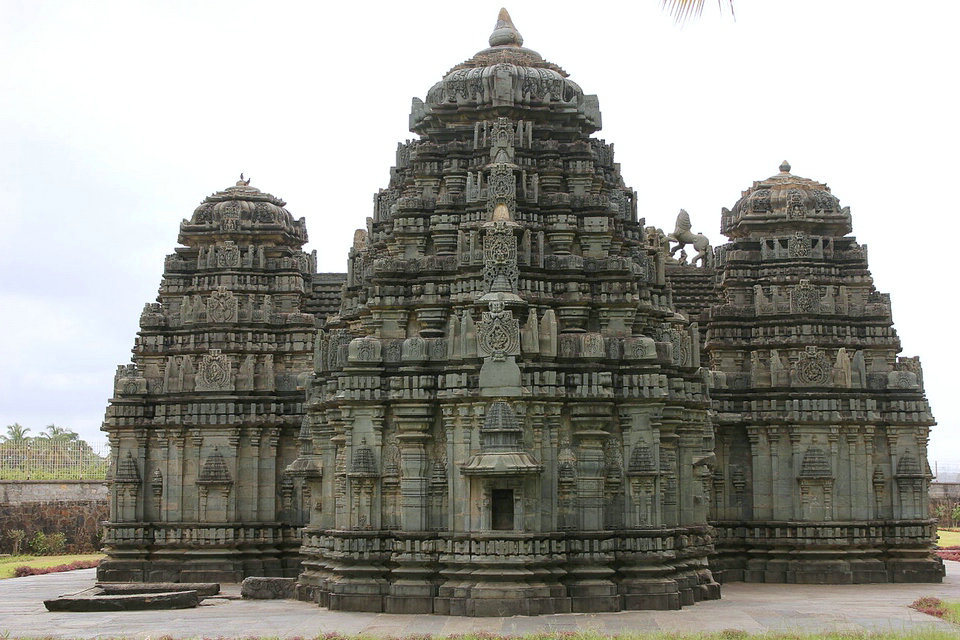
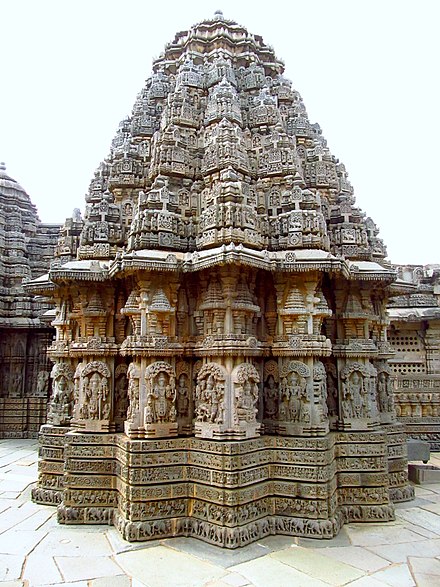
  • Pulakesin I established the western Chalukya kingdom when he secured the land around Badami in 543.
  • Early Chalukyan activity also takes the form of rock-cut caves while later activity is of structural temples.
  • The earliest is probably the Ravana Phadi cave at Aihole which is known for its distinctive sculptural style.
  • One of the most important sculptures at the site is of Nataraja, surrounded by larger -than-life-size depictions of the saptamatrikas: three to Shiva’s left and four to his right.
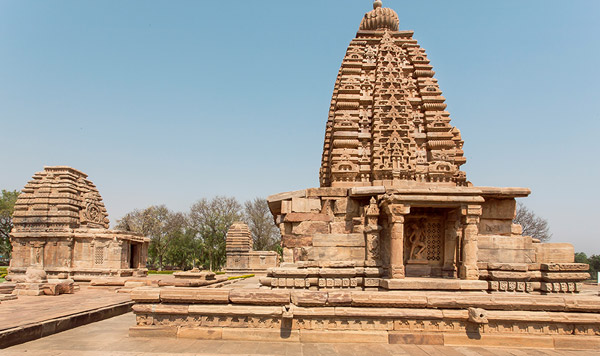
  • The most elaborate of all Chalukyan temples at Pattadakal made in the reign of Vikramaditya II (733-44) by his chief queen Loka Mahadevi is Virupaksha temple. Another important temple from this site is Papnath temple, dedicated to Lord Shiva.
  • Lad Khan temple at Aihole in Karnataka, seems to be inspired by the wooden-roofed temples of the hills, except that it is constructed out of stone.
  • The Hoysaleswara temple (Lord of the Hoysalas) at Halebid in Karnataka was built in dark schist stone by the Hoysala king in 1150. Dedicated to Shiva as Nataraja, the Halebid temple is a double building with a large hall for the mandapa to facilitate music and dance.
  • Founded in 1336, Vijayanagara, literally ‘city of victory’, attracted a number of international travellers such as the Italian, Niccolo di Conti, the Portuguese Domingo Paes etc.who have left vivid accounts of the city.
  • In addition, various Sanskrit and Telugu works document the vibrant literary tradition of this kingdom.
  • Architecturally, Vijayanagara synthesises the centuries-old dravidian temple architecture with Islamic styles demonstrated by the neighbouring sultanates.

Shree Jagannathji temple

• Situated in Ahmedabad, Gujarat.

• Established 460 years ago – beside river Sabarmati.

• Main deities – holy trinity – Lord Jagannath, Lor Baldevji, Goddess Subhadra Ji.
 Idols installed in the temple by sadhu Shree Sarangdas ji.
• Sadavrat – yeoman service – meals every day to 1000 to 1200 needy, poor persons
including saints irrespective of caste, creed and religious distinction.

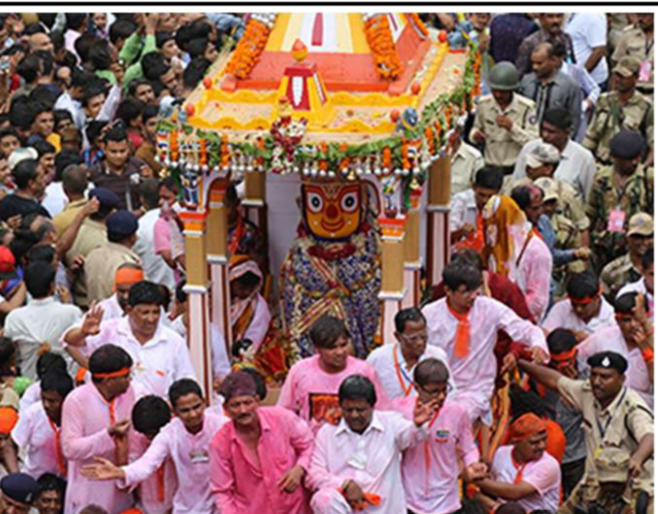
Rath yatra

• Also referred as Ratha-yatra, Ratha-jatra

  • ‘Chariot festival’ – public procession in a
    chariot carrying a deity.
  • • Particularly annual Rathayatra conducted in
    Odisha, Jharkhand, Gujarat, West Bengal
    and other East Indian states.
  • • Chariot carrying holy trinity and the
    Sudarshana Chakra.

• Shree Jagannathji temple Rathayatra – introduced in 1878.
 Conducted on the Ashadhi Beej every year.
 Starts with pahind vidhi – cleaning the way
for the chariots using a golden broom.
 Led by 15 to 20 elephants in decorative dress + group of trained athletes performing aerobatics + disciples with
decorative flags of the temple.
 Finally comes the Holy Trinity on chariots pulled by devotees.

Kailasa Temple: A Golden Inscription on the Pages of Indian History

Rock cut architectures, especially from the bygone eras, are awe inspiring pieces of excellent craftsmanship and structural engineering. The sheer amount of details and size of some of the best examples of this art form can leave the people dumbstruck. It is unimaginable for many minds as to how such extravagant monuments and structures were carved with the tools that were available during their creation. These architectures are a reflection of how human beings can create even with limitations, which again, is a relative term with respect to time. 

India has a special relation with rock cut architecture, as for the country has the most variety and abundance of these structures across the world. Most of the rock cut structures in India are religious in nature. Amongst all, the Kailash Temple, which is a part of the Ellora cave series is considered to be the pinnacle of this category of architecture. So, what makes it special? Let’s see…

Introduction

Rock cut architecture mainly refers to carving out of structures from a solid natural rock. The large amount of surplus rock pieces that were produced during this process were presumably shifted somewhere else for other economic purposes. To prevent the rocks from falling over the workers, the interiors were carved starting from the roof and then working downwards.

Ellora is one of the largest rock-cut monastery- temple complexes, and also a UNESCO World Heritage Site. It is situated at a distance from 29 kilometres north-west of Aurangabad, Maharashtra, India and features Buddhist, Jain and Hindu monuments, dating back to 600 CE. This complex was constructed over a large period of time, spanning from 600-1000 CE. They were built during the reign of Rashtrakuta dynasty (constructed the Hindu and Buddhist caves) and Yadava dynasty (added quite a number of Jain caves). Over 100 caves were excavated in this site from the basalt cliffs in the Charanandri Hills. Out of them, only 34 are open for the public. 12 Buddhist (caves 1-12), 17 Hindu (caves 13-29)and 5 Jain (caves 30-34) make up the public accessible attractions and also display the religious harmony that was the binding cultural fabric of ancient India. The legendary Kailasha temple is featured in cave 16, and holds the honour of being the largest monolithic rock excavation in the world.

Glory of the Bygone Era

Kailasa or Kailashanatha temple is the largest rock cut Hindu temple in the Ellora cave complex. It is a megalith (stone from which a structure or monument is created, alone or along with other stones) shaped like a chariot, carved from a rock cliff face, ranging across 2 kilometres along the sloping basalt cliff. Its construction is estimated to have started in between 756-773 CE and was completed around the 8th century CE. Though there is a lack of dedicatory inscription, but on the basis of two epigraphs (the Vadodara copper plate inscription of Karkaraja II, a ruler of Rashtrakuta branch of Gujarat and the Kadaba grant of Govinda Prabhutavarsha), it is considered that Krishna I, a Rashtrakuta ruler has commissioned the creation of Kailasa temple. Though there are some specks of uncertainty due to various irregularities in the timeline and other historical documents. This magnanimous structure is dedicated to Kailashanatha (Shiva), but there are various sculptures of deities from Vaishnavism and Shaktism, along with relief panels depicting the two major Hindu epics, Ramayana and Mahabharata.

Due to the size, architecture and sculptures, it is considered to be one of the  most exceptional cave temples across the world.  One of the highlight worthy fact about the construction of this temple is that it has been excavated vertically, that is, the carving started from the top of the original rock and moved downwards, in contrast to the established method of carving from the front. The architecture defers from the earlier style attributed to the Deccan region. The southern influence is considered to be due to involvement of Chalukya and Pallava artisans. Based on a Marathi  legend, an architect named Kokasa is theorized to be the chief architect of Kailasa temple. It has some resemblance to the Virupaksha temple, Pattadakal and Kailasa Temple, Kanchi.

Exploring the Culture

The temple courtyard entrance has a low gopuram. The deities on the left side of the entrance belong to Shaivism and on the right side, deities of Vaishnavism are more prominent. This gateway leads to U shaped courtyard, which is edged by a three storey high columned arcade. The arcade and the complementary alcoves are decorated by sculptured panels and relief carvings of various deities. Some of the famous sculptures are ascetic Shiva, dancing Shiva and Shiva being warned by Parvati about Ravana.
The central shrine is dedicated to Shiva and has an image of Nandi (the sacred bull), and is situated within the courtyard. The temple encasing the lingam, also include a flat-roof mandapa, held up by 16 pillars and a Dravidian shikhara. Throughout the entire shrine, carvings of niches, windows, images of deities and mithunas are in abundance. As the tradition, Nandi sits on the porch in front of the primary temple. The Nandi mandapa and the main Shiva temple is situated on a height of 7 metres, and built in two storeys. The base of the temple is carved as such to project that the elephants are holding the temple aloft. The Nandi mandapa is connected to the main shrine via a rock bridge. The lower levels, upon which the temple is standing, depicts various mythological scenes and sculptures. Five detached shrines in the compound are also a notable feature, three of which are dedicated to Ganga, Yamuna and Saraswati.

Website References

https://en.wikipedia.org/wiki/Kailasa_Temple,_Ellora

https://en.wikipedia.org/wiki/Ellora_Caves

https://en.wikipedia.org/wiki/Indian_rock-cut_architecture