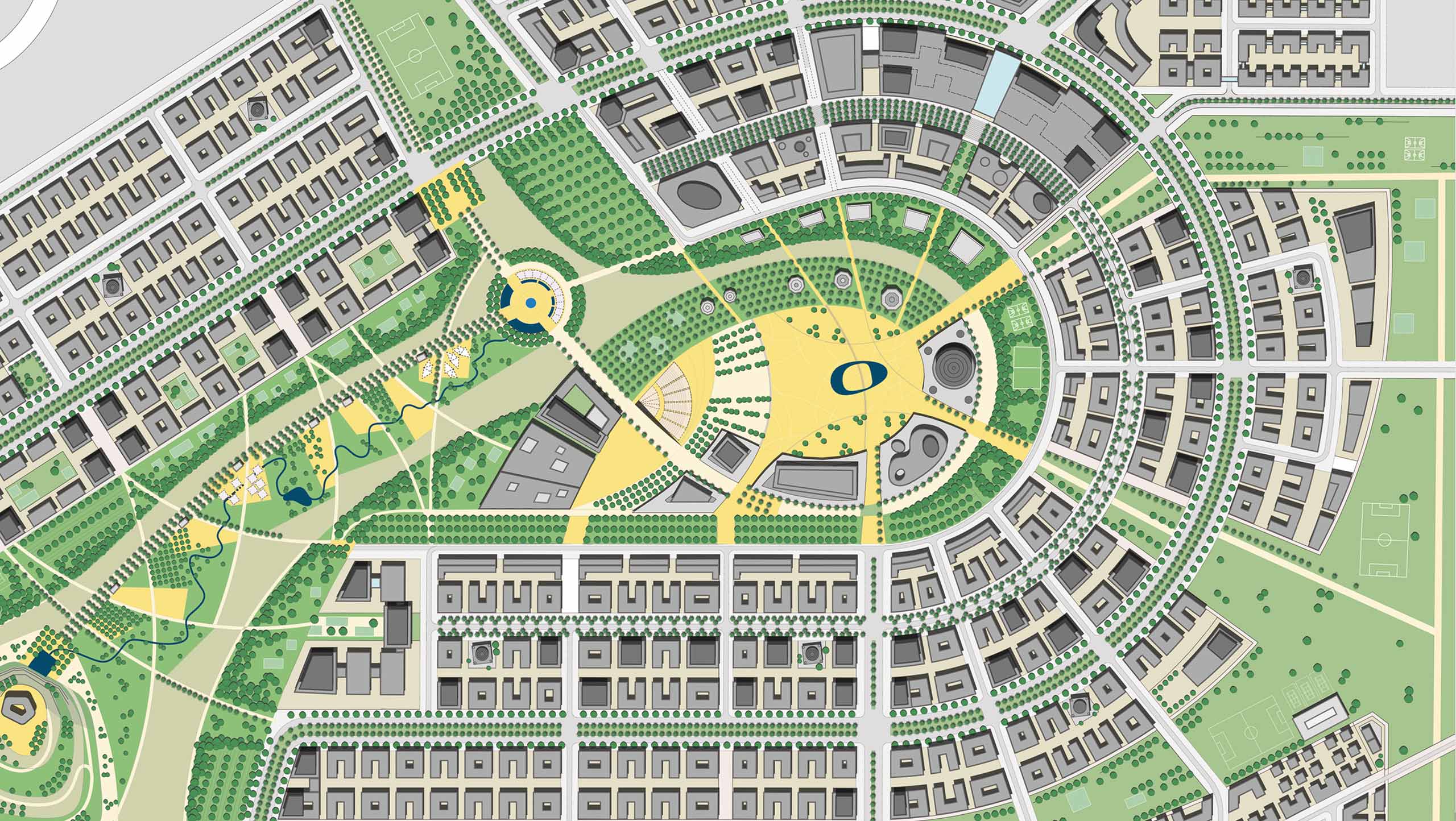
In the beginning, a ‘Master Plan’ is prepared, which identifies the long-range, comprehensive planning by or for a government agency as a foundation for the overall land development policies within specific corporate limits. The master plan deals with the natural city or a town as a whole. It offers a broad, general picture of the projected spatial pattern of the total metropolis. Three aspects of the master plan may be studied, each of which represents a major historical emphasis on city planning.
1) Land Use Pattern
Planning for effective use of land within the town/city limits involves decisions regarding:
- The various types of utilization that require distinctive subareas.
- The percentage of the total occupied space that should be apportioned to each type and the grade of utilization.
- The proper location within the city/town of each type of functional area.
2) Land Utilization
The master plan or the general plan has to give scope to various categories of land utilization, both public and private. Three major categories of private land use are common stores, factories and residences each may be subdivided further. Factories may be separated into at least two subtypes, Tight’ and ‘heavy.’ Residences may be divided into three subcategories by value low, medium and high and into two or more subcategories according to the intensiveness of utilization.
Commercial establishments may be divided into subcategories such as wholesale and retail, with the latter further subdivided. In addition, storage and switching facilities may require separate areas in connection with heavy transportation lines. Public land utilization, such as parks, playgrounds and civic centres, also have to be provided for in the city plan. However, the most extensive form of public land utilization streets spread throughout the city is in no need for a separate demarcation of space.
3) Spatial Locations for Each Category
In determining the spatial location for each category, various types and grades of subareas available in the city are indicated on the master plan map. The planner then considers the following to determine which land has to be allotted to which category.
- The kinds of services to be performed within the city.
- The ideal locations for stores, factories and residences.
- Significant characteristics of the urban site that suits this ideal pattern.
- The existing heritage of the past construction that gives the city its present spatial pattern.
- The trends of the spatial change that already have started but have not run their full course.
- Anticipated effects of any new inventions.
With these considerations in mind, the planner undertakes to formulate a general map of the most efficient spatial pattern. This plan is usually effected within a time span of 20 to 50 years. The planner has to recommend to appropriate officials such controls and changes as will further the realization of this pattern. The ideal master plan places every category and subcategory in a subarea of a city that
- The total cost of moving men and materials from place is minimized
- Safety and beauty are maximized
- Constructive social contacts are stimulated
In formulating these proposals, the planner can utilize a generalized description of the ideal spatial pattern of a city or study the various types of city planning recommended by the experts.He needs to make detailed studies of the unique characteristics of each city and to modify the generalized ideal pattern so as to fit the local conditions and needs. For an already existing city/town, the urban planner ordinarily finds that the basic pattern of heavy transportation already has been established. The major system of streets has been laid out and the locations of the central business district and of major secondary commercial centres have been fixed, and that many areas of light and heavy industries have been established. Even though he must begin with this existing pattern and has numerous decisions to make regarding future changes.
Industrial Location
Although the planner has the choice to assign industrial locations to various typical positions, such as near the central business district; along the lines of heavy transportation and at breaks in transportation within the city; and at the periphery or in the nearby hinterland, etc., he has to make an effort to place them in the periphery. The planner should also provide a plan for peripheral and hinterland industrial areas, to prevent the loss of property values for the property owners of these areas.
Sometimes, it may so happen that the new industrial areas may generate many more factories, the plan has to provide for the growth of these interdependent industries, which cluster in adjacent sites, so that they can serve one another more effectively and also obtain cheaper and more efficient heavy transportation services. In addition, the urban planner needs to prepare for the expansion or migration of certain industrial areas within the city and also the migration of some industries to the city. Consequently, the planner has to make a detailed study of the factors affecting a particular city before determining the size and location of its industrial areas.
Commercial Location
Commercial areas ideally depend for the location and size both on the functions they are expected to perform and on the size and location of the population they will serve. In general, the major shopping goods and luxury goods centre should be planned for the middle or the centre of the city/town. This area normally is expected to expand slowly in the direction of greater population growth. With increase in the widespread automobile transportation, the larger shopping centres or commercial centres can also be located in the peripheral or outlying locations. The planner, however, has to provide for parking facilities and less traffic so that city dwellers may not face the inconvenience.
Residential Location
Within the built-up area of the city, some old residential districts will sometimes require extensive reconditioning or complete remodeling. Sometimes, the existing single family areas will need to give way to more intensive types of residential utilization. Sometimes, it may so happen that new residential areas have to be curved out in the peripheral regions or in the suburban areas.
The general plan or the projected plan when made initially should place areas of multifamily residences close to busy centres of dominance especially the central business district or close to the streets or transportation lines that give ready access to such centres. Smaller areas of intensive utilization may be planned to take advantage of exceptional amenities. Expansion of residential areas into unoccupied land presumably follows the principles of distribution. Under the influence of individual and rapid speed transportation, residences will probably become more decentralized but larger numbers of peripheral communities will grow.
City Beautification
City beautification, which was emphasized to a very great extent in the ancient and medieval ages, has taken a backstage in recent years. Nevertheless, it deserves careful consideration by the urban planner. One major aspect of beautification, which claims the attention of many planners, involves the design and erection of an imposing civic centre. The planned civic centre counteracts the random erection of public buildings in scattered locations among other structures. When visitors visit this city, they will gain a more favourable impression of the metropolis and local residents will develop a greater civic pride if public buildings such as the corporation, public library and museum are grouped together in a beautiful civic centre.
Other types of civic beautification projects involved in master planning include the selection of large and small parks to preserve exceptional beauty spots and make them available to the public and the designing and planting of parkways and residential streets so as to enhance their beauty.
Buildings : Old and New
The city/town consists of buildings that vary in age and condition. Cities require old buildings, else it is impossible that vigorous streets and commercial centres grow in them because if the cities consist of only new buildings, the enterprises that can exist there are automatically limited to those that can support the high costs of new construction. For example, well financed supermarkets, chain restaurants and banks, which are capable of paying high costs, use these buildings. But in a city, there are some small investors and shopkeepers, who cannot pay high costs; to cater to such people, old buildings are a must in a city. It is the same with respect to residential places also some people who can afford new buildings will reside in these buildings, some others prefer to reside in old buildings.
The only harm of aged buildings is the harm that eventually comes of nothing but old age. In some cities/towns, some of the older buildings, year by year, are reconstructed or renovated. Over the years, therefore, there will be a mixture of buildings of many ages and types. With the passage of time, high building costs or new buildings of one generation become bargains or old buildings of the next generation. The colonies built up all at once usually change little physically over the years. But after many years, almost all the buildings in these colonies become old and dilapidated.
Slum Clearance
Many cities contain extensive areas of closely packed deteriorated dwellings, often called slums. To make the city more beautiful, the local authorities have to undertake to raze a few blocks of slum dwellings and to build new residences. At such times, city planning officials may be asked to study the local area and to make recommendations about its spatial layout. If a slum clearance project is to cover only one of several deteriorated sections of a city, the planner may first be asked to make recommendations as to which specific locality should be rebuilt. In carrying out this preliminary task, he starts with some estimate of land space that will be needed and proceeds to select one or more areas of that size. In deciding which area to recommend for reconstruction, he collects the data covering such points as follows.
- The number of structures unfit for human use.
- The number of dwelling units lacking adequate lighting.
- Delinquency rates.
- Income to the city from taxes as compared with the costs of expenditure on the police and health services.
The planner should also take into account the location of various deteriorated areas as related to the anticipated changes in the total spatial pattern of the city. He then recommends for rebuilding only such areas as will be needed for residential utilization throughout the normal life of the proposed new dwellings. The planner then presents all these data to the officials.Based on all these data, the officials then select a slum area for clearance. The planner then has to prepare a map showing the recommended pattern of land utilization. He has to estimate the amount of space needed by store, shops, schools and playgrounds. He should also decide on the preferred locations for each type of utilization.
He has to then recommend on how much of land has be utilized for residential purposes and also indicate the size and location of individual structures on a map. Usually on an in lying slum clearance area, the structures rebuilt are aimed at multifamily, low cost residences, generally fewer in number and higher in grade than those replaced. If a considerable slum area is cleared at one time, the planner can ignore the previous pattern of streets and can shape the area almost as if he were beginning with vacant land. Ideally, he places heavy traffic streets only among the edges of a neighbourhood and uses narrow, curved secondary streets to divide the neighbourhood into large residential super blocks, and provide necessary access to and from homes. These features of local street plans for slum clearance areas are much like those characteristics of the peripheral preplanned communities.
Streets and Transportation Facilities
The planning of streets and transportation facilities relates so intimately to the spatial structure of the city that the two cannot be separated. The major function of urban transportation is that of connecting one area with another so that men and materials can move with greater safety and less cost. Sometimes, some specific projects may create problems for transportation. Thus, a multiplicity of transportation and communication facilities confronts the city planner. Some facilities link the city with the hinterland and some others link with other cities, towns and villages.
City planning has to deal with the routes of heavy transportation and location of terminal facilities and other problems that involve street use. It should also take into consideration the congestion and danger created by the large volume and potentially high speed of urban street traffic. Three aspects have to be considered while planning the streets, traffic counts and calculation of street requirements, elimination of bottlenecks and dangerous intersections, and special high-speed expressways and bypass routes.
Traffic Counts and Major Street Pattern
Sound planning of the major street system requires for the quantitative determination of needs. To determine these needs, the traffic engineers count the number of vehicles using each major street at different hours of the day and on various days of the week. Such traffic counts measure the total volume of traffic and the size and hours of peak loads. Sometimes, the engineers have to survey the origin and destination of the traffic to determine how much traffic can conveniently be diverted from the more congested streets to alternate routes. Using such data, engineers calculate the number and width of streets needed and make recommendations for new construction or for changes in the existing streets.
Elimination of Bottlenecks and Dangerous Intersections
One best method of lessening the traffic congestion on certain streets is the elimination of bottlenecks. If, throughout most of its length, a busy road is broad enough to handle the ordinary volume of traffic, then there will not be any problem of congestion. But at any point on the road, there is a narrow street or a bridge, it interferes in the ordinary movement of the traffic. The planner usually recommends the widening of such narrow places.
Sometimes, if the bottleneck results from on street parking, the planner has to recommend the elimination of the practice or he may introduce a system of ‘one-way’ traffic streets. If peak loads result in congestion during morning and evening hours, and if the highway has four or more traffic lanes, the planner may recommend the use of movable directional signs so placed as to permit a greater number of lanes to be used in the direction of heavier traffic.
Another major problem is traffic intersection or traffic caused due to intersecting streets. Collision and injuries are common at such places, which can be greatly reduced by overpasses and underpasses. These can eliminate cross traffic. At times, the planners can work out a system that provides for entrances and exits to facilitate the movement between cross streets or intersecting streets.
The planners can provide for two special categories of highways to manage the traffic – high speed expressways and bypass routes. The former should ordinarily extend from the city centre outward through less populous areas into the hinterland. Such expressways can be entered only at designated points, with entrance and exit lanes especially designed to lessen the danger and to minimize interference with speeding traffic. The second highway should provide for slow traffic. These routes should lead through traffic around rather than through areas of congestion. Thus, planners can recommend a number of methods to overcome bottlenecks including the barriers caused due to pedestrian traffic.




 Eduindex News