NITI Aayog and UNDP sign Memorandum of Understanding on fast tracking SDGs

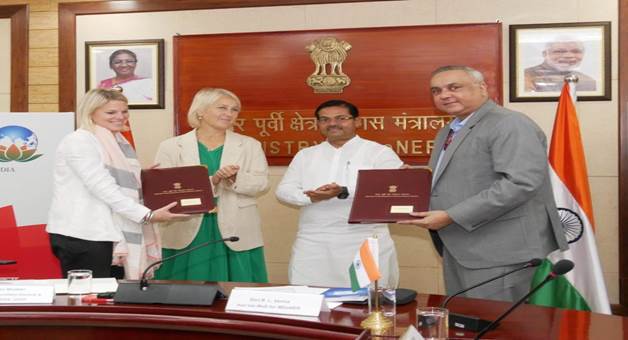
 Reiterating a mutual commitment towards fast-tracking progress towards the Sustainable Development Goals, NITI Aayog and UNDP India have signed today, a Memorandum of Understanding (MoU) to formalise a framework of cooperation on a range of areas, including SDG localisation, data-driven monitoring, Aspirational Districts and Blocks, among others.

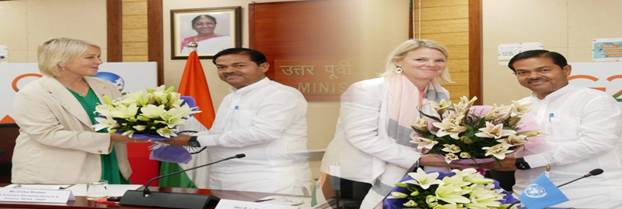
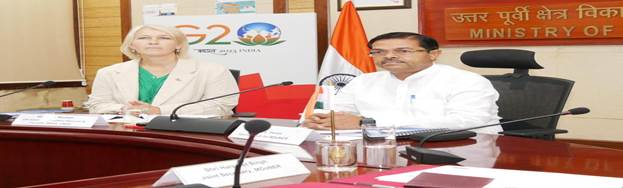
The MoU was signed in the presence of Shri B. V. R. Subrahmanyam CEO, NITI Aayog by Dr Yogesh Suri, Senior Adviser (SDGs), NITI Aayog, and Ms Shoko Noda, Resident Representative, UNDP India.

Welcoming the partnership, Shri B. V. R. Subrahmanyam said, “Over the years, NITI Aayog and UNDP’s collaboration has grown from strength to strength. With monitoring going beyond districts down to the block level, we see this partnership fostering data-driven policy interventions and programmatic action. Standing at the midpoint of the 2030 agenda, we look forward to working together with the States in the true spirit of cooperative federalism. We also look forward to partnering with UNDP to showcase and share India’s successes in realizing its development priorities to its peers”

Reaffirming UNDP’s commitment Ms Shoko NodaResident Representative, UNDP India said, “Midway to 2030, India’s leadership is critical for making the SDGs a reality. India nearly halved multidimensional poverty between 2015-2016 and 2019-2021, demonstrating that despite complex challenges, accelerating progress towards the Goals is possible. Through this MoU with NITI Aayog, UNDP stands ready to enhance its support for localization of the SDGs, data-driven decision-making through various indices, the Aspirational Districts and Blocks programme, and SDG financing. UNDP will also provide support for NITI Aayog’s work on women’s livelihoods, innovation, and Mission LiFE.”

The MoU was signed for a period of five years. NITI Aayog is the nodal Institution for coordinating the adoption and monitoring of SDGs at the national and sub-national levels. UNDP plays the integrator role in coordinating efforts to fast-track progress on the SDGs within the UN system.

****
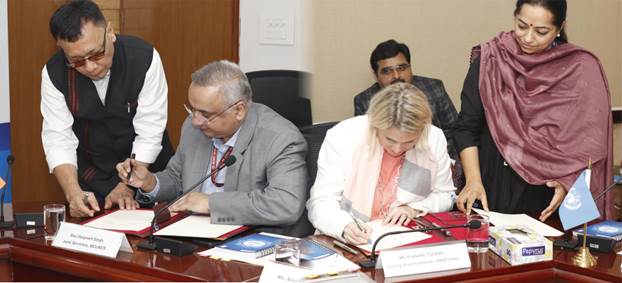
MoU signed between Ministry of Development of North Eastern Region and UNDP

 On 22nd  August, 2023, Ministry of Development of North Eastern Region (MDoNER) and UNDP, in the presence of  Minister of State for Ministry of DoNER and Ministry of Cooperation,  Shri B.L.Verma and UN Assistant Secretary-General & Director of the United Nations Development Programme (UNDP) Bureau of External Relations and Advocacy (BERA), Ms Ulrika Modéer,   entered into an MoU wherein UNDP would provide MDoNER with technical support on fast-tracking progress on the SDGs; monitoring, evaluation and capacity building; support Aspirational districts and blocks; support in the deployment of emerging technologies in governance and in scaling up good practices.


WhatsApp Image 2023-08-22 at 3.56.06 PM.jpeg

WhatsApp Image 2023-08-22 at 4.08.47 PM.jpeg


Minister of State, MDoNER, Shri B.L. Verma   addressed the delegates and said, Prime Ministers’ main focus is development of Social and Infrastructure connectivity in NER and hope UNDP will help the Ministry in achieving this goal.  He also said, “The Ministry of DoNER has taken remarkable strides across critical sectors such as infrastructure, connectivity, health, education, climate change and economic growth to transform the lives of the people in the region. In this journey, UNDP has been our key partner in promoting data-driven decision-making, especially through the North East Region District SDG Index”

MoS also stated that the NER District SDG Index helped in forming the flagship PM-DevINE scheme, which provides infrastructure and social development funding to boost livelihood opportunities in the region, especially for women and youth.


WhatsApp Image 2023-08-22 at 4.03.42 PM.jpeg


Ms. Ulrika Modéer appreciated the Government of India’s efforts towards fast-tracking the development of the North Eastern Region. She said, “UNDP is privileged to sign this MoU with the Ministry of Development of North Eastern Region. We are committed to supporting national and sub national efforts to accelerate progress on the goals by providing technical support on SDG localization and improved capacities towards implementation and monitoring of programmes.”

***

Human Security and Development

The concept of human security has given rise to a range of responses and attracted a lot of attention. It has connected the idea of security with that of human development. The very notion of human security has become a part of a broader political discourse. Typically speaking, the concept represents a departure from traditional security studies, which focus on the security of the state. The subjects of the human security approach are individuals, and its end goal is the protection of people from traditional (i.e. military) and non-traditional threats such as poverty and disease.

The advocates of human security have generally been less focused on meta-theoretical debates about the nature of security and have instead focused on influencing policy to take into account the security of individuals in a more practical sense. The concept of Human Security is often believed to have its basis in the realm of policy and the 1994 UNDP Report is believed to be the key official statement of the concept. The report sought to shift the focus from inter-state conflict to that of issues related to development.

Beyond territorial and military concerns, the Report argued that human security is fundamentally concerned with human life and dignity. For analytical purposes, UNDP classified its four main characteristics as: 1) it is universal, 2) its components are interdependent, 3) it is best ensured through prevention, 4) and it is people-centred.

For UNDP, human security meant safety from chronic threats such as hunger, disease, and repression, and it meant protection from sudden and hurtful disruptions in the patterns of daily life. Understood in these terms, it has also been embodied in the policy axiom of “freedom from fear” and “freedom from want”. While acknowledging the varying intensity of possible threats to human welfare, UNDP grouped these threats in seven non-exhaustive and nonexclusive security categories: –

1) community- protection of traditional culture of ethnic groups

2) economic- freedom from poverty

3) environmental- protection from factors such as pollution and degradation

4) food security- i.e. access to food

5) health- access to healthcare

6) personal- physical safety from the use of violence

7) and political- protection of civil liberties and freedom of political expression

One of the key debates in regarding the definition of Human Security. Primarily these are narrow human security and broad human security. The narrow definition emphasizes on ‘freedom from fear’ i.e. essentially conflict prevention and resolution. On the other hand, the broad definition emphasizes on ‘freedom from fear’ and ‘freedom from want’ i.e. conflict prevention and resolution as well as broader social issues such as health and education.

For many scholars operating within the ambit of critical security studies, the emerging practices associated with human security and development are a source of both critical opportunity and concern. Some say that what usually happens is that the policies and practices, in the name of human security, often fail to fulfill its progressive potential. Thus, Human Security is one of the most challenging contemporary ideas that critical approaches to Security are trying to come to terms with. The concept of Human Security provides a continuing source of debate.