China’s driven plans with respect to its missions to the Moon are not unused. In January 2019, China had as of now earned the refinement of being the primary nation to arrive a test on the distant side of the Moon, that’s the area of the characteristic adherent that faces absent from the Soil. Presently, after two a long time, it shows up that China is prepared to broaden its skyline when it comes to Moon travel and is taking dynamic steps to empower kept an eye on landing on the Moon. A brief news report distributed by the Xiamen College School of Flight and Astronautics on July 1 has pointed at the nation pointing to create a “human landing framework for lunar missions.
The report (by means of Space News) alludes to the lunar landing extend as a “national strategy” and has too named striking people heading the different united ventures. The initial news report was distributed within the scenery of an scholarly visit by the concerned parties. Several individuals at China Foundation of Space Innovation (CAST) — a wing of the state-owned space and defense temporary worker China Aviation Science and Innovation — are working on a modern dispatch vehicle for people, that’s one of the key and as of now lost compliments in China’s Moon mission plans.
As per the report, the assembly did not uncover what plans were in store for the advancement of the lander, but “current advance and future plans for human moon landings” were talked about. Whereas the nation has had a history of creating and testing dispatch vehicles, considering it a “national strategy” recommends the significance that’s being connected to the project. Earlier this year, in Walk, China had moreover reported that they were working on two variations of super-heavy dispatch vehicles that are appropriate for lunar ventures. Inside the following five a long time, the China Foundation of Dispatch Vehicle Innovation (CALT) said that it would create a modern era group dispatch vehicle as well as a overwhelming dispatch vehicle. China’s 14th Five-Year Arrange for 2021-2025, that was endorsed in Walk, did not highlight a particular kept an eye on lunar landing extend.
A consider of the Ophiuchus star-forming complex has advertised unused experiences into the conditions in which our possess sun based framework was born.
The discoveries of the ponder were distributed within the diary Nature Astronomy. A locale of active star arrangement within the group of stars Ophiuchus is giving stargazers modern bits of knowledge into the conditions in which our possess sun oriented framework was born
In specific, the ponder appeared how our sun based framework may have ended up improved with short-lived radioactive elements. Evidence of this enhancement prepare has been around since the 1970s when researchers considering certain mineral incorporations in shooting stars concluded that they were flawless remainders of the newborn child sun based framework and contained the rot items of short-lived radionuclides. These radioactive components seem have been blown onto the early sun powered framework by a adjacent detonating star (a supernova) or by the solid stellar winds from a sort of gigantic star known as a Wolf-Rayet star.
The creators of the unused ponder utilized multi-wavelength perceptions of the Ophiuchus star-forming locale, counting marvelous unused infrared information, to uncover intelligent between the clouds of star-forming gas and radionuclides delivered in a adjacent cluster of youthful stars. Their discoveries shown that supernovas within the star cluster are the foremost likely source of short-lived radionuclides within the star-forming clouds. “Our solar framework was most likely shaped in a mammoth atomic cloud along with a youthful stellar cluster, and one or more supernova occasions from a few enormous stars in this cluster sullied the gas which turned into the sun and its planetary system,” said co-author Douglas N. C. Lin, teacher emeritus of space science and astronomy at UC Santa Cruz. “Although this scenario has been recommended within the past, the quality of this paper is to utilize multi-wavelength perceptions and a modern factual examination to infer a quantitative estimation of the model’s probability,”
To begin with creator John Forbes at the Flatiron Institute’s Center for Computational Astronomy said information from space-based gamma-ray telescopes empower the discovery of gamma beams transmitted by the short-lived radionuclide aluminum-26. “These are challenging perceptions. Ready to only convincingly identify it in two star-forming districts, and the finest information are from the Ophiuchus complex,” he said. The Ophiuchus cloud complex contains numerous thick protostellar cores in different stages of star arrangement and protoplanetary disk improvement, speaking to the most punctual stages within the arrangement of a planetary system. By combining imaging information in wavelengths extending from millimeters to gamma beams, the analysts were able to picture a stream of aluminum-26 from the adjacent star cluster toward the Ophiuchus star-forming locale.
The enhancement handle we’re seeing in Ophiuchus is steady with what happened amid the arrangement of the sun based framework 5 billion a long time back,” Forbes said. “Once we saw this decent case of how the method might happen, we set almost attempting to demonstrate the adjacent star cluster that created the radionuclides we see nowadays in gamma beams,” he added. Forbes created a demonstrate that accounts for each enormous star that may have existed in this locale, counting its mass, age, and likelihood of detonating as a supernova, and joins the potential yields of aluminum-26 from stellar winds and supernovas. The show empowered him to decide the probabilities of distinctive scenarios for the generation of the aluminum-26 watched today. “We now have sufficient data to say that there’s a 59 per cent chance it is due to supernovas and a 68 per cent chance that it’s from numerous sources and not fair one supernova,” Forbes said.
This sort of factual investigation allots probabilities to scenarios that cosmologists have been debating for the past 50 a long time, Lin noted. “This is the modern heading for cosmology, to measure the probability,” he added. The unused discoveries moreover appeared that the sum of short-lived radionuclides consolidated into recently shaping star frameworks can shift widely. “Many unused star frameworks will be born with aluminum-26 plenitudes in line with our sun powered framework, but the variety is tremendous – a few orders of greatness,” Forbes said. “This things for the early advancement of planetary frameworks since aluminum-26 is the most early warming source. More aluminum-26 likely implies drier planets,” he added. The infrared information, which empowered the group to peer through dusty clouds into the heart of the star-forming complex, was gotten by coauthor Joao Alves at the College of Vienna as portion of the European Southern Observatory’s VISION overview of adjacent stellar nurseries utilizing the VISTA telescope in Chile
There’s nothing uncommon almost Ophiuchus as a star arrangement locale,” Alves said. “It is fair a normal setup of gas and youthful enormous stars, so our comes about ought to be agent of the improvement of short-lived radioactive components in star and planet arrangement over the Smooth Way,” he concluded. The group moreover utilized information from the European Space Agency’s (ESA) Herschel Space Observatory, the ESA’s Planck adj., and NASA’s Compton Gamma Beam Observatory.
A whooping 7.9 billion people, 8.7 million discovered eukaryotic species and an estimated 1 trillion microbes- How did it all came into being? How did our Earth or even better, the solar system or the whole universe came into being?
So, it all began about 13.8 billion years ago. There existed a single point, a minute, hot and really dense point which violently exploded-‘The Big Bang’, and it is how everything came into being- Matter, Energy space, universe, stars, solar system, me, you-everything. After the explosion took place, it expanded into what we today call the universe. And, what’s more interesting is the fact that it is still expanding, and this is how the scientists came to believe that it all began with a big bang.
Scientists divide the period after the big bang into 2 era-
Radiation era
Matter era
Radiation era
The period between 10^(-43) seconds (after the explosion took place)-the Planck era(here, the current laws of physics do not apply), to about 30,000 years after the big bang is referred to as the radiation era. During this period, the temperature of the atmosphere was soo high that there was no distinction between matter and radiation ,or even better, no matter existed.
It is divided into 7 era or epoch-
Grand unification epoch- Named for the unification of 3 grand forces of nature- Electro-magnetic forces, Weak forces, Strong nuclear forces. With a temperature greater than 1029 K, it began 10−43 s after the big bang. At the end of this epoch, the strong nuclear force broke away from the other two.
Inflationary epoch- With a temperature greater than 1032 K, it began 10−36 s after the big bang. As the name suggests, the universe rapidly expanded in this epoch. The universe, ta this time had electrons, quarks and antiquarks.
Electroweak epoch- Here, now all the 4 forces of nature have split off. Temperature- 10^20 K and time after big bang- 10^(-32)s.
Quark epoch- Temperature here is 10^16K and 10^-12 s have passed since the big bang. All of the ingredients required to form subatomic particles were present but the universe still was too hot and dense.
Hadron Epoch- Temperature- 10^10 K and Temperature-10^-6 s. The universe has not finally cooled down enough for subatomic particles to form and hence, quarks bind to form protons and neutrons.
Lepton epoch- Temperature- 10^ 12 K and finally, about1 sec have passed since the big bang.
Nuclear epoch- Temperature-10^9 K and 100 s approximately have passed since the big bang.
In these last two epoch, when the universe has cooled down quite a lot, the protons and neutrons fuse together to form the very first chemical elements- Hydrogen and Helium. And now that our universe is capable of forming elements, it brings us to the end of radiation era and the matter era begins.
Matter Era
Matter era includes 3 epoch that spread over billions of years and include the formation of our galaxy, solar system and even the present day.
Atomic epoch- With the temperature of 3000 K and time after big bang- 50,000 years, this epic marks the beginning of attachment of electrons to nuclei. This process is known as recombination.
Galactic epoch- Now, 200 million years have passed since the formation of our universe. With the ability of universe to now form Hydrogen and Helium molecules, the universe is dotted with atomic clouds. Within the clouds, due to gravity, clusters were formed which later led to the formation of galaxies.
Stellar epoch- 3 billion years have now passed. Within those clusters of clouds, now stars will be formed. Stars begin their lives as proto-stars. These are formed as a result of gravitational forces between particles of dust and gas and heat is generated due to friction and collision. When the proto-star becomes extremely hot, the process of thermonuclear fusion starts taking place. This is how stars generate heat and electricity. This heat within the clouds convert the already exiting elements into all others that are currently known to humankind. When stars burn themselves and are destroyed in explosion know as supernova, it destabilizes the heat cloud, which then begins to rearrange itself in the shape of a flattened disc. At the center a proto-star forms (eg.- our sun). The clumps of dust are flash heated and form chrondules that later from planetesimals by cohesion. These planetesimals then, later accrete to form what we call today as planets.
And this is how our solar system was formed about 4.5 billion years ago. It is located in the Milky Way galaxy’s Orion Star Cluster and has about 8 planets with a total of 63 moons. The inner 4 planets (also known as terrestrial planets) are separated form the outer 4(also known as jovian planets) by a belt of asteroids. Terrestrial planets are known as such because they are made of rocky material, have solid surface, do nor have rings and are relatively small. Earth, among these, is the only one to have a moon.
The jovian planets, on the other hand, have multiple moons, support ring system, have no solid surface and are immense in size. The Oort Cloud, a collection of icy debris, marks the edge of our solar system as the gravitational and physical influence of sun diminishes .
This is how our solar system and our Earth were formed. Now, can our solar system end? If yes, then how and by when? It’s a question for a later time.
When astronomers first started using radio telescopes in the 1950s to study the Universe, they discovered a strange phenomenon. They found objects that shone brightly in the radio spectrum, but they couldn’t see any visible object associated with them. They called them quasi-stellar radio sources, or “quasars” for short. Within a decade of their discovery, astronomers learned that these quasars were moving away at tremendous velocities. This velocity, or red-shift of their light, indicated that they were billions of light-years away; beyond the capabilities of most optical telescopes. It wasn’t until the 1960s when a quasar was finally tied to an optical object, a distant galaxy.
Here’s where Astronomers got creative. Maybe quasars weren’t really that bright, and it was our understanding of the size and expansion of the Universe that was wrong. Or maybe we were seeing the results of a civilization, who had harnessed all stars in their galaxy into some kind of energy source. Then in the 1980s, astronomers started to agree on the active galaxy theory as the source of quasars. That, in fact, several different kinds of objects: quasars, blazars and radio galaxies were all the same thing, just seen from different angles. And that some mechanism was causing galaxies to blast out jets of radiation from their cores.
Black hole at the center of Milky Way
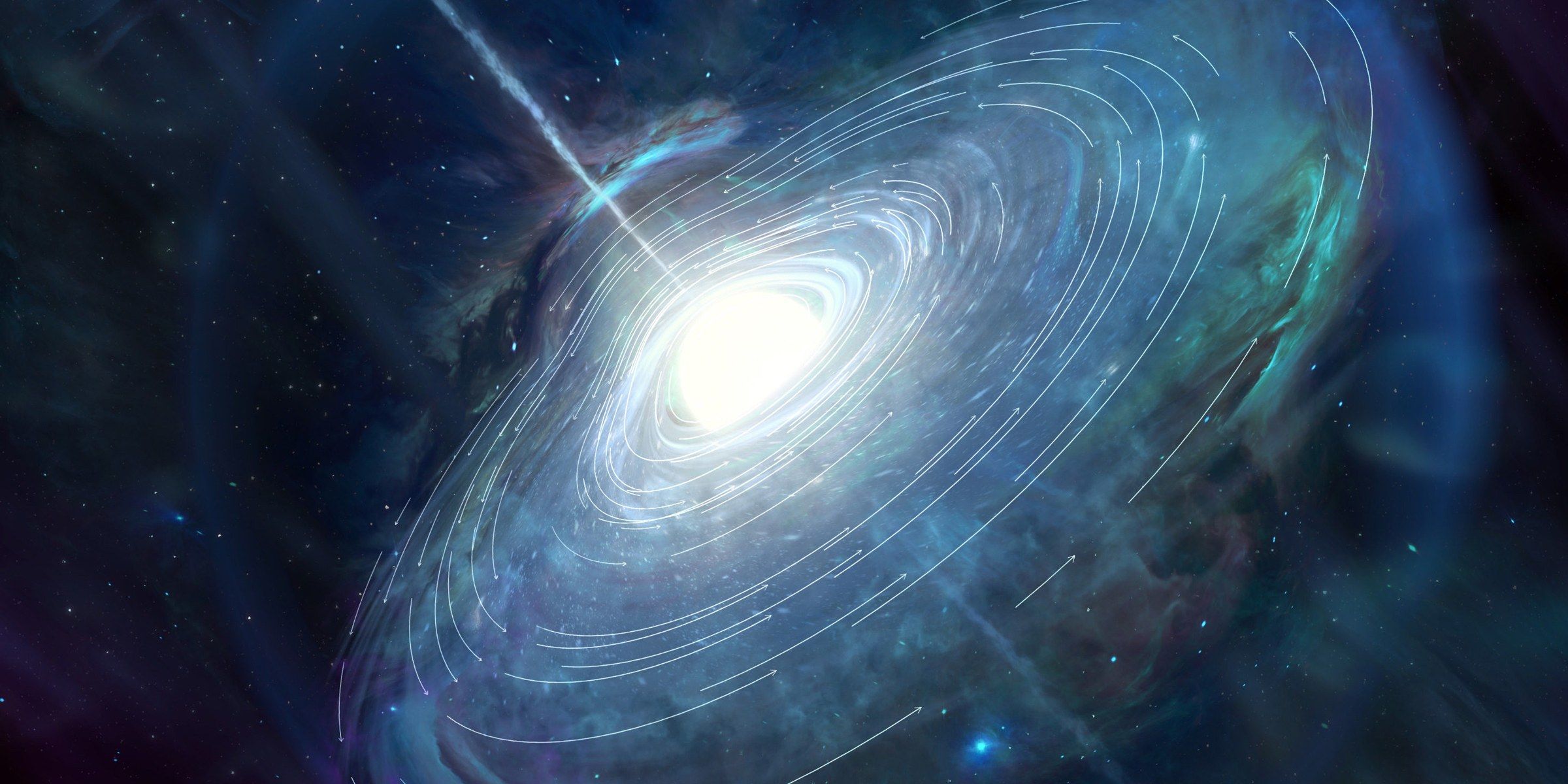
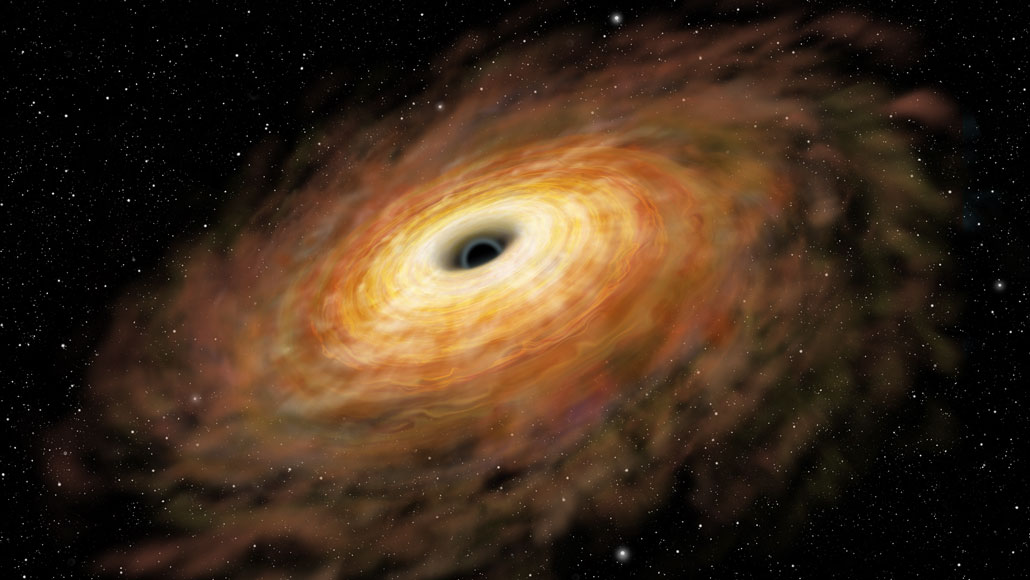
We now know that all galaxies have supermassive black holes at their centers; some billions of times the mass of the Sun. When material gets too close, it forms an accretion disk around the black hole. It heats up to millions of degrees, blasting out an enormous amount of radiation. The magnetic environment around the black hole forms twin jets of material which flow out into space for millions of light-years. This is an AGN, an active galactic nucleus. Since our own Milky Way has a supermassive black hole, it’s likely that we have gone through many active stages, whenever material is falling into the black hole; our galaxy would be seen as a quasar. But other times, like now, the supermassive black hole is quiet.
Supermassive black holes aren’t always feeding. If a black hole runs out of food, the jets run out of power and shut down. Right up until something else gets too close, and the whole system starts up again. The Milky Way has a supermassive black hole at its center, and it’s all out of food. It doesn’t have an active galactic nucleus, and so, we don’t appear as a quasar to some distant galaxy. With new powerful telescopes, astronomers have observed that some quasars have long jets of material firing out from the center of the galaxy. These are channeled by the magnetic fields created by the supermassive black hole’s rotation in the accretion disk. The most luminous quasars can exceed the radiation output of an average quasar. We may have in the past, and may again in the future. In 10 billion years or so, when the Milky way collides with Andromeda, our supermassive black hole may roar to life as a quasar, consuming all this new material.
Warning! Spoilers ahead for The Flash season 7 episode 16, “P.O.W.”
The Flashseason 7 is barreling towards its two-part finale and Iris West-Allen’s latest storyline could bring back the Arrowverse’s multiverse following its collapse in Crisis on Infinite Earths. Time and interdimensional travel have been heavily utilized in the shared universe ever since The Flash unlocked the titular character’s abilities to move backwards and forwards in time. The team’s trip to Earth-2 opened up yet another gateway to traversing the multiverse. While Crisis on Infinite Earths changed that for good, Iris’ situation could unlock the multiverse once again.
Iris has been noticeably absent from two episodes of The Flash. In season 7’s episode 15, Barry revealed she wasn’t feeling well and was recovering from a bout of illness at home. In the following episode, however, Iris confirmed what she was experiencing was far more than a regular cold; when she sneezed, her eyes briefly and startlingly flashed green before returning to their normal color afterward. Why the illness is affecting Iris in this way remains unclear, but her symptoms have led her molecules to become unstable, inducing headaches and time displacement.
At the end of the episode, Nora West-Allen confirms that Iris will be okay, but there’s no telling when her symptoms will clear up or what will happen before they do. That said, it’s possible Iris moving in and out of the timeline could play a crucial role in the future of the multiverse and the reason for her predicament may be hiding in plain sight.
Iris Is Phasing In & Out Of The Timeline
Iris’ absence from The Flash season 7’s episode 15 was suspicious, especially since it involved a possible pregnancy storyline that was happening without her. In the following episode, however, fans learned why Iris has been absent. As it turns out, her cold wasn’t a normal one and it was somehow causing her to phase in and out of the timeline. It got so bad apparently that Deon, the Still Force, swooped in to protect Iris by using his abilities to stabilize her from phasing through various temporal planes, moving her to “pure temporal strains” to keep her alive. If it wasn’t for Deon, Iris would have fractured through time itself, which doesn’t sound very pleasant and could have unprecedented repercussions.
This subplot creates an interesting twist considering everything happening on The Flash right now. Between what’s going on with Iris, the Godspeed clones, August Heart — who originated as Godspeed in 2049 pre-Crisis on Infinite Earths — coming into the picture, and Barry dreaming about Nora telling him there seems to be something wrong in the future, Iris’ timeline instability may be the one thing connecting each of these separate storylines. That said, the reason why she’s suddenly phasing in and out of the timeline has yet to be confirmed on the show, but all roads seem to be leading back to one cause.
Iris Being Pregnant Is Causing Her To Be Unstuck From Time
Barry and Iris have been trying to conceive for a few episodes now. After Barry dreamed about Nora the first time, he assumed Iris was pregnant only for the results of the test to come back negative. However, this could have been a false negative. Considering that Iris’ presence in the timeline has been unstable, it’s possible that she is already pregnant and doesn’t realize it. What’s more, being pregnant with speedster babies won’t follow the same patterns of a normal pregnancy and it’s possible that Iris carrying metahumans is causing her to be unstuck from time. Her phasing in and out of the timeline could be The Flash’s equivalent to morning sickness.
This could also explain why she will be able to regain her speedster powers in the season 7 finale. In the comics, Iris phases back and forth in time because it’s revealed she is actually from the future and was sent back to the 20th century by her birth parents. The Flashshowrunner Eric Wallace has teased this storyline coming into play, but like with all things that make their way onto the show, it will probably be a loose adaptation from the comics storyline it’s based on. Traveling between timelines because of a pregnancy might be the closest the series gets to this particular comics arc in this instance.
Jay Garrick’s The Flash Return Hints At Alternate Earths Connection
Jay Garrick (aka, The Flash of Earth-3) was last seen prior to Crisis on Infinite Earths, warning Barry of the impending doom facing the multiverse. However, the speedster didn’t participate in the crossover, nor was he confirmed to be alive in the aftermath that saw the multiverse rebooted and Earth-1 merge with others (including Supergirl’s Earth-38) to become Earth-Prime. Jay will be appearing in The Flash’s two-part season 7 finale to aid in the Godspeed clone war. How his reappearance will be explained remains to be seen, but it’s possible he will show up courtesy of Iris’ temporal phasing. Jay originally hails from Earth-3 and his return to The Flash coinciding with Iris being able to phase through time (and maybe dimensions) could be connected. Iris may be acting as the bridge between Earth-Prime and Jay’s world without even realizing, and the superhero series might confirm that he is now from Stargirl’s Earth-2 instead.
Theory: Iris’ Temporal Phasing Brings Back The Multiverse
In The Flash season 6, Nash Wells detected particles of Eternium, an interdimensional (and multiversal) element, on Iris prior to the events of Crisis on Infinite Earths. At the time, nothing much came of it, just another tease that seemed to lead nowhere. However, this could come back into play now that Iris is phasing through temporal planes in season 7. It’s possible the combination of Eternium and her moving in and out of time now allows her to connect to not only different time periods on Earth-Prime, but alternate universes as well. Perhaps before she is finally stabilized, Iris will indeed fracture through time and that’s what breaks the barrier separating Earth-Prime from the rest of the multiverse, which has remained a secret post-Crisis.
Namely, Iris’ temporal instability could alert her and The Flash to the fact there are still other worlds out there despite the collapse of the multiverse during Crisis. After all, Stargirl exists on the rebooted Earth-2 and it’s been confirmed that Jay Garrick will make an appearance on the series in its sophomore season. And so Iris’ temporal imbalance could open the gateway to interdimensional travel once more, reestablishing the connection between Earth-Prime and other earths. There has to be a reason for why Nash detected Eternium on her. All of this could also be setting up The Flash’s five-episode crossover event in the fall. Whatever the reasons behind Iris’ phasing in and out of time, the introduction of this storyline for her could finally tie together so many loose plot threads for The Flash and the Arrowverse at large.
One 27th MARCH 2020, a long periodic comet with near parabolicorbit was discovered by a group of astronomer during the NEOWISE Mission the Wide-field Infrared Survey Explorer (WISE) space telescope. At that time, it was an 18th-magnitude object, located 2 AU (300 million km; 190 million mi) away from the Sun and 1.7 AU (250 million km; 160 million mi) away from Earth.
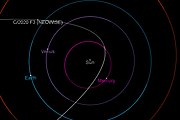
C/2020 F3(NEOWISE)
Discovered by NEOWISE Discovery date March 27, 2020 Orbital characteristics A Epoch 2458953.5 (April 14, 2020) Observation arc 113 days Number of observations 376 Orbit type Long period comet Aphelion 538 AU (inbound) 710 AU (outbound) Perihelion 0.29478 AU Semi-major axis 270 AU (inbound) 355 AU (outbound) Eccentricity 0.99921 Orbital period ~4400 yrs (inbound) ~6700 yrs (outbound) Inclination 128.93° Node 61.01° Argument of periapsis 37.28° TJupiter −0.408 Earth MOID 0.36 AU (54 million km; 140 LD) Jupiter MOID 0.81 AU (121 million km) Dimensions ~5 km (3 mi) Last perihelion July 3, 2020 Next perihelion unknown
HISTORY AND OBSERVATION
The object was discovered by a team using the WISE space telescope under the NEOWISE program on March 27, 2020.It was classified as a comet on March 31 and named after NEOWISE on April 1. It has the systematic designation C/2020 F3, indicating a non-periodic comet which was the third discovered in the second half of March 2020.
Comet NEOWISE made its closest approach to the Sun (perihelion) on July 3, 2020, at a distance of 0.29 AU (43 million km; 27 million mi). This passage through the planetary region increases the comet’s orbital period from about 4400 years to about 6700 years.Its closest approach to Earth occurred on July 23, 2020, 01:09 UT, at a distance of 0.69 AU (103 million km; 64 million mi) while located in the constellation of Ursa Major.
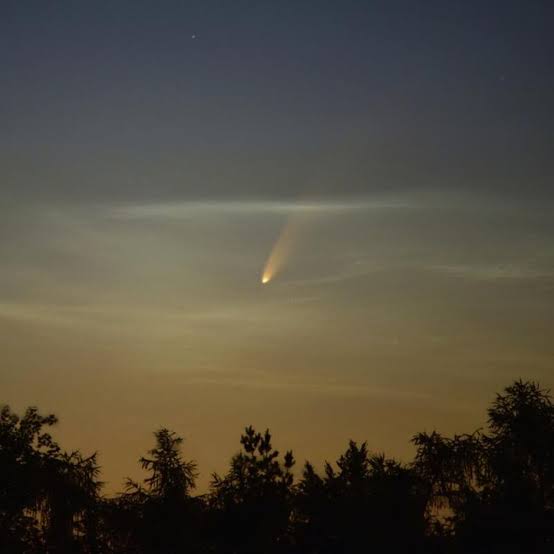
In early July, the comet could be seen in the morning sky just above the north-eastern horizon and below Capella. Seen from Earth, the comet was less than 20 degrees from the Sun between June 11 and July 9, 2020. By June 10, 2020, as the comet was being lost to the glare of the Sun, it was apparent magnitude 7,when it was 0.7 AU (100 million km; 65 million mi) away from Sun and 1.6 AU (240 million km; 150 million mi) away from Earth. When the comet entered the field of view of the SOHO spacecraft’s LASCO C3 instrument on June 22, 2020, the comet had brightened to about magnitude 3, when it was 0.4 AU (60 million km; 37 million mi) away from the Sun and 1.4 AU (210 million km; 130 million mi) away from Earth.
By early July, Comet NEOWISE had brightened to magnitude 1, far exceeding the brightness attained by previous comets, C/2020 F8 (SWAN), and C/2019 Y4 (ATLAS). By July, it also had developed a second tail. The first tail is blue and made of gas and ions stretching almost 70° from its nucleus. There is also a red separation in the tail caused by high amounts of sodium which is nearly stretched 1°. The second twin tail is a golden color and is made of dust stretched almost 50°, like the tail of Comet Hale–Bopp. This combination resembles comet C/2011 L4 (PANSTARRS). The comet is brighter than C/2011 L4 (PANSTARRS), but not as bright as Hale–Bopp was in 1997. According to the British AstronomicalAssociation, the comet brightened from a magnitude of about 8 at the beginning of June to −2 in early July.This would make it brighter than Hale–Bopp. However, as it was very near to the Sun, it was reported as 0 or +1 magnitude and remained that bright for only a few days. After perihelion, the comet began to fade, dropping to magnitude 2. Its nucleus activity subdued after mid-July, and its green coma was clearly visible after that.
On July 13, 2020, a sodium tail was confirmed by the Planetary Science Institute’s Input/Output facility. Sodium tails have only been observed in very bright comets such as Hale–Bopp and C/2012 S1 (ISON).
From the infrared signature, the diameter of the comet nucleus is estimated to be approximately 5 km (3 mi). The nucleus is similar in size to Comet Hyakutake and many short-period comets such as 2P/Encke, 7P/Pons-Winnecke, 8P/Tuttle, 14P/Wolf, and 19P/Borrelly. NASA’s Parker Solar Probe had captured an image of the comet, from which astronomers also estimated the diameter of the comet nucleus at approximately 5 km (3 mi). Later in July 2020, other observations were also reported, including those related to coma morphology and spectrographic emissions. On 31 July 2020, strong detection of OH 18-cm emission was observed in radio spectroscopic studies at the Arecibo Observatory. On August 14, 2020, the rotation period of the comet was reported to be “7.58 +/- 0.03 hr”.
A glimpse
TRAJECTORY
Comet NEOWISE retrograde orbit crossed to the north of the plane of the ecliptic, to which it is inclined at approximately 129 degrees, on June 29, 2020, 01:47 UT. It made its closest approach to the Sun (perihelion) on July 3, 2020, at a distance of 0.29 AU (43 million km; 27 million mi). This passage increases the comet’s orbital period from about 4400 years to about 6700 years.On July 18 the comet peaked at a northern declination of +48 and was circumpolar down to latitude 42N. Its closest approach to Earth occurred on July 23, 2020, 01:09 UT, at a distance of 0.69 AU (103 million km; 64 million mi) while located in the constellation of Ursa Major.
Pluto is one of the most mysterious and controversial celestial objects in the solar system. Pluto is a complex and mysterious world with mountains, valleys, plains, craters, and maybe glaciers. Discovered in 1930, Pluto was long considered our solar system’s ninth planet. But after the discovery of similar intriguing worlds deeper in the distant Kuiper Belt, icy Pluto was reclassified as a dwarf planet. Pluto is orbited by five known moons, the largest of which is Charon. Charon is about half the size of Pluto itself, making it the largest satellite relative to the planet it orbits in our solar system. Pluto and Charon are often referred to as a double planet. Pluto’s four other moons are named Kerberos, Styx, Nix and Hydra.
Some facts about Pluto
The name of Pluto was suggested by an 11 years old girl named Venetia Burney. When her grandfather told her the news that they have founded a new planet, then she said that Why not we can put its name Pluto under the name of the Roman Gods.
Pluto is very, very cold. It is much colder than Antarctica. It is so cold that Earth’s air would freeze into a kind of snow there. Pluto has less gravity than Earth. This means a person would weigh much less on Pluto than on Earth. It is so distant that the Sun’s light, which travels about 300,000 km per second, takes more than five hours to reach it. An observer standing on Pluto’s surface would see the Sun as an extremely bright star in the dark sky, providing Pluto on average 1/1,600 of the amount of sunlight that reaches Earth. Pluto’s surface temperature therefore is so cold that common gases such as nitrogen and carbon monoxide exist there as ices. Pluto is one third water, it is in the form of water ice which is more than 3 times as much water as in all the Earth’s oceans, the remaining two thirds are rock. Pluto’s surface is covered with ices, and has several mountain ranges, light and dark regions, and a scattering of craters.
Why Pluto is known as a dwarf planet
Pluto is a dwarf planet because it has not cleared the neighborhood around its orbit. Pluto goes around the sun, it’sround enough, it’s got moons, and behaves like a planet, but the idea is that Pluto did not form the same way as the rest of the planets. Pluto’s orbit is both eccentric and inclined more than the rest of the planets by about 17 degrees. That’s suggests something is different about this object.
Comparison with the other planets of solar system
Compared with the planets, Pluto is also anomalous in its physical characteristics. Pluto has a radius less than half that of Mercury; it is only about two-thirds the size of Earth’s Moon. Next to the outer planets—the giants Jupiter, Saturn, Uranus, and Neptune—it is strikingly tiny. When these characteristics are combined with what is known about its density and composition, Pluto appears to have more in common with the large icy moons of the outer planets than with any of the planets themselves. Its closest twin is Neptune’s moon Triton, which suggests a similar origin for these two bodies (see below Origin of Pluto and its moons).
2 Super-Earths are revolving around Red dwarf Star (red dwarf stars are most commonly found and are a smallest and coolest sort of star in a Milky way) Gilese 887 also known as GJ 887 which is approximately 11 light-years away from earth and claimed to be much dimmer than earth and half of its size. Super-Earth are planets which are heavier mass than the Earth but less than planetary twins Neptune and Uranus. Scientists have said that these two exoplanets Gilese 887b and Gilese 887c “could potentially hold life”.If you might not know exoplanets are the planets outside our solar system. According to the research conducted by the University of Gottingen, The RedDots team of Astronomers led by Dr. Sandra Jeffers had detected exoplanets using the radial velocity method also known as Doppler Spectroscopy – a method which is an extensively effective technique of discovering exosolar planets from the earth and the method depends on the evidence that the star doesn’t remain stationary when a planet orbiting it. It starts moving slightly, in a short ellipse responding to the gravitational pull of the planet orbiting it. When sighted from a distance, the slight movement of starts affects the star normal spectrum. The radial velocity signals reveal the existence of two exoplanets Gilese 887b and Gilese 887c with the orbit period of 9.3 and 21.8 days which figures that they both are moving much faster even than mercury. This discovery is a big deal in the mission of figuring whether we are only one in the universe or not.
On the basis of discoveries, the two Super-Earths orbiting around the Red dwarf star Gilese 887 holdings to be the habitable region is much closer to it than the Earth’s distance from the sun, which could lead to the possibility that it can be habitable since the water can exist in the liquid state and could be a rocky planet like Mars and Earth which one of the most sensational discoveries about the two exoplanets that they can potentially support existence. Due to unknown inclination of both the exoplanets the minimum mass of the exoplanets possibly could be determined. The scientist has found that the two exoplanets Gilese 887b and Gilese 887c have a thicker atmosphere than that of earth. Scientists have also calculated the temperature of 21.8 days likely to be 70-degree Celsius (359 Kelvin). Even they have observed that Red dwarf star GJ 887 has photometric variability than the 500 parts per million which is scarcely high for the red dwarf star.
According to scientists they have detected the unconfirmed signal with a period of nearly 50 days, which could be the possibility that it can be the three- Super-Earths multiplanet system. But yet not confirmed.
These planets will be the best opportunities to find the life outside the solar system said by the Dr. Sandra Jeffers. Since it can be likely to be a recently discovered planets to retain an atmosphere.
The new study on the two exoplanets Gilese 887b and Gilese 887c orbiting a red dwarf star GJ 887 have been published in the Science Journal.
Big-bang model, widely held theory of the evolution of the universe. Its essential feature is the emergence of the universe from a state of extremely high temperature and density —the so-called big bang that occurred 13.8 billion years ago. Although this type of universe was proposed by Russian mathematician Aleksandr Friedmann and Belgian astronomer Georges Lemaitre in the 1920s, the modern version was developed by Russian-born American physicist George Gamow and colleagues in the 1940s.
The Big bang theory itself is the outcome of thousands of brilliant minds put all together in astronomy and cosmology cautiously for exploring the origin of our universe.
Let’s move back in time.13.82 billion years ago, what was there?
Credit: Third Party Reference
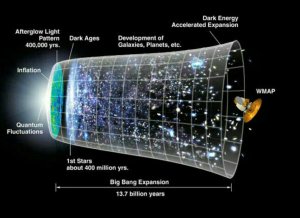
A point of singularity, extraordinary small and hot where no laws of physics were applied, the time has no existence, all four fundamental forces exist forming a unified force called super force suddenly exploded because of no reason.
”SOMETHING CAME FROM NOTHING”
In less than one second, gravity split off from the super force. Three minutes later, the temperature dropped to 10 billion degrees of Fahrenheit, an appropriate temperature for the formation of atoms to take place. Lighter element, hydrogen came into existence.
Credit: Third Party Reference
After 380,000 years, light travelled through the darkness. 4 billion years later, stars started shaping due to the presence of heavier elements such as nitrogen, oxygen, carbon etc. At the age of 13.7 billion years, the sky filled with stars and galaxies.
Credit: Third Party Reference
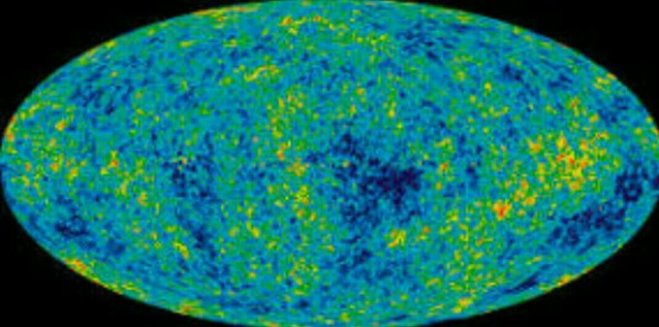
In 1965, Arno Penzias and Robert Wilson build a radio receiver which accidentally recorded echo or aftershock noise of big bang docking from everywhere and every corner of the universe. This was experimentally proved by NASA’S Wilkison microwave Anisotropy probe on 3 June 2001.
In February 2003, Cosmic microwave background provided a baby picture of our universe. Some of the major anomalies with the big bang theory were the unanswerable questions –
IS THERE SOMETHING OUT OF OUR UNIVERSE?
WHAT HAPPENED AT THE POINT OF SINGULARITY?
WHAT’S THE EXACT SHAPE OF OUR UNIVERSE?
HOW IS SPACE STRETCHING ITSELF FASTER THAN THE SPEED OF LIGHT?
WHAT WAS THE REASON BEHIND BIG BANG EXPLOSION?
Many alternate theories exist claming answer to these questions but none of them is experimentally verified.In 1980’s Alan Guth came up with the hypothesis of cosmic inflation i.e expanding universe which is now accepted as part of big bang theory.






 Eduindex
You must be logged in to post a comment.