Antioch University

 Antioch University’s roots began as Antioch College. It first opened its doors in 1852 in Yellow Springs, Ohio. Antioch’s first president, Horace Mann, was a lawyer and Congressman from Massachusetts, a well-known abolitionist and social reformer. He is considered the founder of public education in the United States, believing that a well-educated populace was essential to a strong democracy. In his first graduation speech, Horace Mann implored the Antioch graduates to “be ashamed to die until you have won some victory for humanity.” Those words remain throughout our history a guiding light of our values and an underlying commitment to an Antioch education.

Nonsectarian and co-educational from the outset, Antioch was a leader of progressive thought and innovation. Antioch was the first college in the country to have a woman faculty member as equal to her male counterparts. Antioch’s curriculum was the same for men and women and we admitted black and white students to learn together over a century before civil rights laws would require the same result. In the early 1860s, Antioch adopted a policy that no applicant could be rejected due to his or her race. Sadly, this was quite revolutionary for its time.

The modern Antioch began to take shape in the 1920s under the leadership of President Arthur E. Morgan. As an engineer and former Chair of the Tennessee Valley Authority, he was interested in progressive education. He reorganized the Antioch curriculum to include co-op, a structured method of combining classroom-based education and practical work experience. Antioch was the first liberal arts college in the United States to establish a co-op program. This important innovation in experiential learning has been widely reproduced throughout higher education today.

Always positioned at the forefront of social activism, the period during and after World War II proved even more groundbreaking for Antioch. During the war, Antioch participated in a program that allowed Japanese citizens incarcerated in internment camps to enroll at Antioch and move to Yellow Springs, Ohio.

Also in the 1940s and beyond, Antioch set out to diversify the campus by offering more scholarships to people of color. A number of famous African Americans graduated from the College, including Coretta Scott King, author, activist, civil rights leader, and the wife of Dr. Martin Luther King, Jr.; Eleanor Holmes Norton, Congressional Delegate for Wash. D.C., and A. Leon Higginbotham, Jr., civil rights advocate, author, and Chief Justice of the U.S. Court of Appeals for the 3rd Circuit.

Other notable Antioch alumni include two Nobel laureates, Mario Capecchi (B.S. 1961), co-recipient of the 2007 Nobel Prize in Physiology or Medicine, and José Manuel Ramos-Horta (M.A., Peace Studies, 1984), co-recipient of the 1996 Nobel Peace Prize, and later President of East Timor (2007-2012).

One University

The current Antioch University began to take shape in the 1960s. As Antioch College’s reputation for academic excellence, social relevance, activism and experiential learning continued to grow, so did its campuses. As part of the ‘university without walls’ movement of the 1960s and 70s, Antioch expanded to sites across the country. The strong values-based nature of developing these campuses is important to recognize. The vision inspiring the expansion in the mid- to late 1960s and early 1970s was to serve adult learners and especially women and minorities, an approach to ‘taking the ivory tower’ out to the people. This was a very distinctive call for higher education at the time.

The first of the adult campuses, today’s Antioch University New England, was established in 1964, and the last, Antioch University Santa Barbara, was established in 1974. During this era, over 35 Antioch “satellite” campuses were founded across the country, including locations in inner cities from coast to coast, on native-American reservations, and in international locations. Antioch also founded an innovative law school in 1972 in Washington D.C. which operated on an experiential legal clinic teaching model. All students of the Antioch School of Law participated in the clinic which provided legal services to poor and underserved communities in D.C. The law school now operates as The University of the District of Columbia David A. Clarke School of Law and is no longer part of Antioch University.

Due to its expansion of programs, graduate degrees, and campuses, Antioch’s name was changed in 1978 from Antioch College to Antioch University. Nonetheless, it is the same institution that was originally incorporated in Ohio in 1852. It has been in continuous existence since then, and has been continuously accredited by the Higher Learning Commission since 1926.

We are proud that Antioch University has had significant influence on higher education; in fact, the precursor to the national Council of Adult and Experiential Learning (CAEL), was founded by Morris Keeton when he was Antioch’s Vice President of Academic Affairs. CAEL’s influence was instrumental in facilitating other colleges and universities recruiting and supporting adult learners, especially as the demographics of traditional 18 to 22 year old students was decreasing in the 1980s.

We are also proud of the many innovations in academic programming offered by the campuses in promoting undergraduate degree completion and graduate degrees responsive to the needs of adult learners. As examples, our New England campus offered Antioch’s first APA accredited doctoral program in Clinical Psychology (PsyD) followed by a PhD in Environmental Studies, one of the first in the nation. In 2001, Antioch University established a highly innovative low residency PhD Program in Leadership and Change. It has expanded to become Antioch’s Graduate School of Leadership & Change, which is a distinctive, outcomes-based, doctoral program focused on the study, research, and practice of leading positive change in workplaces and communities worldwide.

In 2008, Antioch University closed its residential College campus in Yellow Springs, Ohio due to significant enrollment and financial challenges. The College campus and other assets were then transferred in 2009 to a new Ohio non-profit corporation known as Antioch College Continuation Corporation, formed by a group of Antioch alumni. In that transaction, the University agreed to license to them the name “Antioch College”. The College was subsequently reopened in 2011 as a legally separate institution, but with a shared heritage with Antioch University. Those shared roots and an abiding commitment to social, economic and environmental justice remain at our core.

Today’s Antioch University is composed of Antioch University New England, Antioch University Midwest, Antioch University Los Angeles, Antioch University Santa Barbara, Antioch University Seattle, Antioch University Online, and the University’s Graduate School of Leadership & Change. Collectively, they make up one Antioch University with progressive values and a mission to educate the next generation of those determined to win victories for humanity.

Our Mission

Antioch University provides learner-centered education to empower students with the knowledge and skills to lead meaningful lives and to advance social, economic, and environmental justice.

Our Vision

Antioch aspires to be a leading university offering learners and communities transformative education in a global context that fosters innovation and inspires social action.

Our Core Values

Excellence in Teaching and Learning

The University offers quality academic programs relevant to the needs of today’s learners and embraces experiential learning by bridging academic outcomes with the real-world experience of all members of its learning community.

Nurturing Student Achievement

The University educates the whole person by cultivating personal growth, pragmatic idealism, and the achievement of professional goals.

Supporting Scholarship and Service

The University supports the active engagement of students and faculty in both scholarship and service. Antioch values the creative and deliberative application of teaching and learning to ‘further social, economic and environmental justice.’

A Commitment to Social Engagement

The University maintains a historic commitment to promoting social justice and the common good. Students graduate from Antioch University with a heightened sense of their power and purpose as scholars, practitioners, and global citizens.

Building and Serving Inclusive Communities

The University nurtures inclusive communities of learners, inspiring diversity of thought and action. Antioch University engages and supports the educational, cultural, and environmental vitality of the diverse regional, national, and international communities that it serves.

Argosy University


Introduction

Argosy University entered into federal receivership on January 18, 2019 and its schools closed on March 9, 2019. This page is designed as a guide to support the needs of former students.

Transcripts

Transcripts may be ordered through Parchment. Visit:  https://www.parchment.com/u/registration/30244283/account  for more information and to order. We have filled more than 45,000 transcript requests to date. With our apologies, if you requested a transcript previously and your request was not fulfilled, your request was not received and you must re-order through Parchment.

Completing Your Education/ Transfer Opportunities 

If you are interested in completing your education and earning your degree, please visit www.dcedh.org for a list of partner institutions willing and able to assist students. 

Diplomas

If you are in need/would like a print of your diploma, please visit https://www.parchment.com/u/registration/30244283/account. Parchment is is the only place that diplomas can be requested moving forward. If you have not received your diploma as of yet (even if you previously requested it) you will need to order it here. 

Anaheim University


Mission 

Anaheim University was established as a unique, innovative and sustainable institution of higher learning to meet the educational needs of a diverse and global student body through academic programs of the highest quality. Dedicated to a student-centered philosophy, Anaheim University makes higher education accessible to qualified students worldwide through both online and on-campus study.

Anaheim University Objectives

Taking advantage of opportunities available through the newest of technological innovations, Anaheim University has been designed to be a global institution with a multicultural perspective with programs designed to meet the needs of its diverse student population. To accomplish this, Anaheim University has the following objectives:

  • Excellence of academic instruction through the guidance and expertise of dedicated faculty
  • Utilization of new and reliable technologies
  • Deployment of technology-based learning resources
  • Meeting the educational needs of the students by offering instructional programs otherwise unavailable to those students because of access, cost, or work schedule
  • Provision of an instructional environment where students can take active roles in their learning processes
  • Support of an academic environment where faculty members are able to deliver the highest quality educational programs
  • Regular course and program assessments and evaluation to ensure the quality of the curriculum


History

stdmain 2220Anaheim University was founded in Orange County, California in 1996. Anaheim University is accredited by the Distance Education Accrediting Commission (DEAC). The DEAC is listed by the U.S. Department of Education as a recognized accrediting agency and recognized by the Council for Higher Education Accreditation (CHEA).

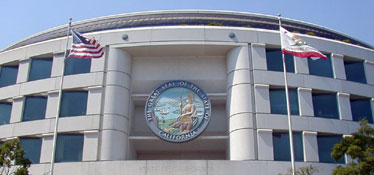
 In addition, Anaheim University is approved to operate by the California Bureau for Private Post-Secondary Education. \”Approval to operate\” means that Anaheim University operates in compliance with state standards as set forth in the California Education Code and the California Code of Regulations.

Anaheim University operates primarily as a distance education institution.

About Anaheim:

Celebrating its 160th anniversary in 2017, the City of Anaheim is one of the nation’s premier municipalities and California’s 10th most populous city. Located in Orange County, California, 28 miles southeast of Los Angeles, Anaheim covers 50 square miles with more than 346,000 residents, and has established sister-city relationships with Mito, Japan and Vitoria-Gasteiz, Spain. The municipal corporation’s annual budget is $1.6 billion. Anaheim supports a thriving business community with companies such as Disneyland Resort, CKE Restaurants, Inc., L-3 Communications, and Pacific Sunwear. Successful sport franchises including the Los Angeles Angels of Anaheim Major League Baseball (MLB) team, the Anaheim Ducks National Hockey League (NHL) team, and the USA Men’s National Volleyball Team call Anaheim home. Anaheim also boasts world-class meeting and entertainment venues with the Anaheim Convention Center, the largest on the west coast, Honda Center, The Grove of Anaheim and Angel Stadium of Anaheim. Anaheim is ranked one of the safest cities in the nation and annually welcomes millions of visitors to the city, truly making it where the world comes to live, work and play.

For more information, please visit Anaheim.net.


Anaheim University\’s Vision

Share It Forward

Anaheim University\’s Vision is a commitment to Share It Forward and to make a positive impact on society and the natural environment through a series of initiatives. \”Share It Forward\” means doing your part to make the world a better place so that we can all share in the benefits for many generations to come. Share It Forward originated from the concept of \”Pay It Forward\”, which means to ask that a good turn be repaid by having it done to others instead. It was first described by Benjamin Franklin and became the subject of the 2000 film by the same name.

The tradition of Sharing It Forward was originally initiated by Anaheim University students who sought to develop a practice within the institution that would help new students get used to the online learning environment. Their proactive student involvement in developing student-centered systems, introducing supplemental learning resources, and offering tutorship and guidance to new and potential students, was done with the hope that those that receive the benefits would also Share It Forward.

The idea of Sharing It Forward had such an impact on our learning community that the University\’s administration has embraced it. The philosophy has been incorporated into the mission of numerous University-led projects including our Vision in which we spread goodwill beyond our own institution to the world.

The administration, faculty and student body are united. We have a clear vision of our role and responsibility in leading change towards a sustainable future. We are now at the threshold of fulfilling our Quest to be Paperless. This is an achievement that has taken the cooperation of our entire learning community. Becoming the world\’s first paperless university certainly brings a feeling of pride and satisfaction to those of us who have worked hard to lead change within our own institution. However, an even stronger sense of pride will come when we have encouraged other universities to join us in this quest of becoming paperless and developing a sustainable future through environmental and social responsibility. It is the hope of Anaheim University to inspire students and academic leaders around the globe to join this initiative to change the world, one good turn at a time.


Alliant International University

Alliant Mission and Vision

Our Mission: Alliant International University prepares students for professional careers of service and leadership, and promotes the discovery and application of knowledge to improve the lives of people in diverse cultures and communities around the world.

Our Vision: An inclusive world empowered by Alliant alumni.

OUR STORY

Alliant Pillars

Alliant is committed to excellence in four areas:

Education for Professional Practice

Alliant’s educational programs are designed to give students the knowledge, skills, and ethical values they need to serve and lead effectively in a variety of professional settings. Alliant graduates are expected to achieve mastery of a body of knowledge and be able to apply that knowledge in professional practice in order to achieve desired, and beneficial outcomes.

Scholarship

Scholarship in the Alliant context includes the discovery of new knowledge; the discovery of new applications of knowledge to solve practical problems; the integration of knowledge in new ways; and innovation in teaching knowledge and professional competencies.

Multicultural and International Competence

Alliant is an inclusive institution committed to serving diverse populations around the world by preparing professionals to work effectively across cultural and national boundaries, by increasing the number of professionals working in underserved areas, and by understanding and responding to the needs of diverse communities.

Community Engagement

Alliant’s faculty, students, alumni, and staff are dedicated to making a positive difference in the world through professional education and practice. We measure the success of our university in part by the impact we have—both directly and indirectly—on the welfare of individuals, families, organizations, and communities.

Why Choose Alliant?

Hands-On Training

A combination of internships, practica, consulting, and community service projects will ensure that you have the professional practice you need to begin making an impact in your field from the moment you take your first step off of our commencement stage.

Accreditation

Alliant is accredited by the WASC Senior College and University Commission (WSCUC) and offers programs accredited by The American Psychological Association (APA), the California Commission on Teacher Credentialing (CTC), and the Commission on Accreditation for Marriage and Family Therapy Education (COAMFTE), among others.

See All Accreditations

Industry Immersion

Alliant staff and faculty work with students to harness every opportunity to present at industry conferences, publish their work, and build partnerships with industry organizations while earning their degrees.

Small Classes, Individual Attention

Our faculty are pioneers in their fields and prepare each of their students to continue their legacy. Our professors train their students with the expectation that they will one day join them in the top echelon of industry experts—they are training their future colleagues.

Proven Professional Success

The national average loan default rate is 10.8%, Alliant’s is less than one third of the national average at 3.3%.

Global Network of Impact

Alliant has nearly 50,000 alumni making an impact across the world. From the U.S. Congress, to NASA, the United Nations, non-profit organizations, and more, our alumni are transforming the world—one industry, one community, one family, and one individual at a time.

See Alumni Impact

The Alliant Difference

Theory & Practice

Our model of theory paired with practice helps Alliant students become innovative agents of change. Each of our programs is designed to help develop professionals to do meaningful work that makes a lasting impact. Our approach to education combines theory and practice; scholarship and application. We provide a professional school environment in which students learn from a faculty of seasoned working professionals and receive practical training while still in school through a combination of internships, practica, consulting, and community service projects.

Purpose & Impact

At Alliant, success is measured not only in terms of the number of degrees awarded and the quantity of academic papers published, but also by the impact students and graduates make in their communities. Alliant students contribute more than 1.2 million hours of community service each year as part of their professional education. Field placements, practica, and internships are often aimed at benefiting underserved communities, and students frequently engage in projects that address the real-time needs and issues in their surrounding communities.

Diversity & Alliance

Alliant has been a top producer of graduate degrees for minorities for the last six years and has been named one of the nation’s most military friendly schools. Our students come from all walks of life, from the first in the family to pursue a higher education to military veterans completing or re-starting their education to working professionals and graduates of community colleges as well as the Ivy League. We believe a diversity of views leads to a better environment for solving communal problems and inspires bigger thinking.

“One of the greatest things taught to me throughout my journey at Alliant was not from a textbook, or even from a lecture from the professors, it was the ability to understand by experience…This gift taught throughout my experience allows me to understand how impactful I can be both within my professional life and within my community.”
Jessie Ramirez
Alliant Alumna

Alliant 2022

Here is Alliant\’s 5-year Strategic Plan, which outlines how we plan to grow and change and become the best version of Alliant we can be by the year 2022.

Click here to download the pdf

Areas of Study

Find the Alliant International University Program that is right for you.
VIEW AREAS OF STUDY

University of Delhi to promote intermediate students with backlog for next semester.

New Delhi: University of Delhi has issued promotion criteria for intermediate semester students of undergraduate and postgraduate courses. According to an official notification, all UG and PG students (except for the Council Mandatory course, including the Non-Collegiate Women’s Education Board (NCWEB) and the School of Open Learning (SOL)), students will be allowed to pursue those subjects , In which they have failed.

“Students will be allowed to pursue subjects in which they failed in one semester or year and will be promoted next year,” an official statement said.

“However, such students may approve the syllabus for the examination in which they failed or in which they were absent, when the examinations are conducted by semester and term next year,” the statement said.

DU said that students in the second semester (part I) or fourth semester (part II) of undergraduate and postgraduate courses are eligible for promotion under the criteria.

Registered with the School of Open Learning and Noncollegiate Women’s Education Board (NCWEB) for second year UG courses under the annual mode and second semester (1 year), first year UG students under Choice Based Credit System (CBCS) Delhi. The university said that the School of Open Learning (SOL) is also eligible for promotion.

University of Delhi further stated that this provision is applicable only for the current academic session (2019-20) in view of COVID-19 epidemic. Courses administered by statutory regulatory bodies or councils will not be covered under this provision.

UGC RELEASES ACADEMIC CALENDAR FOR UG AND PG 2020-21 SESSION

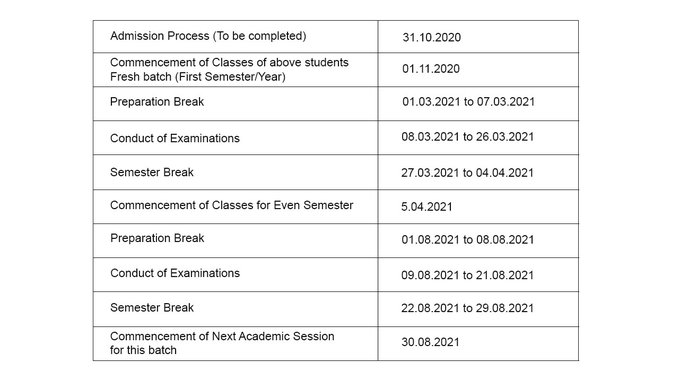
University Grants Commission, UGC has directed all the varsities to start the classes for the new sessions from November 1 onwards, as per the revised academic calendar approved by UGC on Monday. The first-year classes for undergraduate and postgraduate courses can begin in November. The varsities have been asked to wrap up the admission schedule by October 30.

Union Education Minister, Dr Ramesh Pokhriyal Nishank took to his official Twitter handle and made the important announcement. In his tweet, Dr Ramesh Pokhriyal Nishank said, ‘In view of the COVID-19 pandemic, the Commission has accepted the Report of the Committee and approved the @ugc_india Guidelines on Academic Calendar for the First Year of Under-Graduate and Post-Graduate Students of the Universities for the Session 2020-21.’ He also shared the suggested UGC new academic calendar 2020.


According to the suggested calendar, the classes for first-year students oof UGC undergraduate courses and UGC postgraduate courses will start from November 1, 2020, and the exams will be held from March 8, 2021, to March 26, 2021. Earlier UGC had advised that the new academic session of 2020-2021 should begin in September. However, due to the rising number of COVID-19 cases in India, the UGC calendar has been revised. Here is a look at Dr Ramesh Pokhriyal Nishank’s Twitter and important dates of the suggested UGC new academic calendar 2020.

To avoid financial hardship being faced by the parents due to lockdown and related factors, a full refund of fees will be made on account of all cancellation of admissions/ migration of students, up to 30.11.2020, for this very session as a special case.#UGCGuidelines                                      — Dr. Ramesh Pokhriyal Nishank (@DrRPNishank) September 22, 2020

In a separate tweet, the minister also noted that to avoid financial burden being faced by parents due to lockdown and related factors, a full refund will be made on account of all cancellation of admissions/ migration of students, up to 30 November.

Meanwhile, the Supreme Court on Tuesday asked the Central Board of Secondary Education (CBSE) to declare the results of compartment exams as soon as possible and coordinate with the University Grants Commission (UGC) to enable around two lakh students passing out in these exams to apply in colleges in the current academic year.

Grand Canyon University

The Beginning as Grand Canyon College

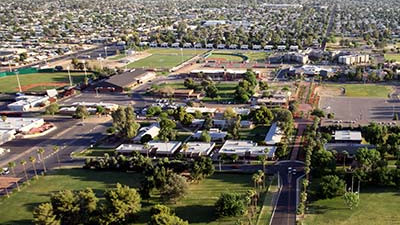
Grand Canyon College was chartered on Aug. 1, 1949, with 16 faculty and approximately 100 students in Prescott, AZ. In 1951, the college relocated to a 90-acre tract in West Phoenix and was fully accredited in 1968 by the Commission on Institutions of Higher Education. Established as a Baptist-affiliated institution with an emphasis on religious studies, the school initially offered bachelor’s programs in education. Programs expanded to include the sciences, nursing, business, music and fine arts. It was during this time when the college started to develop a reputation for producing effective teachers, nurses and health care professionals in the Southwest.
Becoming Grand Canyon University

While planning to change in institutional organization and status to Grand Canyon University, Grand Canyon College identified several landmark events during this transition: organizing programs and departments into colleges, offering graduate degree programs, establishing the Grand Canyon University Foundation and the generosity of those who pledged or gave unrestricted gifts valued at $1 million dollars or more. In May of 1984, college trustees voted to prepare for transition to university status on the school’s 40th anniversary. Then GCU moved from being owned and operated by the Arizona Southern Baptist Convention to being self-owned by the Board of Trustees.

New Mission and Vision

By the early 2000s, GCU struggled with maintaining its operations in light of dwindling financial support. The university faced a critical juncture in September 2003, teetering on the verge of insolvency and facing the prospect of bankruptcy. A small group of investors acquired the university and refocused on online education for working adults. With an improving financial structure, the university recruited a new leadership team in 2008 to envision a future that centered around a hybrid campus strategy—combining traditional students with nontraditional students (primarily working adults studying at the graduate level). The university completed an initial public offering in 2008 to generate the capital necessary to improve its online infrastructure and expand its campus.

University Transformation and Investment

The university grew its campus student body from fewer than 1,000 students in 2009 to over 19,000 ground students in fall 2017, where the incoming student GPA was 3.5. By 2016, more than 75% of the university’s traditional students study in rigorous STEM and business programs. GCU’s nontraditional student body increased from approximately 22,000 students at the start of 2009 to over 60,000 online students currently. Over 47% of GCU\’s online student body is studying at the graduate level and that percentage is growing.

In total since 2009, the university had invested over $1 billion dollars—and today, continues to invest in full-time faculty, improved technology infrastructure, new facilities and programmatic expansion in high-growth, high-demand areas such as engineering, computer science and IT. The university has been able to self-fund these investments with only nominal increases in tuition for nontraditional students, while freezing tuition for traditional students for 10 straight years.

Back to Non-Profit Roots

In 2018, GCU transitioned back to a non-profit institution, which provided faculty and students with equitable opportunities to:
Participate in academic and co-curricular opportunities with peer institutions
Operate a philanthropic foundation
Provide grant writing and research opportunities for faculty and students
Invest in educational infrastructure
Allow the university to continue offering tuition at levels that make private higher education affordable to all Americans despite socio-economic class
Provide employment and career growth opportunities for faculty and staff
Continue to invest in the communities where the university serves
Permit student athletes to participate in governance opportunities afforded by the NCAA


1 / 7

University Development

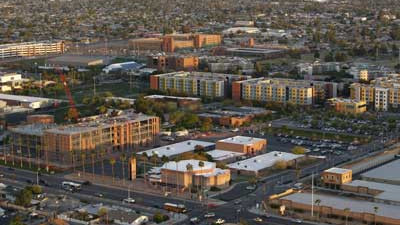
GCU\’s campus continues to grow to meet the needs of students and cultivate world-class learning experiences. Here\’s a snapshot of the campus today – a home away from home for our Lopes:
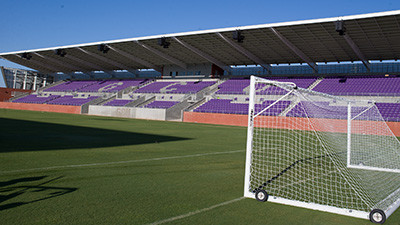
State-of-the-art GCU Stadium and GCU Arena
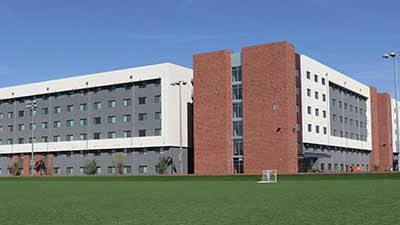
Contemporary residence halls and apartments with resort-style swimming pools
Recreation and fitness centers
Student Union and popular eateries along Lopes Way
Two new engineering classroom buildings dedicated to cutting-edge STEM learning
The Grove – a community of four suite-style residence halls exclusively for freshmen
Division I athletics, club sports teams, intramural sports teams
Academic, professional, social and recreational clubs
Academic and student support resources

State-of-the-art STEM building opened in fall 2015

Community Transformation

West Phoenix is where GCU calls home. That\’s why GCU stands committed to transforming the surrounding neighborhoods into a safe, thriving place for those in the community to live with hope and better futures. Along with providing academic excellence and a vibrant campus life, GCU believes its purpose is to partner together to implement initiatives in the area that open educational opportunities for all, create jobs, restore housing and reduce crime. GCU calls this United by Purpose.

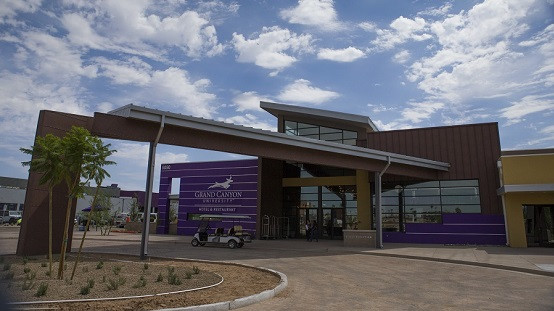
One aspect of this transformative endeavor starts with the new development project at 27th Avenue and Camelback Road that\’s changing the face of the Canyon Corridor. Developed to be the gateway into West Phoenix, this new development will serve as a commercial hub featuring:
A four-story office complex
Renovated GCU Hotel, resort-style pool and fitness center
Canyon 49 Grill and Grand Canyon Beverage Co. coffee shop
Building that will be home to a future business, economic and education innovation center

This development is only the beginning for reshaping West Phoenix into a destination of economic, tourism, business, employment and educational growth. Our new enterprises (GCU Golf Course, GCU Hotel, Canyon 49 Grill, Grand Canyon Beverage Co.) also play a role in reviving the local community.

Tremendous transformation is happening now, and the future looks even brighter.

Bryan University


Mission

We believe in challenging the boundaries of traditional education and in liberating the innate greatness in people.

As a private institution with an 80-year track record of excellence, Bryan University’s mission is a commitment to our students, graduates, and employees. It’s a commitment to providing experiences that transform their lives for the better.

Through a series of research-based strategies, continuous innovation, and strategic industry partnerships, our mission includes revolutionizing the way students learn online and solving complex challenges in online education. We believe that online learning can be a desired and preferred educational experience.

Vision

Bryan University is a leading student experience innovator that delivers strong value with social impact.

Bryan University’s vision is achieved through three strategic imperatives:

  1. Deliver high student return on investment (ROI) across all activities through the student life cycle.
  2. Provide a high value, equitable, and inclusive experience to all students and employees.
  3. Identify diverse, sustainable revenue sources.

Our vision ensures that Bryan graduates are empowered with the self-efficacy, knowledge, and practical, productive skills that lead directly to professional careers. We provide an inclusive educational experience to our students, driven by a core belief that all students can succeed, regardless of their differing life experiences, cultural backgrounds, economic conditions, attitudes and beliefs, or personal characteristics.

Our vision encourages an employment culture where each of our employees is valued and respected. We celebrate our diversity, recognizing that our differences make us stronger.

Our vision requires a long-term focus on organizational sustainability. To this end, we seek diverse revenue sources based upon our core competencies, while staying true to our mission and organizational values.

We believe that our mission and vision will inspire greater societal impact by reducing inequity in higher education and increasing educational access and attainment. These broader impacts align with the objectives of the United Nations’ Sustainable Development Goal 8 to promote: “inclusive and sustainable economic growth, full and productive employment, and decent work for all,” in addition to Sustainable Development Goal 4 to: “ensure inclusive and equitable quality education and promote lifelong learning opportunities for all.” This also aligns with AchieveAZ60’s vision to develop a: “diverse, well-educated, highly-skilled workforce participating in a thriving economy.”

We believe that by pursuing this mission and vision with tenacious and urgent resolve, Bryan will attain a position within the higher education spectrum that is unique, respected, and worthy of emulation.

Our Core Values

Deliver Delight Every Time

Be intentionally delightful– each experience matters, every time.

Impatiently Innovate

Find a better way– relentlessly and courageously.

Trust and Be Trusted

Always assume positive intent– we’re all in this together.

Embrace Difficulty

The most worthwhile accomplishments are hard-won.

Inspire Greatness Around You​

Bring out the best in others and you’ll bring out the best in yourself.

L, LOL

Literally, laugh out loud. Don’t take yourself too seriously– have fun and celebrate successes.

Own It

Own the challenge. Be part of the solution.

University of Arkansas at Little Rock


About UA Little Rock

The University of Arkansas at Little Rock is a metropolitan research university that provides an accessible, quality education through flexible learning and unparalleled internship opportunities. At UA Little Rock, we prepare our more than 11,000 students to be innovators and responsible leaders in their fields. Committed to its metropolitan research university mission, UA Little Rock is a driving force in Little Rock’s thriving cultural community and a major component of the city and state’s growing profile as a regional leader in research, technology transfer, economic development, and job creation.

Academics

Nursing studentsUA Little Rock students get to learn from the best professors around in classes that are as engaging as they are rigorous. Coursework blends critical thinking with real-world experience, providing a springboard for internships and later careers in such in-demand fields as nursing, engineering, data quality, criminal justice, and education. The university offers more than 60 undergraduate programs and more than 40 graduate programs.

U.S. News and World Report has recognized the William H. Bowen School of Law’s legal writing program as one of the nation’s Top 10, the College of Business among the top tier business schools in the country, and the George W. Donaghey College of Science, Technology, Engineering and Math’s systems engineering program as one of the best in the South.

UA Little Rock nursing students have the advantage of one of the country’s top state-of-the-art simulation hospital, known as SimCare. It’s a 22-bed, high fidelity hospital, training students in all areas of care as they work with interactive manikins that simulate a variety of medical-surgical scenarios.

Applied Design, a UA Little Rock program to study contemporary studio craft such as ceramics, metalsmithing and jewelry, and furniture design and woodworking is the only degree program of its kind in the state and one of a very few accredited programs in this specialty.

The UA Little Rock Department of Criminal Justice houses the largest criminal justice program in the state and offers the only Ph.D. criminal justice program in Arkansas. The department’s Senior Justice Center is one of only a few student intern programs in the country that directly addresses crime against the elderly.

Research

ResearchWhether it’s building a better tomato or looking into cancer treatments, students get an opportunity to work alongside faculty, putting their knowledge to use in UA Little Rock’s state-of-the-art research facilities. Additionally, they are tackling big data for businesses and curating historical collections for the world to see.

UA Little Rock is a regional leader in using and teaching advanced technology in areas such as nanotechnology, information quality, and emerging analytics.

UA Little Rock is a leader in the preservation and dissemination of Arkansas history through the alignment of the Department of History, the Master of Arts in public history program, and the Center for Arkansas History and Culture. Collections 88,000 archival papers, images, and books, including those of five Arkansas governors, provide a wealth of research opportunities.

Campus

Campus campaignThe UA Little Rock community embodies the Trojan spirit, which can be seen in the numerous acts of giving and outreach that take place on campus and beyond.

UA Little Rock reached a milestone two years ago during its first comprehensive fundraising campaign when an overwhelming number of businesses and individuals from central Arkansas and beyond raised more than $100 million.

UA Little Rock was the first Arkansas university recognized by the Carnegie Foundation for the Advancement of Teaching for the elective classification as a Community Engaged institution.

University of Arkansas


ABOUT

The University of Arkansas is one of the nation’s top public research universities. Our ideas, solutions and collaborations make communities and economies stronger. The opportunities and skills we provide make lives better. We envision a better world and we’re determined to build it.

THE U OF A

That \’students-first\’ philosophy is a big reason why the U of A is consistently ranked among the nation\’s top public research universities and best values. We work hard to ensure a low student-to-faculty ratio that promotes plenty of personal attention and mentoring opportunities. The Carnegie Foundation classifies the university as having \”the highest possible level of research,\” placing us among the top 3 percent of colleges and universities nationwide.

Founded in 1871 as a land-grant institution, the University of Arkansas is the flagship of the University of Arkansas System. Our 27,000 students represent all 50 states and more than 120 countries. The U of A has 10 colleges and schools offering more than 210 academic programs. The University of Arkansas is accredited by the Higher Learning Commission.

Our picturesque campus is located in Fayetteville in the hilly northwest corner of Arkansas and includes two arboreta overlooking the Ozark Mountains. Some of the nation’s best outdoor amenities and most spectacular hiking trails are within a short drive of campus. Fayetteville is routinely considered among the country’s finest college towns, and the surrounding Northwest Arkansas region is regularly ranked one of the best places to live in the U.S.

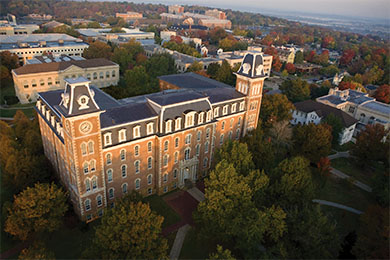
Old Main

Visitors Guide

VISITORS GUIDE

Welcome! This handy guide provides information about the campus and community including what to see and where to eat in one of the nation’s best places to live.

Quick Facts

QUICK FACTS

Key facts, figures, and some interesting trivia. For instance, did you know Bill and Hillary Clinton began their careers by teaching law at the U of A?

History

HISTORY

Learn more about the university as we approach the 150th anniversary of its founding in 2021.

OUR MISSION

The University of Arkansas is determined to build a better world by providing transformational opportunities and skills, promoting an inclusive and diverse culture, nurturing creativity, and solving problems through research and discovery, all in service to Arkansas.

Since 1871, our fundamental purpose as a land-grant institution and state flagship remains unchanged — to serve the state of Arkansas as a partner, resource and catalyst by:

  • Providing access to a comprehensive and internationally competitive public education, and fostering student success across a wide spectrum of disciplines.
  • Utilizing research, discovery and creative activity to improve the quality of life, develop solutions to the challenges we face and drive the state\’s economy.
  • Contributing service and expertise through outreach, engagement and collaboration.

Our mission provides a broad outline of the work required to achieve our vision – that the University of Arkansas represents the best of public higher education, advancing Arkansas while building a better world.

A campus-wide, collaborative effort led by Chancellor Joe Steinmetz resulted in eight Guiding Priorities and measurable goals that provide direction for the university’s Strategic Plan. This roadmap for our future is articulated through unifying themes that describe who we are, what we do and why it matters.

OUR VALUES

We are guided by our mission to advance Arkansas while building a better world. Our core values help frame a desired culture that best supports that mission. We value:

Curiosity

Curiosity drives progress – the need to know more, understand better, ask questions and find answers. We embrace the challenges that come with exploring the unknown and seeking solutions to problems shared by all. This intellectual curiosity feeds our determination to improve lives through discovery, innovation and the expansion of knowledge.

Creativity

We are inspired by the art, music, literature, architecture and other creative works that enrich our lives. But creativity is not limited to the arts and humanities; it is no less important to the sciences, driving innovation and new technologies. A creative environment stimulates original thought, varied perspectives and new ways of looking at things. Creative people and approaches lead to new ideas, improved outcomes and other valuable contributions that make our lives better.

Character

We value personal integrity and the related behaviors that make us better people, collectively strengthening our community and society. We strive to be trustworthy, to lead by example, to get better every day and to have a positive impact on others. We cultivate a culture of honesty, fairness, respect and understanding. We are accountable to ourselves, each other and the publics we serve.

Our Shared Humanity

We care about the safety, health and well-being of those around us. We support an open exchange of ideas and respect the unique perspectives and contributions that each of us provides. As a community of individuals, our diversity is our strength. We help nourish an inclusive environment where equity, opportunity, representation and civility are valued. Respecting our differences creates better understanding of our shared humanity, the foundation of our mission to build a better world.

COLLEGES & SCHOOLS

Colleges and Schools

Dale Bumpers College of Agricultural, Food and Life Sciences
The Bumpers College prepares leaders for careers that matter – in areas of food, family and the environment. The business of foods, healthy families, quality of life, the stewardship of our environment, the impact of foods on health and a positive self-image affect everyone. The School of Human Environmental Sciences is a part of Bumpers College. 

Fay Jones School of Architecture and Design
The Fay Jones School of Architecture and Design offers architecture, landscape architecture and interior design education, with the architecture program ranked among the nation\’s top 10. The renovation of our historic home and the addition of a modern design center provide an opportunity for collaboration in a world-class facility.

J. William Fulbright College of Arts and Sciences
Fulbright College is the largest and most diverse academic unit on campus with 19 departments and more than 30 academic programs and research centers. The college provides the core curriculum for all  University of Arkansas students and is named for J. William Fulbright, former university president and longtime U.S. senator. The School of Social Work, The School of Art, and the School of Journalism and Strategic Media are all a part of Fulbright College.

Sam M. Walton College of Business
Founded in 1926, the Sam M. Walton College of Business currently ranks among the top business schools in the nation. The Walton College combines outstanding academic programs in a number of disciplines with a wide range of experiential learning to help students connect world-class scholarship with real-world business practice.

College of Education and Health Professions
The College of Education and Health Professions focuses on two very important areas – education and health – with disciplines as diverse as teaching, nursing, community health promotion, human resource development, kinesiology, recreation and sport management, and communication disorders. Students gain hands-on experience and work with faculty on research in these fields. The college includes the Eleanor Mann School of Nursing.

College of Engineering
The most comprehensive engineering program in Arkansas, the College of Engineering offers ABET-accredited bachelor\’s degrees, plus master\’s degrees and doctorates. With over 100 labs and a dedicated, supportive faculty, the College of Engineering provides an environment of exploration and innovation.

Honors College
Our endowed Honors College unites the university\’s top undergraduate students and professors from all disciplines in a learning environment characterized by discovery, creativity and service. Honors students enjoy small, in-depth classes, priority registration, special housing and enhanced opportunities for hands-on research and study abroad.

Global Campus
The Global Campus supports the development and delivery of online, distance and professional education offerings. The University of Arkansas ONLINE is your portal for online and distance education programs and courses. High-quality teaching combined with technology gives students flexible, robust academic options, backed by the university\’s strong student support system.

Graduate School and International Education
The Graduate School and International Education is the home for all graduate students and all international students, both graduate and undergraduate, and all students seeking an educational experience abroad. Our vision, mission and goals encompass our dedication to the recruitment, admission, retention and graduation of students from Arkansas and across the U.S. and the world, as well as our service to the University of Arkansas.

School of Law
The School of Law, a National Jurist top 15 value in legal education and among U.S. News and World Report\’s top 36 public law schools, prepares students for success. The law school offers challenging courses taught by outstanding faculty, unique service opportunities and a community that puts law students first.

ADMINISTRATION

Office of the Chancellor
Joseph E. Steinmetz became the sixth chancellor of the University of Arkansas on January 1, 2016. Find out more about Chancellor Steinmetz, his administration and staff, and other key communications from this office.

Academic Affairs
The Division of Academic Affairs works to enhance the university\’s excellence in instruction; research; outreach and public service; and student affairs; and is responsible for academic planning and budgeting, faculty development and promotion, and academic initiatives.

Enrollment Services
Enrollment Services seeks to enroll and graduate a diverse group of capable students who will engage fully in academic and service programs, develop intellectually and personally, and contribute to the campus, the state, and the global community. To assist students in achieving their academic and career goals, the Enrollment Services Division offers support in academic success, admissions and orientation, financial aid and scholarships, nationally competitive awards, registrar, and UAConnect.

Finance and Administration
The Division of Finance and Administration provides services that enable the university to support its learning mission. Services provided include maintenance of facilities, information technology systems, financial services, purchasing, budgeting, financial reporting, operation of business services, protection offered by the University Police, and human resources.

Student Affairs
Ensuring every student\’s success is the focus of the Division of Student Affairs. Students benefit from multiple support services, programs and initiatives focused on community engagement, activities and entertainment, standards and conduct, Greek life, student media, housing, dining, mental and physical health, and career development.

University Advancement
The Division of University Advancement builds understanding and support for higher education in three key ways: enhancing the university\’s image by communicating the accomplishments of our outstanding students and faculty while highlighting special points of pride; involving alumni and other constituencies in proactive functions and raising private gift support. The division includes the Arkansas Alumni Association, and the offices of University Development, University Relations, Donor Relations and Special Events, and Central Arkansas Regional Advancement.

Governmental Relations
Coordinating university activities related to government and community organizations on a local, state and federal level is the focus of the Governmental Relations office. Locally, the office works with Chambers of Commerce and other community groups. At the state level, the office handles legislative issues and assists faculty and staff with issues involving state agencies and offices. The office also works with our congressional delegation on the university\’s priorities for federal initiatives.

Diversity and Inclusion
The Office for Diversity and Inclusion is responsible for enriching campus diversity and inclusion, one of the university’s top priorities. More inclusive and diverse learning environments yield better learning and productivity outcomes for all students, staff, faculty and even our community. To help the university develop and sustain a more diverse, inclusive environment, the office provides guidance, support and leadership for initiatives, policies and programming and other strategic efforts designed to support the university’s academic mission. The office collaborates with units across campus as well as external stakeholders to achieve this important work.

Economic Development
The Office of Economic Development directs and coordinates the university’s campuswide efforts to expand economic opportunities and improve quality of life in Arkansas and beyond. The office is responsible for assessing, increasing and communicating the university’s economic and social impacts. The office collaborates with colleges, schools and administrative units across campus to maximize the university’s influence on quality of place, economy and social betterment.

Research and Innovation
The Carnegie Foundation for the Advancement of Teaching classifies the University of Arkansas among those with the “highest research activity.” The Office of Research and Innovation is responsible for growing the university’s research program, developing and improving research infrastructure and capacity, and energizing innovation. The office also oversees research administration and compliance, optimization of research space and equipment, interdisciplinary research centers, undergraduate research and the University of Arkansas Press.

See our complete organizational structure.

Fulbright Fountain

University of Central Arkansas

 Welcome to the University of Central Arkansas, located in the heart of the state. Here at UCA, students can experience city life while enjoying the quaint downtown feel of home. We\’re currently in front of Old Main, a beloved landmark in the heart of campus that houses classrooms and Ida Waldran Auditorium. Old Main has been host to many significant people and events, including a vocal concert by President Harry Truman\’s daughter, Margaret, and presentations by President Gerald Ford and President Bill Clinton. It is the oldest building on campus and has been a vital part of UCA since it was built in 1919. Before we get started, let me explain the many ways in which you can explore our beautiful campus: – You can click on the front facing arrow to start walking around our campus – You can jump to the next stop by clicking on the \”Next\” button – Now, if you already know where you want to go, you can select any location by using the list or by clicking directly on the map – Lastly, remember that you can explore any particular location in more detail by clicking on the 360, photos, or video icons.

You are now on the 3rd point on the Welcome Old Main trail coming from Old Main on your way to Reynolds Performance Hall.You are now on the 5th point on the Welcome Old Main trail coming from Old Main on your way to Reynolds Performance Hall.You are now on the 7th point on the Welcome Old Main trail coming from Old Main on your way to Reynolds Performance Hall.You are now on the 9th point on the Welcome Old Main trail coming from Old Main on your way to Reynolds Performance Hall.You are now on the 11th point on the Welcome Old Main trail coming from Old Main on your way to Reynolds Performance Hall.

Ouachita Baptist University

 Welcome to Ouachita Baptist University! What makes us different? For more than 130 years, Ouachita has been committed to encouraging a love of God and a love of learning.

Vision
Ouachita Baptist University seeks to foster a love of God and a love of learning by creating for students and other constituents dynamic growth opportunities both on campus and throughout the world. With foresight and faithfulness, Ouachita makes a difference.

Mission
Ouachita Baptist University is a Christ-centered learning community. Embracing the liberal arts tradition, the university prepares individuals for ongoing intellectual and spiritual growth, lives of meaningful work, and reasoned engagement with the world.

Values
Ouachita strives to be an academic community of vision, integrity, and service grounded in the following values:

Faith. We believe that life is lived most abundantly in response to the love of God through Jesus Christ.


Scholarship. We advance excellence in teaching, learning, research, and creative expression.


Growth. We foster broad-based education, encouraging growth in intellectual, spiritual, physical, and social domains.


Character. We affirm that respect and honesty undergird responsible citizenship and stewardship.


Community. We promote a vibrant community strengthened by diversity, sustained by common aims and supportive relationships, and committed to leadership and service on campus and beyond.


UNIVERSITY LEARNING GOALS


Through all its educational programs—curricular and co-curricular, classroom and experiential—Ouachita promotes the following goals for student learning:

1.  Intellectual and applied skills that promote competency and lifelong learning:

a.  articulate communication

i.   written

ii.  oral

b.  critical thinking

c.   creative thinking

d.  analytic reasoning

e.  quantitative reasoning

f.  scientific reasoning

g.  information literacy

2.  Engagement with the content and methods of the major domains of knowledge

3.  Heightened awareness of personal and social responsibility:

a.  civic engagement

b.  ethical reasoning

c.  personal integrity

d.  stewardship

e.  physical well-being 

f.  spiritual growth

4a.  Appreciation for cultural diversity

4b.  Development of intercultural competence for constructive engagement in both local and global contexts

5.  Depth of knowledge and skills in a chosen discipline or combination of disciplines sufficient to provide the foundation for advanced study, professional competence, and meaningful work.

6a.  Connect learning across disciplines

6b.  Apply knowledge and skills to solve problems

As a leading liberal arts university, Ouachita has earned a strong academic reputation. Combine all that with a close-knit campus community and you have a setting where students thrive academically, spiritually and personally.

Year after year, Ouachita is ranked among the nation’s top colleges by such publications as U.S. News & World Report and Forbes. Our students also earn state and national recognition for accomplishments ranging from scientific research and business competitions to student publications and musical performances. We even host an annual Scholars Day to celebrate academic achievements.

We invite you to discover the exceptional education Ouachita provides. Our 12:1 student-to-faculty makes a huge difference. Our students get to know their professors on a personal level as role models and mentors. Beyond the classroom, campus life always is busy with Tiger Tunes, Tiger Serve Day, social clubs, intramurals, campus ministries – or just hanging out with friends at Dr. Jack’s.

Take a few moments to learn more as you discover the Ouachita difference for yourself.

Ouachita History


Accreditations & Memberships

Quick Facts

  • Enrollment: 1,500 students from 30 states and 30 nations. Gender: Male 43%, Female 57%.  Minority Enrollment: 16%. Average Age: 20

  • Academic Tradition: Liberal Arts

  • Student-to-Faculty Ratio: 12:1

  • Average Class Size: 18

  • Prepared Graduates: 98% acceptance rate to graduate programs

  • Athletics: 25% of Ouachita\’s students compete on one of its 14 NCAA Division II athletic teams

  • Tradition of Service: Since 1997, Ouachitonians have volunteered more than 80,000 hours as part of Tiger Serve Day, a semi-annual community service event

Student Outcomes Data

  • Retention: 80% of freshmen return for their sophomore year
  • Graduation: 66% of entering freshmen graduate within six years

  • Student-Athlete Academic Success Rate: 77%

  • Post-Graduation Outcomes: 99% have a full-time job or are accepted to graduate school within 6 months

Harding University


bout Harding

IN THIS SECTION
  • This is a photo of student on Harding University\'s front lawn on campus.

    Worldly impact | More than 5,000 students from 50 states and 50 nations & territories come here to turn passions into service.

    GLANCE AT QUICK FACTS

WELCOME TO HARDING UNIVERSITY

Harding began as a senior college in 1924, when two junior colleges, Arkansas Christian College and Harper College, merged their facilities and assets, adopted the new name of Harding College, and located on the campus of Arkansas Christian in Morrilton, Ark. In 1934 Harding was moved to its present site in Searcy, Ark. The board of trustees approved the study\’s recommended change of Harding to university status, and on Aug. 27, 1979, the name of the institution officially became Harding University. We are, at our core, a Christian university.

The character, example, and concerns of Jesus Christ are the standards that shape us and chart the course for our future. Because of this, an all-encompassing love for God and a corresponding love for people are at the heart of who we are.

Harding\’s mission is to provide a quality education that will lead to an understanding and philosophy of life consistent with Christian ideals. Explore this section to learn more about our mission, our history and what makes us stand apart as a Christian university.

THE PRESIDENT

Dr. Bruce D. McLarty was named the fifth president of Harding University Nov. 1, 2012. Read a short biography, take a look at footage from the inauguration ceremony, and see how you can stay connected to Harding through his Instagram, Twitter and Harding Two Minutes video series.

About the President

ARKANSAS TECH UNIVERSITY

 ARKANSAS TECH UNIVERSITY


OUR HISTORY


Arkansas Tech University is a public institution of higher education offering credentials at the certificate, associate, baccalaureate, master, educational specialist and doctoral levels. It was founded in 1909 as the Second District Agricultural School and its Russellville campus conducted its first day of classes on Oct. 26, 1910.

The name of the institution was changed to Arkansas Polytechnic College in 1925 and Arkansas Tech University in 1976. The former Arkansas Valley Technical Institute, now known as ATU-Ozark Campus, joined ATU in 2003.

ATU curriculum is approved by the ATU Board of Trustees and the Arkansas Higher Education Coordinating Board. Together, the ATU faculty, staff, Board of Trustees and Coordinating board work to ensure Arkansas Tech fosters an environment where students succeed, innovation thrives and communities flourish. 


VISION STATEMENT 

Adopted October 19, 2016

Arkansas Tech University: where students succeed, innovation thrives, and communities flourish.

OUR MISSION

Adopted October 19, 2016

Arkansas Tech University is dedicated to student success, access, and excellence as a responsive campus community providing opportunities for progressive intellectual development and civic engagement. Embracing and expanding upon its technological traditions, Tech inspires and empowers members of the community to achieve their goals while striving for the betterment of Arkansas, the nation, and the world.


LEARN MORE ABOUT WHO WE ARE


OUR LOCATION


ATU offers instruction in locations across the Arkansas River Valley. These campuses give you complete access to higher education. With programs ranging from a certificate of proficiency through a doctorate, you can leverage your career goals without leaving the River Valley. Each campus offers its own culture and program options, but they equal a great experience, regardless of the location or program you pick.


18:1

STUDENT TO 
FACULTY RATIO

AFFORDABLE MASTER\’S DEGREE IN EMERGENCY MANAGEMENT

40

STATES REPRESENTED 
ON CAMPUS


ABOUT RUSSELLVILLE CAMPUS


Our Russellville campus offers associate’s degrees, bachelor\’s degrees and graduate degrees — with stackable options, taught in modern facilities with top-tier technology. Plus, with thousands of trees, 150 miles of nearby trails and 7 state parks — you’re always near the Great Outdoors.


EXPLORE RUSSELLVILLE CAMPUS


44

OZARK DEGREES QUALIFY FOR AR FUTURES

100%

OZARK DEGREES THAT CAN BE COMPLETED IN 2 YEARS OR LESS

82%

CURRENT STUDENT SATISFACTION


ABOUT OZARK CAMPUS


With dozens of certificates of proficiency, technical certificates and associate’s degrees — you’ll be ready to begin a rewarding career in your industry quickly. And since ATU offers degrees at all levels, your courses can count toward your next one, seamlessly — what we call stackable degrees.


EXPLORE OZARK CAMPUS


ONLINE EDUCATION PROVIDER IN ARKANSAS

600

EARN CREDIT 
THROUGH ATCC

6

GRADUATE PROGRAMS OFFERED AT CLL


ABOUT ONLINE & ACADEMIC CENTERS


At Arkansas Tech we also offer online education and courses at multiple academic centers. These access points help make it easy for you to achieve your educational goals.


Students use laptops at a table in BazTech


ONLINE EDUCATION

Through Online Education at Arkansas Tech, students are able to complete their education while staying rooted in their local communities. Online Education includes multiple types of credentials allowing students to achieve their goals. Currently, online programs at ATU are housed in ETech, which is the online component of Arkansas Tech.


An instructor and student discuss mechanics


ARKANSAS TECH CAREER CENTER

Built in 1972, the Career Center has undergone extensive remodeling and additions to become one of the largest secondary career and technical centers in Arkansas. The Career Center draws students from 11 area high schools in Pope, Yell and Johnson counties, including Russellville, Dover, Pottsville, Hector, Atkins, Dardanelle, Danville, Two Rivers, Western Yell County, Lamar and Clarksville high schools.

Recipients of Masters Degrees line up at graduation


CENTER FOR LEADERSHIP & LEARNING

The Center for Leadership and Learning (CLL) is a graduate department within Arkansas Tech University\’s Graduate College. The CLL\’s offices and classrooms are housed at ATU\’s Lakepoint Conference Center. The CLL\’s main emphasis is the preparation of school leaders. The Center is unique in design by virtue of the four graduate degree programs which embrace the distributed leadership concept. 


College and University Admissions 2020

Students are very worried about their careers as all admission procedures have been delayed due to the Coronavirus pandemic. Many have expressed concerns over the delay and cancellation of exams for they might lose an academic year. Final year students are suffering the worst. Many students of intermediate years in have started their classes in online mode for now.  

Photo by Pixabay on Pexels.com

Delhi University has scheduled its entrance tests for admission to 10 undergraduate and 86 masters and MPhil/PhD programmes from the 6th of September. The exams will be computer based and will be conducted by the National Testing Agency. They will take place from September 6th to 11th in three slots from 8 am. There will be 24 centers across the country. 1.47 lakh students have applied to the masters courses, and 21,699 students have applied for MPhil and PhD programmes. The undergraduate course entrance tests will be held for 3 management courses, journalism, education and a few specialised disciplines. 

Students are also worried about sitting for exams in this condition. There is the issue of social distancing and also wearing a mask, gloves and shield the entire time while appearing for an exam is quite taxing. The centres are located in specific cities so there is also an issue about travel restrictions and hotel accomodation. Some exam dates have also coincided with others as DU’s joint admission test for management courses and Common Law Admission Test (CLAT) is supposed to take place on the same day that is September 7. There is another problem about the masters aspirants as most of them have still not finished with their final year exams and yet to receive the degree. Students are waiting for the University to make an announcement and provide some clarification regarding the issue. JNUSU president Aishee Ghosh has expressed concern over the issue of students who are badly affected by floods and the pandemic. Many of them might not be in a position to appear for these exams in a specific centre.  

Jamia Milia Islamia has extended the dates of application for admission. The last date to fill the online application form has been extended to September 14. Students seeking admissions in any undergraduate course at the university can apply at the official website of the university. The applications for admissions under the sports category will end on September 16. This is applicable for students who play sports at the national, state, regional or university levels. Under the sports quota, students will be enrolled in both undergraduate and postgraduate courses. Sports including boxing, badminton, athletics, cricket, hockey, shooting, football, tennis, table tennis, volleyball, and wrestling will be accepted for the courses. 

The Jamia Milia Islamia University has been ranked first among the top central universities across India. Over 21,000 students are enrolled across 270 programmes in Jamia. This year, it has introduced several new courses including two MTech programmes, two MSc, and one MLib course. Among the undergraduate courses there are – BSc aeronautics, four BVov courses, diploma in hospitality management, and three postgraduate diploma courses including entrepreneurship, innovation and design thinking.  

New sessions across colleges and universities have all been postponed due to the Covid 19 pandemic. The application deadline has been extended for almost all courses including free UPSC tutoring classes that are conducted to support candidates belonging to minorities, SC, ST community, and women as well as NRI admissions.