
UNIX

UNIX Full Form - GeeksforGeeks

UNIX is a multi-user and multitasking operating system. in a multi-user environment. the computer can receive the commands from a number of end users programs, access files, and print documents simultaneously.

The host computer, which has a UNIX operating system, provides services to the terminal, such as file access services. four terminals are connected to one host computer and all the terminals are sharing resources from the host computer.

Features of UNIX

The general and additional features of UNIX operating system are :

  • File and Processes : file and process are two entities that are supported by UNIX. A file contains information, such as text, code or directory structure that you need to save in the computer, The file is stored in the hard disk of the computer at a particular location, which can be easily remember whereas a process is the name given to a file or a programs that is currently running . UNIX provides various tools that enable you to control a process, change the sequence of the process, and kill the process.
  • Multi-user system: UNIX supports multitasking system as the kernel is designed to handle multiple processes. A single user can run multiple process simultaneously. For example, an end user can print a file and edit another file simultaneously. The kernel handles the multiple processes as foreground and background process. The current process runs in the foreground and the other processes run in the background. This multitasking feature is an advantage for the programmers, as they do not have to close the editor and run the program; this can done simultaneously.
  • UNIX toolkit: The UNIX toolkit provides various tools that are enable you to perform different tasks in UNIX as kernel alone cannot perform every task. The tools that are included in the UNIX toolkit are:

1:- General purpose tools , such as vi editor

2:- Text manipulation utilizes filters that are used to retrieve the output from two or more commands simultaneously .

3:- Compiler and Interpreter .

4:- Network administration and system tools , such as mailx and pine.

  • Pattern Matching :- UNIX supports pattern matching feature that enables you to retrieve the output according to the required pattern . Pattern matching in UNIX can be implemented using a special characters , such as * known as metacharacter .
  • Programming Facility :- UNIX provides a programming facility known as shell that is developed specifically for programmers and not for the users .
Flavors of Unix

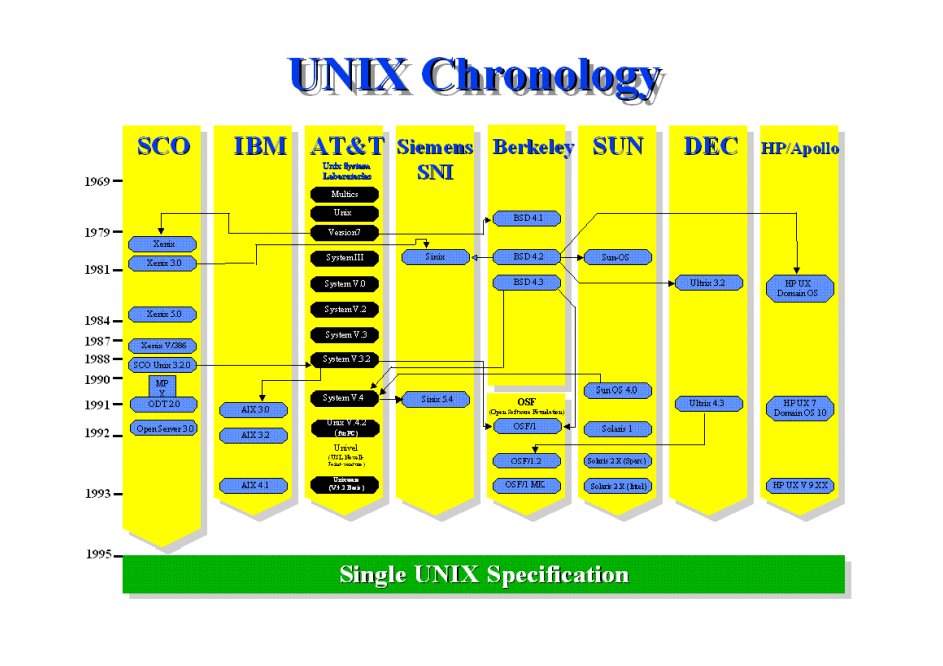
Unix is not a single operating system. It is in fact a general name given to dozens of o.s. by different companies, organizations or groups of individuals. These variants of unix are referred to as flavors. Although based on the same core set of unix commands, different flavors can have their own unique commands and features, and are designed to work with different types of h/w. Linux is often considered a unix flavor.

Among the ways in which the various flavors of UNIX differ are (1) fundamental design, (2) commands and features, (3) the hardware platform(s) (i.e., processors) for which they are intended and (4) whether they are proprietary software (i.e., commercial software) or free software (i.e., software that anyone can obtain at no cost and use for any desired
purpose).

Linux :
The most popular and fastest growing of all the Unix-like operating systems. It is developed by Linus Torvalds, Linux is a product that mimics the form and function of a UNIX system, but is not derived from licensed source code. Rather, it was developed independently; by a group of developers in an informal alliance on the net. A major benefit is that the source code is freely available (under the GNU copyleft), enabling the technically astute to alter and amend the system; it also means that there are many, freely available, utilities and specialist drivers available on the net. Linux is a registered trademark of Linus Torvalds. Recent versions of Glibc include much functionality from the Single UNIX Specification, Version 2 (for UNIX 98) and later.

FreeBSD :
The most popular of the BSD systems (all of which are direct descendants of BSD UNIX, which was developed at the University of California at Berkeley). BSDI is an independent company that markets products derived from the Berkeley Systems Distribution (BSD), developed at the University of California at Berkeley in the 60’s and 70’s. It is the operating
system of choice for many Internet service providers. It is, as with Linux, not a registered. UNIX system, though in this case there is a common code heritage if one looks far enough back in history.

IBM :
IBM has been quietly working on its mainframe operating system (formerly MVS) to add open interfaces for some years. In September 1996, The Open Group announced that OS/390 had been awarded the X/Open UNIX brand, enabling IBM to identify its premier operating system to be marked UNIX 95. This is a significant event as OS/390 is the first product to guarantee conformance to the Single UNIX Specification, and therefore to carry the label UNIX 95, that is not derived from the AT&T/ SCO source code.

NetBSD :
NetBSD is a free, fast, secure, and highly portable Unix-like Open Source operating system. It is available for a wide range of platforms, from large-scale servers and powerful desktop systems to handheld and embedded devices. Features the ability to run on more than 50 platforms, ranging from acorn26 to x68k

OpenBSD :
The OpenBSD project produces a FREE, multi-platform 4.4BSD-based UNIX-like operating system. Our efforts emphasize portability, standardization, correctness, proactive security and integrated cryptography. As an example of the effect
OpenBSD has, the popular OpenSSH software comes from OpenBSD. It May have already attained its goal of becoming the most secure of all computer operating systems.

Darwin :
Darwin is an open-source Unix-like operating system first released by Apple Inc. in 2000. It is composed of code developed by Apple, as well as code derived from NeXTSTEP, BSD, Mach, and other free software projects The new version of BSD that serves as the core for the Mac OS X

Many of the proprietary flavors have been designed to run only (or mainly) on proprietary hardware sold by the same company that has developed them. Examples include:

  • AIX – developed by IBM for use on its mainframe computers
  • BSD/OS – a commercial version of BSD developed by Wind River for Intel processors
  • HP-UX – developed by Hewlett-Packard for its HP 9000 series of business servers
  • IRIX – developed by SGI for applications that use 3-D visualization and virtual reality
  • QNX – a real time operating system developed by QNX Software Systems primarily for use in embedded systems
  • Solaris – developed by Sun Microsystems for the SPARC platform and the most widely used proprietary flavor for web servers
  • Tru64 – developed by Compaq for the Alpha processor

History of Unix

Origins of Unix

UNIX development was started in 1969 at Bell Laboratories in New Jersey. Bell Laboratories was (1964–1968) involved on the development of a multi-user, time-sharing operating system called Multics (Multiplexed Information and Computing System). Multics was a failure. In early 1969, Bell Labs withdrew from the Multics project.

Bell Labs researchers who had worked on Multics (Ken Thompson, Dennis Ritchie, Douglas McIlroy, Joseph Ossanna, and others) still wanted to develop an operating system for their own and Bell Labs’ programming, job control, and resource usage needs. When Multics was withdrawn Ken Thompson and Dennis Ritchie needed to rewrite an operating system in order to play space travel on another smaller machine (a DEC PDP7 [Programmed Data Processor 4K memory for user programs). The result was a system called UNICS (UNiplexed Information and Computing Service) which was an
’emasculated Multics’.

Unix Development

The first version of Unix was written in the low-level PDP-7 assembler language. Later, a language called TMG was developed for the PDP-7 by R. M. McClure. Using TMG to develop a FORTRAN compiler, Ken Thompson instead ended up developing a compiler for a new high-level language he called B, based on the earlier BCPL language developed by Martin Richard. When the PDP-11 computer arrived at Bell Labs, Dennis Ritchie built on B to create a new language called C. Unix components were later rewritten in C, and finally with the kernel itself in 1973.

Since it began to escape from AT&T’s Bell Laboratories in the early 1970’s, the success of the UNIX operating system has led to many different versions: recipients of the (at that time free) UNIX system code all began developing their own different versions in their own, different, ways for use and sale. Universities, research institutes, government bodies
and computer companies all began using the powerful UNIX system to develop many of the technologies which today are part of a UNIX system. By the late 1970’s, a ripple effect had come into play.

Key Factors

1969 The Beginning

The history of UNIX starts back in 1969, when Ken Thompson, Dennis Ritchie and others started working on the “little-used PDP-7 in a corner” at Bell Labs and what was to become UNIX.

1980 Xenix

Microsoft introduces Xenix. 32V and 4BSD introduced.

1983 System V

Computer Research Group (CRG), UNIX System Group (USG) and a third group merge to become UNIX System Development Lab.
AT&T announces UNIX System V, the first supported release. Installed base 45,000.

1991

UNIX System Laboratories (USL) becomes a company – majority owned by AT&T. Linus Torvalds commences Linux development.
Solaris 1.0 debuts.

1998 UNIX 98

The Open Group introduces the UNIX 98 family of brands, including Base, Workstation and Server. First UNIX 98 registered products shipped by Sun, IBM and NCR. The Open Source movement starts to take off with announcements from Netscape and IBM. UnixWare 7 and IRIX 6.5 ship.

2007

Apple Mac OS X certified to UNIX 03.