The discovery of Uranus is an important milestone in the history of astronomy. Uranus is the seventh planet from the sun and is the third-largest planet in our solar system. It was discovered by Sir William Herschel on March 13, 1781. Herschel was a German-born British astronomer who had a keen interest in studying the stars and planets. He had built his own telescopes and was known for his expertise in optics.
Source – NASA
In 1781, while observing the night sky from his garden in Bath, England, Herschel noticed an object that he initially thought was a comet. However, as he continued to observe it over the course of several nights, he realized that it was something much larger and farther away than a comet. Herschel’s discovery of Uranus was significant for several reasons. First, it was the first planet to be discovered since ancient times. The other planets, including Mercury, Venus, Mars, Jupiter, and Saturn, had been known since ancient times, and Uranus was the first new planet to be added to the list. Second, it provided evidence that there were other planets in our solar system beyond the orbit of Saturn. Prior to Herschel’s discovery, it was believed that Saturn marked the edge of our solar system.
The discovery of Uranus was also significant because it challenged existing beliefs about the nature of the universe. At the time, it was believed that the planets orbited the sun in a predictable pattern based on their distances from the sun. However, Uranus did not follow this pattern, and its orbit was difficult to explain using the existing models of the solar system. This led astronomers to question their understanding of the laws of physics and the nature of the universe.
After Herschel’s discovery, astronomers around the world began studying Uranus in more detail. They found that it was a gas giant planet with a distinctive blue-green color. They also discovered that it had a system of moons and a ring system, similar to those of Saturn. Over the years, astronomers have continued to study Uranus using telescopes and space probes, providing new insights into the planet’s composition, atmosphere, and history.
To conclude, the discovery of Uranus by Sir William Herschel in 1781 was a significant event in the history of astronomy. It was the first new planet to be discovered since ancient times and challenged existing beliefs about the nature of the universe. Herschel’s discovery opened up new avenues for scientific inquiry and inspired generations of astronomers to study the planets and the stars. Today, Uranus remains an important object of study for astronomers, providing insights into the workings of our solar system and the universe beyond.
Uranus is the seventh planet from the Sun. Its name is a reference to the Greek god of the sky, Uranus, who, according to Greek mythology, was the great-grandfather of Ares (Mars), grandfather of Zeus (Jupiter) and father of Cronus (Saturn). It has the third-largest planetary radius and fourth-largest planetary mass in the Solar System. Uranus is similar in composition to Neptune, and both have bulk chemical compositions which differ from that of the larger gas giants Jupiter and Saturn. For this reason, scientists often classify Uranus and Neptune as “ice giants” to distinguish them from the other giant planets.
Some facts about Uranus
Diameter- 51,118 km
Orbital period- 84yrs
Length of a Day- 17hrs
Axis tilt- 97.7 degrees
Distance from the Sun- 19.2 AU
Moons- 27
Special features
Uranus was discovered by William Herschel in 1781. Like the other giant planets, Uranus has a ring system, a magnetosphere, and numerous moons. The Uranian system has a unique configuration because its axis of rotation is tilted sideways, nearly into the plane of its solar orbit. Its north and south poles, therefore, lie where most other planets have their equators. In 1986, images from Voyager 2 showed Uranus as an almost featureless planet in visible light, without the cloud bands or storms associated with the other giant planets. Voyager 2 remains the only spacecraft to visit the planet. Observations from Earth have shown seasonal change and increased weather activity as Uranus approached its equinox in 2007. Wind speeds can reach 250 metres per second (900 km/h; 560 mph).
Natural satellites and Rings
Uranus has 27 known natural satellites. The names of these satellites are chosen from characters in the works of Shakespeare and Alexander Pope. The five main satellites are Miranda, Ariel, Umbriel, Titania, and Oberon. The Uranian satellite system is the least massive among those of the giant planets. The largest of Uranus’s satellites, Titania, has a radius of only 788.9 km (490.2 mi), or less than half that of the Moon, but slightly more than Rhea, the second-largest satellite of Saturn, making Titania the eighth-largest moon in the Solar System. Uranus’s satellites have relatively low albedos; ranging from 0.20 for Umbriel to 0.35 for Ariel (in green light). They are ice–rock conglomerates composed of roughly 50% ice and 50% rock.
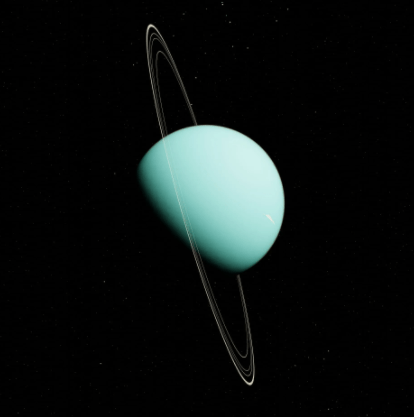
The Uranian rings are composed of extremely dark particles, which vary in size from micrometres to a fraction of a metre. Thirteen distinct rings are presently known, the brightest being the ε ring. All except two rings of Uranus are extremely narrow – they are usually a few kilometres wide. The rings are probably quite young; the dynamics considerations indicate that they did not form with Uranus. The matter in the rings may once have been part of a moon (or moons) that was shattered by high-speed impacts. From numerous pieces of debris that formed as a result of those impacts, only a few particles survived, in stable zones corresponding to the locations of the present rings.
Structure and Atmosphere
Uranus’s atmosphere is similar to Jupiter’s and Saturn’s in its primary composition of hydrogen and helium, but it contains more “ices” such as water, ammonia, and methane, along with traces of other hydrocarbons. It has the coldest planetary atmosphere in the Solar System, with a minimum temperature of 49 K (−224 °C; −371 °F), and has a complex, layered cloud structure with water thought to make up the lowest clouds and methane the uppermost layer of clouds.
The standard model of Uranus’s structure is that it consists of three layers: a rocky (silicate/iron–nickel) core in the centre, an icy mantle in the middle and an outer gaseous hydrogen/helium envelope. The core is relatively small, with a mass of only 0.55 Earth masses and a radius less than 20% of Uranus’; the mantle comprises its bulk, with around 13.4 Earth masses, and the upper atmosphere is relatively insubstantial, weighing about 0.5 Earth masses and extending for the last 20% of Uranus’s radius. Uranus’s core density is around 9 g/cm3, with a pressure in the centre of 8 million bars (800 GPa) and a temperature of about 5000 K.The ice mantle is not in fact composed of ice in the conventional sense, but of a hot and dense fluid consisting of water, ammonia and other volatiles. This fluid, which has a high electrical conductivity, is sometimes called a water–ammonia ocean.
Exploration
In 1986, NASA’s Voyager 2 interplanetary probe encountered Uranus. This flyby remains the only investigation of Uranus carried out from a short distance and no other visits are planned. Launched in 1977, Voyager 2 made its closest approach to Uranus on 24 January 1986, coming within 81,500 km (50,600 mi) of the cloud tops, before continuing its journey to Neptune. The spacecraft studied the structure and chemical composition of Uranus’s atmosphere, including its unique weather, caused by its axial tilt of 97.77°.The possibility of sending the Cassini spacecraft from Saturn to Uranus was evaluated during a mission extension planning phase in 2009, but was ultimately rejected in favour of destroying it in the Saturnian atmosphere.It would have taken about twenty years to get to the Uranian system after departing Saturn.


 Eduindex