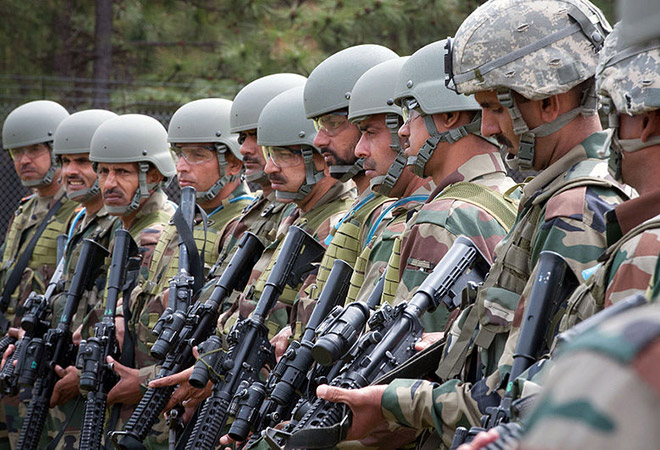
Today 28th September, we are celebrating the anniversary of surgical Strike. It was the first operation in which the Indian army’s para special forces has crossed the Line of Control to destroy terrorists camps and launch pads.
Reason for conducting surgical Strike
The Indian Army conducted the surgical Strike in response to the Uri attack on September 18, 2006, which was conducted by a Pakistani base terror group jaish-e-mohammed. The Attack aimed Indian army camp killings 19 soldiers. Similar attacks where done in Gurdaspur and Pathankot, so this was an alarming security alert for the Indian armed forces.
How it was conducted
Indian Army Army conducted this operation In the Midnight of 28 and 29 September 2016. There were 70 to 80 soldiers involved in teams a team of the forces crossed LOC in Kupwara district while, another group cross LOC from poonch district. They destroyed terrorist camp using granites and rockets, there were no casualties and no commoner was harmed during this mission. A soldier was injured due to tripping landmine.
New India
This was a moment the whole Nation was celebrating as we got our revenge of Uri attack and other previous attacks. Nations security is atmost priority and Indian Army Soldiers showed the whole world that this is New India, which knows how to enter in enemy’s land and finish them off ( Bhart dushmano ke ghar me ghusega bhi aur marega bhi).
In 1989 Tim-Berners-Lee invented the internet as we know it today and the fundamental building block for this framework is the hyperlink. With the use of hyperlinks, different documents are connected and any document on the web can be identified with that link. This is also known as Web 1.0 (Web of Documents) and its main goal was to exchange information between different machines together on an interconnected network.
The Semantic Web is a collaborative effort led by the World Wide Web Consortium (W3C). Semantic Web which is also called Web 3.0 or web of data links to a specific piece of information contained in that document or application. The semantic web is also modular and dynamic because if the information is ever updated, users can automatically take advantage of any updates. Scalability is an essential requirement of the semantic web as well. In the semantic web, we go beyond the documents and we go towards the lower (data) level.
Some of the main underpinnings of The Semantic Web are as follows:
Building models: the quest for describing the world in abstract terms to allow for an easier understanding of a complex reality.
Computing with knowledge: the endeavor of constructing reasoning machines that can draw meaningful conclusions from encoded knowledge.
Exchanging information: the transmission of complex information resources among computers that allows us to distribute, interlink, and reconcile knowledge on a global scale.
Linked Data is used to connect the web of data in the Semantic Web. Links are made so that a user or a computer can explore the web of data. Linked data is much more interactive, visibility, powerful and useful in retrieving, finding, and determining its relation with other data on the web. So instead of having URLs (Links) between documents, in Semantic Web, we have URLs between facts. To present knowledge about the data in a much more organized manner. It also seamless data integration and it can bring intelligence to the system. URIs consists of two entities: URL (Uniform Resource Locator) and URN (Uniform Resource Name).
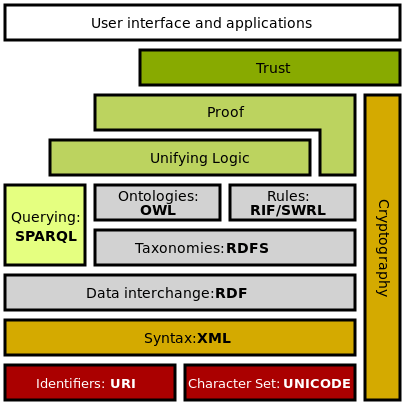
The Basic Structure of The Semantic Web
To implement these URIs we need Resource Description Frameworks (RDFs). RDF is a standard model for data interchange on the Web. It is a framework or a data model for describing resources. RDFs are the formal language to describe the information in the Semantic Web. The goal of RDF is to enable applications to exchange data on the Web while still preserving their original meaning. RDFs comprise triples. A triple gives a unique identifier so that we can link the data and form a relation between various other data nodes. Multiple triples connected are called Graphs.
In metadata terms, RDF and expressed in (Triples). Triples comprise of three fundamental entities:
Object is the resource being described by the metadata record
Predicate is an element in that record
Subject is a value assigned to that element
SPARQL (SPARQL Protocol and RDF Query Language) and OWL (Web Ontology Language) are the other two technical standards used in the Semantic Web.
Semantic the web is an extension to the World Wide Web and it has made significant strides towards making the internet more seamless, efficient, and scalable. Linked Data is very critical in making this happen. But still, Semantic is not yet adopted and many corporations and organizations are unaware of it. So the focus should be to promote wider adoption of the Semantic Web with better availability of the learning resources.


 Eduindex
You must be logged in to post a comment.