
3 R’s of Waste Management

Waste is one of the biggest problems for humans in today’s world. Whether it be of any kind ,(solid or liquid) it can cause a lot of health damage and many other problems. Basically, waste is any material that is discarded because it has serves its purpose and is no longer useful for us. waste is anything that occupies space, produces odour and smell, and has some weight.

But management of this waste is very difficult and important step to manage it. we know that nature recycles a lot of waste through many processes but due to increasing population , nature cannot manage all waste and this is where humans have to step up because if we will not be look into this it will gradually destroy our environment, cause harmful diseases and many other serious problems.

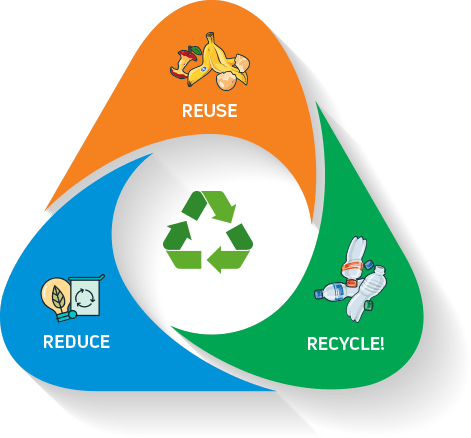
one of the easiest and popular way to do management of waste is 3 R’s( Reuse, Reduce and Recycle ) let us discuss these 3 R’s in detail :-

  1. Reduce: reducing the waste is the very good way to manage the waste in environment . As more we will reduce the waste more , the less waste will be in environment .some efforts that we can do to reduce waste are:-

we should try to use disposals as minimum as possible, we should buy less products with packaging as it is a very big reason of waste, we always see food packages in streets and roads. This is a major reason of waste. we should either avoid packaging food or manage it properly by keeping it in dustbin. some more methods are:-

  • we should change our old processes for best use of raw material , through which we will be able to reduce waste in industries.
  • the liquid waste can be reduced by many scientific techniques such as precipitation etc.
  • we should try to use segregation of waste method to manage the waste .

2. Reuse: This method is becoming popular day by day. because if we reuse any particular material rather than throwing it away after just 1 use, definitely we will be able to reduce waste in pour area or environment .

we should not throw any material or product just due to a small defect or something else we can do something out of it. it can be reused in a different manner. we should only throw it if we realize that it cannot be reused anymore.

In countries like India, some waste materials like glass, bottles rubber etc. are placed casually in streets, these materials’ can be reused if we use them properly. Although many waste collectors in areas collect these wastes and supply them in useful areas helping in reducing the waste.

3. Recycle : the best R of waste management is recycling the waste. it is a processing of remanufacturing a product to make it useful again. some materials that can be recycled are such as plastic, rubber , glass etc. In India, we have tonnes of waste that is recycled . Plastic is one of the most recyled material that is recycled in tonnes. Recycling helps in reducing the consumption of fresh materials .it is one of the most important process of waste management .

Why is WASTE a hazardous problem in India

Urban India generates 62 million tones of municipal solid waste annually of which 43 million is collected by the authorities assigned workers or vehicles. Out of this 43 million tones of waste collected, 39 million tones is dumped in the open sanitary landfills, the most convenient and oldest form of waste disposal which is a total disaster in recent times and only 12 million tones of waste is treated. The municipal waste dumped on the open stretches of land , contains all kinds of wastes- degradable, non degradable and hazardous domestic waste. The ragpickers in India act as an important source of segregation segregating the plastic and metals from the waste which is then sent to factories for recycling but the problem doesn’t get solve here.

In a population of billions , it is not possible for segregation to be done manually everywhere which leads to the mixture of the non degradable harmful materials with the biodegradable ones. Also, plastic poly bags, pose a great danger for animals as there have been more than one incident where cows or street dogs are found to have swallowed the plastic bags while loitering in the waste to find food.

There are other waste disposal methods also like Incineration and Composting. In Incineration, the waste is combusted at high pressure and heat to convert it into ash, heat and gases. The method was used since ages to get rid of hazardous bio medical waste but this process releases pollutants like particulate matter, metals, acid gases, oxides of nitrogen, and sulphur, aside from the release of innumerable substances of unknown toxicity which causes respiratory ailments. Though the proper treatment of the gases before releasing them into air is mandatory but due to the lack of resources and scientific technology , the gas is released untreated , hence causing severe damages to the environment.

Composting method is used for the bio degradable domestic waste like vegetable peels, papers, waste plants etc. These wastes are then left to decompose using the natural process and the residue serves as an excellent manure. This is the best waste treatment which can be used at homes also. However, the poor segregation of waste does not allow the success of this process.

Reasons for poor segregation

In India , all though most of the places provide door to door garbage collection facility which is collected in tri cycles or hand carts at many places and the lack of knowledge on people’s part does not let them segregate the waste. People consider the segregation of waste into degradable and non degradable items as a time consuming process. Moreover, in urban cities, where the municipalities offer garbage vans with separate columns for degradable and non degradable wastes, has not proved to be beneficial as people dump all types of wastes together.

After the launch of Swacch Bharat Abhiyan by the Hon’ble Prime Minister Mr. Narender Modi on October 2nd, 2014,green and blue dustbins for degradable and bio degradable wastes are put almost in every locality. However, the tardiness and laziness of people doesn’t allow them to use it in an effective way.

The waste dumped on open stretches of land or on road side is not only a sore to the eye but also is responsible for the contamination of environment in more than one ways.

Hazardous effect of waste disposal system famous in India on the environment

  1. SOIL CONTAMINATION– The disposal of collective waste collected from houses includes hazardous and non bio degradable waste also which does not blend in soil easily and the long exposure to the atmosphere leads to the discharge of harmful chemicals which blends with the soil , hence polluting it. For example, when plastic bottles are dumped in open, they release DEHA, a carcinogen that affects our reproduction systems, causes liver dysfunction, and weight loss. Soil contamination does not only affect plant growth, it is also unhealthy to humans and animals feeding on those plants.
  2. WATER CONTAMINATION– The chemicals from the disposed waste seeps into the ground water through the soil, hence polluting groundwater table which is used for many purposes from houses to farms to the factories.
  3. AIR CONTAMINATION – The plastic and other wastes which is burnt by the ragpickers for gaining warmth during winters or to clear the dumping ground, produces gases which are responsible for ozone depletion. Also, the accumulation of excessive rotten material at a place leads to the production of landfill gases which again harms the humans inhabiting the nearby areas.
  4. HARMFUL FOR HUMANS AND ANIMALS AND GIVE RISE TO INSECT BORNE DISEASES ALSO- As mentioned in the above points, the dumped waste causes severe health hazards to humans as well as animals. Also, the dirty landfills becomes a breeding ground for mosquitoes and house fly who transmits the dirt they pick up from there to the domestic houses they visit. Mosquitoes breed in cans and tires that collect water, and can carry diseases such as malaria and dengue. Rats find food and shelter in landfills and sewage, and they can carry diseases such as leptospirosis and salmonellosis.
  5. EXTREME CLIMATE CHANGES– Decomposing waste emits gases that rise to the atmosphere and trap heat. Greenhouse gases are one of the major culprits behind the extreme weather changes that the world is experiencing. From extremely strong storms and typhoons to smouldering heat, people are experiencing and suffering the negative effects of greenhouse gases.

These all factors are leading to slow death of our planet.

Change starts from ourselves. The pragmatic approach of the three R’s- REDUCE, REUSE and RECYCLE which we once learnt in the school is needy during these times.