
2nd Webinar on Public Policy and Good Governance in Collaboration with IIT Kanpur

Daily writing prompt
What are your favorite websites?

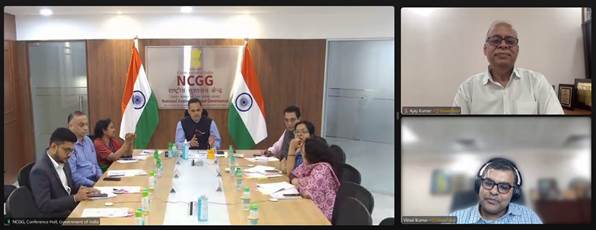
NCGG concluded its 2nd Webinar of webinar series on Public Policy and Good Governance in collaboration with IIT Kanpur on 24th October 2024. The webinar was chaired by Shri V. Srinivas, Secretary, Department of Administrative Reforms and Public Grievances (DARPG) & Director General, National Centre for Good Governance (NCGG).

There were two esteemed speakers for the webinars. The first speaker for  the  webinar  was Dr. Ajay Kumar, former Defence Secretary, Government of India & Distinguished Visiting Professor at IIT Kanpur and the second speaker for the webinar was Prof. Vimal Kumar, Head, Dept of Economic Sciences, IIT Kanpur.

Dr. Ajay Kumar delivered lecture on Challenges in Public Policy highlighting the role of Government of India in Policy making and how over the time it has changed its approach in policy making. His lecture further highlighted that changes in public policies should be calibrated in phases, the impact of digitization in mitigating the challenges faced while making new policies by highlighting the digitization of land records. He also highlighted on using data in decision making. He elaborated on the  different  approaches to policy making and  emphasized that the process of policy making should involve diverse stakeholders. While discussing the challenges in public policy he also suggested the solutions such as incentivizing the progressive policies.
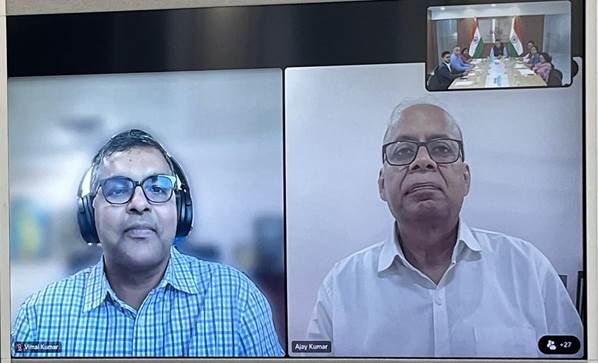
The second speaker for the webinar was Prof. Vimal Kumar, Head of Economic Sciences, IIT Kanpur who delivered his lecture on Platform Business Model & their regulation in Digital Economy. He started his lecture by discussing a quick history of Business in India from artisans producing single product to mass production.  His lecture also suggested the importance of network and platform creation for any successful business model. He emphasized on diverse usage of various business platforms including payment networks, social media, traditional media such as newspaper, e-commerce platforms like Amazon & Flipkart, Apple’s App store and others. He also highlighted network on a platform within the group and cross-group wherein he explained attraction loop and attraction spill over. He concluded his lecture with the importance of digital platform using the comparison between BMW and Uber as case studies.

The webinar was concluded by the vote of thanks given by Dr. Himanshi Rastogi, Associate Professor, NCGG. Dr. Rastogi, expressed her heartfelt thanks to all participants, from Institutes of National Importance and Central Universities. She also thanked Shri V. Srinivas, Secretary, DARPG & Director General, NCGG for chairing the webinar.
***

Virtual Classrooms – An Alternative for Classroom learning

When the lock down was announced our whole educational system came to an abrupt stop. Now we had to depend on online apps and webinars to learn.

 Until the lock down period was announced most of us were not even aware of the existence of such apps.  By the time lock down was announced the fame for an app like Zoom, had won over the millions of people across the world. It was one of the popular apps used around the world to conduct meetings. It accommodated more than about 100 participants.

First times in online classes are always a headache because half of the people  forget to turn on the audio and camera. Not only us but teachers also have hard time in finding different functions.  Online classes are always an advantage in situations where classroom learning cannot take place but in many strong opinions it can never take over the idea classroom learning.

To the other side of online classes, it opens us to a world of disparities between the elite and the middle class and the poor. An online class eliminates the human connection that a face-to-face, in-house teaching environment provides. An online instructor cannot gauge the mood, involvement and engagement level of her students the way she can in a traditional lecture-based classroom.

There are a lot of problems with online learning. Most of the students will face difficulty in connecting with the teacher. Without a proper connection at home for internet, students will find difficulty in attending the classes. Proper 4G connection is need for the smooth conduct of meeting in Zoom. This creates a digital divide between the students. Not all students can afford a phone or not all will have a proper connection. This creates a differentiate between the haves and have nots. 

Such a simple issue as this can really draw us attention over the issue of network and internet connections, but what most of us forget is in some states of India, internet connections have been cut off which makes it very hard for students in that are to attend class.

Zoom classes does not allow you to enhance your learning capacity. It doesn’t provide for any kind of learning other than the academics. Sometimes the app would crash and there would be a lag.

Most of the times when classes go on, the system gets lagged and create network problems due to which students wont be able to focus. Students are forced to sit in front of their phones for hours listening to lectures which can have a lot of effect on their eyes as well as their thinking capacity.

Sometimes classes are taken without giving any breaks in between, this can cut off the span of concentration of a student. One person can normally concentrate to max to max half an hour without any other thoughts barging in, with proper breaks in between it becomes easier to learn.

Taking all these facts into consideration we can come to the conclusion that online learning may not always be an alternative for classroom education. Being in touch with human beings and socializing with people is what develops a persons character.

Most of us learn from school, from what we see and hear we develop into better versions of ourselves. Being outside in the sun, playing in the mud, reading a book to bed etc adds up to the character of a child. In all places learning by experience matters.