

Noise is usually defined as unwanted sound or a sound without value that causes discomfort to the listener. Noise is usually measured in units of decibels and is denoted by dB.
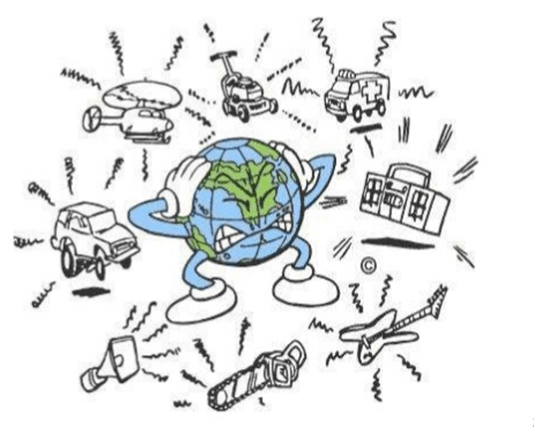
1. On human beings:-
• Mental health
Exposure to intense levels of noise can cause personality changes and violent reactions. Noise has also been shown to be a factor that attributed to violent reactions.
Psychological health effects from noise include depression and anxiety stress. Individuals who have hearing loss, including noise induced hearing loss, may have their symptoms eased with the use of hearing aids. Individuals who do not seek treatment for their loss are 50% more likely to have depression than their aided peers. These psychological effects can lead to detriments in physical care as reduced self-care, work-tolerance, and increased isolation.
• Physical health
Exposure to loud sound or longer exposure causes threshold shift. Noise-induced threshold shifts are seen as a notch on an audiogram from 3000 to 6000 Hz, but most often at 4000 Hz.
Exposure to loud noises, either in a single traumatic experience or over time, can damage the auditory system and result in hearing loss and sometimes tinntius as well. Noise induced hearing loss is sometimes unilateral and typically causes patients to lose hearing around the frequency of the triggering sound trauma.
2. On animals:-
•Marine animals
Two main reasons that make an environmental impact of noise in marine life a grave are – 1. Noise travels much more in water, covering greater distances than it would do on land while travelling though air, and secondly because the marine life is extremely sensitive to noise pollution and an absence of any mechanism to safeguard them against it, underwater noise pollution disrupts marine life in more serious ways.
The deaths can occur because of haemorrhages, changed diving pattern, migration to newer places, and damage to internal organs and an overall panic response to the foreign sounds. There is also a disruption in normal communication between marine animals because of underwater noise pollution. This means animals prone to noise pollution cannot call their mates, look for food or even make a cry for help under such circumstances.
•Birds
Anthropogenic noise, emitted from the oil and gas compressors, is becoming a global issue. The idea of the study was to measure the stress levels of the birds compared to the distance they were nesting with the oil and gas compressors.
So much so that they were showing Post Traumatic Stress Disorder-like (PTSD) symptoms. In the birds, their corticosterone levels were relatively low. And that isn’t exactly what you would expect to see in a high-stress situation. This is likely to be what was happening with the birds. It triggered health defects such as stunted growth, issues with their reproduction, and fewer feathers on the birds. Their ability to hear predators also seemed to be jeopardised because of the noisy surroundings.
Preventive measures to reduce noise pollution
- Factories should be established away from the settlements.
- Settlements should be located 20 kms away from the mining areas and coal areas.
- Explosives should be not used in mountainous, forest and mining areas.
- Use of horn in public places should be banned.
- The sound of musical instruments should be controlled to desirable limits.
- The use of sound amplifiers of high power should be banned in religious events.
- The use of sound absorber tiles should be encouraged in the construction of multi-storeyed buildings.
- In industrial, commercial and hospital buildings, adequate soundproof systems should be installed.
- Intensive plantation should be made in the entire building complex.
- Planting green trees along the roadside reduces the intensity of noise pollution.
- Protective tools should be provided for workers.
- Legal provisions should set limits on noise and control over noise pollution.
.jpg)
 Eduindex
You must be logged in to post a comment.