WORKSHOPS ON SAGAR SETU APP

 Sagar Setu has achieved integration with all 13 major ports and 41 non-major ports of India. The details of major ports and non-major ports are given in Annexure-I.

Sagar Setu application has garnered a base of over 21,000 users spread across diverse geographic regions within India. The sector wise details of user/Stakeholder using the Sagar Setu application is at Annexure-II. These users are port authorities, service providers like shipping agents, terminal operators, Customs House Agents (CHAs) Importers/ Exporters etc. The number of users, state wise including Andhra Pradesh is at Annexure-III.

The Benefits of Sagar Setu are as below:

  1. Real Time Data Exchange enabling the following in the long term:


  1. A single platform to perform all core activities for importers, exporters, customs brokers, and freight forwarders;
  2. end-to-end functionality for performing self-clearance digitally and online transactions with custodians;
  3. providing a level playing field for all relevant stakeholders, both large and small;
  4. complete domestic tracking of shipments with notifications at each stage;
  5. real-time information on activities;
  6. enhanced transparency in government-to-business relations and ease of doing business;
  7. reduced costs and timeframes for the execution of trade and logistics operations; and
  8. paperless transactions for all stakeholdersalong with business intelligence reporting and data analytics.


  1. The visibility of operation is indicated stakeholder wise, as detailed below:


  1. Ports & Terminal Operators: All 13 major ports (with their Terminal Operating System, TOS/ Port Operating System, POS) and 41 non-major ports are integrated with National Logistic Portal Marine (NLP-M). Almost all terminal operators at major ports have been onboarded.
  2. Customs: Integration with Indian Customs Electronics Gateway (ICEGATE) streamlines the electronic exchange of data and information between customs and ports.
  3. Port Health Organisation (PHO) module: PHOs can approve and issue certificates using the PHO module, and notifications will be sent to port officials. Requests for Free Pratique and Health Declaration Certificates to PHOs at ports are available through Sagar Setu.
  4. Mercantile Marine Department (MMD) module: Real-time and online information exchange regarding vessel detention and release is available to MMD inspectors, port authorities, and other stakeholders.
  5. Indian Railways: Messages from Sagar Setu are integrated with Frieght Operations Information System (FOIS) for sharing voyage registration, Electronic Verified Gross Margin (eVGM), berth allotment, container pendency, and bulk pendency.
  6. Unified Logistics Interface Platform (ULIP): Multiple messages are integrated between ULIP and Sagar Setu.
  7. Directorate General of Lighthouses and Lightships (DGLL): The DGLL module has been developed and provides information on lighthouse dues payment status on Sagar Setu.
  8. Banks: Multiple banks have been onboarded in Sagar Setu for Business to Government Transactions (B2G) transactions. Sagar Setu also plans to implement Business to Business (B2B) transactions on its platform.


  1. Improving Port Operations and Efficiency:


    1. 98 messages have been integrated over NLP-M, providing the Ministry of Ports, Shipping and Waterways (MoPSW) with visibility into key port operations metrics and monitoring efficiency.
    2. The processes for PHO free pratique and health declaration forms have shifted entirely from manual to NLP-M, leading to a much reduced process time of five hours at most major ports.
    3. With the data available in Sagar Setu, insights can be provided regarding vessel approval times, voyage tracking, and crew and cargo details, which can enable ports to improve their turnaround times and ensure greater transparency.


In the fiscal year 2024, there were close to 69 Lakhs message exchanges on Sagar Setu. The total value of financial transactions processed on the Sagar Setu platform amounted to INR 12,000+ crores.

The details of message exchange port/state wise including Andhra Pradesh are at Anneure-IV

A 24/7 Sagar Setu Helpdesk team operates to offer both operational and technical assistance. On an average around 1300 queries and issues are reported. The predominant issues reported by users are as under :

  1. Challenges encountered with the exchange of Electronic Data Interchange (EDI) files;
  2. difficulties related to the integration with Customs (ICEGATE);
  3. problems with the receipt of COPRAR (Container Pre-arrival Report) messages; and
  4. various lesser application-related issues, including those concerning user registration and login, payment processes, etc.

The average time to resolve an issue is around 4 days.

A series of workshops and training programs have been organized, featuring key events such as Conference Room Pilot sessions in August 2022, Port Feedback sessions in August 2023, and a User Acceptance Testing (UAT) Demo session in September 2023. In addition to these scheduled events, bespoke sessions are also offered on an as-needed basis to educate users about the Sagar Setu application. Tailored sessions are regularly provided upon the request of stakeholders, including Port Authorities, regulatory bodies, and shipping agents, to ensure they are well-versed in using the application. Furthermore, routine weekly and monthly meetings with the nodal officers from various trade associations are held to discuss and resolve any issues that users may encounter during their operations. Sagar Setu also offers a range of user guides and video tutorials that are readily accessible to the general public.

Conducting workshop/training is a periodic and continuous exercise.

Annexure-I

Details of Major and Non Major ports of India onboarded on Sagar Setu.


List of Major Ports onboarded on Sagar Setu:                                             

S. No

Port Name

State

1

Chennai Port Authority

Tamil Nadu

2

V.O.Chidambaranar Port Authority

Tamil Nadu

3

Kamarajar Port Limited

Tamil Nadu

4

Mumbai Port Authority

Maharashtra

5

Jawaharlal Nehru Port Authority

Maharashtra

6

Cochin Port Authority

Kerala

7

Visakhapatnam Port Authority

Andhra Pradesh

8

New Mangalore Port Authority

Karnataka

9

Paradip Port Authority

Odisha

10

SMPA Haldia Dock Complex

West Bengal

11

SMPA Kolkata Dock System

West Bengal

12

Deendayal Port Authority

Gujarat

13

Mormugao Port

Goa


List of Non-Major Ports onboarded on Sagar Setu:

Sr. No.

Port Name

State

1

Kakinada Seaport Limited

Andhra Pradesh

2

Krishnapatnam Port

Andhra Pradesh

3

Adani Gangavaram Port Pvt Ltd

Andhra Pradesh

4

Kakinada Anchorage Port

Andhra Pradesh

5

KAKINADA DEEP WATER PORT ( KDWP )

Andhra Pradesh

6

Ravva Port (Terminal)

Andhra Pradesh

7

Panaji Port

Goa

8

Adani Petronet (Dahej) Port

Gujarat

9

Hazira Port

Gujarat

10

Magdalla Group Of Ports

Gujarat

11

Mundra Port

Gujarat

12

Pipavav Port

Gujarat

13

Sika Port

Gujarat

14

AMNS Port Hazira

Gujarat

15

Gujarat Chemical Port Limited, Dahej

Gujarat

16

Essar Bulk Terminal (Salaya) Limited

Gujarat

17

Dahej Harbour and Infrastructure Limited

Gujarat

18

UltraTech Cement Ltd,GCW, Kovaya

Gujarat

19

Bhogat Port facility – Vedanta Limited

Gujarat

20

Bhavnagar Port

Gujarat

21

Vizhinjam International Port

Kerala

22

Kollam Port

Kerala

23

Beypore Port

Kerala

24

Vizhinjam Port

Kerala

25

Azhikkal Port

Kerala

26

Bankot Port

Maharashtra

27

Konkan LNG Pvt Ltd

Maharashtra

28

Dharamtar Port

Maharashtra

29

Dahanu Port

Maharashtra

30

Angre Port Pvt Ltd

Maharashtra

31

JSW Jaigarh Port

Maharashtra

32

REDI PORT LTD

Maharashtra

33

RANPAR

Maharashtra

34

Indo Eng Pvt Ltd

Maharashtra

35

JSW Revdanda Port

Maharashtra

36

Dighi Port Ltd.

Maharashtra

37

Karanja Terminal & Logistics Pvt. Ltd

Maharashtra

38

Dhamra Port Pvt Ltd

Odisha

39

Gopalpur Port

Odisha

40

Kattupalli Port Pvt Ltd

Tamil Nadu

41

MIDPL Kattupalli Port

Tamil Nadu


Annexure-II

Details of sector wise Stakeholders using the application:         

Sr. No.

Stakeholders

Count

1

Importer/Exporter

7519

2

Customs Broker

5685

3

Shipping Agent

4619

4

Importer

792

5

Container Agent

645

6

Stevedore

379

7

Empty Yard Operator

222

8

Ship Chandlers

192

9

Shipping Line

184

10

Container Freight Station

178

11

Port Operations

109

12

Freight Forwarder

105

13

Exporter

104

14

Inland Container Depot

95

15

Non Vessel Operating Common Carrier

85

16

Terminal Operator – Sea

80

17

Rail Transport

64

18

Port Authority

61

19

Road Transport Operator

34

20

Regulatory Authority

31

21

Surveyor

27

22

Barge Operator

25

23

Port Health Organization

21

24

Port Marine

20

25

Coast Guard / Indian Navy

19

26

ICD Shipping Line

19

27

RAIL TRANSPORT OPERATOR

18

28

Port Finance

16

29

Mercantile Marine Department

15

30

Bunker Supplier

14

31

Latch-On Service Provider

14

32

IW–Vessel Operators

13

33

SA Administrator

11

34

BANK

9

35

Inland Waterways

8

36

Port Traffic

8

37

Container Train Operator

6

38

DG Shipping

4

39

HMC Operator

4

40

Coastal Cargo Stakeholders

3

41

Regulatory Operation

3

42

Tank Farm Operator

3

43

Plant Quarantine Organisation

1

44

Export Promotion Council

2

45

Indian Customs

2

46

Ministry of Commerce and Industry(DPIIT)

2

47

Directorate General of Lighthouses And Lightships

1

48

Food Safety and Standards Authority of India

1

49

Freight Operating Information System

1


 Annexure-III

Number of Users, state-wise using Sagar Setu app:

Sl No

State

No of Stakeholders

1

Maharashtra

10285

2

West Bengal

3614

3

Tamil nadu

1804

4

Andhra Pradesh

1286

5

Gujarat

1123

6

Kerala

695

7

Odisha

483

8

Karnataka

249

9

Goa

199

Annexure-IV

Message exchanges (During FY24):

Sr. No

Port Name

State

Total (in Lakhs)

1

Chennai Port Authority

Tamil Nadu

29.4

2

V.O.Chidambaranar Port Authority

3

Kamarajar Port Limited

4

Jawaharlal Nehru Port Authority

Maharashtra

15.6

5

Mumbai Port Authority

6

Visakhapatnam Port Authority

Andhra Pradesh

9.5

7

SMPA KDS

West Bengal

9.3

8

SMPA HDC

9

Cochin Port Authority

Kerala

1.9

10

Deendayal Port Authority

Gujarat

1.9

11

New Mangalore Port Authority

Karnataka

0.8

12

Paradip Port Authority

Odisha

0.6

13

Mormugao Port Authority

Goa

0.2

National Health Authority (NHA) organises Accelerator Workshops on ABDM Integration and NHCX Adoption

 The National Health Authority (NHA) and the Insurance Regulatory and Development Authority of India (IRDAI) have joined hands to operationalize the National Health Claim Exchange (NHCX), a digital health claims platform developed by National Health Authority.  This initiative is being undertaken in the context of a circular issued by IRDAI in June 2023, whereby the insurance regulator had advised all insurers and providers to onboard the NHCX.

The NHCX will serve as a gateway for exchanging claims-related information among various stakeholders in the healthcare and health insurance ecosystem. The integration with NHCX would enable seamless interoperability of health claims processing, enhancing efficiency and transparency in the insurance industry and benefiting the policyholders and patients.

In this regard, a three-day workshop was organized from 7th to 9th November in New Delhi, aimed mainly at hospital providers to onboard on the NHCX and insurance companies to fully integrate with the NHCX. This workshop was the third in a series of workshops that have been organized by NHA and IRDAI. The first two workshops were organized in August and October of this year and had participation from insurance companies and TPAs.

Over 150 professionals representing 45 organisations – insurance companies, TPAs, and hospitals have participated in these workshops. Considering the encouraging progress made by the insurance companies in these workshops, the organisations were advised to select their most popular retail product along with one network hospital to pilot the operationalization of NHCX.

This workshop saw participation from 10 hospitals, each assigned to an insurance company. The technical and business teams of these hospitals were guided by teams from NHA, IRDAI and NRCeS (National Resource Centre for EHR Standards) to onboard on the NHCX. At the end of the workshop, 10 hospitals namely Jupiter Hospital,Thane ; Kauvery Hospitals, Chennai; A J Hospital Research and Research Centre, Bengaluru ; Sarvodaya Hospital, Faridabad; Fortis Hospital, Gurugram; Fortis Hospital, Noida; Shri Balaji Action Hospital, Delhi; Sanar International Hospital, Gurugram; Centre for Sight, Dwarka, Delhi; and Narayana Hrudayalaya, Delhi were onboarded on the NHCX provider Registry.

In addition, the hospital/claim management systems (HMIS) of these hospitals, namely M/s Jupiter Hospitals, Kauvery Hospitals, Akhil systems, Kare Expert, Fortis Hospitals, Narayana Hrudayalya and Vitraya Technologies Private Limited were able to complete the requisite M1 integration of Ayushman Bharat Digital Mission (ABDM), which is an essential step to complete NHCX integration. The M1 integration enables a software to create and verify Ayushman Bharat Health Account (ABHA).

The workshop also saw completion of full integration with NHCX by eight insurance companies/TPAs, taking the total count to 12 insurance companies having successfully completed the NHCX integration. Four insurance companies, namely Aditya Birla Health Insurance, Star Health and Allied Insurance, Bajaj Allianz Insurance Company and HDFC Ergo Insurance had already completed the full integration in the second workshop in October. During this workshop, seven insurance companies and one TPA, namely  ICICI Lombard General Insurance, The New India Assurance Company, Care Health Insurance, Go Digit General Insurance, Acko General Insurance, Tata AIG General Insurance company, Paramount TPA,  United India Insurance Company successfully completed NHCX integration.

To encourage adoption of digital health transactions and digitization of patient health records in the country, NHA has also announced financial incentives under the Digital Health Incentive Scheme (DHIS) from Jan 2023. Under the DHIS, to encourage efficiency in insurance claim processing, there is a provision that for every insurance claim transaction through NHCX, financial incentives of Rs 500 per claim or 10% of the claim amount, whichever is lower would be provided for the hospitals. More information on the DHIS is available here: https://abdm.gov.in/DHIS

Considering the enthusiastic participation by the insurance companies and providers, a full scale launch of this transformational initiative is expected soon. For more information on the National Health Claims Exchange (NHCX), see https://sbxhcx.abdm.gov.in/

****

Climate Change Narrative from Total Emissions to Per Capita Emissions of each country


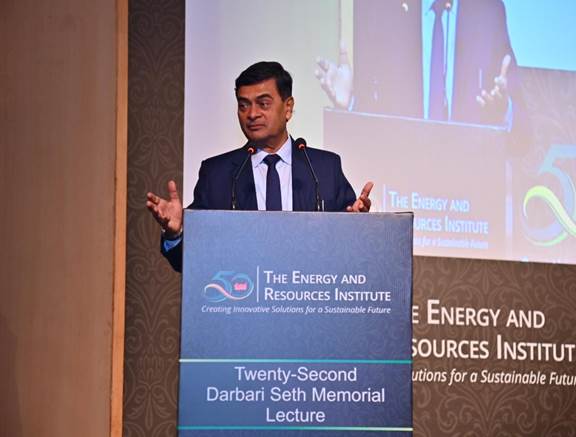
The Union Minister for Power and New & Renewable Energy Shri R. K. Singh has called for a change in the global climate change discourse and narrative, shifting from a focus on total emissions to per capita emissions of each country. “India’s per capita emissions are one third of global average, one of the lowest in the world; despite that, the developed countries until recently had been putting pressure on large countries like India, to reduce emissions. Their per capita emissions remained 3 – 4 times the global average. The narrative was on total emissions of each country.”

“Point of comparison should be Per Capita Emissions”

The Minister asserted that the narrative and discourse should not be about total emissions. “If we talk about total emissions, the country with minimum emissions could be an island nation with small population, even though they may be consuming huge amounts of energy and emitting huge quantities of carbon dioxide per person. Hence, the point of comparison has to be per capita emissions. This is the change in discourse which is needed, and I want institutions like TERI to talk about this.”

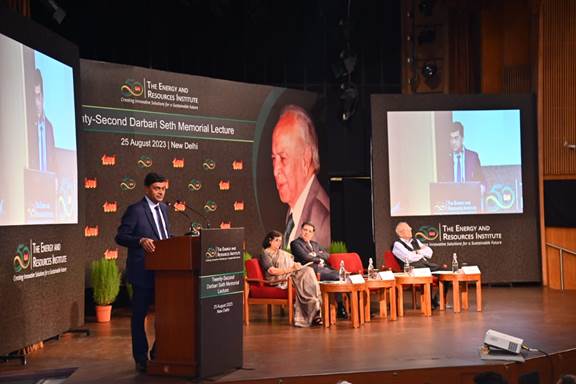
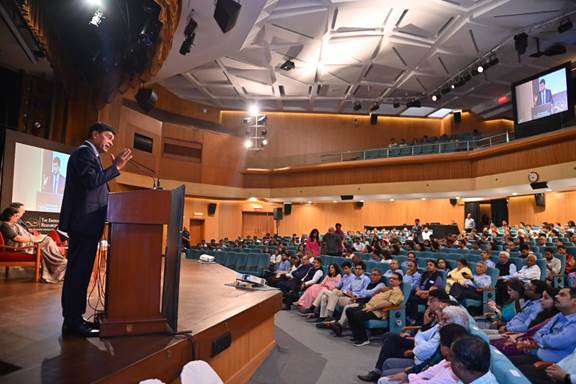
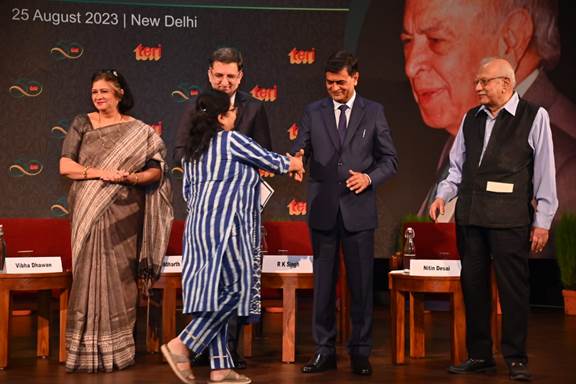
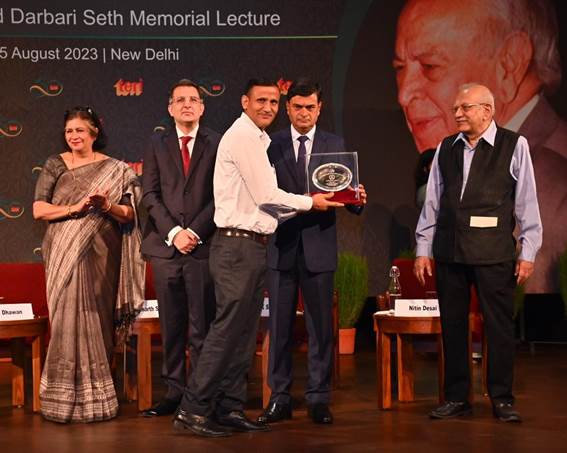
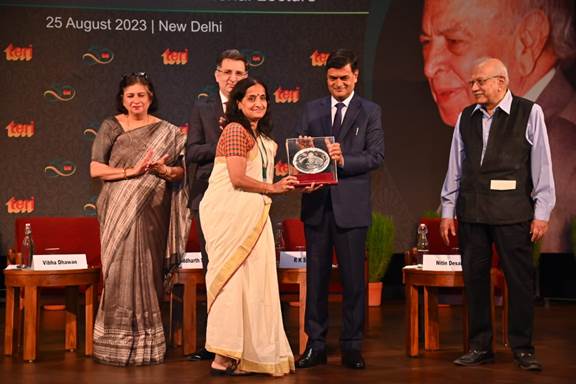
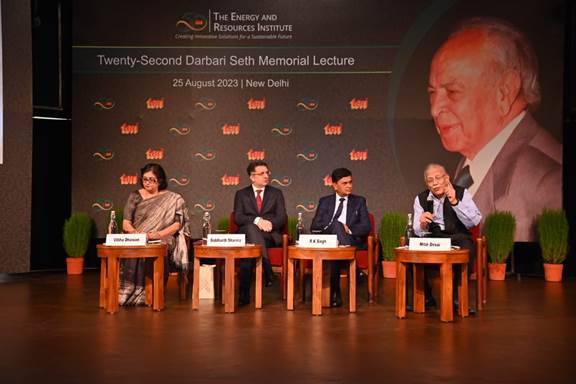
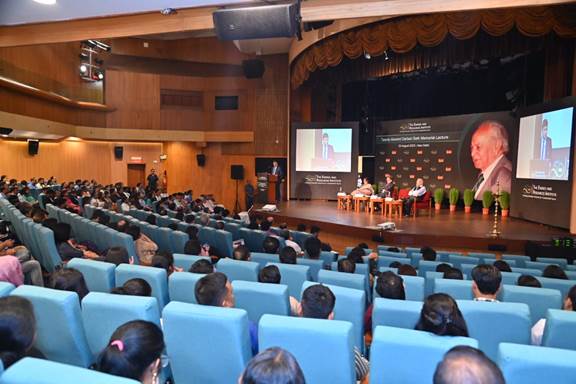
The Minister said this, during his Presidential Address at the Twenty-Second Darbari Seth Memorial Lecture, held in New Delhi today, August 25, 2023, in memory of Late Shri Darbari Seth, the founder of TERI.

Noting that developed countries would talk about phasing out of coal, but not about phasing out of natural gas or other fossil fuels, the Minister exhorted TERI to come out with studies on climate actions by various countries. Once the global South starts controlling the narrative, the world will be a much fairer place, said the Minister, adding that India has been insisting on phasing out of all fossil fuels.

Speaking about India’s actions towards reducing carbon emissions, the Union Minister said that India has achieved its NDC target of 40% of our installed electricity capacity coming from non-fossil energy sources nine years ahead of schedule, in 2021 itself. “Today, 43% of our capacity is from non-fossil fuel sources. No other country has added renewable energy capacity at a rate at which we have done. We pledged at COP-21 in 2015, that we will reduce our emissions intensity by 33% by 2030; we did this by 2022, eight years in advance. So, in Glasgow, we have said that by 2030, we will have 50% of our capacity coming from renewables and that we will reduce our emission intensity by 45%. We will achieve that too well before time.”

“The truth needs to be told, developing countries need space to grow”

Shri Singh said that the developed countries have reached their peak of development; so, their emissions will either remain static or come down. “However, the building stock of developing countries will multiply, since we are developing; we will need more cement, steel and aluminium to construct those buildings and plants. This will lead to more emissions. So, we need space to grow. This point needs to be made by think tanks like TERI, that this is the space which is required by developing countries to grow.”

The Minister said that the nation is not going to compromise on the availability of energy for our growth, adding that the country is responsible for only 4% of legacy carbon dioxide load in the environment, whereas our population is around 17% of world population.

The Minister said that this discourse needs to be changed not at only at the level of world leaders, but also among the people around the world in the developed countries. “The truth needs to be told, I want institutions like TERI to step up and change the discourse.”

“Can you imagine someone thinking about climate change in the year 1974?”

Paying tribute to Shri Darbari Seth, the founder of The Energy and Resources Institute (TERI), the Union Power and New & Renewable Energy Minister asked the gathering, “can you imagine someone thinking about climate change in the year 1974?” The Minister said that this occasion serves to honour Shri Seth’s unwavering determination, entrepreneurial spirit, and strength of mind. “As a towering figure of his era, Shri Seth moulded Tata enterprises’ destiny, dedicating his time and effort fervently to the noble cause of sustainable development. This commitment steered TERI’s journey, propelling it toward a future committed to fostering a greener world and a safer planet.”

The Minister said that the organization which Shri Seth founded has grown and spans the total spectrum of issues which affect sustainability. “TERI has done well. It has earned reputation for probity and publications which we can rely upon.”

The 22nd Darbari Seth Memorial Lecture

The 22nd Darbari Seth Memorial Lecture year marks the 102nd birth anniversary of Shri Seth and brought together thought leaders, industry, and policymakers for insightful discussions, inspired by the ideals of Shri Seth, towards fostering collaborative efforts and finding meaningful solutions for climate change.

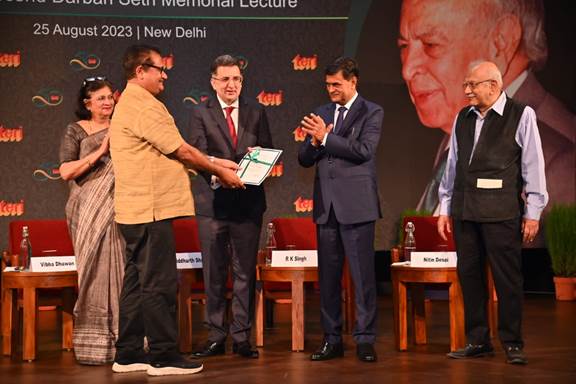
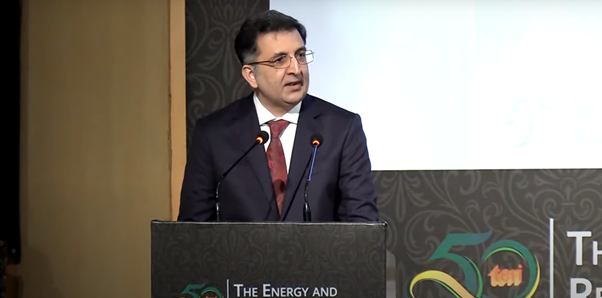
The 22nd Darbari Seth Memorial Lecture was delivered by Shri Siddharth Sharma, Chief Executive Officer, Tata Trusts. On the occasion, Winners of “TERI Roll of Honour” were felicitated and mementos were presented to TERI employees who have completed 20 and 10 years of service in TERI. Chairman, TERI Governing Council, Shri Nitin Desai delivered the welcome address and Director General, TERI, Dr. Vibha Dhawan delivered the vote of thanks.

In the 22nd Darbari Seth Memorial Lecture, Chief Executive Officer, Tata Trusts, Shri Siddharth Sharma said that Shri Darbari Seth was an extraordinary leader who could get his people to move mountains. “It is his defining interest in his energy, energy conservation and environmental sustainability much before it became the existential issue of our times which made him take the lead and set up TERI. He said that men like him leave behind enduring legacies and uplift the generations that follow.”

Shri Sharma said that TERI has grown from humble beginnings into a globally renowned institution at the forefront of sustainable development and environmental research and that the institute has taken pioneering steps in addressing climate change. He said that the institution must continue to push the boundaries of knowledge, drive transformative change and advocate for policies which promote sustainable development.


“Tata Group has committed to Net Zero aspiration by 2045”

Speaking of the need for a just energy transition and recounting India’s climate action commitments including climate justice and sustainable lifestyles, the speaker said that the Tata Group as a responsible partner in national development has committed to a Net Zero aspiration by the year 2045, riding on the pillars of deep decarbonization, circular economies and preserving nature and biodiversity.


“Citizens need to come together and build new frameworks to address the climate crisis”

Speaking of the climate crisis, Shri Sharma pointed out that markets have a critical role in shaping the future of India’s economy, highlighting the need for cross-sectoral collaboration among academia, civil society, private sector and the state. “India’s response to climate change has major repercussions, both domestically and globally. While India has become a world leader in promoting policies and practices for addressing climate change, mitigation of risks cannot rest with the state alone.”

The speaker said that citizens need to come together and build new frameworks to respond to the crisis. Here, institutions like TERI can not only find solutions for the nation but also influence global responses based on India’s learnings, he added.

The Tata Trusts CEO spoke also of the philosophy of the Tata Group and the contribution of the Group to nation building over its long history since 1868. He said that the Tatas represent one of the finest examples of a distributive model of wealth, where a substantial portion of the profits of businesses are shared with the communities from which they are derived, in the form of welfare initiatives.  

The event can be watched here (Part I) and here (Part II). A film on TERI @ 50 was played on the occasion, which can be watched here.


***