Short Essay on \’Importance of Advertisements\’ (160 Words)

Advertisements play a vital role in our lives. Advertisements are essential for starting a new business. Promoting sales is the main motive of a large enterprise. Advertisements rule every aspect of our lives and provide a link between an individual and the world.
 
Advertising, by the definition, is a paid form of non-personal communication to promote the goods and services. It simplifies the choice of consumers by creating an awareness among people about several brands and products available in the market. As advertisements help in business expansion, the companies spend crores or millions on them.
 
Advertisements are contained in various means of communication such as magazines, newspapers, television, radio, bill boards etc. Attractive pictures, slogans, taglines etc shown in the advertisements lure customers, thereby pushing up sales.
 
Advertisements are popularized by the government for betterment of the society in the field of education, providing better facilities, housing facilities for poor, medical facilities like polio drops and other vaccines etc. So, we can conclude by saying that advertisements greatly influence our lives. 

Short Essay on \’Importance of Advertisements\’ (160 Words)

Advertisements play a vital role in our lives. Advertisements are essential for starting a new business. Promoting sales is the main motive of a large enterprise. Advertisements rule every aspect of our lives and provide a link between an individual and the world.
 
Advertising, by the definition, is a paid form of non-personal communication to promote the goods and services. It simplifies the choice of consumers by creating an awareness among people about several brands and products available in the market. As advertisements help in business expansion, the companies spend crores or millions on them.
 
Advertisements are contained in various means of communication such as magazines, newspapers, television, radio, bill boards etc. Attractive pictures, slogans, taglines etc shown in the advertisements lure customers, thereby pushing up sales.
 
Advertisements are popularized by the government for betterment of the society in the field of education, providing better facilities, housing facilities for poor, medical facilities like polio drops and other vaccines etc. So, we can conclude by saying that advertisements greatly influence our lives. 

Short Essay on \’Importance of Advertisements\’ (160 Words)

Advertisements play a vital role in our lives. Advertisements are essential for starting a new business. Promoting sales is the main motive of a large enterprise. Advertisements rule every aspect of our lives and provide a link between an individual and the world.
 
Advertising, by the definition, is a paid form of non-personal communication to promote the goods and services. It simplifies the choice of consumers by creating an awareness among people about several brands and products available in the market. As advertisements help in business expansion, the companies spend crores or millions on them.
 
Advertisements are contained in various means of communication such as magazines, newspapers, television, radio, bill boards etc. Attractive pictures, slogans, taglines etc shown in the advertisements lure customers, thereby pushing up sales.
 
Advertisements are popularized by the government for betterment of the society in the field of education, providing better facilities, housing facilities for poor, medical facilities like polio drops and other vaccines etc. So, we can conclude by saying that advertisements greatly influence our lives. 

What Is The Corpse Flower Sensation? And Why Is Viral Science A Learning Opportunity?

Source: National Geographic


It\’s rare that a single flower becomes a viral, stakeout sensation. We admit that we\’ve been fixated. While YouTube eyes are currently obsessed with a grotesque and freakish bloom, educators may be missing an opportunity.

Yesterday the New York Botanical Garden (NYBG) announced that after a decade of cultivation, the Amorphophallus titanum finally began to bloom. Commonly known as the \”corpse flower,\” this plant from Sumatra in Indonesia exudes the smell of rotting meat as it opens. The putrid odor and the otherworldly shape are keys to its appeal, as its startling height. The flower has notched the Guinness World Record for the tallest bloom in cultivation at over 10 feet (and even larger in its natural habitat).

The New York Botanical Garden first hosted a successful bloom of the corpse flower in 1937. A second emerged in in 1939, but generations have past to witness the third revelation of this dreamy, rancid blossom. Visitors have been lining up, and online watchers have been glued to the YouTube livestream, mostly because the scare appearance lasts for only 24 – 36 hours.

Why is this floral oddity relevant for teachers and students? On a basic level, this quirky natural artifact offers countless avenues for science learners to explore biology, botany, morphology, behavior, pollination, inflorescence, germination, dormancy, regionality, and cultivation. For example, the bloom is not actually one large flower. Instead it comprises a leaf-like ring of outbursts surrounding a central column.

On a higher level, the fascination with this shy and fetid flower speaks to every teacher\’s desire (and angst): how can we make make learning relevant? How can we pinpoint the moving target of our contemporary kids\’ attention spans? If they are attracted by a weird plant, what can we learn from this momentary buzz to inform our curricula?

Is it too much to ask that a daily lesson is unexpected? Is it pandering to give students something to anticipate, to look forward to? The allure of the NYBG \”Corpse Flower Cam\” lies in the waiting. It rests in the charisma of the macabre. Why does a flower smell so bad? What is the evolutionary attraction for carrion creatures that will come and spread the pollen?

Source: NYBGChicago Botanic Garden


Source: University Of Wisconsin-Madison

In other words, all classes should unfold like a mystery. Children ought to be rapt in the one-in-a-million stories: the collapse of the Spanish armada, the elegance of Euler\’s identity, the chance of penicillin\’s discovery, or the lightning of a boy\’s forehead.

For locals, the occasion to visit a monstrous plant that reeks of spoiled flesh is priceless. Would that all of our classes were as exhilarating. For the rest of us, this is a neat moment that we should remember in September, to excite STEM learners and to wake up the drowsy kids who don\’t think our \”Do Now\” exercise lives up to their Snapchat feed.

Day Three – Panel

The last part of the panel session was about the Future of learning 2027:
Generic off-the-shelf products are no longer in vogue and businesses have moved out of the tertiary organisations. \”The only sure thing is that things will change\”. There may be holographs accessed via smart cards as learner needs them.
Also the 4 Rs – \”Right information to the right person at the right time and in the right way\”. Situated learning in the workplace.

\”Not everything is possible\” and \”we\’re just all going to be lazy\” or \”work too hard\” – we already do. what can we do that computers can\’t – creative stuff. Skill sets instead of knowledge because information is doubling constantly – need to know how to handle all the information. We will be moving between careers more rapidly. \’Don\’t afraid to jump on the technology train. We\’re not and it is going to be exciting!\” (Miria Royal, 2007.) 

The workplace will be the new university. \”The illiterate of 21st century will not be those who cannot read or write but those who cannot learn, unlearn or relearn\” (Rachel Skudder, 2007).

The law of more! More bandwidth, web 2.0, 3.0, 4.0. More creating content. speed – faster, faster. Just-in-time products. Pull vs push, m-Learning. Open education resources. Content rich courses will not longer be norm. Push rather than pull…RSS. Power shift to the learner.

Scenario planning for educators – session 1

Well here I am again on another MOOC train. Hopefully, this one will be designed so the activities are achievable.  Luckily I already had a workable blog so that has saved some time. This series of workshops is on Scenario planning for educators. If I remember right, I was first introduced to this concept in 2004 when Wayne Macintosh spoke about the concept at the Third Pan-Commonwealth Forum conference. I found the concept fascinating then albeit a little hard to comprehend.

A lot has happened since then in education – change has accelerated in the tertiary sector.  Now the concept of MOOCs and Open Education Resources (OER) and Open Education Practices (OEP) is at the forefront along with mobile learning, and predictions about gamification and the concept of seamless learning. I have written about these predictions in the Trends module for the Flexible Learning course

One of my goals for this course is to understand how scenario planning can be used for engaging teams with strategic change within an organisation. I am sure that more goals will unfold as I learn more about the process. 

The Uber Generation Of Learning — Fast, Efficient, And Driven By Tech

Source: ASIDE 2015

It’s no surprise that the New York Taxi and Limousine Commission is lobbying for limits to Uber’s expansion. In fact, municipalities across the country are fretting over Uber’s intrusion.

Uber’s appeal — and its rapid, unmitigated ascent — is exactly like the edtech groundswell in contemporary learning.
Uber is a private car service currently taking the country by storm. It allows anyone with an app to instantly summon a professional ride. It takes away the guessing about street corners and hand-waving. It offers customized choices, such as a car seat or SUV. Uber provides real time, visual tracking of how far away the car is and how much the trip will cost. 
Uber takes the frustrating tasks of flagging a phantom taxi or confronting a gruff phone operator and replaces them with immediate, digital satisfaction.
This is exactly what today’s students expect from their lessons and teachers.
For better or for worse, children enter our classes with a ready affinity toward online tools and an understandable assumption of digital learning. They are used to texting in realtime, chatting in realtime, Googling in realtime, and creating in realtime. When anachronistic teachers give them paper worksheets and bubble tests, it’s no wonder they roll their eyes and feel like they’re being intentionally stranded on the side of a high-tech boulevard, while the wired world seems to be passing them by.
Kids (and adults) live on their smartphones. They demand instantaneous answers via Siri or Wikipedia to any question that might pique their curiosity. In this way, they are uber-researchers. They seek information more actively and more frequently than any prior generation. The gift of the Internet offers them answers, but they still need to know their end destination. They still need to have a conclusion in mind, to drive their scholarship in the right direction.
Source: ASIDE 2015

The greatest gift from laptops, iPads, SMARTboards, and phones is efficiency. What used to take a middle schooler an entire Saturday now takes a split second. Kids can diagram the locks of the Erie Canal or study the bricks of the Giza pyramids in the same time it takes to tie one’s shoelaces. The “Internet of things” is a powerful encyclopedia. Any school district that blocks access to YouTube or Twitter, therefore, is closing the doors to Alexandria, erecting antiquated barriers in the face of authentic learning.

We expect our Uber driver to know our name, know our route, and know our credit card number. We expect service with a smile and quiet satisfaction in skipping the crowded van to the airport or the late-night carpool quest.
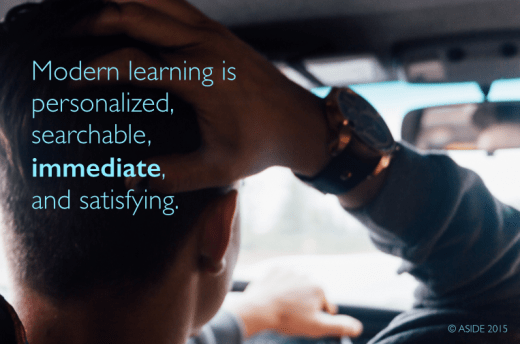
This is modern education — personalized, differentiated, and affordable.
This is technological learning — satisfying, searchable, and immediate.
As a point of reference, check out this current ad for Microsoft Windows 10:

Many educators still fight against this disruption, against these invading technological hordes. They demand professional development and budget studies to delay the inevitable. Many administrators side with city districts, viewing apps as interlopers seeking to upset the status quo.

Many still resist the arrival of a learning alternative, because it’s not “the way we’ve always done it.”

But the rabid popularity of Uber speaks to a communal need. The instinctive embrace of real-time learning by students means that if educators don’t change, kids will be chauffeured off into the sunset without them.


Visualizing The Summer Olympics – Mapping The 2016 Rio Torch Relay

Source: Rio 2016 Olympics Wiki


On Friday, August 5, 2016, the eyes of the world will be fixated on Rio de Janeiro for the opening ceremonies of the Games of the XXXI Olympiad. The #RoadToRio has notoriously been potholed by damaging news stories about Zika mosquitoswater pollutionconstruction delaysfinancial collapse, and rampant crime. Still, the tenacity of the tireless athletes and the nobility of the Olympic quest will unite the globe for two weeks and will present terrific opportunities for visualizations and education.

Source: Rio 2016


The torch relay, in particular, inaugurates the Games as the flame travels from its Greek origins to then crisscross Brazil in an escalating parade of famous athletes and historic sites. Mapping this journey through graphics and animations offers valuable chances to learn about geography and c

Swami Vivekananda: A Great Legendary Personality and Selfless Person

January is an auspicious and significant month for many people in the world. With the starting of 1 January, English New year starts. Many Orthodox Christians celebrate Christmas on 7 January as they believe date works to the Julian calendar that pre-dates the Gregorian calendar (when I was in Eritrea, Africa observed the Orthodox Christians celebrate Christmas on 7 January). Anyway, in India Makara Sankranti, Magh Bihu, Lohri, Thai Pongol etc., are celebrated in this month and on 26 January our country became Republic.  In addition, two great souls were born in January in our country – Swami Vivekananda and Netaji Subhas Chandra Bose.

Swami Vivekananda was born on 12 January 1863 in Kolkata then Calcutta.  His real name in school / college was Narendranath Dutta and pet name was “Biley”.  By this (“Biley”) name parents used to call him.  Although he is considered a key personality in introduction of Vedanta philosophy and Yoga to Western countries mainly in USA and Europe but humanity was his only consideration. Swami Vivekananda was intelligent since childhood. He was the only student to have received first division marks in Presidency College entrance examination. He was a positive and broad-minded person with the feeling for all human beings irrespective of caste, creed and religion. To get an in-depth idea about his philosophy few lines from his speeches are quoted here, “All power is within you, you can do anything and everything.  Believe in that; do not believe that you are weak.  You can do anything and everything, without even the guidance of any one.  Stand up and express the divinity within you. Arise, Awake, and Sleep no more.  Within each of you there is the power to remove all wants and all miseries.  Believe in this, and that power will be manifested”.

Love and affection towards others is reflected from his saying, “All expansion is life, and all contraction is death.  All love is expansion, all selfishness is contraction.  Love is therefore the only law of life”.  His positive feeling towards different religious is realized by this discourse, “The Christian is not to become a Hindu or a Buddhist, nor a Hindu or a Buddhist to become a Christian.  But each must assimilate the spirit of the others and yet preserve his individuality and grow according to his own law of growth”.  He further told, “Feel like Christ, you will be a Christ; feel like Buddha and you will be a Buddha. It is feeling that is the life, the strength, the vitality, without which no amount of intellectual activity can reach God.” Thus one can easily understand Swami Vivekananda’s feeling towards human beings.

He was great believer of welfare of humanity and hard work without selfish attitude.  In his words, “It is a tremendous error to feel helpless.  Do not seek help from anyone.  We are our won help.  If we cannot help ourselves, there is none to help us.  The moment you fear, you are nobody.  It is fear that is the great cause of misery in the world”.   His patriotic fervour can be understood through this line, “The soil of India is my highest heaven, the good of India is my good and repeat and pray day and night…….O Thou Mother of Strength, take my weakness, take my unmanliness and make me a man!”

Swami Vivekananda was always in favour of development for all. In fact today’s Inclusive Growth concept may be termed as his vision. His beautiful message in this regard, “In India there are two great evils, trampling on the women and grinding the poor through caste restrictions.” “…..forget not – the ignorant, the poor, the illiterate, the cobbler, the sweeper, are thy flesh and blood, thy brothers.  Thou brave one, be bold, take courage, be proud that thou art an Indian and proudly proclaim – ‘I am an Indian – every Indian is my brother’, Say, The ignorant Indian, the poor and destitute Indian, the Brahmin Indian, the pariah Indian, is my brother. ……..Our only work is to arouse this knowledge in our fellow-beings.  We see that they too are the same pure self.  Only they do not know it; we must help them to rouse up their infinite nature”.

Our former Prime Minister Pandit Jawaharlal Nehru had high regards for him. This one line of Nehruji’s saying reflects fully about Swami Vivekananda, “I think that our younger generation will take advantage of his fountain of wisdom, spirit and fire that flows through Swami Vivekananda”.

Although, Vivekananda passed away on 4th July 1902 but no Indian can forget him as his thought-provoking lecture in Chicago in 1893 at the Parliament of the World’s Religions conquered heart of the millions of the people of the World. The people of the world could get an in-depth idea about Hindu philosophy which earlier many of them had no knowledge or superficial knowledge.                                  

Dr. Shankar Chatterjee

Former Professor& Head (CPME)

NIRD &PR (Govt. of India),

Hyderabad-500 030

Telangana, India

Email <shankarjagu@gmail.com>


                                        ****************

eLearning guidelines project day

All the project leaders involved in the eLearning guidelines project gathered today at the Wellington airport conference centre. The steering committee meeting held yesterday was used to plan today\’s event.

The main aim for today was to introduce project leaders to each other and to discuss items around managing the projects. There were some group activities around finding common ground, sharing ideas and resources, and risk factors. The risk analysis brainstorm session highlighted a lot of concerns. or example, staff turnover, keeping to milestones, budgets, project management skills. It was a very useful exercise. The show and tell after lunch was an excellent way to keep everyone awake and informed about who was doing what. The short snappy explanations about the projects were just the right length (two minutes) to inform. Also the session where we had to migrate into groups of similarity was also very useful.

I joined the design group and it became apparent that everyone was keen to keep the discussion going around best practice in design, and also to share resources developed for the projects. For example, several people are gathering material for a literature review. The Otago Polytechnic project is called: The power of design on flexible learning and digital network literacy

The eLearning guidelines that the project will use are listed below:
  • TD11 Should staff use a team approach to develop and teach the course?
  • TD12 Is the design of learning informed by research on effective eLearning?
  • TO9 Are staff encouraged to participate in networks and learning communities involved in reviewing, developing or sharing good practice in the use of e-learning?

For the demo session today , I added some information about the project to the Otago Polytechnic project space on WikiEducator. This was essentially the project application. The plan is to have a meeting as soon as possible with Leigh and Terry to discuss the way forward for the project and who will be involved.

It was very good to meet most people involved in the projects, and people seemed keen to keep the contact going on group email and to support each other. Motivation and pastoral care from John, the project manager will be very important in keeping us all on track. And I hope people will take the time to log what they are doing regularly and share their progress in an open manner and support each other.

Have you got a happy place – my introduction

Welcome to my blog. I will be using this to connect with you in the Learning and Teaching in Practice course. I reckon it is my role as the course coordinator to show you how it all works.  Do you know how scary that is? I have to write something interesting so you will read it. I am going to use this blog less formally to share my thoughts and ideas about the topics, and also any information that I come across. I hope you will take the time to leave me comments.

I see this as my chance to develop a digital portfolio alongside you….and find out if it really is going to work. Can you see the link to my ePortfolio top right? More detail about my profile and how I got to this space can be read on there. I see the portfolio as a more formal record of the evidence and learning for each module of the course. It will become an exemplar that I hope you find useful. 

I am a little nervous about all this because getting teachers to use blogs and digital portfolios can either be an adventure for everyone or something they want to avoid, and then it doesn\’t work so well. Perhaps I should book that ticket to Bhutan now. I mention Bhutan because that is my favourite place at the moment – they have Gross National Happiness – how cool is that! I guess it is my happy place to retreat to when things get challenging. Have you got one?

For all this to work requires everyone to make time to read each others blogs/portfolios and leave comments. Since there are 16 people in the course you will need to be selective and to rotate around the blogs you read. Don\’t expect to read every blog every week – just do what you can manage. It is surprising what you can learn from others\’ ideas, and that can sometimes save you time. In time you may decide to only follow those people who are more in tune with your context.

“The Understudent” — Notice The Kids Waiting In The Wings And Turn Every Child Into A Star

Source: ASIDE 2015
Every teacher knows the high-achieving students in his or her classroom. These are the trusted “high verbal” pupils who raise their hands, who answer each question, who quote the night’s reading, and who ferry the conversation. It’s a tacit trust between educator and child — the rewards are mutual. The lesson can proceed according to the teacher’s design, and the extroverts can succeed according to the traditional model.
But what about the introverts?
What about the “low verbals”?
What about the children who read the homework, who complete the worksheets, who memorize the vocabulary words, who post their projects, and who code their webpages — but who don’t speak up?
Most of a typical class is a chorus. Most of the kids who fill the seats and laugh at the jokes and fulfill their studies do not win awards. They do not give speeches at graduation. They do not take a bow with an audience on its feet.
Source: ASIDE 2015
The majority of learners will not play the leads. They will fill the background and be part of the cast. They will not see their names on the marquee, and they won’t even think to deserve it.

If school is a stage, then few actors will sing the solos or shine in soliloquies.

Most kids will be understudies — or “understudents.”
They will know their lines, they will be at every practice, they will work like heck — and yet they will receive little recognition. Because that’s how life is. And when they do step away from the ensemble and raise their hands to give a correct answer, it will be a surprise, an anomaly. 
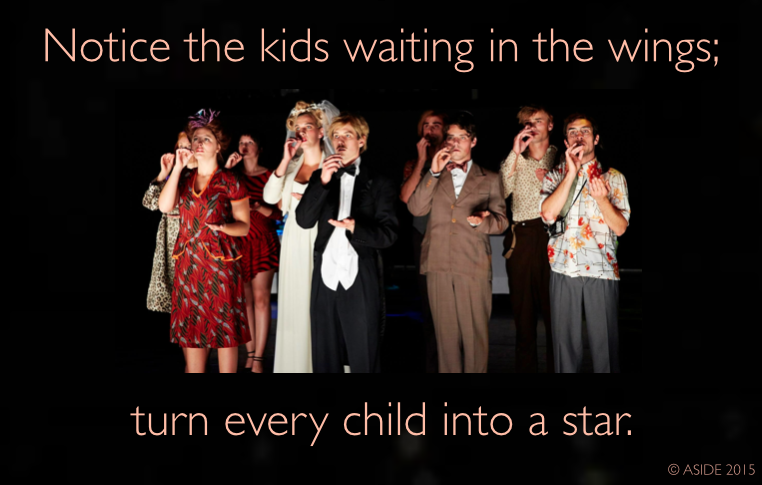
The greatest challenge, therefore, for classroom teachers is to identify the talent waiting in the wings. Who is lurking behind the scenes? Who is quieting her voice within the chorus? Who is restraining herself within the dance?
Somewhere, a student just needs a break, some encouragement, and a teacher who believes in him to break out and become a star.
Think about the Tom Bradys and the Kurt Warners who needed a first string player to falter just so they could have a chance.
Source: ASIDE 2015
Too many times the demands of high stakes testing and rigid teacher evaluations throw educators into survival mode, where they can barely keep their own heads above water, much less look out for a glimmer of light among their docile classrooms.
But that’s the job. That’s the key. Getting to know each child on a personal level is more important than drilling rote facts into their heads. All of us can think back to the mentor who believed in us, who pulled us out of our comfort zones.
As the new school year gets underway, one of our resolutions is to seek out the understudents. We also strive to recognize the kids with underparents. They don’t make a fuss, they don’t complain, and too often, therefore, we attend to the squeaky wheels.

But the modest geniuses in our midst need us more than ever. If we don’t pluck them from obscurity, then they may end up seeing themselves as members of the throng — humble nodders in the choir, content not to speak up, not to dare, not to lead, and not to share all of the insights within their quick and boisterous minds.

Go For Western Economy With These Pioneering

but it is too much for my strength — I sink under the weight of the splendour of these visions!

I am alone, and feel the charm of existence in this spot, which was created for the bliss of souls like mine. I am so happy, my dear friend, so absorbed in the exquisite sense of mere tranquil existence, that I neglect my talents.

Continue reading “Go For Western Economy With These Pioneering”