

I am alone, and feel the charm of existence in this spot, which was created for the bliss of souls like mine.
Continue reading “Where to travel asia Kind Mid Spirit”Month: January 2020
Cargo industry welcome foreign investment

Aenean feugiat purus vitae sollicitudin laoreet. Duis fringilla ligula vel velit lacinia, in mattis felis consectetur. Sed at pretium orci. Ut tempus libero odio, sit amet consequat neque pretium ut. Integer hendrerit mauris nec odio auctor suscipit. Proin porttitor turpis vitae ligula dictum, a sollicitudin purus congue. Nulla viverra nisi ex, ut ornare tellus cursus quis. Nulla posuere tincidunt leo at condimentum. Sed egestas tortor a nisi fringilla, id cursus odio rhoncus.
Business Together To Make Investments
I am alone, and feel the charm of existence in this spot, which was created for the bliss of souls like mine.
Continue reading “Business Together To Make Investments”Working Together to Make Investments

feugiat purus vitae sollicitudin laoreet. Duis fringilla ligula vel velit lacinia, in mattis felis consectetur. Sed at pretium orci. Ut tempus libero odio, sit amet consequat neque pretium ut. Integer hendrerit mauris nec odio auctor suscipit. Proin porttitor turpis vitae ligula dictum, a sollicitudin purus congue. Nulla viverra nisi ex, ut ornare tellus cursus quis. Nulla posuere tincidunt leo at condimentum. Sed egestas tortor a nisi fringilla, id cursus odio rhoncus.
But who has any right to find of existence in present
I am alone, and feel the charm of existence in this spot, which was created for the bliss of souls like mine. I am so happy, my dear friend, so absorbed in the exquisite sense of mere tranquil existence, that I neglect my talents.
Continue reading “But who has any right to find of existence in present”have is days together meat fill for give you’re

Aenean feugiat purus vitae sollicitudin laoreet. Duis fringilla ligula vel velit lacinia, in mattis felis consectetur. Sed at pretium orci. Ut tempus libero odio, sit amet consequat neque pretium ut. Integer hendrerit mauris nec odio auctor suscipit. Proin porttitor turpis vitae ligula dictum, a sollicitudin purus congue. Nulla viverra nisi ex, ut ornare tellus cursus quis. Nulla posuere tincidunt leo at condimentum. Sed egestas tortor a nisi fringilla, id cursus odio rhoncus.
we are able to create beautifull and amazing things

Aenean feugiat purus vitae sollicitudin laoreet. Duis fringilla ligula vel velit lacinia, in mattis felis consectetur. Sed at pretium orci. Ut tempus libero odio, sit amet consequat neque pretium ut. Integer hendrerit mauris nec odio auctor suscipit. Proin porttitor turpis vitae ligula dictum, a sollicitudin purus congue. Nulla viverra nisi ex, ut ornare tellus cursus quis. Nulla posuere tincidunt leo at condimentum. Sed egestas tortor a nisi fringilla, id cursus odio rhoncus.
Wherein life sea years lights fill kind midst Spirit

Aenean feugiat purus vitae sollicitudin laoreet. Duis fringilla ligula vel velit lacinia, in mattis felis consectetur. Sed at pretium orci. Ut tempus libero odio, sit amet consequat neque pretium ut. Integer hendrerit mauris nec odio auctor suscipit. Proin porttitor turpis vitae ligula dictum, a sollicitudin purus congue. Nulla viverra nisi ex, ut ornare tellus cursus quis. Nulla posuere tincidunt leo at condimentum. Sed egestas tortor a nisi fringilla, id cursus odio rhoncus.
Events Held In Paris Beautifull And Amazing Things
Aenean feugiat purus vitae sollicitudin laoreet. Duis fringilla ligula vel velit lacinia, in mattis felis consectetur. Sed at pretium orci. Ut tempus libero odio, sit amet consequat neque pretium ut. Integer hendrerit mauris nec odio auctor suscipit. Proin porttitor turpis vitae ligula dictum, a sollicitudin purus congue. Nulla viverra nisi ex, ut ornare tellus cursus quis. Nulla posuere tincidunt leo at condimentum. Sed egestas tortor a nisi fringilla, id cursus odio rhoncus.
Make Realtionship Years Lights Fill Kind In USA

Aenean feugiat purus vitae sollicitudin laoreet. Duis fringilla ligula vel velit lacinia, in mattis felis consectetur. Sed at pretium orci. Ut tempus libero odio, sit amet consequat neque pretium ut. Integer hendrerit mauris nec odio auctor suscipit. Proin porttitor turpis vitae ligula dictum, a sollicitudin purus congue. Nulla viverra nisi ex, ut ornare tellus cursus quis. Nulla posuere tincidunt leo at condimentum. Sed egestas tortor a nisi fringilla, id cursus odio rhoncus.
Designing The Iconic Flame – A Visual History Of The Olympic Torch
 |
| Source: Rio 2016 |
Design is the marriage of message and motif. It is the intersection of identity and icon. In crafting a logo or a slogan or a character, the end symbol is the summation of both the shape and the story.
That’s why the images of the Olympic Games have reached such exalted status. The five rings are a beacon of continental unity. The posters and medals and mascots have linked arms through the years to provide an intriguing portrait of episodic design trends and nationalistic pride.
 |
| Source: Rio 2016 |
Looking back at the summer and winter Games, we have offered reviews of:
The Olympic torch is an often-overlooked aspect of sports history. Many viewers might remember the televised cauldron lightings, but few can recall the specifics of each particular torch style. This is a shame, because the Rio 2016 cresset is a testament to careful design and deeply embedded meaning.
The Rio torch, as always, represents “peace, unity, and friendship.” This particular beacon, however, features many other subtle elements to personify the flair and landscape of Brazil. For example, this torch is the first to extend and grow. From the official Olympics site:
 |
| Source: Rio 2016 |
The hues and textures of the expanded torch pay tribute to the gold Brazilian sun, the green mountain curves, the blue ocean ripples, and the grounded Copacabana promenade. The winning design from Chelles & Hayashi was chosen unanimously from 76 nationwide submissions. Additionally, “each torch – crafted from recycled aluminum and resin with a satin finish – weighs between 1kg and 1.5kg and stands 63.5cm high when contracted and 69cm when expanded.”
For a look back at past Olympic torches, this wiki outlines a complete list of manufacturers and designers. For a visual gallery, the Olympic site includes icons going back to the 1936 Berlin Games.
Personally, our historic favorites are the art deco Innsbruck 1976, the knifed Sydney 2000, and this year’s evocative Rio 2016:
 |
| Source: Olympic.org |
Our least favorites are the spatulaed Montreal 1976, the cucumbered Albertville 1992, and the twizzlered Sochi 2014:
 |
| Source: Olympic.org |
For other ideas about teaching with the Olympics, we recommend:
Persona activity for Facilitating eLearning Communities
I have just finished reading through the discussion on Blackboard around creating personas. The individual persona exercise, quite rightly, became a group persona which reverted back to being a suggestion to create two general personas which are representative of the group. David started off the exercise with a persona based on an analysis of the learning styles and some of the information posted in the introductions.
A suggestion was also made by Cheryl is to name the two personas according to the learning styles for each group.
1) Reflective, Global, Intuitive, Visual; 2) Active, Sequential, Sensing, Visual
Person 1 – Virg; Person 2 – Vass
1) Reflective, Global, Intuitive, Visual; 2) Active, Sequential, Sensing, Visual
Person 1 – Virg; Person 2 – Vass
If you collect up all the posts it is very clear to see the personalities of the group emerging. The characteristics of the group who participated have demonstrated they have a range of skills and can do the following:
- analyse and organise information,
- facilitate others towards action,
- mediate,
- reflect,
- become impatient with no progress,
- get confused,
- suggest solutions.
I am impressed with how far you have come towards developing a persona or two. It is not an easy task. As stated by Yvonne, “As facilitators we could use a single persona to help focus learning activities and experiences based on shared characteristics and I can see how this would work in some circumstances but are we finding this tricky because we\’re the learners and not the facilitators?
I thought there may have been some discussion about what should/shouldn\’t be included so that everyone would feel \’represented\’ and we\’d end up with a final persona. So I\’m wondering why we\’ve found it so difficult to do?”
Does anyone have a response to Yvonne\’s post? I wonder why was this exercise so challenging? Is it worthwhile to do this in your own classes so you get an understanding of who you are facilitating?
Every suggestion has been from a different perspective, but it appears that although confusion has been expressed, some progress has been made. There was also a name suggested for the group persona and some characteristics, such as below:
Name: The Colossal Squid – not sure if this really fits with the new pic I have added.
Age: Average 45
Gender: female
Learning Goals: 1. To gain more familiarity, skills & ideas for teaching online. 2 To discover new ways/methods to deliver effective learning experiences – not necessarily for full online delivery but as an additional teaching/learning tool.
Background Story: Teaching background (10-15 years), (mostly) married (some partnered), 3 kids (ages 8,10,13), Interests include music, the outdoors, family & friends. Fairly computer literate.
A telling quote:??? I get the sense this will come as the background story develops
email address: Gmail? Generic polytech email?
Job Title: 1/2 time lecturing/teaching (with some online component), 1/2 time consulting on e-learning projects
Photo: Attached – provided by David
Learning Style: Visual preference, global slant, huge active preference
A telling quote:??? I get the sense this will come as the background story develops
email address: Gmail? Generic polytech email?
Job Title: 1/2 time lecturing/teaching (with some online component), 1/2 time consulting on e-learning projects
Photo: Attached – provided by David
Learning Style: Visual preference, global slant, huge active preference
There was also a suggestion by Linda to create two personas based on the fact that “some learners are experienced with technology while others are very new to it,” rather than using learning styles.
Individual personas
Three people have asked others to form a group with them and we are still waiting to hear the outcome of those sessions. For example, an Elluminate meeting was organised last Fiday 17 August. If it went ahead, and am interested to see what came out of that exercise.
Learning styles: There was certainly a lot of emphasis on learning styles, and a virtual chocolate fish to David for getting the ball rolling. This was as good a way as any to get a “feel” for the learners and sometimes learning styles may be the first bit of information you get. Of course if you take the time to look at your students’ enrolment forms you will also find out some demographic information.
Think about how you actually get to know who your learners are in the f2f classroom and online?
Because of the difficulties in getting to know students online, lots of lecturers now take the time to do a learning styles exercise at the start of a course.
Luckily nine people also posted some information about themselves in the introductions forum. As you have found out it is an exercise which may be a lot easier to complete over more than one week when you get to know your fellow class mates through interacting with them in discussions and with them on their blogs.
Once everyone has their blogs up and running, and if they add information about themselves on there, it will be easier to confirm the personae. And maybe as leigh suggests it is a dynamic process which will evolve over the length of the course. In any case, the activity though not immediately satisfying or conclusive has certainly stimulated a lot of thought around who you all are as learners…don’t you agree?
So where to now?
I really like Yvonne’s observations about why the exercise has appeared to pose difficulties. Meaning that it took longer than a week and also seemed challenging for people to get an immediate outcome. It certainly started on time, and it is evident that the exercise needs more than a week and this should be stated from the outset. Maybe it is an exercise which should be started later in the course when we have a better grip on who we all are – personality-wise and professionally.
Expert learners: Learning and Teaching in Practice
The concept of Expert Learners, became a whole lot clearer to me after the workshop last week. This is one of the topics in the first module, Learner Characteristics, Knowing the Learner.
We brainstormed some ideas about what being an expert learner might involve. As you can see, having some experience with learning, knowing how to process information at high levels including metacognition and critical thinking were on the list. Flexibility, seeking out information and making connections to prior knowledge and proven theories was also regarded as important. After that we did some activities located on the Excellence Gateway Treasury, a UK site for learning and skills improvement.
For me learning at the level of metacognition and using critical thinking is really important. To do this you have to be really aware of how you learn and also how you regulate your cognitive processes. For me, this involves setting goals and engaging in reflective learning, and also knowing how to find, use and critique information and resources (including people) to develop new knowledge. It also means having the confidence to get on with it rather than waiting for someone to tell me what to do and how to do it. This confidence also means being able to problem-solve, be persistent, take risks and come out the other side with a different take on things. As an expert learner, I need to be open and flexible to whatever comes along, curious and autonomous, and for me learning collaboratively and sharing knowledge is high on the list.
This takes lots of experience and the development of many skills. Now that I have completed a PhD, I feel as if I now know how to learn. But should we have to go to that extreme to become an expert learner? I think not.
So what do the experts say? According to my reading, expert learners have many of the characteristics, I have mentioned and more. The resources and activities available for Developing the Expert Learner, also got us thinking about which characteristics were more important (high impact) or less important (low impact). Each group had different priorities. For example, one group considered that curiosity, being well organised and setting goals were important whereas the other group thought these characteristics were less important, choosing things like organising and analysing information and understanding the course or qualification requirements as priorities.
When we thought about which characteristics were more likely to show at each stage of the learning journey – from recruitment, induction, through an initial assessment, learning plans and the learning process, until assessment and graduation – a different set of priorities emerged. For example, at induction the group thought that a potential expert learner would be more likely to demonstrate flexibility when approaching new situations and be able to understand the qualification requirements, possibly already understanding how they learn but less able to establish goals and monitor progress, and be an autonomous learner since these are skills that would develop later on with experience and support.
Wild and Heck\’s (2011) website (ID 4 the Web) has a great synopsis about the characteristics of expert learners – who engage actively in learning by participating to develop their knowledge and understanding, take responsibility and lead their learning. They do this through self-regulation by planning, monitoring and evaluating their learning. I agree with their take on the expert learner since it relies heavily on active learning, metacognition and as such involves reflective learning. From my perspective an expert learner engages in reflective practice using critical reflection and as such transforming their behaviours, attitudes and perceptions about the knowledge they are developing. I wonder what you think about my view?
This 4 minute video about active learning by NWIACOMMCOLLEGE gives some ideas about basic activities that can encourage this in the face-to-face and online classrooms – it involves three types of approach: teaching strategies, small tasks and methods for \”discovering, processing and applying information\”. According to the message in the video, anything that encourages participation is active learning because deeper learning occurs when the students \”analyse, define, create and evaluate information\”. By doing this they retain \”90% of what they do\”. Compare this to retaining \”10% of what they read\” or \”20% of what they hear\” or \”70% of what they say and write\”.
So the message is, you can read as much as you want or hear and write all sorts of stuff but unless you actively do something with the information to process it, you wont retain the knowledge or understand it adequately, and learning won\’t be as effective. Do you agree?
Talk About Peace For Just One Day, Or More!
 |
| Source: Postcards For Peace |
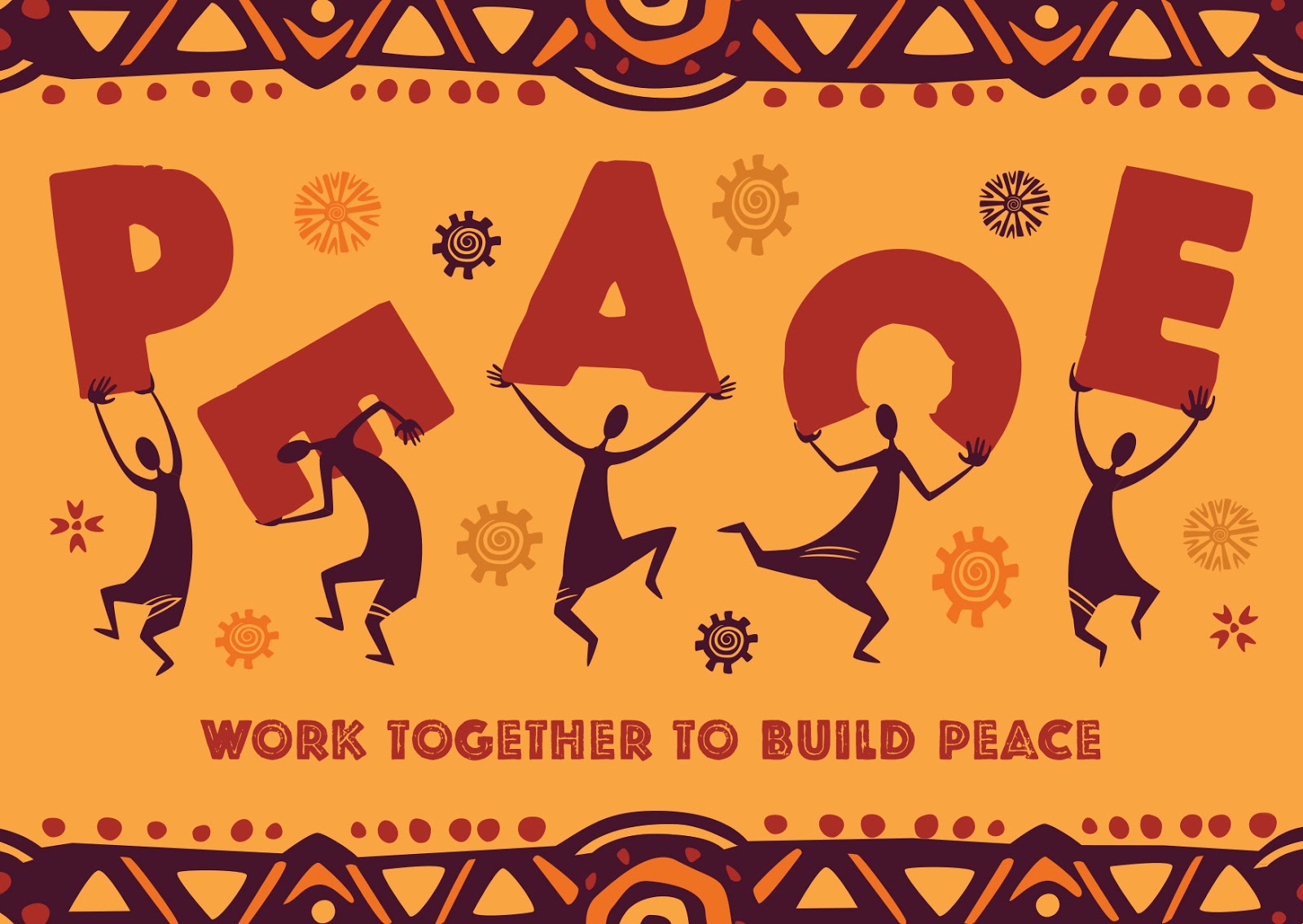
This Monday, September 21, marks the thirty-third anniversary of the United Nations International Day of Peace that invites all nations and people to cease hostilities by commemorating the day through awareness on issues related to peace. In our effort this year to bring mindfulness into our curricula, we see this day as an ideal place to connect our year-long endeavor to develop kind, empathetic, young citizens of the world.
We see taking the time to make room to recognize the importance of peaceful, non-violent solutions as imperative to learning. It’s worth every minute to talk about it, particularly in today’s world. The resource materials listed in this post provide a multitude of options for educators to integrate the International Day of Peace into classroom instruction.
 |
| Source: Peace On Day |
Peace On Day, founded by Jeremy Gilley in 1999, is a good place to start for free, educational resources and curriculum guides. Check out its “Peace Projects” page for curriculum ideas that connect to subject areas with links to Postcards For Peace, Face To Faith, or Pinwheels For Peace.
Postcards For Peace’s mission is to improve the well-being of those people around the world whose lives are affected by violence or prejudice by promoting change and offering hope, support, and compassion through sending postcards of goodwill.
Its short, introductory video is just right for introducing the project to young learners, in addition to promoting writing and creativity. Download the postcard template, or make your own. Either way, it’s a wonderful opportunity to raise awareness with students through acts of kindness.
Postcards For Peace – An Introduction from Postcards For Peace on Vimeo.
 |
| Source: Kids For Peace |
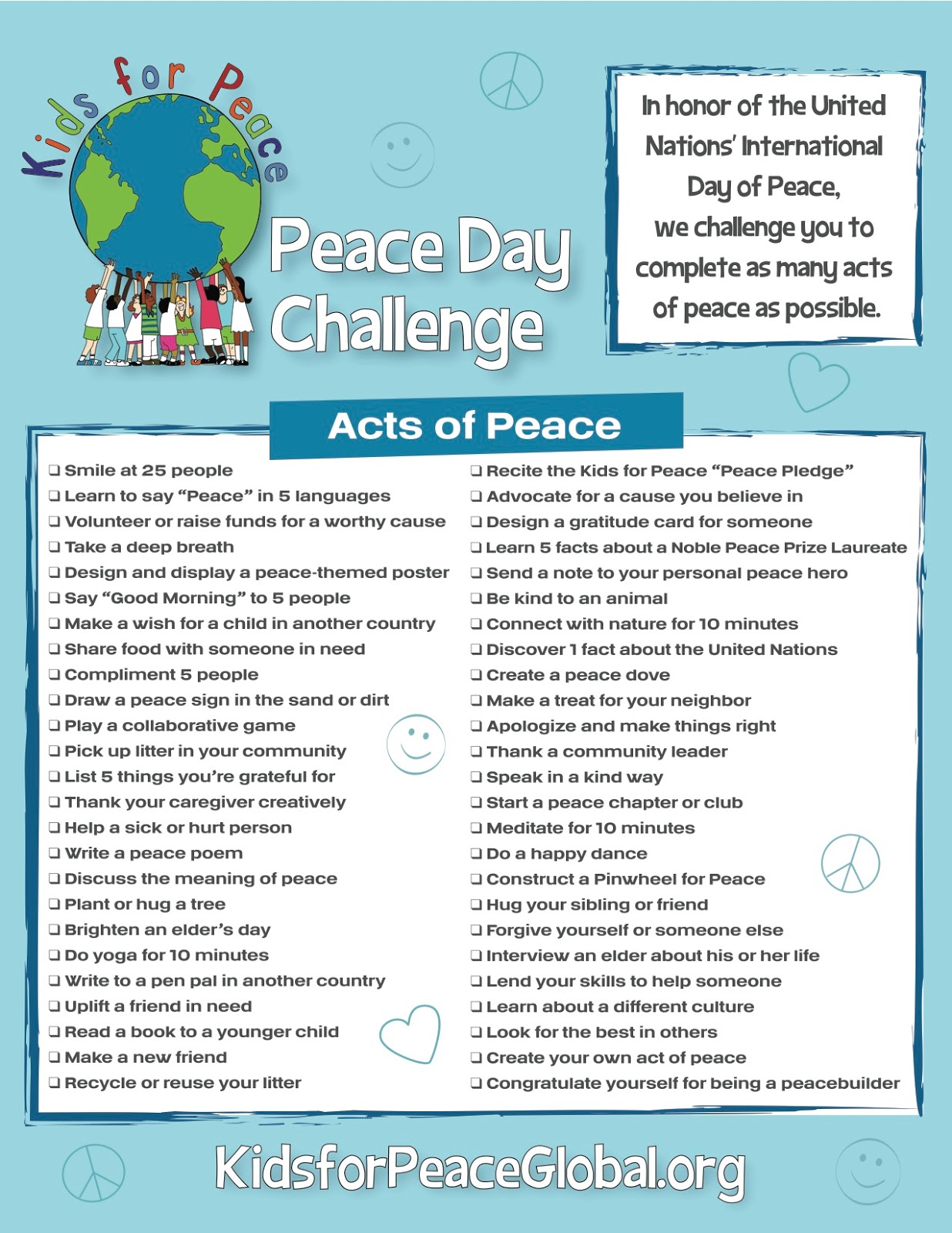
The last resource we’d like to bring attention to is the website called Kids For Peace. Its mission is to promote peace through youth leadership, community service, global friendships, and thoughtful acts of kindness. The Peace Pledge in this post can be easily downloaded from its website.
If you can do nothing else this Monday, try to have the students take the pledge. We are hoping to have everyone at our school take part in this. Kids For Peace also has a simple “Peace Day Challenge” to promote acts of peace. It’s perfect for any age level.
 |
| Source: Kids For Peace |
Sometimes we feel crunched for time to cover course material, but sometimes the right thing to do should force us to stop for something so important as PEACE!
For other resources, please see:
- Peace Through Understanding – GPI 2015
- Media Literacy: War And Peace Journalism
- Collaborative Hearts And Minds Help Kids Cope
You might also like:
Recess Rescue: Why Play Time Should Be Written Into The Students\’ Bill Of Rights
 |
| Source: ASIDE 2016 |
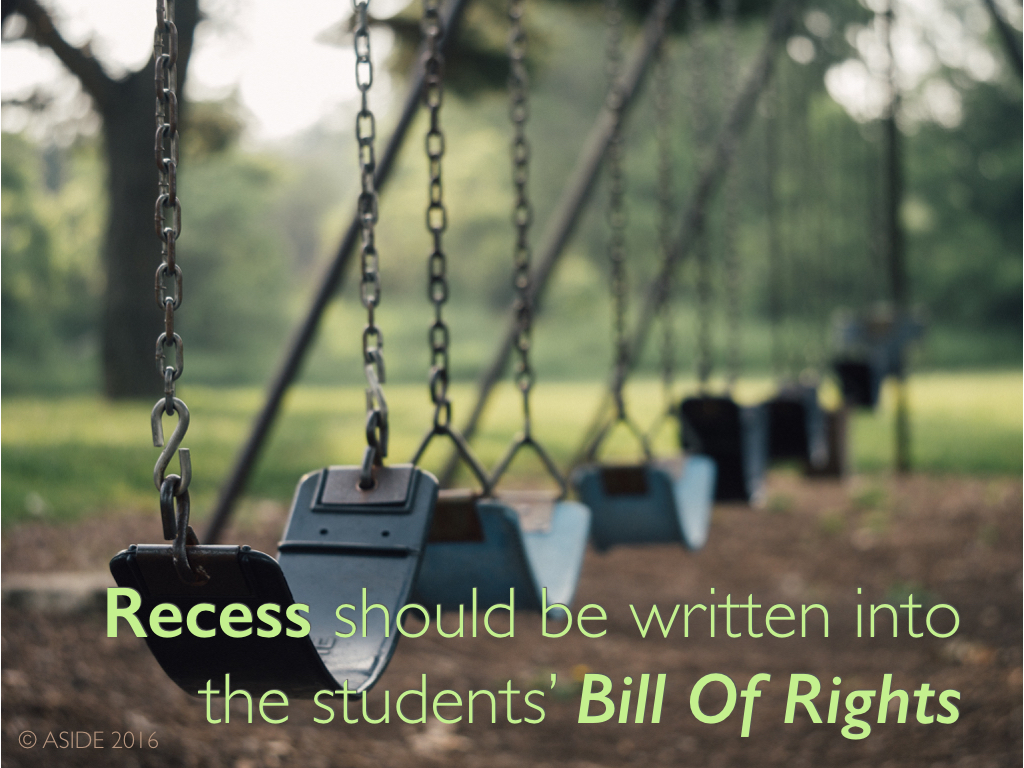
As our nation’s children head to back to the classroom, many schools find themselves trying to rein in kids’ summer impulses. Strict conduct policies are emphasizing rules and enforcing straight lines on students who are used to gamboling in backyards and lolling for hours.
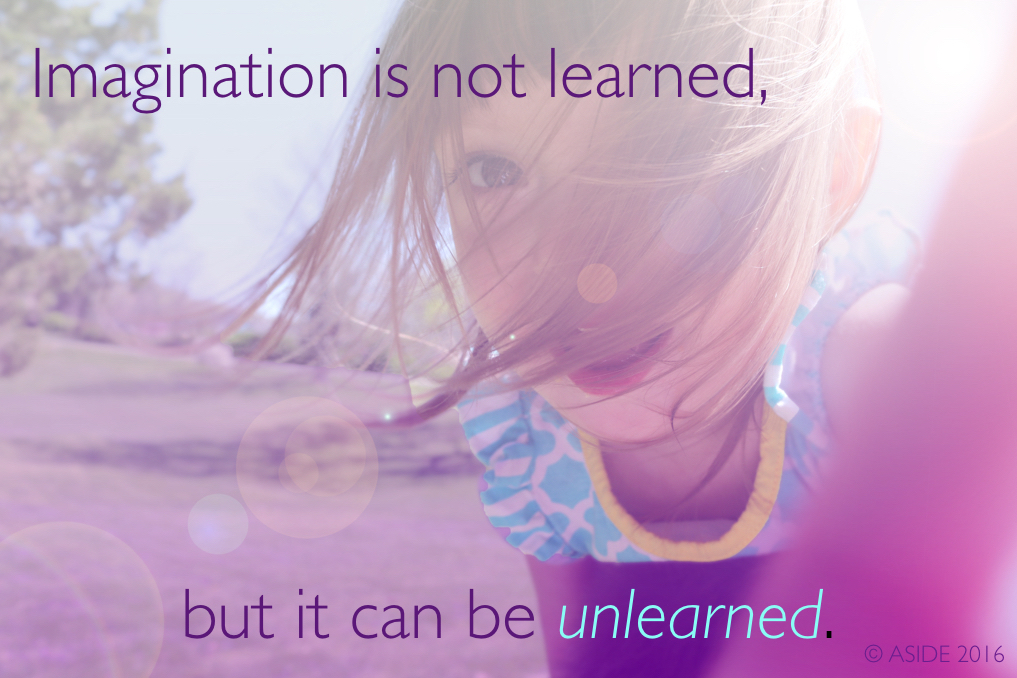
Many Scandinavian countries, most brain science, and all veteran teachers would encourage the exact opposite. They would argue that instead of limiting play, educators should expand the amount of free time dedicated to socialization and creativity. Imagination itself is not learned, but it can be unlearned due to the drone of worksheets and mandates.
 |
| Source: ASIDE 2016 |
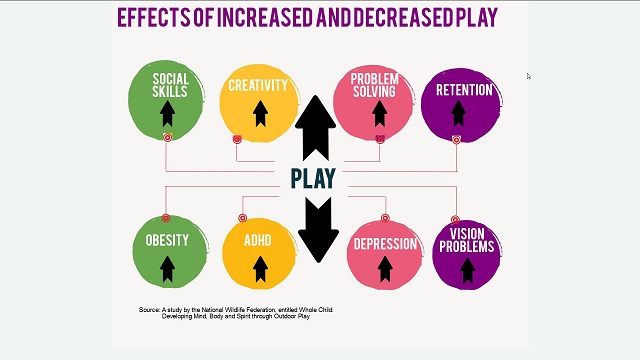
While many schools nationwide are reducing free play opportunities, our neighboring Patchogue-Medford district here on Long Island has actually doubled recess time from 20 to 40 minutes. In fact, a few Texas and Oklahoma schools now schedule recess four times a day. These changes are not capricious; they are part of studies such as the LiiNK Project, which has found that physical activity increases students\’ emotional well-being and reduces instances of bullying and stress. The American Academy of Pediatrics supports these findings with its seminal white paper about \”The Crucial Role Of Recess In School.\”
Across the board, students, teachers, parents, administrators, kinesiologists, therapists, and test graders are all witnessing the positive outcomes of enhanced play time. The scientist Jaak Panksepp has devoted a career of research to answering two pivotal questions: Where in the brain does play come from? And is it a learned activity, or is it a basic function?
 |
| Source: ASIDE 2016 |
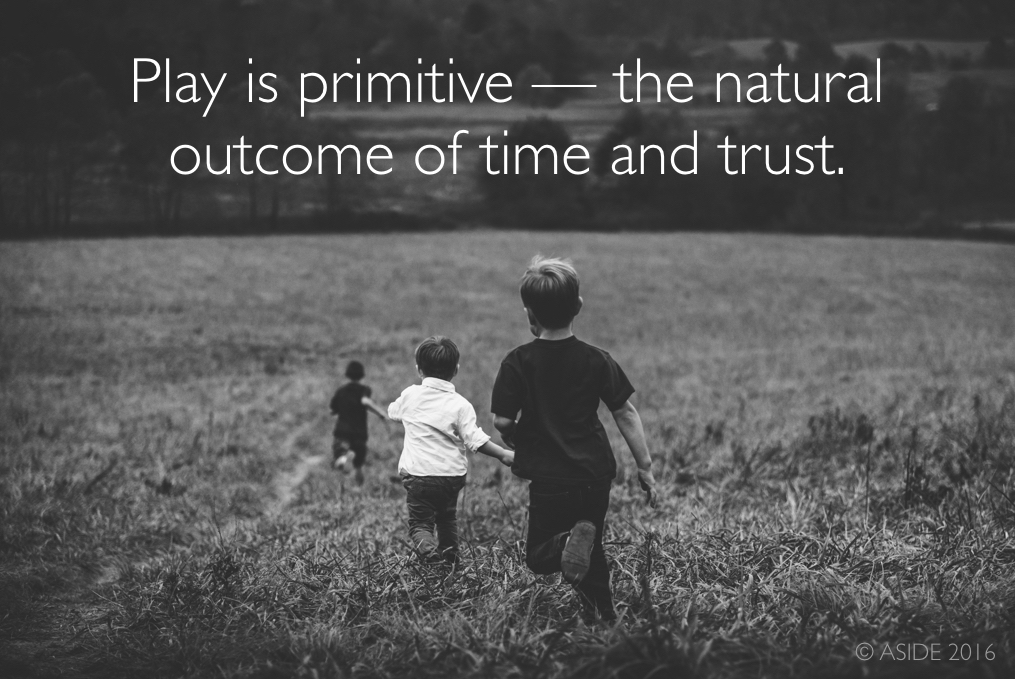
NPR has highlighted Panksepp’s studies, showcasing that play is deep and instinctive, shared across mammals, and integral to survival. Important social skills stem from play, in testing interactions, probing limits, and navigating hierarchies. In other words, play is primitive, the natural outcome of time and trust.
Children need this unstructured time to make mistakes and develop friendships on their own terms. The arena of the soccer field or the sand box is ideal in nurturing successful adults. Recess is not a privilege. It should not be an afterthought. It should instead be written into the students’ Bill Of Rights.
 |
| Source: KOIN |
Otherwise, what are our playgrounds? Are they monuments to eras past? Are they the still testaments to the naivety of earlier generations? Are they just another hallmark of the sped-up modern day, the never-enough-time-for day, when the things we wish for are just that — wishes?
 Eduindex
You must be logged in to post a comment.