ARE YOU FREE?

Everyone is trying to accomplish something big, not realizing that life is made up of little things.

The things and deeds we did in past are now to give us fruit in present and also in the future. And our present which is going to be our past will give us its fruit in the future. The topic “To look to the future’ One must study the past” revloves in the region of past present and the future of all mankind. It covers the whole story of human being. Some think it is essential to study history in order to make their future bright but some think past has no concern with the future. Other thinks that future is related to present, the things they have in present remain same as in future. Different people have different believe on the same the topic. Why is it so? Due to the different experiences they have in their past life. In some way or another experience is second name of past.

What actually affect the future? Experience affects the future. Future can never be predicted but we can strive to make it better by mean of the past experiences. Without knowing the past we repeat mistakes made in the past, and destroy our future. We can’t say that we are guessing future upon the past, but in some way we can perk up our future by relating it to the events take place in past, and work to make it enhanced. No one knows what will happen in the future but the past lend us a hand and lead us to our destiny.

There must be some reasons why past contribute a lot in building future. It is vitally important to study history and keeping the past in mind to avoid repeating the mistakes of the past and understand why things are as they are! We study history to learn where we were in the past and where we are now, to learn what worked for people in the past. We study history in order to remember the great achievements accompolished by our ancestors to make our future shine bright like diamonds and to remember the worst things happen in past and make sure not to do these things happen again in future. We study history to know what is the right thing to do and what is wrong so that we can understand what to do in life and how the wrong things happen and how we can be prevented.

Just think, if we do not have a past what would we be today? Obviuosly nothing, if we don’t know the hard works of our ancestor then how can we realize their great achievement, and what we can learn from their achievements and hardships and how can we pay respect to them. The biggest example is the achievement of Paskistan, if do not study history then how we could be able to compete with others and maintain or moral value. How could we realize and feel proud on our country, culture and faith. Without a past we couldn’t go through life. Our personal life is also interrelated with past. We can call our past as our memory it can be good or bad. It depends upon us with whom we want go either with bad one or by good one. We can take experience from bad memory furthermore good memories give us courage to live. It’s all about experiences. The more you know about history, the more you will be ready to build your future.

“Those who do not study history are doomed to repeat it.”
No one is strictly doomed to repeat it. But Yes! History repeats itself because no one pays attention for the first time. But if someone forgot the past they will surely repeat in number of manners. The game remains same but the player changes. Of course if we forgot something which we have to do then certainly we will some face outcome and consequences. There are many interesting events in the history which indicates us and enlighten with the truth about the words said above. Learning regarding the bad things in history is a way to prevent them from happening again

Some times for some people in some ways past acts as a greatest enemy of them. That who had a worst and most awful happening in their past life and couldn’t cope up with them for such people past is the greatest enemy. They rely on their past and start blaming other things that they came from this background and so on and start asking their self that why this happened to them and think if it would not happen then they would be in pleasure instead of working for the future they humiliates their past. They do not even try to come out of it and to deal with other and this will how they lose with the fear of defeat, after some time it become impossible for them to come out of this and to glow and rise again. In some ways their society won’t allow them to learn from their past, they keeping on repeating their past and let them feel bad and make them realize their mistakes and make them feel ashamed. This will lead them to disappointment.

We study history to think and feel proud on our country and on our motherland. History also introduces us to the important people of past they may be our idol or evil who contributed a lot in the structure of our country. There are loads of other reasons why do we prefer to study history. It tell us where were in our past life and where we are going to be in the future. It tells us our originality where we came from and how things, people and times change, how the culture and belief developed and then how suddenly with the passage of time they changed. History takes us to new era where we can judge our selves. Similarly if we can judge and understand our selves by studying our past, then simply we can guess, judge and understand other by analyzing their past. By mean of studying history we can understand about people behavior when they acted and how they behaved in such manners. If we do not understand them then how will we make interaction with them and develop relations with them. It also develops our thinking and relating skills that how we can relate one thing with another and then get better result. Many philosophers, scholars say to gain and learn from your past experience in order to understand your life and move towards golden future and to learn lessons, wisdom and intelligence. Therefore, history leads us to understand the past and use this fact and figure to work in present and get better result in future.

“A person with no sense of the past is a person who is a stranger both to his or her own roots and to the human condition more generally. For human beings are not creatures of nature; we are inheritors of the history that has made us what we are. Not to know our history is not to know ourselves, and that is the condition not of human beings, but of animals. And even from a practical point of view, to be ignorant of the past is to make us impotent and unprepared before the present

Our future is unwritten and can be designed to our own liking. But often what we do is we let our past determine the design of our future. And as a result, it looks quite similar to our past. We repeat the same mistakes because we bring our baggage from the past into the next chapter of our lives.

Sure we want to learn from the past and from our mistakes. But when that learning turns into so much baggage that the future looks exactly like our past, the value of that learning diminishes. The future is a blank slate that is completely open for invention.

If we’re going to effectively design our future, at some point we have to let go of our past. We have to let go of all the pain, all the agony, all the grief, and all the bullshit that’s in our heads.

To design your future you have to see the world as malleable, something that can be shaped to your own liking. And you have to see yourself as the kind of person who has the ability to take the world in your head and impose it on the world around you until the world around you looks like the one in your head.

The greatest opportunity cost you have as a human is not taking your own ideas seriously. Write a 500 word description of what you want your life to look like in 2 years. This will act as your signpost. Then (and here’s the kicker) post it on your blog or email it to someone who will “get it”. It’s hard to go back on a revolution that you’ve already announced.

If you want to be happy, do not dwell in the past, do not worry about the future,
The past is the past for a reason.
That is where it is supposed to stay,
But some cannot let it go.
In their heads it eats away
Until all their focus becomes
The person they used to be,
The mistakes they made in their life.
Oh, if only they could see
That you cannot change what happened,
No matter how hard you try,
No matter how much you think about it,
No matter how much you cry.
What happens in your lifetime
Happens for reasons unknown,
So you have to let the cards unfold.
Let your story be shown.
Don’t get wrapped up in the negative.
Be happy with what you have been given.
Live for today not tomorrow.
Get up, get out, and start living,
Twenty years from now you will be more disappointed by the things you didn’t do than by the ones you did do.
So throw off the bowlines, sail away from the safe harbor.
Catch the trade winds in your sails.
Explore. Dream. Discover.

Destiny has a way of creating chain reactions in our lives. And sometimes this chain reaction occurs when the shit hits the fan or we hit rock bottom, setting in a motion a series of events that you couldn’t have planned for or predicted. Friends we’ve yet to meet, opportunities we’ve yet to receive, and lovers whose stars have yet to cross with ours. And with each of these events our destiny unfolds into a journey worthy of our heart and soul, a life worthy of living, full contact, in full color. Remember this through fortune and misfortune, joy and grief, good times and bad ones.

Carry it with you. Let it guide you in the direction you’re destined to go, along with the path that you are destined to take. The future is an unpaved road and a destiny that is yours to shape.
Was it really a lockdown?

As I sat to pen down my thoughts, came an announcement that the nation-wide lockdown has been lifted up with new rules “unlock-1”. I was thinking “what’s left than being atmarnirbhar anymore”, but rules are rules even if no one follows them. Even before the dust settled on this communication, out came the opposition parties with their words as knifes drawn, excoriating the government! The time when we expect are political mass to speak in unison for the nation, they are throwing knifes at each other without minding, not just India but the whole world is currently in the grip of a pandemic of epic and high proportions. The need of the hour is to stand together( speaking metaphorically, social distancing needs to be maintained), and here we are having a political party comprised of imperators leading the attack on the ruling party, hate-filled rhetoric, tinged with jealousy, knowing that offers nothing productive.

An extremely infectious virus and contact of it can lead to mushrooming of it. Despite warnings, we still have people on the streets; few with genuine needs of purchasing, few hundred misled migrants wanting to return to their hometowns, and the remaining are hundreds of morons roaming the streets with absolutely no essential needs measuring the lengths even without a mask as if they are some supernatural being, a vampire or something who cannot be effected by this deadly virus. But above all they do have an intention; they are roaming with a sole intention of defying authorities! And the list not ends here; we have some self-proclaimed comedians and so called celebrities abusing the prime minister- even calling him a clown for the tasks that he assigns to us, “Indians”. All of this without realizing that this is being done to keep the spirits of the people high and country united and we did feel that in the given tasks.

 I personally had a balanced and jocular view on this lockdown period. I have been to multiple zero cost excursions to exotic locations within the house or I would rather say within my room having extremely fond memories of these trips finding my own self and working upon that and I enjoy standing in my balcony listening to birds or staring at the night sky full of stars, I loved standing in peace and the thing I loved the most is to see our mother nature heal.

I cannot understand the cribbing and negativism in some people. Is making money, socializing, visiting malls, shopping, etc. more important than life itself? If nothing, appreciate the real life heroes who are out there saving lives! One should take this as an opportunity to introspect, shed apathy and restart life with fresh dynamism.

Remember, yesterday was not ours to cure but tomorrow can be a win….or lose, choose wisely!

USE OF PHYSICAL METHODS IN MICROBIAL CONTROL

Although microorganisms are beneficial and necessary for human well being, microbial activities have undesirable consequences such as food spoilage and disease. To minimize there destructive effects, it is essential to kill a wide variety of microorganisms or inhibit their growth.

  1. Heat
    Heating is still one of the most popular ways to destroy microorganisms. Fire and boiling water have been used since the time of Greeks for sterilization and disinfection. Exposure to boiling water for 10 minutes is sufficient to kill or destroy vegetative cells and eukaryotic spores, but not enough to kill or destroy bacterial endospores, hence boiling does not sterilize but can be used for disinfection of drinking water and objects not harmed by water. This can be carried out within an autoclave. Hot and saturated steam enters a chamber and the desired temperature and pressure which is usually 121°C and 15 pounds is reached. At this temperature and pressure the steam destroy all vegetative cells and endospores. Moist heat is thought to kill so effectively by degrading nucleic acids and by denaturing enzymes and other essential proteins It may also disrupt cell membranes.
    Pasteurization is a process where many substances such as milk, are treated with controlled heating at temperatures well below boiling. There are two types of pasteurization- flash pasteurization or high temperature short term (HTST) pasteurization and the other method used is ultra high temperature (UHT) pasteurization.
    Dry heat sterilization can also be used on many objects in the absence of water. The items to be sterilized are placed in an oven at 160 to 170°C.
  2. Low temperatures
    Another convenient method to inhibit the growth and reproduction of microorganisms is to use lower temperatures like freezing or refrigeration. Mostly this method of control is used in food microbiology. Freezing items at -20°C or lower stops microbial growth because of the absence of liquid water and the ice crystal destruction of cell membranes at this temperature. This method is also used for long term storage of microbial samples in the laboratory in the form of glycerol stocks. This method of control at low temperatures slows microbial growth and reproduction but does not half it completely. Fortunately most pathogens are mesophilic and do not grow well at low temperatures around 4°C. Thus, refrigeration is a good technique only for short-term storage of food and other items.
  3. Filtration
    The filters simply remove the microbes instead of killing them. The material used mostly is glazed porcelain, asbestos or other similar materials. Membrane filters are also used and have replaced depth filters in recent times. These filters are used to remove most vegetative cells, but not viruses from solutions ranging in volume from 1 ml to many liters.
    The other way this method is used is in the laminar flow biological safety cabinet where the air is sterilized by filtration. These cabinets contain high efficiency particulate air(HEPA) filters.
  4. Radiation
    The radiations like ultraviolet and ionizing can be used for sterilizing objects. UV radiation is used as a sterilizing agent only in a few specific situations like UV lamps are placed on the ceilings of room for in biological safety cabinet to sterilize air and other exposed surfaces. Commercial UV units are available for water treatment. Pathogens and microorganisms are destroyed when a thin layer of water is passed under the lamps (water purifiers).
    Ionizing radiation penetrates deep into objects and is an excellent sterilizing agent. It destroys bacterial endospores and vegetative cells of both prokaryotic and eukaryotic origin but not against viruses. Gamma radiation from a Cobalt 60 source is used in the cold sterilization of antibiotics, hormones and plastic disposable supplies such as syringes and petri dishes.

Commercialization of Education

Back in the 90s, getting 60 percent on your boards meant having a party in the whole neighborhood; it was a celebration. Today, even 95 percent is not enough to secure your admission in the college and course of your choice. So, what changed during all these years? Not the NCERTs for sure.

India is fast becoming a country where education is just another commodity. With everyone obsessing over education and paying any amount of money to get the best, the real essence of education has been devalued. It is no longer a noble cause; it is a mere means for people to earn a profit, to scam others into paying for a basic necessity.

To educate someone means to impart that person the knowledge so that he or she can survive in society. But the commercialization of education has turned almost every institution into a business or a money-making factory, charging huge amounts for all the facilities that they provide. And the sad part of it all is that these facilities aren’t even required most of the time.

Today, every nook and corner has a new coaching institute being run by someone who is not even a professional of the field they are teaching or tutoring students in. As a result, most of the students going from schools to colleges are not using any prior knowledge from their formative years. Furthermore, the students passing out of colleges are not ready to be employed right away. Yet they are being employed, many even as teachers. A teacher is a pillar of a child’s future, but what will happen if the teacher himself fails to build a strong foundation for his student’s life?

Another important parameter for quality education is having the right infrastructure. The environment of the place where you send your child to study matters a lot. As a student, it is important to keep in mind that nurture plays a huge role in the development of our minds and the correct environment is the first step towards nurturing the feeling of learning in our minds. Schools and colleges are spending way more on advertising their institutions and finding prospective customers in the name of students rather than spending that same money on improving the infrastructure and the facilities available for the students. The parents are falling prey to these lucrative ads, readily paying a huge amount of money to get their ward into the said institution, without even realizing that their hard-earned money will be used to catch other prey. Basically, they are being cheated in the name of education.

Instead of being the solution to a problem, education itself is becoming more of a problem. Even though the education industry is rising, it is lagging behind in fulfilling its social responsibility towards the society.

The education system has to improve, thereby improving the meaning of education. Providing education should no longer equate to just paying the fees. The youth has to be provided with quality education and the whole society has to work together to convey this message to the world.

Image Courtesy: Google

Pronam to Shri Guru Ravidas Ji: A Great Saint of India

    Time to time, many great personalities were born in our country and also from ancient time to present days many foreigners have been visiting India for different purposes inter alia of which are learning of Indian languages, to gain in-depth knowledge about the biography of Indian saints, Indian culture etc. While I was in many countries, honestly informing many foreigners told me ‘India/your country is great/incredible’. In this article, I am presenting few lines about a great saint Shri Guru Ravidas Ji so that readers can refresh their knowledge about this great personality.

Shri Guru Ravidas Ji, also known as Raidas (flourished 15th or 16th century) was a spiritual person, poet, great human being associated with Indian bhakti movement. He was born in Varanasi in a so called ‘untouchable leather-working caste’, but his knowledge, wisdom, spiritual development and humanitarian activities were so high that many upper castes or other castes persons cannot stand near to his activities. I feel simply by caste one cannot be great; for greatness humanitarian activities are sine qua non.    

       Many researchers believe that Shri Ravidas ji met Guru Nanak Dev Ji, the founder of Sikhism and 41 of Shri Ravidasji’s poems were included in the Adi Granth. 

Shri Ravidas ji was a prominent figure in the bhakti movement and a renowned poet of the Nirgun bhakti tradition that valued the worship of a formless God. Two researchers who have carried out extensive study on Shri Ravidas ji’s activities are Dr. Winand Callewaert and Dr. Peter Friedlander have published many books and articles on him. They have translated his songs also. One is presenting here. It may be mentioned that Prof Dr. Winand Callewaert is now retired but still teaches Sanskrit at the KU Leuven University in Belgium. He studied in India and obtained degrees in Hindi and Sanskrit. He has published many books and articles in English, Dutch and Hindi. Another scholar Dr. Peter Friedlander lived in India from 1977-1982 and learned Hindi in Varanasi. He then studied at SOAS London University and completed his PhD on the life and works of Saint Ravidas in 1991.

“Raidas says, what shall I sing?

 Singing, singing I am defeated.

How long shall I consider and proclaim:

 absorb the self into the Self?

This experience is such,

 that it defies all description.

I have met the Lord,

 Who can cause me harm?

Hari in everything, everything in Hari –

 For him who knows Hari and the sense of self,

no other testimony is needed:

 the knower is absorbed”.

(As mentioned already Shri Ravidas ji wrote and translated by Winand Callewaert and Peter Friedlander). The noteworthy point from the song is that “Hari in everything, everything in Hari” (Hari is name of a God/Bhagawan as per Hinduism).

Another researcher, David Lorenzen has mentioned Shri Ravidasji’s poetry is filled with themes of infinite loving to God, wherein this divine is intended as Nirguna. It is pertinent to mention that Nirguna bhakti is an unconditional devotion to God without any form (formless) whereas Saguna bhakti is devotion to an established deity who takes the form of an idol, an image or an incarnation. Guru Ravidas Ji was vocal against the Varna (caste) system and in his poetry, questioned caste hegemony, valued labour of all sorts, as well as a life of simplicity and morality. He initiated dialogs with upper caste Hindus about caste, social justice, love and forms of worship. He spread the message that “God created man and not man created God”, means everyone is created by the God and has equal rights on this earth. It is believed that because of his teachings and discourse many persons irrespective of castes (including upper caste) and rich or poor were his followers including the King and Queen of the Chittoor kingdom presently in Rajasthan.

    Shri Guru Ravidas Ji undoubtedly was a great saint and rightly a temple has been constructed in his hometown, where he is worshipped every day. His songs are purely devotional and recited every morning and evening in the temple. His birthday is celebrated every year on Magh Purnima day i.e. at full moon day of Magh month of Indian calendar as a religious event with full enthusiasm, dedication and devotion.

    Although, Shri Guru Ravidas Ji has passed away around 500 years ago (believed in 1520) but he will be in the heart of millions because of his spiritual, devotional and humanitarian activities. Also it is evident from his life that caste can never be a barrier to be a Saint and Guru.

I extend my respectful Pronam to such a Great Soul, Saint and Guru.

The following websites have been consulted while writing the article:

  1. https://www.britannica.com/biography/Ravidas
  2. https://en.wikipedia.org/wiki/Ravidas
  3. https://www.yogapedia.com/definition/8501/nirguna-bhakti
  4. https://www.manifestias.com/2019/11/05/saint-ravidas

Dr. Shankar Chatterjee

Former Professor& Head (CPME)

NIRD &PR (Govt. of India),

Hyderabad-500 030

Telangana, India

Email <shankarjagu@gmail.com>

Discovery of God Particle : Super Exclusive >>>>>>>

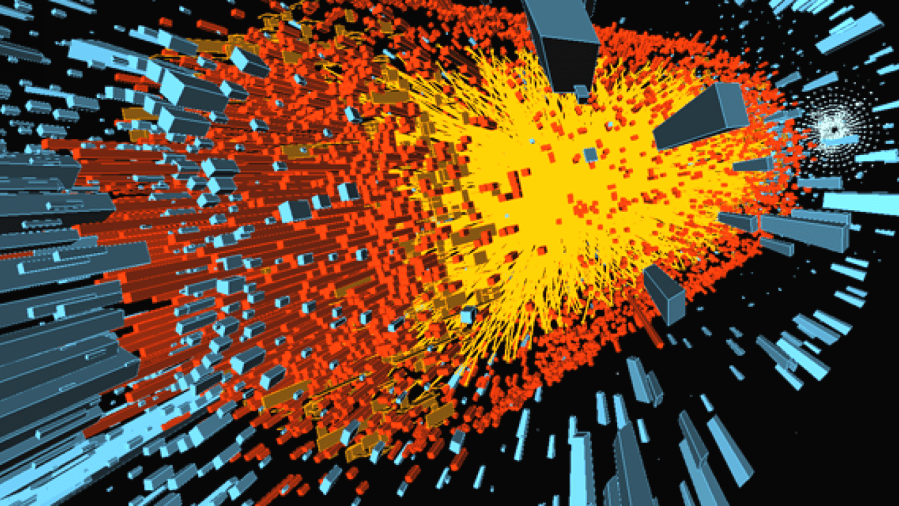
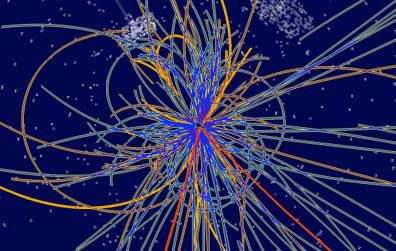
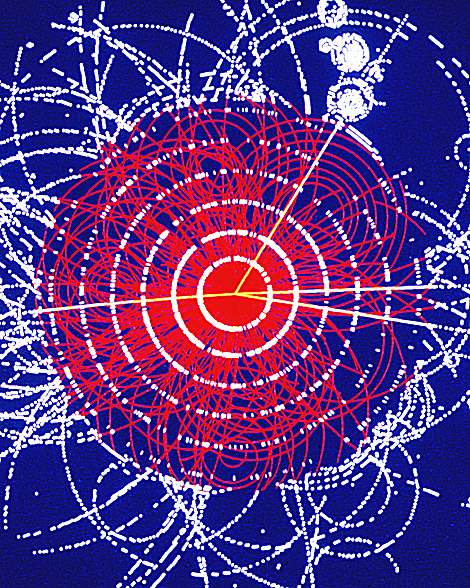
The two largest experiments at the Large Hadron Collider (LHC), ATLAS and CMS, have observed a previously undetected way that the Higgs boson can decay — into an elementary particle called the bottom quark, and its antiparticle.

The same experiments, based at CERN, the European particle-physics laboratory outside Geneva, Switzerland, first discovered the Higgs in 2012. The boson, which is a key part of the mechanism that gives other particles their masses, put in place the final piece of the standard model of particle physics.

LHC researchers have accumulated evidence of the particle decaying into a variety of products, following theoretical predictions, including into two photons and an electron–antielectron pair.

Credit: Third Party Reference

In June, researchers revealed that they had also seen the Higgs interact with the top quarks, the most massive known elementary particle. The bottom-quark decay, announced on 28 August is expected by theory but the signal had been hiding in the data, because the interaction is difficult to single out from the many other processes that can also produce those particles.

Geneva, 28 August. Six years after its discovery, the Higgs boson has at last been observed decaying to fundamental particles known as bottom quarks. The finding, presented today at CERN by the ATLAS and CMS collaborations at the Large Hadron Collider (LHC), is consistent with the hypothesis that the all-pervading quantum field behind the Higgs boson also gives mass to the bottom quark. Both teams have submitted their results for publication today.

The Standard model of particle physics predicts that about 60% of the time a Higgs boson will decay to a pair of bottom quarks, the second-heaviest of the six flavours of quarks. Testing this prediction is crucial because the result would either lend support to the Standard Model – which is built upon the idea that the Higgs field endows quarks and other fundamental particles with mass – or rock its foundations and point to new physics.

Credit: Third Party Reference

Spotting this common Higgs-boson decay channel is anything but easy, as the six-year period since the discovery of the boson has shown. The reason for the difficulty is that there are many other ways of producing bottom quarks in proton–proton collisions. This makes it hard to isolate the Higgs-boson decay signal from the background “noise” associated with such processes. By contrast, the less-common Higgs-boson decay channels that were observed at the time of discovery of the particle, such as the decay to a pair of photons, are much easier to extract from the background.

To extract the signal, the ATLAS and CMS collaborations each combined data from the first and second runs of the LHC, which involved collisions at energies of 7, 8 and 13 TeV. They then applied complex analysis methods to the data. The upshot, for both ATLAS and CMS, was the detection of the decay of the Higgs boson to a pair of bottom quarks with a significance that exceeds 5 standard deviations. Furthermore, both teams measured a rate for the decay that is consistent with the Standard Model prediction, within the current precision of the measurement.

This observation is a milestone in the exploration of the Higgs boson. It shows that the ATLAS and CMS experiments have achieved deep understanding of their data and a control of backgrounds that surpasses expectations. ATLAS has now observed all couplings of the Higgs boson to 

“Since the first single-experiment observation of the Higgs boson decay to tau-leptons one year ago, CMS, along with our colleagues in ATLAS, has observed the coupling of the Higgs boson to the heaviest fermions: the tau, the top quark, and now the bottom quark. The superb LHC performance and modern machine-learning techniques allowed us to achieve this result earlier than expected,” said Joel Butler, spokesperson of the CMS collaboration.

Credit: Third Party Reference

With more data, the collaborations will improve the precision of these and other measurements and probe the decay of the Higgs boson into a pair of much-less-massive fermions called muons, always watching for deviations in the data that could point to physics beyond the Standard Model.

“The experiments continue to home in on the Higgs particle, which is often considered a portal to new physics. These beautiful and early achievements also underscore our plans for upgrading the LHC to substantially increase the statistics. The analysis methods have now been shown

Reference- https://divyanshspacetech.wordpress.com

Medical Emergency Not An Excuse To evade Fundamental Rights Under Article 21 Of Constitution

It is most heartening, most refreshing and most comforting to note that the Telangana High Court has on May 20, 2020 in a latest, landmark and extremely laudable judgment titled Ganta Jai Kumar Vs State of Telangana Rep. by Chief Secretary and others in Writ Petition (PIL) No. 75 of 2020 authored by Justice MS Ramachandra Rao for himself and Justice K Lakshman has explicitly, effectively and elegantly observed that a medical emergency is not an excuse to trample on the fundamental rights of a citizen under Article 21 of the Constitution. While holding so, the Telangana High Court has quashed a government order which compelled citizens to get testing and treatment for COVID-19 from designated government hospitals and prevented them from approaching private hospitals and laboratories for such purposes even though they have requisite approval from the ICMR. Very rightly so!

                                       Needless to say, the Telangana High Court was unable to agree with the contention of the Advocate General for the State of Telangana that there is a state of emergency in the State in view of the Covid-19 pandemic and that such emergency justifies the State action. It candidly and convincingly stated in para 50 that, “We are unable to agree. Admittedly no emergency has been declared by the Government under Article 356 of the Constitution of India, though there is a pandemic situation undoubtedly.” Besides, it also noted that Article 359 has been amended by the Constitution (44th Amendment) Act to say that the President cannot suspend the right to move a court for violation of Article 20 and Article 21 even in an emergency and seek appropriate relief.

                                     In this backdrop, the Telangana High Court in para 57 then very crucially went on to point out that, “This above decisions of the Supreme Court are a complete answer to the plea of the Advocate General that because there is a medical emergency or a war emergency anything can be done by the State including arbitrarily restricting the right to health conferred under Art 21 on a citizen of the State. An emergency of any sort is not an excuse to trample on the rights under Art 21 and the Courts have the power to see that the State will act in a fair, just and reasonable manner even during emergencies. Whether the State has done so or not is judicially receivable in the light of the law laid down by the Supreme Court.”    

                                          Of course, the Court also in para 56 quoted the famous words of Lord Atkin in Liversidge v Anderson that, “In this country, amid the clash of arms, the laws are not silent. They may be changed, but they speak the same language in war as in peace.”

                                                 In this context, it would be pertinent to mention that in para 33 of this noteworthy judgment, it is rightly held that, “Every human being has a basic and natural born instinct to protect himself and his kith and kin from danger – be it from human, animal or one in the nature of a disease, by utilizing all the means available in his power. The State cannot incapacitate him by restricting his choice particularly when it comes to a disease which affects his life/health or that of his kith and kin.”

                                                       More relevantly, it is then very rightly pointed out in para 28 that, “It is the basic principle of administrative law that every action of the State which affects the rights of citizens must be supported by reasons so that a Court can, while judicially reviewing it, know that there is application of mind to the issue by the authority concerned, which passed the said order. Absence of reasons would undoubtedly vitiate the later order dt 11.4.2020.”

                                  In the same vein, it is also then noted in para 38 that, “According to the Supreme Court of India, it is imperative that any restriction of right of the citizens in that regard must be by a procedure prescribed by “law” and such “law” must be reasonable, fair and just. It cannot be arbitrary, whimsical or fanciful.” Similarly, it is then observed in para 42 that, “As stated by the Supreme Court, the right to health of a citizen is a fundamental right under Art 21 and restriction thereupon must be reasonable, fair and just.” 

                                        What cannot be overlooked is what is then stated in para 43  while emphasizing the role of private sector that, “It is of utmost importance that each and every case (suspects/confirmed) of COVID-19 is isolated and provided appropriate treatment and their contacts traced at the earliest to break the chain of transmission. It is important that support and cooperation of the private sector is enlisted, in this regard. This is the policy which has been declared by the Ministry of Health and Family Welfare, Government of India in its “Guidelines for notifying COVID-19 affected persons by Private Institutions” notified recently.”

                             While acknowledging the petitioner’s contention, it is then put forth in para 59 that, “As rightly contended by the petitioner, we find that there is no power in Sec. 2 of the Epidemic Diseases Act, 1897 either to prevent private hospitals from testing suspected any victim of an epidemic such as COVID-19 patients or treating confirmed infected patients. In fact in that era (pre 1900), the concept of private sector participation in health care was hardly there in India.”

                                           Furthermore, it is then enunciated in para 60 that, “What the Sec 2 prohibits and what it permits, in a case where there is a dangerous epidemic, disease for which the ordinary provisions of the law are insufficient. In such a case the State may take, require or empower any person to take “such measures” and by public notice such “temporary regulations” to be observed by the public or by any person or class of persons as it shall deem necessary to prevent the outbreak of such disease or the spread thereof.” 

                                      Not stopping here, it is then envisaged in para 61 that, “The Ministry of Health and Family Welfare, Union of India and the ICMR cannot be said to have ignored these provisions of the Epidemic Diseases Act, 1897 and this Court has good reason to believe that the Union of India and the ICMR did give due consideration to this provision of law while permitting testing and treatment of COVID-19 patients by private laboratories and hospitals.”

                                          On similar lines, it is then further conceded in para 62 that, “On the other hand by issuing a set of guidelines called “Guidelines for notifying COVID-19 affected persons by Private Institutions”, the Union of India had clearly applied its mind to the provisions of the above Act which permit the Government “to take measures necessary to prevent the outbreak and spread thereof” by permitting private laboratories and hospitals also to be involved in the said prevention and outbreak and spread of the epidemic.”

                                          Be it noted, it is then observed in para 63 that, “The State Government, in its counter, has not questioned the wisdom of the Union Government and the ICMR in permitting private laboratories to achieve the very object of prevention and spread of the epidemic. On the other hand, the respondent Nos. 1-4 appear to have come to the opposite conclusion, contradicting the wisdom of the Union of India and an expert body like ICMR.”

                                         Going ahead, it is then disclosed in para 64 that, “In fact we find that the ICMR has notified on 3.5.2020, 111 private laboratories and 310 Government laboratories. It is obvious that by permitting 111 private laboratories to conduct COVID-19 tests across the country, the Union Government and ICMR were trying their best to take the private sector on board and to achieve the goal of stopping the spread of the epidemic.”

                                        No wonder, it is then held in para 65 that, “We therefore hold that the respondents Nos. 1-4 have no logical or legal basis to come to an opposite conclusion and come forward with total prohibition.”

                                             More strikingly, in a big setback to the respondents, it is then held in para 66 that, “It is not the case of the respondent Nos. 1-4 that there is a cure for the COVID-19 virus, that only Gandhi Hospital in the State of Telangana has got a vaccine for it, and so everybody in the State of Telanagana, who is infected with the virus has to go to the said hospital. May be the facilities in the said Hospital or other designated Government Hospitals are very good, but that does not mean that the respondent Nos. 1-4 can, under the guise of taking steps to prevent the spread of the Pandemic, restrict the liberty and freedom of a citizen to choose his own doctor and hospital and force him to take a test for COVID-19 infection or treatment from Government sources, if found to be infected with the said virus.” 

                                   Most crucially, it is then observed in para 92 that, “For the elaborate reasons given above, we hereby allow the Writ Petition and we:

(i)                         declare that the proceedings Rc.No.Spl/COVID-19/DMHO/HYD/2020 dt 11.4.2020 issued by the District Medical and Health Officer, Hyderabad which states:

“Adverting to the subject cited above, orders issued by this office regarding certain instructions on treating only emergency cases at notified hospitals in Hyderabad District vide reference 6th cited are hereby cancelled with immediate effect.”

is violative of Art. 14 and Art. 21 of the Constitution of India and also the principles of natural justice (for not giving any reasons) and is set aside;

(ii)                      hold that the respondent Nos. 1-4 cannot compel residents/citizens of the State of Telangana to get (a) testing for COVID-19 in NMS/Gandhi Medical Hospital or only in the other designated laboratories decided by them and (b) treatment/isolation only in hospitals designated by them, when the citizens/residents are willing to pay the cost and get their blood samples tested in the private ICMR approved laboratories or private sector hospitals having the requisite infrastructure by paying the requisite charges;

(iii)                   hold that it shall be the right of the citizens and residents of the State of Telangana to get tested on payment basis, if they choose to do so, for COVID-19 in any private laboratory presently approved by the ICMR or may be approved in future at such rates as may be determined by ICMR or any other competent authority of the Union of India;

(iv)                   hold that it shall be the right of the citizens and residents of the State of Telangana to get treatment on payment basis, if they chose to do so for COVID-19 in any private hospital presently approved by the ICMR or may be approved in future by it; and

(v)                      direct that all private hospitals, who wish to provide treatment/isolation for COVID-19 patients (other than the ones already granted such approval by the ICMR), shall make an application to the ICMR offering their facilities for the said purpose; the ICMR shall nominate qualified and experienced persons to scrutinize the said applications and cause inspections made of the available facilities and infrastructure in the said private hospitals, to verify whether they possess adequate number of qualified doctors, qualified nurses, paramedical staff apart requisite equipment and notify the same. This exercise shall be completed within the shortest possible time in view of the grave urgency and rising cases of persons infected by COVID-19 and deaths caused by it. Only such private hospitals as are approved by the ICMR shall be permitted to treat COVID-19 patients.       

                                           On a different note, it is then further added in this same para 92 that, “It is needless to observe that all protocols approved by ICMR or other competent authority from time to time shall be followed by the ICMR approved private laboratories and hospitals that have already been or would be approved in future by the ICMR for testing or treating/isolation of COVID-19 suspects/patients; and all possible precautions shall be taken by the ICMR approved private laboratories and hospitals to take good care of the suspects/confirmed COVID-19 patients; and the ICMR approved hospitals shall keep the respondent No. 4 or any other authority designated by respondents 1-4 informed on a daily basis of the persons who are being treated by them for COVID-19 and their health status.”

                                       Before parting, the Telangana High Court very commendably observes in para 93 that, “We place on record our appreciation for the petitioner for approaching this Court and bringing to our notice this important issue concerning the health and lives of our fellow citizens.”

                                                     In conclusion, it is a very well written, well balanced and well reasoned judgment. It leaves no room for doubt whatsoever that medical emergency cannot be an excuse to trample upon citizen’s fundamental rights under Article 21 of the Constitution. No doubt, all the State Governments as also the Union Government must from now onwards always in their own best interest bear this latest, landmark and extremely laudable judgment while deciding in such cases of medical emergency! 

Sanjeev Sirohi, Advocate,

s/o Col BPS Sirohi,

A 82, Defence Enclave,

Sardhana Road, Kankerkhera,

Meerut – 250001, Uttar Pradesh.

NHAI becomes first construction sector organisation to go ‘Fully Digital’

As one of the biggest reform, the National Highway Authority of India (NHAI) under Ministry of Road Transport and Highways has gone ‘Fully Digital’, with the launch of unique cloud based and Artificial Intelligence powered Big Data Analytics platform – Data Lake and Project Management Software. The entire project management work flow of NHAI is transformed from manual to online portal based, wherein the complete project execution operations including ‘workflow with time lines’ and ‘alert mechanism’ have been configured. All project documentation, contractual decisions and approvals are now being done through portal only. 

With advance analytics, the Data Lake software will forecast the delays, likely disputes and will give advance alerts. Thus apart from expediting the decision making, it will also facilitate in taking correct and timely decisions as the system is likely to predict financial impacts of different alternatives based on the historical data. This will reduce a lot of disputes.

NHAI has a history of having large number of arbitration cases pending with huge amount of claims and counter claims. Majority of the disputes are generic in nature like delay in handing over of encumbrance free site, shifting of utilities, idling charges of plant, machinery, equipment, manpower and delay in decisions etc. These disputes can be minimized as the Data Lake software has provisions to keep track and check on all these constraints and will ensure work is carried out within the deadlines in a transparent manner. As all processes are going to be portal-based, decision-making is going to be faster and will eventually diminish chances of litigation in future.

The complete project documents and correspondences will be stored in Digital format in the cloud-based ‘Data Lake’ linked with GIS tagging and Unique Project ID, so that the project data can be easily retrieved as and when required from any location. NHAI’s all contractors/ concessionaires/consultants/Authority Engineers (AE)/ Independent Engineers (IE) and Project Directors (PDs)/ Regional Officers (ROs) have already started using it extensively. NHAI’s e-Office module is also integrated in the system so that all correspondences can flow digitally in a secured manner from field units to HQ seamlessly. 

In the current Covid-19 pandemic scenario, when most of the organizations are facing serious challenges in working, NHAI employees are continuing their works undeterred and happily without any fear of physical contacts and touching of physical files.  Rather, lockdown period was used by NHAI to train its employees about using Data Lake.

The Data Lake will bring revolutionary changes to NHAI with benefits like No delays, Quick decision making, No question of missing records, Work from anywhere/anytime. It will enhance transparency, as all officers and stakeholders, connected with the project can see what is going on real time basis which will amount to concurrent performance audit by the seniors.

Children integral part of any country and need to be empowered with protection of their rights

On the World Day against Child Labour on June 12, 2020 the Ministry of Labour and Employment (MoLE) and the V.V. Giri National Labour Institute (VVGNLI) in collaboration with the International Labour Organization (ILO), New Delhi organized a National Stakeholder Webinar on “COVID-19: Protect Children From Child Labour, Now More Than Ever”. This World Day against Child Labour in 2020 focuses on the impact of COVID-19 crisis on child labour.

The webinar was inaugurated by Shri Santosh Kumar Gangwar, Minister of State for Labour and Employment (I/C). He acknowledged the efforts of Shri Kailash Satyarthi and also the efforts of the ILO towards the elimination of child labour. He stated that children are an integral part of any country and need to be empowered with protection of their rights. He mentioned that in observing 12th June as the World Day against Child Labour, the Government of India has reiterated its commitment towards eradication of child labour. The Amendment of the child labour (Prohibition and Regulation) Amendment Act, 2016 is a noteworthy achievement of the Government of India, he stated. He also spoke about the various initiatives taken by the government in the eradication of child labour including the increase in the NCLP training centres stipends to Rs 400 from Rs 150 per month per child. He emphasized that the ratification of ILO conventions 182 and 138 reflect on India’s commitment towards this cause. At the end, he highlighted on the need for collective efforts by all stakeholders towards the eradication of child labour.

Shri Kailash Satyarthi, Nobel Laureate in his special address, acknowledged the children participating in the webinar. He also referred to the historical decisions taken in the context of child labour in the past. He stated that the efforts of the government of India has contributed immensely in reduction in the numbers in child labour. The ratification of ILO Conventions 182 and 138 reflect on India’s commitment towards the elimination of child labour. He referred to studies which have reflected on the need to invest in children’s education. He highlighted that in order to revive the economy, it is important to attract foreign investment but there is a need to ensure no child labour is engaged in supply chains. He emphasized on the need to ensure adults receive employment instead of children so that the employed children get liberated to pursue education and grow into healthy citizens.

Shri Heeralal Samariya, Secretary, Ministry of Labour and Employment, presided over the inaugural session. He highlighted the various labour legislations and policy initiatives taken by the government which have led to amelioration of the child labour problem. He further highlighted the efforts of the Ministry of Labour and Employment during the COVID-19 pandemic by opening up grievance handling centers throughout the country by the chief labour commissioner office and the efforts of Employees Provident Fund Organization in promptly clearing the disbursals apart from the medical succor provided by the ESIC hospitals. He said that the Ministry is continuously monitoring and taking immediate necessary steps so that the common man and the vulnerable children are taken care of.

Dagmar Walter, Director, ILO India, gave her perspective on the global child labour problem and said that the so called ‘normal’ is getting redefined as today this programme is being held virtually. She called upon all the stakeholders to contribute to reduce the child labour problem.

Earlier, Ms Kalpana Rajsinghot, Joint Secretary in her welcome address highlighted the problem of child labour and also the steps taken by the government in addressing the challenges, from time to time. She also outlined the contours of the webinar.

The inaugural session was followed by Two Technical Sessions on the themes ‘COVID-19: Protect Children from Child Labour-Across Sectors’ and ‘Barriers and Solutions in addressing the Rehabilitation Programme’. Resource Persons from the Central and State Government, ILO, NCPCR, Employers Organizations, Workers Organizations, VVGNLI Faculty, and NALSAR shared various technicalities of the child labour problem.

Dr. H. Srinivas, Director General, VVGNLI proposed the vote of thanks and also provided consolidation and way forward. Dr. Helen Sekar, Senior Fellow, VVGNLI coordinated the programme. The webinar was attended by around 450 government representatives, representatives from ILO and other international organizations, trade unions, employers’ organizations, academicians, representatives from research institutions and faculty and officers from VVGNLI.

Everyone’s dream – life after Lockdown…

The situation of whole world is like all are suffering from the Immortal virus Corona right now. The Government of any country is really trying hard for protection its citizens. But the death rate of humans are slightly increasing which really gives goosebumps to whole nation .

Whenever we think about it, it makes a pressure inside our mind, and lowers our confidence too. Now in our country too, the third stage is coming on, many of us are the deaths of people who were living with us. And everyone is threatened and praying for his or her family.

But the question is that the dream of every human is they want to live the life after the lockdown, in meaningful way, all want to live their normal life which theywere enjoying before this crises.

It’s now the dream of everyone to live ,but question arises can this dream be fullfilled. Of course Yes, if we maintain the social distance and follow all the precautions. And we are most eagerly waiting for the vaccine of this virus.Although many doctors and scientists are busy in making it, we also pray for God for it same.

National Institutional Ranking Framework (NIRF) 2020 – Top 25 Universities

India Ranking 2020 Report has been released by Ministry of HRD under National Institutional Ranking Framework (NIRF) 2020. There are many surprises in the University category.

As expected Indian Institute of Science (IISc) Bangalore, India’s science & technology based research university, remains at the top among universities in India. Jawaharlal Nehru University, the top central university, has bagged second place. Banaras Hindu University,  another central university, retains the third place. There is no change of position the top three spots.

There are Six Central Universities among Top 25 in India Rankings 2020. University of Hyderabad secures sixth place. Jamia Millia Islamia, New Delhi for the first time breaks into Top 10 place. University of Delhi secures 11th place while Aligarh Muslim University bags 17th place.

There are seven private universities break into NIRF Top 25  Universities 2020.  Amrita Vishwa Vidyapeetham Coimbatore has emerged as the Top among universities with a spot of 4th in the University category.  Manipal Academy of Higher Education is another private university remains in the Top 10 with 8th spot.

BITS Pilani and VIT Vellore grab 15th and 16th position in the Ranking Table. The other private universities in the Top 25 are as followed: Siksha `O` Anusandhan, Bhubaneswar-20, Kalinga Institute of Industrial Technology, Bhubaneswar -24, and Shanmugha Arts Science Technology & Research Academy, Thanjavur -25.

There are nine state universities that break into Top 25.  Jadavpur University, Kolkata secures 5th spot while Calcutta University bags 7th place. The other state universities in the Top 25 club are as followed: Savitribai Phule Pune University, Pune -09,  Anna University Chennai -12, Bharathiar University Coimbatore -13,  Institute of Chemical Technology    Mumbai -18, Andhra University, Visakhapatnam -19,  University of Madras, Chennai -22, and Kerala University, Thiruvananthapuram-23.

National Institutional Ranking Framework (NIRF) 2020 – Top 25 Universities  

  1. Indian Institute of Science Bengaluru
  2. Jawaharlal Nehru University
  3. Banaras Hindu University
  4. Amrita Vishwa Vidyapeetham Coimbatore
  5. Jadavpur University, Kolkata
  6. University of Hyderabad
  7. Calcutta University
  8. Manipal Academy of Higher Education
  9. Savitribai Phule Pune University, Pune
  10. Jamia Millia Islamia, New Delhi
  11. University of Delhi
  12. Anna University Chennai
  13. Bharathiar University Coimbatore
  14. Homi Bhabha National Institute Mumbai
  15. Birla Institute of Technology & Science Pilani
  16. Vellore Institute of Technology Vellore
  17. Aligarh Muslim University Aligarh
  18. Institute of Chemical Technology Mumbai
  19. Andhra University, Visakhapatnam
  20. Siksha `O` Anusandhan, Bhubaneswar
  21. Jamia Hamdard, New Delhi
  22. University of Madras, Chennai
  23. Kerala University, Thiruvananthapuram
  24. Kalinga Institute of Industrial Technology, Bhubaneswar
  25. Shanmugha Arts Science Technology & Research Academy, Thanjavur
  26. Panjab University Chandigarh

Recommendations of GST council related to Law & Procedure

The 40th GST Council met under the Chairmanship of Union Finance & Corporate Affairs Minister Smt Nirmala Sitharaman through video conferencing here today . The meeting was also attended by Union Minister of State for Finance & Corporate Affairs Shri Anurag Thakur besides Finance Ministers of States & UTs and senior officers of the Ministry of Finance& States/ UTs.

The GST Council has made the following recommendations on Law & Procedures changes.

  1. Measures for Trade facilitation:
    1. Reduction in Late Fee for past Returns:

As a measure to clean up pendency in return filing, late fee for non-furnishing FORM GSTR-3B for the tax period from July, 2017 to January, 2020 has been reduced / waived as under: –

    1. ‘NIL’ late fee if there is no tax liability;
    2. Maximum late fee capped at Rs. 500/- per return if there is any tax liability.

Thereduced rate of late fee would apply for all the GSTR-3B returns furnished between 01.07.2020 to 30.09.2020

  1. Further relief for small taxpayers for late filing of returns for February, March & April 2020 Tax periods:

For small taxpayers (aggregate turnover uptoRs. 5 crore), for the supplies effected in the month of February, March and April, 2020, the rate of interest for late furnishing of return for the said months beyond specified dates (staggered upto 6th July 2020) is reduced from 18% per annum to 9% per annum till 30.09.2020. In other words, for these months, small taxpayers will not be charged any interest till the notified dates for relief (staggered upto 6th July 2020)and thereafter 9% interest will be charged till 30.09.2020..

  1. Relief for small taxpayers for subsequent tax periods (May, June & July 2020):

In wake of COVID-19 pandemic, for taxpayers having aggregate turnover upto Rs. 5 crore, further relief provided by waiver of late fees and interest if the returns in FORM GSTR-3B for the supplies effected in the months of May, June and July, 2020 are furnished by September, 2020 (staggered dates to be notified).

  1. One time extension in period for seeking revocation of cancellation of registration:

To facilitate taxpayers who could not get their cancelled GST registrations restored in time, an opportunityis being provided for filing of application for revocation of cancellation of registrationup to 30.09.2020, in all cases where registrations have been cancelled till 12.06.2020.

  1. Certain clauses of the Finance Act, 2020 amending CGST Act 2017 and IGST Act, 2017 to be brought into force from 30.06.2020.

*****

Note: The recommendations of the GST Council have been presented in this release in simple language for information of all stakeholders. The same would be given effect through relevant Circulars/Notifications which alone shall have the force of law.

Horoscope Hysteria

Most of us have a habit of checking our monthly or weekly horoscope, we blindly submit to the predictions it states and it can become a cause of fear and tension or happiness and excitement. To be frank many of us strongly feel our fate lies in the words of the weekly horoscopes but that is not true at all. We have even gone our way ahead and done our own bit of research when it comes to horoscopes, zodiac signs and predictions. We might have even checked our sun signs and its personality traits so that we can counter check if it relates with ourselves. Many social media sites are filled with horoscope content and sun sign predictions e.g. – Instagram has many pages offering you an insight into this interesting world. We have even gone our way ahead and downloaded many horoscope applications like “Timepassages” or “Horoscoper Club” to keep ourselves updated.

Most of us have bought jewellery and other products with our respective sun signs, we also tend to go about and ask our partners about their birth dates to see how compatible we could be according to our horoscopes, we even judge peoples’ personalities based on their sun signs. Even though technology is grabbing us by its hands our belief in spirituality is getting stronger day by day.

Even though we say that this generation of millennials is quite open minded and believes in a free and liberated world but we still have a spiritual side to us which loosens us up and it allows us to un-clench ourselves.

For many astrologers horoscope reading has now even become an online business via video or phone calls, or blogs or sites and they are minting a good amount.

In this world filled with hurdles and unforeseen events we are quite keen to know the unpredictable events or all the wonderful surprises which are lined up for us in the coming future and this is one of the main points which attracts  us towards Horoscopes. We tend to abide to the horoscope and believe in the prophecies frantically.

Many people believe astrology will  give you a glimpse of how one’s day/week would be ahead, many people even adjust themselves according to their respective horoscope data, be it love life, financial woes or family problems or public and personal relations we feel the horoscope actually tells us about our future. But the question is “is it true after all”.

But many a times negative horoscope readings fill us with anxiety and fury, many scientists say there is no scientific validity behind horoscope predictions, many denigrate the belief in horoscopes as there is no strong underlying proof about the validity of data it has to offer us.

Most of us impetuously believe in the personality traits which the apps and other sites state under the respective zodiac signs and they can form many stereotypes in our working minds. One of the reason we follow horoscopes so diligently is because from old times it’s been the path to know many signs and according to many experts the data it predicts based on the position of the sun, moon and earth is quite accurate.

Horoscope and their predictions according to many are true and according to many are just invalid, but most of us definitely will continue looking forward to their predictions.

Abdhi Upadhyay

How to keep yourself amused during Covid 19

Since the global outbreak of the COVID 19 pandemic, we are locked inside our homes trying various things to pass our free time. We can either waste our time or put it to better use by doing something productive. Most people are wasting this precious time, by sleeping, playing online games, watching shows, just thinking about how this lockdown period is affecting their lives. But, for the students, this is the best time to do stuff that he/she has wanted to do all their lives, but never found the time to do. So, here we are compiling some of the interesting and creative stuffs that you must try to keep yourself entertained during quarantine.

Reading: A habit to develop

As we have all the time in the world, so we can devote some time to enhance our knowledge by reading some good books. We couldn’t read much earlier as we had other important things to do, but this time away from the world has allowed us to explore many different books. Many good novels are available online. So, we don’t need to worry about going to the store to buy one. Reading books makes us see the world from many different perspectives, as characters from a novel have different points of view.

Learning new things

As no one is perfect and learning should never be stopped. We could use this time to learn new things, instead of just sitting around wasting time. You could utilise your time by learning French, or any of your favourite foreign language. You could easily found many good online videos and websites and also enrolled myself in a French learning course that is helping me a lot to learn. Also, I’m utilizing my time to prepare for some competitive exams that I need to give in the future.

Enhancing Yourself

We could immerse ourself in the process of self-learning to improve our skills and getting to know ourself better. We should keep trying new things to bring out our creativity. We can try to enhance our cooking skills by making new dishes each day and also investing this time to meditate and give our mind some time to relax and find peace.

Spending time with loved ones

We could best use of our time by spending quality time with our family members. In this digital age, we generally don’t get time to spend with our families due to busy schedule and workload. So this lockdown has given us enough time to appreciate and enjoy our time with family members. We could help our mother in household work, spend time with father talking about different things, help our brother with his studies and we also have fun, playing games together.

There are also many apps which you could prefer to keep yourself entertained. Some of these apps are as follow:

Learning Apps

There are several applications that enabled us to achieve our goals and learn new things through homeschooling. Some of such apps are:

  • DUOLING APP

Duolingo enables users to learn languages through gamification. The app includes 35 languages.

  • BUSUU APP

Due to the current pandemic, Busuu has introduced a new initiative, Keep Kids Learning. This initiative was done to support children and their families while home-schooling. The initiative provides free learning of different languages by some qualified teachers.

Fitness apps

Currently, there is no access to local gyms. So at such time to keep ourself fit and healthy we could install some good apps to follow our daily exercise routine. Two of the apps are as follow:

  • STRAVA

Strava is a fitness app where you can track all your performance and also helps to complete the given challenges. The app is community-driven which has social elements for friendly competition.

  • Runtastic

This fitness app was launched by Adidas. The app provides more than 180+ videos. The videos help users to achieve their daily fitness goals. As a result of the COVID-19 crisis, it is currently offering a three-month free premium trial too.

Music Apps

Well, no doubt, music is the best way of relaxing. So these are few apps that you could also use:

  • Soundcloud

Soundcloud is one of the most common music apps. Here over 200 million tracks are uploaded by the active community. Soundcloud is one of the world’s largest open audio platform.

  • Spotify

Spotify is the other app that provides millions of tracks and even episodes. So during the lockdown period, you can choose any kind of music you to listen according to your mood.

Along with these fantastic Apps, there are many other apps that you can use in this period of lockdown and can keep yourself entertained.
These are some of the exciting and useful things that one could try to keep himself/herself entertained during this lockdown.

COVID-19 recoveries rise to 25,946 in UAE, Cases 1,19,943 in Saudi Arabia

In the United Arab Emirates, Ministry of Health and Prevention (MoHAP) yesterday announced 513 new COVID-19 cases in the country and also noted an additional 712 individuals had fully recovered from the infection, bringing the total number of recoveries to 25,946.
 
The total number of cases in UAE now stands at 41,499. The Ministry also announced one death as a result of COVID-19 complications. It added that the total number of deaths in the country has reached 287.
 
In Saudi Arabia, the Ministry of Health in a statement said that the tally of confirmed cases of Novel Corona virus, in the Kingdom, rose to 1,19,943 cases as  3,921 new cases were reported. The death toll in the Kingdom went up to 893 as 36 new fatalities were reported. Majority of the new cases were detected in the city of Riyadh, followed by Jeddah and Mecca.