FAREWELL OF FOREIGN FANTASY: 59 CHINA APP BANNED

 “ASK NOT WHAT YOUR COUNTRY CAN DO FOR YOU , ASK WHAT YOU CAN DO FOR YOUR COUNTRY”

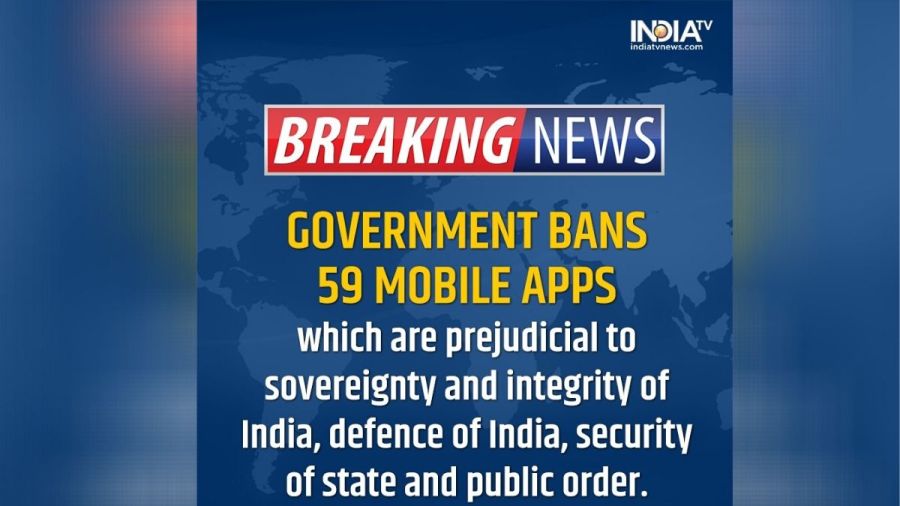
In the wake of the face-off with Chinese forces on the India-China border in Ladakh, and a violent clash on June 15 that left 20 Indian soldiers dead, the Indian government on June 29 banned 59 apps of Chinese origin, citing data security and national sovereignty concerns. These include popular ones such as TikTok, SHAREIt, UC Browser, CamScanner, Helo, Weibo, WeChat and Club Factory. And they are try to steal our details from their country originated app which we are using. Please don’t doubt on our patriotism. We can do everything or anything for our country. Do not dare to look at our country.

Why were the Chinese apps banned?

The Ministry of Electronics and Information Technology in a press release asserted that it had received “many complaints from various sources, including several reports about misuse of some mobile apps available on Android and iOS platforms for stealing and surreptitiously transmitting users’ data in an unauthorised manner to servers which have locations outside India”.

The Ministry said it had decided to block the 59 apps to safeguard the “sovereignty and integrity of India”, invoking powers under Section 69A of the Information Technology (IT) Act read with the relevant provisions of the Information Technology (Procedure and Safeguards for Blocking of Access of Information by Public) Rules 2009.

The government also said that several citizens had reportedly raised concerns in representations to the Indian Computer Emergency Response Team (CERT-In) regarding security of data and loss of privacy in using these apps. In addition, the Ministry said it had also received “exhaustive recommendations” from the Home Ministry’s Indian Cyber Crime Coordination Centre.

And while the government did not name China openly in its action against the apps, public comments by officials including Ravi Shankar Prasad, the Union Minister for Communications, Electronics and Information Technology and Law and Justice — he asserted that the ‘digital strike’ was done “for safety, security, defence, sovereignty & integrity of India and to protect data & privacy of people of India” — signalled that it was aimed at Chinese economic interests.
How large is the user base in India for these banned apps?

Estimates by Sensor Tower show the video-sharing social networking app, TikTok, for instance, has seen about 611 million downloads in India over the app’s lifetime, while estimates of active users vary with the highest pegged at 200 million. According to media reports, file-sharing tool SHAREIt has about 400 million users. Statcounter places the Alibaba-owned UC Browser second in India market share at 10.19%, after Google Chrome (78.2%). Other reports estimate its user base at 130 million.

How will users be affected?

Installed apps may continue to exist on mobile devices. But now that the latest versions of the apps have been removed from Google’s Play Store and Apple’s App Store, users will not be able to access updated versions in future. If a notice goes out to internet service providers asking that data flow from these apps be halted, that could impact the functioning of existing, installed apps.

How does the ban affect Chinese app providers?

The potential loss of advertising revenue impacts app-makers. Tik Tok’s parent ByteDance Ltd. recorded a doubling of global revenue to $17 billion in 2019, over the previous year, with $3 billion in profit.

Its India business may have yielded only $5.8 million in revenue for the year ended March 2019, but with quicker user adoption more recently, the stakes seem to be getting higher. When TikTok was banned briefly in India last year on the grounds that it reportedly promoted pornography, the company had told a local court that it was losing roughly $15 million a month due to the ban, according to a Reuters report. The app had subsequently been permitted to operate.

How children are being portrayed in media?

Media is the mirror of a society. It portrays the existing condition of a society. Media like movies, advertisements and news stories emphasize the lifestyle of people living in a particular area. Not only does it portray, but media can even manipulate the audience as it creates huge impact on people. It can lead the people to think in a structured way. It is true that “media tell us what to think about”. Thus, representation of all things in the media has to be taken into great consideration. People are likely to believe whatever the media want them to. At times, it gives a completely different and fake representation of everything. Representation of children in media can be taken as an example. The media has convinced the world that children are supposed to behave in a particular way, neglecting the fact that it cannot be true always.

Today, every child has been exposed to media in many ways. Advertisements, Movies, Magazines, Social media platforms etc. have been opened to anyone irrespective of their age. Children are now free to engage in the media world just like the adults. So, it can be said that media not only influence or affects adults but children also. It creates a huge impact in molding a child’s attitude as children can see how they have been represented in the media. It has been noticed that media is a powerful tool in creating and manipulating perceptions of audience towards anything that they represent. So, it is very much important to portray them in the right path.

Since, children belong to an inferior and minor community in the media world, they have been exploited in many ways. They are represented in more a negative way. It is a true fact that children are being under represented in the media more than being portrayed positively.  This negative tendency can be seen everywhere in the world irrespective of the cultural diversity. They have always been represented as inferiors or dependents. Children are always given the tag of ‘cuteness’. The whole purpose of being present in an ad or movie is to just to remain cute. Media under estimate the capabilities of children by considering them as a cute creature. Most of the advertisements and movies portray this type of stereotype, where children remain cute and inactive. They are always guided and controlled by elders. It gives a false assumption about kids to the society that children can’t do anything on their own.

It is hard to believe that, this negative portrayal are done on the basis of gender also. The representation of child in terms of gender is quite stereotypical. The portrayal of girl and boy child are very much different in the media. Boys are always presented as active, noisy and even wild whereas in the advertisements that features girl child, girls are quieter, their actions are slow paced and general atmosphere will be softer. The girls are more likely to present in stories about child abuse, ads about beauty products and household activities. On the other hand, boy child is being appeared in ads related to automobiles and sports. Ads are less likely to focus girls who are active in sports. Girl children are mostly associated to craft related items and boys are associated to games and sports. The representation of children influences the children themselves and their attitudes and views on their own roles in the society. It also creates a huge impact on adults and their opinions about the children. So, it is extremely important to represent the children in the right way.

THE POWER OF PEN

Ideas have an impact far more powerful than we imagine. We all wish to express our ideas, and it is the ‘power of the pen’ which helps us express. Who could think that such a small instrument would take such a big space of human life?

When a child, a teacher, a book and a pen come together, they change the world. The teacher using the book directs the child towards self-discovery. A pen gives his innocent dreams the wings and these dreams, hence, see the light of the day. A writer gets to write a new chapter. For him, this pen is everything. He pours all his emotions via a pen on a blank page. This pen becomes the tongue of his mind. A painter gives colours to his imagination. His perspective is serenely painted on a canvas. Anyone who sees it is mesmerized.

In the giant game of construction, some bravely choose a pen. What they create reflects the victory of man’s genius. An architect impeccable shapes homes, giving shelter to many. Cities are constructed based on plans penned by developers.

A hero’s dying wish is that people acknowledge his bravery; not concoct stories which never existed. His pen conveys his heroics. This pen reflected his power. People now know how he served his nation.

In this era, one must learn to protect oneself with the pen, not with the gun. We have journalists who do this for us. They protect our interest when they lift their pen. They give us news with their pen. They keep us updated with the happenings in the world.

In the hands of a doctor, a pen prescribes medicine and saves someone’s life.

Life is given to words with the power of the pen where the spoken words have no place, the written one’s triumph.

The declaration of our independence and its sovereignty was written using a pen without which there would be none of its existence. An actor lifts his pen for an autograph. Design created by this object gives his name value.

Swords are short and sharp, but a pen, the pen is sharper.

The pen is so powerful that if it goes in the hands of a liar, he will not only tongue the false but also deceive by writing.

For some, a pen is as important as a beak is to hen.

A teacher finds it magical for it is she who sees the textures and tone that a mere pen point produces in an exam paper. Lives are created and destroyed in that examination hall. If the pen works you pass and if it doesn’t you fail the test.

This is the ‘Power of Pen’. Let us embrace it and shape a better world together.

The Italian marines case gets more interesting!

The Italian marines’ case meets with a frustrating end, as India loses right to preliminary.

The long journey for equity for the two Kerala anglers shot dead by Italian marines from the Enrica Lexie around 20. 5 nautical miles off India’s coast in February 2012 has finished in disillusionment. A worldwide discretion court has decided that India doesn’t have locale to attempt the marines, who, it held, were qualified for insusceptibility as they were following up for the benefit of a state. The Permanent Court of Arbitration (PCA) in The Hague conceded that the two India and Italy had simultaneous purview in the issue however presumed that the marines’ insusceptibility blocked India’s ward. In support of India, the PCA found that the Italian vessel had disregarded the privilege and opportunity of route of the Indian fishing vessel under UNCLOS, and that the activity, which caused loss of lives, property and mischief, justified remuneration. It requested that the gatherings counsel each other on the remuneration because of India subsequently. All the more altogether, the PCA dismissed a key contention by Italy that India, by driving the Italian vessel into its region and capturing the marines, abused its commitment to help out measures to stifle robbery under Article 100 of UNCLOS. This may imply that the intervention court didn’t see the episode as one identified with robbery by any stretch of the imagination. The episode had caused national shock as the open saw these as wanton killings, because the conditions demonstrated no endeavor by the fishing vessel at robbery. The fishing vessel was inside the nation’s Contiguous Zone and it was very certain that the offense justified capture and arraignment under local law.

With the theft point precluded, an ordinary preliminary was all together. The Union government ought to have assumed control over the arraignment and guaranteed a brisk preliminary. In any case, as legitimate knot were being sifted through, and India was managing the discretionary aftermath, the marines figured out how to get requests to leave the nation. The Supreme Court decided that solitary the Center, and not Kerala, can indict the marines. A greater legitimate issue, which caused more deferral, came later. The National Investigation Agency conjured the Suppression of Unlawful Acts against Safety of Maritime Navigation and Fixed Platforms on Continental Shelf Act, 2002. This caused a conciliatory furore as it accommodates capital punishment. The EU took steps to force exchange sanctions. Eventually, it took effort for these charges to be dropped. The PCA’s honor, which is conclusive and has been acknowledged by India, is a tremendous misfortune for the desire that the two marines would confront a criminal preliminary in India. At long last, Italy prevailing with regards to removing the issue from India’s hands. It should now follow through on its duty to have the marines attempted under its household laws. The takeaway for India ought to be the exercises, in the lawful and discretionary spaces, that can be drawn from the experience.

TEACHING EXCELLENCE IN INDIA

PC: Creator: nzphotonz | Credit: Getty Images/iStockphoto

We have so many students studying in so many educational institutions but is everyone receiving a quality education? It we are striving for excellence; we must define it clearly. It means different things to different people. One can say that creating, imparting and disseminating knowledge to generations with increasing quality implies excellence. The quality of education in any school has to be useful, but India is far from that school. We always talk about private schools. There are more than 70% of students in government school s, and the need is to get trained teachers to educate them. Several students are full of passion, and they have aspirations. There are so many issues that prevail in government schools.

Underprivileged students go there, and they complain that teachers don’t come and infrastructure is miserable. The number of toilets is increasing, but the number of functional toilets is still poor. Same goes for drinkable water as well- taps are increased but not functioning correctly. These children dwell in rural areas and are not from well-to-do families. To progress in life, they somehow do self-study, manage to get a tutor who teaches for a paltry sum and somehow clears class 10. The poor’s children get enrolled late, and even after that, they do not develop an understanding of subjects. A need for bridge course is felt in all schools to see that all gaps are filled regarding subject knowledge. We must understand that even though private schools are in a better education providing position today, excellence can exist anywhere, and we hear about success stories from government ones as well.

Even the poor now want to send children to private school. They believe that if they are in a private school or can learn English then, that gets them the passport to a bright future. Our government introduced the quota system in private schools to address this issue, but it is clear that it is not a solution. Do we need to bridge the gap between private and government schools, or do we privatise education completely? A private school, if it has the significant infrastructure, must accommodate such children and be fit for them in terms of imparting education according to their level. In private schools, many emphases are given on exam result, which is essential, but they need to put equal focus on other skills too. They are looking at skill development also as conceptual education isn’t enough nowadays, but the centre must increase more. Sports, technological advancement, globalised conduct and other curricular develop a child entirely and make for a true representative of modern India.

Even for private schools, there is an issue of access to high-quality education. Only a person studying in topmost school or college will be exposed to that excellent knowledge; while students of their schools, who are not enrolled in that top place don’t have access to it. Unfortunately, our school curriculum is hopelessly outdated. Had the schools been teaching how to study through cell phones and laptops ore, the information provided by top schools would be in their hands. If a student feels like learning something today, he should have access to that particular piece of information that he seeks. Technology is that classrooms create a big difference. If excellence is available somewhere, then through technology, we must bring it to students.

Let us not forget that teachers play the most critical role in bringing excellence; in reality, not every teacher joins this profession out of love and passion; circumstances to have a force on people. Still, every teacher must stay committed to ensure excellence in their work and students. There is undoubtedly a disconnect between industry and education. No matter how conceptually strong a student is, once he goes to the industry, employers require to train him according to their needs. We need a system which prepares us for work-life as well. The education system must cater to the real-life challenges and demands of life. Only a few get into top institutions, and how can the system meet the challenge of creating a platform for more students? Investment in education is critical as we need more quality institutions to meet the demands of rising population. We need to ensure that as we grow more institutions, we also maintain high quality.

Moreover, India needs its best students to compete with the world’s best with cutting edge knowledge. We must produce role models and become magnets for outsiders. We boast of having Indians as the best minds of the world; they are heads of big companies in the world. Ironically, there is no electricity or internet in many villages. So many Indians can make India a superpower if only they would get a fundamental requirement of education and the internet will play a massive role in shaping a bright rural India. The government must ensure that these should reach the common man in all the parts of rural India. If there is a successful model available anywhere, then that has to be emulated. We must take advantage of technology as today the learning process is undergoing tremendous change. If the students have access to quality education, then the students will contribute more to society, and everyone will prosper.

Super Long train “SheshNaag”

Recently, on 2 july, Indian Railways has created record starting the train “sheshnaag” in south east central zone of railways.

the train is 2.8 km long, longest ever in India. It consist of 251 wagons which are pulled by four electric locomotives, fitted in between.

This is a freight train. Indian Railways trying to move multiple freight rakes together as it helps in saving the transportation time and also help in the decongestion of the rail route.

Earlier, on 30 june the South East Central Railway zone operated ‘Super Anaconda’when it attached three rakes of freight train together.

Importantly, the Indian Railways reached this feat on a day when it achieved 100 percent punctuality for the first time ever.

The Indian Railways said in a release that on Thursday (July 2, 2020), it achieved 100 percent punctuality of trains for the first time in history as 201 trains that that run on this day reached the destination on time. 

Prior to this India Railways has achieved 99.54 percent punctuality of trains on June 23 with the delay of only one train making it the second-best rate after today.

The Indian Railway Ministry said, ”First time ever in the history of Indian Railways, 100% punctuality of trains achieved with all trains on time. Previous best was 99.54% on 23.06.2020 with one train getting delayed.”

COMPULSORY MILITARY TRAINING IN SCHOOLS?

Military training in schools.

Any training on a person adds various skills. Some people want the central government must consider this proposal seriously and implement it in educational institutions. Many children are unable to decide what to pursue in life, and when they experience the hardships on military turf, this idea will be clear. Minimum military training is essential and broadens the mindset and toughens it. In a way, it is vocational training. India may get potential officers while will strengthen the armed forces in future. The defence of the country is left alone in the able arms of troops, and with this compulsion, we can also participate in it. The education improves national morale, health, builds up character and even the ability to face hardships.

People who serve in the army stay away from family for a very long time. When the children of their country join them in the training arena, they will get a morale boost. It will be an incredible feeling when so many children come and are with you. At a place, so many children from different backgrounds will share common space and air. This will bring Indian closer, and the walls of difference will get lower. The children need patriotic reinforcement, and this idea will also foster discipline in them. They will be more team spirit, orderliness and respect for one another when exposed to the adventures of training. Once a student receives basic training and wishes to volunteer, the military will get a trained volunteer. Indian girls will develop defensive skills and become stronger physically.

However, the Indian military is not equipped with the necessary infrastructure and number of officers to take on a significant population of a school child. Even if training institutions and academics are established, it will take much time for them actually to take place. They will require much money for maintenance and upkeep. Even if a decision in favour of this is made, it should be done for students above the age of 18 years and not for school-going children. The rigours of training may be too much for a school going child to handle, and also the mind is better prepared for this at a decent age of 18 years. The government has checked the feasibility, affordability and practicality of it. This is practically impossible for now. We do not have resources which are adequate to fulfil wants of everyone, and now we are asking for a further hole in the pocket of the government. India is a democratic set-up; people are free to choose their professions. Compulsion is respect for military training; it is felt, will go against the democratic ethos.[1] The anticipated benefits of imparting military training to all the youth will not be commensurate with the expenditure involved in such an effort. This would translate into unmanageable figure and will also be a significant drain on the limited resources of a developing country.

We are not prepared for it at the moment, but we can always inculcate the knowledge on a curriculum or introduce it as a separate course.


[1] Pradip R Sagar, Centre may not be in favour of Military Training, availabe at: https://www.theweek.in/news/india/2018/03/17/centre-may-not-be-in-favour-of-compulsory-military-training.html.

Deep Down You Know When It’s Time to Let Go

“Holding on is believing that there’s only a past; letting go is knowing that there’s a future.” ~Daphne Rose Kingma

One of the most challenging things in life is knowing when to let go—when to let go of a job, a relationship, a belief, a repeating thought, a situation… fill in the blank.

Most of us have defaulted to safety, which often means procrastinating and generally feeling stuck. While there’s nothing wrong with safety—it is, after all, one of our basic needs—we must learn to discern what is truly safe and what is safe for the sake of comfort and conformity, the latter of which ultimately leaves us feeling depleted.

“Safe” is a subjective term. What feels safe to you may not feel safe to me. For most of us, the unknown feels unsafe, yet as you may have heard, the magic happens when we surrender to the unknown. Chances are, if we are seeking more, longing for more, yet feel paralyzed to move because we feel “safe,” we are probably stuck.

I recently experienced one of the most challenging transitions of my life when I let go of a long-term relationship. It didn’t happen overnight. It all began with a nudge and a deep knowing that I felt stuck, yet all the outer signs evidenced a “good” relationship, and my mind wouldn’t let go of the idea that there was nothing “wrong” with it.

By societal standards, I shouldn’t have been complaining or contemplating, but I believe we all really want one thing: to thrive and experience change when it’s necessary for our evolution and joy.

Resistance and fear will try to tell us a whole lot of stories about why we should be grateful and stay put, but if there is an inkling, a nudge, a quiet inner voice that keeps nagging and telling us it’s time to go, then it’s time to release and move on. Even though letting go may not immediately make any logical sense, listening to that voice can bring new, fulfilling experiences.

This phase in my life has taught me that life is all about flow and movement, and that living, truly living, means that we are constantly changing and evolving. Living means being called to practice detachment to make room for new energy.

I also learned that when we don’t listen to that inner voice that says it’s time to let go, and sometimes screams it loud from our heart and gut, life will conspire to make us move, whether we want to or not.

If we wait long enough and dismiss our deep truth, life will make sure that truth comes out one way or another. Events and circumstances will happen that will cause us to move, and sometimes cause us to move at a rate that we did not expect or plan.

The biggest lesson for me was, do not wait for life to force you; check in daily and connect to the deep truth that overrides logic and analysis and simply nudges you along.

This isn’t easy when the voice of fear is loud and untamed.

Letting go is part of the human experience, but there are ways to minimize the impact of transition if we are mindful. Here are some actions I took and lessons and insights I learned during this transition that helped me embrace letting go. These can apply to any situation that requires letting go.

I took inventory of all the gifts from my relationship and sat in gratitude.

I reflected on how I could have shown up differently and more authentically.

I took responsibility for what I had contributed to the situation.

I promised myself that I would never betray my inner voice.

I embraced alone time often.

I constantly asked myself, “What do I need in this moment?”

I allowed myself to mourn and grieve whenever those feelings arose.

I allowed myself to have hard days and was extra gentle with myself during those moments.

I asked myself what part of me needed to heal so that I could hear my inner voice and override the fear-based thoughts that keep me stuck.

I indulged in a self-care routine and opted for activities that felt nourishing.

I kept a daily promise to myself, no matter how small it was.

I surrounded myself with people I love and with whom I feel safe.

I traveled and welcomed the energy of newness and curiosity,

I hugged myself a lot—it is so nourishing!

I got comfortable with patience and surrender—two great lessons that I needed to learn.

I embraced the unknown.

I learned that you can love that job, that person, that circumstance, and still feel a deep urge to move on.

We are all worthy of feeling fulfilled and nourished; that is the point of life

Sometimes, we just grow apart from that person, thing, or circumstance. It’s that simple, don’t fight it.

It is never about blame or shame; it is always about experience and experiencing life right where you are and where you are nudged to go.

It’s okay to say goodbye and still feel love and gratitude.

Nothing is ever wasted. Every experience has a meaning in your life.

Everything has a season—sometimes the season lasts a minute, sometimes it lasts years, but eventually there is a new season on the horizon.

Here is the thing, if we don’t listen to the voice that is asking us to let go, then we will never know what beautiful blessings await us on the other side—in the unknown. Our minds cannot possibly conceive what lies ahead.

I had to make room for new love and new energy, two elements I longed for daily. I had no idea what my life would look like, but I was pleasantly surprised to find that with newness comes great curiosity and joy.

If resentment, wonder, curiosity, longing, stuckness, and boredom seem to keep circling in your mind, it’s time to take inventory and ask yourself a very hard question: Is it time to let go?

Even if you don’t feel any “negative” feelings but feel a nudge, a knowing pushing you forward, listen and listen with your heart.

Betraying myself

I know, I can, if I do, but I don’t know why I don’t give a try to do it. I am escaping from trying and proudly expressing it. How shameful must I be to admit such a fact. Why do I even give a push to myself when I am capable of doing it. If I am not capable, atleast I should give a try to be capable enough. I am capable of doing it but incapable of trying it. Knowing that makes me feel insecure about me. I know about it and behave as though I am I never knew.

Atleast I should be true to myself. Betraying me and trying to hide myself from me is the worst thing that I can do to myself. I know it and I still do nothing. Telling lies to others is not that offensive but trying to be someone to yourself is not good. I know that I can but I push myself either by knowing it or by can’t doing it. Either way I dont do it.

Doing for doing is not at all a doing. Enjoy the doing and make it done else undo it and do some other thing that makes you do and will make you go through doing and make it happen as a done. Do it by enjoying else quit it by undoing. The only thing that we remember is the process of doing. We will forget the result of doing. Enjoy the doing till it’s done. Do with joy and enjoy the feeling of joy.

I know I should do what I should but I must do only the things which make me happy. Happiness is not measurement, it is a sudden process. Happiness is a temporary process which can bring people, the permanent happiness. The way we feel for the things tells us the way we love the process. Live tour work, if you can’t love it then leave it. The work must make you feel the feel that lasts till the work got completely completed.

Behave truly to yourself. You should not feel regret about yourself. The only thing that matters to you is you. Atleast be true and behave accordingly. The last suggestion about your decision you make is made by you either it’s regarding your death. Your life or death is both in your hands. The decision you take is the decision you make.

Negotiating- The Art, a small story!!!

I think there is an art to it it’s a craft, the negotiating training this morning in the office and the reason, negotiating it be is because it’s the one area of the deal where people need me the most and they need me the most they think I have the most confidence and the confidence that I have going to the deal comes from experience and it comes from honestly – practice practice practice because no matter what you’re selling you’re selling. Two different people you’ve got a seller and a buyer and in every negotiation you’ve got price you’ve got pressure and you’ve got persistence those are the three P’s remember that is it can be a nice little instructional.

The negotiations between Disney and Lucasfilm - A negotiation case ...

An iPhone cost to make now you’re not going to negotiate the price of an iPhone because there’s too strong demand but let’s say there wasn’t strong demand then you can negotiate or you can find a retailer who’s going to sell it to you for cheaper because it doesn’t cost nearly as much to make that phone. As it does for you to buy it real estate is the same way a deal that’s listed from 10 8 down to 10 so 10 million bucks the offer originally came in at 8 million dollars okay that seems like it’s way too far apart. If I go to the seller he’s going to say you got to come up they’re going to say oh no this is my offer so what do you do what do you do you remember the price you want to try to get – which in this instance was around 8 and a half that’s where we thought we’d get a deal done and the legacy price what the seller paid seller paid six point five. So, even at our low terrible awful offer that sellers making money that’s a good thing to remember and to consistently remind each side and then you let time saturate the emotions of the deal and you use repetition you only paid six five even if this bullshit offer you’re making money.

The Art of Negotiation in Project Management

There are clients who are losing million and they use pressure right the fear of a falling market and the fear of missing out every seller fears they’re not going to get their price going forward because maybe the market could change every buyer has a little fear that they’re going to lose it a little fear they’re going to miss out and then you’re trying to find the price in the middle where both sides will say we came to that number because that’s the max or the minimum that I’m willing to go to get this deal done.

Can a Business Simulation Game help develop Negotiation and ...

Here is some tips for people who wish to pass their time productively and it’s benifits!

3 ways to spend your time productively

1. Online course

Variety of programs and courses: From traditional four-year universities to completely online career colleges, higher education today offers a variety of options for students. This means that no matter what students study, from nursing to neuroscience, they can find the courses or programs they need online. Students can also earn every academic degree online, from a career certificate to a doctorate.

More comfortable learning environment: Commercials that feature online students studying in their pajamas only skims the surface of one of the benefits of online education no physical class sessions. Students listen to lectures and complete assignments sent to them electronically, with no need to fight traffic, leave work early for class, or miss important family time.

Convenience and flexibility: Online courses give students the opportunity to plan study time around the rest of their day, instead of the other way around. Students can study and work at their convenience. Course material is always accessible online, making special library trips unnecessary. All of these benefits help students balance work and family commitments with their education.

Lower total costs: Online programs prove a more affordable option than traditional colleges. Though not all online degrees offer less expensive net tuition prices than traditional colleges, associated expenses almost always cost less. For example, there are no commuting costs, and sometimes required course materials, such as textbooks, are available online at no cost. In addition, many colleges and universities accept credits earned via free massive open online courses (MOOCs), the most recent advance in online education. These free online courses can help students fulfill general education requirements.

2. Volunteering

  • Gain confidence. Volunteering can help you gain confidence by giving you the chance to try something new and build a real sense of achievement.
  • Make a difference. Volunteering can have a real and valuable positive affect on people, communities and society in general.
  • Meet people.Volunteering can help you meet different kinds of people and make new friends.
  • Be part of a community. Volunteering can help you feel part of something outside your friends and family.
  • Learn new skills. Volunteering can help you learn new skills, gain experience and sometimes even qualifications.
  • Take on a challenge. Through volunteering you can challenge yourself to try something different, achieve personal goals, practice using your skills and discover hidden talents.
  • Have fun! Most volunteers have a great time, regardless of why they do it. 

3. Digital Marketing

Marketing is all about connecting with your audience in the right place at the right time. In the age of digitization, your best strategy would be to meet your customers online where they are already spending much time. Digital platforms are increasingly getting associated with marketing schemes and everyday life. In such circumstances, it’s essential to understand the key benefits of digital marketing. By incorporating technology-focused strategies into marketing, business owners can gain better outputs easily. So, What Exactly is Digital Marketing?

According to Victor he says, Digital marketing is the promotion of products/services via various forms of electronic media, mainly based on the internet. Basically, the definition of digital marketing refers to all of your online marketing efforts. Many businesses have already experienced advantages of digital marketing over traditional marketing. Unlike traditional marketing, it involves the use of channels and methods for a proper understanding in the real-time scenario. Thus, organizations can analyze marketing campaigns and implement necessary steps accordingly. Regardless of what your company sells, digital marketing can work effectively for any industry. With digital marketing, you can see results much faster than you might with offline marketing. The interactive nature of digital marketing strategies helps companies to grow their client base in a short span of time.

So what are you all waiting for don’t spend all your precious time by just sleep or gaming let’s do something productive.

You can also try blogging or start your very own YouTube channel or sketch the idea’s in your mind and make it into a reality!

WOMEN EMPOWERMENT IN CORPORATE SECTOR

If a woman can bring me into this Earth, if a woman can bear the labour of raising and guiding me, then certainly a woman can be my boss at work.

Times have indeed changed, and myths have been effaced where other than the ‘exotic’ not much came to mind when thought about Indian women. Indian women are becoming increasingly visible and thriving in the professional and public sphere.

Whether it is Barkha Dutt, who has become an idol for several journalists, Arundhati Roy, a Booker prize winner and a social activist, the industry bigwig and a magnate Indra Nooyi, or Kiran Mazumdar Shaw, who become the wealthiest Indian women after the initial public offering of her company Biocon, worth over $1.1 billion. All herald the advent of Indian professional woman.

During 1987-93, the role of women worldwide underwent a dramatic change. Women today share the podium with men in almost all fields, be it kitchen or office. They have now entrenched themselves as an integral part of the workforce.

After 1991, the increased role of the private sector and spurt in the number of MNCs facilitated a slow but definite rise in the number of women managers and entrepreneurs as against some abysmal figures two decades ago.

MNCs in the previous decade has witnessed quite a volatile environment with numerous challenges calling for the multitalented and experts. Many executives have emerged and are recognised by their expertise, organisational contribution and leadership despite these corporate vicissitudes. India has not by serendipity but by destiny witnessed the proliferation of women who have spurred and fostered growth in the economy and marked themselves as stellar performers. Women have time and again contrived to leave a good mark here.

I will not call it unfortunate rather consequential that we see only a handful of companies headed by women or women at the helm of strategic departments. Till the corner of the new century, women have not been welcomed to hold and glorify the top positions of a slew of corporate houses. Society had its stereotypes and biases against women in management where the male trains had higher perceived value than female traits. Innumerable myths had clouded this society and deemed women in control as anachronistic. Stymied with the straightjacket of envy and as a result male chauvinism, female employees confronted barriers while climbing up the corporate ladder. The perceived notion was that women are ruled by the heart and not head; they are more personal than professional/ the fallacious idea was deduced from their parallel profession, as an employee and as a mother.

Following are some of the myths perceived by society-

  1. Women switch jobs more frequently than men.
  2. They are not willing to travel extensively for the organisation.
  3. They fall apart in a crisis.
  4. They only work because their economic reasons force them to do so.
  5. They are too concerned with the social aspects of the jobs and cannot be entrusted with important matters

Furthermore, women have to deal with the complexities of a dual role as working women and mother. Unfortunately, they were thought of as less committed and tenacious. Lastly, they have inner battles as well likely mainly getting scupper by their apathy, which they need to fight and overcome by developing confidence, appropriate skills and attitude.

Male chauvinists, in particular, have denounced them with such shoddy treatment in mentoring, training and development at work, there was bound to be resentment. Fortuitously, our genial women didn’t resort to vandalism but charted their way into the corporate turf, competing for head to head with males. Today globally, women are the 10% senior managers in fortune 500 companies. Having said this, aspirations will never foil, and women are here to stay.

Today the beautiful part of women manager is that she is very good at juggling around tasks. One of their most persuasive skills is her ability at multitasking. Researchers have developed reports which state that women managers see things laterally, intuitively and differently. They can handle more contradictions, can tolerate more and can deliver much more than men. The reality is that women have a different value system, which they bring to the organisation. Management studies on gender initiatives have three findings:

  1. Some companies like female workers to be ‘boys’, wanting them to play golf, do things like men; they even commend them but sarcastically complement after doing a task efficiently- ‘She is the man’, citing male chauvinism again.
  2. Some companies recognise that females do the same work but require different incentives.
  3. Others recognise that women bring them a different approach and attitude to the workplace.

This doesn’t revamp the gender equality inherent in the system, which requires a paradigm shift in its perspective. A qualification of being a male and not a female doesn’t guarantee organisational excellence. Therefore, women in corporate India are aware of the various constraints they work under and are trying to make the best of the bargain. And when they do reach the managerial level, they bring with them the silver lining. For instance, employers today exhibit a preference to employ more women in Human Resources as compared to men and also in the retail and service sector. Hence, they are no longer damsels in distress.

The statistics say that 1/3rd of employees at Indian software companies today is a woman; which were stereotyped as abstract, obsessive and unsuitable for them. NASSCOM puts this figure at 38% higher than their western counterparts. Let me now give you a glimpse of the Indian corporate divas- Vidya Mahan Chhabria, the chairperson of the $2billion Jumbo Group and Naina Lal Kidwai, vice-chairperson and MD of HSBC securities and capital markets, are the two Indian women to feature of the list of the 50 most powerful women in International business by The Fortune magazine. There are several others like Sullaija Firozi Motwani heading Kinetic Group and Mallika Srinivasan leading Chennai- based Tractor Making Co. name TAFE, who are prominent figures in the burgeoning automotive sector and other who successfully manage family-run businesses. Shahnaz Hussain of Shahnaz Group, Renu Karnad of HDFC. Schuana, Alisha and Nadia Chouhan managing Parle Argo are the epitomai of the phenomenal works done by the Indian corporate women. In a country where sex ration is on the decline, where the representation of women in the Parliament has remained at an abysmal low of less than 7% since independence, the emergence of leading ladies, even if it just a few, In India’s corporate sector is hopefully only a precursor for more. In India, women can achieve greatness if their path is clear.

To trounce men in this sector is afar away but not inconceivable for it took men millenniums to dominate this society and now having witnessed women shake this supercilious pillar in the last two decades, it won’t be long before these emerging flairs vociferously exorcise this notion as they are getting empowered.

Delhi LG Anil Baijal inaugurates world’s largest COVID Care Centre at Radha Soami Satsang Beas

In a big support to fight against COVID -19 in Delhi, the Indo-Tibetan Border Police, ITBP today started the operations at Sardar Patel Covid Care Centre, Radha Soami Satsang Beas in Chhatarpur. Lieutenant Governor of Delhi Anil Baijal inaugurated this Centre, which is the largest of its kind in the world with over ten thousand beds.
 
Adequate arrangements have been made by the ITBP at the centre including security, reception, call centre, nursing stations, command control stores and maintenance staff. Over one thousand doctors, nurses and paramedic staff of ITBP and other CAPFs have been deployed at the facility to operate it smoothly.
 
More than 75 Ambulances will also be deployed at the Centre. A group of first patients are expected at the centre this afternoon. 
 
On the occasion, Anil Baijal reviewed with agencies concerned, the availability of facilities like beds, oxygen cylinders, concentrators, ventilators, ICU and medical staff.
 
Mr Baijal advised the officials to focus on severely ill patients and if required, shift them to dedicated COVID-19 Hospitals. He instructed South Delhi Municipal Corporation to ensure cleanliness and sanitation at the centre. The LG said management of COVID centre by ITBP is greatly appreciated.

National COVID19 recovery rate improves to 60.77per cent

Government today said that due to collective and focused efforts for containment and management of COVID-19 by the Centre along with the States and Union Territories, the number of recovered cases rose to over four lakh nine thousand.

During the last 24 hours, a total of 14 thousand 856 COVID-19 patients have been cured. Union Health Ministry said, there are over one lakh 64 thousand more recovered patients than COVID-19 active cases.

This takes the national recovery rate amongst COVID-19 to 60.77 per cent. The Ministry said, there are over two lakh 44 thousand active cases and all are under active medical supervision.
 
The testing lab network in the country continues to expand. As of now, a total one thousand one hundred laboratories across India have been given approval to conduct Covid-19 tests including 786 government laboratories and 314 private laboratory chains. During the last 24 hours around two lakh 49 thousand samples have been tested. The cumulative number of samples tested, so far is more than 97 lakh 89 thousand.