

Day: July 21, 2020
Jack Ma’s Ant Group chooses Hong Kong and Shanghai for its Mega IPO
One of China’s biggest tech firms has chosen to stay home for its blockbuster IPO, shunning Wall Street where Chinese companies are facing heightened Scrutiny because of rising geopolitical tensions.
Ant Group announced on Monday that it is planning “a concurrent initial public offering” in Hong Kong and on Shanghai’s Star Market, China’s answer to the Nasdaq extending a series of mega tech listings amid the fallout in US-China trade relations.
Ant Group, previously known as Ant Financial, is an affiliate of Alibaba Group Holding, the owner of the South China Morning Post.
Ant is affiliated with E-commerce giant Alibaba, which raised a record $25 billion when it debuted on Wall Street in 2014 still the world’s second largest IPO to date. Ant owns Alipay, one of the most popular payment apps in China, and also offers online financial services such as loans, investments and credit scoring systems.
While the provider of the Alipay service is still discussing the size and timing of the share sale, the outcome is likely to be one of the largest initial public offerings in years. Stock analysts are valuing Ant at more than US$200 billion, higher than state-owned China Construction Bank and just shy of Bank of America’s market capitalisation.
Alibaba received a 33 per cent equity interest in Ant Financial in September last year under a restructuring that also ended a profit-sharing arrangement between them, according to its prospectus in November. While Alibaba does not control Ant Group, its co-founder and China’s richest man Jack Ma effectively controls about 50 per cent of the voting interest in Ant Group, according to its annual report.
The public listing will enable Ant, which operates the Alipay wallet used across Alibaba’s e-commerce networks, to work toward several goals: digitize China’s service industry, such as getting mom and pop shops in far-flung regions to use its payments service; drive domestic demands, such as being a conduit of government-issued coupons for consumers amid coronavirus pandemic; expand globally through its e-wallet partners in nine countries; and finally, invest in new technologies.
Bankers are valuing Ant at a staggering $200 billion, according to sources from Reuters. The company declined to comment on its valuation. If Ant sells 10% of the company in the IPO, it would generate $20 billion in proceeds, which would place it third in terms of the largest IPO deals ever, just behind Alibaba’s $22 billion IPO and Saudi Aramco’s $25 billion IPO.
‘Aryabhata’- Father Of Indian Mathematics

Aryabhata was one of the first Indian mathematicians and astronomers belonging to the classical age. He was born in 476 BC in Tarenaga, a town in Bihar, India. His major work, Aryabhatiya, a compendium of mathematics and astronomy, was extensively referred to in the Indian mathematical literature and has survived to modern times. The mathematical part of the Aryabhatiya covers arithmetic, algebra, plane trigonometry, and spherical trigonometry. It also contains continued fractions, quadratic equations, sums-of-power series, and a table of sines. It is however definite that he travelled to Kusumapara for studies and even resided there for some time. It is mentioned in a few places that Aryabhata was the head of the educational institute in Kusumapara. The University of Nalanda had an observatory in its premises so it is hypothesized that Aryabhata was the principal of the university as well. On the other hand some other commentaries mention that he belonged to Kerala.
Mathematical Work
Aryabhata wrote many mathematical and astronomical treatises. His major work, Aryabhatiya, a compendium of mathematics and astronomy, was extensively referred to in the Indian mathematical literature and has survived to modern times. The mathematical part of the Aryabhatiya covers arithmetic, algebra, plane trigonometry, and spherical trigonometry. It also contains continued fractions, quadratic equations, sums-of-power series, and a table of sines. His chief work was the ‘Aryabhatiya’ which was a compilation of mathematics and astronomy. The name of this treatise was not given to it by Aryabhata but by later commentators. A disciple by him called the ‘Bhaskara’ names it ‘Ashmakatanra’ meaning ‘treatise from the Ashmaka’. This treatise is also referred to as ‘Arya-shatas-ashta’ which translates to ‘Aryabhata’s 108’. This is a very literal name because the treatise did in fact consist of 108 verses.
Aryabhata worked on the place value system using letters to signify numbers and stating qualities. He also came up with an approximation of pi and area of a triangle. He introduced the concept of sine in his work called ‘Ardha-jya’ which is translated as ‘half-chord’.
Astronomical Work
Aryabhata also did a considerable amount of work in astronomy. He knew that the Earth is rotating on an axis around the sun and the moon rotated around it. He also discovered the position of nine planets and stated that these also revolved around the sun. He pointed out the eclipses, both lunar and solar. Aryabhata stated the correct number of days in a year that is 365 days. He was the first person to mention that the earth was not flat but in fact a spherical shape. He also gave the circumference and diameter of the earth and the radius of the orbits of 9 planets.
More about Aryabhata
Aryabhata was a very intelligent man. The theories that he came up with at that time present a wonder to the scientific world today. His works were used by the Greeks and the Arabs to develop further. A commentary by Bhaskara I, a century later on Aryabhatiya says:
‘Aryabhata is the master who, after reaching the furthest shores and plumbing the inmost depths of the sea of ultimate knowledge of mathematics, kinematics and spherics, handed over the three sciences to the learned world.’
Aryabhata’s Legacy
Aryabhata was an immense influence to mathematics and astronomy. Many of his works inspired Arabs more particularly. His astronomical calculations helped form the ‘Jalali calendar’. He has been honored in many ways. The first Indian satellite is named after him as ‘Aryabhata’, so is the lunar crater. An Indian research center is called ‘Aryabhata Research Institute of Observational Sciences’.
TIPS TO FIND YOUR PASSION
Some people are born understanding their passions, but others have to work to find them— and it is overwhelming to consider how to begin. The first step is to start. Below are five tips to help you on your journey to finding work and hobbies you are truly passionate about:
1. WHAT DO YOU DO WELL?
This question helps you uncover that unique talent that sets you apart from others. Perhaps you’re good at public speaking or motivating others. Or maybe you’re good at finding computer bugs or supporting your friends through tough times. Whether you have a hard or soft skill, knowing what you do well will put you on your way to using your talent in your purpose.
2. WHAT DO THE PEOPLE AROUND YOU SAY ABOUT YOUR SKILLS?
Unfortunately, it can be hard to recognize your own talent. When something comes naturally, it doesn’t always seem special. To get some help, ask your family or friends what they think you’re good at doing. This question gets to the heart of recognition “Most of us are not self-aware,” says Maxwell. “We all have blind spots, but you can ask others to help you identify your talents. “Ask several people, suggests Maxwell. When you start to hear certain talents over again, you’ve identified an area of strength.
3. IF YOU COULD DO OR BE ANYTHING, WHAT WOULD YOU DO OR BE?
This question taps into your internal desires, and can help you identify your purpose. A good way to answer this question is to consider those things you like to do in your free time or the projects at work you volunteer for or seek out. You can also think about the spots in the day when time seems to fly—what are you doing when you get lost or immersed in a project?
These things should also align with your talent, and it’s important to not confuse purpose with passion, says Maxwell. “Sometimes your passion is something you’re not any good at,” he says. “If you’re passionate about something you’re not good at, you can make it a hobby, not a career.”
4. WHAT GIVES YOU RESULTS WHEN YOU DO SOMETHING?
Your purpose will give you a return, and this question helps you identify the things you do that generate results. For example, if your talent is sales, you likely hit your goals every month. Or if you are good at innovative thinking, you might share ideas at work that prompt new projects. Pay attention to the tasks you do that get you accolades and awards.
Strengths and purpose are more than knowledge, says Maxwell. “Knowledge is overrated,” he says. “I can ask Siri, and she’ll tell me what I need to know. But what value is something if you know it but don’t use it? The result of knowing or learning is action application.”
5. HOW CAN YOU GET BETTER?
Once you identify your uniqueness, you need to fine-tune and work harder at it to set yourself apart. While having talent helps make you special, developing it further can make you strong. “Your growth potential is connected to your strengths,” says Maxwell. “In your weak areas, your growth potential is low, but when you’re working to improve your strength, you have a higher capacity.”
Mark Twain once said the two greatest days in a person’s life are the day they’re born and the day they discover why. Deep? Definitely. But let’s be honest: the first day is a somewhat passive experience. The second day, however, can feel like a lot of pressure. While some of us can quickly identify our purpose (in our careers, or otherwise), others may struggle to answer the question “Why am I here?”
No one has ever been successful doing something that they didn’t like, and no one has ever been successful doing something they can’t do well, says Maxwell. “I see millions of people every day doing something they don’t like doing and wondering why they’re not a success,” he says. “Success is knowing your purpose in life and having a growth plan to help you reach your maximum potential.”
Changes in Labour Laws to reduce COVID-19 impact
Amidst the COVID-19 induced lockdown, many states such as Uttar Pradesh, Madhya Pradesh, Rajasthan, and Gujarat have brought in changes to their labour laws by way of amendments. Recently, Uttar Pradesh government has passed an ordinance by virtue of which businesses and both existing and new industrial units have been exempted from the purview of most labour law provisions for the next three years. The state cabinet cleared the labour law ordinance suspending more than 30 kind of labour laws in the state. Nonetheless, the four laws that will still apply to businesses and industries are the Building and Other Construction Workers Act, Section 5 of Payment of Wages Act, Workmen Compensation Act and Bonded Labour Act.
Other labour laws likes those related to settling industrial disputes, health and working conditions of workers and trade unions, contract workers and migrant workers will be defunct for three years. By such act of the State Government, the owners of the factories have been given more powers to hire and fire without attracting punitive measures from the labour department up to a certain limit. In another departure from the past, the enforcement wing would not raid the premises of factories on minor issues.
Labour minister Swami Prasad Maurya states that suspension of such labour laws would assist in establishment of new industries and ease the problems of existing ones during present catastrophic situations which has created a severe impact on the economy. “The laws will apply to both existing businesses and new industries. We have made sure that labourers do not suffer or are taken advantage of, but we also had to ensure to remove any additional burden on the industrialist,” he said.
Since labour is a concurrent subject, states can frame their own laws but will need the approval of the Centre to enforce them. Therefore, the ordinance will also be sent to the Central government for approval.
Like Uttar Pradesh, State Government of Madhya Pradesh has exempted employers from some obligations under various labour laws, like Madhya Pradesh Industrial Relations Act and Industrial Disputes Act, as well as Contract Labour Act for 1,000 days, allowing employers to hire and fire workers “at their convenience”. The state has also allowed exempted firms flexibility of extension of working hours. Further, it has exempted new factories under the Factories Act, 1948 from inspection from the Labour Department and permitted the flexibility to conduct third party inspections at will. The state has also issued an ordinance to the Madhya Pradesh Labour Welfare Fund Act, 1982, exempting all newly established factories from filing annual returns and paying prescribed nominal amount per labourer per year to the Madhya Pradesh Labour Welfare Board for next 1,000 days. It must be noted that the changes to the Madhya Pradesh Industrial Employment (Standing Orders) Act, 1961 will exempt industries employing up to 100 workers from the law’s provisions.
In a similar attempt, State Government of Rajasthan has raised the working hours from 8 hours per day to 12 hours per day. Moreover, the State Government has also amended the Industrial Disputes Act to increase the threshold for lay-offs and retrenchment to 300 from 100 earlier. Furthermore, in order to recognize the trade union, the threshold membership of the trade union has been increased from 15 per cent to 30 per cent.
The New Consumer Protection Act,2019 in India is an upper hand and an added advantage for the consumers in manifold ways

The Consumers can now cheer as the Consumer Protection Act, 2019 has recently replaced the three decade old Consumer Protection Act, 1986. The Consumer Protection Act, 2019 which came into effect on Monday (July 20) has replaced the earlier Consumer Protection Act, 1986.
The new Act as per the Experts say that “it gives more power to the consumers”. It seeks to revamp the process of administration and settlement of consumer disputes, with strict penalties, including jail term for adulteration and misleading ads by firms.

On July 20, 2020 certain provisions of the Consumer Protection Act, 2019 came into force as notified by the Central Government. Following the the key features of the relevant provisions:-
Key features of the Consumer Protection Act, 2019 which came into effect on July 20, 2020:-
1) Consumers can now institute a complaint from where they reside or work for gain.
2) The original pecuniary jurisdiction of the District Commissions has increased upto ₹1 crore from ₹20 lakh earlier.
3) The Pecuniary jurisdiction of State Commissions has been increased from ₹1 crore to Rs. 10 crore.
4) The National Commission can hear cases above ₹10 crore when compared to above ₹1 crore earlier.
5) While the provisions relating to e-commerce are not yet notified, a section relating to electronic service provider (covering software services, electronic payments) is notified.
6) The opposite party needs to deposit 50% of the amount ordered by the District Commission before filing an appeal before the State Commission. Earlier, the ceiling was a maximum of ₹25,000, which has been removed.
7) The limitation period for filing of appeals to the State Commission has been increased from 30 days to 45 days.
8) The Parties can be allowed to settle the disputes through mediation.

Following are the Sections which came into force:
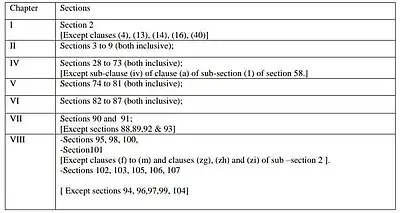
Above mentioned provisions pertain to the Consumer Protection Councils, Consumer Disputes Redressal Forum, Mediation, Product Liability, punishment for manufacturing, selling, distributing etc spurious good or products which contain adulterant.
As per the rules, the e-commerce players will have to display the total ‘price’ of goods and services offered for sale along with break-up of other charges. Only a few certain miscellaneous provisions with regards and respect to the powers of the Central and State Government to make the rules and regulations have also been enforced.
On misleading advertisements there is provision for jail term and fine for manufacturers. There is no provision for jail for celebrities but they could be banned for endorsing products if it is found to be misleading.
For the first time there will be an exclusive law dealing with Product Liability. A manufacturer or product service provider or product seller will now be responsible to compensate for an injury or damage caused by the defective product or deficiency in services.
The Act has also defined an “e-commerce” as the buying or selling of goods or services including the digital products over digital or electronic networks. The existing definition of e-commerce has been adopted from India’s FDI Guidelines on e-commerce.
The definition of ‘e-commerce Entity’ as provided under the FDI Guidelines includes inventory and market place models.
There is also a provision for class action law suit for ensuring that rights of consumers are not infringed upon. The authority will have power to impose a penalty on a manufacturer or an endorser of up to 10 lakh rupees and imprisonment for up to two years for a false or misleading advertisement.
WEBSITES REFERRED
1)https://consumeraffairs.nic.in/acts-and-rules/consumer-protection
2)https://www.barandbench.com/news/law-policy/provisions-under-consumer-protection-act-2019-to-come-into-force-on-july-20-2020-centre-notifies
3)https://www.google.com/amp/s/www.thehindu.com/news/national/tamil-nadu/new-consumer-protection-act-gives-more-power-to-consumers-experts-say/article32135908.ece/amp/
4)https://www.google.com/amp/s/www.livemint.com/news/india/consumer-protection-act-rules-for-e-retailers-to-be-effective-by-this-weekend/amp-11595291549084.html
5)https://www.google.com/amp/s/zeenews.india.com/economy/new-consumer-protection-act-2019-comes-into-force-today-know-how-it-will-benefit-you-2297012.html/amp
6)https://www.google.com/amp/s/m.economictimes.com/wealth/spend/heres-how-consumers-will-benefit-under-the-new-consumer-protection-act/amp_articleshow/70711304.cms
7)https://www.google.com/search?q=consumer+protection+act%2C2019&tbm=isch&ved=2ahUKEwjOhv7-sN7qAhVIH3IKHTOCBfMQ2-cCegQIABAC&oq=Consumer&gs_lcp=ChJtb2JpbGUtZ3dzLXdpei1pbWcQARgAMgQIIxAnMgUIABCxAzIFCAAQsQMyBQgAELEDMgUIABCxAzoHCCMQ6gIQJzoCCAA6BwgAELEDEEM6BAgAEENQ0xRYzipg1jBoAnAAeACAAZABiAGHCJIBAzAuOJgBAKABAbABBcABAQ&sclient=mobile-gws-wiz-img&ei=e-QWX47dJsi-yAOzhJaYDw&bih=682&biw=393&prmd=ivn#imgrc=eILduqMFjleJaM
8)https://www.vecteezy.com/free-vector/consumer
9)https://www.google.com/amp/s/www.livelaw.in/amp/news-updates/most-provisions-of-consumer-protection-act-to-come-into-force-160003
Child labour
Child labour is a term you might have heard about in news or movies. It refers to a crime where children are forced to work from a very early age. It is like expecting kids to perform responsibilities like working and fending for themselves. There are certain policies which have put restrictions and limitations on children working.
The average age for a child to be appropriate to work is considered fifteen years and more. Children falling below this age limit won’t be allowed to indulge in any type of work forcefully. Why is that so? Because child labour takes away the kids opportunity of having a normal childhood, a proper education, and physical and mental well-being. In some countries, it is illegal but still, it’s a far way from being completely eradicated.
Causes of Child Labour
Child Labour happens due to a number of reasons. While some of the reasons may be common in some countries, there are some reasons which are specific in particular areas and regions. When we look at what is causing child labour, we will be able to fight it better.
Firstly, it happens in countries that have a lot of poverty and unemployment. When the families won’t have enough earning, they put the children of the family to work so they can have enough money to survive. Similarly, if the adults of the family are unemployed, the younger ones have to work in their place.
Moreover, when people do not have access to the education they will ultimately put their children to work. The uneducated only care about a short term result which is why they put children to work so they can survive their present.
Furthermore, the money-saving attitude of various industries is a major cause of child labour. They hire children because they pay them lesser for the same work as an adult. As children work more than adults and also at fewer wages, they prefer children. They can easily influence and manipulate them. They only see their profit and this is why they engage children in factories.
Eradication of Child Labour
If we wish to eradicate child labour, we need to formulate some very effective solutions which will save our children. It will also enhance the future of any country dealing with these social issues. To begin with, one can create a number of unions that solely work to prevent child labour. It should help the children indulging in this work and punishing those who make them do it.
Furthermore, we need to keep the parents in the loop so as to teach them the importance of education. If we make education free and the people aware, we will be able to educate more and more children who won’t have to do child labour. Moreover, making people aware of the harmful consequences of child labour is a must.
In addition, family control measures must also be taken. This will reduce the family’s burden so when you have lesser mouths to feed, the parents will be enough to work for them, instead of the children. In fact, every family must be promised a minimum income by the government to survive.
In short, the government and people must come together. Employment opportunities must be given to people in abundance so they can earn their livelihood instead of putting their kids to work. The children are the future of our country; we cannot expect them to maintain the economic conditions of their families instead of having a normal childhood.
Child labour refers to the exploitation of children through any form of work that deprives children of their childhood, interferes with their ability to attend regular school, and is mentally, physically, socially or morally harmful.[3] Such exploitation is prohibited by legislation worldwide,[4][5] although these laws do not consider all work by children as child labour; exceptions include work by child artists, family duties, supervised training, and some forms of child work practiced by Amishchildren, as well as by indigenous children in the Americas.[6][7][8]
Child labour has existed to varying extents throughout history. During the 19th and early 20th centuries, many children aged 5–14 from poorer families worked in Western nations and their colonies alike. These children mainly worked in agriculture, home-based assembly operations, factories, mining, and services such as news boys—some worked night shifts lasting 12 hours. With the rise of household income, availability of schools and passage of child labour laws, the incidence rates of child labour fell.[9][10][11]
In the world’s poorest countries, around one in four children are engaged in child labour, the highest number of whom (29 percent) live in sub-saharan Africa.[12] In 2017, four African nations (Mali, Benin, Chad and Guinea-Bissau) witnessed over 50 percent of children aged 5–14 working.[12] Worldwide agriculture is the largest employer of child labour.[13] The vast majority of child labour is found in rural settings and informal urban economies; children are predominantly employed by their parents, rather than factories.[14] Poverty and lack of schools are considered the primary cause of child labour.[15]
Globally the incidence of child labour decreased from 25% to 10% between 1960 and 2003, according to the World Bank.[16]Nevertheless, the total number of child labourers remains high, with UNICEF and ILOacknowledging an estimated 168 million children aged 5–17 worldwide were involved in child labour in 2013.[17]
The Child Marriage Restraint Act, 1929 and Jaya Jaitly Task Force
By Udbhav Bhargava
The minimum age of marriage for women in India will probably get changed from 18 to 21 as the government has created up a high-level committee to delve deep into to the matter to deliver their recommendations by July 31. The 10-member working group would have members from Women and Child Development, Law and Education ministries. An amendment in the marriage age provisions of the Sarda Act is seen as a probable conclusion.
Jaya Jaitly, former president of the Samata Party, is coined as the head of the committee and will guided by VK Paul (Health Department, NITI Aayog) along with the other members. The Task Force will discuss topics pertaining to motherhood and marriage at an early age, the age of motherhood, the imperatives of a decline in maternal mortality rates, and dietary changes.
A background of laws codifying legal age of marriage
The legislation prescribes a minimum marriage age to effectively prohibit child marriages and deter child violence. In 1860, the Indian Penal Code criminalized any sexual activity with a child below 10 years of age. Age of Consent Bill, 1927 found marriages with a girl below 12 illegitimate.
Sarda Act
The Child Marriage Restraint Act of 1929, defined 14 and 18 years as the minimum marriage age for women and men respectively. After its proponent Harbilas Sarda, a judge and an affiliate of Arya Samaj, the legislation is popularly known as the Sarda Act. It was the first topic of social change that an organized women’s community in India had taken up. Via picketing their delegations, carrying placards and shouting slogans, this group forced many lawmakers to back the act. They thought passing of this act would show the world that India is serious about social reforms. During the colonial era of British rule in India the Act remained a futile exercise British did not want to gain the resentment among the communal elements of Hindus and Muslims. Principally states have been excluded from the effect of the Act.
Post-Independence the Sarda act was amended in 1978. Since then, the minimum legal age for marriage has been 18 for women and 21 for men. The Prohibition of Child Marriage Act, 2006 also prescribe 18 and 21 years as the minimum age of consent for marriage for women and men respectively and have codified provisions that enable stringent measures against the promoters of child marriage.
A Rainy Day in Summer
I don’t know about you, but I absolutely love the rain. This is especially true when I am indoors with the day to myself, with the ability to do whatever I please. Rain seems to make everything cozier and more magical.
You may consider being stuck inside horrific- but it doesn’t have to be that way! First, I suggest you to forget about that to do list. If you must go out in the rain don’t forget your lovely rainboots and fetching raincoats and the thought of putting on the kettle for tea when you return.
Instead of feeling as though you are stuck inside, look at the rain as a gentle encouragement to do all of the things for yourself that you would normally put off or set aside as not important. Allow the day to unfold with ease and enjoy the cleansing feeling that rain brings.
You can Even snuggle up with a good book. Pick up something you have been wanting to read but couldn’t find the time, or an old favorite. Try to avoid books you “have to” read and instead go for something you want to read. Curl up with your softest blanket and let yourself lost within the pages.
Often the temperature drops when it rains, so warm yourself up with a nice hot cup of tea. Sip it slowly and enjoy the moment.
It is amazing the variety of sounds that rain can make. Drip, drizzle, splash, splat, slush. Listen to how the rain you are experiencing sounds and capture it in a short poem. See if you can include other senses by describing the scent, feel, look, and taste of the rain. Feel free to use your imagination.
Another way to warm up the house and cheer yourself up with some comfort food. Choose an easy recipe that you already have all the ingredients for. Baking is also a wonderful way to make your home smell delicious and inviting.
Nothing lifts the gloom off a rainy day quite like hearing a friends voice. Discover what is new in each other’s lives and just chit chat for fun. Perhaps call someone that may need a little extra comfort today. I’m sure you will both hang up the phone smiling.
Put on music that beat reflects your mood at the moment and be absorbed by the sound. Let your body move in new and spontaneous ways to the music. It doesn’t have to be traditional dance music for you to get moving! Let the music move you in a way that feels most natural for you.
Watch a childhood movie. Choose one you haven’t seen in ages. Chances are there will be scenes and conversations in the movie that went right over your head when you were little! Perhaps you remember the movie differently. In any case, you will have fun rediscovering why you loved it.
How to identify a ‘Convent’ educated person?
A Convent educated person means someone who has studied among a community of nuns or sisters, and who are devoted and have a religious bend towards life. Most of the convent schools are divided into two basic categories – Methodists and Catholics. Methodists are the one devout follower of Jesus Christ and they believe that faith in Jesus Christ is necessary for salvation. In contrast, Catholics are the ones who believe that men can be ordained and they firmly believe that the Catholic Church was founded by Jesus Christ which is necessary for salvation.
Not delving further into the history of the origin of such schools, I would like to diversify towards some practices and behaviour which can provide an insight about the nature of a ‘Convent’ raised person. Most of these quirks are those which I have acquired over the years through experiences, considering the fact that I am a convent educated too. Below are some of the most notable illustrations:
- Morning Prayer in Church. Convent schools cannot think of starting a day without a short, about 15 minutes prayer in the Church. Usually the prayer consists of a student or a teacher reading a verse or gospels, followed by singing from the hymnal and then saying the prayer and then taking a pledge. Such schools have a strong fascination for church and every celebration starts from within a church.
- Nuns roaming on the campus. It is very normal for the students to see white-robbed nuns, with rosary beads either in their hands or wrapped around the neck, strolling on the campus. Usually they tend to be very strict, but at the same time they are the most helpful person on the earth.
- Wearing short skirts, preferably at or above the knee level. Any convent educated person feel very comfortable wearing such western culture dress because they have spent almost one-third of their life wearing such kind of dresses. So the norm is that most convent educated students have to wear such knee length skirts as per the rules mentioned in the diary, shoes should be polished without any signs of shabbiness.
- Extremely disciplined and punctual. Convent schools follow this idea of being present without any delay. In fact if you have any such friend and you ask them to meet at 6 PM, you will see them standing there, maybe at 5:59 PM. In fact, convent schools did not allow any student to leave the campus even during the lunch break and one more thing, it was mandatory for the students to bring their School Diary every day, otherwise they will be punished.
- Moral Science class. It was one of the most exciting classes because usually the teachers used to say some fantastic stories and then used to illustrate the moral of the story. And another perspective is that, it was a scoring class and also a break from the monotony of all the other heavy classes.
- School Fests. One very big attraction of convent schools is the mandatory organisation of fests and conclaves, both inter-school and intra-school. And it is fun because we get to meet the students of other schools which is a very big thing considering the nuns always used to be on us.
- Grammar Nazi. One word of advice – Do not ever mispronounce or say a grammatically incorrect statement. Convent educated person tends to be a very big Grammar Nazi throughout one’s life.
- Mandatory English. It’s very frightening for a student if he or she is being overheard of speaking in any language other than English, by any teacher or nun. Yes, it is mandatory for us to speak in English to survive a day in school.
- Music. A day in a Convent School is not complete without a musical lesson, of any form. Most important thing is the Christmas Carol, which usually comprised of musical carols and singing songs from our beloved hymn books.
So these are some, but not exhaustive lists of quirks which one can easily be observed in a Convent educated person. The thing is we are not weird, but we seem to have a different take and perspective on this world.
Amen…
Source:
Self
Mahatma Gandhi
Mahatma Gandhi was a great patriotic Indian, if not the greatest. He was a man of an unbelievably great personality. He certainly does not need anyone like me praising him. Furthermore, his efforts for Indian independence are unparalleled. Most noteworthy, there would have been a significant delay in independence without him. Consequently, the British because of his pressure left India in 1947. In this essay on Mahatma Gandhi, we will see his contribution and legacy.
Contributions of Mahatma Gandhi
First of all, Mahatma Gandhi was a notable public figure. His role in social and political reform was instrumental. Above all, he rid the society of these social evils. Hence, many oppressed people felt great relief because of his efforts. Gandhi became a famous international figure because of these efforts. Furthermore, he became the topic of discussion in many international media outlets. Mahatma Gandhi made significant contributions to environmental sustainability. Most noteworthy, he said that each person should consume according to his needs. The main question that he raised was “How much should a person consume?”. Gandhi certainly put forward this question. Furthermore, this model of sustainability by Gandhi holds huge relevance in current India. This is because currently, India has a very high population. There has been the promotion of renewable energy and small scale irrigation systems. This was due to Gandhiji’s campaigns against excessive industrial development.
Mahatma Gandhi’s philosophy of non-violence is probably his most important contribution. This philosophy of non-violence is known as Ahimsa. Most noteworthy, Gandhiji’s aim was to seek independence without violence. He decided to quit the Non-cooperation movement after the Chauri-Chaura incident. This was due to the violence at the Chauri Chaura incident. Consequently, many became upset at this decision. However, Gandhi was relentless in his philosophy of Ahimsa.
Secularism is yet another contribution of Gandhi. His belief was that no religion should have a monopoly on the truth. Mahatma Gandhi certainly encouraged friendship between different religions.
Legacy of Mahatma Gandhi
Mahatma Gandhi has influenced many international leaders around the world. His struggle certainly became an inspiration for leaders. Such leaders are Martin Luther King Jr., James Beve, and James Lawson. Furthermore, Gandhi influenced Nelson Mandela for his freedom struggle. Also, Lanza del Vasto came to India to live with Gandhi. The United Nations has greatly honored Mahatma Gandhi. UN has made 2nd October as “the International Day of Nonviolence.” Furthermore, many countries observe 30th January as School Day of Nonviolence and Peace. The awards given to Mahatma Gandhi are too many to discuss. Probably only a few nations remain which have not awarded Mahatma Gandhi.
In conclusion, Mahatma Gandhi was one of the greatest political icons ever. Most noteworthy, Indians revere by describing him as the “father of the nation”. His name will certainly remain immortal for all generations.
Human Rights Violations
“We can disagree and still love each other unless your disagreement is rooted in my oppression and denial of my humanity and right to exist.”
James Baldwin
What are Human Rights?
We learn social and moral cues from our environment. No one teaches us norms, things that come “naturally” to us. However, the basic freedom that everyone needs can’t be left up to the general public. They need to be written down and strictly monitored.
Human Rights are basic rights each person deserves and gets, to live, express, study freely, and more.
Towards the end of World War II, the UN and other organizations created the Universal Declaration of Human Rights as the Universal Constitution.
There are 30 Rights given to each individual and they are entitled to them regardless of their sex, age, orientation, colour, or any other differential characteristic.
Why is Human Rights important?
Every person is unique and so is every culture, religion, and nationality. These differences and the human urge to control and dominate makes it hard to maintain human rights for everyone. So a list was of articles were made to ensure:
- Everyone is treated with respect and given equal opportunities
- Protects those vulnerable from exploitation
- Give citizens the opportunity and support to stand against societal corruption and inequality
- Encourage freedom of speech and expression
- Provide an opportunity for education
- Allows everyone to practice their religion or any other practice
- Allow people to love, marry, and start a family with whomever.
- Encourages equal work opportunities
- Protects the environment
- To protect the world from having another war.
Who governs the Human Rights? How to Protect Human Rights?
The UN has set up a lot of committees that govern Human Rights.
- Office of the UN High Commissioner for Human Rights (OHCHR)
- The OHCHR is most responsible for promoting and protecting human rights.
- The High Commissioner of Human Rights regularly comments on Human Rights situations in the world and has the authority to investigate situations and issue reports on them.
- Human Rights Council
- Established in 2006, is the key independent UN intergovernmental body responsible for human rights.
- Human Rights Treaty Bodies
- Is the committee of independent experts that monitor implementation of the core International Human Rights Treaties.
- Special Procedures
- Experts working voluntarily, who examine, monitor and publicly report and advice on Human Rights
- UNDG-HRM
- UN Development Group’s Human Rights Mainstreaming Mechanism pushes the mainstreaming efforts within the UN.
Enforcing International Human Rights:
- The International Bill of Human Rights
- The first legal document protecting universal rights
- Democracy
- Democracy is the ultimate means of achieving the 3 pillars of the UN Charter, international peace and security, economic and social progress, and development.
- Security Council
- Main duties involve dealing with grave human rights violations.
- Third Committee of the General Assembly
- Examines a range of issues including human rights questions.
- Other Bodies
- Secretary-General, General Assembly, Economic and Social Council, Member States, The United Nations Permanent Forum on Indigenous Issues are a few other committees that work to maintain the UDHR’s promise of providing each individual all the Human Rights.
Retribution for Violations:
Violating Human Rights not only weakens a country’s strength, but also affects an individual socially, emotionally, and economically. Human Rights are set in place to protest people, breaking them causes deep psychological trauma for years to come. African-Americans freed from slavery centuries ago, still are restricted and living lives fighting systematic racism each day.
In 1996, the International Criminal Court (ICC) was created to prosecute any human rights violator. “The ICC is authorized to try crimes against humanity, genocide, war crimes, slavery, mass rape, torture, and racism.”
The ICC can prosecute any individual, group, or government out of power and sentence them to prison (in their state) or death.
Why hasn’t Human Rights bettered the World?
Countries that are Violating Human Rights:
Almost every country is violating at least 3 human rights. Below is a list of violations from a few countries.
Australia
- Denying basic rights to Asylum seekers and Refugees
- Exploiting Indigenous people
- Unreliable cyber surveillance
- Lacking support and rights for Disabled citizens
- Forced labor in the form of the recent Modern Slavery Bill
Brazil
- Horrifying Prison Conditions
- Prisoners face torture, assault, and unfair punishments
- High rates of Juvenile Detainees
- Reporters being made political prisoners
- Denying basic rights to Asylum seekers and Refugees
Cuba
- Illegal detaining
- Denied freedom of speech and expression
- An increasing number of political prisoners
- Horrifying prison conditions
- Exploiting workers
Democratic Republic of Congo
- Denied freedom of speech and expression
- Frequent attacks on civilians
- Corrupted justice system
- Women being denied basic rights
- LGBTQ people denied basic rights
- Disabled people being denied rights
El Salvador
- Police Brutality
- Horrifying Prison Conditions
- Degrading prisoners and abusing them
- Increasing gang violence
- Women being denied basic rights and reproductive rights
- Attacks on media
France
- Flawed Asylum and Immigration Laws
- Denying basic rights to Asylum seekers and Refugees
- Flawed Child Protection services
- Increased Sexual Assault and Rapes
Germany
- Flawed Asylum and Immigration Laws
- Denying basic rights to Asylum seekers and Refugees
- Xenophobic culture
- Illegal detaining
- Corrupted Criminal Justice System
Haiti
- Corrupted Criminal Justice System
- Illiteracy
- Women being denied basic rights
- LGBTQ people denied basic rights
- Disabled people being denied rights
- Child Labor
- Illegal detaining
- Exploiting workers
India
- Increased violence against Dalits, Tribals, Muslims and other marginalized communities
- Denied freedom of expression
- Police brutality
- Women being denied basic rights
- LGBTQ people denied basic rights
- Disabled people being denied rights
- Targeting political oppositions
- Denied freedom of speech
- High rates of Human trafficking
- Corrupted Criminal Justice System
- Child Labor
- Illiteracy
- Forced Prostitution and Begging
- Increased Violence against women, LGBTQ and marginalized communities
- Honour Killings
- Denying Inter-Caste Marriages
- Female Foeticide
- Conservative Abortion Laws
- Exploiting workers
- Racist courts, hospitals, educational institutions, work places
- Corruption
- Poverty
- Alarming rise in Sexual Assault and Rapes
- Broken Healthcare System
- Pollution
- inconsistent access to food
- Inconsistent access to sanitation
- Regionalism, Casteism
- Increasing addiction amongst the youth
- domestic violence
- Double Burden of Malnutrition
Japan
- High rates of Death Penalty
- Denied freedom of speech
- Women being denied basic rights
- LGBTQ people denied basic rights
- Disabled people being denied rights
Kenya
- Government controlled Media
- Open threats to oppositions
- Lack of accountability for rape and sexual violence
- Women being denied basic rights
- LGBTQ people denied basic rights
Libya
- Armed Conflicts and War Crimes
- Illegal Detaining
- High rates of Death Penalty
- Denied freedom of speech
- Denied freedom to practice one’s religion
Maldives
- Targeting political oppositions
- Denied freedom of expression
- Women being denied basic rights
- LGBTQ people denied basic rights
- High rates of Human trafficking
Nepal
- Changing Criminal Codes
- Exploiting migrant workers
- Women being denied basic rights
- Disabled people being denied rights
- LGBTQ people denied basic rights
Oman
- Denied freedom of expression
- Women being denied basic rights
- Disabled people being denied rights
- LGBTQ people denied basic rights
- Exploiting migrant workers
Peru
- Police brutality
- Denied freedom of expression
- Women being denied basic rights
- Disabled people being denied rights
- LGBTQ people denied basic rights
Qatar
- Women being denied basic rights
- Exploiting migrant workers
- LGBTQ people denied basic rights
- Refugees being treated horribly
Russia
- Opposing citizens are openly tortured to death
- Denied freedom of speech
- Denied freedom of web use
- LGBTQ people denied basic rights
- A high number of domestic violence cases
South Korea
- Denied freedom of expression
- Exploiting workers
- Women being denied basic rights
- LGBTQ people being denied basic rights
Tunisia
- Inoperative Constitution and parliament
- Denying freedom of expression
- Women are denied basic rights
- LGBTQ people are denied basic rights
United States of America
- Unfair and Harsh Criminal Sentencing of marginalized communities
- Police Brutality often leading to deaths
- Increasing Hate Crimes
- No Health Insurance
- Many are denied education/employment-based on discriminatory grounds
Venezuela
- Prosecuting political opponents and those who speak against the government
- Dictator as the Country Head
- Preventing peaceful protests
- Humanitarian Crisis
Zimbabwe
- Media is controlled by the government
- Non-heterosexual relationships are a criminal offense
- Right to health has been violated multiple times
What happens when a Country Violates Human Rights?
Enforcing Human Rights on an international level is difficult and often problematic. Many countries might be unwilling to cooperate. The Human Rights Council was set up in 2006 to promote and protect human rights and is the main committee that overlooks the workings. The UN has a screening process in place to filter out any breach ton human rights violations.
When the UN receives a complaint, it launches an investigation. The International Criminal Court carries out the criminal proceedings of human rights abuse.
Why isn’t the UN and the ICC able to control Human Right Violations?
The UN has the right to intervene and fix any violations of Human Rights. The problem arises when the country in question refuses to let the UN intervene. The UN cannot carry out an investigation when the country denies consent. A debate may be held on the country’s human rights abuses. If neither the investigation, not the debate allows the UN to intervene, all the UN can do is pass a resolution condemning the country’s human rights abuse.
Unlike the UN, this court is authorized to extend legal opinions without consent from the offending country.
The ICC may hold the authority to prosecute the North Korean Dictator. Where it lacks is the manpower force. Without support from the North Korean Police, the ICC cannot arrest the dictator.
While International Law and Human Rights seem strong on paper, they continue to prove weak and unorganized in practice. Without complete support from a state, none of the rulings of the ICC nor the presence of the UN are of any use.
The International Criminal Court works independently from the UN and hols the authority to prosecute individuals or groups for crimes violating human rights. If the UN violates Human Rights, then the ICC, which operates separately from the UN and holds the right to call out the UN on their wrongdoings. However, without the support of manpower, the pronouncement has no merit.
Key to being Financially Independent in India
We all work right from graduating till retirement for five days a week -sometimes six days – only to spend what we have earned. In the midst of this daily hustle, how much time do we actually devote to plan for financial independence? Hardly any! Is financial independence a plan only for retirement? The answer is NO.

The first step towards financial independence is to not procrastinate it. A single drop of penny today will contribute to an ocean of financial resource. Then comes the below mentioned road map to a start of a great solo journey of life.
- Financial planning – First, define clear and realistic financial goals like child’s education or a comfortable retired life. It is critical to factor in inflation while drawing up your financial plan. If you are planning your child’s education, you should be aware that a professional degree that costs Rs.4 lakhs today, is likely to cost around Rs.20 lakhs, 10 years from now.
- Personal research – While a qualified financial planner can give you investment advice, the importance of doing your own research cannot be undermined. You can rely on credible websites to understand the pros and cons of each financial instrument.
- Personalized financial plan – A common mistake is to opt for a particular plan simply because others are doing so. An investment plan must be customized according to personal factors such as your risk appetite, financial goals and life-stage needs.
- Adequate time horizon – It is necessary to align the investment plan and the expected time frame for getting returns out of it. It is irrational to expect immediate returns from long term products like insurance, PPF etc.
- Risk diversification – A smart investor would always ensure that the risk is distributed over a variety of instruments. A high risk instrument such as, an equity should ideally be balanced with a stable one such as bonds. Your investment portfolio should be a judicious mix of equity, debt, life insurance, real estate etc.
- Planning for unforeseen events – Along with the current assessment of your future needs, risk of unexpected events must also be factored in. As a woman, it is crucial to be financially prepared to deal with unfortunate events like death, divorce etc.
- Regularly track your investment – It is common to become complacent and expect the returns to flow in, once the investments are done. However, it is every investor`s responsibility to keep a tab on the performance of their portfolio.
- Proper paperwork – There have been several instances where an investor is unable to claim returns from a bona fide investment simply because of misplaced or wrongly-filled documents. Proper documentation is a must to safeguard your investments. Also, ensure that someone other than yourself is fully aware of all your investments.
- Securing your future: As a working member of the family, it is crucial for you to have adequate insurance to ensure that in your absence, your family does not go through any financial stress. Investing in a simple term insurance plan will ensure financial continuity.
- Plan and execute – Last, but most important is to begin planning for all your financial needs from an early stage. The cost of postponement will weigh heavily on you in the later years when investing will become a compulsion rather than a choice.
In this world of instant gratification, have patience and watch as your pot fills with money one sweat and hard work at a time. Kudos to being financially independent!
Human Resource strategies and Industrial Relation- case study
Abstract
A diversity of opinion exists about the definition, intellectual boundaries, and major premises of the
fields of human resources management (HRM) and industrial relations (IR). To help provide a
common frame of reference for discussion and debate on the symposium topic, I endeavor in this paper to flesh out a consensus position on these matters. The method used is largely historical. Based on a review of the origins and evolution of the two fields from the early 20th century to the present day, I
show that human resources (HR) up to the early 1960s was typically considered to be a subfield of IR.
In more recent years, however, HR has largely severed its links with IR and now is widely regarded as
a separate, sometimes competing and sometimes complementary field of study. In the last part of the
paper I use this historical analysis, together with a review of the literatures in the two fields and the
findings and conclusions of the other papers in this symposium, to identity both the commonalities and
differences that distinguish the two fields in terms of their approach to science building (research) and
problem solving.
Defining HR and IR
As described more fully in a moment, the fields of HRM and IR as both subject areas in
university curriculums and vocational areas of practice in the business world were born in
North America in the late 1910s to early 1920s. In the beginning a plethora of names were
used to describe this broad subject area. Names commonly encountered include employment
management, labor management, personnel management, personnel administration, labor
relations, industrial relations, industrial relations management, and employment relations.
The term ‘‘human resource management’’ was not used, as far as I can tell, but the more
general term ‘‘human resources’’ was already employed to connote the idea that the nation’s
labor input is embodied in human beings and represents a form of capital good that can be
augmented through various forms of private and public investment, such as education,
training, and public health programs (Commons, 1919, p. 129).During the 1920s certain of these terms gained ascendancy and others largely disappeared
and, at the same time, a consensus slowly emerged about their meaning and content. All of
these terms somehow dealt with work, employment, and relations between employers and
employees.
Commonalities and differences
Commonalities
Focus on employment and workplace issues.
Gives attention to management, unions, and government policy.
Recognizes the humanness of labor.
Seeks positive-sum solutions to labor problems.
Are largely applied, multidisciplinary fields.
Have normative blind spots.
Difference
HR emphasizes employer’s solution to labor problems; IR emphasizes workers’ and community’s solutions.
HR largely takes an ‘‘internal’’ perspective on employment problems/research; IR largely takes an
‘‘external’’ perspective.
HR’s primary goal is organizational effectiveness/efficiency; IR’s goal is a combination of organizational
effectiveness/efficiency and employee well-being.
HR takes a ‘‘instrumental’’ approach to promoting employee interests; IR treats employee interests as an largely
important independent end goal.
HR focuses on creating a unity of interest between employer and employees; IR focuses on mediating a conflict
of interest.
HR views management power as necessary for organizational effectiveness/efficiency; IR assumes management
power needs checks and balances.
HR assumes conflict not inevitable and can be minimized by management; IR sees conflict as inevitable and
requiring third-party intervention. HR sees management as primary contributor to positive employment outcomes and unions and government as
occasionally necessary but often burdensome constraints; IR also sees management as key contributor but only
if supplemented by strong unions and government legislation.
Conclusion
In the introduction to this essay I noted that a good deal of controversy and uncertainty exists
as to the definitions and intellectual domains of HR and IR as fields of study and how the two
fields relate to each other. Largely through an historical analysis of the two fields’ respective
origins and developments, I have tried to shed further light on these matters. My claim is that
HR and IR in North America both have common roots in the late 1910s and arose in
universities and the business world as a progressive reform movement aimed at increasing the
efficiency, justice, and humanity of the workplace. This progressive heritage still provides a
common ethos for people in the two fields, as exemplified by the continuing effort of
researchers and practitioners to craft better solutions to a host of employment-related problems.
The HR and IR fields are also distinguished, however, by numerous differences in their
approach to research and practice. When the fields were born in the late 1910s, three
alternative ‘‘solutions’’ (or strategies) to employment problems were advanced: the ‘‘employ-
er’s,’’ the ‘‘workers’,’’ and the ‘‘community’s.’’ HR and IR envision a role for all three, but
the emphasis differs. The HR field focuses on the ‘‘employer’s’’ solution of personnel/HRM,
makes increased organizational effectiveness the primary goal, and examines the role
management and HRM practices can play in this process. IR also considers organizational
effectiveness an important goal but emphasizes, in addition, the independent importance of
protecting and promoting the interests of employees. Hence, while IR views employers as an
important actor in the employment relationship, considerable attention is also given to the
workers’ solution of trade unions and collective bargaining and the community’s solution of
labor legislation and social insurance.
References
Arensberg, C., Barkin, S., Chalmers, W., Wilensky, H., Worthy, J., & Dennis, B. (Eds.) (1957). Research in
industrial human relations. Madison, WI: Industrial Relations Research Association.
Bakke, E. W. (1958). The human resource function. New Haven, CT: Yale Labor-Management Center, Yale
University. [Reprinted in part In: E. Wight Bakke, et al. (Eds.), (1960). Unions, management, and the public,
2nd ed. (pp. 173 – 177). New York: Harcourt Brace.].
Reward system In Organisation- Gasco industrial oil company.Case Study
Abstract
This paper looks at the influence of the reward and evaluation systems in GASCO industrial oil company. The paper introduced general information of the important of the reward and evaluation in company success. Moreover, how the policy of the workforce should be designed in the company for employee to understand it. GASCO designed an effective reward and evaluation system for their employee will be presented in this paper. Finally it will present some errors that obstacle the employee from getting the good performance during the evaluation process.
Introduction
Evaluation and reward system is the most important element of any organization to success and achieving the goals. The mangers of any organization private or public should consider that the employee is the power of the work, so they need effective system to motivate them to continue working in the organization. The system of evaluation and reward are different among the companies .There are a competition between the companies to create an effective system to attract a new employee to join them.
The successful evaluation and reward system should meet the employees’ need, so each organization should consider that in their planning. The important needs that employees are looking for it in the organization are safety, fair evaluation system, good environment and good amount of salary and bonds. GASCO one of the government companies that create a good planned system of evaluations and rewards which will demonstrate in this paper. Sometimes even a success evolution system has many errors that might oppose the effective of it, so the mangers should find solution for any of these difficulties.
Brief History of Gasco
Abu Dhabi Gas Industries ltd (GASCO) is one of the gas companies in AbuDhabi in the UAE. The company is managed by Mohammed Sahoo Al Suwaidi. It was established in 1978 which following the directive of late His Highness Sheikh Zayed Bin Sultan Al Nayhan. It was a partnership Company between Abu Dhabi National oil company (ADNOC) with the majority part of % 68, Shell and Total with %15 and Partex of 2%.GASCO is operating company which responsible for producing natural gases and associated gases from onshore oil production. ADNOC was completely owned GASCO in April 2001 and gave the whole responsibilities of controlling and operating the gases in Asab Plant. Now days GASCO become the largest operating gas in the world and the biggest and important oil industrial project in the UAE. There are four deserts plant that under control of GASCO, they are Asab, Bab, Bu Hasa and Habsan. All the GASCO’S four dessert transfer the gases that produced to a Ruwais Plant for continuing the process of the gases disruptions. Moreover, the product of gases which is producing from GASCO Plants are Methan (C1), ethane (C2), propane (C3), butane (C4), pentane plus (C5 plus) and produced liquid sulphur.
The GASCO’s vision is to be the most innovative and respected supplier of Gas and Hydrocarbons in the UAE. Also this vision focuses on main principles which include honesty, integrity, and respect for people with particular focus on health, safety and environment. The GASCO’s was directed by the manger Mr. Mohamed who realized to make the main goals clear for everyone who wants to join it. GASCO’s vision faced many challenging to implement it such as cultural change, changing in the workforce, and the industrial development, so he started to build a strong vision of GASCO from inside the company and focuses on the employee. He puts a strong strategy to lead the company to achieve the goals and become the most important company in the UAE. This strategy was consisted many procedures. First it was focused on team leadership and trained the employees by organizing a strategic and leadership workshop to develop their weakness and strength their performance. Second, focus on developing the customer service by improving the skills and capacities of the entire workforce which will support the stuff, technicians, operators, engineers and supervisors. Moreover, the workshops of customer service that will arrange by the company are focused on main concept which understand others and listen up. Finally, understanding the business and capacities of the entire workforce which will support the stuff, technicians, operators, engineers and supervisors. Moreover, the workshops of customer service that will arrange by the company are focused on main concept which understand others and listen up. Finally, understanding the business and operational environment in the workforce, so every employee according to his positions should understand important concept like engineers should be familiar with hydrocarbon chain. Also the financial managers should be familiar with finance operations and how the reward system works in the company. All these steps enhance the company performance and enable the company to be one of the most oil industries in the UAE.
Employee policy
GASCO is like any company that give an opportunity for qualified people to join working the in the company. The most important aim of GASCO is achieving strategic goal by giving opportunity for their employee to utilize their talent and abilities in attractive environment. The employee policy is set in clearly written and available for all employees to motivate, make the work environment attractive and more efficient. Human Resource is the most assets for every organization and responsible for setting the employee’s policy and se the system for evaluate or reward them. Also it supplied the manger with a good plan for improving the employee skill to strength them and keep record of their progress. HR’s policies are include conditions of the work, vacations and leaves of absence, salary administration ,allowances, rewards , evaluations development and health insurance.
Reward System
Reward system in the company is playing an important role to motivate the employees. Reward in business filed refer to a producers, rules and benefits that employee get for their works like salaries, allowances and health insurances. GASCO treat their employees fairly, honestly and providing them with healthy and safety environment in the workforce. The reward system in the company is very clear for every employee and written in clear way in the annual book for employee to let them understand how they will reward according to their job. GASCO’s reward system had many objectives and designed which are maintain a competitive salary level with comparable employers in the region, reward individual employees according to their performance in the work and refer the earning to the job and know differences in skills level.
The policy of salaries depends on the grade level of the employee’s position and the grade structure consists of 20 grades. The policy of company to pay equality and competitive salaries to attract, motivate qualified employee. Moreover, that will lead employee feel satisfy and fairly. The employee gets their salaried according to their performance and contribution toward the company success. There are two formal salary scales in GASCO one for UAE national and the second one for expatriates. It structures composed of two components basic salary and supplement allowances that depended on the employee’s grade level. In addition, there is a range of the salary that allows employee’s salary to progress over period depending on their performance, implement and achieving the company’s objective. There are other benefits that employee can have it like car allowances, housing allowances, educational assistance for their children and health insurance.
Errors of the evaluation system in the company
The manger in any company should be qualified and understand how to assess their employee. Sometimes there some errors that might happen during evaluating performance.
Recent Effect
This case might happen when the supervisor assess employee on the recent performance job instead of asses him according to his performance over longer period.
Contrast Errors
This error might happen when a supervisor start to assess the employee against each other’s instead of comparing them according to slandered performance. This way will confuse the employee of understand the requirements of the jobs and how they achieve the objectives or not.
Ratting Patterns
This error might happen when the supervisor tend to rate all employee with the narrow range and everyone looks average. This is not effective because he should identify the weak and strong performing employee.
Conclusion
It was clear that how the reward and evaluation systems influence the company achievements. The mangers play the important role to set an effective policy of his company and how he can realize the employee stratifications. GASCO has a good reward system that motivate and interactive any qualified employee to join them. Also it was set a clear evolution procures that will help their employee to develop their skill and perform in a high slandered. All that understanding of the employee needs and how they motivate and feel fairly in workplace will help the company to success and be the most important company like GASCO’s achievement.
 Eduindex
You must be logged in to post a comment.