Covid-19 Impact on Indian Economy

Year of 2020 had been an omen for the entire world and India is no exception to dodge from this curse. Unemployment rose from 6.7% on 15 March to 26% on 19 April and then back down to pre-lockdown levels by mid-June. During the lockdown, an estimated 14 crore (140 million) people lost employment while salaries were cut for many others. More than 45% of households across the nation have reported an income drop as compared to the previous year. The Indian economy was expected to lose over ₹32,000 crore (US$4.5 billion) every day during the first 21-days of complete lockdown, which was declared following the corona virus outbreak. Under complete lockdown, less than a quarter of India’s $2.8 trillion economic movement was functional. Up to 53% of businesses in the country were projected to be significantly affected. Supply chains have been put under stress with the lockdown restrictions in place; initially, there was a lack of clarity in streamlining what an “essential” is and what is not. Those in the informal sectors and daily wage groups have been at the most risk. A large number of farmers around the country who grow perishables also faced uncertainty.

The Government of India announced a variety of measures to tackle the situation, from food security and extra funds for healthcare and for the states, to sector related incentives and tax deadline extensions. On 26 March a number of economic relief measures for the poor were announced totalling over ₹170,000 Cr. The next day the Reserve Bank of India also announced a number of measures which would make available ₹374,000 Cr. to the country’s financial system. The World Bank and Asian Development Bank approved support to India to tackle the coronavirus pandemic.

Businesses across the world namely hospitality, entertainment, aviation etc have seen a major negative impact. Various sports events such as IPL and Olympics have been postponed. Schools and colleges have been closed. The virus has also disrupted the functioning of various online giants such as Amazon. Countries such as USA, Italy and Spain are suffering the most since their death toll is very high. Factories, Restaurants, Pubs, Markets, Flights, Super Markets, Malls, Universities and Colleges etc. were shut down. Fear of corona virus has limited the movement of the individuals. People were not even going to buy the daily essentials and these all were somewhere impacting the economy of the world as a whole. The Organization for Economic Co-operation and Development (OECD)reveals that they have cut their expectation for global growth to 2.4% from 2.9%, and warns that it could fall as low as 1.5%.

India faces a huge decline in government revenues and growth of the income for at least two quarters as the coronavirus hits economic activity of the country as a whole. A fall in investor sentiment impacts privatization plans, government and industry. The lockdown in India will have a sizeable impact on the economy mainly on consumption which is the biggest component of GDP. India’s total electronic imports is equal to 45% that of China. Around 1/3rd of machinery and almost 2/5th of organic chemicals that India purchases come from China. For automotive parts and fertilisers China’s share in India’s import is more than 25%. Around 65 to 70% of active pharmaceutical ingredients and around 90% of certain mobile phones come from China to India.

On the upside, better news on vaccines and treatments, and additional policy support can lead to a quicker resumption of economic activity. On the downside, further waves of infections can reverse increased mobility and spending, and rapidly tighten financial conditions, triggering debt distress. The Geopolitical and trade tensions could damage fragile global relationships at a time when trade is projected to collapse by around 12 per cent.

Believe

If you can’t do it atleast have a hope. Don’t get disappointed because that makes you go into deep depression. Take a moment to analyse yourself. Take a deep breath and have a moment to revise what gone wrong.

If you didn’t get what you want then definitely something more is waiting for you. You have to wait for the moment and be patient till then. You never know what’s next. If you know what’s gonna happen then life becomes so boring. Be brave enough to accept the failure. Success don’t teach you because failure make you think in all possible ways.

Believe in you and there will be some power deep inside which pushes you to do something that you never thought of doing. Believe while you live and make it worth.

Understanding Strict Liability

In tort, the liability of a person generally emanates from his negligence and therefore, if the person can be proved negligent then he is held liable. But this general principle of liability does not apply to any person who keeps hazardous substances in his premises or involves in hazardous activities. In that case, the person is invariably liable for the consequences of that act irrespective of the fact whether he was negligent or not. Such a principle is an exception to the general rule of “liability for fault”, it is called “Strict liability”. The principle was first laid down in Rylands v Fletcher and the exceptions to this rule are Plaintiff’s fault, Act of God or Act of the third party. The rule of absolute liability, on the other hand, is often defined as the rule of strict liability minus the exceptions of strict liability. According to this rule, if a person is involved in any hazardous activity and any person due to any accident which occurred during the carrying out of the hazardous activity is harmed, then person carrying out such activity will be held absolutely liable. In India, this rule evolved in the case of MC Mehta v Union of India. Under these acts, the liable person may be not have been involved in the act but will still be held responsible for the damage caused due to the acts.

Strict liability was established through the case of Rylands v Fletcher[1].

In the case, the defendant(Fletcher) was an owner of a mill in Answorth. He wanted to improve water supply for his mill therefore, he employed the services of independent competent Engineers to construct a reservoir. In course of excavation work they notices some old shafts and passages to defendant’s land but did not block them. When the water was filled in the reservoir it ran through the porus shafts and flooded the plaintiff’s (Rylands) coal mines on the adjoining land. The defendant did not know about the shafts nor was he told about them by the qualified Engineers who constructed the reservoir.[2]The plaintiff sued the defendant.

The issues raised were whether the defendant can be held at risk, regardless of the fact that the act of another person led to an element get away in the plaintiff’s territory? It was exceptional that there was no carelessness or expectation on part of the defendant.

The court held that the supplication of the defendant was dismissed, and he was held at liable for all the damages in Ryland’s mine. A rule was set in this case which states that, if a man keepers in his territory any hazardous thing, he will be at first sight held liable if it escapes and harms even if he was not careless in keeping it there. Regardless that the defendant had no blame or carelessness, he was held liable since he kept some unsafe thing on his territory and the said thing has gotten away from his property and caused harm.

There are certain qualifications which are required to decide whether a liability should be strict liability or not. It is only after these qualifications are satisfied can a liability be termed as “strict liability”. These qualifications include:

  1. Dangerous thing : This essentially implies that the defendant will be at risk when the thing got away from his territory was a dangerous thing. The word “dangerous” , in the context, implies that the thing can probably do any kind of mischief when it escapes.
  2. Escape : This essentially implies that the thing causing harm should escape from the territory of the defendant, and it should not be within the reach of the defendant once it escapes.
  3. Non-natural use of land : This essentially implies that for the use to be non-natural, it must be some special use that brings with it increased danger to others. It must not be ordinary use of land or use as is proper for the benefit of community.

Strict liability also includes certain exceptions in Strict Liability which are as follows:

  1. Plaintiff’s fault : If the plaintiff has any blame or any damage is caused then the defendant would not be held liable, as the plaintiff himself interacted with the dangerous thing.
  2. Act of God : This expression can be characterized as an occasion which is not under the ability to control of any human. Such acts happen solely because of characteristic reasons and cannot be anticipated even while practicing alert. The defendant, then, would not be held liable for the misfortune if the dangerous thing got away in the view of some unexpected and common occasion which could not have been controlled in any way.
  3. The Act of Third Party : This rule additionally does not make a difference when the damage is caused by a third party i.e an outsider. The outsider implies that the individual is neither a servant of the defendant, nor the defendant has any sort of agreement with him or control over their work. But in cases, where the act of the third party could have been taken care of by the defendant, he must take care. Else, he will be considered liable.
  4. Consent of the Plaintiff : This special case take the guideline of the maxim “volenti fit injuria”. Suppose if A and B are neighbors, and they share similar water source at the place of A, and if the water escapes and makes harm to B, he cannot claim damages, as A wouldn’t be obligated for the dam.

Thus, for tortious liability, whether the wrongful act was done intentionally, unintentionally or maliciously is generally immaterial as the main consideration in deciding these cases is whether the act complained by the plaintiff constitutes violation of any of his legal right. If it constitutes an infringement of the plaintiff’s legal right then the plaintiff will succeed and held to recover damages from the defendant but if there is no infringement then the case will be dismissed. The non-liability of defendant is also an indication that the alleged violation of right against the defendant has no legal existence.


[1] Rylands v Fletcher, 330 UKHL 1 (1868)

[2] N.V Paranjape , Law of torts and Consumer protection Law and Compensation under Motor vehicles Act, Central Law Pusblisher,ed.1

Globalisation- The Challenges and opportunities it poses to Business ethics.


“Globalisation is process by which events, decisions, and activities in one part of the world come to have significant consequences for individuals and communities in quite distant parts of the globe”. It refers to a deviation to a more unified, interdependent, consolidated and reciprocal, complementary shift in the world economy. In the past few decades globalization has become the buzz word and the focal point for most global companies. With the advent of globalisation various barriers in the business environment has been demolished with an establishment of direct contact with every part of the world which has resulted in the free flow of goods and services since the World War II with dramatic technological changes and development. This development has resulted in changes in life and living status of people, culture enhancement, easier penetration into markets, better communication, quicker flow of money and information, faster travel, global availability of any goods and services and enormous opportunities for the business and economy. With these advancements issues are raised on how companies will gain competitive advantage. Global brands gain the competitive advantage by being ethical. Though many believe that ethics and business cannot go hand in hand one cannot deny the fact that it is an important element of their strategic business goals taking the primary role in an vision and mission statement of any company. As William C Butcher, Retired chairman , Chase Manhattan Corporation puts it, ” “Ethical decision-making isn’t an option today. It’s an obligation-in business, in education, in government, in our daily lives” . Though every company strives to be ethical, the business industry has faced a plethora of unethical acts such as duplication of products, discrimination, child labor, money laundering, cyber crimes, sexual harassment in workplace, environment damages, stealing parents etc. Therefore many companies now have committed themselves to follow business ethics in order to gain competitive advantage, goodwill and a stand in the world of business.

Ethics helps in drawing the line between right and wrong with by imbibing certain principles, values and beliefs which fall into three categories : code and compliance, values and social outreach and it includes respecting differences culturally, honest communication and trust when posed globally.

Challenges /Threats :
A threat to enlightened self interest :
A major threat that globalization poses to ethics is going against the concept of enlightened self-interest. Enlightened self interest is a philosophy in ethics that states that a person or organization that acts to further the interest of others ultimately serve their own self interest which is simply put as “do well by doing good ” or “do unto others what you would want to do unto yourself “. But what globalization poses as a threat is the unenlightened self interest in other words selfishness or greed. Individuals might profit in the material sense by it but the commons are bound to suffer. Greenwashing is one such example of this unenlightened self interest which global companies follow with “Green” becoming one of the pressing words as the demand for green practices with companies striving to appear more sustainable than they actually are in practice for which they inevitably opt for the easy out by using green washing through marketing and advertisements by misleading consumers regarding the environmental practices of a company in order to appear environmentally responsible. H&M has been one such brand promoting greenwashing with its clothing made of sustainablly sourced material and in-store recycle bins where customers drop off their clothes and get coupons instead which is an ethical jumble since all this might seem like they are being “environmentally friendly ” but what they are actually doing is blurring the line between green and greed since giving more coupons is only going to encourage people to buy more clothes which accounts to profitability for the company but pollution to the environment.

A threat to the legal framework :
The world is a unified market and nations and states and there is a stimulation in the growth of the global economy with the increasing international trade and foreign direct investment (FDI). But liberalisation was also imposed on less developed countries who were unprepared to compete at the international market. As a result, the expected growth did not occur and even if it did, it did not bring benefits to all. Unfair tax regime has been imposed internationally which promote western standards which has led to the increase in inequality among the countries. Therefore only the international corporations are the beneficiaries of globalisation. This poses a disruption of ethics since globalisation not only promotes capitalism as a global system but empowers their role as political actors which ultimately implies “a going beyond the borders of state-nations, or even being above them”.
The government’s power is limited only to its boundaries and when economy transactions and connections is extended beyond regional territories, the more the business is prone to escape the control of the national government. A country tends to have a very different legal framework when it leaves it’s home country which gives the position to the managers when deciding on the right or wrong of any business practice. Business ethics begins where the law ends. A behaviour which is considered ethical in one country may not necessarily be ethical in another country. This also poses an issue in cultural differences. For example, The United States considers child labour as unethical but it is quite common in the Asian countries though there are laws that prohibit it. In the same way in China it is unethical to sack employees when faced with downturns but it is quite common in European countries. Therefore globalisation also poses a threat to the legal framework, for example in the above case, an US company might choose to enforce child labour while establishing a business in Asian countries and an European company might sack employees if needed so. Laws are just codified ethics but not all that is considered ethical becomes a law. Therefore this is threat to ethics in globalisation considering the fact that there is always a choice to decide to be ethical or not. For example, Nike products are produced majorly in the south east Asian countries and despite the enormous profits the company makes, these employees are paid low wages with long working hours. The sum of wages of 20,000 workers annual income ois equal to the amount paid to one of its celebrity promoters. Manufacturing outside home country is not unethical but paying substandard wages (which is considered unethical in the home country) is something that poses a threat to the legal framework and this is where corporate leadership plays a very important role. Other such threats include exploitation of workers, unhealthy labour practices, exploitation of tax loopholes, unethical financial processes etc.


Opportunities :
Ethics and corporate leadership :
Leadership works as a lever that is designed to support ethical conduct .Globalization poses a lot of dangers that require a leadership which is above all collaborative. There will be a destructive impact on the society if the leadership does not adapt to the changing environment created by globalization. Therefore, the role of corporate leadership is to strike a balance between the opportunities and the challenges that globalization extends by providing the type of ethical values that has its focus on addressing the pressing problems.
Ethics can help protect the society even before any law can because the development in technology is rapid and it is impossible for the government to regulate policies in the same pace. But corporate leaders and the corporate world know well in advance of the dangers in any technology therefore in a place where law fails ethics can play a major role. Therefore globalization provides this platform for the leaders in the corporate world to act ethical and protect even before the danger can occur. For eg, a firm managed by an ethical leader will take measures to prevent child labour or pollution even before any law can be regulated. Further more .A corporation is generally influenced by its leaders who are the primary promoters of ethical conduct Leaders. The leaders are responsible for the the code or conduct of the behavior of its employees and are responsible for the norms and codes of conduct that guide employees’ behaviour. This helps prevent hawking poor quality products and makes them compliant with the laws and statutes and develops their concern for the global communities.
Stakeholder vs shareholder :
A debate has always been a part of ethics concerning the shareholder and the stockholder viewpoints. According to the stakeholder a business has various duties towards the society, environmentally and socially in which it carries out its operation. On the other hand the shareholder view, the primary duty of a business is profit which are a part of its legal obligations to increase the wealth of a shareholder though the employer has his contractual duty towards his employees. A stakeholder business is a moral obligation whereas the shareholder model is a legal obligation. This can invariably pose a threat or provide an opportunity to business ethics. If a company chooses to follow the shareholder theory which enhances short term perspectives, then the company might pose a threat in case of ethics since most scandals and mishandling in an organization is caused by these short term perspective. For example, Adelphia communication which invented subscribers or Enron where the losses and debts where hidden in subsidiaries. But a stakeholder model adopts long term perspectives which does not just limit itself to the shareholder value of the company but also goes beyond and takes the value of the stakeholder into account. This is more relevant than the shareholder model since globalisation creates an atmosphere where both direct( like subsidaries in various locations) and indirect (eg, for raw materials) interactions are global, and beyond cultures and societies. An ethical company will help it’s stakeholders have a part in its success. For example, globalization will provide enormous opportunities for employees where they can integrate their goal and the company’s goal, globalization also provides variety of things for the customers to choose from ,suppliers to produce quality goods and services and to have ethical interaction with their customers etc. Therefore globalization can create a threat if the organization chooses to only follow the shareholder theory but a company to succeed in a global market it ought to act economical, ethical and social.

Professor Thomas Piper, an architect of the business ethics program at Harvard says
“Our emphasis is on a three-lens model: an economic imperative; a legal/regulatory imperative that connects to public policy concerns; and an ethical imperative”.
We believe that each lens is very important; no one lens is sufficient.” Therefore what can be understood is that globalization gives the privilege to the business organisations to choose between a threat or an opportunity and it does not pose any threat or opportunity by itself. It all depends on how ethical an organization and it’s leader is. It is in their hands to either change an opportunity into a threat or a threat into an opportunity.

Tips to combat problems due to increase in screen time

Now that most of the people are working from home, their dependence on mobile and laptop has significantly increased. This is adversely affecting our physical and mental health. Some of the ill effects are dry eye, redness in the eyes, irritation in the eyes, blur visibility and headache. Sometimes even pain in ears due to long usage of headphones. This effects our ability to hear.

Some of the ways you can take care of yourself are

•take your eyes off your screen every 20 minutes. This helps relieve the nerves of your eyes.

•to avoid unnecessary stress make sure to blink your eyes consistently.

•whenever your eyes feel tired wash them with cold water.

•make sure the brightness of your phone or laptop is in oneness to the brightness in your room.

•you can do some exercises like you can look left right up down and repeat it.

•use table and chair whenever working so that your posture is proper and you maintain a sufficient distance from your screen.

•eat healthy food and make sure to you take sufficient rest. Include fruits such as mausambi, dry fruits and vegetables which have sufficient Vitamin-C, in your diet.

•you can also practice yog or do some exercises like Surya namaskar, taadaasan and anulom-vilom to calm yourself.

The New Normal

The pandemic of Covid-19 has greatly affected not only the health of the people but also their lives. There is a daily increase in the cases of patients who are being infected by the virus along with the rise in the recovered patients. There has also been an impact on the economy of the country as businesses have been shut, and people are facing unemployment. The living standard of the people has also seen quite a change as people are now opting for the lifestyle that is far from luxurious because of the financial crunch they are facing. The pandemic has also taught us the importance of self hygiene as well as hygiene around us. It also made us realise the need to spend the time with our families which we were unable to do with regard to our busy schedules. As there was a lockdown, as a preventive measure against the virus, people had the opportunity to try out new things as well as work on their hobbies.

During the lockdown, proper hand washing techniques as well as keeping a sanitizer handy were the policies adopted and preached by the people. Wearing masks while going out and practicing social distancing were also two important measures that each individual opted for and is abiding by it. However, these measures are something that we should be continuing to use even when the complete lockdown is lifted; as the virus is something that is not going away anytime soon and we need to learn to live with the virus instead of living in the fear of it.

The concepts of work from home as well as online classes were the new methods that companies and schools/colleges opted for so that neither the working nor the education stops. These concepts quickly gained popularity among people as well as have been the preferred method for them. Many schools have even resumed the online classes for the session of 2020-2021 as normal wherein the children are taught the lectures online and are given assignments as homework. Many employees are willing to continue this mode of work as they feel that they are more relaxed while working from home and the environment for work is also easy-going.

Many individuals have inculcated cooking skills in them as they are everyday trying to learn new recipes and sharing them on the social media to inspire others. The people have also learned the importance of home cooked food and the fashion of eating fast food is also seeing a decrease. People are also inclined to learning new things and are enrolling themselves in various online courses, workshops, seminars etc.

Many people are and will be facing a new type of issue i.e. Adjustment Issue. Most of us might be apprehensive to go out due to the fear of virus or many would and are finding it difficult to wear masks or adapting to the new lifestyle. However, they must understand that these measures are for our own benefit and for our protection from the virus. Thus, people must wear masks whenever they go out and must also practice social distancing. They should also maintain personal hygiene by constantly washing hands for 20 seconds and avoid touching any surface when they are out. 


Child labor

Child labour is a term you might have heard about in news or movies. It refers to a crime where children are forced to work from a very early age. It is like expecting kids to perform responsibilities like working and fending for themselves. There are certain policies which have put restrictions and limitations on children working.

The average age for a child to be appropriate to work is considered fifteen years and more. Children falling below this age limit won’t be allowed to indulge in any type of work forcefully. Why is that so? Because child labour takes away the kids opportunity of having a normal childhood, a proper education, and physical and mental well-being. In some countries, it is illegal but still, it’s a far way from being completely eradicated.

Causes of Child Labour

Child Labour happens due to a number of reasons. While some of the reasons may be common in some countries, there are some reasons which are specific in particular areas and regions. When we look at what is causing child labour, we will be able to fight it better.

Firstly, it happens in countries that have a lot of poverty and unemployment. When the families won’t have enough earning, they put the children of the family to work so they can have enough money to survive. Similarly, if the adults of the family are unemployed, the younger ones have to work in their place.

Moreover, when people do not have access to the education they will ultimately put their children to work. The uneducated only care about a short term result which is why they put children to work so they can survive their present.

Furthermore, the money-saving attitude of various industries is a major cause of child labour. They hire children because they pay them lesser for the same work as an adult. As children work more than adults and also at fewer wages, they prefer children. They can easily influence and manipulate them. They only see their profit and this is why they engage children in factories.

Eradication of Child Labour

If we wish to eradicate child labour, we need to formulate some very effective solutions which will save our children. It will also enhance the future of any country dealing with these social issues. To begin with, one can create a number of unions that solely work to prevent child labour. It should help the children indulging in this work and punishing those who make them do it.

Furthermore, we need to keep the parents in the loop so as to teach them the importance of education. If we make education free and the people aware, we will be able to educate more and more children who won’t have to do child labour. Moreover, making people aware of the harmful consequences of child labour is a must.

In addition, family control measures must also be taken. This will reduce the family’s burden so when you have lesser mouths to feed, the parents will be enough to work for them, instead of the children. In fact, every family must be promised a minimum income by the government to survive.

In short, the government and people must come together. Employment opportunities must be given to people in abundance so they can earn their livelihood instead of putting their kids to work. The children are the future of our country; we cannot expect them to maintain the economic conditions of their families instead of having a normal childhood.

Doctrine of Notional Extension under the Workmen Compensation Act, 1923


There is no problem in detecting that the accident occurred in the course of employment when a workman is injured in the working place and in the working hour and doing his duty. The problem arises when these elements do not coincide together. But a workmen if injured just near the work premises or just before joining the work or in the way to work problem arises. To address this kind of problem and giving some kind of relief to the workmen the theory of notional extension evolved.

“As a rule, the employment of a workman does not commence until he has reached the place of employment and does not continue when he has left the place of employment, the journey to and from the place of employment being excluded. It is now well-settled, however, that this is subject to the theory of notional extension of the employer’s premises so as to include an area which the workman passes and repasses in going to and in leaving the actual place of work. There may be some reasonable extension in both time and place and a workman may be regarded as in the course of his employment even though he had not reached or had left his employer’s premises. The facts and circumstances of each case will have to be examined very carefully in order to determine whether the accident arose out of and in the course of the employment of a workman, keeping in view at all times this theory of notional extension.” 

Wider interpretation of duty:

Court has given a wider and popular meaning of “duty” to expand the scope of this section. The court also talks about the service contract to determine which can be come under the preview of this section. Justice Cozens-Hardy M. R. said “……… it was an implied term of the contract of service that these trains should be provided by the employers, and that the colliers should have the right, if not the obligation, to travel to and from without charge.” In the next case the court has interpreted the term “duty” in stricter sense.

In Weaver v. Tredegar Iron Coal Co.  House of Lords after examining a large number of authorities given a wider meaning of “duty” but did not negated the duty test.In this case lord Atkin said that there can be no doubt that the course of employment cannot be limited to the time or place of the specific work which the workman is employed to do. It does not necessarily end when the “‘down tools” signal is given, or when the actual workshop where he is working is left. In other words, the employment may run on its course by its own momentum beyond the actual stopping place. There may be some reasonable extension in both time and space.” Lord Porter further said that if an accident occurs while coming to the workplace or leaving the place can be out of and in the course of employment if he is bound by the way he proceed under the terms of the contract of service express or implied. Here duty test was confirmed.

Expanding the preview of Service Contract:

In St. Helens Colliery Co Ltd v. Hewlston  the court said that the injury did not occur in the course of employment because the employee was not bound or obliged to travel by that special train and he could have taken other transport. If he were bound by the service contract to travel by that train then it would have been in the course of employment (Lord Buckmaster). It was also added that if the place of work is like that there is no alternative means of transport other than the transport given by the employer then it can be concluded that there is an implied term in the service contract to use that transport (Lord Atkinson). The same view was taken in Mackenzie v. I.M. Issak says that a workman in a colliery is not in course of his employment while using the transport of the employer if he is not bound by the terms of the contract to travel by that transport.

There was a particular situation where employee has to take bus service to reach his workplace from home and vise versa. It was necessary for doing his duty efficiently and punctually which was a condition under his service  . So, travelling in that bus was an implied condition to his duty. It was also said that this doctrine was developed to cover the factory, workshops and harbors but it can be applied in this kind of situation also. Compensation was granted holding that the accident arising in the course of employment. Though the court said what would be the indicator that when the work starts and ceases that depends on case to case basis.

In Union of India v. Mrs . Noor Jahan  a railway gangman was ordered by his employer to go to another place for cleaning and in the way from one place to another accident happened. Justice Sukla observed that the accident has occurred in the duty hour and when he was going to do his duty on behalf of his employer and he concluded that the accident has occurred in the course of his employment.

Public Place and this Doctrine:

There are some situations where this doctrine does not apply. When a workman is on the public road or public place and not there for fulfilling the obligation and his work does not make necessary to be there. The proximity of the work premises and spot of accident become immaterial. The notional extension of the place of work cease when workman come to a public road. There were some clarification made in the next case in this matter.

In Saurashtra Salt Manufacturing Co. v. Valu Raja  Justice Jafer Imam said that,

“It is well settled that when a workman is on a public road or a public place or on a public transport he is there as any other member of the public and is not there in the course of his employment unless the very nature of his employment makes it necessary for him to be there. A workman is not in the course of his employment from the moment he leaves his home and is on his way to his work. He certainly is in the course of his employment if he reaches the place of work or a point or an area which comes within the theory of notional extension, outside of which the employer is not liable to pay compensation for any accident happening to him.”

Web Development

When browsing the internet and forging, do you ever feel like making various web pages? Ok, if yes, you can probably go to web development. One of the basic skills that almost every technological enthusiast should learn, this skill is one of the most fascinating and easiest. Now, what’s the web development?

Web development refers to building, creating, and maintaining websites. It includes aspects such as web designweb publishing, web programming, and database management.

While the terms “web developer” and “web designer” are often used synonymously, they do not mean the same thing. Technically, a web designer only designs website interfaces using HTML and CSS. A web developer may be involved in designing a website, but may also write web scripts in languages such as PHP and ASP. Additionally, a web developer may help maintain and update a database used by a dynamic website.

Web development includes many types of web content creation. Some examples include hand coding web pages in a text editor, building a website in a program like Dreamweaver, and updating a blog via a blogging website. In recent years, content management systems like WordPress, Drupal, and Joomla have also become a popular means of web development. These tools make it easy for anyone to create and edit their website using a web-based interface.

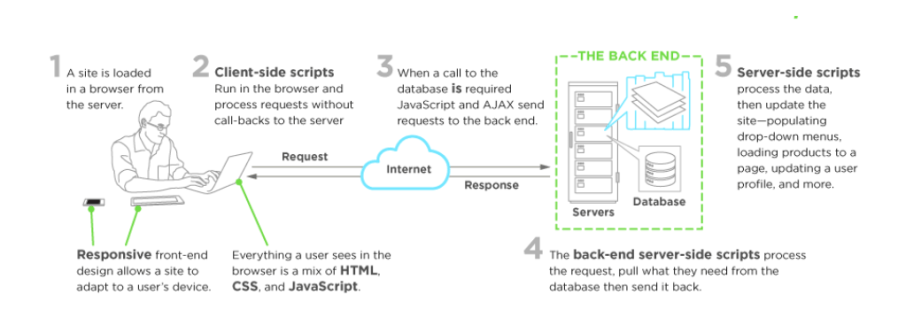
Web Development has many terms associated with it like front-end. back-end, and full-stack developer. What are they and in which perspective are they used?

front end developer

A front-end developer is a person who is responsible for the looks and design of the website. The design of the site aims to ensure that, when users open the site, they see the information in a format that is easily readable and relevant. This is further complicated by the fact that consumers are now using a vast range of devices of different screen sizes and resolutions, thereby requiring the designer to take these considerations into account when constructing the web. They need to ensure that their site is correctly positioned in different browsers (cross-browser), different operating systems (cross-platform) and different devices (cross-device), which require careful planning on the developer’s side.

The front end section is constructed using some of the languages discussed below:

HTML: HTML is the HyperText Markup Language. It is used to build the front end portion of a web page using a markup language. HTML is a mixture of Hypertext and Markup. Hypertext describes a connection between a web page. The markup language is used to define the text documentation within the tag that defines the web page structure.

CSS: Cascading Style Sheets affectionately referred to as CSS is a simple language designed to simplify the process of making web pages presentable. CSS allows you to apply styles to your web pages. More significantly, CSS helps you to do this independent of HTML.

JavaScript: JavaScript is a well-known scripting language used to build magic on blogs that render the web interactive for the user. It is used to improve the functionality of a website to run cool games and web-based applications.

Front End Framework and libraries

AngularJS: AngularJs is a front-end open-source JavaScript platform that is predominantly used to build single-page web applications (SPAs). It is a constantly growing and evolving platform that offers better ways to build web applications. Changes static HTML to dynamic HTML. It is an open-source project that can be freely used and updated by anyone. It extends HTML attributes with Directives, and data is bound with HTML.

React.js: React is a declarative, efficient, and flexible JavaScript library for creating user interfaces. ReactJS is an open-source, component-based front end library responsible for the view layer of the application only. It’s being maintained by Facebook.

Bootstrap: Bootstrap is a free and open-source collection of tools for creating responsive websites and web applications. It is the most popular HTML, CSS, and JavaScript framework for the development of responsive, mobile-first websites.

jQuery: jQuery is an open-source JavaScript library that simplifies the interaction between an HTML / CSS document or, more precisely, a Document Object Model (DOM) and a JavaScript document. Developing terminology, jQuery simplifies HTML document traversing and handling, browser event handling, DOM animations, Ajax interactions, and JavaScript cross-browser creation.

SASS: is the most accurate, mature, and robust CSS extension language. It is used to expand the features of the current site CSS, including everything from variables, inheritance, and nesting to ease.

Certain libraries and frameworks are Semantic-UI, Framework, Materialize, Backbone.js, Express.js, Ember.js, etc.

back-end developer

Backend is the server-side of the web. It stores and arranges data, and also ensures that everything on the client-side of the website works fine. It’s the part of the website you can’t see and interact with. It’s the portion of the software that doesn’t come into direct contact with users. Parts and features developed by backend designers are accessed indirectly by users through a front-end application. Activities such as writing APIs, creating libraries, and working with system components without user interfaces or even science programming systems are also included in the backend.

Back-end Languages

The back end component is built using some of the languages discussed below:

PHP: PHP is a server-side scripting language built specifically for web creation. Since PHP code is running on the server-side, it is called the server-side scripting language.

C++: It is a general programming language and is now widely used for competitive programming. It’s also used as a backend script.

Java: Java is one of the most common and widely used programming languages and platforms. It’s very scalable. Java components are readily available.

Python: Python is a programming language that helps you to work quickly and implement systems more efficiently.

JavaScript: Javascript can be used as both (front and back end) programming languages.

Node.js: Node.js is an open-source and cross-platform runtime environment for running JavaScript code outside the browser. You need to remember that NodeJS is not a framework and is not a programming language. Most people are confused and understand that it’s a framework or a programming language. We also use Node.js to create back-end services like Web App or Mobile App APIs. It is used in the development of major corporations such as Paypal, Uber, Netflix, Wallmart, and so on.

Back-end Frameworks

The list of back end frames is Express, Django, Rails, Laravel, Spring, etc.

The other back end programs/scripting languages are: C #, Ruby, REST, GO, etc.

Difference between Frontend and Backend:

Frontend and backend developments are quite different from each other, but there are still two aspects of the same situation. The frontend is what users see and interact with, and backend is how it works.

The frontend is a part of the website that users can see and interact with, such as the graphical user interface ( GUI) and command line, including design, navigation menus, text, pictures, videos, etc. Backend, on the other hand, is where part of the website users are unable to see and communicate.

The visual aspects of the website that users can see and experience are front-end. On the other hand, everything that happens in the background can be attributed to the backend

The languages used for the front end are HTML, CSS, Javascript, while those used for the backend are Java, Ruby, Python, .Net.

full stack developer

A full-stack web developer is a person who can develop both client and server software. Besides mastering HTML and CSS, he/she also knows how to:

Browser software (such as JavaScript, jQuery, Angular, or Vue)

Programming a server (like using PHP, ASP, Python, or Node)

Program a database (such as SQL, SQLite, or MongoDB)

Being a full-stack developer is a good practice because you know almost every aspect of web development. You can switch between front-end and back-end stuff according to the requirement.

Resources to learn

  • W3 School(Free)
  • Coursera(Paid)
  • Udemy(Paid)
  • FreeCode Camp(Free)
  • Treehouse(Paid)
  • Codeacademy(Free)
  • Traversy Media(Free)
  • HTMLDog(Free)

So, all the best guys for this amazing learning journey, hope you guys find this piece informative.


Can mid day meals solve the school education crisis in rural India ?

The roots of the mid day meal program can be traced back to the pre-independence era, when the British administration decided to come up with ways to help disadvantaged children. Today, this scheme seeks to address the following issues – food security, lack of nutritional food in rural areas, and access to education. It is hoped that by providing hot meals to children in lower primary and upper primary classes, more children will be encouraged to attend school regularly.    

Today, in India, 4 percent of the children do not attend school, and 58 percent of the children have not completed primary school. In fact, only 10 percent of the children in India make it to college. This is the education crisis that India is facing today. According to the government, the mid may meal program reaches out to more than 120 million children in over 1 million schools nationwide. However, has the number of children attending school increased over the past few years because of this scheme ?   

In fact, according to a government report, in Bihar, the attendance of children dropped by 9 percent in the last five years and in Madhya Pradesh, the attendance of children dropped from 67 percent to 54.5 percent between 2008 and 2011. And in other states such as Andhra Pradesh, Kerala and Uttar Pradesh, there is an increase in private school enrollment in rural areas over the past five years. This proves that the mid day meal program has not been effective in solving the school education crisis. Despite providing healthy meals for children, there is a significant decline in the enrollment of students in schools in rural areas. On paper, the government has urged schools to provide meals with a minimum of 300 calories for those studying in lower primary classes and meals with a minimum of 700 calories for those studying in upper primary classes.   

The Mid Day Meal is a significant part of the diet of Indian children. The meal is available to all primary and upper primary children (classes 1 to 8) in government schools, government-aided schools and Education Guarantee Scheme (EGS) schools. Two out of three Indian children go to government schools alone (according to the 2011-12 India Human Development Survey). Not every child entitled to the mid-day meal receives it; the survey shows that 82% of children in government schools reported getting a mid-day meal. In all, at least half of all children in classes 1-8 in India get a mid-day meal.

How many children get a mid-day meal ?

For many, the mid-day meal is invaluable. The 2011-12 National Sample Survey (NSS) data shows, 10% of the meals that all primary school-age children (5-9) in rural India receive in a month are from school. The Mid Day Meal’s self-selection works; the poorest children in both rural and urban India get more meals per head from school than richer children, the NSS data shows.

There is evidence that the Mid Day Meal has contributed to the gradual improvement in child malnutrition indicators. The Mid Day Meal scheme explained at least one-tenth of the total reduction in stunting in India in between 206 and 2016, researchers at the International Food Policy Research Institute found. Adolescent girls, now 12-17, who got meals under the Mid Day Meal Scheme in 2004 were taller, they found. The effects on health were multi-generational; children born to young women who had received school meals in 2004 were less likely to be stunted.

Yet, the nutritional value of the meal is far from perfect. On paper, each hot cooked meal is meant to provide a primary school child with 450 calories and 12 grams of protein, and an upper primary child with at least 700 calories and 20 grams of protein. This is often not the case; earlier this year, journalist Pawan Jaisal recorded a government school in Uttar Pradesh’s Mirzapur serving the children rotis and salt only. In 2012-13, 90% of school lunches served to primary school students in Delhi did not meet the energy and protein norms.

This becomes important in the context of general under-nourishment among school-going children. The CNNS shows that the diets of school-age children are highly deficient, and they consume lower than recommended amounts of most healthy foods.

School-age children have deficient diets

The outcomes are evident. 22% of children 5-9 were stunted (low height for age), and 23% were thin (low Body Mass Index for age). 24% of adolescents (age 10-14) were thin. The prevalence of stunting was higher among children who were out of school.

School-going children have significant rates of malnutrition and micronutrient deficiency

For those from richer families, availability of healthy foods is a lesser problem (though it exists) compared to obesity and related non-communicable diseases, which stem from poor nutritional awareness.

However, there is no government body to monitor these schools and ensure that nutritious meals are reaching the students. A survey conducted by the Department of Economic and Statistical Analysis shows that 72 percent of schools do not have kitchens and facilities to cook. So, food would be cooked miles away and transported to the schools. By the time the food reaches these poor children, it would have turned cold. Also, 69 percent of the schools that were surveyed did not have proper eating utensils.     

So, the mid day meal scheme is not a solution to the school education crisis in India. Steps have to be taken by the government to ensure that schools have the proper facilities for cooking. In the last few weeks, there have been incidents of a dead lizard and insecticide being detected in mid day meals. This shows that the government has no mechanism in place to check the quality of food before it is consumed by children. Government schools lack the proper infrastructure for teaching, which is why students prefer to study in private schools. Those who are unable to afford an education in private schools prefer to work because of the horrific conditions of government schools. So, it is time for the government to take responsibility of the education system and provide proper facilities for the welfare of the children in India.  

Lord Krishna – His side of the Management Guru

Janmashtmi has approached and his devotee will be celebrating it in vivid ways. Different people have different images of lord Shri Krishna but only handful of people are aware of His other side – The management guru. The teachings of Lord Krishna are known all over world and had been encrypted in the very famous Bhagavad – Geeta. Five thousand years back Lord Krishna taught Arjuna self-development which is the key to leadership skills. This leadership would eventually lead to Managerial skills. The teachings of Shri Krishna centuries back are applicable in present day where the knowledge of the individual is powerful.

Many corporate can follow his teachings for human resources development of the managers and workers.   

Shri Krishna started enlightening the world with knowledge right from his childhood days. Though many people feels that he was naughty in his childhood and hence used to steal Maakhan from various houses yet He had a different perspective all together. He was the leader of his poor friends who did not have butter at home. He would steal butter from the houses where it was in excess and would equally distribute it among the poor friends. The message Shri Krishna conveyed is that a true leader would always solve the problem of all those who look up to him, however small or big it might be.

” Karmanye Vadhikaraste ma phaleshu kadachna, Karmaphalehtur bhurma te sangostvakarman “

In the above quoted very famous shloka of Geeta Shri Krishna has beautifully explained about the relation between deeds and results. Shri Krishna says that every person has a right to perform his/her prescribed duty but should not be concerned only to the fruits of action. One must never consider himself as the cause of the result of his/her duty and at the same time should never be attached to not doing the duty. Not many people understand this.

In order to understand consider youth icon Vishwanathan Anand. Whenever he wins a game, he never takes the credit for winning rather he would say that his opponent did some mistakes.

By saying so he does not consider himself as the cause of the result of his deeds but at the same time he does perform his duty very well. In the above shloka, Shri Krishna also guides people to have a right attitude towards the work they perform. There is a very famous story of three stone-cutters who were engaged in constructing a temple. A man asked them what they were doing. The first stone cutter said with a dejected face, “I am a poor man. I have to maintain my family. I am making a living here”. “Well, I work because I want to show that I am the best stone-cutter in the country,’ said the second one with a sense of pride. The response of the third worker to this innocent-looking question is illuminating. He said “Oh, I want to build the most beautiful temple in the country,” with a visionary gleam. Their jobs were identical but their perspectives were different. What the Geeta tells us is to develop the visionary perspective in the work we do. It tells us to develop a sense of larger vision in our work for the common good.  

The famous epical story of Shri Krishna and Sudama is not unknown to anyone. After being the king of Dwarika when Shri Krishna once got to know that His childhood friend Sudama has come to meet Him, He left his throne and went to the main gate of the kingdom to receive Sudama and embraced him. The story clearly portrays a very humble and down to earth nature of Lord Shri Krishna. The message any management professional can take from the story is even after achieving the heights of success and glory one must keep his/her feet firmly on ground. More humble and down to earth a person is more he/she succeeds in the life and carrier.   

The Mahabharata war was fought three thousand years ago, on the battlefield of Kurukshetra. Shri Krishna gave up all his men-power to the Kauravas and was standing with Arjuna to guide him and to perform his responsibility of being a true leader. History has witnessed that though kauravas had enormous resources, yet it was the leadership of Shri Krishna who guided a handful people and Arjun’s sheer talent that led Pandavas towards success and victory. Kauravas had great archers like Dronacharya, Karan and many more yet they could not win. The reason being is lack of leadership. Clearly even best mind and talent cannot achieve success without a good leader. And looking on the other side of the coin, despite having limited resources a good leader can definitely take his company to the zenith and much above.   

In the battle of Mahabharata Shri Krishna had the most powerful weapon called “sudarshan Chakr” but never used it for anyone who was not guilty of any wrong deed. The message that he has conveyed through this is that even though a leader or manager might have the supreme powers but he/she should never misuse it. The lessons of Bhagwat Geeta are very much applicable in today’s scenario as well. The iconic industrialist Mr. Ajay Piramal Says “Bhagavad Geeta is one of the greatest management books as it prescribes optimism and freedom from stress”.

People generally get confused with effectiveness and efficiency and its applicability in management. In Bhagwat Geeta there is a beautiful extract in which the difference between effectiveness and efficiency has been distinguished in a crisp manner. It quotes; Effectiveness is doing the right things and Efficiency is doing things right. Management has become a part and parcel of everyday life, be it at home, in the office or factory and in Government. In all organizations, where a group of human beings assemble for a common purpose, management principles come into play through the management of resources, finance and planning, priorities, policies and practice. Management is a systematic way of carrying out activities in any field of human effort. The critical question in all managers’ minds is how to be effective in their job. The answer to this fundamental question is found in the Bhagavad Geeta, the teachings of Shri Krishna which repeatedly proclaims that you must try to manage yourself.’ The reason is that unless a manager reaches a level of excellence and effectiveness, he or she will be merely a face in the crowd.  

Indeed Lord Shri Krishna is teacher of the universe, “krishnam vande jagat gurum”. Although throughout his life he taught some body or the other but in battle field of Kurukshetra he taught Arjun, principles management and leadership. This conversation between Krishna and Arjuna is known as Bhagwat Geeta. This is not only Hindu holy book but it is for the whole of the mankind. And an idol book for management.

India tested more than 6 lakh COVID-19 samples for third consecutive day

India has tested more than 6 lakh COVID-19 samples for the third consecutive day in a row. India’s resolve to rapidly increase the number of tests done per day has resulted in a successful march towards 10 lakh per day testing capacity with 6 lakh 64 thousand 949 tests conducted in the last 24 hours.
 
The Tests Per Million too have seen a sharp rise to more than sixteen thousand. A key component for the successful implementation of the “Test, Track and Treat” strategy has been the continuously expanding network of diagnostic labs across the country. The lab network as on today consists of 1370 labs. These consist of 921 labs in the government sector and 449 private labs.

Top finalists under ‘AatmaNirbhar Bharat App Innovation Challenge’ to showcase apps in Mega Hackathon

A Mega Hackathon will be organised today where the top finalists selected under the ‘AatmaNirbhar Bharat App Innovation Challenge’ across categories will be showcasing their Apps.

The Mega Hackathon will be streamed live from 12 noon to 5 PM on Social Media platforms of MyGov India and Digital India.

The AatmaNirbhar Bharat App Innovation Challenge’, was launched by Prime Minister Narendra Modi on 4th of last month, which saw participation from 6 thousand 9 hundred 40 tech entrepreneurs and start-ups across the country.

The mega Challenge had entries for 9 different categories namely Business, eLearning, Entertainment, Games, Health, News, Office and Work from Home, Others and Social.

National Handloom Day being observed today

National Handloom Day is being organised today by the Ministry of Textiles on a virtual platform. Textiles Minister Smriti Irani will be the Chief Guest on the occasion. During the function, handloom clusters across India, NIFT campuses, all the 28 Weaver Service Centres, National Handloom Development Corporation and others will be connected online.

7th August was chosen as the National Handloom Day to commemorate the Swadeshi Movement which was launched on the same date in the year 1905. The objective is to generate awareness about the Handloom Industry among the public and its contribution to socio-economic development.

To mark the occasion and to instil pride in the workmanship of handloom weaving amongst citizens, a social media campaign is planned for the handloom weaving community.

Prime Minister Narendra Modi has said, the Handloom and Handicrafts of India encompass a glorious history of hundreds of years.

In his Mann Ki Baat address on All India Radio last month, the Prime Minister urged everyone to use Indian Handloom and Handicrafts as much as possible, and also communicate to more and more people about them. He said, local artisans and weavers will benefit from conversations about the richness and diversity of Indian handloom and handicrafts.

The Prime Minister emphasized that the correct and positive approach always goes a long way in transforming distressing times into opportunities, adversities into triggers of development and progress.

Country’s first Kisan Special Parcel Train to run from today to provide seamless supply of perishable produce

The country’s first Kisan Special Parcel Train or Kisan Rail will start from today. The train will start at 11 AM and it will transport material between Maharashtra’s Devlali and Bihar’s Danapur Railway station. The Kisan Rail will carry fruits and vegetables and will make stoppages at several stations and pick-up and deliver them.

Agriculture Minister Narendra Singh Tomar and Rail Minister Piyush Goyal will flag off the train through video link. The train is scheduled to reach its destination Danapur tomorrow at 6:45 PM, covering a distance of one thousand 519 kilometres in around 32 hours.

The train will halt at Nasik Road, Manmad, Jalgaon, Bhusaval, Burhanpur, Khandwa, ltarsi, Jabalpur, Satna, Katni, Manikpur, Prayagraj Chheoki, Pandit Deendayal Upadhyay Nagar and Buxar.

With the launch of Kisan Rail, the Railways aims to help double farmers’ income. The Railway Ministry said, this will help in bringing perishable agricultural products like vegetables, fruits to the market in a short period of time.

The Kisan Rail train with frozen containers is expected to build a seamless national cold supply chain for perishables, inclusive of fish, meat and milk. Our correspondent reports that, Finance Minister Nirmala Sitharaman had announced to start ‘Kisan Rail’ in the current year’s Budget, for providing a seamless supply chain of perishable produce.