History of Chocolate

The first thing which comes to our mind when we hear the word chocolate is a candy or a dessert which tastes sweet. At present, Chocolate is one of the most famous food items in the world. It is consumed worldwide in different forms and is loved by foodies. At first thought we think of it as something to eat and not drink. Chocolate has a very different history and the story behind its popularity is quite an interesting one. The history of Chocolate dates back to about 450 B.C. when it was originally consumed as a bitter drink mixed with spices or corn puree. It originated in Mesoamerica where the Aztecs believed that the cocoa or cacao seeds were the gifts of the God of wisdom. It was used as an aphrodisiac which gave the drinker strength. The sweet pulp of the cacao fruit surrounding the beans, was also fermented into an alcoholic beverage at that time. Today local folks of South Mexico are still known to make such drinks.

Photo by Pixabay on Pexels.com


The word chocolate came from the Aztec word “xocoatl” meaning a bitter drink brewed from cacao beans. The cacao tree has a Latin name “Theobroma cacao” meaning Food of the Gods. In pre-modern Latin America, the cacao seeds were considered so valuable that it was used as a currency. It was one of the essential items in rations of the United States soldiers during war. According to a 16th century Aztec document 100 cacao beans could be exchanged for a good turkey hen.  

The cacao tree is native to Mesoamerica where its cultivation, consumption and cultural use began. When pollinated, the seeds of the cacao tree form a sheath, within which 30 to 40 brownish-red almond shaped beans are embedded in a sweet viscous pulp. The beans are bitter but the pulp is sweet which may have been consumed by humans at first. The cacao pods grow in a wide range of colors, like pale yellow, bright green, purple and crimson. The texture may vary from sculpted to completely smooth. The plantation of the cocoa trees is a tough process. When in natural environment, the trees can grow up to 60 feet tall but in plantations they grow only up to 20 feet.  

Photo by Sheena Wood on Pexels.com

Chocolate was prepared as a sweet by the European people when it arrived there. It got popularized among the rich people and eventually among the common. Christopher Columbus first came across cacao on his fourth mission to America, when he and his crew seized a canoe full of native goods for trade. He took the beans back to Spain. After it got imported to Europe, it was used as a medicine for treating abdominal diseases because of its bitter taste. After getting sweetened with the addition of sugar or honey, it became a court favorite and chocolate established a foothold in Europe within hundred years.  

In 1828, a Dutch chemist found a way to make powdered chocolate and this product became known as the Dutch cocoa. This led to the creation of solid chocolate. The first modern chocolate bar was made by Joseph Fry in 1847 by making a moldable chocolate paste. By 1868, a small company called Cadbury was making chocolate candies in England. A few years later milk chocolate was made by Nestle. In the 20th century the word chocolate includes a variety of sweet treats. Modern day chocolate is made from the hardiest but least flavorful cocoa beans and it is often said that it has more sugar and additives than actual cocoa.  

Reasons why the Power of Purchasing Parity theory is effective

a) Strong relation between exchange rate and purchasing power of two countries currency and its rate of exchange:

Practically there is no defined link that exist between power to purchase the currency and its exchange rate. Apart from power to purchase, there is exchange rate which is influenced due to various factors like flow of capital, balance of payment, tariff and speculation. As these have not been considered, the purchasing power parity is not giving the desired forecast.
b) Level of prices:

This theory calculates the rate of exchange by using indices of price level in both countries as generic version. In general price level is inclusive of prices which are domestic and internationally traded and the theory is based on implicit assumption that prices in two segment of goods shows variation equally and proportionately assuming that it is in same path in both countries. It is seen that prices can move in any direction internal as well international. International trading of goods is not taken into account. As per this, prices of goods produced and used in home country will not have much impact on exchange rate.
c) Price Index Numbers:

Another issue in this theory, is using price index based on power to purchase a currency in two different countries. Price index numbers may be varying kind that raise issue of selecting the correct price index. Another problem which is based on price index of two countries is that it may not be comparable due to difference in same base period, choice of commodity and average pricing of each commodity. Keeping such diverse problem into account, constructing price index for two countries will be difficult as correct measurement of purchasing power parity is not available.

d) Price Level and Exchange Rate: PPP theory takes into account change in price level and it indicates that as cause for changing exchange rate. In other words, change in price level is cause and change in rate of exchange is effect. Changes in exchange rate can also lead to changes in price level. This can be faulty and misleading. In practical condition, depreciation in exchange rate stimulates export and gives restriction to imports. Reduction in supply for domestic market is likely reason for pushing the prices in upward direction in home country. In foreign country prices may fall, this will induce change in price level. Domestic prices are following the exchange rate rather than preceding.
e) Capital Account:

This theory has not taken into account capital transaction. It is considering only the Balance of Payment based on merchandising. Capital account which is significant in India is ignored. It seems to be more apt for trading nations and not so relevant when it comes trading and banking.
f) BOP Equilibrium:

In relative pattern, this theory assumes that balance of payment during the specified base time is in equilibrium. Assuming this, new rate of exchange is determined and such an assumption may not be true. It is difficult to locate such a period in any country due to unequal balance of payment.
g) Structure:

It is considering that there is no change in structure of factors, which are underlying the base time equilibrium. Factors like tastes, preference, resources, productivity and technology etc are considered. Assuming that related structural factors are unrealistic and rate of exchange are bound to be affected due to variation in factors.
h) Capital Movement:

PPP theory does not take into account variation of internal price which are changing in two countries. Zero capital investment is assumed and such assumptions do not give realistic results. Capital flow has substantial influence on exchange rate based on demand and supply of foreign as well as domestic currency. This impact of capital flow on exchange rate has been neglected in this theory.
i) Elasticity of demand and its reciprocal:

PPP fails to consider the reciprocal demand elasticity. Rate of exchange which are between two currency in two countries are determined not only due to changes in relative pricing but it takes into account the elasticity of reciprocal demand(Ca’Zorzi, M et al., 2016).
j) Barter Terms:

PPP depends on the assumption that there is no change in terms of bartering between two countries. Based on this assumption, the theory gets invalid. There are frequent changes in barter terms of trade due to several factors like export supply of goods, home demand for foreign goods, loans from foreign land etc.
k) Demand and Supply Forces:

Rate of exchange is not impacted by price change in two countries alone. Demand and supply of foreign exchange form fundamental force for determining rate of equilibrium. Other influencers are flow of capital, transportation cost, banking system, insurance system. PPP theory is not giving much importance to such forces of demand and supply of foreign exchange.
l) Income and Expenditure: Variation in aggregate level of income and expenditure and its effect on rate of exchange is not considered as per this theory. The effect of trading volume is not considered in this theory. As per this theory, demand is straight function of price wherein shift in income and expenditure in the business cycle is completely not taken into account. This leads to wide variation in volume and foreign exchange even if the prices remain the same.
m) International Economy:

This theory does not consider the cognizance and volatility of international business relationship. Third country purchasing commodity from first two countries who are already in trade relationship is not considered. Third country trading can have an impact on the demand and supply of goods and its volume. Hence proper measurement in multi country trading is not established.
n) Longevity:

PPP theory is apt for long period of time wherein not many other disturbances can have impact. However, price variation is one important aspect in exchange rate, it is not the only factor.
In spite of various weakness noticed in PPP theory, they form the central model and has proven to be good for long term analysis. Hence this theory has been considered for studying the exchange variation between EUR and USD. It is empirically proven theory, hence the same has been taken into account for the analysis of bilateral rate of exchange.

Competency mapping

Competency mapping identifies an individual’s strengths and weaknesses. The aim is to enable the person to better understand himself or herself and to point out where career development efforts need to be directed.

Competencies are derived from specific job families within the organization and are often grouped around categories such as strategy, relationships, innovation, leadership, risk-taking, decision-making, emotional intelligence, etc. So far as the way to go about for competency mapping is concerned, the first step is job analysis, where the company needs to list core competency requirements for the job concerned. The next step should be development of a competency scale for the job on the parameters previously identified.

The actual mapping of employees can be a self-done exercise or done by others like superiors. It can also be done by using the 360-degree method where peers, first reports and customers also rate the employee.

Competency approach to job depends on competency mapping. Competency Mapping  is a process to identify key competencies for an organization and/or a job and incorporating those competencies throughout the various processes (i.e. job evaluation, training, recruitment) of the organization. A competency is defined as a behavior (i.e. communication, leadership) rather than a skill or ability. 

Competency is your ability to do something successfully or efficiently. Therefore, competency mapping is simply a process of matching your competence with the job role and/or organization. Furthermore, it is also about matching people to the job role and hence used even in selection.

Definition: Competency mapping is the process of identifying the specific skills, knowledge, abilities, and behaviors required to operate effectively in a specific job or organization. Competency maps are often also referred to as competency profiles or skills profiles.

Some of the major practical applications of competency mapping include :

Job Evaluation: By analyzing the key skills to required to do a job a simple job evaluation can be prepared. It can help in allocating existing or new resources to the specific job based on the evaluation process

Project Planning: What key tasks can be performed by what resources ject can easily be identified through the mapping process and helps in project planning.

Performance Management:

A competency mapping exercise results in preparing Competency Framework, which in turn helps in allocating desired proficiency for the job vs current proficiency to do the job. By analyzing any gaps the performance management can be seamlessly conducted

Job analysis: By identifying the key behaviors required to perform each job role, competency mapping is really useful in preparing job analysis. Not to be confused by Job description step in competency mapping process where the job roles analyzed for allocating competencies and behaviors.

Succession Planning : The analysis of competencies required for a leadership role and mapping them with proficiency shown by potential leaders a clear roadmap for succession planning can be created.

Any developmental need can also be ascertained by mapping the critical competencies with the current proficiency level demonstrated by an individual vis-à-vis the required proficiency level for the position.

Recruitment: By identifying key skills required to do the job and also developing a competency-based interviewing process the organizations can benefit by hiring the most suitable resources while it helps in all stages of the recruitment process.

Individual development plan: Any gaps in desired and current proficiency levels help in developing individual development and learning roadmap for individuals and even job roles and categories.

Jobs in India are attracting Foreign Resumes.

In the tough time due to Covid-19 pandemic the jobs all around the world are worst affected.Many top companies have removed their employees for the cost cutting approach.So,in this case many are jobless and for many employees in different companies are working with a hefty pay-cut due to this.As everywhere everything is started to lease slowly and steadily we can see again the job openings by different companies have started and that’s a good sign for everybody else out there who want jobs.

When Teamlease Services just posted about their job openings in the field of Marketing,the company was surprised and shocked to see that resumes are coming from foreign countries such as US.As due to this situation there is wide spread of opportunities open for each and every candidate around the world to apply.Now in this case companies have also got the potential to hire the best candidate and having ample of opportunities to hire according to their criteria.

It will not be a kind of one way system but there is same kind of opportunities open for Indian candidates to apply for foreign roles said hiring firms.Hiring firms are keen to hire candidates on the roles for R&D,processing and design,in addition technology.Randstadd India head Sanjay Shetty says “Some Global CEOs we are looking at India for its quality talent.This could be another wave of jobs being outsourced to India in a big way. A number of high-end jobs — which were hitherto kept close to the mothership of an MNC, especially in FMCG (fast-moving consumer goods), FMCD (consumer durables), banking and liquor industries — are expected to relocate to India. Some of these companies had earlier shied away from doing so, for various reasons”.

Key reasons for this transition is because as Indian companies has gone into Work From Home as they business continuity.In this new trend all the companies are gone into strengthening cyber security systems.As in this period company wants mind workers rather than hand workers.Some companies also said that the person who is an individual coder can work from anywhere just he needs only laptop.In this the company mentioned that people who have been living far from their hometown have reached to their hometown.So they will have good quality time spend with family,a well cooked home food and environment with their loved ones.

So in this case the companies are getting foreign resumes because working from any corner of the world is possible just by having a good connectivity and a laptop.

Dwaraka – The Kingdom of Lord Krishna

The discovery of the legendary city of Dwaraka which is said to have been founded by Sri Krishna, is an important landmark in the validation of historical relevance of Mahabharata. It has set at rest the doubts expressed by historians about the historicity of Mahabharata and the very existence of Dwaraka city. It has greatly narrowed the gap of Indian history by establishing the continuity of the Indian civilization from the Vedic age to the present day. The discovery has also shed welcome light on second urbanization in the so-called ‘Dark age’, on the reestablishment of dharma, on the resumption of maritime trade, and use of Sanskrit language and modified Indus script.

Dwaraka is a coastal town in Jamnagar district of Gujarat. Traditionally, modern Dwaraka is identified with Dvaraka, mentioned in the Mahabharata as Krishna’s city. Dwaraka was a port, and some scholars have identified it with the island of Barka mentioned in the Periplus of Erythrean Sea. Ancient Dwaraka sank in sea and hence is an important archaeological site. The first clear historical record of the lost city is dated 574 A.D. and occurs in the Palitana Plates of Samanta Simhaditya. This inscription refers to Dwaraka as the capital of the western coast of Saurashtra and still more important, states that Sri Krishna lived here.
There are many mythical tales woven around the city of Dwarka. The most prominent myth is associated with the ‘hero of the Dwapara’; Lord Krishna who is believed to have held his kingdom here. Dwarka in the ancient times was known as Anarta which had been Lord Krishna’s terrestrial empire. Dwarka consisted in islands like Antar dwipa, Dwarka Island and the mainland of Dwarka. The city had been the capital city of the Yadava clan which ruled over the place since many years. In the great epic Mahabharata Dwarka is mentioned as Yadavas’ capital city consisting in many other neighboring states such as Vrishnis, Andhakas, Bhojas within its jurisdiction. The most important chiefs of Yadava clan inhabiting Dwarka included Lord Krishna, who was the king of Dwarka, then Balarama, Kritavarma, Satyaki, Akrura, Kritavarma, Uddhava and Ugrasena.

According to the most popular legendary tale, Lord Krishna migrated to Kusasthali; the name by which Dwarka was known in the ancient times in order to evade the continual harassing raids done on Mahura by Jarasandha; Kansa’s father in law. Jarasandha wanted to avenge the death of Kansa, the wicked cruel uncle of Krishna whom the lord had killed and thus was attacking Mathura time and again.

When he came back to Dwarka along with his clan of Yadavas, he ordered Lord Vishwakarma to build a city for his kingdom. Answering his order, Lord Vishwakarma told that the city can be built only if Lord Samudradevi offered them some land. Lord Krishna then prayed to Samudradeva who responding to the prayer providing them with land up to 12 Yojna and soon after the celestial constructor Vishwakarma built the city of Dwarka in a short span of only 2 days. The city was called ‘Suvarna Dwarka’ because it was all clad in gold, emeralds and jewels which were used to construct the houses in lord Krishna’s ‘Suvarna Dwarka’. It is believed that Lord Krishna’s original residence was at Bet Dwarka from he administered the entire Dwarka kingdom. Legend further adds that after Lord Krishna departed from his mortal body, the city went under the sea with Samudradeva taking back what he had given once upon a time.

The Temple of Dwarkadhish is believed to have been set by Vajranabha; grandson of Lord Krishna, in order to pay tribute to the great lord. The religious significance of Dwarka is associated with other myths too. One such myth points out the Dwarka is the spot where Lord Vishnu had demolished the demon Shankhasura.

Archaeological history:

The first archaeological excavations at Dwaraka were done by the Deccan College, Pune and the Department of Archaeology, Government of Gujarat, in 1963 under the direction of H.D. Sankalia. It revealed artefacts many centuries old.

The objective of the excavation was to know the antiquity of the site, based on material evidence. In the offshore excavation, the ASI’s trained underwater archaeologists and the divers of the Navy searched the sunken structural remains. The finds were studied, dated and documented. On land, the excavation was done in the forecourt of the Dwarakadhish temple. Students from Gwalior, Lucknow, Pune, Vadodara,Varanasi and Bikaner joined in to help the ASI archaeologists.

Findings at Dwarka excavation site:

The underwater excavations revealed structures and ridge-like features. Other antiquities were also found. All the objects were photographed and documented with drawings – both underwater. While underwater cameras are used for photography, drawings are done on boards – a transparent polyester film of 75 micron fixed with a graph sheet below. The graph sheet acts as a scale. One or two divers take the dimensions and the third draws the pictures. The Public Works Department routinely conducts dredging in these waters to keep the Gomati channel open. This throws up a lot of sediments, which settle on underwater structures. Brushes are used to clear these sediments to expose the structures.

* Explorations yielded structures such as bastions, walls, pillars and triangular and rectangular stone anchors.
* A semi-spherical single-hole stone which might be the base for flagpost.
* L-shaped edges of stones for proper grip and arresting wave action on bastions.
* Seals, inscriptions, which have been dated to 1500 BC.
* Pottery, which have been dated to 3528 BC.
* Stone sculptures, terracotta beads, bronze, copper and iron objects.
Marine archaeological explorations have thrown light on a number of structures of different shapes, stone anchors and other artefacts. The exploration has found sandstone walls, a grid of streets and remains of a sea port, some 70 feet beneath the sea. The evidence points to the fact of the existence of a city some 9,000 years ago.

Also according to them this was one of the most important and busy ports during historical and medieval periods.

Dwarka was supposed to have been built on six blocks, two on the right bank and four on the left. All the six sectors have protective walls built of dressed stones of sandstones. Whatever has been traced so far conforms to the description of Dwarka in the Mahabharat to a large extent. For example, the enclosures may correspond to the Antahpurs (harems) of the texts.

Similarly, the large number of stone anchors is indicative of overseas trade. The large ships were anchored to the sea, whereas the small ones were near to the warehouses on the Gomati, part of which has been submerged.

The layout of the excavated city, the spread and the location of fort walls and bastions match the descriptions mentioned in Harivamsha, a prologue to Mahabharata. Harivamsha described the city of Dwarka in minute details. According to it, the area of Dwarka was 12 yojanas. It was connected to the mainland by a strip, which is visible even now, in low tide. The city excavated is of the same size.

What really happened to Dwarka?

The rise in the sea-level in Dwarka is a scientific truth. Studies have proved that the sea considerably and suddenly rose to submerge the city. Harivamsha describes the submerging of Dwarka saying Krishna instructed Arjuna, who was then visiting Dwarka, to evacuate the residents of the city as the sea was going to engulf the city. “On the seventh day (of Krishna saying this), as the last of the citizens were leaving the city, the sea entered the streets of Dwarka.”


According to experts, there could have been three reasons why the sea entered the land. One, a change in the level of seabed, two, a massive earthquake and three, sudden increase in the level of sea water. Of the three, the last is the most plausible. If it was a change in the level of seabed, some remains of the “tearing off action” on the shore would be visible, which is absent. Earthquake can be ruled out as the structures have not collapsed because of the shake. The third reason is most acceptable as a similar phenomenon had occurred in the shores of Bahrain, around the same time, as some recent findings indicate. It is to be noted here that considerable work has been done on shore and offshore underwater excavations in Bahrain, which has indicated a deep and regular trade and other relations between the western coast and the coasts of the present-day Bahrain region.

Dwarka, as of today is still one of the best-studied underwater sites in India.

It is indeed surprising that the history associations, archaeologists and historians have taken little notice of the findings at Dwarka. In its early days, the project received UNESCO support and several foreign marine archaeologists also offered help. However, the government’s indifference to the project has kept them away. Unlike several other land excavations, the underwater excavations can be done only with total government help. Several levels of permissions are needed. While land excavations are demanding in labor, the underwater explorations need machinery and equipment. Skillful divers, who are trained to look for meaningful objects are required too.
an Indian, Dwarka is not a mere archaeological site, nor is it a proof. Indians have all along believed Mahabharata to be a historical narration. But the excavations are a national heritage, a symbol of pride, an honor that is shared by all who are born in this land of Bharata. It is a call for action on Dwarka.


Delhi Electric Vehicle Policy

Delhi government recently announced the Delhi Electric Vehicle Policy to remote usage of electric vehicles in Delhi. For this the government is providing three major incentives

• The government providing subsidy on electric vehicles. For vehicles like e rickshaw two wheelers and freight vehicle the subsidy will be around ₹30,000 and ₹1.5 lakh subsidy on electric cars. And there will be no capping on e-auto rickshaws.

• The government has also made it scrapping of old petrol or diesel cars easier. It has decided that if you scrap sell your petrol or diesel car to buy new electric car then more subsidy will be given.

• For commercial vehicles government has decided to give low interest loans. Additionally the registration and road tax fee will also be waived off.

Along with giving incentives to the e-vehicles, it has also been decided that pollution cess an extra road tax will be put on non electric vehicles. All these decisions have been made to combat air pollution which is a big problem for Delhi. Also, the government sees it as an opportunity to help revive the economy which currently is suffering due to COVID-19. It has also been planned that by 2025 the delivery services will have 50% e-vehicles which will by the year 2050 be using only e-vehicles. By the end of 2020 there will be 1000 state run e-buses in Delhi and in the next three years it will increase to 50% of total. For the successful initiation of e-vehicles it is necessary to set up charging stations. does it has been decided to put up 200 charging stations at every 3 km in Delhi.

INDIAN RAINS

Heavy downpour leads to water logging, major traffic snarls

The India Meteorological Department has predicted heavy rainfall in central and eastern Indian parts.

Mumbai was lashed with intense rainfall last week, leaving multiple regions waterlogged. High tide hits Marine Drive in Mumbai as Mumbai’s civic body, the Brihanmumbai Municipal Corporation (BMC) warns people to stay away from the coast.Almost every monsoon, Mumbai struggles to cope with the chaos caused by the rain. The suburban trains – the city’s lifeline – are affected and low-lying areas get flooded.

A fresh spell of heavy rains lashed the national capital on Tuesday, inundating low-lying areas and affecting traffic movement in parts of the city. The problem could be solved by fixing this but it needs an overhaul of the drainage system, which, according to experts cannot be done, unless there is more data, both on rainfall and drainage infrastructure. Over 40 locations in north Delhi got inundated due to the downpour, including areas in Mukherjee Nagar, Fateh Puri, Burari, Rohini, Narela and West Patel Nagar, according to the North Delhi Municipal Corporation (NDMC). Even a small downpour proved to be huge problem for Delhi as road got flooded resulting in traffic chaos and drown cars.

The summer showers in the state of Kerala, Thiruvananthapuram are all set to gain momentum as the Kerala State Disaster Management Authority has sounded a yellow alert in nine districts for Sunday and Monday, followed by a warning of isolated heavy rains. The alert has been sounded in Kollam, Pathnamthitta, Alappuzha, Kottayam, Idukki, Ernakulam, Thrissur, Palakkad and Malappuram. Extremely heavy rainfall lashed Kerala disrupting normal life of every individual. Floods in certain part had worsened the situation.

he India Meteorological Department (IMD) has forecast heavy rainfall, thunderstorm and lightning in at least eight districts of Bihar, where more than 80 people were killed in several parts of the state. IMD had said earlier that a situation conducive for enhancing rainfall activities is likely to prevail over the foothills of the Himalayas along with Bihar-Nepal border and adjoining areas.Widespread rain after a gap causes more thunderstorm and lightning activity. Patna continue to wallow in a sea of misery as most localities remained flooded for a long time.

Heavy rainfall lashed north Bengal on Saturday, leading to flooding in low-lying areas, and the weather department issued a yellow warning for Himachal Pradesh for July 12 as the monsoon trough ran close to the foothills of the Himalayas passing eastward from Arunachal Pradesh to Punjab. Kolkata was too lashed by rainfall leading to traffic snarls in parts of the city.

Everything in excess proved to be dangerous, so stop playing out with nature.

Positive Attitude.

Surround yourself with positive people. Find people who challenge you, believe in you to make this world better place to live for everyone.

When you are positive you see good in everything. When you are negative, you find something bad in almost everything. You almost find something to blame someone for, something bad, something to criticise, something to boil over shout at, if you are looking for all that. Though life is both positive and negative, it is seen that negatives come naturally to us. But the change from negative to positive I’d quite easy. To convert negative to positive, we have to fight our natural instincts also, which are mostly negative. For example when situation get hot, we easily give in to negativity, irritation, impatience or blame game: though everyone knows that by cultivating non-confrontation abilities, we can achieve very good positive outcome which can bring us peace, harmony and happiness.

For positive outcome in life we have to cultivate positive attitude and make a habit of it. It is up to you to chose your course, an easy path through an angry egoistic reaction which may lead to the loss of opportunity later or it could be a well considered response which would surely result in being benificial to all – to you and in turn, to your family, friends and society.

Human being are unique, intelligent and with a discerning mind, and the only species on this planet who know the difference between right and wrong. Then, why do we let ourselves be taken over by cross negative forces, by being reactive and lose a sea of opportunities waiting for us when we can adopt a positive attitude that makes us happy, energised, blissful and joyful?

The question is why don’t we do that more often to change the course of our life from negative to positive!? Why do we get lured by negative and easier rays which inhibit our true progress and growth??

Document Object Model(DOM)

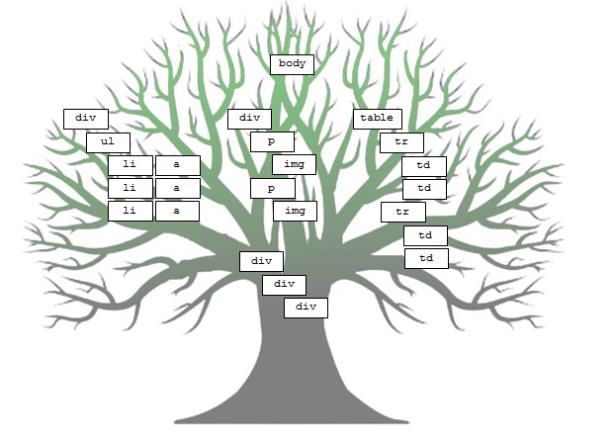
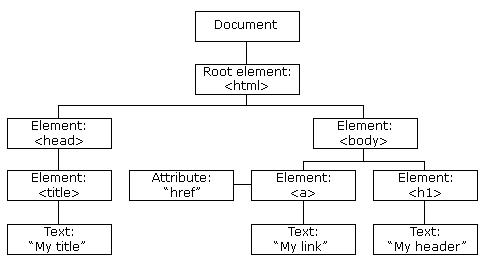
When it comes to design a site or a web page it plays a very important role, basically here we are talking about HTML DOM, with the help of this the javascript can interact with the HTML code and can find or change any element of HTML code. Let’s try to make it simpler, whenever any web page loads it creates a document object model, it has a tree-like structure and have nodes, every node has one parent and probably many children.

The Document Object Model (DOM) is the HTML and XML application development API. This determines the basic framework of the records and how the paper is obtained and exploited. The Document Object Model may be used in any programming language.

THE HTML DOM TREE OF OBJECTS

Java Script can change all the existing HTML elements and attributes of a page, all the CSS styles of the page and you can even add new ones. the HTML DOM is the standard of how to get, change, add, or delete HTML elements.

DOM and JavaScript

The DOM is not a programming language, but without it, the JavaScript language will have no concept or notion of web pages, HTML documents, XML documents, and their components ( e.g. elements). Each document element — the document as a whole, the heading, the column tables, the table headers, the text in the table cells — is part of the database object model for that column, so that they can all be accessed and controlled using the DOM and the JavaScript scripting language.

In the beginning, JavaScript and DOM were closely intertwined, but eventually, they evolved into separate entities. The output of the website is stored in the DOM and can be accessed and manipulated using JavaScript so that we can write this approximate equation:

API = DOM and JavaScript

The DOM was developed to be independent of any common programming language, allowing the conceptual representation of the text accessible from a single, coherent API. While we concentrate solely on JavaScript in this reference paper, DOM implementations can be designed for any language.

Accessing the DOM

You don’t have to do something different to continue using the DOM. Different browsers have different DOM implementations, and these implementations show varying degrees of compliance with the actual DOM standard (the subject we are trying to avoid in this documentation), but each web browser uses a document object model to make web pages accessible via JavaScript.

When you create a script–whether it’s inline in an <script> element or included in the web page through a script loading instruction–you can immediately begin using the API for the document or window elements to manipulate the document itself or to get at the children of that document, which are the various elements in the web page. As this is not a topic that can be covered at once.

So here I am concluding this. Hope you guys enjoy reading this!

CASE SUMMARY: R.M.D.C. VS. UNION OF INDIA

DETAILS:

Case Name: R. M. D. Chamarbaugwalla vs. Union of India

Citation: 1957 AIR 628, 1957 SCR 930

Court of jurisdiction: Supreme Court of India

Year of the Case: 9 April, 1957

Appellant: R. M. D. Chamarbaugwalla 

Respondent: Union of India

Bench/Judges: HON’BLE JUSTICE T. L. VENKATARAMA AYYAR, HON’BLE JUSTICE S. R. DASS (CJI), HON’BLE JUSTICE B. P. SINHA, HON’BLE JUSTICE S. K. DAS AND HON’BLE JUSTICE P. B. GAJENDRAGADKAR

SUMMARY:

In R.M.D.C. v. Union of India, AIR 1957 SC 628, the constitutionality of the Prize Competitions Act 1955, was challenged on the ground that it violated the Fundamental Right of the petitioners secured by Article 19(1(g). The impugned Act, provided for the control and regulation of prize competitions. It was contended that Section 2(d) of the impugned Act which defined the expression “prize competitions” included not only competitions of a gambling nature but also those in which success to a substantial degree depends on skill.

Having regard to the circumstances under which the impugned Act was passed, the Supreme Court held that it was to control and regulate prize competitions of a gambling character. Therefore, the Court stated that the application of impugned provision of the Act could be restricted to the competitions of gambling character. The provisions of the impugned Act were thus held severable in their application to competitions, in which, success did not depend, to any substantial extent, on skill. The Court held that when a Statute, was in part, void, it would be enforced as regards the rest, if that was severable from what was invalid, The Court then referred to the rules of construction laid down by the American Courts for the operation of the doctrine of severability and applied these to the present case.

The Supreme Court then summed up the rules relating to severability

1. In determining whether the valid parts of the statute are separable from the invalid parts thereof, it is the intention of the Legislature that is the determining factor. The test.to be applied is whether the Legislature would have enacted the valid part if it had known that the rest of the statute was invalid.

2. If the valid and invalid provisions are so indistinguishably mixed up that they cannot be separated from one another, then, the invalidity of a portion must result in the invalidity of the Act in its entirety. On the other hand, if they are so distinct and separate that after striking out what is invalid, what remains is in itself a complete code independent of the rest, then it will be upheld notwithstanding that the rest has become unenforceable.

3. Even when the provisions which are valid are distinct and separate from those which are invalid, if they all form parts of a single scheme which is intended to be operative as a whole, then also the invalidity of a part will result in the failure of the whole.

4. Likewise, when the valid and invalid parts of a statute are independent and do not form part of a scheme but what is left after omitting the invalid portion is so thin and truncated as to be in substance different from what it was when it emerged out of the legislature, then also it will be rejected in its entirety.

5. The reparability of the valid and invalid provision of a statute does not depend on whether the law is enacted in the same section or different sections (Vide Coley’s Constitutional Limitations, Vol. I, pp. 361-362), it is not the form, but the substance of the matter that is material, and that has to be ascertained on an examination of the Act as a whole and of the setting of the relevant provision therein.

6. If after the invalid portion is expunged from the statute what remains cannot be enforced without making alterations and modifications therein, then the whole of if must be struck down as void, as otherwise it will amount to judicial legislation.

7. In determining the legislative intent on the question of severability, it will be legitimate to take into account the history of legislation, its object, the title and the preamble to it.

REMARKS

Intention of the legislature will determine whether the valid part of a statute is severable from the invalid parts. If the valid and invalid provisions are so inseparably mixed up that they cannot be separated from another, then the irrationality of a portion must result in the invalidity of the Act in its whole. On the other hand, if they are so distinct and separate that after striking out what is invalid what remains is itself a complete code independent of the rest, then it will be upheld notwithstanding that the rest had become unenforceable.

Courts would be reluctant to declare a law invalid or ultra vires on account of unconstitutionality. Courts would accept an interpretation, which would be in favour of constitutionality rather than the one which would render the law unconstitutional. The court can resort to reading down a law in order to save it from being rendered unconstitutional. But while doing so, it cannot change the essence of the law and create a new law which in its opinion is more desirable.

We May Lose Complete Sea Ice By 2035- A Study

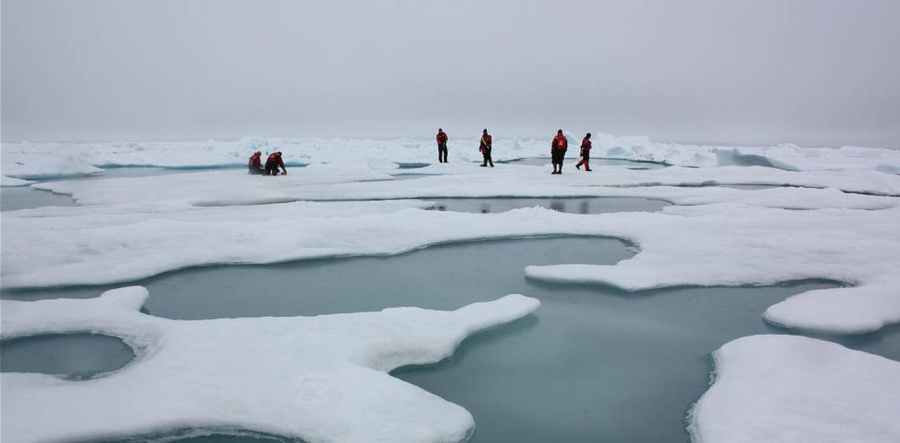
Arctic melt ponds. Image retrieved from theconversation.com

Around 1,27,000 years ago, during the last inter-glacial, the high temperature at that time have confounded researchers for years. An international team of researchers authorized by the UK Met Office’s Hadley Centre Climate Model was able to juxtapose Arctic sea ice conditions and last inter-glacial with today’s situation. Such discoveries have the capacity to change the current of ongoing research and can be used in better evaluation and prediction in future sea changes. An astounding study about Arctic sea being free of sea ice by 2035 published in a journal, Nature Climate Change, has given researchers a new lead to work on.

Appearance of shallow pools of water on the surface of Arctic sea- ice during every spring and prior summer help in the study of absorption of sunlight by ice and reflection of it into space. As a result of such studies every year, the team is able to culminate the result of such prediction, as there are many melt ponds which can be seen during recent summers created due to an impact of intense sun rays. 

INTERNATIONAL YOUTH DAY

 “A few heart-whole, sincere, and energetic men and women can do more in a year than a mob in a century.” –  Swami Vivekananda

International Youth Day is a United Nations-designated day when youth from different countries participate in events and discussions on socio-economic and socio-political issues. It is celebrated on august 12 every year.

This year the theme was ‘Youth Engagement for Global Action’. It focus on majorly three areas:

  • Engagement at the community level
  • Engagement at the national level (formulation of laws, policies, and their implementation)
  • Engagement at the global level.

Due to the coronavirus pandemic, this year no huge events are planned but the UN has launched a social media campaign, Join #31DaysOfYOUth, to celebrate young people throughout the month of August to help spread the word and strike up a conversation surrounding youth engagement for global action. Many online debates and discussions were done to ensure that needs of the young are met. Several universities, colleges and schools had organised a webinar to spread inter generational understanding, organisation of a youth forum to exchange ideas are too done.

Over the past weeks, maybe months, young people have been taking action and developing many creative ideas to face these challenging times, whether by helping their community, finding innovative learning ways, keeping a positive spirit, taking care of their relatives and loved ones, and much much more.

In this time of pandemic, it is important that governments too should listen to youth alongside other sections of the population in responding to COVID-19 challenges.

A young mind and body is far more productive both economy and politically. If directed towards right path they could do wonders for the country as a whole. This day every year lays emphasis on up liftment of people and contribute in spreading awareness about importance of human resources for development of oneself as well as the country.

It is not possible for civilization to flow backwards while there is youth in the world. Youth may be headstrong, but it will advance it allotted length.There is a fountain of youth: it is your mind, your talents, the creativity you bring to your life and the lives of people you love. When you learn to tap this source, you will truly have defeated age.

Is Work From Home next big thing as companies and individuals save resources like time and money?

Being up every morning to head to the workplace, looking for the car keys, hiring an Ola or Uber or racing to catch the subway now seems like a sight. Despite the proposal for a full shutdown owing to the COVID-19 pandemic, everything was shifting nearly overnight. Life was thrown out of balance and the modern standard was social distancing.

Indians and people around the world are also getting used to meeting up with phone calls with friends and families, waiting at grocery stores a few steps away, or just talking with neighbors. For several the greatest shift has been the idea of operating from home. About the country’s whole population is doing it right now. The world has never had a the exercise of magnitude.

Will the work from home stay temporary or here in its current format? Do companies see that as a feasible choice, especially with people arguing that the barriers between work and life are almost gone?

Pros of work from home:

1.Related to Transportation: First and foremost, it will save a lot of time-travel back and forth From work-Particularly in dense urban areas where traffic jams are high. It also saves a great deal of diesel, eases the pressure on public transport and road transport .

2.Savings on office facilities and infrastructure:

Companies require office room, work desk , chair, monitor, lighting, air State, meeting spaces, private car parking space etc. None of that Can be reduced, though can not be done away with completely, if we follow Wherever and whenever WFH can.

3.Can help in women empowerment:

This often restricts their job options. For further acceptances at WFH, They could have larger career options. Women can be involved in the work force Edited. Harassment in offices should be prevented.

Cons of Work From Home (WFH):

1.Loss of social interaction:Ideas pop up through group experiences in other artistic areas. For instance in Fresh suggestions for a tea or coffee break are explored at the seminar. This can not happen Occur in the case of WFH. Work becomes easier when the people surround you. Whenever you’re stuck you can ask your superiors for support. You got Meetings in meeting centers with proposals to present and improvise on. 

2.May affect women negatively:

When women are at the workplace, they can get relief from housekeeping jobs. This is especially of traditional households where harassment of women is recognized as a regular routine. We can never get off house hold job with WFM. Less on others Indian house holding has limited office service facilities.For example, they only have a single laptop- this is used by man head of the house, leaving women with no options. Internet connection is also not universal (not even 50%). In rural areas the situation is even worst.

3.Effects livelihood of small shop keepers:

Each office should have a small coffee shop nearby. As WFH has fresh Normally all of those people are going to be unemployed. Housekeeping, defense, work force of clerks Will be reduced to a minimal. Since they are not professional employees, it is going to be really hard To transferring them to a certain kind of work.

4.Lot of distractions and no leisure from work, change in lifestyle:

Kids are still around to annoy us. For most of us a daily career brings Following procedure. Which organizes our body and mind. On WFH- Habits to sleep and eat can go to a toss.

Can WFH be adopted universally?

Answer is a big no.There are other occupations where you need to be there for successful learning or some other learning on the ground. A laboratory technician, for example, can not guide an engineering student to conduct an online chemistry experiment. Likewise, education isn’t only a place to study academic topics, but instead a position of personality.

Conclusion:

First of all, we will decide what kinds of organisations had 100% WFH, Which partial and kind of employment may there be where WFH is not successful. Then figure out Dispose with such criteria to assess workplace performance when operating From Home and the School.Once we have done that, we can continue by giving 1 day or 2 WFH mandatory days in a week for all workers imaginable. When this fits perfectly, To both workers we will have obligatory working days of 1 or 2 days. Tweet Group workers will provide alternating working days.This will have a win-win situation as employees and employers will save cost and time, will not miss on socialization. To avoid discrimination towards women or any other potentialemployee, employers can offer a laptop to them from the savings they makeon infrastructure cost.

International youth day

Celebrating Hope for the Future

August 12 marks the annual celebration of International Youth Day. It is an international day of awareness, recognizing youth across the globe and empowering the world’s youth to make positive contributions to their communities and nations.

International Youth Day and World Youth Day

International Youth Day is not to be confused with World Youth Day. World Youth Day was founded by Pope John Paul II in 1986 as an invitation for youth to respond to the call to bring the love of Christ to the world. World Youth Day is celebrated each year on Palm Sunday.

International Youth Day is a United Nations supported celebration, while World Youth Day is a celebration founded within the Catholic tradition. Though technically different celebrations, both International Youth Day and World Youth Day recognize the value of young people across the world.

Understanding the World Programme of Action for Youth

The United Nations (UN) celebrated the first ever International Year of Youth in 1985. A decade later, the UN General Assembly adopted the World Programme of Action for Youth (WPAY), a set of policies and guidelines for nations to look to in improving the situation of the world’s youth. However, it was not until 2000 that the world celebrated the first International Youth Day.

The values and celebrations of International Youth Day are heavily influenced by the core principles of the WPAY.

The World Programme of Action for Youth is a strategic framework of policies and guidelines to guide nations in supporting, empowering, and improving the conditions of young people. The focus of the WPAY is to encourage national actions to improve the number of quality opportunities for youth, ultimately encouraging them to be active and effective participants in society.

The program also encourages youth around the world to gather and create awareness about the realities young people face within their own nation.

The Impact Potential of Youth

The world currently holds the largest generation of youth in history. Young people represent hope for the future. However, they are more than just that.

In a message about International Youth Day, Director-General of UNESCO, Irina Bokova, writes, “Young people are not only our future—they are our present…They are the most connected, the most outspoken and the most open-minded generation the world has ever seen.”

Today’s youth have potential to shape the world both in the present and in the future.

Sadly, this potential for impact is often inhibited. The tragedy is that many young people around the world battle the suffocating grip of poverty, disease, lack of resources, education, and more. The progress, dreams, and world-changing abilities are restricted for many young people.

Youth and You

The destructive nature of poverty often follows children out of their childhood and into their youth. Many young people around the world lack basic literary, reading, and writing skills. Without opportunities for education or to learn a trade, many teenagers in poverty get involved with gangs, drugs, and other dangerous activities.

We want the lives of youth across the world to tell a different story. We want better stories. And we want you to be a part of it.

Our work in youth development provides young people ages 12 and older with customized training and educational paths according to their unique God-given talents and potential. Our goal is for youth to be prepared, equipped, and able to support themselves while contributing positively to their families and communities. By partnering with us, your donation may support formal education, non-formal education, or income generation training.

Empowerment through education has the ability to bring positive change to the lives of young people and release them from the grip of poverty.

India is full of Natural Resources but are we conscious of this fact ?

A country’s economy largely depends on the amount and preciousness of the natural resources it possesses. Yes, industries and agricultural factors do contribute the economy, but these are all secondary factors. If we concentrate on India particularly, we will see that the main economy of India heavily depends on these natural resources. The cultivable land in India almost comprises 57 percent of the whole land area. The water resources are plenty, having several major rivers crisscrossing across the country. However though these are important natural resources for any country, let us concentrate on the mineral resources which are abundantly found in India.  

Here’s a list of some of the mineral resources that are abundantly found in India and their use :  

• Coal (India is the fourth largest producer of industrial and domestic coal) – Mainly used in the power generation sector.  

• Bauxite – Aluminium, whose usage ranges from making planes to utensils, is extracted from this ore.  

• Manganese – This is mainly used in the manufacture of ferromanganese and steel.  

• Titanium ore – Used in the steel industry, among others.  

• Petroleum – Mainly used as a fuel for running vehicles.  

• Limestone – Used in the cement industry.  

• Thorium (the Kerala beaches account for the world’s largest thorium deposits) – Used as a fuel in nuclear power plants  

• Iron ore – Used for manufacturing raw iron which is used for making heavy machines for industries.  

• Mica – Used in condensers, transformers, electronic tubes, and radio or radar circuits.  

• Chromite – Used in the manufacture of stainless steel.  

• Natural gas – Used a fuel for vehicles.  

• Diamonds – Their main usage is for making jewelleries and cutting glass.  

Coal :  

India has the fourth largest coal reserves in the world. The total amount of coal reserves in India is expected to be around 267 billion tons. It is also one of the top nations in the world when it comes to the usage of energy derived from coal in heavy industries. The notable areas in India where coal is found and, as a result mined are – Orissa, Chhattisgarh, Jharia, Nagpur and Chandrapur, Raniganj, Jharkhand, Neyveli, Singrauli and Umaria coalfields. The coal found in India has high ash contents and low calorific coal. However these are combustion friendly and needless to say this is the reason behind the underground fires which occur in a few mining districts. Almost 94 percent of the coal produces is from the Government sector companies. In the 2011-12 period the total production has been reported to be around 680million tons, while the demand was 731million tons.  

This vast use of this singular reserve has led to its depletion in recent years, and it has been predicted that India will run out of its coal reserves within 2040. This stresses the need to employ new mining technologies and the use of alternative fuels to run the heavy industries.   

Petroleum :  

India ranks next to China in terms of its oil reserves in the Asia-Pacific region, china being the leading producer. Most of these reserves are located along the western coast of India, namely Mumbai High and the north-east region of the country. Though underdeveloped, some reserves have been recently found in the Bay of Bengal along the eastern coast of India and in Rajasthan. The sector is dominated by the state-owned enterprises, namely Oil and Natural Gas Corporation.   

The usage is much more than the production, and this result in India having to import oil from foreign nations to meet its rising consumption levels. Statistics show that India is a net importer of oil, as 70percent of its oil needs is imported from countries like Saudi Arabia and Iran. The rest 30percent is produced within the country. This is because the demand for oil is somewhere around 3million barrels per day, whereas the production is only a meagre 500 thousand.   

Natural Gas :  

As of April 2010, India has an approximately 1437 cubic metres of natural gas. Of this a huge percentage comes from the Mumbai High reserves. Assam, Andhra Pradesh and Gujarat also have reserves which produce considerable amount of natural gas. In terms of production volume, ONGC is the leading producer of natural gas in India. Among the private enterprises, Reliance Industries play a big role in this sector due to the large reserve found in the Krishna Godavari basin. India has to import small amounts from Qatar and likewise nations. At this level of production and consumption, the reserves are predicted to last for around 29 years.  

Iron ore :  

Possessing one of the richest reserves of iron ore in the world, India holds a leading position in the world in terms of its iron ore production. The haematite deposits found in India are spread throughout the country, though the huge deposits are concentrated in a few regions like Chikkamagaluru, Singhbhum etc. Many iron and steel industries are located near these mines. The nearness of the industries not only reduces transportation costs but also reduces the times taken to produce the final products. The ores found in Goa are mainly shipped to Japan. Export of iron is mainly done from the ports of Vishakhapatnam, Marma Goa, Paradip and Kolkata. At present the deposits are quite vast, but some calculations indicate that the exponential rise in consumption in coming years may make these reserves seem finite in the near future.   

Bauxite :  

India is one of the leading producers of bauxite in the world. The reserves account for 7.5 percent of the world’s total deposits; however the aluminium output is only 3 percent. This indicates the lack of infrastructure which dominates the Indian market. The state-owned NALCO is the largest company dealing with bauxite ores. The acquiring of INDAL by Hindalco Industries accounted for a steep rise in the aluminium production of the country in the last year.   The extensive deposits will take a long, long time to get replenished.