Common Eligibility Test

The Union Cabinet meeting chaired by Prime Minister Narendra Modi decided that a single exam will be conducted to fill vacancies for all Central Government jobs. This exam will be called Common Eligibility Test (CET) and will be conducted by National Recruitment Agency.

According to secretary of Department of Personnel and Training, C. Chandramouli there are around 1.25 lakh vacancies in Central government jobs for which almost 3 crore aspirants sit every year. For now CET will be conducted for group B and C non technical jobs. Till now the central government jobs were conducted by Staff Selection Commission, Railway Recruitment Board and Institute of Banking Personnel Selection. The national recruitment agency will have representatives from all three agencies mentioned. The CET exam will be conducted once a year for three different levels which are for 10th pass, 12th pass and graduates. The CET will be just preliminary examination and if the agency wants they can conduct the specialised tier examinations.

CET will be conducted online. It has been planned that every district will have an examination centre for this and special focus will be given 117 aspirational selected districts. It will be conducted in 12 different languages so that more and more candidates can apply. the marks obtained in the seat will be valid for a period of three years.

ATTORNEY GENERAL OF INDIA

He is the highest law officer in the country. The constitution, ARTICLE-76 provides for his office provisions. He is appointed by the president and must be qualified to be appointed as the judge of supreme court. The term of office is not fixed by the constitution nor it contain the procedure and grounds for his removal. He holds office during the pleasure of president. He is free to resign anytime from his office by addressing the letter to the president. He receives the salary as decided by president.

DUTIES- To give legal advice to government of India on legal matters, to discharge functions conferred on him by constitution, to appear on behalf of government in all cases in supreme and high court in which government is concerned.

He has the right of audience in all courts in territory of India. He has the right to speak and take part in proceedings of both the houses of parliament without entitled to vote.

He is no full time counsel of government nor he fall in category of government servant and is not allowed to practice any private legal practice against government.

HE is not advice to hold any brief in cases in which he is called to advise for government of India. He should not defend accused person in criminal proceedings without government approval. He should not accept appointment as a director in any company without permission of government.

He holds a prestigious office and the powers should be performed accordingly.

Is India truly free after Independence!?

Democracy is a government meant for the people, as it is by the people, and of the people. The news that us currently making rounds in the country is mostly about corruption, black money, Swiss bank accounts and what not. In this era, everyone wants to earn money without hard work.

The politicians of this country crave for money today. All they do in their long tenures is hog money illegally. Today many of these politicians are preying on the nation itself, which is very disgusting and immensely horrible to describe. We even talk a lot about unification or unity in diversity. Where did this unity disappear during the “Godhra incident”? India did lack the day so called brotherly feeling during the 92-93 Mumbai blasts as well as the 26/11 Mumbai terror attacks. When the media thinks of setting down and decides to focus on some other interesting topics, we say everything is fine, but what about the lives lost, the wives widowed and children orphaned?

The politicians even try to divide people on the basis of religion. Just take the example of Ram Mandir v/s Babri Masjid issue. These politicians present themselves in frontnif people for votes at the time of elections, saying that they will promise to build a respective religious place of worship. They just bribe the people for votes. After they win the elections, they simply abscond. They loot the money of the people and fool them. In this way, they try to segregate the people and create communal violence across the country, thereby breaking the unity and integrity of the nation.

I don’t think there is any state in India which can claim to have stable government. We at times forget that the land of the country’s territory belongs to the nation first and then to the states. We have even heard of tonnes if food grains rotting. Each grain is a token of happiness and satisfaction to the hungry stomachs of the poor, yet the Government has the audacity to let it rot without distributing the food grains amongst the needy.

I feel, currently in India only rich become richer and the poor beg for a living, and hence we love in an era of ignorance. We see the temples plundered, mosques demolished and the churches ransacked. So where is the so called brotherly love here!?

Japan got it’s freedom in 1945. It came out superbly from the shock of atomic attacks. India got freedom two years later still it is no match to the Japanese technology and competence. Instead, we rely on them for the construction of railways and roadways.

In India there have been some changes and development in the past few years, but they are not considerable in number. There are many changes and developments yet to to be done. We can see a lot of evil, dirty practices and policies going on in India that are huge in number even after Independence.

But do we do anything to stop all these? We think that someone, somewhere will take the initiative in order to control the situation to buy we don’t actually figure the fact that in one way or the other everyone thinks the same. Everyone has the same mentality. They think that why should I care about all these things when there are many others to think about it.

But we are wrong. If everyone thinks like this, do you think India can call itself a developed nation or a super power within 20-30 years? Do you think India will achieve this rank? Our country needs us, and by doing something for the country we can make a big difference. We say that India is a country of the youth, but what is the use finally the youths of this country sit quitely and watch all these atrocities and injustice? So, it is up to us, how seriously we take these issues and however solve them. Being the future citizens of India, it is our duty to lead our country to a better future.

On 15th August, evey year we celebrate Independence Day, but I feel, sadly, India is not truly free even after getting it’s independence.

Cyberbullying

We all are very nicely aware of this term and still many of us take this in a not so serious way. But this problem has a major impact on today’s generation. Now, what exactly is cyberbullying? It is any sort of humiliation that can be done to any individual by using digital devices or any digital platform. Cyberbullying can take place through SMS, Email, and Applications, or online via social networking, blogs, or gaming where people can access, engage in, or exchange information. Cyberbullying means mailing, publishing, or exchanging derogatory, damaging, misleading, or mean information regarding someone else. Which may involve revealing sensitive or private knowledge about someone else causing shame or humiliation. Some cyberbullying crosses the line of illegal or criminal behavior.

Given the proliferation of social networking and public platforms, tweets, videos, updates, and information posted by individuals may also be accessed by both outsiders and associates. Content and human web communication – including their personal information and any derogatory, rude, or malicious material – provides a kind of permanent public archive of their opinions, behaviors, and behavior. This public record may be used as an electronic profile that can be made available to teachers, jobs, universities, organizations, and anyone that might be investigating a person now or in the future.

When you find early indicators that a child may be engaged in cyberbullying, take action to examine the child’s digital behavior. Cyberbullying is a type of abuse, so parents will adopt the same path to handling it: help the person being harassed, fix the offensive actions of the offender, so reassure children that cyberbullying is being taken seriously. Since cyberbullying occurs online, reacting to it involves a range of strategies.

Many states have regulations allowing schools to respond to abuse. As cyberbullying has become more common through the usage of technology, multiple jurisdictions now have cyberbullying or cyber-bullying offenses in these statutes. Schools can take action, either as necessary by statute or through local or school policies that encourage them to discipline themselves or to take other action. Few States do include laws to tackle discrimination in situations where it impacts school results. You will read about the laws and regulations of will jurisdiction, including how they include cyberbullying.

And guys please don’t overlook this, as this is a really serious problem , particularly for adolescents, but that doesn’t mean it can’t happen to the elders. Consider that personally and address issues with your parents and others that are near. Bear in mind, and remain healthy.

How President of India is elected ?

The president of India, is the ceremonial head of state of India and the commander-in-chief of the Indian Armed Forces.

The president is indirectly elected by an electoral college comprising the Parliament of India (both houses) and the legislative assemblies of each of India’s states and territories, who themselves are all directly elected.

Although the Article 53 of the Constitution of India states that the president can exercise his powers directly or by subordinate authority, with few exceptions, all of the executive powers vested in the president are, in practice, exercised by the prime minister (a subordinate authority) with the help of the Council of Ministers. The president is bound by the constitution to act on the advice of the prime minister and cabinet as long as the advice is not violating the constitution.

Origin

India achieved independence from the British on 15 August 1947, initially as a dominion within the Common wealth of Nations with George VI as king, represented in the country by a governor-general. Still, following this, the Constituent Assembly of India, under the leadership of B.R.Ambedkar, undertook the process of drafting a completely new constitution for the country. The Constitution of India was eventually enacted on 26 November 1949 and came into force on 26 January 1950, making India a republic. The offices of monarch and governor-general were replaced by the new office of President of India, with Rajendra Prasad as its first incumbent.

The Indian constitution accords with the president, the responsibility and authority to defend and protect the Constitution of India and its rule of law. Invariably, any action taken by the executive or legislature entities of the constitution shall become law only after the president’s assent. The president shall not accept any actions of the executive or legislature which are unconstitutional. The president is the foremost, most empowered and prompt defender of the constitution (Article 60), who has pre-emptive power for ensuring constitutionality in the actions of the executive or legislature. The role of the judiciary in upholding the Constitution of India is the second line of defence in nullifying any unconstitutional actions of the executive and legislative entities of the Indian Union.

Difference between democracy and republic is a minor one where democracy refers to the government elected by the people while republic refers to the Head of the state elected by the people.   

In India, Prime Minister is the head of government while President is the head of the state. In England, Prime Minister is head of government and Queen is the head of the state. Since Prime minister is elected by the people of England but Queen is not, England is a democracy but not a republic. But in India both the head of the government as well as state both are elected by the people of India, India is a democratic as well as republic.   

As per Article 52 of the Constitution of India, there shall be a President of India and the executive powers of the Union shall be vested in the President. The President of India is the first citizen and represents the Indian nation and does not, therefore, belong to any particular political party. Election of President is conducted by the Election Commission of India. He / She  is indirectly elected by the people of India as the representatives of the people through an Electoral College.   

The main reasons behind the indirect election of President of India as discussed in the Constituent Assembly were –  

• If the direct election of the President were adopted, the Presidential candidate who has to carry on an election campaign from one corner of the country to another will certainly be put up by some party or the other, which may cause political excitement and generate party feelings. Thus the person elected to the Presidential office through this means will never be able to forget his party affiliations.  

• A directly elected President may not be content with his position of a mere constitutional head and can claim to derive his authority directly from the people. So, if he wanted to assume real power, it would lead to a constitutional deadlock.  

The Electoral College constitutes the elected members of Lok Sabha, Rajya Sabha and State Legislative Assemblies who elect the President through proportional representation single transferable vote.   

Candidate who corners the majority i.e. more than 50 percent of votes is the winner but it is possible that four aspiring candidates A, B, C and D gets 35 %, 30% 25 % and 20 % respectively and no one gains more than 50% of votes. In this case, single transferable vote is used where each voter gave preference to each candidate as first, second, third of fourth preference. Since in the said example, D gets least number of first preference votes, He will be eliminated from the race and his votes will be distributed among the other contestants on the basis of the second preference.   

The Proportional Representation is followed by assigning a value to the votes of MP and MLA. Each member of the Electoral College who is a member of a State Legislative Assembly will have a number of votes calculated as follows : 

On vote of MLA = Total population of state/ Number of MLAs in the state x 1000 Fractions exceeding one half being are counted as one.   

For example , The population of Punjab is 1,35,51,060. Let us take the total number of elected members of the Legislature of Punjab to be 117. Now applying the aforesaid process, if we divide 1,35,51,060 (i.e. the population) by 117 (i.e. the total number of elected members), the quotient is 115821.0256. Therefore, the number of votes which each member of the Punjab Legislature would be entitled to cast is 115,821.0256/1000 i.e. 116.  

The value of a vote of MP is = Total value of vote of all MLAs/ Total No. of MPs  

In 2012 Presidential elections,  Value of vote of each elector in Parliament = 1025179/776 = 1321(without fraction)  

Total value of votes of Parliament = 776 x 1321= 1025096  

Total value of votes of State electors (4120 MLAs) = 1025179  

Total value of 4896 electors for Presidential election in 2012 = 2050275  

In this manner, total 4896 electors from the country will vote to elect the President of India through a single transferable vote. In order to be elected as President of India, he / she    

• Must be a citizen of India. 

• Completed 35 yrs in age. 

• Eligible to be a member of Lok Sabha. 

• Must not hold any Government post     

Supreme Court inquires all disputes regarding President’s election. President takes oath in presence of Chief Justice of India, or in his absence, senior most judge of Supreme Court.


Impact of Insurance Bill

Insurance is a means of protection from financial loss. It is a form of risk management, primarily used to hedge against the risk of a contingent or uncertain loss.

An entity which provides insurance is known as an insurer, insurance company, insurance carrier or underwriter. A person or entity who buys insurance is known as an insured or as a policyholder. The insurance transaction involves the insured assuming a guaranteed and known relatively small loss in the form of payment to the insurer in exchange for the insurer’s promise to compensate the insured in the event of a covered loss. The loss may or may not be financial, but it must be reducible to financial terms, and usually involves something in which the insured has an insurable interest established by ownership, possession, or pre-existing relationship.

The insured receives a contract, called the insurance policy, which details the conditions and circumstances under which the insurer will compensate the insured. The amount of money charged by the insurer to the policyholder for the coverage set forth in the insurance policy is called the premium. If the insured experiences a loss which is potentially covered by the insurance policy, the insured submits a claim to the insurer for processing by a claims adjuster. The insurer may hegde its own risk by taking out reinsurance, whereby another insurance company agrees to carry some of the risks, especially if the primary insurer deems the risk too large for it to carry.

Insurance sector in India has seen instrumental change since the last two decades when there was only one player namely Life Insurance Cooperation (LIC) before it was opened up for the private and foreign players. Currently, there are 28 players in the non life insurance business and 24 players in life insurance thus infusing the competition in the sector. The Insurance Regulatory and Development Authority (IRDA), headquartered at Hyderabad, being the regulatory authority of the insurance sector in India is the sole authority which frames regulations for the sector, ranging from registration of insurance players to protection of policy holders’ interest, thus aiming to regulate and promote the growth of the insurance sector. 

The Insurance Laws (Amendment) Bill, 2015, which intended to increase the FDI limit in the insurance sector from 26% to 49% apart from introducing several other changes, got the nod of the parliament on March 12, 2015 after much deliberations. The bill is expected to provide a major fillip to growth of the sector. Some major changes introduced by the bill are as under –

Capital Infusion


Apart from increasing the foreign holding, the bill also provided various other avenues and flexibility in raising the capital for the cash strapped sector. The current insurance penetration is just 3.9% in India. The capital infusion would not only increase the penetration of insurance which is need of hour, but would also augment the product diversification.


Consumer Interests


In order to curb the miss-selling, heavy penalties have been imposed on intermediaries and insurance companies for misconduct. The penalty is increased to up to INR1.0 crore for the insurance companies and up to INR10,000 for agents depending upon the nature of violation. This would work as a deterrent to the companies and agents for any miss-selling. Further, if the policy is older than three years, no life insurance policy can now be rejected by the insurer on any ground. This will motivate insurers to strengthen their underwriting standards and increase faith amongst consumers and protect the policyholder’s interest. Ban is also imposed on multilevel marketing schemes.  

Commission and Pay Outs

The bill confers the power to determine the quantum of commission, pay outs and other expenses to the IRDA. From now onwards, IRDA would try to bring more transparency in the sector for the benefit of the end consumers. Meanwhile, agents and intermediaries have been banned from more than one company. 

Empowering IRDA

Empowering IRDA to frame operations related rules and regulations would provide it with the opportunity to adapt quickly with the changing environment while securing best interest of the policyholders. IRDAI is now empowered to regulate key aspects of operations including solvency, investments, expenses and commissions etc. It also empowers the Authority to regulate the functions, code of conduct, etc., of surveyors and loss assessors.

Changes in Health Insurance Sector

Under the revised regulations, minimum capital investment in health insurance sector has been increased to Rs 100 crore, to ensure that only serious players are present in the sector. The amendment Act has also expanded the definition of health insurance business by including travel and personal accident cover. This would result in further growth of the health sector, which is one of the most under-insured segments in India.

Thus the new amendments in the Insurance sector aims to bring a holistic improvement in the sector by augmenting competition, infusing capital, introducing product diversification as well as safeguarding the interests of the final consumer. In this way, insurance business can increase its depth and penetration in conformity to the developed world.

HEAD ON (2004) AND, THE ROARING TWENTIES (1939) MOVIE REVIEWS

HEAD ON (2004)

Head On is about two Turkish immigrants living in Hamburg. Sibel wants to get married because she wants freedom so she doesn’t want to live with her family. Cahiit is a guy in his 40s who’s addicted to booze and drugs. Sibel meets him at a mental institution and asks him if he would marry her. They would just be labelled as married but ehy would not be actually behave like a married couple.They will just have to live together, but they could see other people. But soon they develop feelings for each other, and things don’t go right.


This is a great meditation on two characters, and nicely shows how these two different people find themselves in the midst of their so called marriage. They face many emotional ups and downs, and its all portrayed in a very poignant way. I also liked the style that Fateh Akin has adopted, the first half is more of a not so intense drama filled with music. The music often playing an instrumental role in taking the story further. The second half is way more intense, with characters facing consequences for their actions and coming to understand themselves better.


The performances are excellent, I felt like I was myself experiencing the despair that they went through. The characters are so well fleshed out that you actually relate with them. Birol Unel is great as this alcoholic, he’s kind of this rough nihilistic guy in his 40s. Sibel Kekilli is as good, her arc is way more tragic.


I was really impressed by the bleak and unsettling story, it affected me deeply. It’s bitter to watch but everything is shown really beautifully. It’s also very human and realistic, and very different from most mainstream love stories. In the end, Head On is a great piece of filmmaking. It’s poignant, moving, unsettling and one of the best tragedies I’ve ever seen.

THE ROARING TWENTIES (1939)

The Roaring Twenties (1939) is about Eddie Bartlett (James Cagney) who returns to America after fighting in the first world war. America is under the prohibition law which bans manufacture and sale of alcohol. Eddie gets into the bootlegging business and his business flourishes. The film is basically about his rise and fall, shown in the span of twenty years.


The Roaring Twenties has inspired most gangster films that you see today.The layered screenplay with cracking dialogues and one liners make this a massively entertaining film. James Cagney as Eddie carries the film with such ease. He’s so charismatic as this character, it was amazing seeing him. This film is one of Bogart’s earliest roles and he kills it as this short tempered and sadistic world war vet. I loved the way they’ve shown characters turning against each other and all the mindless gun slinging. Even the love triangle in this movie was really well done, and unique for that time period.


The film immaculately portrays the roaring twenties, a time when the U.S. prospered a lot, also a time when there was the prohibition law. It was a time of modernisation and I just loved how the film captures it in the background. I also really liked the music along with the jazzy score, adding to the glamour of that time period. Raoul Walsh has directed this epic time period very gracefully.


All in all, The Roaring Twenties is a slick gangster flick, with great writing and one of the best performances ever given by James Cagney.

FILM SUGGESTIONS – O BROTHER, WHERE ART THOU (2000) AND RUN LOLA RUN (1998)

  1. O BROTHER, WHERE ART THOU (2000)


O Brother, Where Art Thou is set in 1937 Mississipi, and it’s about Ulysses Everett who escapes from prison with his two companions Pete and Delmar. Their goal is to now find the treasure that Ulysses had buried, without getting caught by the authorities. And we are shown all the problems and chaos that they encounter on the way. It’s based on the greek poem Odyssey by Homer.

I like what Coen brothers have done with this movie, they have nicely captured the depression era. There’s a lot of attention to detail to create a sense of that time period. The extensive use of the sepia tint adds to it. The characters are all whacky and nicely done. Our leads George Clooney, John Turturro, and Tim Blake Nelson are excellent as these convicts. Even the minor characters made me laugh as they are all eccentric, like the scene with Coen’s long time collaborator, John Goodman was the most memorable because of how surreal and funny it was.

As always, the writing is really fine. Coen Brothers know how to create a clever southern crime comedy. It’s really funny and entertaining. And it’s all very unique! I’ve never seen anything like this.

I really liked how they’ve used folk and country music. The music is important to the film as it precedes the story. The film would not have been the same without the music.

All in all, O Brother, Where Art Thou is one of the many perfect films made by the Coen Brothers. It’s odd, unpredictable, hilarious, and original.


  1. RUN LOLA RUN (1998)


In Run Lola Run, Lola needs to bring 100 grand marks under 20 minutes or her boyfriend would have to face some consequences from his employer. We are shown three different scenarios, on how Lola secures the money.

This is no brain entertainment at it’s best. The film is thrilling and fast paced. It does a great job at creating tension. The fast editing is really cool and I even liked the use of animation. The high beat techno music elevates the tension. The film just begins without introducing the main characters, indicating that we have no time to breathe. I’d like to praise the director for how innovatively he has used fast takes, quick cuts, slow motion and panning to create this adrenaline filled experience. I also liked how well put together all the little elements of the plot were. All three scenarios tie together perfectly.

The film is basically about how every small decision we take affects our life. The movie shows this in three different scenarios. A lot of details are used to show how if one little thing had not happened to a particular character, his/her life would have been different. It also portrays the importance of time. For an entertaining thriller, it portrays all this quite effectively.

I’d highly recommend this movie, it’s a well made film that is easy to watch. It’s a fun fast paced thriller.

Concentrated focus required on increasing Covid-19 testing in Delhi: HC

The Delhi High Court on Wednesday called for a concentrated focus on ramping up laboratory testing for Covid-19 in the national capital as 1,300-odd cases are still reported daily. The high court also raised the question of migrant labourers returning to Delhi after Unlockdown-3 has been declared by the government and construction and industrial activity have picked up. A bench of justices Hima Kohli and Subramonium Prasad asked whether adequate arrangements have been made by the Delhi government at the borders and other places, where industries or construction sites exist in the national capital, for large scale testing to detect Covid-19 cases and for segregating them without causing any inconvenience.

University of South Alabama

 We’re the University of South Alabama. South, for short. Home to more than 14,000 students and more than 100 academic programs, South is a dynamic community of leaders and learners who support and challenge one another to be actively engaged citizens who advance the Gulf Coast region and the world. Founded in 1963, South’s vision is to foster an environment that couples engaging learning experiences with high-level research, enabling our faculty and students to be leaders in their disciplines.

The unique and beautiful Gulf Coast region is a catalyst for discovery and innovation, and South’s 1,200-acre campus has been transformed over the past decade with new facilities and resources for teaching, housing and recreation, health sciences, the arts, engineering, computer science and athletics.

Jaguar athletes compete in 17 NCAA Division I sports, including baseball, basketball, cross country, football, golf, soccer, softball, tennis, track and field, and volleyball.

The coastal region is healthier because of the USA Health system. Through its five components — Children’s & Women’s Hospital, University Hospital, Mitchell Cancer Institute, USA Health Physicians Group and the College of Medicine — and supported by the College of Nursing and the Pat Capps Covey College of Allied Health Professions — USA Health provides care to hundreds of thousands of people, and is a training ground for future physicians and healthcare professionals.

The University has implemented a strategic plan that is organized around five major priorities: Student Access and Success, Enhancement of Research and Graduate Education, Global Engagement, Excellence in Health Care, and University-Community Engagement. These priorities are the guiding influence in developing a strong, consistent vision for the future of the University.

USA is a place where students discover and strengthen their career passions, and form connections that result in lifelong relationships. At South, we look at the world and see things that we have the power to change, affect and shape — together. So that’s exactly what we do, every single day.

We are South!


Samford University

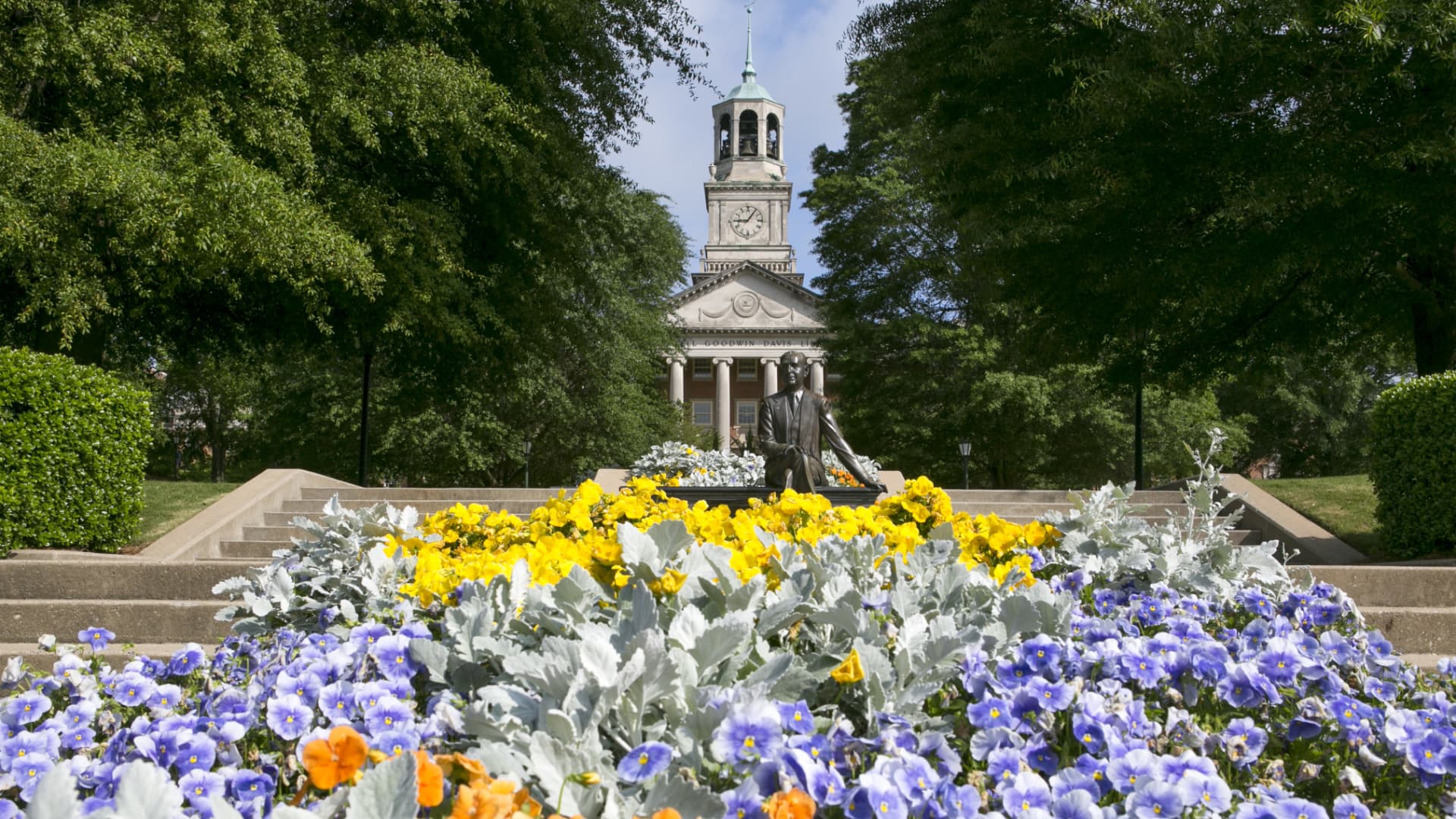
 Samford University is a premier nationally ranked Christian university. Founded in 1841, Samford is the 87th-oldest institution of higher learning in the United States. Located in the Birmingham, Alabama suburb of Homewood, the university’s campus covers approximately 247 acres and is renowned for its beauty and Georgian-Colonial style architecture. The university currently enrolls 5,692 students from 47 states and 28 countries.

Samford is the top-ranked university in Alabama in national rankings published by The Wall Street Journal. Additionally, The Wall Street Journal ranks Samford third in the nation for student engagement. U.S. News & World Report ranks Samford 40th in the nation for best undergraduate teaching and 100th for best value. Kiplinger’s Personal Financeranks Samford 34th among U.S. private universities for value and affordability. The student-to-faculty ratio is 13:1.

Samford offers undergraduate programs grounded in the liberal arts and a distinct blend of graduate and professional schools through 10 academic schools: arts, arts and sciences, business, divinity, education, health professions, law, nursing, pharmacy, and public health. The university has one of three accredited law schools and one of only two accredited pharmacy schools in Alabama. Samford’s Beeson Divinity School is the only fully accredited graduate divinity school based in Alabama. The university is classified by the Carnegie Commission on Higher Education as a doctoral/professional institution.

Samford’s mission to nurture student development intellectually, ethically and spiritually is fostered through an array of opportunities, including 166 student organizations, global engagement in more than 19 different countries and more than 180 courses that incorporate community service. Additionally, undergraduate students complete Samford’s core curriculum, providing a well-rounded foundation in the liberal arts. The result is a highly-tailored educational experience that results in 97% of undergraduate alumni employed or in further study within six months of graduation.

Samford’s strategic plan expresses four focus areas: emphasize student success, enhance our community, extend our reach and ensure financial strength. To support the continued advancement of this strategic plan, the university launched in the fall of 2016 a capital campaign titled Forever Samford. The six-year, $300 million campaign is intended to provide new financial resources to support student scholarship, academic programs and capital projects. Samford maintains a strong endowment with investments totaling $301 million (June 2019), which helps support scholarships, study abroad opportunities, general operations and other programs. In addition to the main campus in Homewood, the university owns a house in Marion, Alabama used for cultural study and service, and the Daniel House, a study center located in the heart of London, England near Kensington Park.

Samford’s 52,838 alumni have included more than 60 members of the U.S. Congress, eight state governors, two U.S. Supreme Court justices, one U.S. Secretary of State, four Rhodes Scholars, multiple Emmy and Grammy award-winning artists, two national championship football coaches, and recipients of the Pulitzer and Nobel Peace prizes.

The university fields 17 intercollegiate sports—eight men’s and nine women’s—that participate at the NCAA Division I level. The Samford Bulldogs have won 40 conference championships since joining the Southern Conference in 2008. Samford’s athletic teams in the 2018-2019 academic year enjoyed a 97% Graduation Success Rate (GSR) as calculated and published by the NCAA. For that academic year, Samford was ranked first in Alabama and 18th in the nation for GSR among all colleges and universities in the NCAA Division I level.

Oakwood University

At Oakwood University we are dedicated to teaching with RESPECT and COMPASSION. We are dedicated to ensuring that our graduates enter the work force with strong commitment to INTEGRITY and a focus on EXCELLENCE. We are dedicated to instilling a sense ofcommunity in our graduates through numerous opportunities for Christ-centered SERVICE learning. We are dedicated to INNOVATION and COLLABORATION with our students through groundbreaking research and the latest technology. We are dedicated to you.

RESPECT

COMPASSION

INTEGRITY

EXCELLENCE

SERVICE

INNOVATION

COLLABORATION

God First! It’s not just our institutional aim, it’s the very core around which our identity, ethics, values, relationships, and curricula orbits. Whether it’s in the classrooms, dorms, the dining hall, on the campus green, or everywhere in between, we strive to put God first in everything we do. Simply put, it’s a way of life. So many ministries and mission opportunities to choose from, such as choirs, drama clubs, outreach and mission groups—you can be an active partner in ministry here. Use your talents and discover new ones as together, we seek to serve God and our fellow man.


For years, Oakwood University has consistently been ranked by the U.S. News & World Report as one of the best regional colleges and universities to attend. With over 58 different majors, divided across five different schools from which to choose, our students are equipped with the tools they need to become leaders of industry in their fields. Our students receive an education that is further augmented by strategic partnerships that have produced internships and other opportunities with numerous leading corporations, nationwide. Our passionate faculty not only make learning a rewarding experience but also maintain supportive relationships for years after students have graduated. Come and experience an academic learning environment that is unlike any you could have imagined.


Oakwood is regionally accredited by the Southern Association of Colleges and Schools Commission on Colleges to award associate, baccalaureate, and master’s degrees. In addition, the following programs are further accredited through national and professional associations: Business, Dietetics, Social Work, Education, and Nursing.next traffic light after Jordan Lane, which is Adventist Blvd. Proceed to campus entrance on the right.

Medical science Latest News: Some Interesting Researches.

  1. Do you know how your cell phone’s sensor can calculate the alcohol percentage present in your body? It calculates the percentage by monitoring the way you are walking.
    Researchers from Stanford University and the University of Pittsburgh completed this study on 18th August. In a sample of 17 participants, they could calculate the intoxication amount with 92% accuracy. The study focuses on blood alcohol concentration (BAC) and breath alcohol concentration (BrAC). They published the study in Journal of Studies on Alcohol and Drugs.
  2. Can we treat dementia and Alzheimer’s with sound waves? A team of Doctors led by Cardiologist Hiroaki Shimokawa recently experimented and discovered that applying low-intensity pulsed ultrasound (LIPUS) to the entire brain of a mouse improved blood vessel formation and nerve cell regeneration without having apparent side effects. “The LIPUS therapy is non-invasive physiotherapy which could apply to high-risk elderly patients with no surgery or anesthesia, and could be used repeatedly,” says Shimokawa. See the study here.
  3. Scientists solve mystery behind body odour! This is not our fault. Researchers at the University of York found out that there is a special microbe which lives in the human armpits. This odour is called thioalcohol, which gets released when these microbes feed on other compounds on our skin. The study is published in Nature journal.
  4. Coronavirus: Filter “paper” made from titanium oxide nanowires can trap pathogens and destroy them with light. This is a discovery by an EPFL laboratory which can be put to use in personal protection equipment, in ventilation and air conditioners. Although experiments are still under process, they say that it be equally successful on a wide range of viruses, including SARS-CoV-2 or coronavirus.