

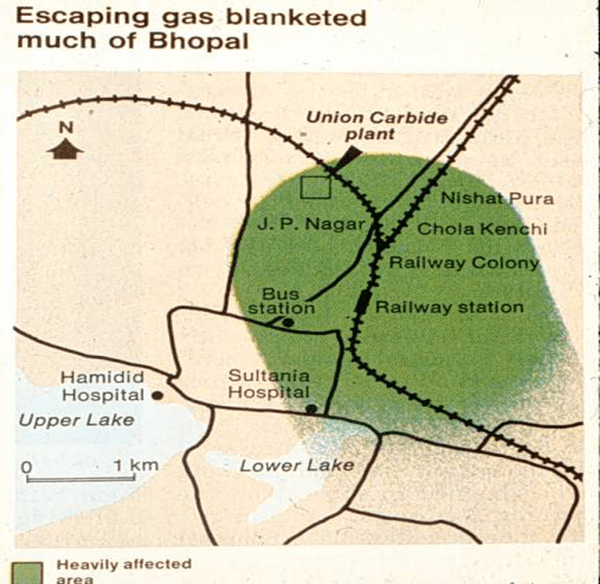
Around 1 a.m. on Monday, the 3rd of December, 1984, In the city of Bhopal, Central India, a poisonous vapour burst from the tall stacks of the Union Carbide pesticide plant. This vapour was a highly toxic cloud of methyl isocyanate. 2,000 people died immediately, 300,000 were injured. 7,000 animals were injured, of which about one thousand were killed.
POSSIBLE CAUSES
A tank containing methyl isocyanate (MIC) leaked. MIC is an extremely reactive chemical and is used in production of the insecticide carbaryl. The scientific reason for the accident was that water entered the tank where about 40 cubic meters of MIC was stored. When water and MIC mixed, an exothermic chemical reaction started, producing a lot of heat. As a result, the safety valve of the tank burst because of the increase in pressure. It is presumed that between 20 and 30 tonnes of MIC were released during the hour that the leak took place. The gas leaked from a 30 m high chimney and this height was not enough to reduce the effects of the discharge.
The high moisture content (aerosol) in the discharge when evaporating, gave rise to a heavy gas which rapidly sank to the ground. A weak wind which frequently changed direction, which in turn helped the gas to cover more area in a shorter period of time (about one hour). The weak wind and the weak vertical turbulence caused a slow dilution of gas and thus allowed the poisonous gas to spread over considerable distances.
One of the main reasons for the tragedy was found to be a result of a combination of human factors and an incorrectly designed safety system. A portion of the safety equipment at the plant had been non-operational for four months and the rest failed.
LAPSES ON THE PART OF THE GOVERNMENT
The Madhya Pradesh State government had not mandated any safety standards. Union Carbide failed to implement its own safety rules. The Bhopal plant experienced six accidents between 1981 and 1984, at least three of which involved MIC or phosgene.
WHY DID THE PEOPLE STAY QUITE ??
The country needed pesticides to protect her agricultural production. MIC is used to produce pesticides that control insects which would in turn, help increase production of food as a part of India’s GREEN REVOLUTION. Initially, India imported the MIC from the United States. In an attempt to achieve industrial self-sufficiency, India invited Union Carbide to set up a plant in the state of Madhya Pradesh to produce methyl isocyanate. To the people of the city of Bhopal, Union Carbide was a highly respected , technically advanced Western company. This coupled with political power and scientific expertise worked together to changed the people’s perception of what was dangerous and more importantly what was safe.
Suggested Solution
Alpha Napthol on carbonyl group addition followed by reaction with methyl amine would eventually gives carbaryl. This process does not generate or require handling the of Phosgene. This process does not require storage of MIC. Inherently safe process.


You must be logged in to post a comment.