

Methodology:
● Description of the problem.
● Cause of the problem.
● Analysis of the problem.
● Control of the problem.
➡ Introduction to the problem:
According to a World Health Organisation (WHO) study, published in early 2017, Skopje, which is located at the bottom of a valley, was among ten cities in Europe with the highest concentration of fine particles. Skopje, like the four other Balkans cities listed among the 10, has an industry based on coal or lignite, used also for heating. Skopje, Sofia, Prishtina, and Sarajevo are on the list of Europe’s most polluted cities.
According to the local media, 38% of all deaths in Tetovo and 22% at the state level are the direct result of air pollution. Yet, the problem is neglected for most of the year. Only when winter comes and thick smog suffocates the city and its inhabitants, it is revived by the media and the political opposition. Hence, VMRO-DPMNE is now blaming the ruling SDSM for the bad air quality, as if it had not ruled the country for 10 years until 2017.
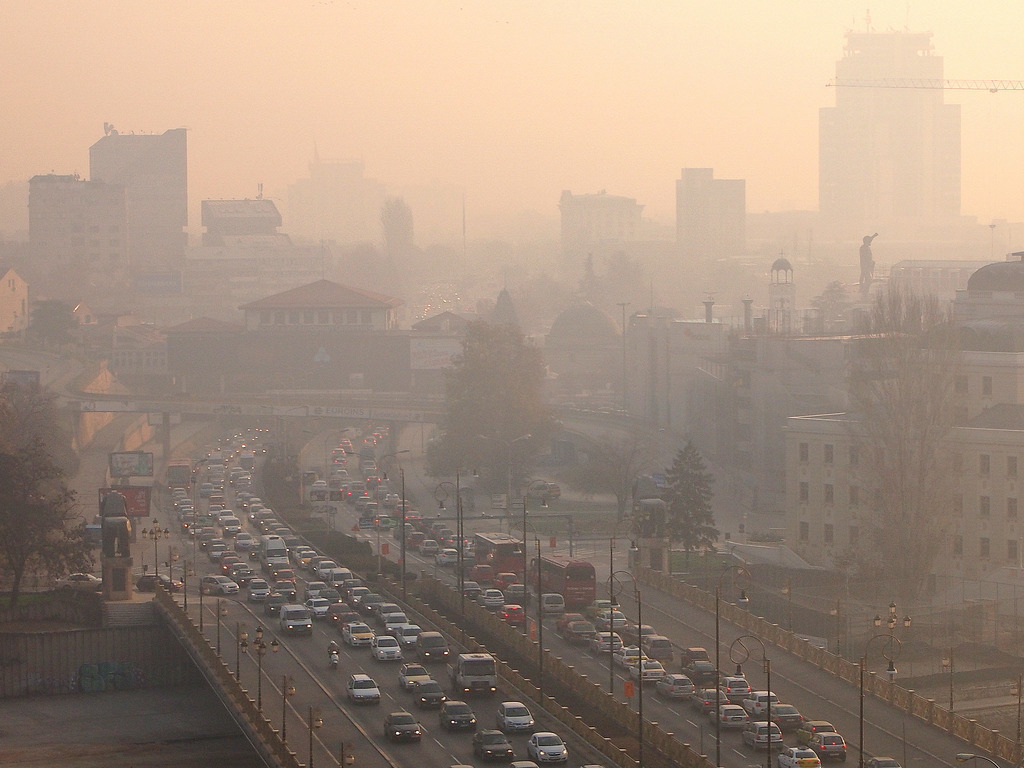
Pollution grip on the Macedonian’s capital Due to the high air pollution the whole city is not visible from the sky. By just seeing this picture we can understand what is the actual condition of the air pollution in Macedonian.
➡ Cause of the problem:
As a consequence, in less than five years, the number of registered vehicles increased from 350,000 to 475,000 – most running on diesel, therefore with higher emission of PM particles compared to gasoline.
Another factor is the savage urbanization of the cities. Instead of green parks, new buildings are springing up like mushrooms after rain. Apart from the main city park, there is not a single green space in Skopje that has not shrunk in the past 10-15 years. Illegal logging is endemic around cities and in the neighboring mountain areas, further deteriorating the ecosystem. Rather than addressing the problem, politicians have exploited it for electoral purposes.
During the VMRO-DPMNE era in 2006–2017, the SDSM constantly attacked the government’s reckless ecological policies, promising a more eco-friendly approach. Excess usage of vehicles in that particular area has adversely affected the climate change in Skopje and has increased air pollution at the same time.
➡ Analysis of the problem:
The poor air quality in the Republic of Macedonia is predominantly due to the tiny combustion particles called PM10 (10 micrometers or less in diameter) and PM2.5 (2.5 micrometers or less in diameter).
These can easily penetrate deep into the body, causing not only breathing problems, but also other dangerous health issues. According to the World Health Organization (WHO), 2,574 people die prematurely every year as a direct result of air pollution. Skopje’s annual mean for 2016 was 40 µg/m3 (40 micrograms per cubic meter), which is 4 times higher than the annual WHO guideline (10 µg/m3), and 60 percent greater than the official Macedonian target[2] and European guideline[3] (25 µg/m3).
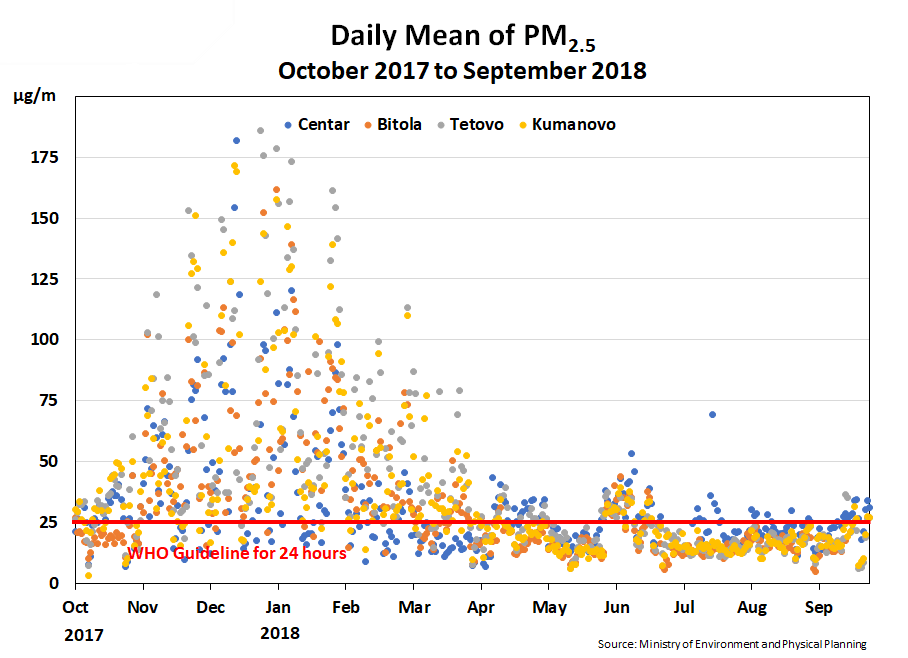
Graph 1 below shows the daily PM2.5 observations over the last year for Skopje (Centar), Bitola, Tetovo, and Kumanovo. All four cities regularly exceed the WHO daily guideline (25 µg/m3) with winter being the worst period.
➡ Control of the problem:
Quality and a healthy living environment are one of the basic preconditions for a quality life of all citizens in the Republic of Macedonia and a commitment of the Government of the Republic of Macedonia. Clean air is one of the main components, which, unfortunately, historically seen in the Republic of Macedonia, has seen high values in recent decades.
Some ways to prevent the effect of air pollution in Macedonian Capital Skopje are:
● The plantation of trees can reduce the increase of harmful chemical gases in the air.
● Less use of vehicles.
● More use of renewable energy in place of oils and fuels.
● Use of solar panels.

 Eduindex
You must be logged in to post a comment.