

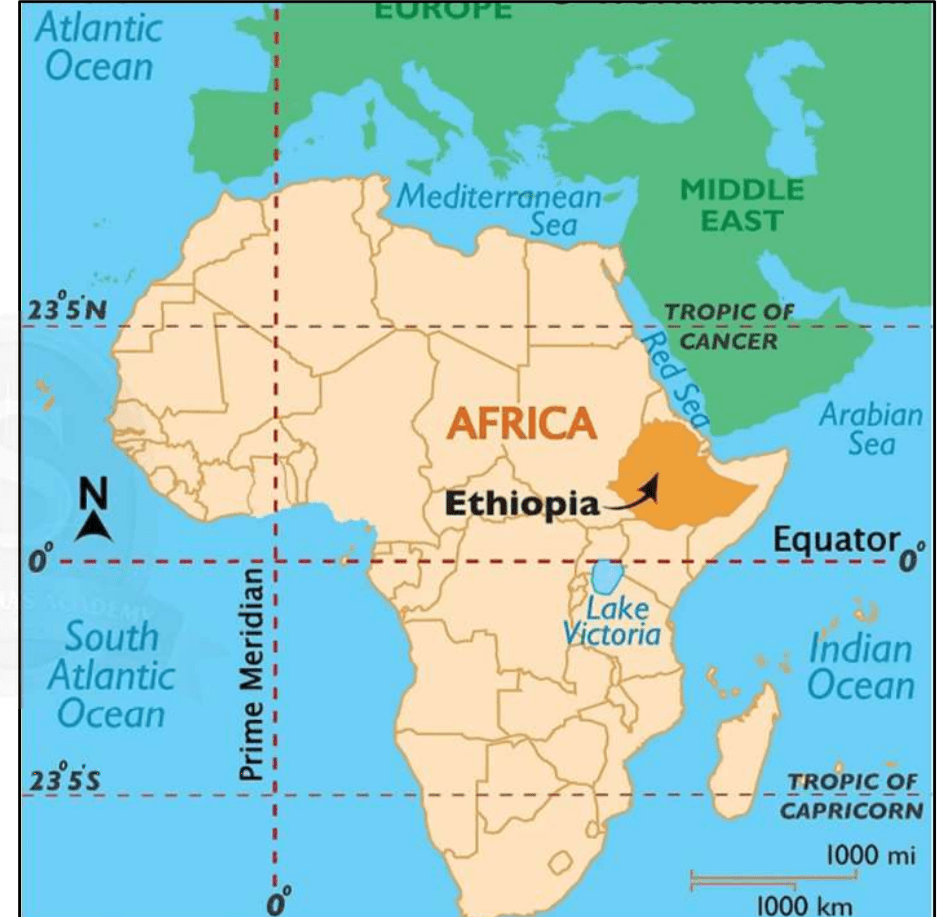
• Situated – Horn of Africa – Eastern Africa.
• Capital – Addis Ababa.
• Lies completely within the tropical latitudes.
• Borders with
Eritrea – North
Djibouti – Northeast
Somalia – East
Kenya – South
South Sudan, Sudan – West.
Topography
• One of the most rugged in Africa
• Built on four geologic formations
• High central plateau with some mountains.
• Elevation – highest just before the point of descent to the Great Rift Valley
Splits the plateau diagonally.
• Number of rivers cross the plateau
Blue Nile flowing from Lake Tana.
Economy
• Based on agriculture – coffee, major agricultural
export crop.
• Limited reserves – gold, platinum, copper, potash,
natural gas, hydropower.
Population
• Highly diverse.
• Most – Speak a Semitic or Cushitic language.
• More than 77 different ethnic groups – own
distinct languages within Ethiopia.
• Africa’s oldest independent country.
• Second largest in terms of population.
Political structure
• Federal republic under the 1994 constitution.
Prime minister – Head of government
Titular president – Head of state.
• Bicameral legislature – House of Peoples
Representative & House of the Federation.
• Prime minister – Designated by the ruling
party in the House of Peoples’ Representatives.
• Nominates candidate for the presidency and subjected to a vote by both legislative
houses.
Local government
• Structure – allows the country’s ten regions a
significant amount of autonomy.
• Regional state – Headed by a president elected by the state council
• Cities – headed by a chairman.
• Regions – own parliaments, security forces and the right to a referendum for independent rule.
Ethiopia’s Tigray crisis
• Issue – Conflict between PM Abiy Ahmed’s party and the Tigray People’s Liberation Front is escalating.
• Conflict – Traced back to the time when Abiy Ahmed – the prime minister came to power in 2018.
Tigray region
Wealthier than other parts of the country,
It has got a well-trained army.
• Tigray People’s Liberation Front – fighting
for the autonomy of Tigray and reconstitution of Ethiopia on the basis of ethnically autonomous regions.
Its Authority considerably reduced since Abiy took office.
• Ongoing conflict – 2 different political
ideologies for supremacy and control in the country.
• Tigray held local elections.
• PM ordered troops to counter a Tigray rebel
attack on federal army barracks.
Result – Killing of several civilians.
• United Nations and Amnesty International –
Accused Ethiopia of war crimes, ethnic cleansing and the resort to rape and hunger
as weapons of war.

 Eduindex
You must be logged in to post a comment.