SUPREME COURT

The Supreme Court of India is the country’s highest judicial court. It is the final court of appeal in the country. It is hence, an extremely important topic in the UPSC exam polity and governance sections.

  1. 15th February 2021: Former Supreme Court Judge, Justice PB Sawant Passed Away on this day.
  2. Supreme Court is examining a petition relating to the Social Media Firm Facebook and its Messaging Application WhatsApp over their terms of service and privacy policy that were to be out on February 8th, 2021.
  3. 13th February 2021: Statement from Supreme Court while dismissing a review petition on the anti-citizenship law protests held in Delhi’s Shaheen Bagh in 2019 – “Right To Protest Cannot Be Anytime, Everywhere.”
  • The Federal Court of India was created as per the Government of India Act 1935.
  • This court settled disputes between provinces and federal states and heard appeals against judgements of the high courts.
  • After independence, the Federal Court and the Judicial Committee of the Privy Council were replaced by the Supreme Court of India, which came into being in January 1950.
  • The Constitution of 1950 envisaged a Supreme Court with one Chief Justice and 7 puisne Judges.
  • The number of SC judges was increased by the Parliament and currently, there are 34 judges including the Chief Justice of India (CJI). 

Supreme Court of India – Functions

  • It takes up appeals against the verdicts of the High Courts, other courts and tribunals.
  • It settles disputes between various government authorities, between state governments, and between the centre and any state government.
  • It also hears matters which the President refers to it, in its advisory role.
  • The SC can also take up cases suo moto (on its own).
  • The law that SC declares is binding on all the courts in India and on the Union as well as the state governments.

Supreme Court Jurisdiction

The jurisdiction of the SC is of three types:

  1. Original – Read in detail about Original Jurisdiction of the Supreme Court in the linked article. 
  2. Advisory – Notes on Advisory Jurisdiction of the Supreme Court are given in the linked article. 
  3. Appellate 

Supreme Court Composition

  • Including the CJI, there are 34 judges in the Supreme Court.
  • The judges sit in benches of 2 or 3 (called a Division Bench) or in benches of 5 or more (called a Constitutional Bench) when there are matters of fundamental questions of the law is to be decided.

The Procedure of the Supreme Court of India

The Supreme Court of India has powers to consult the President to regulate the practice and procedure of the Court.

The Constitutional Cases are usually decided by a bench consisting of five judges whereas other cases are decided by a bench of at least three judges.

The seat of Supreme Court

As per the Constitution of India, Delhi is declared as the seat of the Supreme Court of India. However, the Chief Justice of India has the power to assign another place (s) as the seat of the Supreme Court. This is only an optional provision and not mandatory.

SC Judge Eligibility

As per Article 124, an Indian citizen who is below 65 years of age is eligible to be recommended for appointment as a judge of the SC if:

  1. he/she has been a judge of one or more High Courts, for at least 5 years, or
  2. he/she has been an advocate in one or more High Courts for at least 10 years, or
  3. he/she is in the opinion of the President, a distinguished jurist.

Independence of Judiciary

The Constitution has many provisions to ensure the judiciary’s independence. They are discussed below:

  1. Security of tenure: The judges of the SC are given security of tenure. Once appointed, they will retain their office until the age of 65 years. They can be removed only by a presidential order on grounds of proven misbehaviour and/or incapacity. This requires a Special Majority according to Article 368. Read more about the types of majorities in Parliament in the linked article.
  2. Salaries and allowances: The judges of the SC enjoy good salaries and allowances and these cannot be decreased except in the case of a financial emergency. The expenses of the High Court are charged on the Consolidated Fund of the State, which is not subject to vote in the state legislature.
  3. Powers and Jurisdiction: The SC’s powers and jurisdiction can only be added by the Parliament and not be curtailed. 
  4. The conduct of any judge of the Supreme Court in the discharge of his/her duties cannot be discussed in the legislature.
  5. The SC has the power to punish any person for its contempt, as per Article 129. (Read about Contempt of Court in India in the linked article.)
  6. Separation of the Judiciary from the Executive: A Directive Principle of State Policy says that the state shall take steps to separate the judiciary from the executive in the public services of the state. According to Article 50, there shall be a separate judicial service free from executive control.

Who is the Chief Justice of India in 2021?

The Current Chief Justice of India (CJI) is Sharad Arvind Bobde. He took the office of Chief Justice of India on 18 November 2019.

How many supreme courts are there in India?

There is only 1 Supreme Court in India. And, there are 25 High Courts.

What are the powers and functions of the Supreme Court?

SC is the highest judicial court in India. It upholds the rule of law and also guarantees and protects citizens’ rights and liberties as given in the Constitution. Therefore, the Supreme Court is also known as the Guardian of the Constitution.

How many judges are there in Supreme Court?

At present, there are 34 judges in the SC including the CJI.

Can Supreme Court overrule President India?

Technically, the President cannot overrule the SC. Only Parliament can amend any law to overcome the decision of the SC. The President has the pardoning power, which he can exercise on the advice of the Council of Ministers. Even here, the President does not overrule the SC. The judgement of the Court remains, only, the President can “pardon” the punishment.

The Pandemic’s Impact on Mental health

BY-ADITI RAJ

Everyone across the world is being informed about the physical health effects of covid-19 infection and the steps to prevent exposure from the virus. But, the effects of this pandemic on an individual’s mental health have still not studied in length. As most of the efforts are focused towards understanding the epidemiology, prevention from the contamination and management from covid-19 outbreak, there’s been a little concern over the effects of one’s mental health. The present situation arising due to the stressful situation in pandemic requires raising awareness in public, which can be helpful to deal with the calamity. This article deals with the detailed description of the effect of the covid-19 outbreak on the mental health of an individual.

The coronavirus pandemic is not just a medical phenomenon; it is affecting an individual mental health causing anxiety, stress and causes disruption or even xenophobia(fear of strangers).As more and more people are being forced to stay at home with self-isolation to prevent the further contamination of the virus, governments should must take the necessary measures to provide mental health support prescribed by the mental healthy experts. According to study conducted in United States ,17.5% of participants reported suicide ideation, and 4.9% had attempted suicide during the covid-19 outbreak.

Quarantine and self-isolation can most likely cause a negative impact on a person mental health. Also a review published in The Lancet said that the separation from loved ones, loss of freedom and boredom can cause a sudden deterioration in one’s mental health. Kids can have anxiety because of the isolation situation they are facing and being away from their school and friends can lead them to distress feeling. In this situation parents should remain calm along with trying every possible way to cheer their child. Elderly people are also facing problem and also they are more prone towards the COVID-19 outbreak. The elderly people living in nursing homes can face extreme mental health issues. However, as simple as a phone call from their family can help to console them.

Understanding the effects of the COVID-19 outbreak on an individual’s mental health of various population is as important as understanding the physical features and management. Hence, spending time with your family members and taking break from traditional and social media can help to overcome health issues.

“Save Water ,Save Life”

‘Water is a driving force of all nature’- Leonardo Da Vincci.

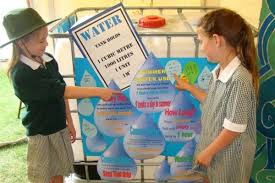
A children holding a poster with the request SAVE WATER is actually sending across a severe warning……………

We are headed for a water crisis and a very serious one at that. Do you really think it is an issue we can dare to neglect? I do not think so.Water is very essential for all life forms to survive and grow. For any personal, commercial, industrial, or any other use the water is required.Life without water is impossible. Also, the drinkable water is quite low and if we continue to wastewater at the speed we do today, the day is not far when we will have to fight for water. But still, let me ask you one question, are we actually working in the direction of saving water? The rightful answer would be no.

Water management & conservation of resources:

The problem with these issues (water management and conservation of resources) is that there are numerous parties with vested interests that tend to play down these serious threats staring us in the face in a not so distant a future. While most authorities that are respected are unanimous in their conclusion of global warming as a serious threat, there are others who look upon the very phenomenon of global warming as a typical case of environmental Cassandras trying to hog the limelight. If you have to seriously address issues like global warming or water crisis, one leading to the other, corporate houses which depend on numerous factories that create all the filth shall have to take steps that would seriously create a big dent in their pockets. No corporate house would be eager to do this.

Therefore, they purposely overlook the fact that the sources of fresh water are limited. If you are so concerned with your immediate profit that you tend to overlook the disastrous results in the long run for all life on this earth, you are no less than plain stupid! The extent to which the corporate sector can be callous can be clearly understood from the following example:-

A proposal by South India Bottling Company Private Limited (SIBCL), a Coca-Cola franchisee, to set up a 280 million (US $ 6,500,000) soft -drinks unit in Gangaikondan village of Tirunelveli district in southern Tamil Nadu, has run into trouble. Many local residents, political parties and environmentalists have raised concerns that the water-intensive plant will deplete and contaminate groundwater and draw from Tamiraparani River, that cannot fully meet even drinking water and agricultural needs of local communities. Research by the India Resource Centre revealed a number of discrepancies and misinformation in SIBCL’s public statements regarding its water usage and daily production. We can also remember in this context that the world leaders really fight it out when something as dangerous as poisonous gas emissions bave to be curtailed. Indeed, how myopic can people be!

However, blaming corporates and factories would not be a complete part of the solution. There is the other side of the picture too. A 2006 United Nations report focuses on issues of governance as the core of the water crisis, saying There is enough water for everyone’ and “Water insufficiency is often due to mismanagement, corruption,lack of appropriate institutions, bureaucratic inertia and a shortage of investment in both human capacity and physical infrastructure.” Official data also shows a clear correlation between access to safe water and GDP per capita.

While the observation made by the UN is true, the role of climate change in aggravating a terrible water crisis around the globe is also An Inconvenient Truth as Al Gore calls it. According to a UN climate report, the Himalayan glaciers that are the sources of Asia’s biggest rivers-Ganga, Indus, Brahmaputra, Yangtze, Mekong, Salween and Yellow-could disappear by 2035 as temperatures rise. Approximately 2.4 billion people live in the drainage basin of the Himalayan Rivers. India, China, Pakistan, Bangladesh, Nepal and Myanmar could experience floods followed by droughts in coming decades. In India alone, the Ganga provides water for drinking and farming for more than 500 million people. The west coast of North America, which gets much of its water from glaciers in mountain ranges such as the Rocky Mountains and Sierra Nevada, would also be affected.

What would happen if this wastage of water is allowed to continue? News reports about the Gangotri Glacier receding have become fairly common. Can you imagine India without the Ganga? Are we going to silently bear with the progressive destruction of the most precious resource, and leave our future generations to face some bloody war for the control of water resources?

How can we Save Water?

you know there is many points you can do in your day to day life for water conservation.Each of these methods of water conservation is simple and easy and certainly things that anyone can take advantage of.

1. Turning the water off when brushing your teeth or washing your hair can save a lot of water. In fact, as much as 160 gallons of water can be conserved each month when you turn the water off.

2. Purchase water-efficient products and appliances for your home. This includes dishwashers, sink systems, bathtubs and more. These products pay for themselves in no time at all.

3. Plant you garden in the spring and you can save since water requirement levels are less during this season.

4. Do not use water to defrost foods. Although many people do use this method it requires a lot of water consumption to do this.

5. Check for leaks. This includes the toilet and the sinks in the home. Even a small leak could cause an extensive amount of extra water usage and more money added to the water bill.

6. Stop using extra water when you flush by avoiding placing anything in the toilet. This includes tissue and cigarette butts. Using this method to eliminate these items will cost you an additional 5 to 6 gallons of water per flush.

7. Insulate your pipes. This will prevent them from freezing in the winter while also helping heat water up faster, among other benefits.

8. When washing clothes, make sure that you are washing full loads of laundry only. You are wasting a lot of water washing only half of a load.

Russian Revolution and its Impact

The biggest outcome of the war,the Russian revolution,was unique in world history.The socio political and economic conditions prevailing in Russia were brought to head by the War.There were really two revolutions in the year 1917 ,one in March and the other in November.On the abdication of the Tsar the bourgeois government which followed, wanted to continue the war.But the people were against it.So there was a second great uprising under the guidance their leader Lenin,who seized power and established a communist government in Russia.

Causes of the Revolution

Social causes

In Russia Peter the Great and Catherine I I attempted westernisation without changing the social conditions.The Russian peasents were serfs tied to lands owned by wealthy Russians.Afer Russia’s defeat in the Crimean War,some reforms were introduced.In 1861 Tsar Alexander I I abolished serftom and emancipated the serfs .But they were not given enough land to subsist.These peasents became the powder keg for the revolution.The labourers and workers whose number had increased on account of industrialisation were aggrieved as they got very low wages.

Role of Revolutions

The spread of revolutionary ideas among the intelligentsia and their repression by the Tsar’s government made the socialistically inclined students to carry their propaganda to the peasantry.In course of time these students disillusioned with the outcome of their work with the peasants,took to “terrorism”.yet the revolutionary forces swelled ,with the joining of the many minority groups like Jews and poles.Soon,based on the Marxist philosophy,new ideas began to take shape and a social and Democratic Labour party was formed.The Marxists declared themselves against acts of terriosm.They believed that the working class had to be roused to action,and inky by such mass action could they achieve thier goal.

Autocracy of the Tsar

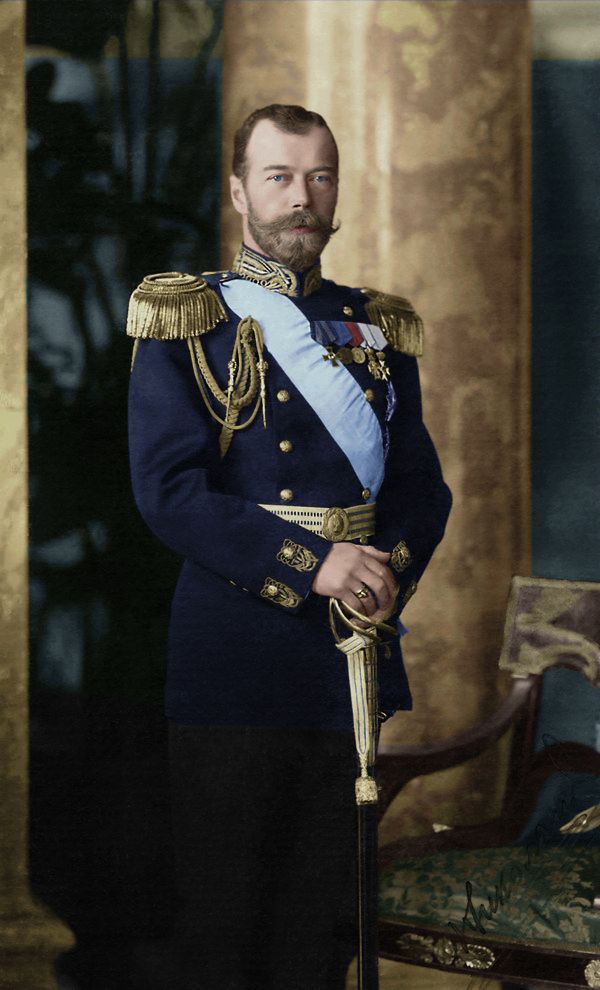
Tsar Nicholas I I of Romanow dynasty had little experience of government.His wife Tsarina Alexandra was a dominant personality and Nicholas was under her strong influence.Nicholax mistrusted most of his ministers and he was surrounded by flatters.Determined that Russia should not be left out in tha scramble for colonial possessions, Nicholas encouraged Russian expansion in Manchuria.This provoked a war with Japan in 1904.The resulting Russian defeat led to strikes and riots.On 23 January 1902 Father Gapon,a priest,organised a march of men, women and children on the Tsar’s winter palace in St.Petersburg demanding a representative national assembly and agraian and industrial reforms.But police and soldiers fired on the procession.Hundreds were killed and many thousands wounded.The events of this day led to riots, strikes and violence in which the governor-general of Moscow,an uncle of the Tsar,was killed by a bomb.Nicholas was forced to grant a constitution and establish a parliament,the Duma.This was no longer satisfactory to the left-wing parties that formed a Soviet of workers delegates in St Petersburg,led by Trotsky.Similar Soviets were set up in other cities.The Duma gave the middle classes,a voice in government.So the moderates were supportive of the government’s policy,while the left wing continued their opposition.

Opposition to Tsar and Dissolution of Duma

The outbreak of the First world war had temporarily strengthened the monarchy,as Russia allied to France and Britian.As there was rumour of a palace revolution.Nicholas made himself the commander-in-chief of the army.At the end of 1916 ,Rasputin,who had a domineering influence over the Tsar and the Tsarina,was murdered by a member of the Tsar’s family.The members of the St.Petersburg Soviet were arrested.Whenever the Duma opposed the Tsar’s move,it was dissolved and fresh elections held.Without change of government policy,the fourth Duma ended with the revolution of 1917.

Popular uprisings

Even on 23 February 1917,when the socialists celebrated International working Women’s Day on that day ,The Tsar seemed unchallengeable.But he had to abdicate on the morning of 2 March.Though none called for strikes fearing that the time was not ripe for militant action,the bread shortages among women textile workers,many with husbands in the army, forced them to go on strike anyway and March through the factory areas of Petrograd ,the capital of the Russian Empire.Masses of women workers demanding “Bread for workers “waved their arms towards factory workers and shouted”Come out !” “Stop work!” The city’s 4,00,000 workers joined the movement the next day (24 February)

Abdication of Tsar

The government used the troops to break the strike.But soon mutinies broke out in the barracks.The Tsar ordered a declaration of material law.But his order was not broadcast in the city,as there was no one to do this job.The Tsar then tired to return to Petrograd.The railway workers stopped his train.The generals at the front and some leaders in petrograd, frightened by these developments pleaded with the Tsar to abdicate.On 15 March, Nicholas I I abdicated.

The revolutionary Tamil poet Bharathiyar cheerfully welcomed the revolution in Russia by penning these poetic lines…

The Mother Great,the power supreme,
Turned her galance benign towards Russia,
The Revolution of the Age,
Behold the wonder ,rises high
The tyrant howling falls down limp,
The shoulders of the heavenly god’s,
Are swelling now with joy and pride,
Eyes hot with unshed tears,the demons,perish.O people of the world, Behold this mightly change!

Provisional Government

There were two parallel bodies to take on government functions.One was of the bourgeois politicians of the old state Duma, comprising prospertied classes.On the other there were workers’ delegates drawn together in a workers council,or Soviet.The workers’ delegates in the Soviet were influenced by the underground left-wingers .Those in the Duma were able to form a provincial government with the consent of the Soviets.The Soviet was dominated by Mensheviks and the minority Bolshevik were timid and undecided.The situation changed with the arrival of Lenin.

Failure of provisional Government

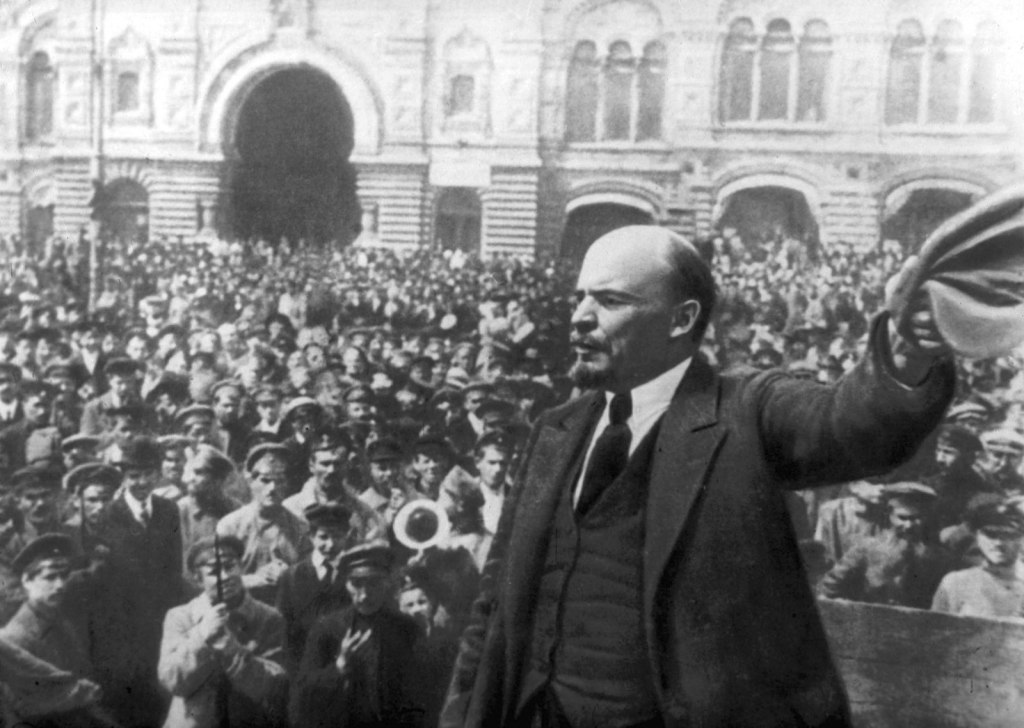
Lenin was in Switzerland when the revolution broke out.Lenin wanted continued revolution.His slogan of All power to the Soviets soon won over the workers leaders.Devasted by war time shortages,the people were attracted by the slogan of ‘Bread ,peace and Land’.But the provisional Government made two grave mistakes.First,it postponed a decision on the demand for the redistribution of land and the other was government decided to continue with the war.Frustrated peasent soldiers deserted their posts and joined those who had restored to land grabbing.

Takeover by the Bolshevik party under Lenin’s leadership

In Oct Lenin persuaded the Bolshevik central Committee to decide on immediate revolution.Trotsky prepared a detailed plan.On 7 November the key government buildings, including the winter palace,the prime minister’s headquarters,were sized by armed factory workers and revolutionary troops.On 8 November 1917 a new Communist government was in office in Russia.Its head this time was Lenin.The Bolshevik party was renamed the Russian Communist party.

Outcome of the Revolution

The Russian Communist party eliminated illiteracy and poverty in Russia within a record time.Russian industry and agriculture developed remarkably.Women were given equal rights, including rights to industries and banks were nationalised.Land was distributed to poor peasents.Lenin thought the most important factor for the fall of provisional Government was its failure to withdraw from world war.So Lenin immediately appeared for peace.unmindful of the harsh terms dicated by the central powers,Lenin opted for withdrawing from the war to concentrate on the formation of new government.In March 1918 the treaty of Brest-Litovsk was signed.

Global Influence of the Russian Revolution

The revolution fired people’s imagination across the world.In many countries, communist parties were formed.The Russian Communist government encouraged the colonies to fight for their freedom.Debates over key issues,and reforms,social welfare, workers’ rights and gender equality started taking place in a global context.

Muhammad-bin-Tughlaq

The Tughlaq administration, also called as Tughluq or Tughluk dynasty, was a Muslim line of Turkey which managed over the Delhi sultanate in medieval India. Its rule began in 1320 in Delhi. Ghiyasuddin Tughlaq was the first ruler of this dynasty. Khusrau Khan, the last ruler of the Khilji administration was executed by Ghazni Malik. Slave dynasty was the one which mark the beginning of delhi sultanate.

He was intellectual of reasoning, philosophy, astronomy, mathematics, calligraphy and physical sciences. He had good knowledge of various languages such as Turkish, Sanskrit, Persian and Arabic. The famous traveller Ibn Battuta visited India during his reign.  He was a liberal king who believed in equality. He gave freedom to Hindu as well as Jains.

Reforms- Taxation in the Doab: The Sultan made a stupid budgetary examination in the Doab between the Ganges and Jamuna. He expanded the rate of duty as well as restored and made some extra Abwabs or cessess, Transfer of Capital (1327): It seems that the Sultan needed to make Deogir as his second capital so that he may have the capacity to control south India better. Deogir was renamed Daulatabad. After two or three years, Muhammad Tughlaq chose to forsake Daulatabad basically on the grounds that he soon found out that he couldn’t control south India from Delhi and he couldn’t control north from Daulatabad, Introduction of Token Currency(1330): Muhammad Tughlaq chose to present bronze coins, which were to have the same worth as the silver coins. Muhammad Tughlaq may have been effective in the approach if he could keep individuals from moulding the new coins, Khurasan Expedition: The Sultan had a dream of widespread victory. He chose to win Khurasan and Iraq and activated a gigantic armed force for the reason. Be that as it may, his campaign demonstrated a disappointment, Quarachi Expedition: This campaign was propelled to counter Chinese attacks. It likewise gives the idea that the campaign was coordinated against some headstrong tribes in Kumaon-Garhwal district with the objective of bringing them under Delhi Sultanate.

He died in Thatta while battling in Sindh against Taghi, a Turkish slave.

Balance diet

What is a balanced diet?
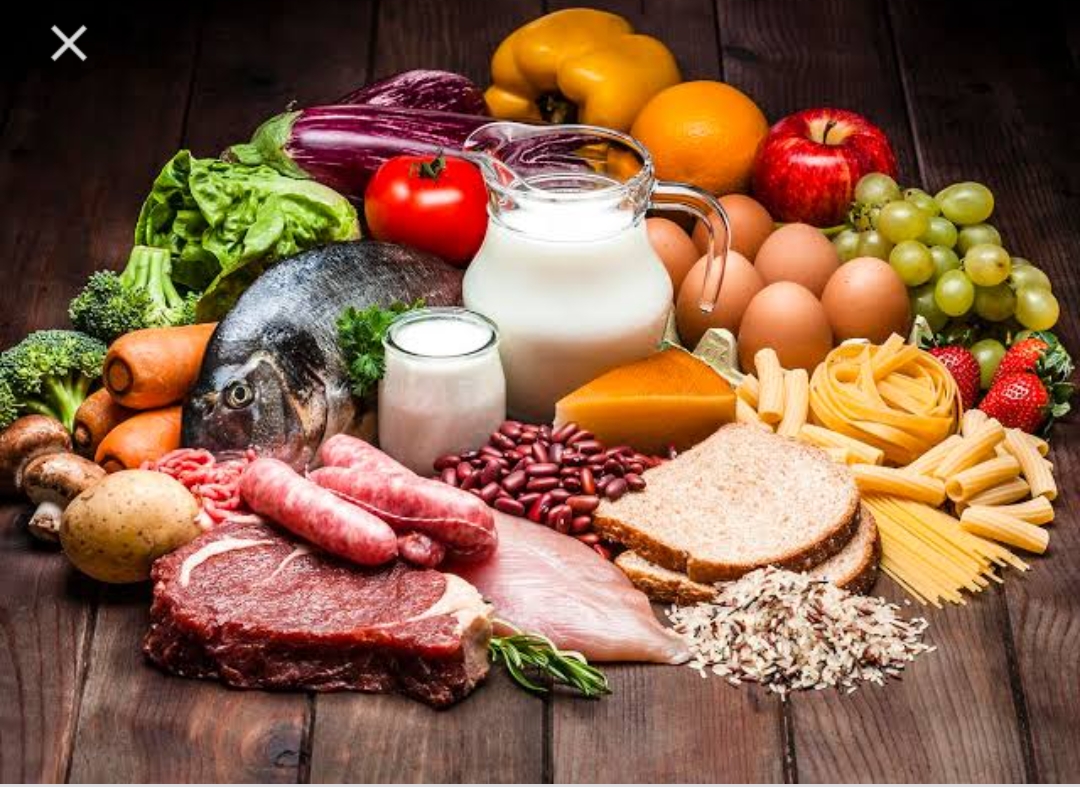
A balanced diet gives your body the nutrients it needs to function correctly. To get the nutrition you need, most of your daily calories should come from:

fresh fruits
fresh vegetables
whole grains
legumes
nuts
lean proteins

What to eat for a balanced diet
A healthy, balanced diet will usually include the following nutrients:

vitamins, minerals, and antioxidants
carbohydrates, including starches and fiber
protein
healthy fats

balanced diet will include a variety of foods from the following groups:

fruits
vegetables
grains
dairy
protein foods
Examples of protein foods include meat, eggs, fish, beans, nuts, and legumes.

Food groups in your diet
eat at least 5 portions of a variety of fruit and vegetables every day (see 5 A Day)
base meals on higher fibre starchy foods like potatoes, bread, rice or pasta.
have some dairy or dairy alternatives (such as soya drinks)
eat some beans, pulses, fish, eggs, meat and other protein.

COPA América

Copa América, known until 1975 as the South American Football Championship, is the main men’s football tournament contested among national teams from south america. It is the oldest still-running international football competition, as well as the third most watched in the world.The competition determines the champions of South America. Since the 1990s, teams from North America and Asia have also been invited to compete.

The 2021 Copa América was the 47th edition of the Copa america, the international men’s football championship organised by South America’s football ruling body CONMEBOL. The tournament took place in Brazil from 13 June to 10 July 2021. The tournament was originally scheduled to take place from 12 June to 12 July 2020 in Argentina and Colombia as the 2020 Copa América. On 17 March 2020, CONMEBOL announced that due to the COVID-19 the tournament had been postponed for a year, in conjunction with UEFA’s decision to also postpon to 2021.

Hosts Brazil were the title holders, having won their ninth title in 2019, which they also hosted. Argentina won their fifteenth title after defeating Brazil 1–0 in the final, their first senior title since the 1993 of the same tournament. They also equalled Uruguay’s overall record of Copa América titles.

The trophy was Messi’s first with Argentina after a string of painful, agonizing, maddening failures, including perhaps the most demoralizing defeat of his career — against Germany in the World Cup final — inside the same stadium, Rio’s hulking Maracanã, in 2014.

When the whistle blew to end the final, Messi — his relief palpable — dropped to his knees and was immediately surrounded by his teammates. Moments later, they were lifting him above their shoulders and tossing him in the air.

Little about Jesus Christ.

The cross- symbol of God’s love to people.

Jesus Christ is the central figure of Christianity. He was born at Bethlehem; Judea in Roman empire in 4-6 B.C and his mother was Mary. The Christians traditionally believe that Jesus was born of a virgin, performed miracles and founded an independent religious movement. The majority of Christians worship Jesus as the incarnation of son of god, one of three divine persons of a trinity. A few Christian groups, however, reject trinitarianism, partly or wholly, taking it to be non- scriptural. The principal sources of information regarding Jesus are the four canonical gospels, and most critical scholars find them useful for reconstruction the life and teachings of Jesus. Some scholars believe apocryphal texts such as the gospel of Thomas and the gospel of Hebrews are also relevant.

Later on, the Bible has been divided into two parts- the Old Testament (before Christ) and the New Testament, containing the life of Jesus and principles of Christianity. In Islam, Jesus (transliterated in Arabic as Isa) is considered one of God’s prophets, and the product of a virgin birth; but do not believe that he was God incarnate.

Most of the historians agree that Jesus was a Jew regarded as a preacher and healer, and was crucified between the age of 33-36yrs in Jerusalem on the orders of the Roman Prefect of Judaea, Pontius Pilate, on charge of sedition against the Roman Empire. His date of death was 30-33 A.D.

Population explosion and its problems

population is a very serious and underrated issue in todays life. Its need to be considered and handled as soon as possible. the population of whole world is estimated around 7.5 billion, which is a huge number.it has its own advantages and disadvantages.

Photo by Oscar Chan on Pexels.com

the biggest problem we are facing is population explosion. Population explosion is sudden or sharp increase in number of people in an area . due to which we face lot of problems such as poverty, unemployment migration of people from rural to urban areas due to less facilities, shortage of food items, low standard of living and many other effects.

causes of population explosion

There are many causes of population explosion some of them are listed below:-

  1. The most important reason of the huge population explosion is Birth rate. The rate of birth rate is very high.it is due to many reasons such as lack of awareness and knowledge among people .especially in our country India .The rate of birth rate is very very high and some of the main reason is people are very fond of having a male child ,joint families ,infant mortality rate and many other reasons.

2. Falling death rate of human beings is also a big reason of such increase in population . Medical sciences have discovered many medicines (vaccines and antibiotics) and treatments through which human life has been increased significantly.

3.Poverty in developed countries is one of the reasons of population explosion.it is because it is considered that having more children means an extra chance of earning more when he/she will be grown up.

These are few causes of popuation explosion.

Problems due to population explosion

This sudden increase in population will definitely have some serious issues, some of them are:-

1 .More increase in population will result in more demand of food, healthcare, water, transportations housing and many other things. that will be impossible at one point if we will not do something to stop it.

2. The more population will result into more violence and conflicts in different parts of world.

3. Deforestation:- we all are aware of the term deforestation population is increasing day by day we need more land or area to live and it can only be accompished by cutting trees (forests).due to which our ability to take carbon dioxide decreases. Due to deforestation, wild animals and species are also suffering .

4.global warming :it is due to the burning of greenhouse gases. As population is increasing ,fossil fuels have a large impact in industrial societies when these fossil fuels (coal ,gas and oil) are burned they give carbon dioxide in huge amount and other greenhouse gases such as methane, carbon monoxide etc, which also leads to depletion of fossil fuels.

these are some few problems associated with population explosion which are creating a lot of problem for human beings.

Actions that can be applied to solve this problem

According to united nation, the population of world will be 10.8 billion by 2100.This is a very huge number and we do not know whether we will be able to tackle that difficulties in future.

strategies should be made to control population explosion that should include making public realize about consequences of overpopulation like it will decrease the quantities of basic needs of life .Employment rate should be increased as much as possible, family planning should be made, medical facility should be good in developing nations and there are many other measures that can be taken to control population explosion.

Ethiopia

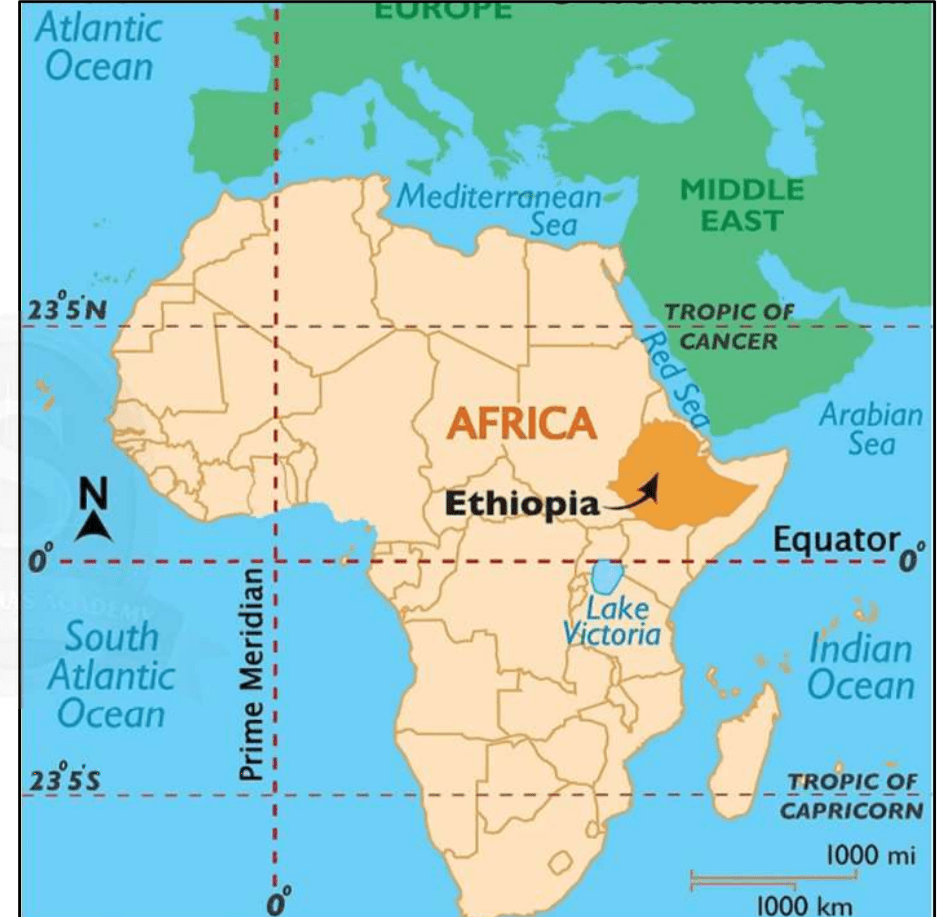
• Situated – Horn of Africa – Eastern Africa.

• Capital – Addis Ababa.

• Lies completely within the tropical latitudes.

• Borders with
 Eritrea – North
 Djibouti – Northeast
 Somalia – East
 Kenya – South
 South Sudan, Sudan – West.

Source -world altas

Topography

• One of the most rugged in Africa

• Built on four geologic formations

• High central plateau with some mountains.

• Elevation – highest just before the point of descent to the Great Rift Valley
 Splits the plateau diagonally.

• Number of rivers cross the plateau
 Blue Nile flowing from Lake Tana.

Economy

• Based on agriculture – coffee, major agricultural
export crop.

• Limited reserves – gold, platinum, copper, potash,
natural gas, hydropower.
Population

• Highly diverse.

• Most – Speak a Semitic or Cushitic language.

• More than 77 different ethnic groups – own
distinct languages within Ethiopia.

• Africa’s oldest independent country.

• Second largest in terms of population.

Political structure

• Federal republic under the 1994 constitution.
 Prime minister – Head of government
 Titular president – Head of state.

• Bicameral legislature – House of Peoples
Representative & House of the Federation.

• Prime minister – Designated by the ruling
party in the House of Peoples’ Representatives.

• Nominates candidate for the presidency and subjected to a vote by both legislative
houses.

Local government

• Structure – allows the country’s ten regions a
significant amount of autonomy.

• Regional state – Headed by a president elected by the state council

• Cities – headed by a chairman.

• Regions – own parliaments, security forces and the right to a referendum for independent rule.

Ethiopia’s Tigray crisis

• Issue – Conflict between PM Abiy Ahmed’s party and the Tigray People’s Liberation Front is escalating.

• Conflict – Traced back to the time when Abiy Ahmed – the prime minister came to power in 2018.

Tigray region
 Wealthier than other parts of the country,
 It has got a well-trained army.

• Tigray People’s Liberation Front – fighting
for the autonomy of Tigray and reconstitution of Ethiopia on the basis of ethnically autonomous regions.
 Its Authority considerably reduced since Abiy took office.
• Ongoing conflict – 2 different political
ideologies for supremacy and control in the country.

• Tigray held local elections.

• PM ordered troops to counter a Tigray rebel
attack on federal army barracks.
 Result – Killing of several civilians.

• United Nations and Amnesty International –
Accused Ethiopia of war crimes, ethnic cleansing and the resort to rape and hunger
as weapons of war.

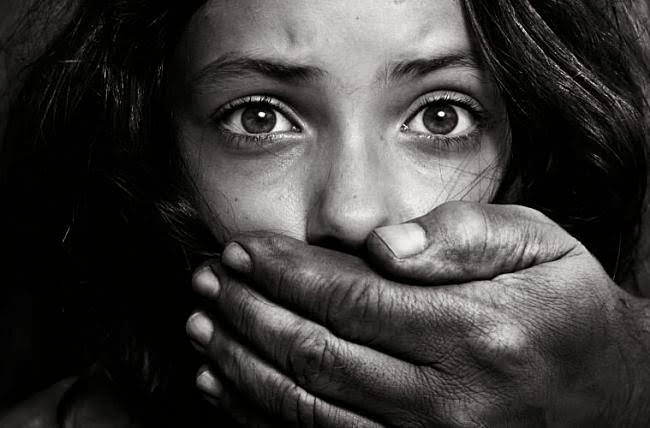
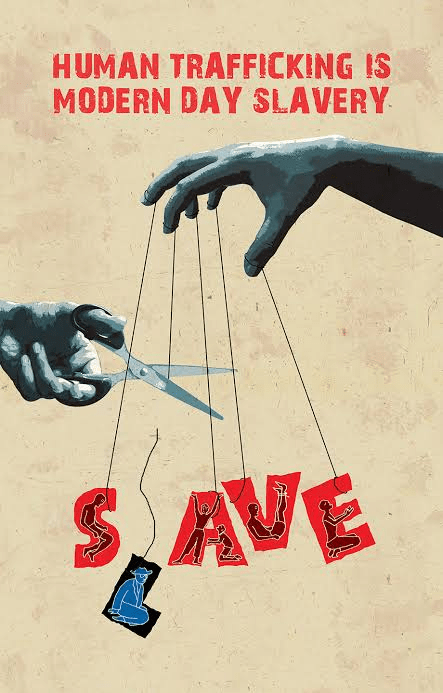
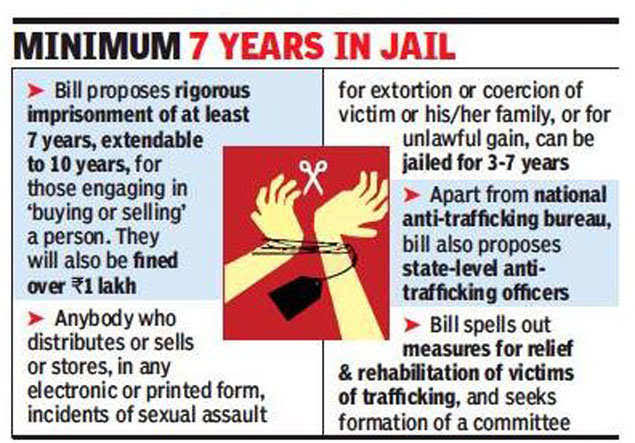
HUMAN TRAFFICKING DURING PANDEMIC

Human Trafficking is a major issue in India and Worldwide. Though, it has been there for ages, the reason for the need of immediate attention is the COVID – 19 Pandemic. The pandemic bought about various social and economical changes in India giving rise to human trafficking cases. The lockdown raised higher level of unemployment amongst daily wage earners. This further lead to effecting the economic background of such families, especially in the rural areas. Having no other source of income lead to desperation in people which made them promote human trafficking by selling their children, making them beg for money and sending their children for child labour. Moreover, the closure of schools increased human trafficking cases as there was no source of education for children. This gave the families and opportunity to use the children economically for labour and wed their girl child at an early age to save the future expenses. Absence of schools further increased the burden on families as many rural schools provided mid-day meal to their students. Absence of which made the children a further burden on the families and an additional stomach to feed. This made them give their children away in a hope for a better future for them and food for their children.


Along with such cases, many organ removal cases in the name of covid cases were found. Many physically fit people with weak financial backgrounds were falsely shown positive for corona virus and later declared dead because of the same. It was found that many traffickers removed organs from such bodies and declared them dead. Hence, this issue is important in the current times and require more attention than ever.

Yes, it’s difficult to step outside and help in this uncertain times but we individuals can start from our homes. The family domestic help, house help, workers, etc belong to rural and economically weak family backgrounds. Hence, talking to them and knowing about their lives can help us get a clear picture of their situation. We can educate them and spread awareness about the wrongs that they might be exposed to. This knowledge might help them be aware and spread the words to different people in their families and neighbourhood, that in turn might create a huge impact on the society as a whole.

Many a times people give into such situations where they willingly promote human trafficking, out of desperation and helplessness. As in case of a daily wage worker who has no other means to support his family economically might sell his child to survive. Hence, it is important to make them aware about various other way where they might get financial help without getting trapped into such rackets. There are government supports yojanas and schemes where they help such people, but in order to get help it is important to know about the availability of that help and that can only be done through awareness. It may not change the entire world scenario but one step by every citizen might make a huge impact altogether.

What is World Trade Organisation ( WTO ) ? ( History , Objectives , Principles , Structure )

The World Trade Organisation is the successor of General Agreement on Tariffs and Trades (GATT ).
The WTO Agreement is the Uruguay Round agreement where the original GATT is now part of the WTO Agreement which came into force from January 1,1995.

WTO is a multilateral organisation .It has its headquarter in Geneva , Switzerland. It is the central body that facilitates global trade .


It is the only international organization that deals with global rules of trade between nations.
It provides a framework for conduct of international trade in goods and services.


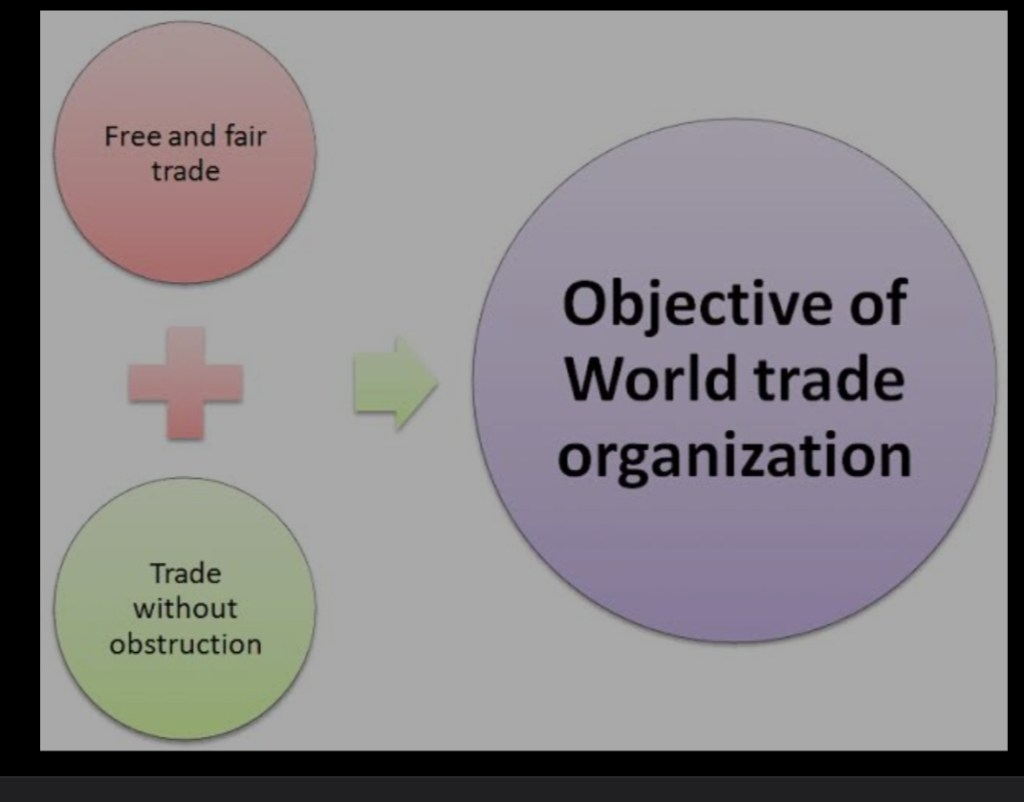
The fundamental objective of the rule-based system of international trade under the WTO is to ensure that international markets remain open and their access is not disrupted by the sudden and arbitrary imposition of import restrictions.


It lays down the rights and obligations of governments in the set of multilateral agreements.
It also covers a wide range of issues related to international trade, such as protection of intellectual property rights and dispute settlement, and prescribes disciplines for governments in formulation of rules, procedures, and practices in these areas.


Structure of WTO

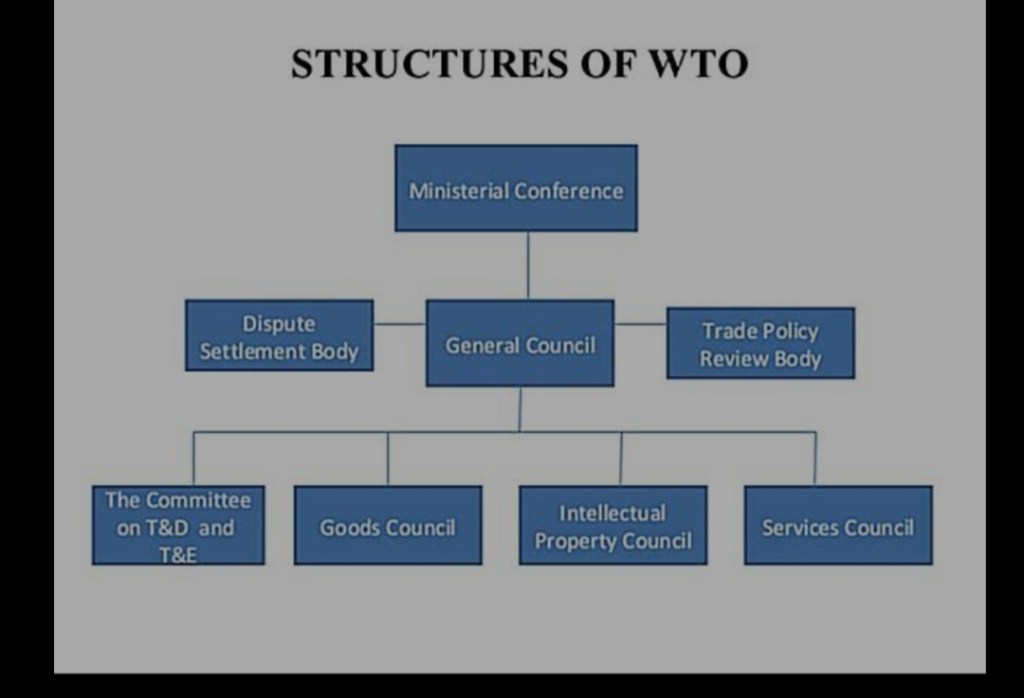
The structure of WTO is headed by the Ministerial Conference composed of representatives of all members which meet at least once every two years.
It carries out the functions of the WTO and takes actions necessary to this effect .

The Ministerial Conference is the supreme authority of the WTO .
The Ministerial Conference operations by different authority bodies.

General Council composed of representatives of all members to oversee the operation of the WTO Agreement and ministerial decisions on a regular basis. It also acts as a Dispute Settlement Body (DSB) and a trade policy review body (TPRB) ,each having its own Chairman.

The Director General , who is the secretariat head of WTO . The Ministerial Conference appoints the Director General and sets out his power duties , conditions of services and term of office. The Director General appoints the members of Staff of the Secretariat and determines their duties in accordance with the regulations adopted by the Ministerial Conference.

There is the Council of Trade in goods , The council for Trade in Services and the Council for Trade Related Aspects of Intellectual Property Right (TRIPs) which operates under the General Council .

Principle of WTO

Five important principles of WTO are :-

Non-discrimination
Reciprocity
Binding and enforceable commitments
Transparency
Safety values

___________________________________________


Objectives

The Preamble of the organisation , The Agreement establishing the WTO lays down the following objectives :-

• It’s relation in the field and economic endeavour shall be conducted with a view to raising standards of living , ensuring full employment and large and steadily growing volume of real income and effective demand and expanding the production and trade in goods and services.

• To allow for the optional use of the world’s resources in accordance with the objectives of sustainable development , to protect the environment and to enhance the means for doing so in a manner consistent with respective needs and concerns at different levels of economic development.

• To make positive efforts designed to ensure that developing countries , especially the least developed among them , secure a share in the growth in international trade commensurate with the needs of their economic development.

• To achieve these objectives by entering into reciprocal and mutually advantageous arrangements directed towards substantial reduction of tariffs and other barriers to trade and the elimination of discriminatory treatment in international trade relations.

• To develop an integrated , more viable and durable multilateral trading system encompassing the GATT , the results of past liberalisation efforts and all the results of the Uruguay Round of multilateral trade negotiations .

• To ensure linkages between trade policies , environment policies and sustainable development.

___________________________________________

Functions :-

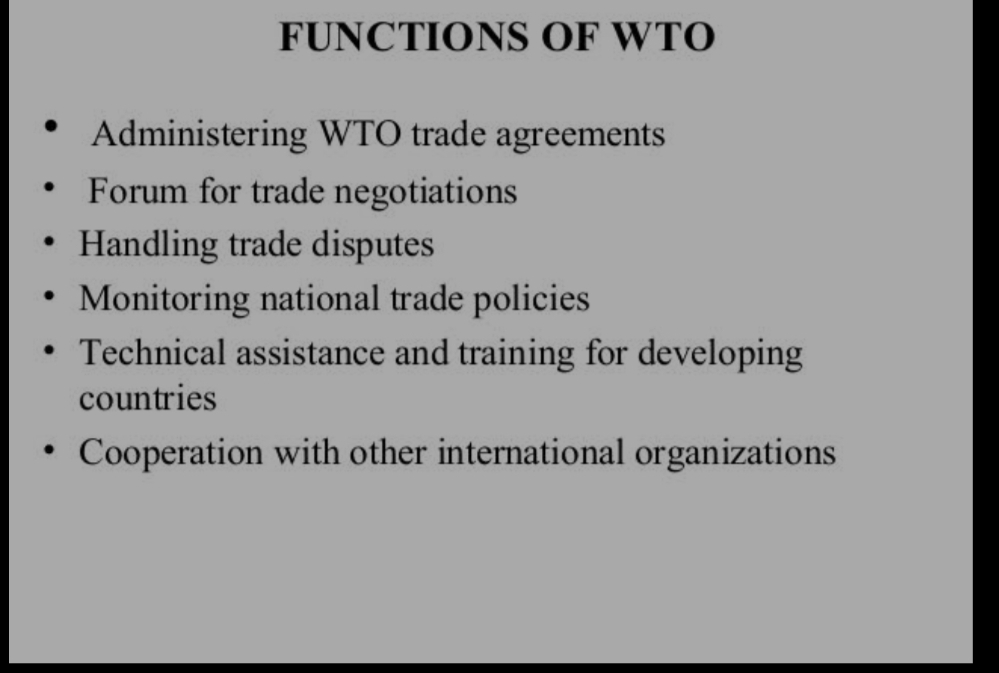
The main functions of WTO are :-

1. To facilitate implementation, administration and operations of the objectives of the Agreement and of the Ministerial Trade Agreement.

2. To provide the forum for negotiations among its members concerning their multilateral trade relations , in matters relating to the agreements .

3. To provide a framework for implementation, administration and operation of multilateral and bilateral agreements of world trade.

4. To administer the understanding of rules and Procedures governing the Settlement of dispute .

5. To ensure the optimum use of world resources.

6. To assist international organizations such as, IMF and IBRD for establishing coherence in Universal Economic Policy determination.

___________________________________________


WTO Agreements

The Agreement establishing WTO consists of the following :-

1: Multilateral Agreements on Trade in Goods :

The general agreement on trade in goods defines the GATT 1994 and includes various agreements dealing with Different aspects related to trade in goods.

• GATT Rules 1994
,•Agreement on Agriculture
•Agreement on Textiles and Clothing
•Agreement on Technical Barriers to Trade
• Agreement on Trade Related Aspects of Investment Measures ( TRIMs)
• Agreement on Anti – Dumping


2: General Agreement on Trade in Services .

This agreement covers all Internationally traded services .It also sets out special conditions relating to individual sectors .

In financial services , it establishes the right of governments to take appropriate measures for the protection of investors , depositors and policy holders to ensure integrity and stability of the financial system.

In telecommunications ,the Agreement requires a Member to establish , construct , acquires ,lease , operate or supply telecommunications transport networks and services and make it available to the public

The GATS also contains consultations and dispute settlement and the establishment of a Council on Services.


3: Agreement on Trade – Related Aspects of Intellectual Property Right ( TRIPs) .

The TRIPs covers seven categories of intellectual property –

• Copyright and Related Rights.
• Trademarks
• Geographical Indications
• Industrial Design
• Patents
• Integrated Circuits
• Trade Secrets

This agreement refers to controls of anti competitive practices for developed countries to bring their legislation and practices into conformity for the implementation of TRIPs.


4:. Understanding on Rules and Procedures governing the Settlement of Disputes.

This agreement applies to consultations and the settlement of disputes between Members concerning their rights and obligations under the provisions of the Agreement establishing the WTO .
For this, a Dispute Settlement System was established .


5: Plurilateral Trade Agreement .

This agreement consists of the Agreement on Trade in Civil Aircraft , Agreement on Government Procurement , International Dairy Agreement and International Bovine Meat Agreement . The first Agreement was made at Geneva in April 1979, as subsequently modified , rectified or amended . The latter three Agreements were done at Marrakesh on April 15,1994.


6: Trade Policy Review Mechanism.

The TPRM aims to carry out reviews of the trade policies and practices under the Multilateral Trade Agreements and the Plurilateral Trade Agreements for the smoother functioning of the multilateral trading system.To operate this purpose , Trade Policy Review Body ( TPRB) was established. For better transparency each member reports regularly to the Trade Policy Review Body about the trade policies and practices pursued by it .

__________________________________________

Entrepreneurship Development

Entrepreneurship is the ability to develop, organize and run a business enterprise, along with any of its uncertainties in order to make a profit. Entrepreneurship is basically the act of creating a business or businesses while building and scaling it to generate a profit. It’s about building a life on your own terms. No bosses. No restricting schedules. And no one holding you back.
Entrepreneurship development is a process of developing certain skills in an individual which are required to make him/her a successful entrepreneur. The success of an entrepreneur can be judged by success of his project or business. Finding a way to sell oneself before anyone believes in one or ones business, being able to explain and prove why their product or service is worth the price or investment, knowing when something is valuable, even if no one else does etc. are some of the features a successful entrepreneur possess.
Big successful companies like Microsoft, Google, Apple etc. have all attained the status they have now because of their respective entrepreneurs. Success of such start-ups not only benefits the people associated with it but also the economy as a whole. It slowly changes the world. Off course not every start up is a massive hit, some might be pretty mediocre and some might even do more losses than gains but nevertheless in the contemporary world, the need and urge for entrepreneurship development has drastically increased.
There are certain characteristics which are observed in entrepreneurs who write big success stories. These characteristics are a prerequisite for becoming a successful entrepreneur. The first and foremost skill is creativity. It means thinking out of the box. Coming up with new ideas, being open to new methodologies, creating something new etc. are some examples of being creative. Creativity gives birth to Originality. Risk taking is another characteristic of a successful entrepreneur. Without the will to explore the unknown, one cannot discover something unique. Risk-taking involves a lot of things. Using unorthodox methods is also a risk. Investing in ideas, nobody else believes in but you is a risk too. Good entrepreneurs are always ready to invest their time and money. But, they always have a backup for every risk they take.
Planning is another characteristic and probably the most important one. They say “If you fail to plan, you plan to fail.” Planning is strategizing the whole thing ahead of time. It basically sums up all the resources at hand and enables one to come up with a structure and a thought process for how to reach ones goal. It involves how to make optimum use of these resources. Facing a situation or a crisis with a plan is always better. It provides guidelines with minimum to no damage incurred to a business.
Other characteristics include passion for the work or business one choose to do, professionalism in the way the work is done, knowledge of the field of work or business, social skills including relationship building. An entrepreneur must be open minded towards learning, people and even failures.

https://www.jbcnschool.edu.in/blog/characteristics-of-an-entrepreneur/

https://www.entrepreneur.com/article/250564

Pollution in China – What is being done

Pollution levels and effects:

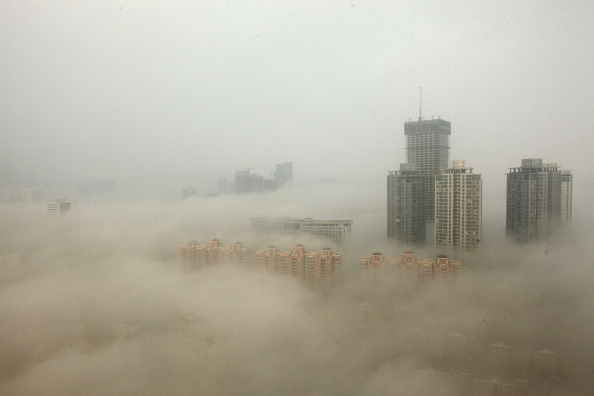
China is globally known for its extreme air pollution levels. Causes include the country’s population, being the biggest in the world, and China’s “economic boom,” being the fastest among major nations in the past few decades. While urbanisation has led to a surge in wealth, it means that the people are deprived of basic health security. Effects include lower birth rates, 411,00 premature deaths, and higher adult mortality from respiratory related diseases; in fact, lung cancer rates have risen by 60% in the past 10 years despite no change in smoking rates.

Action taken:

Over the years, the Chinese government has taken a series of steps to battle air pollution. This includes the ban of new coal-fired power plants and the closing down of many old ones, as chemicals released like sulphur dioxide account for 33% of China’s total national emissions. Iron and steel production have been limited and many coal mines have been shut, meaning the government favoured health over the economy in this situation. Moreover, large cities like Shanghai and Shenzhen have limited the number of vehicles on the road and introduced electric buses. According to earth.org, the country planted more than 35 billion trees and with investments of an estimated $100 billion in such programmes, “China’s forestry expenditure per hectare exceeded that of the US and Europe and became three times higher than the global average.” 

Furthermore, two major action plans have been established. The first was in 2013, helping cities to make improvements in air quality; by 2017, levels of atmospheric particulate matter (PM2.5) dropped by 33% in Beijing. While this is a great change, cities failed in meeting WHO’s recommended PM2.5 levels; this resulted in a new, three-year, action plan, applying to the entire nation this time. Because of such steps taken for public safety, research suggests “the average citizen can now expect to live 2.4 years longer on average if the declines in air pollution persist.” 

Links:

Chiellini claims he ‘cursed’ Saka before decisive penalty miss

Italy star Giorgio Chiellini has claimed that he put a “curse” on Bukayo Saka before the England teenager’s decisive penalty miss in Sunday’s Euro 2020 final. 

Saka saw his spot kick saved by Gianluigi Donnarumma, handing Italy the European title after the two teams drew 1-1 over 120 minutes. 

Just before Saka took the kick, Chiellini screamed “Kiricocho!” – a word that’s been used by footballers for decades to impart bad luck on the opposition.