

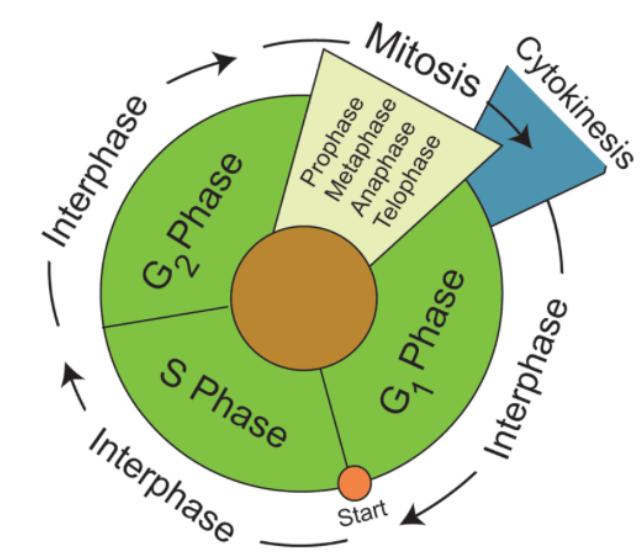
Growth and reproduction are characteristics of cells and of all living organisms. All cells reproduce by dividing into two, with each parental cell giving rise to two daughter cells each time they divide. These newly formed daughter cells can themselves grow and divide, giving rise to a new cell population that is formed by the growth and division of a single parental cell and its progeny.
Cell division is very important process in all living organisms. The cell cycle is a process a cell will go through to replicate all of its material and divide itself from one cell into two identical cells. During the division of a cell, DNA replication and cell growth also take place. All these processes, i.e., cell division, DNA replication, and cell growth have to take place in a coordinated way to ensure correct division and formation of progeny cells containing intact genomes. The sequence of events by which a cell duplicates its genome, synthesises the other constituents of the cell and eventually divides into two daughter cells is termed cell cycle. Although cell growth in terms of cytoplasmic increase is a continuous process, DNA synthesis occurs only during one specific stage in the cell cycle. The replicated chromosomes (DNA) are then distributed to daughter nuclei by a complex series of events during cell division. These events are themselves under genetic control.
PHASES OF CELL CYCLE
To divide, a cell must complete several important tasks it must grow, copy its genetic material (DNA), and physically split into two daughter cells. Cells perform these tasks in an organized, predictable series of steps that make up the cell cycle. The cell cycle is a cycle, rather than a linear pathway, because at the end of each go-round, the two daughter cells can start the exact same process over again from the beginning. These cells divide in approximately every 24 hours and mostly the duration of cell cycle can vary from organism and also from cell type to cell type.
In eukaryotic cells or cells with nucleus, the stages of the cell cycle and divided into two major phases:
INTERPHASE
Interphase is a series of changes that takes place in a newly formed cell and its nucleus before it becomes capable of division again. It is also called preparatory phase or resting phase. It is the time during which the cell is preparing for division by undergoing both cell growth and DNA replication in an orderly manner. Typically interphase lasts for at least 91% of the total time required for the cell cycle.
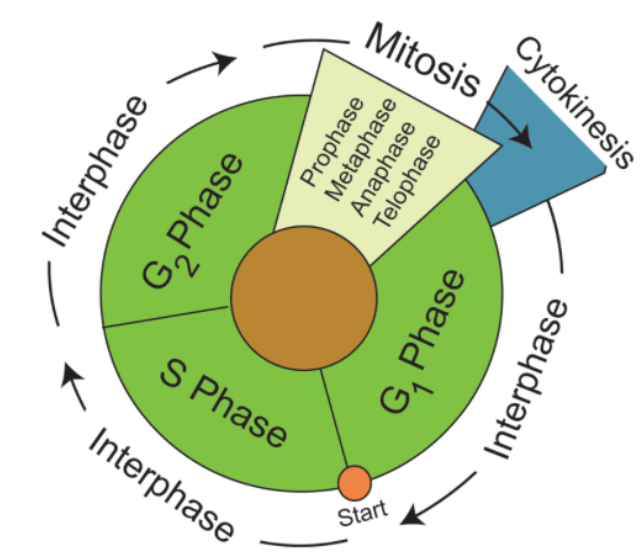
Interphase proceeds in three stages, G1, S, and G2, followed by the cycle of mitosis and cytokinesis.
G1 PHASE
The first phase of the interphase is called the G1 phase or the Gap 1 phase. Also called as growth phase. The duration of G1 is highly variable, even among different cells of the same species. In this phase, the cell increases its supply of proteins, increases the number of organelles (such as mitochondria, ribosomes), and grows in size. The cells are metabolically ac/ve and con/nuously grows but does not replicate its DNA. The cells needs to con/nue cell cycle and enter S phase which is the step or the next phase of the interphase.
S PHASE
S phase or the synthesis phase marks the period during which DNA synthesis or the replication takes place. During this time the amount of DNA per cell doubles. It also duplicates a centrosome. The centrosome helps separate the DNA during Phase. However, there is no increase in the chromosome number. If the cell had diploid or 2n number of chromosomes at G1, even aTer Phase the number of chromosomes remains the same. Rates of RNA transcription and protein synthesis are very low during this phase.
G2 PHASE
It occurs after the DNA replication and is the period of protein synthesis and rapid cell growth to prepare the cell fo mitosis called as the second gap phase. During this phase the cell grows more, makes proteins and organelles and begins to recognise its contents in preparation for mitosis.
The G1, S and G2 phases together are known as the interphase. Here the the prefix inter means between, reflecting that interphase takes place between one mitotic phase or the M Phase and next.
QUIESCENT STAGE (G0)
Some cells in the adult animals do not appear to exhibit division (e.g., heart cells) and many other cells divide only occasionally, as needed to replace cells that have been lost because of injury or cell death. These cells that do not divide further exit G1 phase to enter an inactive stage called quiescent stage (G0) of the cell cycle. Cells in this stage remain metabolically active but no longer proliferate unless called on to do so depending on the requirement of the organism.
M PHASE
This is the most important and dramatic period of the cell cycle involving a major reorganisation of virtually all components of the cell cycle. And since the number of chromosomes in the parent and progeny cells is the same, it is also called as equational division. This has mainly consists of nuclear division in various stages (karyokinesis). This phase is complex and highly regulated and sequence of events are divided into phases. Karyokinesis involves following stages:
- PROPHASE
- METAPHASE
- ANAPHASE
- TELOPHASE
- CYTOKINESIS

 Eduindex
One thought on “Introduction to ‘Interphase’ in Mitosis”
Comments are closed.