THE JOURNEY OF PURI TOWARDS FIRST CITY TO PROVIDE 24 X 7 CLEAN WATER

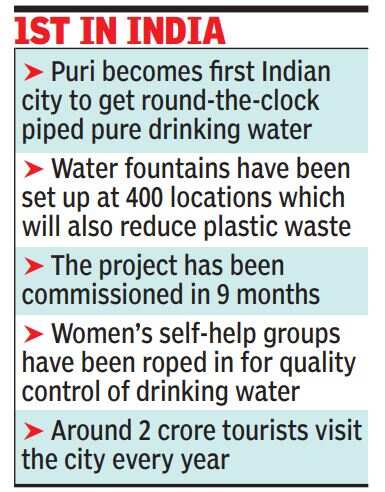
Puri is one of the major heritage cities of the country and every year more than 2 crore tourists visit every year. And this month the city earned an unique distinction of becoming the first Indian city to provide 24X7 pure drinking water. This is the landmark achievement for the city and state and is one of the major contributors for enhancing the status of sanitation and hygiene in Puri, Odisha. The city has become the first city to offer safe drinking water directly from taps to the residents and the tourists visiting the city every year and now has joined the group of global metropolitans like London and New York for providing safe drinking water.

The government launches “Sujal: Drink from Tap Mission” which has the goal of providing all time safe drinking water to all the residents and people visiting the cities directly through taps. The city has fulfilled and achieved the credentials of the ambitious mission and has achieved the goal of the mission. The 24 hour drink from tap facility provides water which can be used directly without filtration for different purposes such as drinking, cooking etc. This move is beneficial for the 2.5 lakh people residing in the city and the 2 crore tourists visiting the city every year. And the people don’t need to carry water bottles with them and can directly rely on the taps. This type of facility is present in very limited number of cities globally and Puri has established its place. Furthermore, the state government had installed 400 water fountains in different locations of the city with the aim of reducing the reliance and usage of plastic bottles in Puri. This will eventually reduce the amount of plastic wastes being can be reduced.

The government uses 5T initiative for increasing the efficiency and effectivity of the services being delivered across the city. The Chief Minister of the state emphasized on the linkage between safe drinking water with health, living standards and the economy, thereby, urging the people not to waste or pollute water. Transparency, teamwork, technology, time-frame and transformation form the 5Ts which has been adopted by the government for improving its governance. The budget for drinking water has been doubled in 5 years from Rs 200 crore to Rs 4000 crore thereby making the city the first heritage town in the country to get this facility. It is expected that the initiative will have great contribution in reducing the amount of plastic wastes generated. It is estimated that the amount of plastic waste being generated by the city will reduce by 400 tonne per annum. 1100 Stand posts were already present in the city and the state government has established additional 110 modern public stand posts along the Grand Road (Badadanda) and nine by the sea beach area have been installed. Old stand posts are being replaced with steel pipes and taps and at present 36 MLD clean water is being supplied everyday in the city. About 135 – 140 liters of drinking water per head per day is being provided to the residents everyday.

Digital literacy in India

Abstract 

Digital literacy is for a developing country like India. Digital literacy brings independence of easy accessibility of the internet among the people of urban as well as rural areas. The article discusses the need for digital literacy.

Keywords: digital literacy, need of digital literacy.

Introduction 

During the COVID-19 we all completely depended on the internet. Due to the safety of the people, the governments of different nations opposed the lockdown. Knowledge of the web world became a boon for an individual during this tough time. But we are also facing the challenges of accessibility of the internet. People are not aware or lack knowledge about using the internet. In India 26.8% of the population is not literate and they are suffering a lot due to lack of knowledge of the internet (census of 2011). Digital literacy is easy and helps every person. We all have smart phones and they consist of all the applications and are illiterate, literate and well qualified. Now we need to focus on how we can uplift digital literacy in rural as well as urban areas. 

Digital literacy:

As the word literacy implies, it involves some kind of basic knowledge or the ability to use the digital medium. However, digital literacy encompasses more than just knowledge of how to use the internet.

The ability of accessing the internet and using different applications to communicate, evaluate, create, share and deal with the information. It is not only about having knowledge about application and also the method of dealing technology with ethics.

The American Library Association’s digital-literacy task force offers this definition: “Digital literacy is the ability to use information and communication technologies to find, evaluate, create, and communicate information, requiring both cognitive and technical skills.

In India, across over 6,50,000 villages and 2,50,000 panchayats represented by 3 million panchayat members. Approx 40% population is living below poverty line, illiteracy rate is more than 25-30% and digital literacy is almost non-existent among more than 90% of India’s population.

Need of digital literacy

  • To enhance the digital skills: In India, a good number of the population lives in villages and small towns. They have technology but they don’t know how to use that technology for the betterment of their lives. Digital literacy helps to learn the access to technology efficiency.
  • To ensure security from online frauds: Sometimes people are not aware about online frauds. Especially, elderly, women and children are especially easy targets to become prey. Digital literacy helps them to learn to avoid this kind of fraud.
  • To increase the rate of using online banking: India is a developing country. Having knowledge of online banking and transition is important. India launched many applications such as BHIM and UMANG. Digital literacy helps an individual to access these applications and go cashless.
  • Education purpose: Rising invasion of digital media in the society pushes the need for digital literacy among students. So there is a great need for educating the power of the digital medium so students can play a vital role in defining their ability to succeed both in academic and personal life.
  • Digital citizenship: Digital literacy is one component of being a digital citizen – a person who is responsible for how they utilize technology to interact with the world around them.
  • Pedagogy:  It is up to us educators to decipher the best methods for teaching digital literacy and to help the students become fluent in this new type of literacy.

Opportunities of digital literacy 

  • Help in inclusion: Digital literacy helps in inclusion of people of different backgrounds. During COVID-19, the internet helps to reach the help of needy people. Digital literacy inclusive growth by enabling access to education, healthcare and government services to all the citizens of the country. People can get better advice on health services. Those who can’t afford school/ colleges can get a chance at an online education.
  • Less consumption of time: Opening accounts in banks, submitting bills and fees was a time consuming work but after digitalization the things got easier and became less time consuming.
  • It can help small businesses. People can use online tools to expand their business.
  • It can play a key role in GDP growth. According to analysts, digital India could boost GDP up to $1 trillion by 2025. According to a World Bank report a 10% increase in mobile and broadband penetration increases  in capita GDP by 0.81% and 1.31% respectively in developing countries (World bank report 2017).
  • Once the change is brought it could change the Indian education system, with all the Gram Panchayats having access to the internet will provide access to different teaching aids and materials and empower everyone and increase the literacy levels in the country.

Challenges of digital literacy

  •  Slow internet: The daily internet speed, as well as Wi-Fi hotspots, is slow as compared to other developed nations. In India the connectivity of the internet is not reachable in some places due to geographical background. 
  • Hurdle of small and medium scale industry: Most of the small and medium scale industry has to struggle a lot for adapting to the new modern technology. They are not aware about the terms and conditions of the online business or they don’t want to switch their method of trading.
  • Limited capability of entry-level smartphones for smooth internet access.
  • Unskilled labours: In India there is a lack of skilled manpower in the field of digital technology. They don’t know how to run applications and use them for their betterment.
  • Awareness about digital crime: To look for about one million cybersecurity experts to check and monitor the growing menace of digital crime.
  • Lack of user education: Users are not aware how to use technology or they are limited to Facebook and What-app. There is a need for digital literacy. It helps them to take the first step towards using technology.

Government initiatives:

  • National digital literacy mission: It was launched in 2012 by the Indian government to uplift the digital skills in rural India as well as urban areas. It is also known as the digital saksharta Abhiyan
Our Services – Reynard
  • Digital India was launched by the Prime Minister of India Narendra Modi on 1 July 2015, with an objective of connecting rural areas with high-speed Internet networks and improving digital literacy.
  • NASSCOM is working with SAP India to set up 25 new centres across the country to add to the 75 that already exist. These are the main vehicles of implementation of NDLM.

Conclusion:

Digital literacy is important for India because India is a developing country and we need to focus on sustainable development. According to a survey there is 90% digital literacy in India which is more than actual literacy that shows people are more aware about the web world. The need for digital literacy is really important. There are many challenges and opportunities. NDLM,  NASSCOM and digital India there are some schemes which help in upliftment of digital literacy. 

References 

Manpreet Singh – Flag bearer

Manpreet Singh was selected as the flag bearer of India for Tokyo Olympics 2020 Parade. He is captain of India Men’s National Hockey team since May 2017

Manpreet Singh was born on 26 June 1992 in Mithapur, Jalandar city of Punjab, India. In 2011 he played first time for India at the age of 11years. He also represented India at 2012 Summer Olympics and was named Asia’s Junior Player of the year 2014.

He and his team represented India in various sports events and gave new heights to India Hockey Team. They won 1 gold and 1 silver medal in 2014 Incheon Asian Games and 2018 Jakarta Asian Games. In 2017 Asia Cup they won 1 gold. They also secured 2 medals at Championship Trophy. The list of achievement goes on and on

Manpreet is also a keen listener of music and uses music as a means to relax before his games. He carries his PlayStation with him whenever he travels for matches. He is fan of Salman Khan and enjoys watching movies of sports genre, such as MS Dhone: The untold story, Chak de! India, and Bhaag Milkha Bhaag. His big dream is to “win big for India” and biggest goal is to inspire youngsters to play a sport, any sport.

Swachh Bharat Abhiyan

Swachh Bharat Mission (SBM), Swachh Bharat Abhiyan, or Clean India Mission is a nation wide mission started by the Government of India in 2014 to dispense with open crap and work on strong waste administration. It is a rebuilt form of the Nirmal Bharat Abhiyan dispatched in 2009 that neglected to accomplish its expected targets. Phase 1 of the Swachh Bharat mission kept going till October 2019. Stage 2 will be executed between 2020–21 and 2024-25.

Started by the Government of India, the mission meant to accomplish an “open-crap free” (ODF) India by 2 October 2019, the 150th commemoration of the introduction of Mahatma Gandhi. The destinations of the main period of the mission additionally included destruction of manual searching, producing mindfulness and achieving a conduct change with respect to sterilization practices, and expansion of limit at the neighborhood level. The second period of the mission plans to support the open crap free status and work on the administration of strong and fluid waste. The mission is pointed toward advancing towards target 6.2 of the Sustainable Development Goals Number 6 set up by the United Nations in 2015.

The mission’s true name is in Hindi. In English, it means “Clean India Mission”. The mission was authoritatively dispatched on 2 October 2014 at Rajghat, New Delhi by Prime Minister Narendra Modi. It is India’s biggest tidiness drive to date with 3,000,000 government representatives and understudies from all pieces of India taking an interest in 4,043 urban areas, towns, and provincial networks. At a convention in Champaran, the Prime priest called the mission Satyagrah se Swachhagrah concerning Gandhi’s Champaran Satyagraha dispatched on 10 April 1916.

The mission was parted into two: country and metropolitan. In country regions “SBM – Gramin” was financed and observed through the Ministry of Drinking Water and Sanitation; while “SBM – metropolitan” was managed by the Ministry of Housing and Urban Affairs.

As a feature of the mission, volunteers, known as Swachhagrahis, or “Ministers of tidiness”, advanced indoor pipes and local area ways to deal with disinfection (CAS) at the town level. Other exercises included public ongoing checking and updates from non-legislative associations like The Ugly Indian, Waste Warriors, and Swach Pune (Solid Waste Collection and Handling).

The public authority gave endowment to development of almost 110 million latrines somewhere in the range of 2014 and 2019, albeit a few Indians particularly in provincial regions decide to not utilize them. The mission was condemned for utilizing coercive ways to deal with power individuals to utilize latrines.

Delhi Pollution and Measures to Control

“Delhi, not surprisingly, is inundated into brown haze with beginning of winter. The Delhi Government promptly began faulting different states for air contamination in Delhi. The Central Government was at that point not in accordance with ranchers’ advantage, given another law on 29th October, 2020, expressing ranchers are liable for Delhi’s brown haze.” Said Dr Gurinder Kaur in an online class coordinated by Center for Environment, Sustainable Development and Climate Change, Impact and Policy Research Institute (IMPRI) and India Water Portal on Delhi’s Air Pollution and its Solution.

Consistently in the start of winter, Delhi, yet entire of the Northern India is encompassed in ‘Brown haze’. ‘Brown haze’ is a blend of ‘Mist’ and ‘Smoke’. Haze is a characteristic marvel during winters, and it vanishes before long dawn. Brown haze is shaped when the air is defiled with enormous measure of poisons and it gets thicker after dawn. In 1990-2000, when air in Delhi was intensely dirtied, the then Central Government was unprejudiced, saved Delhi’s air from being contaminated by diesel-driven engine vehicles by utilizing CNG instead of diesel.

From last decade air contamination has been causing destruction in Delhi and the Nation Capital Region. Dr Kaur said, “the genuine explanation of expanding air contamination in Delhi is its expanding number of vehicles, enterprises, fast expansion in development exercises, nuclear energy stations, bricklins, copying of landfills, aimless cutting of trees and air flights.”

She proved this with statistical data points which says in the new years, the quantity of vehicles expanded from 24 lakh (2000) to 1 crore(2018), delivering carbon dioxide (CO2), carbon monoxide (CO), Sulfur dioxide, ozone and different gases which dirty Delhi’s current circumstance. As per the Meteorological Department of Delhi and the Center for Science and Environment in 2012, 70 percent of air contamination in Delhi is brought about by vehicles as it were. An exploration by IIT Kanpur featured modern units discharge 98% of Nitrogen oxide, 60% of sulfur dioxide, 14% of PM I0 and 10 percent of PM 2.5.

Almost certainly consuming of paddy and wheat buildups contaminate the air, however it just goes on for 20-25 days in a year contributes just 4-6 percent in the generally existing contamination. Moreover, paddy was not the yield of Punjab and Haryana it was forced on these states for meeting the prerequisites of the focal pool of food grains through positive MSP and guaranteed obtainment.

Paddy estate season in Punjab was pushed from May to June to correspond with India’s storms. This has abbreviated the time between reaping of paddy and planting of wheat. Ranchers are compelled to consume paddy and wheat buildups because of their financial difficulty. APAU, Ludhiana research featured that in 2017, 2018 and 2019, wind speed was under five kilometers each hour which couldn’t have floated restricted brown haze from Punjab to Delhi and the National Capital Region.

Neither the Central Government nor the State Government discredits that these inside exercises of Delhi are answerable for contamination in Delhi in light of the fact that during the COVID-19 lockdown, the skies had cleared up. Simultaneously ranchers of Punjab, Haryana and Uttar Pradesh were reaping wheat yield and consuming wheat straws.

The Central Government ought not keep public and global reports from getting air contamination or discover a substitute to put it on rather ought to have a strong system to alleviate the current issues and tackle future dangers identified with air contamination. Air contamination is on ascent not just in Delhi and the National Capital Region yet in addition in different conditions of the country.

As indicated by a report of Greenpeace Organization, India, delivered on 21st January, 2020, 80 percent urban communities have contaminated air as per public air quality norm. In this way, both the Delhi and Central Governments should take drives as they did in 2000 to moderate the grave issue of air contamination yet not rebuff the helpless ranchers. The Central Government as opposed to rebuffing ranchers should co-work with them, understanding their issues, give accommodating arrangements and connected at the hip save the country’s air from getting dirtied.

It is basic for the public authority to find ways to control air contamination else our future looks bleak if genuine measures are not taken. The Indian Government needs to smooth out open vehicle administrations to diminish utilization of private vehicles. Person on foot walkway and bike paths ought to be developed on the streets. Sanitization gadgets ought to be introduced in modern units with the goal that the dangerous gases transmitted from the ventures don’t jeopardize the wellbeing of individuals.

Supplant diesel motors with energy from regular sources. Contamination from soil, sand and rock and so on during development work ought to be decreased. Air terminals both homegrown and worldwide ought to be worked with in each state to appropriate air traffic all the more consistently across the states which will assist with decreasing outrageous development of air contamination in Delhi. Drives, for example, National Clean Air program ought to be executed. Suitable fines on any contaminating modern units, vehicles, development unit ought to be forced.

Rather than playing attempt at finger pointing we should find prompt ways to guarantee that our postponements don’t lead guiltless individuals succumbed of air contamination. Other than the focal government, it is the obligation, everything being equal, to keep their environmental factors clean and secure our current circumstance.

Land and Property Conflicts in India

An expected 7.7 million individuals in India are influenced by struggle over 2.5 million hectares of land, compromising speculations worth $ 200 billion. Land questions obstruct all degrees of courts in India, and record for the biggest arrangement of cases as far as both supreme numbers and legal pendency. About 25% of all cases chose by the Supreme Court include land questions, of which 30% concern debates identifying with land procurement. Again,66% of all affable cases in India are identified with land/property questions. The normal pendency of a land securing debate, from formation of the question to goal by the Supreme Court, is 20 years. Since land is key to India’s formative direction, discovering an answer for land struggle is one of the chief arrangement challenges for India. Authoritative and regulatory elements are liable for the high rate of legitimate and particular struggles over land, and legal components are behind the pendency of land questions. Contending verifiable and current arrangement stories of property rights over land, have brought about the concurrence of various, clashing laws driving to legitimate arguments about land. This is the authoritative factor. This issue is compounded by regulatory inability to follow law and order. This is the authoritative factor. The pendency of contention, thusly, is an aftereffect of legitimate and evidentiary boundaries in bringing land debates to court, generally due to authoritative and legal insufficiency; this forestalls quick goal of land questions.

Where laws are clear, questions and clashes emerge in view of authoritative rebelliousness with law and order because of both reluctance and insufficiency. The LRI investigation of all Supreme Court cases ashore securing during 1950-2016 shows that 95% of the debates emerged due to authoritative resistance with the lawful system for obtaining of land, including the cycle of calculation of market esteem pay for land acquired.19 Around 34% of the debates included abnormalities in fulfillment of the system for obtaining. Practically 50% of such cases worried about procedural anomalies included managerial e reluctance to conform to law and order. The leftover portion of the cases included regulatory inadequacy to agree with law and order, to some degree as a result of legislative inability to routinely refresh authoritative manuals dependent on changes in the law. Additionally, the public authority was bound to lose than win these land debates under the steady gaze of the Supreme Court.

Furthermore, since pilgrim times, land in India has been extensively controlled by the income and backwoods offices. In any case, there have additionally consistently existed questions between the two offices with regards to which land has a place with which division. This thus makes and draws out land debates.

At last, lawful disagreements about land are additionally made by evidentiary hindrances for building up rights over land without narrative proof21 on account of obsolete/no land surveys22 and erroneous/obsolete land records23 in many states. The Department of Land Resources has tried to determine the issue of wrong land records through the ‘Digitisation of Land Records Modernisation Program’. Nonetheless, except if the public authority makes a genuine endeavor to refresh land records on the ground to mirror the property privileges, all things considered, digitizing them would not kill the issue of wrong land records.

Land struggle in India, both legitimate and particular, has existed from pilgrim times in light of the inconvenience by the British condition of the thought that all land not secretly held has a place with the ‘state’. This idea has been consistently opposed by ‘individuals’ who were debilitated by the provincial state’s hardship of their lawful property rights under precolonial organization. Over the long run, contending ‘state’ and ‘individuals’ accounts over land have prompted clashing strategy and lawful mediations. This has, thusly, prompted lawful disagreements regarding land. In any event, when laws are clear, authoritative inability to conform to law and order, because of reluctance and inadequacy, adds to the rate and pendency of land questions. Genuine legal inadequacy thusly delays pendency of land questions. Because of the pressing area, and the comparing interest for land to fuel the improvement motor, the scale and extent of land struggle today has expected massive extents, slowing down advancement projects and compromising jobs and speculations. Fair and effective intergenerational the board of land is fundamental for India’s monetary turn of events, yet additionally for its political and social security. Subsequently, pursuing settling land struggle, considering the above strategy proposals, is a basic plan for the new government.

EDUCATION SYSTEM IN INDIA

The current literacy rate of India is 64.8% in which state of Kerala has highest i.e 96.2% and least is of state of Bihar i.e 46.2%. In the ancient times education was not given much importance as feeding the stomach was far more important. At that time, either land owners, King's ministers or Brahmans were the only ones who were educated.
In India, during ancient times, the system of Varna was practiced. Entire society was divided into 4 sections: Brahaman, Kshatriya, Vaishya, Shudra. Brahmans were considered the superior ones, as they were assumed to be intelligent and knowledgeable in the society. Shudras were considered as the lowest of all and were made to feel left out from the society. They and their children weren't allowed to enter the village among other upper sections. Brahaman pandits used to teach only to the prince.
Later when the Varna system was abolished, due to poverty, people were unable to give education to their children. Only rich landlords and farmers could afford education for their children.
As time passed, India got independence from Britishers, and the government of independent India started to focus and upgrade the education system of India. It tried to uplift the literacy rate of India. As India was newly independent and lakhs of people were killed at the time of Partition, people were starving for food. The focal point of the government was to remove poverty and increase the production of grains in the country. Until the 4th five-year plan (1969-1974), improving education facilities was the second priority of the government.
Later after the emergency, in 1975, the education system began to improve. Government schools were built so that poor people could send their children to school with no fees. All sections of people could get education. Most of the people were from agriculture background and used to work in farming. In order to earn more income they wanted every member of the family to engage in work. And so they avoided sending their kids to school.
Decades passed and after 1990 the system of education improved, areas of study improved, standards of universities and schools improved, living standards of families improved. People started to afford education for their children in private schools. However, there are many children who are unable to go to school, especially girls despite a fundamental right mentioned in the Article 21 of Indian Constitution i.e right to education.
As people started to go to school and colleges, a time has come when people don’t go to school for knowledge. They want qualification certificate and a degree which gives them a sign of being literate
When the education system was built it revolved around exams. Pass or fail. I doesn't matter how a child passed, what amount of knowledge he gained? Did he explore anything on his own? Did he learn something to bring change in society as well as within himself? Only the bundles of sheets of homeworks were increased, and personality was still down. No doubt co-curricular activities are practised in Indian schools for personality development, but somewhere they are unsuccessful to find hidden talents of a child as they lack opportunities in many fields.
Whatever you teach a child from the beginning, he adapts it for his entire life. In childhood, from kindergarten, you start testing them, giving them grades and numbers and promoting them to the next class. From here the child starts thinking that he has to get good marks, so that he can be promoted to the next class. He can get that certificate of promotion. This is what every second student here does. They focus on numbers. It's not necessary that you are not a merit student so you have less knowledge. Sometimes low grade students turn out to be geniuses. As a single sheet of paper cannot decide your future and cannot declare your personality.
Along with this mentality of students, teachers who get job of teaching not only in government school, colleges and universities but also in government also have the mentality that no matter what you have taught to your children, doesn't matter even if you have taught or not, you just have to give them a number and grade because this reduces their burden as well this satisfies the student. Core knowledge, personality and perfection are not a priority here.
Now the problem arises when no proper input is given inside the brain of a student, but output is expected and the level of examination conducted is of a genius level.
Secondly corruption in India is practiced at its peak. Everyone wants a government job and hence bribes and political power are used for recruiting ineligible candidates due to which deserving ones who can manage well, who can think well, who can administer well fall behind.
Of course it's not true that each and every college adopts the same system. The nation is developing because many intelligent and deserving candidates are working in the fields of IT and space, but the sad thing is that at most of the places in India this type of wrong teaching and learning techniques are prevalent.
Earlier people were not aware of all the jobs and various examinations to qualify for those jobs. Also not everyone completed an undergraduate level degree and hence competition for jobs was least. But since awareness increased, facilities increased, technology increased the level of competition for jobs has raised to its peak.
In India if something has been amended it takes decades for its implementation. Let's say the NEW EDUCATION POLICY declared by the Modi government last year. It's hard to say when it's going to be implemented in the nation. That's a great challenge.
Another important thing which is lacking in the Indian education system is that children cannot decide their career on their own. They don't know what they have to do and what is their goal. Even if they set a goal here, they aren't dedicated towards it and keep on wasting years and years upon it and contribute to the increasing unemployment faced by the country.
In India, parents decide what their child is going to be, which subject he is going to choose, what degree he is going to pursue, what job he will do, which exam he will take and till when he will study. Independence of taking career decisions is not given here to the children and somewhere the child himself is responsible for their failure in career. Not earning a single penny and giving time to useless education is such nonsense.
No doubt that India is developing in every field. It's going ahead. It has given so much to the world. It has given birth to many geniuses and still it gives. It's also not necessary that every single child becomes a successful person of the nation, but India has a bad record on overall average. Literacy level and employment level needs to be increased, because the country is built by the members of the nation. Good level of employment leads to development of the nation and true knowledge leads to self development which is the most important thing in human life.


Cancer

Cancer is one of the most haunting diseases, squandering lives since ages. It occurs due to abnormal cell growth due to genetic mutations from environmental and lifestyle factors. Major of these factors are smoking, obesity, infections. There are also some certain chemicals known as carcinogens. Tobacco smoke causes almost 90% of the lung cancer. Physical inactivity and obesity also causes about 30-35% of cancer deaths.Not only cancer physical inactivity also hampers endocrine and immune system.

There are various types of cancer:

LEAUKEMIA : Commonly known as blood cancer,leukaemia affects the tissues of the bone marrow which is responsible for blood production. It is caused by abnormal production of white blood cells.

Myeloma: It targets plasma cells of our immune system. These cells divide in the bone marrow causing multiple tumours in the bones 

LYMPHOMA: It affects the lymphocytes in the lymph nodes, which are a part of the immune system.

CNS CANCER: CNS (Central Nervous System) cancers originate from the brain and the spinal cord. Gliomas, vestibular schwannomas, meningiomas, primary CNS lymphomas, pituitary adenomas are few CNS cancers.

Melanoma: It is a form of skin cancer that targets melanin – the pigment responsible for skin colour. In this form of cancer, the melanocytes are affected resulting in the abnormal formation of melanin. It may also affect other tissues that are pigmented, such as the eyes.

Symptoms

There are various symptoms through which cancer can be detected such as irregular loss weight, fatigue, continuous pain, fever or any irregular changes in skin.

Causes

Cancer can be caused by innumerous factors such as genetical factors, tobacco, alcohol, obesity, unhealthy environment, exposure to unnatural radiations etc.

Treatment

With the advancement of science many cures have been found for the treatment of cancer. The process of treatment depends on the type and stages of cancer. Some of the common treatment includes surgery, chemotherapy, hormonal therapy, immunotherapy, and radiation therapy.

Cancer

Cancer is one of the most haunting diseases, squandering lives since ages. It occurs due to abnormal cell growth due to genetic mutations from environmental and lifestyle factors. Major of these factors are smoking, obesity, infections. There are also some certain chemicals known as carcinogens. Tobacco smoke causes almost 90% of the lung cancer. Physical inactivity and obesity also causes about 30-35% of cancer deaths.Not only cancer physical inactivity also hampers endocrine and immune system.

There are various types of cancer:

LEAUKEMIA : Commonly known as blood cancer,leukaemia affects the tissues of the bone marrow which is responsible for blood production. It is caused by abnormal production of white blood cells.

Myeloma: It targets plasma cells of our immune system. These cells divide in the bone marrow causing multiple tumours in the bones 

LYMPHOMA: It affects the lymphocytes in the lymph nodes, which are a part of the immune system.

CNS CANCER: CNS (Central Nervous System) cancers originate from the brain and the spinal cord. Gliomas, vestibular schwannomas, meningiomas, primary CNS lymphomas, pituitary adenomas are few CNS cancers.

Melanoma: It is a form of skin cancer that targets melanin – the pigment responsible for skin colour. In this form of cancer, the melanocytes are affected resulting in the abnormal formation of melanin. It may also affect other tissues that are pigmented, such as the eyes.

Symptoms

There are various symptoms through which cancer can be detected such as irregular loss weight, fatigue, continuous pain, fever or any irregular changes in skin.

Causes

Cancer can be caused by innumerous factors such as genetical factors, tobacco, alcohol, obesity, unhealthy environment, exposure to unnatural radiations etc.

Treatment

With the advancement of science many cures have been found for the treatment of cancer. The process of treatment depends on the type and stages of cancer. Some of the common treatment includes surgery, chemotherapy, hormonal therapy, immunotherapy, and radiation therapy.

Impact of Covid on Education

The world is confronting an emergency today because of the Coronavirus Covid 19 pandemic. Practically all countries have been influenced because of the immediate and the aberrant impacts of the infection and lives of millions of individuals have been changed, by and large hopelessly. The pandemic an affects the training area, as the essential moving supply of this area – the understudy being compelled to stay in their homes to save the danger of conceivable contamination and demise because of the infection, if the schools and universities were to run during the pandemic. This has caused practically all schools and universities to connect with the online course for running the day’s booked classes by means of webcams and cell phones. A further improvement has occurred in the expanding fame of pre-recorded
or then again on-request access online courses made accessible by stages like Coursera, Unacademy and Udemy.

The production of another online course for conveyance obviously content will turn out to be more conspicuous in the post Covid world as the overcomers of the pandemic and the ones who have suffered through the lock down may not be as sure as they were, in the pre Covid world about sending their youngsters and wards to schools and universities, what’s more, along these lines might persuade the schools and universities to offer online based courses to oblige their requirements. This will make another worldview for educators and teachers as they should adjust to this changed circumstance to be more compatible while conveying their talks and course content through the online course.

To comprehend the Impact of Covid19 on the training area of India and the difficulties and openings that can be acquired from it a pursuit of writing was led to discover helpful data, relating to the paper. The web was utilized for obtaining valuable examination papers, having an association with the targets of this paper, as getting to online information bases kept in the organization was delivered inconceivable due to conclusion of the foundation because of the lock down. The web (and Google Scholar) was utilized as an asset for
gaining research papers having an association with the destinations of this paper. Search catchphrases utilized for this design were – Covid 19 pandemic, Corona infection, Wuhan Coronavirus, Effect of the pandemic on understudies,
educators and foundations, Effect of the pandemic on instructive approach choices by the Government, Challenges what’s more, openings introduced by Covid 19, e-learning, web based learning and distance learning answers for conveyance of training, potential troubles in conveying instructive substance by the instructor, potential hardships in getting and understanding the instructive substance conveyed by the educator, potential challenges in directing tests through online course in a legitimate and reasonable manner during the pandemic, an examination between the School terminations requested during isolate brought about by the Spanish Flu of 1919 and the current terminations because of Covid 19 thus
on.
One of the issues that were found with the presentation of e-learning items and framework was innovative issues identifying with the items. Different items have their own advantages/disadvantages, making the
decision of an items which fulfills all gatherings a troublesome one. For instance ‘Chalkboard’ a well known e-learning item is restricted to its current circumstance. At the end of the day, it is limited to conversations, refreshes, data refreshes,
sees and different messages from a solitary merchant just and limits understudy commitment because of its one of a kind highlights, restricting the scholastic staff and the understudies to the boundaries of the climate. Numerous different items
have these sort of difficulties identified with producer arrangements and other comparable innovative issues. This is a significant test in the selection and the notoriety of e-learning items.
Being that e-learning items are fundamentally not the same as conventional strategies for schooling, there will be a need for earlier guidance for the understudies and instructors who will utilize the items. It is significant for the instructor to acquaint oneself with the item so he can help his understudies in understanding the item completely, with the goal that they can gain the most from it. This information can’t be penetrated into everybody effectively as it includes diverse subjective perspectives exceptional to the individual, which need the educational disbursal for utilizing the item to be done in manners that consider the distinctions intrinsic in the individual so he will actually want to see how to utilize the item and how to show the item, subsequently acquiring the most extreme profit with it.
An educator who comprehends the item in an excellent manner will actually want to proceed as an ‘one stop fellow’ for his understudies as he will be the one, the understudies go to, for settling their questions, questions and inquiries about the item.

Impact of Social Media on Teenagers

Like innovation by and large, web-based media has both a potential gain and a disadvantage. Furthermore, with regards to the web-based media consequences for teenagers, those advantages and disadvantages are especially huge.

On the in addition to side, stages like TikTok, Twitter, Instagram, and Snapchat can be lifelines for teenagers who feel confined or minimized, especially LGBTQ youngsters. Furthermore, online media assisted youngsters with feeling more associated and not as forlorn during the pandemic.

Be that as it may, the effect of online media on youth can likewise be altogether unfavorable to emotional wellness. Specifically, web-based media and high schooler misery are firmly connected. Besides, abuse of the applications opens teenagers to cyberbullying, self-perception issues, and tech enslavement, and results in less time spent doing sound, certifiable exercises. And keeping in mind that most of guardians accept they know what their youngster is posting via web-based media, as indicated by a Pew Research survey, a review of adolescents tracked down that 70% of them are concealing their online conduct from their parents.Are teenagers and web-based media a decent blend, or does web-based media use lower high schooler prosperity? This has gotten one of the more dubious inquiries in regards to web-based media’s impacts on youngsters, with examines showing shifted results, remembering ongoing exploration for the utilization of online media during the pandemic.

As per a report delivered in 2021 by Common Sense Media via online media’s impacts on teenagers, about portion of the 1,500 youngsters studied said web-based media is vital for them to get backing and counsel, feel less alone, and articulate their thoughts innovatively, just as for keeping in contact loved ones while social removing. Also, 43% said that utilizing online media helps them to have an improved outlook when they are discouraged, focused, or restless. Among LGBTQ youth, 52% said online media assists them with feeling better when they are encountering these troublesome feelings. Youth with moderate to extreme burdensome side effects were almost twice as prone to say they utilized online media continually: 33% of teenagers with sadness revealed steady web-based media use, when contrasted with 18% of adolescents who didn’t have burdensome manifestations. Moreover, the more serious their manifestations were, the more restless, forlorn and discouraged they felt subsequent to utilizing online media. Obviously, web-based media doesn’t help teenagers who are as of now feeling discouraged, and appears to add to their negative outlook.Is web-based media part of the explanation that youngster melancholy has definitely expanded throughout the last decade? Studies of US young people show that youngster burdensome side effects and self destruction rates showed stamped increments somewhere in the range of 2010 and 2015, particularly among females. A few specialists conjecture that the expansion in online media and generally speaking screen use between those years could represent these changes. The young people reviewed who invested more energy in online media were bound to report emotional well-being issues. The individuals who invested more energy in turned off exercises, for example, in-person friendly cooperation, sports, exercise, schoolwork, and print media, were more averse to report these issues.

In the course of the last decade, this hypothesis has been borne out by an enormous group of examination connecting teens’ utilization of online media with expanded teenager melancholy. These examinations show that the recurrence of an adolescent’s utilization of online media has a reasonable relationship to their psychological well-being. For instance, in a recent report, 14-to 17-year-olds who utilized online media seven hours out of each day were more than twice as prone to have been determined to have discouragement, treated by an emotional wellness proficient, or taken medicine for a mental or conduct issue during the last year. This was contrasted with the individuals who utilized screens just about an hour daily.

Numerous specialists accept that the consistent overstimulation of long range informal communication moves the sensory system into battle or-flight mode. Subsequently, this makes problems like ADHD, high schooler despondency, oppositional disobedient confusion, and teenager tension more terrible. In any case, some examination via online media and adolescent despondency shows that the causality goes the alternate way—i.e., when teenagers are discouraged, they take a gander at web-based media all the more regularly. In one investigation of 600 teenagers, specialists tracked down that online media use didn’t anticipate burdensome manifestations, yet more noteworthy burdensome indications anticipated more web-based media use after some time.

Freedom of Speech

The right to speak freely of discourse is the option to say whatever you like about whatever you like, at whatever point you like, correct? Wrong. The right to speak freely of discourse is the option to look for, get and grant data and thoughts, everything being equal, using any and all means.’
The right to speak freely of discourse and the right to opportunity of articulation applies to thoughts of various sorts including those that might be profoundly hostile. In any case, it accompanies duties and we trust it tends to be genuinely limited.
At the point when the right to speak freely of discourse can be limited You probably won’t anticipate that we should say this, however in specific conditions free discourse and opportunity of articulation can be limited.

Governments have a commitment to preclude disdain discourse and incitement. Furthermore, limitations can likewise be legitimized in the event that they ensure explicit public interest or the rights and notorieties of others.

Any limitations on the right to speak freely of discourse and opportunity of articulation should be set out parents in law that must thus be clear and compact so everybody can get them. Individuals forcing the limitations (regardless of whether they are governments, managers or any other person) should have the option to show the requirement for them, and they should be proportionate. The entirety of this must be upheld by protections to stop the maltreatment of these limitations and consolidate an appropriate offers measure….also, when it can’t

Limitations that don’t follow this load of conditions disregard opportunity of articulation. We consider individuals put in jail exclusively for practicing their right to free discourse to be detainees of soul. Jabbar Savalan was detained subsequent to calling for challenges the government on Facebook. We thought of him as a detainee of still, small voice and lobbied for his delivery. Peruse Jabbar’s story

Governing rules

Any limitation ought to be just about as explicit as could be expected. It is inappropriate to boycott a whole site in view of an issue with one page.

Public safety and public request
These terms should be definitely characterized in law to forestall them being blamed for over the top limitations.

Ethics
This is an extremely abstract region, yet any limitations should not be founded on a solitary custom or religion and should not oppress anybody living in a specific country.

Rights and notorieties of others
Public authorities ought to endure more analysis than private people. So slander laws that stop real analysis of a government or public authority, disregard the right to free discourse.

Impiety
Securing theoretical ideas, strict convictions or different convictions or the sensibilities of individuals that trust them isn’t justification for limiting ability to speak freely.

Media and writers
Writers and bloggers face specific dangers in view of the work they do. Nations thusly have a duty to secure their right to the right to speak freely of discourse. Limitations on Newspapers, TV stations, and so forth can influence everybody’s more right than wrong to opportunity of articulation.

Informants
Government ought to never bring criminal procedures against any individual who uncovers data about denials of basic liberties.

Rights and duties
Free discourse is one of our most significant rights and quite possibly the most misjudged. Utilize your ability to speak freely to stand up for those that are denied theirs. Be that as it may, use it capably: it is something incredible.

Gender Pronouns.

Have you ever come across an Instagram/ social media bio, where the account has either she/her, his/him, they/them or he/she/they written and gotten confused as to why people are writing their pronouns on the Instagram page?

A bio or a social media bio typically means information about the person. 

A pronoun is a term that is used instead of a noun or noun phrase. Pronouns refer to either a noun that has already been mentioned or to a noun that does not need to be named specifically. And the addition of pronouns helps not to misgender a person who isn’t gender conforming. 

Source: www.personneltoday.com

Gender is not what you are assigned at birth, rather what you identify with. It refers to you as an individual psychologically, socially and emotionally. 

Using pronouns in social media bios help people with inclusivity. 

As kids, always in our English grammar class, we are taught to assume the gender of the person based on their physical form. But sometimes this assumption leads to be disrespectful and oppressive to people who don’t go by the pronouns assigned due to their appearance. 

As pronouns are connected to gender identity and a way for people to feel like their own person. Hence it’s important to always ask someone their pronouns and continue to call them by their pronouns even if they are not around.

If you are unsure about someone’s pronouns, all you have to do is ask them. And even if you misgender them, apologise and do not belittle and complain as to why you have to call them by their pronouns. Misgendering more often may lead to depression, anxiety and suicidal tendencies. It invalidates their identity. 

For cisgender people, this may feel like stating the obvious at times. But here’s why it’s crucial: It isn’t appropriate for you. And, rather than dominating the conversation, it’s occasionally necessary to employ cis-privilege in a way that really contributes to equality. So, even if adding pronouns to your “Hello, my name is and these are my pronouns.” routine is a little odd at first, but stick with it. You’ll grow accustomed to it. When persons who are not cisgender use pronouns on a daily basis, they will eventually become less noticeable.

It’s worth mentioning though, that some individuals don’t feel comfortable declaring their gender pronouns publicly, and just because you announce yours it does not entitle you to everyone else’s.

Pronouns Dos and Donts:

Do! 

1) Recognise that even cisgender people have pronouns. 

2) Remember that some people go by more than one set of pronouns. Ask people about the pronouns they use. 

3) Peoples pronouns may change regularly, hence it’s necessary to ask.

4) Consider using ways to make the language more gender-inclusive. 

Don’t!

1) Don’t describe to the pronouns are preferred, as it is not a preference. 

2) Don’t say, male pronouns and female pronouns. Pronouns are not necessarily tied to someone’s gender identity, as pronouns are not necessarily tied to someone’s gender identity.

Its is necessary to not misgender a person and be respectful to their pronoun.

———————–

Reference and source:

1)  https://www.thesmujournal.ca/editor/normalizing-pronouns-why-cis-gendered-folks-should-use-personal-pronouns-too

2)https://in.style.yahoo.com/pronouns-bios-mean-why-sensitive-164629025.html

3) https://www.merriam-webster.com/dictionary/pronounce

SUSTAINABILITY – THE NEED OF THE HOUR

We as Homo sapiens have made quite a lot of evolution over centuries. From learning to stand erect to finding proper methods of growing, cooking and making food into a scrumptious dish from mere kitchen ingredients, learning to communicate, trade, developing intelligence, creating subjects, branches and specializations in learning, making machines which nullify human effort, diversifying living and basic needs into huge businesses, revolutionizing our methods, taking a step ahead to unforeseen intelligence and development with each passing day – there are countless achievements which man as a living being has accomplished, and in so many unimaginable sectors that listing them would be a heck of a job!

But with advancements and products come by-products, most of them unwanted or of negligible use, and these finally end in dumping areas or uninhabited lands, water bodies or space. With an incredible amount of disposable waste produced each day, and with the dumping yards blowing out of proportion with filth, it has become very necessary that we as humans stop as well as reverse the damage we have done to our own abode, because we have come to realize that we ourselves are bound to bear the fruit of our deeds. Researchers have estimated that if we continue creating waste at this rate, we will soon fall out of clean environment and space to live in, and the result of filling the Earth with this ginormous amount of waste will drastically affect us in the process, destroying not just humankind but the whole ecosystem and will severely impact the planet and its precious resources to an irreversible state. So it is time that we step back and ponder on our operating methods, restore back the balance of nature rather than putting a step forward at the expense of deteriorating and exploiting what we have been generously bestowed upon by. Realizing this, the major organizations of the world have taken an initiative to minimise their waste production and make our world a sustainable place.

According to the United Nations World Commission on Environment and Development, ‘Sustainable development is one that meets the needs of the present without compromising the ability of the future generations to meet their own needs.’ This means utilising our resources in a way which ensures enough for our coming generations and also keeping in mind the goal to make the world habitable for them. This also necessarily means that we ought to produce lesser waste and dispose off the existing waste in a proper manner which is not destructive to the Earth and all its entities too. Pertaining to this term, many leaders in the manufacturing fraternity have pledged to make their companies self-sustainable and zero waste emitting ones. This will make all its allied sectors sustainable too – like economy, raw material, handling, etc. To make this happen, organizations are devising and innovating various ways in which a manufacturing / waste producing entity can be sustainable. From recycling to reusing and taking note of all the well-designed ‘R’s in the sustainability arena, various methods are being implemented to climb the ladder of achieving a green and clean world, where environmental balance, growth and revolution go hand in hand with each part of the intertwined cycle supplementing the other’s positive transformation. This will surely help in decreasing damage and revitalizing nature and its components in the long run.