The Industrial Revolution

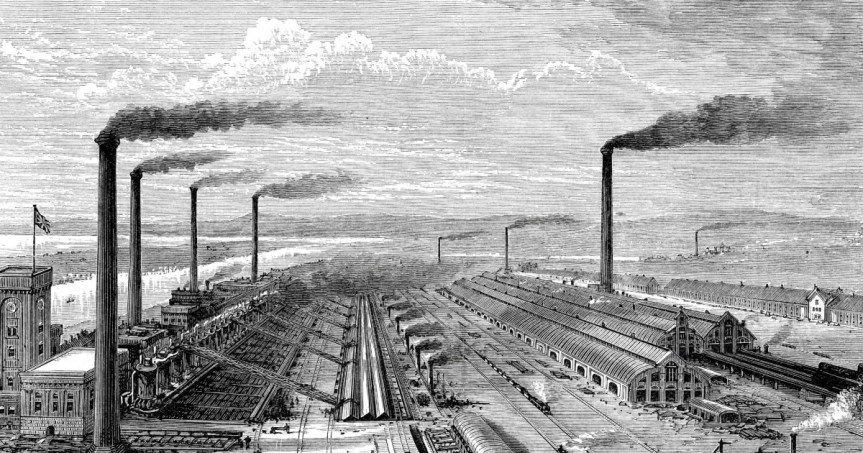
The Industrial Revolution began in the 18th century, when agricultural societies became more industrialized and urban. The transcontinental railroad, the cotton gin, electricity and other inventions permanently changed society. The revolution marked a period of development in the latter half of the 18th century that transformed large rural societies in Europe and America into industrialized, urban ones.

Goods that had once been painstakingly crafted by hand started to be produced in mass quantities by machines in factories, thanks to the introduction of new machines and techniques in textiles, iron making and other industries.

England : Birthplace of the Industrial Revolution

100 Textiles- Vintage Photos ideas | vintage photos, textiles, cotton mill
Cotton factory

Britain had a long history of producing textiles like wool, linen and cotton. The big gamechanger prior to the industrial revolution was in “cotton industry” with the work performed in small workshops or even homes by individual spinners, weavers and dyers. Producing cloth became faster and required less time and far less human labour. The mechanical production of cloth could meet the growind demand at home and abroad. Apart from textiles, the iron industry also adopted new innovations.

Steam Power

An icon of the Industrial Revolution broke onto the scene in the early 1700s, when Thomas Newcomen designed the prototype for the first modern steam engine . Called the “atmospheric steam engine,” Newcomen’s invention was originally applied to power the machines used to pump water out of mine shafts. 

In the 1760s, Scottish engineer James Watt began tinkering with one of Newcomen’s models, adding a separate water condenser that made it far more efficient. Watt later collaborated with Matthew Boulton to invent a steam engine with a rotary motion, a key innovation that would allow steam power to spread across British industries, including flour, paper, and cotton mills, iron works, distilleries, waterworks and canals. 

Just as steam engines needed coal, steam power allowed miners to go deeper and extract more of this relatively cheap energy source. The demand for coal skyrocketed throughout the Industrial Revolution and beyond, as it would be needed to run not only the factories used to produce manufactured goods, but also the railroads and steamships used for transporting them.

Transportation

Britain’s road network, which had been relatively primitive prior to industrialization, soon saw substantial improvements, and more than 2,000 miles of canals were in use across Britain by 1815.

SCIplanet - Steam Power and the Industrial Revolution: 1760-1840
Train powered by steam engine

In the early 1800s, Richard Trevithick debuted a steam-powered locomotive, and in 1830 similar locomotives started transporting freight and passengers between the industrial hubs of Manchester and Liverpool. By that time, steam-powered boats and ships were already in wide use, carrying goods along Britain’s rivers and canals as well as across the Atlantic.

Communication and Banking

In 1837, British inventors William Cooke and Charles Wheatstone patented the first commercial telegraphy system. Cooke and Wheatstone’s system would be used for railroad signalling, as the speed of the new trains had created a need for more sophisticated means of communication.

Banks and industrial financiers rose to new prominent during the period, as well as a factory system dependent on owners and managers. A stock exchange was established in London in the 1770s; the New York Stock Exchange was founded in the early 1790s. 

In 1776, Scottish social philosopher Adam Smith (1723-1790), who is regarded as the founder of modern economics, published The Wealth of Nations. In it, Smith promoted an economic system based on free enterprise, the private ownership of means of production, and lack of government interference.

Working Conditions

Working Conditions - Industrial Revolution

Rapid urbanization brought significant challenges, as overcrowded cities suffered from pollution, inadequate sanitation and a lack of clean drinking water. Industrialization increased economic output overall and improved the standard of living for the middle and upper classes, poor and working class people continued to struggle. The mechanization of labor created by technological innovation had made working in factories increasingly tedious and sometimes dangerous, and many workers were forced to work long hours for pitifully low wages. 

In the decades to come, outrage over substandard working and living conditions would fuel the formation of labour unions, as well as the passage of new child labour laws and public health regulations in both Britain and the United States, all aimed at improving life for working class and poor citizens who had been negatively impacted by industrialization.

DISASTER

A Disaster can be generally defined as “A serious disruption in the society causing widespread material economic, social or environmental losses which exceed the ability of the affected society to cope using its own resources”. Disaster impacts may include loss of life, injury, disease and other negative effects on human Physical, mental and social well-being, together with damage to property, destruction of assets, loss of services, social and economic disruption and environmental degradation.

Disaster

Two types of disaster. They are

✓Natural disaster

✓Man-made Disaster

NATURAL DISASTERS

A natural disaster is a major adverse event resulting from natural processes of the Earth, examples include firestorms, duststorms, floods, hurricanes, tornadoes, volcanic eruptions, earthquakes, tsunamis, storms, and other geologic processes.

Natural disaster

Earthquake

A sudden movement (or) trembling of the earth crust is called as earthquake. The movement of the tectonic plates, mass wasting, landslides, surface fault, etc., causes earthquake.

Earthquake

Effects

Due to a strong earthquake, loss of lives, buildings, roads, bridges and dams are damaged. Earthquake cause floods, tsunami, landslides, fires, break down of water supply and electrical lines. It may change the course of a river too.

Effect of earthquake

Tsunami

When earthquake jolts the ocean floor, the sudden dislocation of the sea bed occurs and the resulting displacement of water can produce one or more huge, destructive waves, known collectively as a Tsunami. The sea waves rise to several meters and may reach the coast within a few minutes.

Tsunami

The word “Tsunami” is derived from the Japanese word. “Tsu” means harbour and “nami” means waves.

Effects

It causes flooding and disrupts transportation, power communication and water supply.

Effect of tsunami

Flood

Sudden overflow of water in a large amount caused due to heavy rainfall, cyclone, melting of snow, Tsunami or a dam burst.

Flood

Effects

✓Loss of life and property.

✓Displacement of people.

✓Spread of contagious diseases such as Cholera and Malaria etc.,

Effect of flood

Cyclone

A low-pressure area which is encircled by high pressure wind is called a cyclone.

Cyclone

Effects

The main effects of tropical cyclone include heavy rain, strong wind, large storm surges near landfall and tornadoes.

Effect of cyclone

MAN-MADE DISASTERS

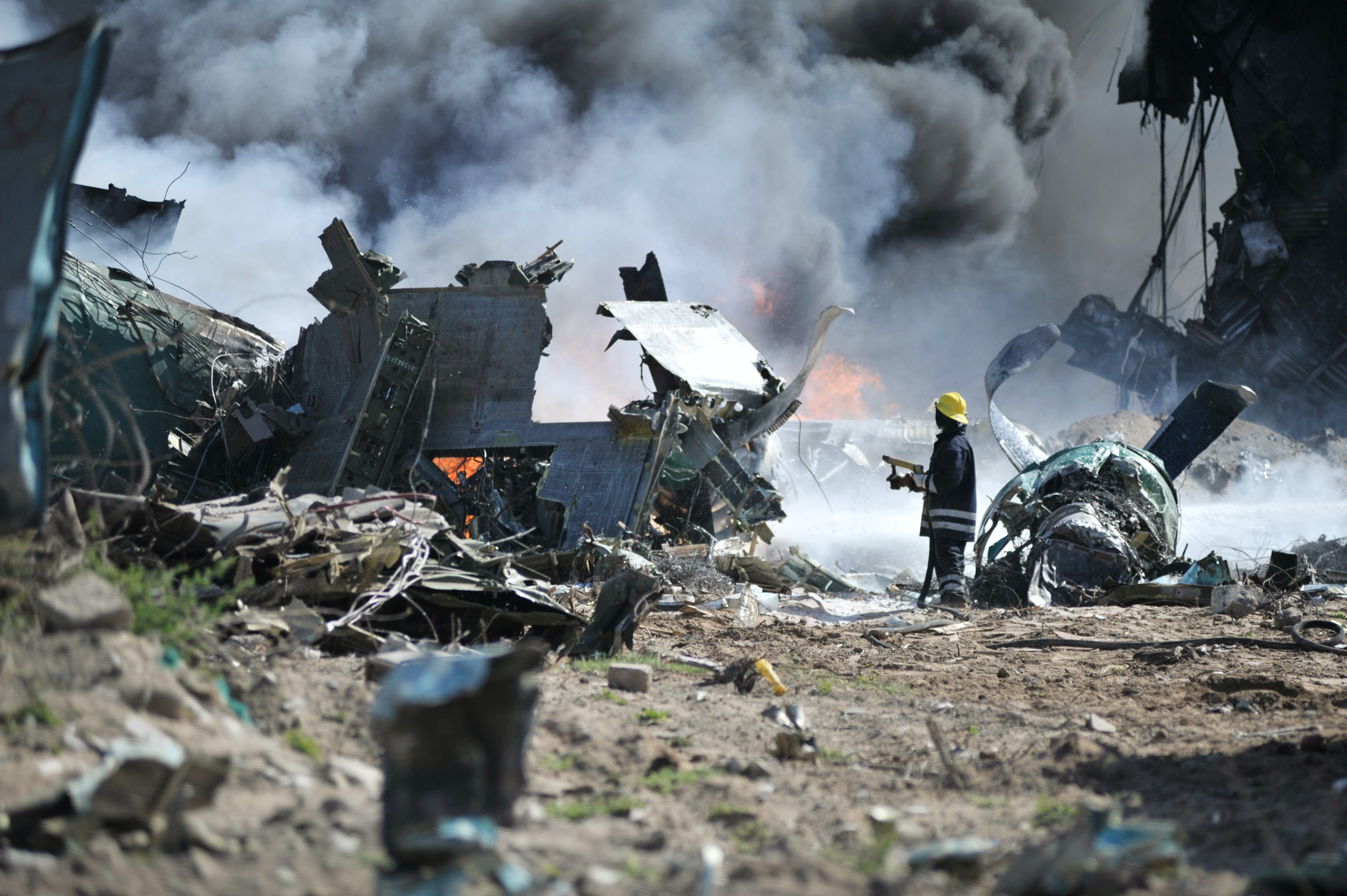
Man-made disasters can include hazardous material spills, fires, groundwater contamination, transportation accidents, structure failures, mining accidents, explosions and acts of terrorism

Stampede

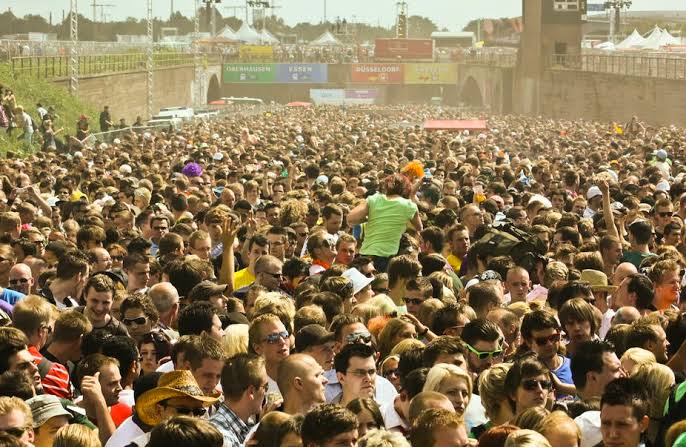
The term stampede is a sudden rush of a crowd of people, usually resulting in injuries and death from suffocation and trampling. It is believed that most major crowd disasters can be prevented by simple crowd management strategies. Human stampedes can be prevented by organization and traffic control, such as barriers, following queues and by avoiding mass gathering.

Stampede

Fire

Fire is a disaster caused due to electrical short circuit, accidents in chemical factory, match and crackers factory.

Fire

Fire involves 3 basic aspects

✓Prevention

✓Detection

✓Extinguishing

On Translation

Translation is defined as the rendering of something into another language from another language.

The purpose of translation, as opposed to the general conception, is not to make it accessible to a new reader base or cater it to the people of a different region. It must not limit itself to a mere identification of the substitute words. The purpose is not to translate the literal meaning to the targeted language but to convey the intention. The purpose of translation is to express the commonalities that connects the original language and the targeted language. It’s purpose is to express the relationship between languages. Translation has the potential to convey a ‘pure language’ and to harmonize the languages. The languages are interrelated in what they want to express and the translation has to identify it. Language, like all things, is affected by time and translation helps it evolve from time to time. The perfect translation is like a tangent, it has to touch the original text and move away from it infinitely. Translation has to broaden the targeted language by coming in contact with the original language. Translation is an artistic revival of the mode of intention that the original text intends to convey.

Translation is widely misinterpreted as a straightforward process of substituting words in the original text with equivalent words in the targeted language. It is often seen as an imitative process lacking creativity and a process incapable of conveying the intention of the original text. However, it is to be understood that literal translation of a text (especially literary text) renders the translation useless. The role of a translator is not just substituting words but involves creativity and creative decision making. A good translator has to identify the correct intention of the original text and has to rewrite accurately in the targeted language. A proper process of translation has to find the effect the mode of intention has on the targeted language. Thus, it becomes an echo of the original. Literal translation is not effective as literal words might convey a different meaning. A good translator reveals what is hidden in the languages in his language or translation. The process of translation is derivative, ideational and ultimate and the process is unique. The translator must allow the targeted language to be affected by the original language and broaden his own language. Hence, it can be concluded that translation is a creative activity and not a linguistic imitation.

Equivalence in translation means that the targeted text has to recreate the same effect of the source text. It has to try to achieve optimal equivalence. The problem of equivalence arises because of differences between the original language and the targeted language(especially cultural differences). If a translation ignores equivalence, it can lead to misinterpretation and might not convey the intention of the original text. Equivalence should been seen as an important criteria to evaluate a translation. Ignoring equivalence might result in spoiling the essence of the original text and creating the same effect is sometimes as important as conveying the meaning. Since a language represents its people, history, culture etc… it is important to achieve equivalence. Considering equivalence as a parameter will result in retaining the originality of the source language and helps in better communication. It helps in understanding the contextual meaning of a text. So, equivalence is an important factor in translation.

Nehru On Secularism

JAWAHAR LAL NEHRU AND SECULARISM

PANDIT JAWAHARLAL NEHRU (1889-1964) was a freedom fighter and seasoned statesman of modern India. He was the architect of modern India, always yearned to build a secular nation.

Nehru regarded secularism as the basic law of Indian nationhood.

Nehru was an ardent champion of the Indian view of Secularism. In a multi-religious societylike India, Nehru defined a secular state that protects all religions but does not favour anyone at the expense of the other.

It does not adopt any religion as the state religion.

During the Independence movement of India, Nehru drafted the congress Resolution on fundamental Rights stated that the state should observe neutrality regarding all religions.

After the Independence of India when the Indian Constitution(1950) had been in force for over a decade, Nehru observed (1961) in an important speech:-

“ We have laid down in our Constitution that India is a secular state. That does not mean or irreligion. It means equal respect for all faiths and equal opportunities for those who profess any faith”.

Nehru did not conceive secularism as indifference to religion.

Nehru strongly condemned those forms of religion which sow the seeds of hatred between different religious communities.

Nehru used every single opportunity to express the danger of mixing religion and politics.

He visualized a secular state as one in which every individual had the full freedom to function according to his way either culturally or in matters of religion. It was Nehru’ a vision that shaped the Constitution of India in such a manner that it should provide for a secular state.

Nehru emphasized four different aspects of secularism :-

  • In the first place, he insisted that secularism meant grant of equal status to all religions in India and opposed grant of special privileges to any religion.
  • Second, Nehru’s Secularism implied the neutrality of the state in religious matters.
  • Third, Nehru viewed secularism as a mental attitude on the part of various communities which could bring about harmony and feeling of fraternity towards one another.
  • Concluding, Nehru’s concept of secularism implied the existence of a uniform civil code for the people of India.

Nehru was a secularist.  He disapproved both the Hindu communism as well as the Muslim communism.

Today’s the secular ethos for which Nehru strived hard through his life is facing a multi-prolonged challenge from the hydra headed communalism.

Human Rights

‘A right is not what someone gives you; it’s what no one can take from you.’

We need human rights for protection when our legal rights have been violated by the state or individuals, and to encourage justice and fairness within our societies.

Because of this widely accepted reason human rights are protected by raising both national and international awareness of human rights violations. This can help draw attention and resolve such situations, by creating moral pressure on the government.

Photo by cottonbro on Pexels.com

Constitutional Rights:

The Constitution of India provides for six Fundamental Rights:

  • Right to equality (Articles 14–18)
  • Right to freedom (Articles 19–22)
  • Right against exploitation (Articles 23–24)
  • Right to freedom of religion (Articles 25–28)
  • Cultural and educational rights (Articles 29–30)
  • Right to constitutional remedies (Article 32)

Chronology of events:

1989- Scheduled caste and scheduled tribe act was passed.

1993- National human rights commission established under human rights act.

2001- Supreme court passes extensive orders to implement the right to food.

2005- National Rural Employment Guarantee Act (NREGA) guarantees universal rights to employment.

Latest petitions in Supreme Court:

The Nirbhaya case- to ensure right against exploitation.

Cheap cancer drugs- to ensure right to life.

Curbing the sale of acid- to ensure the right against exploitation.

Photo by Belle Co on Pexels.com

INDIAN CULTURE

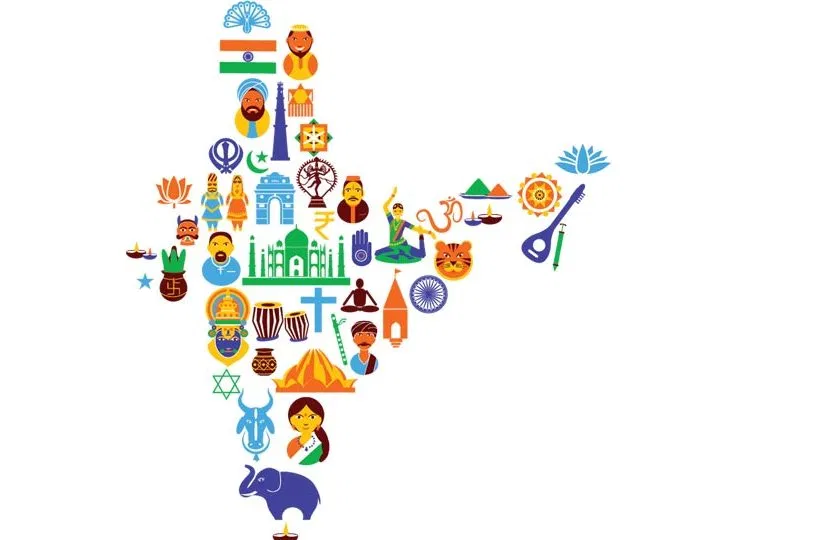
India is a country of rich culture where people of more than one religious culture live together. The culture of India is the oldest culture in the world around 5,000 years. Indian culture is considered the first and supreme culture of the world.


It is the country of the oldest civilizations in the world. The vital components of the Indian culture are good manners, etiquette, civilized communication, rituals, beliefs, values, etc. Even after the lifestyles of everyone have been modernized, Indian people have not changed their traditions and values. There is a common saying about India that “Unity in Diversity” means India is a diverse country where people of many religions live together peacefully with their own separate cultures. People of various religions differ in their language, food tradition, rituals, etc however they live with unity. 

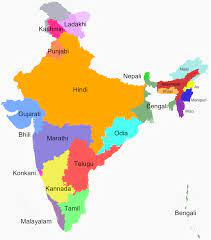
The national language of India is Hindi however there are almost 22 official languages and 400 other languages are spoken daily in India in its various states and territories. According to history, India has been recognized as the birthplace of the religions like Hinduism and Buddhism.

People follow a variety of food cultures such as beaten rice, bread ole, banana chips, poha, potato papad, puffed rice, upma, dosa, idli, sugar, etc. Indian food is wide and includes a lot of variety. Each state of India has its own unique cuisine that reflects the culture and its tradition. Indian food is cooking using various methods, most of which preserve the nutrients contained in the fresh vegetables used.

India today is unfolding a story of a billion-plus people, or more precisely, one sixth of the world’s population, on a big move as India’s large and complex systems rapidly moving top-down and the country emerge as one of the fastest-growing economies of the world, India is probably the only country in the world where people belonging to different religions, castes and creeds, speaking different languages, having different cultures, different modes of living, different clothing, different feeding habits, worshiping different gods and deity live together in harmony and believe to be the children of one mother-MOTHER INDIA,

The Girl In Room 105 : Book Review

About The Book

  • Title : The Girl In Room 105
  • Author : Chetan Bhagat
  • Genre : Mystery, Thriller
  • Year of publication : 2018
  • Number of pages : 304

About the Author

Chetan Bhagat is the author of nine bestselling novels which have sold over twelve million copied and have been translated into more than twenty languages worldwide.

The New York Times has called him ” the biggest selling author in India’s history”. Time magazine named him as one of the 100 most influential people in the world, and Fast Company USA named him as one of the 100 most creative people on business worldwide.

Chetan went to college at IIT Delhi and IIM Ahmedabad, after which he worked in investment banking for a decade before quitting his job to become a full-time writer.

Analysis of the book

The Girl In Room 105 is the eighth novel and the tenth book overall written by the Indian author Chetan Bhagat. The book became a bestseller based on the prearranged sales alone.

It tells about a IIT coaching class tutor who goes to wishes ex-girlfriend in her birthday and finds her murdered. The rest of the story is his journey after her death to find justice.

The book also addresses the stereotypes and political issues we face in India.

“When people say ‘I quote’ and pause, they come across as scary-level intellectuals. Let’s face it, nobody wants to mess with the ‘I quote’ types.”

The novel opens up with a conversation of the author of the book, Chetan Bhagat with a fellow passenger on a midnight IndiGo flight from Hyderabad to Delhi. After an initial conversation, Chetan agrees to listen to the story of the fellow passenger.

Summary of the story

Keshav, a former IITian, works in a coaching centre for the JEE. He is a part of an orthodox family. His mother is a homemaker and his father is a part of the RSS. He had a love story with a Kashmiri Muslim girl named Zara, during his college days but their relationship was not accepted by their families because of the religious feuds.

But he never stopped loving her. He got to know Zara was going to marry Raghu, their classmate. Saurabh is Keshav’s best friend. One day around 3a.m., on Zara’s birthday, Keshav received a message from her asking him why he didn’t wish her and asked him to meet her in her hostel room.

“When you lose something, don’t think of it as a loss. Accept it as a gift that gets you on the path you were meant to travel on.”

When Keshav arrived there, he got to know that Zara was lying dead on her bed. He called Saurabh and then decided that he won’t run away he informed the police and Zara’s parents. Soon the investigation started and Keshav along with Saurabh continues investigation by digging deeper, with the help of the inspector Vikas Rana.

“The ‘let life not hold you back’ kinds, statements that sound profound but actually mean nothing.”

First the Watchman of the hotel was arrested for the missing CCTV footage. Then Prof. Saxena was arrested because he used to harass Zara. But both of them were later found innocent. After seeking information from Zara’s brother, Keshav and Saurabh went to meet Sikander, Zara’s stepbrother who used to work in a terrorist group in Kashmir.

Keshav suspects him but Sikander tells him that he wasn’t the murderer but Keshav forced him and because of which Sikander commited suicide because he said that if he lives then this will become a problem for his terrorist group. After a little more digging, Keshav got to know that Zara got expensive jewelleries by Captain Faiz Khan,as a gift. He was Zara’s childhood friend.

He finds out gun powder and pregnancy kits in Zara’s drawers and the same things in Faiz’s house too. So he decided to reveal the murderer infront of everyone on Zara’s 100th day of her death.

Conclusion

Before revealing the murderer,Keshav went to Hyderabad for a short trip alone. Finally it was revealed that the murderer was Raghu with whom Zara was going to get married because he got to know that Zara and Faiz were having an affair and probably Zara was pregnant with Faiz’s baby. Thus,Raghu was arrested by the cops.

But Keshav finally realised that Zara never really loved Keshav. Though Keshav became happy initially when he got the messages from her, but he realised that it was not from her actually. Those were sent by Raghu.

“Thank you. For showing me what love is all about. And thank you for also teaching me to never love someone too much.”

https://www.goodreads.com/work/quotes/64978767-the-girl-in-room-105

Peace is everybody’s desire, But violence never disappeared-Why?

Before getting into the topic, let us learn what is violence. Violence, as described by the WHO is the ” intentional use of physical force or power, threatened or actual, against oneself, another person, or against a group or community, that either results in or has a high likelihood of resulting in injury, death, psychological harm, maldevelopment or deprivation”. I believe simplifying this definition will make us loose out on something important. Developing such a strong definition for an act shows how it is affecting the humanity without any doubt.

WRVH DIVIDES VIOLENCE INTO THREE TYPES:

SELF DIRECTED VIOLENCE: The violence which is directed to harm one`s self. These include the forms of self harm such as suicide attempts, either successful or not, or even thinking about it. Attempts to injure or destruct body parts without conscious intention of suicide also included in this.

INTERPERSONAL VIOLENCE: Violence that occurs between family members or partners or individuals who may not know each other is included in this category. For example abuse of elders or children.

COLLECTIVE VIOLENCE: This is mainly what we see in public, I mean violence by group of people who identify themselves under a group against another group. This includes genocides, abuses of human rights etc.

Regardless of what type of violence is happening, its impact is always negative. Even witnessing a act of violence leaves a mark. Many people suffer from psychological disorders as the result of violence. Children who are victims of violence may develop insecurities, anxiety, antisocial behavior, anger issues etc.

Having witnessed or experienced violence, people always talk about having peace. There are so many measures explained over internet. But we don’t see any hope of getting rid of it any soon. Why is it so?

  • Preaching is easier than practicing: It`s easy to talk about anything and everything until you have to practice it. Asking for peace is not wrong, its the best thing to do. But only asking to have peace will not be sufficient. One should practice act of peace before preaching.
  • Peace is defined differently according to different perceptions people have: Peace is just the absence of war for somebody and for somebody its peace of mind. Some people think peace is present in what they believe according to their religion or some may describe it as absence of difference.
  • Increase in stress and pressure by various things: It is like a loop. Violence increases stress which may again result in violence. Its like a mother abusing children because of the harassment she faces in the family. Or stress can be induced by other things also which may result in violence. Like a person who is so stressed out in work may abuse family members as a way to vent out his/her frustration.
  • Sometimes, nobody cares: People don’t take violent behaviors seriously until someone they love or themselves face it. Thinking about violence as some other persons problem until it knocks your door is slowing down peace in the race.
  • Increasing materialism: We may not see the direct impact of materialism on violence. But greed of power, money, supremacy and many more other things blurs out peace from the frame.

Then what is the thing that brings peace in a real sense and brings it effectively? nobody knows. That doesn’t mean you should not hope for it. But one thing is sure that it should start from the individual level but definition should be universal. Whatever may be our beliefs, peace should be the ultimate goal.

Deforestation

Deforestation is cutting down of trees.Deforestation includes the conversion of natural forests into tree plantations, like the clearance of tropical rainforests in Southeast Asia for oil palm and timber plantations.Cutting of trees has seriously affected the quality of environment by increasing the temperature, decreasing rainfall,top soil erosion,loss of biodiversity and also causes flash floods.Trees play a very important role in maintaining the environmental role.

Forests provide more than a home for a diverse collection of living things; they are also an important resource for many around the world.Trees also absorb carbon dioxide, mitigating green house gas  emissions produced by human activity.Deforestation not only removes vegetation that is important for removing carbon dioxide from the air.

The long term effects of deforestation are climate change and loss of biodiversity.Climate change occurs due to an increase of green house gases such as carbon dioxide.An increase in carbondioxide will increase the temperature of the earth and will therefore alter the weather.

Deforestation ruins the habitat of the animals and plants causing them to die.Destruction of forest affect the beauty of an area and directly exerts an impact on tourism.

Fast depletion of forests urges rural people to use inferior quality firewood and make them spend more time on fuel collection.Shortage of forests also force the villgers to use more commercial fertilizer in place of manures.Fodder for grazing cattle diminishes resulting in decreasing number of live stock.

Loss of green cover leads to soil erosion.Landslides occur due to cutting of trees in hill stations.

“REVERSING DEFORESTATION MAY BE COMPLICATED,BUT PLANTING OF TREES IS VERY SIMPLE”

Stories of India – ||

India which was considered to be the land of many nations and varying races should understand its population based on their ethnographic, communal and geographic distinction which is not an easy task. In a country like India, National identity has consistently been a part of human life both socially and personally ever since the beginning of ancient history. During the nineteenth century, Punjab became a source of the study of religious identity because of their ethnographic and histories of the local population. Britishers viewed the conflict in the state of Punjab during the colonial period as the result of the deep-seated religious hostility. (The Historian and Indian Census , p. 41)


The historical backdrop of Punjab can be seen driving constantly from Cultural variety and heterogeneity to an expanding fixation on network limits. The Census of Punjab was directed to build up a comprehension of population but it turned out to be understanding the religious identities which later resulted in the partition and turned out to be a political identity. In the minds of Census officials, Punjab society was highly organized on religion and it could be understood in terms of religion. (The Historian and Indian Census , p. 43)The census made strict character more impossible to miss and it turned into the establishment for expanding religion between networks for admittance to employment, education and political representation.

India the rulers of Mughals and maharaja, they made efforts to understand their territories. By mapping and measuring under their control of revenue process, however they didn’t lead any known Census of individual, though they generally acknowledge the identity.

But the census by the Britishers conducted turned to create more communal issues mainly in the urban spaces and religious identities began to dominate the urban politics as these censuses only concentrated their records on religion apart from the survey conducted in 1851. This was despite the fact that in mid nineteenth century when Britain strict alliance made a serious difference between Anglicans, protesters and Catholics had been seen separated from one another since the time of reformation. (The Historian and Indian Census , p. 46)

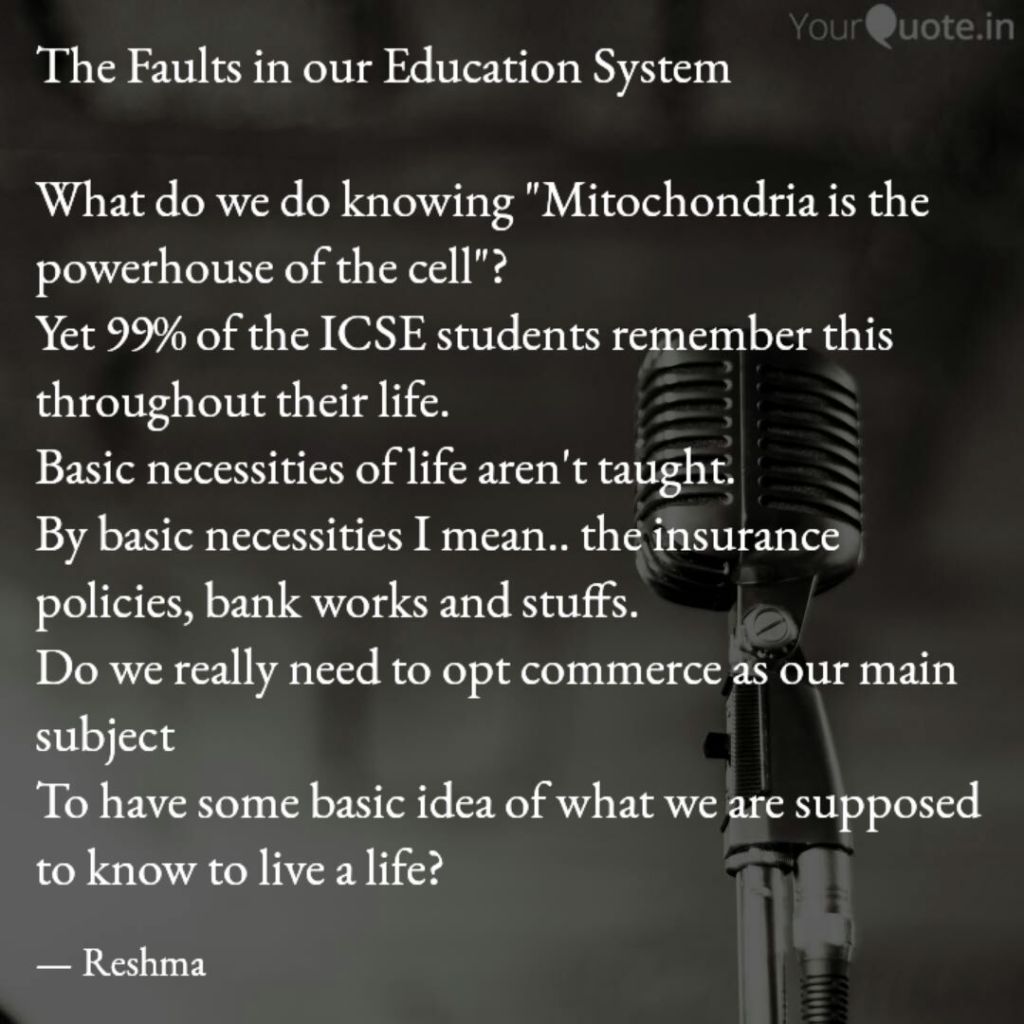
The Faults in our Education System

Why exactly are we educated? Just for the sake of it? No, right? We are suppose to learn everything from basic manners to how to earn a living. At the end of our learnings, we are all supposed earn our own breads and fulfill our desires. It is for this, we are all trained right from the age of 3.

Do we really need to start so early? I’m not so sure about. Still, parents for sure cannot keep calm seeing the rapid increase in the competition these days. I agree. High competitions have ruined the childhood of kids these days by burdening them with homework pressures and stuffs. They don’t even know why are they to study. Innocent kids living in their own fantasy world are being dragged to reality so soon. Pathetic!

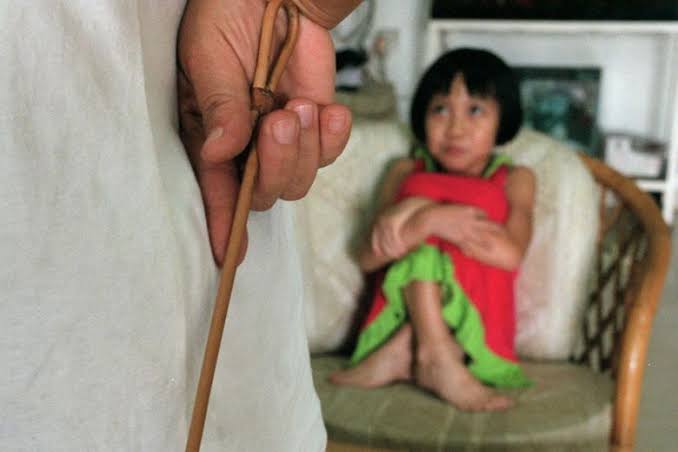
Apart from teachers at school and parents at home, there’s another trend to send a 3 year old to tution centres nowadays, where they get far more tortured and this is going unnoticed in this busy world. Tutions for atleast primary school children should be shut. Kids at this age only require a mother’s guidance I believe.

Being a grown up student, I do sit back and realise the faulty education system which have been the same all these years and nobody bothered to change or raise questions. I wonder, am I the only one facing troubles now due to the education system we have had so far. It paid a lot of attention to the little details which did help me at times during my school days. But we need a lot more than all those science and maths. Basics of computer is so necessary in every field, I hardly knew unless I had to make powerpoint presentations and work on spreadsheets in my college days. We were taught these around std.4. And what were we suppose do learning those back then? It is during the late highschool days we found it necessary when we almost forgot the basic concepts. Had we been taught those during the later years of schooling, it would have been far more helpful I suppose.

Another major issue lies that only students who wish to take up commerce gets to know something about bank stuffs, loan procedures, share markets and everything money related. Aren’t the science and the arts students suppose to know such necessites of life? They too live in the same society and earn for their living. Each one of us needs to have certain practical knowledge other than bookish ones. Those projects and assignments we are burdened up with are certainly of no use. No student does it sincerely. We all know our hardwork is going to be dumped somewhere later. That is what exactly happens.

If not schools, at least colleges should educate students on saving and investing money, several bank procedures, loan applications and certain benifits every citizen of India posses. That is what a complete education means. Where will people end up not knowing where and how to invest their earnings? What should they do not knowing the privileges they own? Literate people somehow get to know it from somewhere or the other. But everyone in the country are not literate enough to know things on their own. They too earn for their living but are unaware of investments they can make. There should be schemes to educate such people as well. Only then will our country grow. You won’t believe, there are still more than a thousands of people who exist even whithout an identity card. What proof do they posses of their existence? Is this how we dream of a developed country?

Education system not just mean educating students at school. It means to educate the country, to help people grow. Only bookish knowledge can never be relied upon to live a life. Practical knowledge about what life exactly is and how it should be lived must be taught.

Child labour

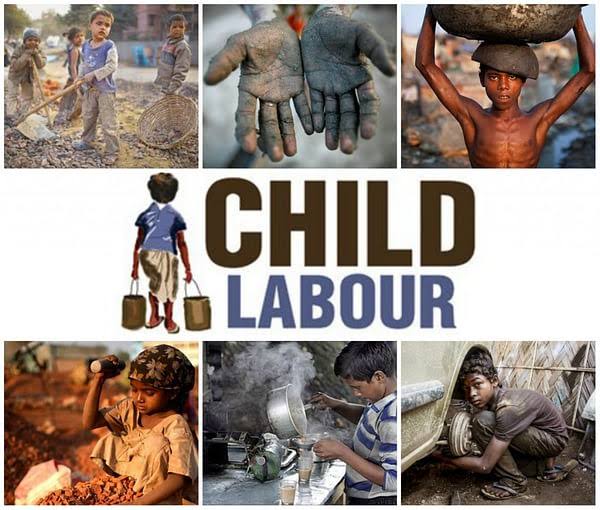
Child labour refers to the exploitation of children through any form of work that deprives children of their childhood, interferes with their ability to attend regular school, and is mentally, physically, socially and morally harmful.

According to the committee on child labour,”child labour can be broadly defined as that segment of the child population which participates in work either paid or unpaid”.Child labour means a working child who is between 6 and 15 years of age,not attending school during the day,and working under a employer or learning some trade as an apprentice.

A child may be found employed in many different kinds of activities to earn.The child may be employed forcibly or voluntarily,in an organized or in an unorganized sector.The common places of employment may be carpet weaving,match factories, fireworks, restaurants,auto garages,quarries, household work etc.,

Poverty seems to be one of the most explicit reasons for child labour.Poverty of parents,or parental neglect leads children to seek employment.Inadequate income of the parents do not fulfil the minimum requirement of the children which in most of the cases induce the children to enter into the jobs market,by foregoing their education.The greedy employers attract such poor children to their factories,hotels and other work places by promising them food and salary.The child labour becomes a convenient tool for employers to escape from giving salary to employees.Employing child labour for dangerous works,for low salary and without required service condition has serious socio,economic, cultural implications.

Physical labour and consequent work pressure make the child weak at times.The use of children as a source of labour force,raises many other questions with regards to demographic and economic implications.Among other implications child labour causes adult unemployment,low productivity with economic loss to the society.

Free and compulsory primary education,mid day meal schemes,and other incentives are meant to reduce the child labour.

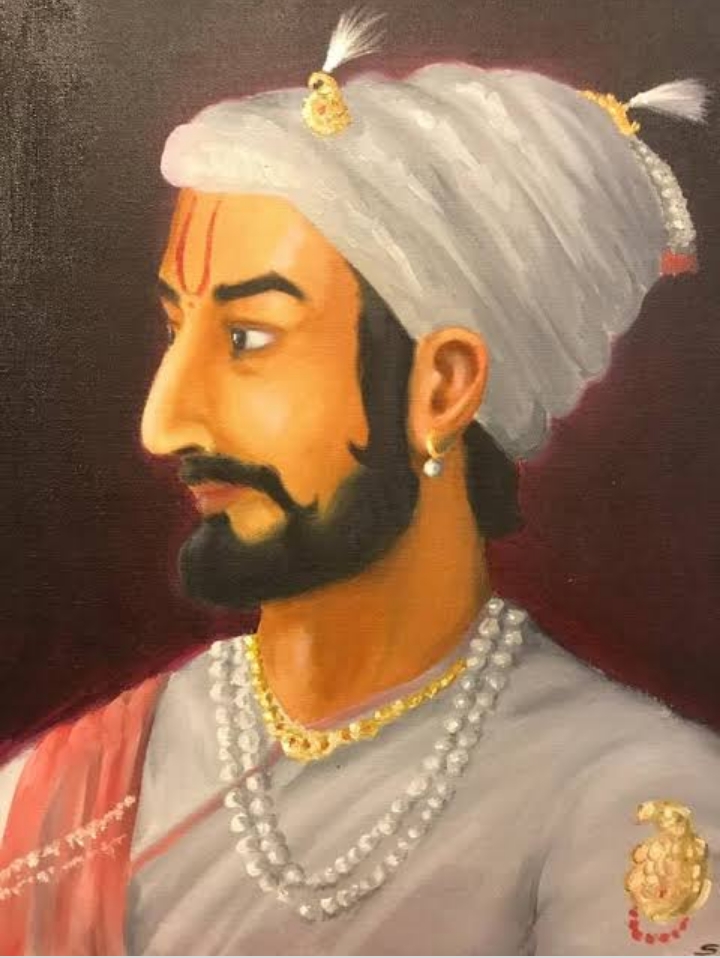
Sambhaji Maharaj

Many Maratha heroes have sacrificed their lives to save Hindutva and one of them the eldest son of Chhatrapati Shivaji Maharaj, Shri Chatrapati Sambhaji Maharaj Bhonsale.  He was born on May 14 1657 to his mother Soyarabai. After the death of Shivaji Maharaj, on April 3, 1680, Sambhaji established the Hindu Empire and took over.

Sambhaji lost his mother Sai bai at the age of 2. After her death, his paternal grandmother Jijabai looked after him. Initially his stepmother, Soyarabai, also doted on him a lot. Sambhaji was a tiger cub in the true sense. He was extremely handsome and possessed immense bravery. He was a scholar of Sanskrit and eight other languages. In 1666, he was married to Yesu bai, and later the couple had a son – Shahu. On June 6th, 1674 at the time of the coronation of Shivaji Maharaj, he was declared the prince of the Sovereign Maratha Kingdom.

As a prince, Sambhaji proved his bravery and military brilliance on more than one occasion. He led and won his first war at Ramnagar at the age of 16. During 1675-76 he led successful campaigns in Goa and Karnataka.

Chhatrapati Sambhaji Maharaj was a true Dharmaveer, who just like his father Shivaji, did not bow before Aurangzeb although Aurangzeb brutally tortured Sambhaji Maharaj for more than 40 days. Hindus must learn how to sacrifice for Dharma from Sambhaji Maharaj.

A dramatic accession

Chhatrapati Shivaji passed away in April 1680, and for a good nine months Sambhaji was entangled in a bitter accession struggle with his half-brother Rajaram, who was 10 at the time. Soyrabai, Sambhaji’s stepmother and the mother of Rajaram, plotted against to keep him away from the throne. Ultimately though, Sambhaji gained the support of Maratha commander-in-chief Hambirrao Mohite and in January 1681 was officially crowned ruler of the Marathas. Rajaram, Soyrabai, and their associates were put under house arrest.

The remarkable things that Sambhaji Maharaj achieved in his short life had far-reaching effects on the whole of India. Every Hindu should be grateful to him for that. He valiantly faced the 8 lakh strong army of Aurangzeb and defeated several Mughal chieftains in the battlefield forcing them to retreat. Because of this, Aurangzeb remained engaged in battles in Maharashtra, thus keeping the rest of India free from Aurangzeb’s tyranny for a long time. This can be considered as the greatest achievement of Sambhaji Maharaj. If Sambhaji Maharaj would have arrived at a settlement with Aurangzeb and accepted his proposal of being a tributary prince, then within the next 2 or 3 years Aurangzeb would have captured North India again. However, because of Sambhaji Maharaj and other Maratha ruler’s (Rajaram and Maharani Tarabai) struggle, Aurangzeb was stuck in battles in South India for 27 years. This helped in the establishment of new Hindu kingdoms in the provinces of Bundelkhand, Punjab and Rajasthan in North India; thus providing safety to the Hindu society there.

Efforts for Reconversion to Hinduism

  We all know that Shivaji Maharaj reconverted Netaji Palkar to Hinduism. However, it is important to note that Sambhaji Maharaj had established a separate department in his province for the ‘reconversion ceremony’ of the Hindus who had earlier converted into other religions. There is a story of a Brahmin named ‘Kulkarni’ of Harsul village in the history of Sambhaji Maharaj. Kulkarni had been forcibly converted to Islam by the Mughals. He tried to reconvert into Hinduism, but local Brahmins in his village did not pay any heed to him. In the end, Kulkarni met Sambhaji Maharaj and told him about his misery. Sambhaji Maharaj immediately arranged for his reconversion ceremony and reconverted him into a Hindu.This noble initiative of Sambhaji Maharaj helped many converted Hindus to reconvert back into Hinduism.

Face-off with the Mughals

The Mughals were the staunchest enemies of the Marathas during Sambhaji’s reign. One of the first major actions taken by Sambhaji against the Mughals, was when his forces attacked Burhanpur, a wealthy Mughal city in Madhya Pradesh. Sambhaji had planned the attack, being aware of Mughal emperor Aurangzeb’s plans to expand into the Deccan. Burhanpur was an important trading center and Sambhaji’s attack came as a huge blow for the Mughals.

For the next six years, between 1682 and 1688, the Marathas under Sambhaji and the Mughals under Aurangzeb were engaged in multiple battles in the Deccan. The Mughals wanted to acquire possession over the forts held by Marathas in Nashik and Baglana regions. In 1682, they attacked the Ramsej fort near Nashik. However, despite months of failed attempts, the Mughals failed to take control of the fort and were forced to retreat. The Ramsej fort had become an important morale booster for the Marathas.

Capture and Execution

        In early 1689, Sambhaji called his commanders for a strategic meeting at Sangameshwar in Konkan. In a meticulously planned operation, Ganoji Shirke (brother of Sambhaji’s wife Yesubai) and Aurangzeb’s commander, Mukarrab Khan attacked Sangameshwar when Sambhaji was about to leave the town. A small ambush followed and Sambhaji was captured by Mughal troops on 1 Feb, 1689. He and his advisor, Kavi Kalash were taken to Bahadurgad. Aurangzeb humiliated them by parading them wearing clown’s clothes. Later, Sambhaji and Kavi Kalash were tied upside down to camels with Mughal soldiers throwing stones, mud, and cow dung at them.

         When they were brought face to face with Aurangzeb, the latter offered to let Sambhaji live if he surrendered all the Maratha forts, turned over all his hidden treasures and disclosed the names of all the Mughal officers who had helped him. Sambhaji refused, and instead sang the praises of Mahadev (Lord Shiva). Aurangzeb ordered him and Kavi Kalash to be tortured to death. Sambhaji and Kavi Kalash were brutally tortured for over a fortnight. The torture involved plucking out their eyes and tongue and pulling out their nails. The later part involved removing their skin. On March 11, 1689, Sambhaji was finally killed, reportedly by tearing him apart from the front and back with ‘Wagh Nakhe’ (‘Tiger claws’, a kind of weapon), and was beheaded with an axe. This grievous death was given to him at Vadhu on the banks of the Bhima river, near Pune.

After every torture, Aurangzeb would ask him if he had had enough and wanted to convert – but the courageous king kept refusing. By doing so he earned the title of Dharmaveer (Protector of Dharma) by which he is known to this day. Aurangzeb ordered for Sambhaji’s body to be cut into pieces and be thrown into the river. Residents of the nearby village named ‘Vadhu’ collected as many pieces of his body as they could find, sewed them together and performed the final rites on his body. These villagers later went on to use the surname ‘Shivle’ or ‘Shivale’, as per spelling preference, which means ‘sewing’ in the Marathi language.

With Sambhaji’s death, the Maratha confederacy was thrown in disarray. He was succeeded by his younger brother Rajaram who became the leader of the Marathas. The Commander in chief of the Maratha army, Mhaloji Ghorpade, who succeeded Hambirrao Mohite, died in the ambush at Sangameshwar. A few days after Sambhaji’s death, the capital Raigad fell to the Mughals and Sambhaji’s wife and son were captured. However, Sambhaji’s torture and heroic death unleashed an unprecedented unity and heroic spirit amongst the Marathas. Aurangzeb continued his grim war against the Marathas for another 18 years but could not subjugate the Maratha state.

 Aurangzeb spent the last 25 years of his life in the Deccan, in constant warfare to vanquish the Marathas. He died in 1707, at Ahmednagar, Maharashtra. In 1737, within 50 years of the torture and death of Sambhaji, the Maratha – Jat Allied armies entered Delhi and re-established Hindu rule over all of western, central and much of northern India.

The Gentleman’s Game

Cricket one of the most widely played sports in the world. A game that has millions of fans. A sport which has not to remain just a sport but a life for many/ but which has become a life of many.

Move passion, move people, move a lot of money, move to television. But to understand this you have to look a little in history, know its origin and evolution now. Cricket was invented in the vast fields of England, supposedly by shepherds who herded their flock. Later on, this game was shown kindness by aristocrats, and now has the stature of being England’s national game. After a century now, cricket stands in the international arena, with a place of its own.

THE GAME

Cricket involves two teams with 11 players on each side. The captain who wins the toss decides whether his team bats or bowls first. If they bat first, they aim to score a lot of runs and make sure the other team does not reach that score.


FORMATS OF THE GAME

Cricket is played in many formats, but the most popular are TEST CRICKET and ONE DAY cricket. In TEST cricket game goes on for 5 days, with each team batting twice – if time permits.

ONE DAY is the most popular format, with each team getting 50 overs to score runs. And the other team tries to outscore them within the same number of overs.

T-Twenty format which consists of 20 overs per team to play is now one of the shortest formats in international cricket and one of the most emerging formats in the current era.

The Cricket world cup is the biggest international event of cricket. The winner of the cup shows who are champions of the game. Australia has 5 World Cup titles in their name the most by any country.


Women’s cricket also emerged a lot in recent years. But it still doesn’t get the same amount of support and viewership from the fans. Seeing the current support from them one day it will get the same amount that today the men’s team get.

Cricket has produced many legendary players all over this time. The first one was Sir Don Bradman with an average 0f 99.97, then comes the god of cricket Sachin Tendulkar, MR Cricket Mike Hussey, and King Virat Kohli, and successful captains like M.S Dhoni, Ricky Ponting and many more.

MODERN INDIA

-MeetaliSoni

“INDIA is the cradle of the human race, the birthplace of human speech, the mother of history, the grandmother of legend, and the great grandmother of tradition. Our most valuable and most artistic materials in the history of man are treasured up in India only!

What is MODERN INDIA?

More than half a century has passed since independence from British rule in 1947. In the last 63 years, poverty has decreased in India but still, 25 percent of people are living in a very pitiable state. Apart from hunger, they have to face basic amenities, health-related services, and a lack of jobs. The situation of middle-class families is not particularly different. Business of wealthy and domination has increased. But this family is only 20 percent of the total population of the country.

After independence, we have made a lot of progress in basic industries, agriculture, textile and textile, traffic, and telecommunications. In the matter of food grains, we are self-sufficient.We are producing all kinds of goods and services in the country. As a result, our economy has become one of the five major economies of the world. Petroleum in the field of materials we are partly dependent on foreign sources. Apart from this, our economy has been in sync with the world’s open market system. India is now exchanging exchanges of rupees in front of international currencies. Our exports and imports are also increasing. But in the international trade, the deficit is going on as a whole, because the import data is more than the export figure.

STUDENTS OF MODERN INDIA

Government of India : National Institute of Electronics & Information  TechnologyIn the era of the absolute age, Indians did not have any right to advance themselves. Students of that time used to get jobs according to the wishes of the British government.

Therefore, the responsibilities of the students have also changed with the circumstances.The future of any country depends on the students of that country. At present, India’s renovation work has begun. The sum of the students is essential in this work.

The current era is the era of science and meaning. Scientific and economic advancement is essential for India. This statement of any scholar is true that India is a rich country, where poor life. This means that natural resources are abundant here, but those resources have not been utilized. Indians can be rich when they are properly utilized.

These students can play a pivotal role in the rebuilding and reconstruction of India. This can happen only if their energies are properly channelized. Students have played a significant role during India’s struggle for freedom. But after Independence, it seems that the students have no aim and noble cause before them for which they can utilize their energy.

Students possess immense youth power.There are many ways in which students can serve their country. First of all, students should imbibe the spirit of discipline because without discipline no nation can progress. Students can be associated with the removal of many social evils. They can help in eradicating the evil of the dowry system by taking a solemn pledge that they will not accept any dowry. They can help in the removal of social evils like casteism, untouchability, gambling, and drinking. They can play an important role in bringing about national unity and emotional integration in the country. They should oppose the communal, provincial, linguistic, and separatist tendencies in the country. They should develop and promote the spirit of ‘Indian first and Indian last.

Advantages of Modern INDIA

  1. Nowadays the education system is going better.
  2. We can know many new things from our schools.
  3. They are keeping some labs to improve our knowledge in practice.
  4. They are taking the children to the picnics to explain them very well in practice.
  5. They are encouraging and motivating the students spiritually too

Disadvantages of Modern INDIA

  1. They are keeping many books to the students, they can’t weigh them even though.
  2. They can’t be finding the difference between rice bags and school bags too.
  3. The fees are going upto hills parents are dying to buy them everything from uniform,books, etc, etc…
  4. Some teachers are reading but not teaching.
  5. Still, they have to teach the students very interestingly. This means they likely to has to go to the schools.

Conclusion

As we know that modernization is necessary as it helps a country to grow efficiently but having modernization at its excess is harmful to our nature as leads to depletion of natural resources, so we need modernization slowly but gradually.

THANKS FOR READING…….