

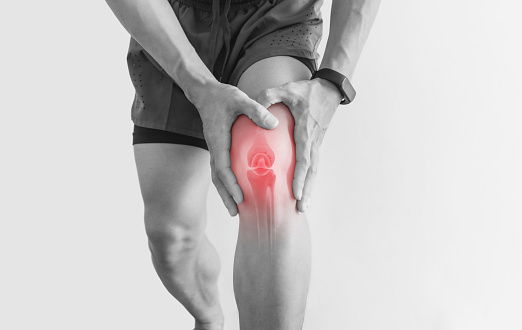
The knee joint is one of the biggest and most important joints in the lower part of the body. The knee plays an important role in distributing the body weight throughout the body. It is worth studying about this joint.
The knee joint is the tibiofemoral synovial hinge joint. This seems a bit complex. This can be easily understood by splitting each term.
- Tibio- tibia bone
- Femoral- femur bone
- Synovial- freely movable joint
- Hinge- swinging motion
We can consider the knee joint as a castle with the patellar bone as a castle wall protecting it from the front, the femur from top, tibia and fibula from bottom and muscles aiding these bones. In general, the massive structures protect the joint from mechanical damage like banging the knee onto a hard surface etc…

Credit:- OpenStax College Anatomy & Physiology, Connexions Web site. http://cnx.org/content/col11496/1.6/, Jun 19, 2013
The above diagram shows the complete parts of the knee joint. There are some terms that were not explained earlier. Bursa can be compared to a tin of oil or any other lubricant and structurally is like a sac containing fluid to reduce friction. Friction is
A physical quantity develops when two things come in contact and the lubricant is the one that provides a medium between the two objects thus reducing friction.
Here are the anatomical terms and their meaning:-
- Anterior-front
- Posterior-back
- Supra-upper
- Infra-lower
- Cruciate-cross shape
- Pre-before
The fat pad is the one present beneath the knee bone and acts as a cushion for the joint. Ligaments are the primary elements of the knee joint which connect bone to bone.
There are two types of ligaments namely ACL and PCL. They connect the tibia to the femur as mentioned earlier through the term tibiofemoral. ACL is medial (present more close to centre) than PCL and PCL are lateral (present far from the centre).
NOTE:-Understanding these structures are very important as an imbalance in each structure can lead to a disorder.
The knee is the largest known joint in the human body which performs very complex functions. The various functions are:-
- It bears the weight load and prevents the lower legs to take in all the weight.
- Acts as a supportive agent to the body.
- Provides motion but is limited.
- Coordination of the movement of upper and lower legs
- Fat present in knee acts as thermal insulator
- Bursa reduces friction between the bones
- Synovial fluid acts as medium for bones to articulate with.
As mentioned earlier motion is a key aspect amongst the functions of the knee. The following table shows the various movements exhibited directly or indirectly using the knee.
Knee movements are of two types- primary and secondary.
| Name | Meaning |
| Flexion | Decreasing the angle |
| Extension | Increasing the angle |
| Medial rotation | Rotating towards centre |
| Lateral rotation | Rotating away from centre |
| Adduction | Moving towards middle |
| Abduction | Moving away from the middle |
| Anterio-posterior displacement | Front and back movement |
Flexion, extension, medial and lateral rotations constitute the primary movements. Adduction, abduction and anterio-posterior displacement constitute secondary movements. Hence all these movements can be offered by the knee. In addition to that knee joint also has sensory receptors and produce proprioreceptic information about the position of knee.
The ligaments contribute more towards the stability of the joint as compared to other elements. The several structures inside the knee must perform perfectly so that the knee functions properly as a whole. The knee joint is hinge type and hence it is more vulnerable to injury (stretching beyond the limit leads to injury). In case of injury, the damaged cells start to heal when the stress is removed but there is a chance of losing their functions as there is a chance of them getting replaced with scars.
It is absolutely worth knowing about the structure and function of the knee joint and how they help to carry ourselves on.

 Eduindex
You must be logged in to post a comment.