PERMACULTURE-ETHICS,PRINCIPLES,METHODS

BY DAKSHITA NAITHANI

INTRODUCTION TO PERMACULTURE:

Permaculture is a method of design in agriculture that emphasises whole-systems thinking and the use of or stimulation of natural patterns.

Bill Mollison, a senior lecturer in Environmental Psychology at the University of Tasmania, and David Holmgren, a graduate student in the Department of Environmental Design at the Tasmanian College of Advanced Education, coined the term.

These principles are being applied in a growing variety of industries.

HISTORY:

Permaculture as we know it now was created in the 1970s t happened approximately a decade after the world became aware of the risks of pesticides like DDT and the damage they represented to humanity and the environment.

Because it was created for the development of long – term (in other words, permanent) systems, the phrase was coined from a combination of the words “permanent” and “agricultural.”

It was one of the first agricultural systems to recognise that local actions might have drastic implications.

 Holmgren is credited for popularising permaculture but it’s worth mentioning that various books on topics like agroforestry and forest farming have been around since the 1930s or earlier.

3 ETHICS:

Permaculture has 3 core tenants:

•             Care for the earth. To put it another way, assist all living systems in continuing to exist and multiply. But a healthy world is required for existence, it is important to understand the principles of nature and how it functions.

•             Care for the people. Allow people to have access to the resources they require to live. Members of the community who are in need of assistance are supported by the community (e.g. after someone dies, help build homes).

•             Fair share. We should take only what we require and reinvest any excess. Any surplus can be used to assist satisfy the other two basic tenets. This involves reintroducing waste products into the system so that they can be reused.

PRINCIPLES:

All sustainable community design initiatives should use Permaculture concepts.

They are the most important rules for putting it into practise. They may aid in improving and protecting the land, ecosystem, and people, as well as maximising efficiency and productivity.

These principles promote innovation while maximising outcomes. Every location, every circumstance, and every family is unique. As a result, each project’s plans, procedures, plants, animals, and building materials may differ. Even yet, the same principles apply to any location and endeavour, big or little.

1. Observe and Interact

2. Catch and Store Energy

3. Obtain a Yield

4. Apply Self-regulation and Accept Feedback

5. Use and Value Renewable Resources and Services

6. Produce No Waste

7. Design From Patterns to Details

8. Integrate Rather Than Segregate

9. Use Small and Slow Solutions

10. Use and Value Diversity

11. Use Edges and Value The Marginal

12. Creatively Use and Respond to Change

BENEFITS OF PERMACULTURE:

Reduced water usage

Wastewater and rainfall are used in permaculture. This is useful for homes, but for farms with larger areas, it becomes a more cost effective and efficient means of watering the produce.

Reduced waste

Nothing is thrown away. Garden waste, leaves, table scraps, and other waste products are composted or fed to animals as food. Some people go beyond and utilise compost toilets to fully live a zero-waste lifestyle. Permaculture is only sustainable if it makes use of leftovers.

Economically feasible

It is cost effective since pesticides are not required, and most systems require minimal upkeep. All you have to do is water the plants and mulch them once in a while.

Less pollution

Permaculture is a more natural manner of growing food, tractors and other powered agricultural equipment are rarely used.

Improved values

You’ll automatically acquire more ethical and good principles like consuming little, just using what you need, minimising pollution, and helping others if you practise.

More self-sufficiency

A farmer or gardener who practises permaculture may grow a broader range of crops on their property. It allows you to be self-sufficient by allowing you to grow whatever you desire or need to eat.

Applicable to existing systems

 Agricultural systems and lands that already exist can be converted to principles. Permaculture may be practised on a big or small scale wherever that you can normally grow food.

COMMON METHODS OF PERMACULTURE:

1) Agroforestry

Agroforestry is a technique that incorporates trees, shrubs, animals, and crops. The term is derived from a blend of agriculture and forestry. These two apparently disparate professions collaborate to produce systems that are more resilient, healthy, lucrative, and productive. Forestry farming, which is a permaculture technique also falls under the category of agroforestry. However, the main concept is to construct your food forest using a seven-layered method. A canopy layer, a low tree layer, a shrub layer, a herbaceous layer, a rhizosphere, a ground cover layer, and a vertical layer are all included. Silvopastoral and silvoarable are two other agroforestry systems.

2) Hügelkultur

Hügelkultur is a German word that means “hill culture.” It’s a method of burying huge volumes of wood in order to increase the soil’s ability to retain water. This rotting wood behaves like an absorbent, soaking up water from the ground.  Plant materials which behave as a compost are usually placed on top of the mound and decomposed into the soil. A Hügelkultur mound generally lasts 5 to 6 years until the wood rots completely and the procedure must be repeated.

3) Harvesting Rainwater and Grey water

Instead of letting rainwater wash from the property, you may collect it and store it for later use. Roofs gather the majority of rainwater. Eaves troughs, which collect and transport water away from buildings, are likely already installed on your farm’s homes, barns, and other structures. To collect rainwater, just connect a big tank to your downspout and catch the water rather than having it seep into the ground and go to waste. Storm water harvesting is another way to collect water. It is distinct from rainwater harvesting in that it collects runoff from creeks, drains, and other waterways rather than from rooftops. Grey water is a last source of reusable water on the farm. This is water that is used in the house or on the farm for things like bathing and doing laundry.  Because grey water includes detergents, it cannot be used for drinking, but it may be utilised for irrigation purposes and other reasons.

4) Cell Grazing

Grazing is commonly seen as a negative activity that, if not carried out appropriately, has the potential to harm the ecosystem in various ways. Allowing animals to overgraze a region can have severe repercussions, and this is true. Cell grazing is the favoured approach in permaculture. This entails moving herds of animals between fields, pastures, or woodlands on a regular basis. The disruptions created by grazing animals, when done correctly, can actually improve the ecosystem and allow plants to recover more quickly. It also keeps an eye on how animals interact with the land. Plants require appropriate time to rest between each grazing and therefore it’s critical that a region receives a rest time after being grazed.

5) Sheet Mulching

Mulching is simply any protective layer placed on top of the soil to retain water and prevent weed development and is used by many farmers and gardeners. A variety of materials such as wood chips, cardboard, plastic, stones, and are frequently employed. Sheet mulching is an organic no-dig technique that aims to imitate natural soil building in forests, namely how leaves cover the ground. Sheet mulching is most often done with alternating layers of “green” and “brown” materials. Fallen leaves, shredded paper and cardboard, pine needles, wood chips, and straw are examples of brown materials. Manure, grass clippings, worm casings, vegetable scraps, hay, coffee grounds, and compost are examples of green materials. It’s possible to utilise 5 to 10 layers of materials. Sheet mulching adds nutrients and minerals to the soil, inhibits weed development, regulates weather and protects against frost, reduces erosion and evaporation, and absorbs rainwater.

6) Natural Building

Natural building is a more environmentally friendly alternative to purchasing materials from your local hardware shop or lumber yard. You should try to employ as much recycled materials as possible in a system. There are a lot of renewable resources on the land that you may employ in your next construction project. Most people ignore clay, pebbles, wood, reeds, straw, and sand, which are all easily available materials. Tires, which are less natural, can also be utilised for building. This is a fantastic method to recycle old tyres that would otherwise be thrown away or burned. Similarly, instead of purchasing new windows, discarded glass windows are frequently repurposed.

7) No-Till or Minimum-Till Farming

The goal of no-till farming is to leave the soil untouched. The soil is left undisturbed rather than being broken up before planting. This helps to keep water in the soil, keeps carbon from leaving the soil, increases soil quality, and lowers the quantity of weed seeds that are brought closer to the surface to germinate. The soil is disturbed by conventional agriculture methods. This allows carbon dioxide to enter the atmosphere while also over oxygenating the soil. Loosening the soil in this way can cause erosion and nutrient runoff, as well as obliterate important fungal networks. Tilling can be reduced or even removed altogether for some systems with the right approaches.

8) Intercropping and Companion Planting

Intercropping is the planting of more than one two plant species in the same region that mutually benefit one another. Companion planting, for example, involves growing strong-scented plants and herbs such as basil, oregano alongside primary. Many of these companion plants with powerful smells are repulsive to pests. Not only that, but some of them really help the plants they’re partnered with to grow and taste better. Others help to loosen the soil or provide additional advantages. While many plants get along well when grown together, there are some who don’t because they demand the same nutrients or for other reasons.

9) Market Gardening

Market gardening is an intriguing shift away from conventional style of agriculture, which is carried out on huge swaths of land far out in the nation, to smaller plots of land, even in metropolitan areas sometimes. Market gardeners, as the name implies, sell their vegetables at farmer’s markets, however some may also supply restaurants and grocery shops directly.

Cash crops are aggressively produced on a small scale in market gardening (usually less than an acre of land.) While cultivating on as little as a quarter acre of land, a market gardener may earn up to $100,000 each year.


Yogeswara

Photo by Prasanth Inturi on Pexels.com

The practice of yoga and even every pose related to it can be very difficult if one does it with the whole control of huff and puffs of breath in and out. Even the great yogis in the body of the human are not able to fully control their body or emotion or attachment with the world, as to be attached with everyone around you yet not getting in the trap of this Maya seems next to impossible to us humans but there was someone who set an example to teach us with the event of his life that even us human with all the ups and downs of the life can finally achieve the stage where we won’t be needing oxygen anymore to detoxify the carbon from it. Yes, the great Lord Krishna is also known as Yogeswara, but how even in the form of human was he able to attain such a peaceful state of the mind and body’s attainment? 

To know how and why let’s go on with me on this ride.

Whole Incarnation

As we have read about the incarnation of Lord Vishnu on earth to protect us and serve us from all the evil of every four cycles of Kaal we know that Lord Vishu has appeared in a different form every time but Lord Krishna is the only incarnation who is considered as the whole Incarnation as he was born with all the 16 kalae and that is why he is considered as the whole form.

Being the complete incarnation Krishna used to be always in a blissful state where he was far beyond anything related to this world that can ever disturb the balanced and bliss of the enlighted form one can ever achieve.

He attained that form not just because he was the whole incarnation but also he taught us how even one can go to that form by trying and implementing the principles he used in his life as much as possible even in this form and time.

The Road 

The teaching of Krishna to attain this blissful state of being the one in control of your mind and emotion can be achieved from The Gita, where he taught many great lessons of life to Arjun. 

The road to this Yogesawara form in this Kalyug can be hard to achieve even if one ought to follow every step with the most dedication, so for this only we have this difficult path narrow down in just three-step of Karma Yoga, Bhakti Yoga, and Gyan Yoga.

Karma Yoga- This is something which every one of us does every day we just have to make sure that whatever we are doing is with pure intention and not to cheat and hurt others.

Bhakti Yoga-  Whenever we hear of Bhakti what we think is we have to perform certain rituals and we are done but it’s entirely different from this. Bhakti means the higher level of dedicating one’s life to serve the one we believe in and not performing rituals and offering expensive things.

Gyan Yoga-  Gyan is something which can’t just come from reading and writing the Gyan which we are mentioning here is far much than knowing many things related to this world.

BAMBOO

” The bamboo that bends

is stronger than the oak that resists”

Bamboo – the giant grass

Bamboos popularity has risen in recent years fuelled by its myriad of practical uses and aesthetic features. Bamboo is the fastest growing and most versatile plant in the world with many nations depending on it for their livelihood. However, in western countries (particularly Australia), bamboo has been somewhat misunderstood and even seen as a pest due to the early introduction of so many running species.

Bamboo timber poles

There are about 1500 bamboo species in the world, however approximately half of these are monopodial (running or invasive) species. It is unfortunate that in the past, so many of these running species have made it into Australian gardens, as it is these species that has tarnished the reputation and acceptance of bamboo. However with the introduction of more and more sympodial (clumping or non-invasive) species to Australia, people are slowly learning that there is a huge variety of bamboos which are perfectly safe and that will not take over your garden. With bamboo species ranging in height from 3 meters to 30 meters and in a variety of colours and shapes, there is sure to be a bamboo to suit everyone and every application.

Bamboo is the world’s fastest producer of biomass and can be used for anything between production of paper or clothing, used as a building material such as flooring, bench tops, fences and screens, or even as a food source in the form of the edible shoots for your favourite curry or stir fry. In China, bamboo leaf extract has a long history of food and medicinal applications and its potential can only be speculated in a global market. Due to the large variety of bamboo and their remarkable ability to adapt, there is a bamboo suitable for every application.

Growing habits

Dendrocalamus asper shoot

Bamboo is in fact a type of grass – a very fast growing and giant grass. Bamboo grows in a short but strong growth spurt during summer and then remains near dormant over winter. During the ‘growth spurt’, a bamboo will start with new shoots from the ground which will grow to full height in two to three months. Due to some of the largest bamboo species being capable of reaching over 30 meters in height, during peak growth a bamboo shoot can grow up to 1 meter per day.

Planting a new bamboo is a very rewarding experience since each yearly generation of culms usually double in diameter and nearly double in height from that of the previous year. This continues until the plant reaches its full mature size. For smaller bamboos, this only takes 3 or 4 years while for larger bamboos, it may take 5 to 6 years. Nonetheless, a 30 meter plant in under 6 years is certainly something to boast about. After reaching its full potential, a bamboo will keep generating shoots of the same size year after year with the only possible causes for fluctuations being factors such as water, temperature, humidity, etc.

As a bamboo clump ages, it will slowly grow in size (diameter) as new shoots emerge on the outskirts of the clump. Some bamboos, even though clumping, will grow into large diameter clumps, while other varieties will stay in a very narrow clumps. This is why careful species selection is crucial when planning what bamboos to plant. You obviously wouldn’t want to plant a bamboo which has a tendency to form a clump 2 meters in diameter in your narrow garden bed along your driveway.

Bamboo terminology

Sympodial (Clumping): Sympodial or clumping bamboos are those that DO NOT spread and form tight clumps which only slowly expand in diameter each year.

Sympodial clumping bamboo
Sympodial

Monopodial (Running): Monopodial or running bamboos are the dreaded bamboos that will not only take over your garden or property, but quite possibly also your neighbours. Bamboo groves of running bamboo can be very beautiful, but only in areas where space is not an issue or where they can be controlled.

Monopodial running bamboo
Monopodial

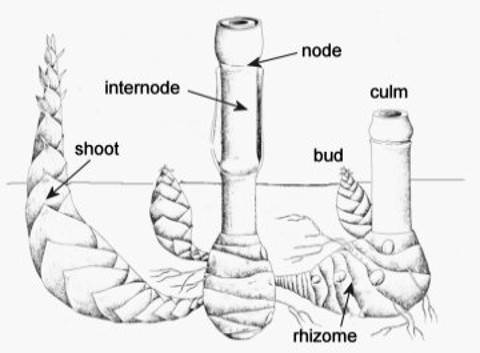
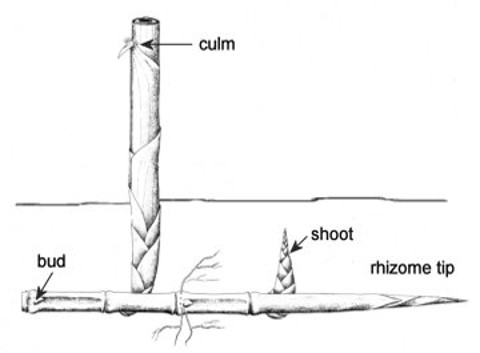
Rhizome: These are the underground stems of a bamboo from which culms, roots and other rhizomes can grow.

Culm: This is the name given to the stems of a bamboo.

Shoot: This is the name given to a young culm as it emerges from the ground from the rhizome.

Node: Nodes are the diaphragms that separate the hollow bamboo culms into compartments. These are the visible ‘rings’ on the bamboo culms.

Internode: The hollow sections between the nodes. These vary in length from species to species.

WWOOFers working

Culm Sheath: This is the name give to the protective leaves which wrap around new shoots / young culms as they grow. They give the culms strength during the initial growth period until the culm matures and the timber hardens. Once this has happened (usually once the culm has reached its full height) the culm sheaths start falling off. Culm sheaths are also an excellent aid in identifying bamboo species – but that’s too much to go into detail here.

Bamboo for construction…a timber resource

In many developing countries, bamboo is traditionally considered as the poor man’s material. This is obviously due to the abundance of bamboo forests and the relative low level machinery and expertise required to obtain a usable building material in its natural form (ie. round poles). It is used for everything from house framing, flooring, thatch cladding for walls and ceiling, and even as shingles for the roof.

Harvested bamboo timber

However, in many other countries where bamboo has not traditionally been used in the past, bamboo timber is starting to establish itself as a more exclusive building material into a niche upper-class market. The superior strength and durability of bamboo has earned its successful use as a timber for flooring and bench tops. These applications are utilising the more processed bamboo timber (ie. laminated strips of bamboo) but bamboo timber even in its natural form (round poles) are in high demand as people are wanting to use it more and more for construction of gazebos, fences, screens, etc.

The strength and hardness of bamboo timber is equivalent to hardwood timber whilst the cost is also comparable to hardwood timber. So why then should people be considering growing bamboo on a commercial level? The simple answer is that it has the potential to be a direct substitute for hardwood timber and thus reducing the pressure on natural hardwood forests.

Bamboo shoots for eating

Bamboo shoots is an important food source in many Asian countries with Thailand, China and Japan being the biggest consumers. Bamboo shoots are not yet part of traditional Western food, however most people have at some point eaten bamboo (perhaps without knowing it) as it is found in most curries and many other Asian dishes.

Currently, Australia imports vast quantities of bamboo shoots to supply restaurants and markets. Most of this however is in tins, despite fresh shoots being far superior and preferred among consumers. Very little of the bamboo shoots available in Australia is grown in Australia, leaving an obvious gap in the market ready to be filled by the entrepreneurial farmer. As bamboo produces new shoots in summer or autumn here in Australia, corresponding to Winter time in China and Japan, there is also an opportunity for export to these countries during their off-season.

Fresh bamboo shoot

Bamboo shoot production does not need to be on commercial scale, in fact it is also a great small crop for the common gardener – even on small suburban blocks. By choosing species which suit your garden (ie. ornamental or screening varieties) that also produce good shoots (or timber), you can combine a multitude of uses in the one clump of bamboo. A very versatile plant to have at your disposal.

Most bamboo species produce edible shoots – though some species produce naturally sweet shoots whilst others tend to be fairly bitter tasting. For clumping species which produce good edible shoots, please refer to the species descriptions in the Catalogue.

Enviromental Restoration

Bamboo is a pioneering plant in that it can be grown in full sun and tolerates high winds. This enables its use as a starting point in restoring cleared land which may have been damaged by overgrazing or poor farming. Because of the bamboos fast growth and dense foliage, it will quickly deposit a thick layer of leaf litter covering the ground, which will then start restoring degraded soils and re-establishing a cooler micro-climate.

Bamboo for erosion control, windbreaks and noise barriers

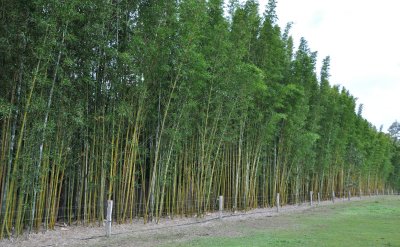
Bambusa Oldhamii windbreak

A bamboos root system grows into a dense ‘mat’ of fine roots which is shallow but wide spread. This means that its ability to hold soil together is excellent, even in areas where erosion caused by flowing water is a problem. It will hold soil together along fragile river banks, deforested areas, dam walls and spillways. There are no tap roots on bamboo plants, thus they are not going to cause any problems if planted on dam walls (like so many other trees will).

Many clumping bamboo species have very erect (straight) growth whilst still tight clumping and bushy. These species are ideal for use as windbreaks around orchards, sugar cane fields, etc. There are bamboos that will grow very uniformly to whatever height is desired. So whether it be a short hedge (so that crops aren’t shaded) or a tall barrier (to prevent storm damage from high winds), there is a bamboo to suit.

Waste water treatment

Bamboo has the capacity for very high nitrogen uptake. This makes it ideal for mitigation of waste water pollution and disposal of effluents. Waste water from manufacturing, livestock farming and sewerage treatment plants can be used to irrigate bamboo crops, thus converting the waste water into useful biomass.

It can also be used to treat water run-off from agricultural land. Most farming adds soil nutrients to waterways from pastures and cultivated fields. This water clouds and poisons clean water. Planted alongside rivers, creeks and ditches and holding dams, bamboo can catch these excess nutrients in the run-off water thus preventing harmful run-off from entering nearby streams.

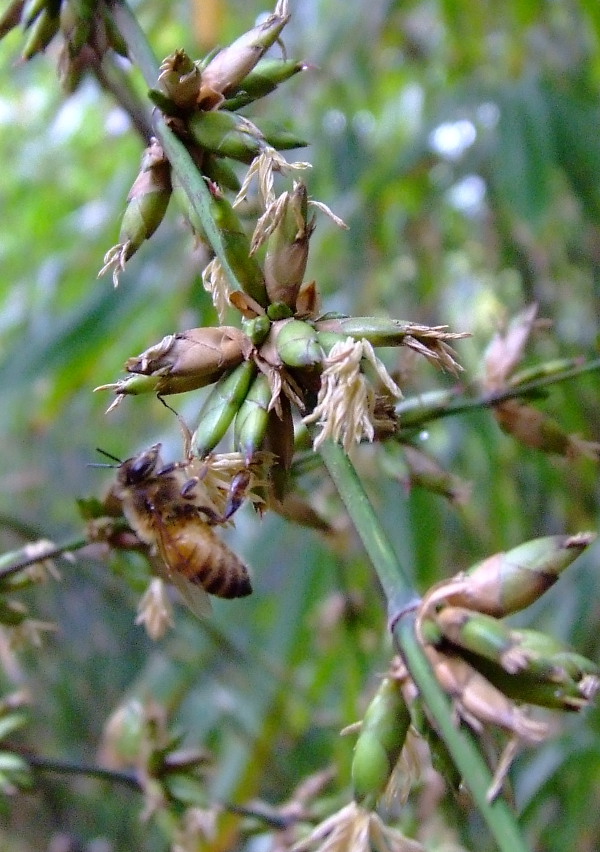
Good heavens, my bamboo is flowering!!

Flowering of G. Atter cv. Pring Legi

You may not have heard that bamboo flowers, or if you have, then you may have been told that if this happens, then its all over for your bamboo and it’s going die. Though this does hold true for some bamboo species – it is not true for all.

The flowering of a bamboo is usually quite an extraordinary event – not because they produce spectacular flowers (quite dull actually) but for the simple reason that it very rarely happens. A bamboo can have one of 3 flowering patterns dependent of genera and species.

The first (and most impressive) pattern is that called gregarious flowering. Many of the big timber bamboos flower in this way. Each species has an inbuilt genetic time clock keeping track of its life cycle which may vary from anywhere between 20 to 120 years. Once a particular species reaches its life expectancy, it will start to flower which is then followed by the development of seeds. A bamboo flowering in this way spends an enormous amount of energy producing the flowers and seeds which usually stresses the plant to such an extent that it will actually die. This, of course, is all part of the bamboos genius plan. A particular species can flower (and die) all over the world at the same time. This happens because all plants originating from a particular source are clones of the mother plant (since bamboo is usually multiplied via cuttings or clump divisions). What this means is that the bamboo that you have just planted in your garden is not actually a young plant (unless grown from seed), rather it could be a 100 year old bamboo. This is the magical phenomenon that is.

Seeds of D.Sikkimensis (flowered 2005)

Another type of flowering pattern that some bamboo varieties undergo is sporadic flowering. As the name suggests, there is very little pattern to this type of flowering and it seems that it is brought on my environmental factors (such as drought or cold) rather than genetics. Flowering is usually not wide spread but can happen to either singular plants or all of the same species within a localized area. Sporadic flowering rarely results in the production of viable seeds but on the upside, the plants very rarely die after the event.

The third and last flowering cycle is annual flowering. A select few bamboos (usually only some of the Schizostachyums) undergo this type of flowering. A particular species may keep flowering year after year without any effect on the plant itself. Viable seeds are a rarity with this type of flowering but not impossible.

Gregarious flowering of G. Atter cv. Pring Legi (flowered 2006)

“The first year it sleeps.

The second year it creeps.

The third year it leaps.

Heath Benefits Of Cycling 15 Minutes A Day

When done properly, cycling is an effective and enjoyable form of aerobic exercise. Cycling can reduce the risk of heart disease, high blood pressure, obesity and diabetes according to a report by Kelley GA. Effects of Aerobic exercise in normotensive adults, 1995. It can reduce your ‘real age’, lowering it more than a decade lower than your chronological age.

The indirect health benefits include reducing serious injuries caused by falls in older people, osteoporosis, and hip fractures.

Statistics show that cyclists, even those who only travel short distances can reduce the risk of death by 22 per cent.

Optimum results are achieved when cyclists are breathing heavily, but are not out of breath. Exercise has been shown to increase HDL (“good” cholesterol) and reduce the amount of triglycerides in the blood. Again, this means improved cardiovascular health. This leads to a reduced chance of heart blockage and reduces the risk of stroke. There are some reports that link exercise to a lowered risk of developing some cancer, like colon cancer.

Cycling burns the calories in a chocolate bar or a couple of alcoholic drinks in one hour, 300 calories. Translated into modern lifestyle terms, a fifteen-minute bike ride, five times a week, burns off 11 pounds of fat a year and meets the requirements for reducing heath risks.

There is a trick to exercising. Running a nine-minute-mile burns 11 calories a minute. Walking at 18 minutes per mile burns five. Faster exercise burns more calories.

Exercise continues to burn fat after the workout ends. Once the sweating stops the body’s metabolisms remains high. You can you increase the post-exercise burn?

A few scientific studies suggest that exercising for 20 minutes at 35 to 55% of aerobic capacity, as in riding briskly, elevated metabolism for 20 minutes after stopping. That means that a 20 minute, brisk bike ride burns fat for 40 minutes.

Cycling has been proven to reduce stress and depression and relieve symptoms of premenstrual syndrome.

The Department of Transport reports that ‘even a small amount of cycling can lead to significant gains in fitness’. The study reveals that aerobic fitness was boosted by 11 per cent after six weeks of cycling ‘short distances’ four times a week and cycling four miles a day the aerobic benefit increased to 17 per cent.

The Fentem PH. ABC of sports medicine report, Benefits of exercise in health and disease, 1994 concludes that cycling is ‘one of the few physical activities which can be undertaken by the majority of the population as part of a daily routine’.

The choice of bike is a personal thing.

Most people never cycle more than five miles, so choosing an expensive bike designed to challenge the most adventurous dare devils. Instead, choose a bike that will manage the local terrain, comfortably.

Equipment needs will also vary. Older people should consider elbow and knee guards. These will help prevent debilitating joint injuries that can seriously limit your mobility. A helmet is not optional.

Do not buy a helmet from a local hardware store. Get one from a bicycle specialty store. The selection is larger, and the quality better. Shopping at an online store can also save money.

Once introduced into the bicyle riding community, you’ll soon set out on your daily cycle for the joy of it. Health benefits will be secondary

Some Weird Restrictions In North Korea that you can’t even imagine.

1.     Consuming marijuana is accepted and unlike in most of the world, trade and consumption of the drug attract no punishment as per law.

2.      Listening to foreign music or watching films in a foreign language are considered criminal activities. In 2015, Kim Jong Un issued a decree to scrap all cassette tapes and CDs that had state-banned songs in order to contain dissent. The sentence depends on the place of origin of the film: someone watching an American movie may be executed, while watching Indian films may lead to imprisonment. Distributing pornography may also lead to the death penalty.

3.     Making international calls is a crime. In 2007, a man who made several international calls was killed.

4.     Anything that disrespects the family of Kim Jong Un, the North Korean government, or the politicians is considered an act of blasphemy and may be met with severe punishment. In January, it was reported that a mother faced jail for trying to save her children instead of former President Kim Il-sung’s portrait in an inferno. Even failing to wipe off the dust of his portrait is enough to make one guilty; so every family is given a special duster.

5.     Only male government officials are allowed to drive. Women are not permitted to drive, even if working as traffic officers. The government restrictions allow only one in a hundred people to have a car.

6.     On July 8, when North Korean President Kim Il-sung died in 1994, smiling is strictly prohibited. Talking loudly, dancing, or drinking alcohol on this day is restricted. Disrespecting the rules may have people sent to labor camps or killed. Kim Il-sung’s body is preserved in a glass tomb and tourists are required to bow down at his feet.

7.     People are not allowed to wear jeans as it is considered a symbol of capitalism. Women wearing skirts must cover the knees. Wearing bikinis is a strict no-no.

8.     All citizens above 17 mandatorily have to vote in the elections. Elections are held to choose the party leaders who will rule the country, except that there’s usually one candidate!

9.      North Korea offers only three television channels for people to choose from and all of them are government-controlled.

10. North Koreans are not allowed to travel abroad without permission. People who try to flee are sent to labor camps or simply executed.

11. Internet can only be accessed through their intranet, which is called “Kwangmyong” or Bright, launched in 2000. For professional use, only 28 websites may be accessed under government supervision. The list of people with Internet access includes political leaders and their families, students attending elite schools, and the military’s cyber-warfare department. Only the state-sanctioned operating system Red Star OS, designed in Korean, is allowed to use and not the standard Windows or Mac. Wi-Fi has been banned from use at all North Korean embassies worldwide.

12. Choice of the profession of an individual is decided by the government based on the country’s needs. Those who do not comply are sent to concentration camps for forced labor.

13. In 2013, Kim Jong Un released a list of haircuts that people in the country are allowed. There are 28 state-approved hairstyles that people can keep.

14. Citizens are not allowed to have the same name as the current president. So, everyone named Kim was made to change their names.

15. Freedom of religion is a myth in North Korea. It is officially an atheist state. Western religious practices and literature are forbidden. People who distributed Bibles have been executed in public. In 2014, American Jeffrey Fowle was imprisoned for five months because he forgot the Bible in the bathroom of a restaurant. Churches are controlled by the state.

16. An entire family could be punished if one person commits suicide. If an individual commits a crime, three generations in his family are punished.

17.  It spends 20 percent of its GDP on the military when the population is desperate for food.

18. It is believed that film director Shin Sang-ok and his actor wife Choi Eun-hee were abducted in 1978 for inducing creativity in North Korean films. Later in 1986, the couple gradually earned the dictator’s trust and escaped during a trip to Austria for promoting North Korean films.

19. The North Korean calendar Juche is based on Kim II-sung’s date of birth – April 15, 1912.

20. North Korea cuts power every night due to the energy crisis in the country. Using electricity needs permission and owning a microwave is illegal!

21. School-going children are required to get their own desks and chairs, others are forced to do laborious tasks for the government.

22. In 2008, citizens were asked to give their stools to help with agriculture when South Korea suspended fertilizer supplies.

23. Newlyweds are expected to visit Kim II-sung’s statue after the official ceremony. Walking down the aisle is not permitted on any of the birthdays of Kim Jong Un and Kim II-sung.

24. Military service is compulsory for men (10 years) and women (seven years.)

25. Mothers are not allowed to give birth if anyone is around and must go into labor alone. They are not allowed to meet their family or even husband for a week after giving birth. If triplets are born, they are given to the state as there are reportedly concerns over the low birth rate in North Korea. They are returned on reaching four years of age.

26. Sunday is collective labor day – all cleaning is done by hands and tools are not allowed.

Why facts don’t change our minds

Humans need a reasonably accurate view of the world in order to survive. If your model of reality is wildly different from the actual world, then you struggle to take effective actions each day. However, truth and accuracy are not the only things that matter to the human mind. Humans also seem to have a deep desire to belong. Understanding the truth of a situation is important, but so is remaining part of a tribe. While these two desires often work well together, they occasionally come into conflict. In many circumstances, social connection is actually more helpful to your daily life than understanding the truth of a particular fact or idea. The Harvard psychologist Steven Pinker put it this way, “People are embraced or condemned according to their beliefs, so one function of the mind may be to hold beliefs that bring the belief-holder the greatest number of allies, protectors, or disciples, rather than beliefs that are most likely to be true.” We don’t always believe things because they are correct. Sometimes we believe things because they make us look good to the people we care about. False beliefs can be useful in a social sense even if they are not useful in a factual sense. For lack of a better phrase, we might call this approach “factually false, but socially accurate.” When we have to choose between the two, people often select friends and family over facts.

Facts Don’t Change Our Minds. Friendship Does.

Convincing someone to change their mind is really the process of convincing them to change their tribe. If they abandon their beliefs, they run the risk of losing social ties. You can’t expect someone to change their mind if you take away their community too. You have to give them somewhere to go. Nobody wants their worldview torn apart if loneliness is the outcome. The way to change people’s minds is to become friends with them, to integrate them into your tribe, to bring them into your circle. Now, they can change their beliefs without the risk of being abandoned socially. Perhaps it is not difference, but distance that breeds tribalism and hostility. As proximity increases, so does understanding. I am reminded of Abraham Lincoln’s quote, “I don’t like that man. I must get to know him better.” Facts don’t change our minds. Friendship does.

The Spectrum of Beliefs

If someone you know, like, and trust believes a radical idea, you are more likely to give it merit, weight, or consideration. You already agree with them in most areas of life. Maybe you should change your mind on this one too. But if someone wildly different than you proposes the same radical idea, well, it’s easy to dismiss them as a crackpot. he most heated arguments often occur between people on opposite ends of the spectrum, but the most frequent learning occurs from people who are nearby. The closer you are to someone, the more likely it becomes that the one or two beliefs you don’t share will bleed over into your own mind and shape your thinking. The further away an idea is from your current position, the more likely you are to reject it outright. In conversation, people have to carefully consider their status and appearance. They want to save face and avoid looking stupid. When confronted with an uncomfortable set of facts, the tendency is often to double down on their current position rather than publicly admit to being wrong.

Be kind first. Be right after.

The brilliant Japanese writer Haruki Murakami once wrote, “Always remember that to argue, and win, is to break down the reality of the person you are arguing against. It is painful to lose your reality, so be kind, even if you are right.” When we are in the moment, we can easily forget that the goal is to connect with the other side, collaborate with them, befriend them, and integrate them into our tribe. We are so caught up in winning that we forget about connecting. It’s easy to spend your energy labeling people rather than working with them. The word “kind” originated from the word “kin.” When you are kind to someone it means you are treating them like family. This, I think, is a good method for actually changing someone’s mind. Develop a friendship. Share a meal. Gift a book. Be kind first, be right later.

Role of youth in the development of country

By: Astha Raghav 

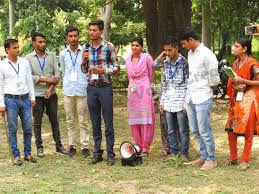
It is a well-known fact that the youth of any country is a great asset. They are indeed the future of the country and represent it at every level. The role of youths in nation-building is more important than you might think. In other words, the intelligence and work of the youth will take the country on the pathway of success. As every citizen is equally responsible, the youth is too. They are the building blocks of a country.

 The youth is important because they will be our future. Today they might be our partners, tomorrow they will go on to become leaders. The youths are very energetic and enthusiastic. They have the ability to learn and adapt to the environment. Similarly, they are willing to learn and act on it as well to achieve their goals.

Our youth can bring social reform and improvement in society. We cannot make do without the youth of a country. Furthermore, the nation requires their participation to achieve the goals and help in taking the country towards progress.

Likewise, we see how the development of any country requires active participation from the youth. It does not matter which field we want to progress in, whether it is the technical field or sports field, youth is needed. It is up to us how to help the youth in playing this role properly. We must make all the youth aware of their power and the role they have to play in nation-building.

There are many ways in which we can help the youth of our country to achieve their potential. For that, the government must introduce programs that will help in fighting off issues like unemployment, poor education institutes and more to help them prosper without any hindrance.

Similarly, citizens must make sure to encourage our youth to do better in every field. When we constantly discourage our youth and don’t believe in them, they will lose their spark. We all must make sure that they should be given the wind beneath their wings to fly high instead of bringing them down by tying chains to their wings.

Furthermore, equal opportunities must be provided for all irrespective of caste, creed, gender, race, religion and more. There are various issues of nepotism and favoritism that is eating away the actual talent of the country. This must be done away with as soon as possible. We must make sure that every youth has the chance to prove themselves worthy and that must be offered equally to all.

In short, our youth has the power to build a nation so we must give them the opportunity. They are the future and they have the perspective which the older generations lack. Their zeal and enthusiasm must be channelized properly to help a nation prosper and flourish.

Thank You!

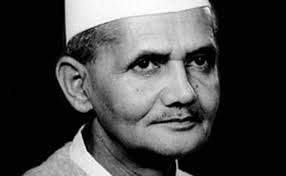
Lal Bahadur Shastri Biography

By: Astha Raghav 

Shri Lal Bahadur Shastri was born on October 2, 1904 at Mughalsarai, a small railway town seven miles from Varanasi in Uttar Pradesh. His father was a school teacher who died when Lal Bahadur Shastri was only a year and half old. His mother, still in her twenties, took her three children to her father’s house and settled down there.

Lal Bahadur’s small town schooling was not remarkable in any way but he had a happy enough childhood despite the poverty that dogged him.

He was sent to live with an uncle in Varanasi so that he could go to high school. Nanhe, or ‘little one’ as he was called at home, walked many miles to school without shoes, even when the streets burned in the summer’s heat.

As he grew up, Lal Bahadur Shastri became more and more interested in the country’s struggle for freedom from foreign yoke. He was greatly impressed by Mahatma Gandhi’s denunciation of Indian Princes for their support of British rule in India. Lal Bahadur Sashtri was only eleven at the time, but the process that was end day to catapult him to the national stage had already begun in his mind.


Lal Bahadur Shastri was sixteen when Gandhiji called upon his countrymen to join the Non-Cooperation Movement. He decided at once to give up his studies in response to the Mahatma’s call. The decision shattered his mother’s hopes. The family could not dissuade him from what they thought was a disastrous course of action. But Lal Bahadur had made up his mind. All those who were close to him knew that he would never change his mind once it was made up, for behind his soft exterior was the firmness of a rock.

Lal Bahadur Shastri joined the Kashi Vidya Peeth in Varanasi, one of the many national institutions set up in defiance of the British rule. There, he came under the influence of the greatest intellectuals, and nationalists of the country. ‘Shastri’ was the bachelor’s degree awarded to him by the Vidya Peeth but has stuck in the minds of the people as part of his name.

In 1927, he got married. His wife, Lalita Devi, came from Mirzapur, near his home town. The wedding was traditional in all senses but one. A spinning wheel and a few yards of handspun cloth was all the dowry. The bridegroom would accept nothing more.

In 1930, Mahatma Gandhi marched to the sea beach at Dandi and broke the imperial salt law. The symbolic gesture set the whole country ablaze. Lal Bahadur Shastri threw himself into the struggle for freedom with feverish energy. He led many defiant campaigns and spent a total of seven years in British jails. It was in the fire of this struggle that his steel was tempered and he grew into maturity.

When the Congress came to power after Independence, the sterling worth of the apparently meek and unassuming Lal Bahadur Shastri had already been recognised by the leader of the national struggle. When the Congress Government was formed in 1946, this ‘little dynamo of a man’ was called upon to play a constructive role in the governance of the country. He was appointed Parliamentary Secretary in his home State of Uttar Pradesh and soon rose to the position of Home Minister. His capacity for hard work and his efficiency became a byeword in Uttar Pradesh. He moved to New Delhi in 1951 and held several portfolios in the Union Cabinet – Minister for Railways; Minister for Transport and Communications; Minister for Commerce and Industry; Home Minister; and during Nehru’s illness Minister without portfolio. He was growing in stature constantly. He resigned his post as Minister for Railways because he felt responsible for a railway accident in which many lives were lost. The unprecedented gesture was greatly appreciated by Parliament and the country. The then Prime Minister, Pt. Nehru, speaking in Parliament on the incident, extolled Lal Bahadur Shastri’s integrity and high ideals. He said he was accepting the resignation because it would set an example in constitutional propriety and not because Lal Bahadur Shastri was in any way responsible for what had happened. Replying to the long debate on the Railway accident, Lal Bahadur Shastri said; “Perhaps due to my being small in size and soft of tongue, people are apt to believe that I am not able to be very firm. Though not physically strong, I think I am internally not so weak.”

In between his Ministerial assignments, he continued to lavish his organising abilities on the affairs of the Congress Party. The landslide successes of the Party in the General Elections of 1952, 1957 and 1962 were in a very large measure the result of his complete identification with the cause and his organisational genius.

More than thirty years of dedicated service were behind Lal Bahadur Shastri. In the course of this period, he came to be known as a man of great integrity and competence. Humble, tolerant, with great inner strength and resoluteness, he was a man of the people who understood their language. He was also a man of vision who led the country towards progress. Lal Bahadur Shastri was deeply influenced by the political teachings of Mahatma Gandhi. “Hard work is equal to prayer,” he once said, in accents profoundly reminiscent of his Master. In the direct tradition of Mahatma Gandhi, Lal Bahadur Shastri represented the best in Indian culture.

Thank You!

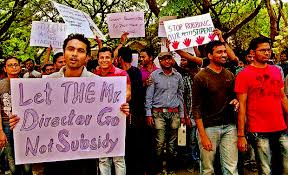
Unrest among students

 By: Astha Raghav 

Student unrest is one of the problems of the day. The problem, however, cannot be analyzed properly unless we view it in the larger context of general unrest and discontentment in the country. As the things are, there is growing dissatisfaction everywhere. Prices are soaring and the burden of taxation is growing heavier. Corruption is rampant everywhere. Academic institutions are no exception to it these have polluted the student’s minds and created unrest in their hearts. Growing frustration is the root cause of student’s unrest. An average student has nothing but frustration in store for him, especially in the matter of employment. He joins one or the other course of study without any definite aim of his life, so he is frustrated.

Political exploitation is another cause of student unrest. The vested interests in all political parties try to use the force of students for their personal ends. They patronize the student leaders in times of their union elections and ultimately use the academic atmosphere. They often instigate the students to indulge in anti-social and subversive activities.

The teacher-taught relationship has undergone tremendous change in recent years. Materialism has stuck deep roots in our thoughts and our teachers are more concerned about their own prospects than about those of their students. As a result, the student feels let down and confused, unable to find anyone to give him proper guidance. Maladministration of academic institutions is also responsible for indiscipline among students. The uncertainty of the future caused by unemployment instigates the students to indulge in anti-social and subversive activities.

We cannot neglect the effects of mass media on students. With the fast-developing means of communication the world is coming closer day by day and the developments in one corner of the globe do not fail to affect others. If a student-led revolution takes place in some countries, their actions will naturally influence their counterparts in India. Students have been at the forefront in bringing about political upheavals in different parts of the world, no wonder; the Indian students feel they can do something similar here too. Student unrest is a social problem. It is to be tackled by responsible leaders and public-spirited men of society. The important remedy to the problem is that efforts should be made to increase opportunities for employment and education should be, as such, geared towards more of the professional career than mere academic pursuits. The academic environment should be improved and closer parent-teacher contact assure. The energies of the students should de-channelized towards a purposeful life. It should be a combined effort of educationists, parents, and leaders.

<

p style=”background-color: white;color: #070707;padding: 7px 0px”> Thank You!